
What Growth Means in a Plant
Growth is one of the most fundamental and conspicuous characteristics of a living being, and the chapter opens by pinning down exactly what the word means.
Growth is an irreversible permanent increase in size of an organ or its parts or even of an individual cell.
Read that definition slowly, because three words in it are the whole examination value of the sentence.
- Irreversible. Whatever goes up must not be able to come back down. A cell that swells and then shrinks again has not grown.
- Permanent. The increase stays after the cause is removed.
- Increase in size. Of an organ, or its parts, or even of a single cell. Growth is not only a whole-plant word.
Growth is generally accompanied by metabolic processes - both anabolic and catabolic - that occur at the expense of energy. A growing cell is building molecules up and breaking them down at the same time, and it is spending energy to do it. A change in size with no metabolism behind it is not growth.
So the expansion of a leaf is growth. It is permanent, it is irreversible, and it costs the plant energy.
[NEET Important] The swelling of a piece of wood placed in water is the standard trap, and the chapter itself asks you about it. It is not growth. The wood takes up water and expands, but the change is reversible - dry the wood and it shrinks back - and there is no metabolic activity behind it. Imbibition is not growth. The same reasoning kills every other example an examiner offers you: a swelling seed before germination begins, a turgid wilted leaf that has been watered. Test each one against irreversible, permanent, metabolic.
Plant Growth Is Generally Indeterminate
Plant growth is unique because plants retain the capacity for unlimited growth throughout their life.
An animal stops. A plant does not. This ability of plants is due to the presence of meristems at certain locations in their body.
The cells of such meristems have the capacity to divide and self-perpetuate. That phrase is doing two jobs at once, and both get asked.
- Divide - the meristem cell splits.
- Self-perpetuate - one product stays a meristem cell, so the meristem is never used up.
The product, however, soon loses the capacity to divide, and such cells make up the plant body.
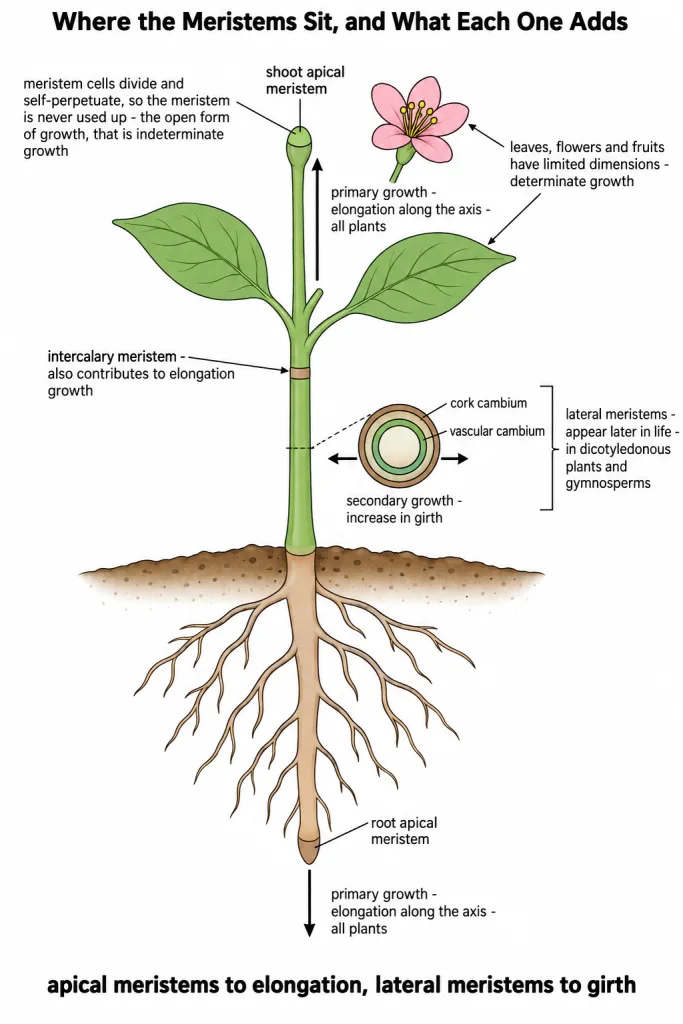
This form of growth, wherein new cells are always being added to the plant body by the activity of the meristem, is called the open form of growth.
Open growth is also called indeterminate growth - there is no fixed final size written into it.
But not every plant part is indeterminate. Leaves, flowers and fruits have limited dimensions; they grow to a set size, stop, and in time fall. Growth that stops at a predetermined size is determinate growth. So a single tree carries indeterminate growth in its stem and root and determinate growth in every leaf and flower it makes.
[NEET Important] Indeterminate does not mean infinite and determinate does not mean short. The distinction is whether a meristem keeps feeding the organ new cells. The stem apex keeps its meristem, so the stem is indeterminate. A leaf primordium exhausts its meristematic activity, so the leaf is determinate.
Primary Growth and Secondary Growth
The meristems divide the work between them by direction.
| Meristem | Where it sits | What it produces | Which plants |
|---|---|---|---|
| Root apical meristem | root tip | primary growth - elongation along the axis | all plants |
| Shoot apical meristem | shoot tip | primary growth - elongation along the axis | all plants |
| Vascular cambium | lateral, inside the axis | secondary growth - increase in girth | dicotyledons and gymnosperms |
| Cork cambium | lateral, towards the outside | secondary growth - increase in girth | dicotyledons and gymnosperms |
The apical meristems are responsible for the primary growth of the plants and principally contribute to the elongation of the plants along their axis.
In dicotyledonous plants and gymnosperms, the lateral meristems - vascular cambium and cork cambium - appear later in life. They are the meristems that cause the increase in the girth of the organs in which they are active, and that is secondary growth.
Notice the two qualifiers the sentence carries, because both are marks. Lateral meristems appear later in life - they are not there from the start. And they are named for dicots and gymnosperms - a typical monocotyledon has no vascular cambium and so no secondary growth.
Intercalary meristems also contribute to elongation growth in some plants, working at the base of internodes rather than at a tip; the chapter's own summary lists them alongside the apical meristems.
[NEET Important] Apical to elongation, lateral to girth is the sentence to hold. The commonest wrong answer pairs vascular cambium with elongation. The second commonest offers secondary growth in a monocot.
Quick Recap
- Growth = an irreversible permanent increase in size of an organ, its parts, or even a single cell.
- Growth is accompanied by metabolic processes, both anabolic and catabolic, and happens at the expense of energy.
- Expansion of a leaf is growth. Swelling of wood in water is not - reversible, and no metabolism.
- Plants keep unlimited growth throughout life because of meristems, whose cells divide and self-perpetuate.
- The product of a meristem soon loses the capacity to divide and makes up the plant body.
- New cells always being added by meristem activity = the open form of growth, that is, indeterminate growth.
- Determinate growth stops at a set size - leaves, flowers and fruits have limited dimensions.
- Root and shoot apical meristems -> primary growth -> elongation along the axis.
- Vascular cambium and cork cambium -> secondary growth -> increase in girth, and they appear later in life in dicotyledons and gymnosperms.
- Intercalary meristems also add to elongation growth.
Solved Examples
Question 1
Q. Define growth.
Answer. Growth is an irreversible permanent increase in size of an organ or its parts or even of an individual cell. It is accompanied by metabolic processes, both anabolic and catabolic, that occur at the expense of energy.
Question 2
Q. A piece of dry wood is placed in water and swells. Is this growth? Give your reason.
Answer. No. The wood swells because it takes up water by imbibition, and that change is reversible - dry the wood and it goes back to its old size. There is also no metabolic activity behind it. Growth must be irreversible, permanent and metabolic, so swelling wood fails on two counts.
Question 3
Q. Why is the expansion of a leaf counted as growth?
Answer. Because the leaf gets permanently bigger and does not go back, and the increase comes from cell division and cell enlargement that cost the plant energy. It satisfies every part of the definition - irreversible, permanent, and driven by metabolism.
Question 4
Q. What is a meristem, and which property of its cells allows a plant to grow all its life?
Answer. A meristem is a tissue of dividing cells at certain locations in the plant body. Its cells have the capacity to divide and self-perpetuate. Self-perpetuation is the key - one product of every division stays meristematic, so the meristem is never exhausted and new cells can be added for as long as the plant lives.
Question 5
Q. What is meant by the open form of growth?
Answer. Growth in which new cells are always being added to the plant body by the activity of the meristem. Because the meristem never runs out, there is no fixed final size - the growth is indeterminate.
Question 6
Q. Name the meristems responsible for primary growth and say what they contribute.
Answer. The root apical meristem and the shoot apical meristem. They are responsible for the primary growth of the plant and principally contribute to elongation of the plant along its axis.
Question 7
Q. Which meristems bring about secondary growth, and in which plants do they appear?
Answer. The lateral meristems - vascular cambium and cork cambium. They appear later in life in dicotyledonous plants and gymnosperms, and they cause the increase in girth of the organs in which they are active.
Question 8
Q. Distinguish primary growth from secondary growth in one line each.
Answer. Primary growth comes from the apical meristems and increases length along the axis. Secondary growth comes from the lateral meristems and increases girth.
Question 9
Q. Would you expect secondary growth in a typical monocotyledon? Why?
Answer. No. Secondary growth needs the lateral meristems, and the chapter places the vascular cambium and cork cambium in dicotyledons and gymnosperms. A typical monocot does not form them, so its girth does not increase in this way.
Question 10
Q. Define determinate growth and give a plant example.
Answer. Determinate growth stops at a predetermined size. Leaves, flowers and fruits show it - they have limited dimensions, grow to that size, stop, and fall in time. Compare that with the stem and root, which keep a meristem and go on growing.
Question 11
Q. What happens to the cells a meristem produces?
Answer. The product soon loses the capacity to divide, and such cells make up the plant body. Only the cell that stays behind in the meristem keeps dividing.
Question 12
Q. What would happen if a meristem ceased to divide?
Answer. The open form of growth would end there. No new cells would be added, so that axis would stop elongating and its growth would become determinate. This is exactly what happens naturally in a leaf or a flower, whose meristematic activity is used up and whose size is therefore limited.