
Two halves of one change
The oxidation number method balances an equation by tracking how far each oxidation number moves. It works, and section 7 shows it working. But it never once mentions an electron.
The half-reaction method does the opposite. It puts electrons on the page as countable items, balances each half of the change on its own, then forces the halves to trade exactly the same number of electrons. Its other name, the ion-electron method, says what it does.
Take the reaction section 7 balances by the other route.
Two things are happening here, tangled together: iron is losing an electron, chromium is gaining three. The method's first move is to untangle them — iron on one line, chromium on another, each balanced completely, then reassembled.
Key Point (Definition): A half reaction is one half of a redox change written on its own, with the electrons lost or gained shown explicitly as . It is a bookkeeping device, not a reaction that happens by itself — an oxidation half reaction never runs without some reduction half reaction to take what it gives away.
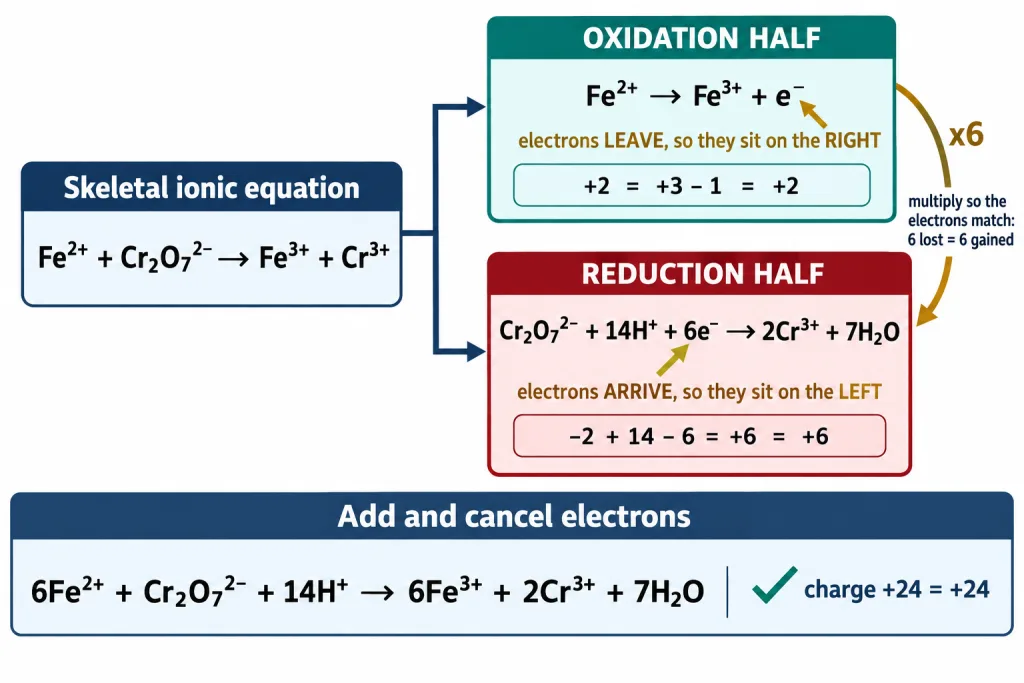
The payoff is control. Each half is small, two or three species, so a mistake stays local and a charge check catches it at once.
Which side do the electrons go on
Settle this first, because it is the one thing students reverse.
Oxidation is loss of electrons. What is given away ends up with the products, so in an oxidation half reaction appears on the right:
Reduction is gain of electrons. What is taken in is consumed, so it belongs with the reactants, and appears on the left:
A second way to see it never fails, and it is the one to fall back on under pressure. Electrons carry negative charge, so adding them makes a side less positive. They go on the side that is more positive, in the number needed to drag it down to match the other. Balance the charge and the side takes care of itself.
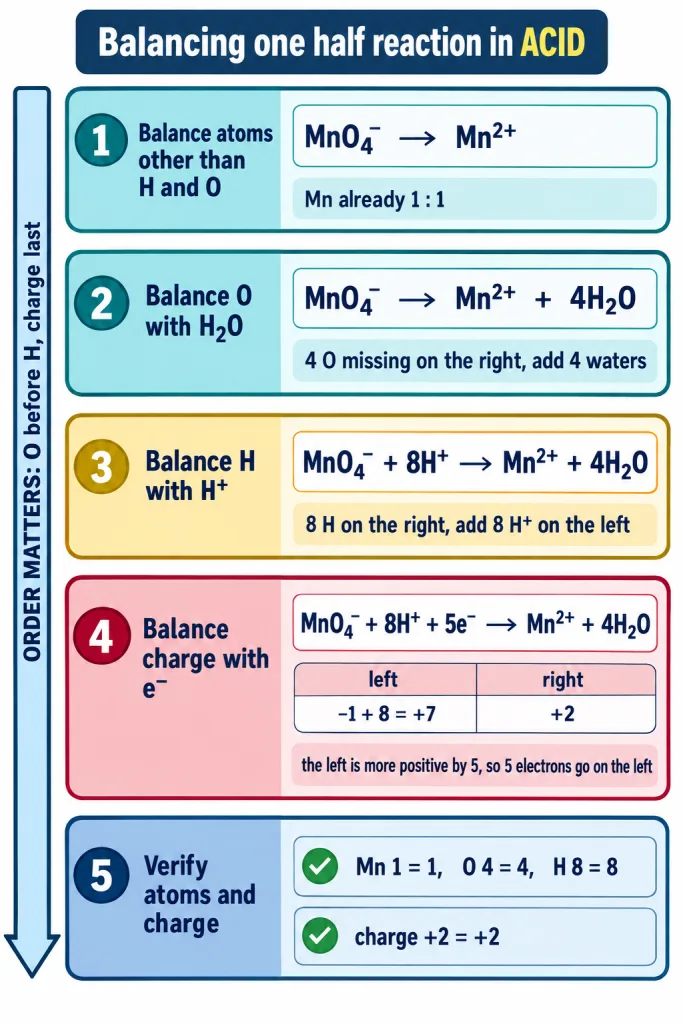
Check that against permanganate. Before electrons, the reduction half reads . The left carries and the right , so five electrons go on the left. That is the same manganese gives by falling from to , and the same the titration arithmetic in section 9 uses.
Key Point: Oxidation half — electrons on the right. Reduction half — electrons on the left. When in doubt, add electrons to the more positive side until both sides carry equal charge.
The procedure
Five steps in acid, six in base, and the order is not arbitrary.
Step 1 — Write the skeletal ionic equation and mark what changes. Strong electrolytes as free ions; spectators such as and the of the acid left out. Identify which species is oxidised (oxidation number rises) and which reduced (it falls). The oxidising agent is the one reduced; the reducing agent is the one oxidised.
Step 2 — Split into two half reactions. One line each, carrying across only the species holding the atom that changed. Balance nothing yet.
Step 3 — Balance each half, in this order.
(a) Balance every atom except H and O.
(b) Balance oxygen with on the deficient side, one water per missing oxygen.
(c) Balance hydrogen with on the deficient side, one per missing hydrogen.
(d) Balance charge with on the more positive side.
Oxygen comes before hydrogen because water brings hydrogen with it, and charge comes last because everything before it changes the charge.
Step 4 — Equalise the electrons, then add. Multiply one or both halves so that electrons lost equal electrons gained, taking the lowest common multiple. Add the halves as you would add two algebraic equations. The electrons must cancel completely, and so must anything else common to both sides, usually some and sometimes some .
Step 5 — Convert to basic medium if the question says basic. Add to both sides as many as there are ; each pair becomes one . Cancel water now duplicated. No may survive.
Step 6 — Verify. Count every element on both sides, then total the charge on both sides. Both must match.
Key Point: Balancing a redox equation conserves three things at once — atoms, charge and electrons. An equation whose atoms balance but whose charge does not is wrong, however tidy it looks.
Why the electron counts must match
Electrons are not created or destroyed in a chemical change. Every electron the reducing agent releases is taken by the oxidising agent, because there is nowhere else for it to go. The total lost must equal the total gained, exactly.
So the coefficient of in the oxidation half must equal that in the reduction half before you add. If iron gives one electron per ion and dichromate needs six, six iron(II) ions are consumed per dichromate ion. That is fixed by the electron count, and it is the same mole ratio the dichromate titration in section 9 rests on.
Mechanically: take the lowest common multiple of the two electron numbers and scale each half up to it.
| Oxidation gives | Reduction needs | LCM | Scale oxidation by | Scale reduction by |
|---|---|---|---|---|
| 1 | 6 | 6 | 6 | 1 |
| 2 | 5 | 10 | 5 | 2 |
| 1 | 5 | 5 | 5 | 1 |
| 2 | 6 | 6 | 3 | 1 |
| 8 | 3 | 24 | 3 | 8 |
| 6 | 3 | 6 | 1 | 2 |
Multiplying a half reaction through by an integer is always legitimate — every coefficient in it, electrons included, scales together. One warning for later: this is stoichiometry only. In section 10 you meet electrode potential, and does not scale when a half reaction is multiplied, because it is intensive.
Electrons surviving into your final equation mean step 4 was not finished.
Acidic medium, worked in full
Question 1: Iron(II) and dichromate, the same reaction by the other route
Balance in acidic medium by the half-reaction method.
Answer:
Iron rises from to , so it is oxidised; chromium falls from to , so dichromate is reduced. Dichromate is the oxidising agent, iron(II) the reducing agent.
Oxidation half. Iron is balanced and there is no H or O. Charge is on the left against on the right, so one electron goes on the more positive right.
Charge check: left ; right .
Reduction half. Chromium first: two on the left needs two on the right. Then seven waters on the right for oxygen, and fourteen on the left for hydrogen.
Charge is on the left against on the right, so six electrons on the left.
Charge check: left ; right .
One against six, so multiply the oxidation by six and add, cancelling the six electrons.
Verify. Fe ; Cr ; O ; H . Charge left ; charge right .
Ans:
Watch out: This is exactly the equation section 7 reaches by the oxidation number method — same coefficients, same , same . The two methods are two routes to one answer, never to two different answers. If yours disagree, one has a slip in it.
Question 2: Permanganate and oxalate in acid
Balance in acidic medium.
Answer:
Manganese falls from to ; carbon rises from to .
Oxidation half. Two carbons need two , and the oxygens then come out at four on each side, so no water or is needed. Charge against , so two electrons on the right.
Charge check: left ; right .
Reduction half, built as before:
Charge check: left ; right .
Two against five gives ten, so scale the oxidation by five and the reduction by two.
Add, and the ten electrons cancel.
Verify. Mn ; C ; O left , right ; H . Charge left ; right .
Ans:
Watch out: The mole ratio falls out of the electron count, and every permanganate titration calculation rests on it. [Board]
Question 3: Permanganate and iron(II) in acid
Balance in acidic medium.
Answer:
Both halves are already built. Oxidation: , charge against . Reduction: , charge against . One against five, so scale the oxidation by five and add.
Verify. Mn ; Fe ; O ; H . Charge left ; right .
Ans:
Watch out: The acid must be dilute sulphuric. Hydrochloric acid would itself be attacked, its chloride oxidised to chlorine, and part of the titre wasted on it.
Question 4: Dichromate and iodide in acid
Balance in acidic medium.
Answer:
Iodine rises from to ; chromium falls from to . Balance iodine first: two iodides make one .
Charge check: left ; right .
Reduction half, exactly as in question 1: , charge on each side.
Two against six, so scale the oxidation by three and add.
Verify. Cr ; I ; O ; H . Charge left ; right .
Ans:
Watch out: Balancing iodine first is what forces the , and that is what makes the electron count two rather than one. Writing breaks the atom count and the electron count together.
Basic medium: balance in acid, then neutralise
A basic-medium answer must contain no . Hydrogen and hydroxide ions cannot coexist in any quantity, so an alkaline-medium equation still showing describes a solution that does not exist.
The safe route is not to avoid but to use it and then remove it.
- Balance both halves as if the medium were acidic — water for oxygen, for hydrogen, electrons for charge.
- Combine the halves and simplify, still as if acidic.
- Count the surviving and add that many to both sides.
- On the side that carried the , each pair collapses into one .
- Cancel water now duplicated, and divide through by any common factor.
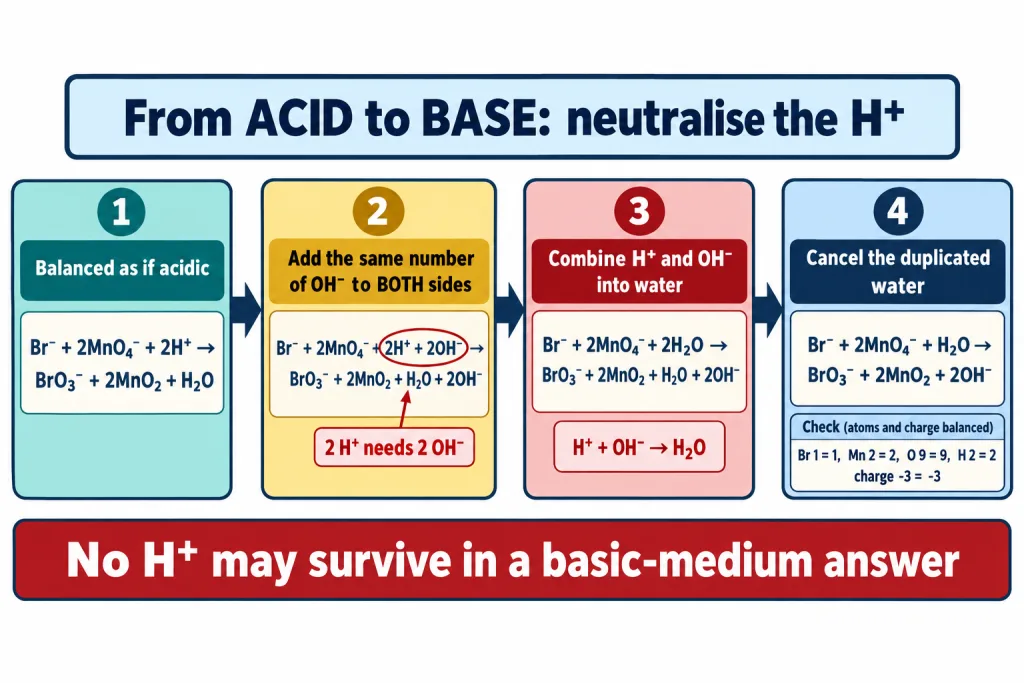
Adding the same species to both sides changes nothing chemically, exactly as it changes nothing in an algebraic equation. What it buys is a form that describes the alkaline solution honestly.
The alternative is to neutralise inside each half before adding, which is how the textbook handles the permanganate-iodide reaction. Both routes end at the same equation, but neutralising at the end is less work.
Key Point: In acid, balance oxygen with and hydrogen with . In base, do exactly that, then add to both sides, one per , combining the pairs into water. Never leave in a basic-medium answer, or in an acidic one.
Almost every mistake in this conversion surfaces as a charge mismatch, which is why step 6 exists.
Basic medium, worked in full
Question 5: Permanganate and thiosulphate in alkali
Balance in basic medium.
Answer:
Manganese falls from to ; sulphur rises from in thiosulphate to in sulphate.
Oxidation half. Sulphur first: two sulphurs need two sulphates. Oxygen: three on the left against eight on the right, so five waters on the left. Hydrogen: ten on the left, so ten on the right.
Charge is on the left against on the right, so eight electrons go on the right.
Charge check: left ; right . The eight agrees with two sulphurs each climbing four.
Reduction half. Two waters on the right for oxygen, four on the left for hydrogen. Charge against , so three electrons on the left.
Charge check: left ; right .
Eight against three gives a lowest common multiple of twenty-four.
Adding cancels the electrons, leaves two of the thirty-two on the left, and one of the sixteen waters on the right.
Now to basic. Two remain, so add two to both sides. The left pairs become two waters, giving three on the left against one on the right; cancel one from each.
Verify. S ; Mn ; O left , right ; H . Charge left ; right .
Ans:
Watch out: Against permanganate in alkali, thiosulphate goes all the way to sulphate, an eight-electron change; against iodine it stops at tetrathionate and gives up one. The product decides the electron count, so read the product.
Question 6: Permanganate oxidising iodide in alkali
Permanganate ion in basic solution oxidises iodide ion to iodine and is itself reduced to manganese(IV) oxide. Write the balanced ionic equation.
Answer:
Skeletal ionic equation: . Iodine rises from to ; manganese falls from to . Oxidation half, iodine balanced first:
Charge check: left ; right .
Reduction half, this time neutralised inside the half. As acid it is ; adding four to both sides turns the four into four waters, and cancelling two against the right leaves
Check: Mn ; O against ; H . Charge left ; right .
Two against three gives six, so scale the oxidation by three and the reduction by two, then add and cancel the electrons.
Verify. I ; Mn ; O left , right ; H . Charge left ; right .
Ans:
Watch out: In acid this same permanganate goes to and takes five electrons; in alkali it stops at brown and takes three. The medium sets the product, the product sets the electron count.
Question 7: Permanganate and bromide in alkali
Permanganate ion reacts with bromide ion in basic medium to give manganese dioxide and bromate ion. Balance the ionic equation.
Answer:
Bromine rises from to , a six-electron loss; manganese falls from to , a three-electron gain.
Oxidation half. Bromine is one to one, so go to oxygen: three waters on the left, then six on the right. Charge against , so six electrons on the right.
Charge check: left ; right .
Reduction half, as in question 5: , charge on each side.
Six against three, so scale the reduction by two and add. Six of the eight and three of the four waters cancel.
Convert to basic: add two to both sides, make two waters on the left, and cancel one water from each.
Verify. Br ; Mn ; O left , right ; H . Charge left ; right .
Ans:
Watch out: Bromide to bromate is a six-electron jump, the largest single-atom change in this chapter. Counting it as one because the ion charge stays at is a common error — the charge on an ion is not the oxidation number of the atom inside it.
When one species is both halves: disproportionation
In a disproportionation the same element in the same starting species is partly oxidised and partly reduced. Chlorine in alkali is the standard case: some becomes (reduced, to ) and some becomes (oxidised, to ).
Students freeze here, because step 2 looks impossible with one reactant. It is not. The same species is written as the reactant of both half reactions, and nothing else changes:
Two independent portions of chlorine are doing two different things, and the halves count those portions separately. When you equalise the electrons and add, the two terms land on the same side and add up. They do not cancel, because they are not on opposite sides.
Two habits keep it straight: write both halves with the same reactant on the left, and after adding collect like terms before hunting for a common factor.
The element must be in an intermediate oxidation state, since it needs somewhere to go in both directions. Chlorine at can fall to and climb to . Fluorine at can only fall, having no positive oxidation state, which is why fluorine never disproportionates.
A disproportionation gives no second reagent to cross-check against, so the charge check at the end is the only safeguard.
Disproportionation, worked in full
Question 8: Chlorine in hot concentrated alkali
Balance .
Answer:
Chlorine starts at . In it is , reduced; in it is , oxidised. Same reactant, both halves.
Reduction half: has charge against , so two electrons go on the more positive left.
Charge check: left ; right .
Oxidation half: . Chlorine balanced; six waters on the left for oxygen, twelve on the right for hydrogen. Charge against , so ten electrons on the right.
Charge check: left ; right .
Ten against two, so scale the reduction by five: . Add. Both chlorine terms sit on the left, so they sum to .
Convert to basic: add twelve to both sides, so the twelve pairs on the right become twelve waters, leaving twelve waters on the right against six on the left; cancel six from each.
Every coefficient is even, so divide by two.
Verify. Cl left , right ; O left , right ; H . Charge left , right .
Ans:
Watch out: The ratio of chloride to chlorate is fixed by the electron count — one chlorine climbing five steps needs five chlorines each falling one. Cold dilute alkali is a different reaction, stopping at hypochlorite with a split: . The conditions decide which. [JEE Main]
Unfamiliar products, and why the half-reaction method copes
The hardest balancing questions are not the ones with big numbers. They are the ones whose product you have never memorised — nitrate reduced all the way to ammonium, sulphur ending up in a species you have not met.
The half-reaction method handles these without you knowing anything beyond the two formulae. Look at what the reduction half asks for:
You do not need to know that this is what very dilute nitric acid does with an active metal. You need only balance N (done), then O (three waters on the right), then H (ten on the left), then charge (eight electrons). The eight electrons come out of the procedure; they were never something to recall.
That is the real advantage. The oxidation number method needs a correct oxidation number in the unfamiliar product before it can start, and a wrong value there wrecks everything downstream. Here atoms and charge do the work, and the electron count arrives at the end as a check rather than a prerequisite.
The same logic covers fractional average oxidation numbers. Handling by oxidation numbers means working with ; inside a half reaction it means counting sulphurs, oxygens, hydrogens and charge, all integers.
Key Point: The half-reaction method never requires you to know an oxidation number — atoms and charge are enough. Use it whenever the product is unfamiliar, an oxidation number is fractional, or the medium is basic.
Unfamiliar products, worked in full
Question 9: Zinc reducing nitrate to ammonium
Balance in acidic medium.
Answer:
Zinc goes from to ; nitrogen goes from in nitrate to in ammonium. Oxidation half, with no H or O involved:
Charge check: left ; right .
Reduction half. Nitrogen is one to one; three waters on the right for oxygen. The right then carries hydrogens, so ten on the left.
Charge on the left against on the right, so eight electrons on the left.
Charge check: left ; right , and the eight matches nitrogen falling from to .
Two against eight, so scale the oxidation by four, then add.
Verify. Zn ; N ; O ; H left , right . Charge left , right .
Ans:
Watch out: The hydrogens inside count towards the hydrogen balance. Missing them gives six instead of ten, then four electrons instead of eight. [JEE Main]
Question 10: Dichromate and sulphite in acid
Write the net ionic equation for potassium dichromate(VI) reacting with sodium sulphite in acid solution to give chromium(III) ion and sulphate ion.
Answer:
Potassium and sodium are spectators and do not appear.
Chromium falls from to ; sulphur rises from to .
Oxidation half. Sulphur balanced; one water on the left for the missing oxygen, then two on the right. Charge against , so two electrons on the right.
Charge check: left ; right .
Reduction half, the standard dichromate one: , charge on each side.
Two against six, so scale the oxidation by three and add. Six of the fourteen cancel, leaving eight, and three of the seven waters cancel, leaving four.
Verify. Cr ; S ; O left , right ; H . Charge left , right .
Ans:
Watch out: A net charge of zero on both sides is a perfectly good outcome. Assuming a balanced redox equation must carry a non-zero charge sends students hunting for an ion that is not missing.
Choosing between the two methods
Both methods are correct and both are accepted in an examination. What differs is effort and risk.
| Situation | Oxidation number method | Half-reaction method |
|---|---|---|
| Molecular equation, no ions given | Faster, works on the formulae directly | Awkward, needs converting to ionic form first |
| Small, familiar oxidation number shift | Very fast, often done mentally | More writing than the problem deserves |
| Net ionic equation asked for | Needs an extra charge-balancing step | Natural, ionic form is where it starts |
| Unfamiliar or complicated product | Risky, needs an oxidation number you may get wrong | Safe, atoms and charge are enough |
| Fractional average oxidation number | Awkward arithmetic with fractions | Unaffected, every count stays an integer |
| Basic medium | Easy to leave the charge unbalanced | Systematic, balance in acid then neutralise |
| Disproportionation | Confusing, one species rising and falling at once | Clean, the species appears in both halves |
| Electrons transferred wanted | Must be worked out separately | Read straight off the half reactions |
A workable rule: a molecular equation with familiar species is quicker by oxidation numbers; an ionic equation, a basic medium, an unfamiliar product or a disproportionation calls for half reactions.
One further reason to be fluent in the half-reaction method matters more than exam-day speed. Class 12 electrochemistry is built entirely on half reactions. A half cell is a half reaction happening at an electrode. A standard electrode potential is tabulated for a half reaction, always written as a reduction with the electrons on the left — exactly the form used all through this section. Cell notation, , the Nernst equation and electrolysis all assume you can look at a redox change and see the two halves. Section 10 makes the first move.
The errors that cost marks
Electrons on the wrong side. Putting on the left of an oxidation half. The fix is the charge rule: electrons go on the more positive side, always.
Balancing hydrogen before oxygen. The waters added afterwards bring more hydrogen with them. Oxygen first, hydrogen second, charge last.
Adding electrons before the atoms are done. The charge changes every time you add water or , so any earlier electron count is stale.
Leaving in a basic-medium answer, or adding to one side only. Alkaline solutions have no free , and hydroxide must go on both sides or the equation itself changes.
Forgetting to cancel. and often end up on both sides. Cancel them, then divide out any common factor.
Including spectator ions. The of and the of the acid do not belong in a net ionic equation.
Skipping the charge check. Almost every wrong answer here balances for atoms and fails for charge.
Key Point: Finish every balancing question with the same two lines — total each element on both sides, then total the charge on both sides. If either fails, the equation is wrong however it was obtained. [NEET]