
Why a Name Sometimes Needs a Number
Iron forms two common oxides, one black and one red-brown. Call either of them "iron oxide" and you have said almost nothing. The same problem turns up with copper, tin, lead, manganese, chromium, gold and mercury.
The older fix was a pair of suffixes: ferrous and ferric, cuprous and cupric, stannous and stannic, aurous and auric. It names only two states, so it collapses for manganese, which runs from to .
Alfred Stock, a German chemist, supplied the fix that is now standard. Write the oxidation number of the element as a Roman numeral in parentheses, placed immediately after the name or the symbol of that element.
Key Point (Definition): In Stock notation the oxidation number of an element is written as a Roman numeral in parentheses, placed immediately after the name or symbol of that element, with no space before the bracket. is iron(II) oxide, written in formula form.
The rules of the notation
1. Roman numeral, in capitals. I, II, III, IV, V, VI, VII. Not 2, not ii.
2. No space before the bracket. iron(III) oxide, never iron (III) oxide.
3. The numeral is the oxidation number of ONE atom. is iron(III) oxide, not iron(VI) oxide. The subscript already counted the atoms; the numeral says what each one is. Adding them together is the commonest slip in this topic.
4. The numeral carries no sign. Stock notation was built for metals, which take positive oxidation numbers in compounds, so the sign is understood. Zero is written as (0) where it matters: is nickel(0) tetracarbonyl.
5. In a formula the numeral follows the symbol. Aurous and auric chloride become and , stannous and stannic chloride become and , and mercurous chloride is , the reduced form of .
Which elements get a numeral
Stock notation is for elements of variable valency: Fe (, ), Cu (, ), Sn (, ), Pb (, ), Mn (, , , ), Cr (, , ), Au (, ) and Hg (, ).
Sodium, potassium, magnesium, calcium, aluminium, zinc and fluorine have one common state each, so no numeral is used. is sodium chloride, not sodium(I) chloride.
[Board] A one-mark naming question almost always draws from four pairs: /, /, / and /.
Reading a Formula and Writing the Stock Name
Work out the oxidation number of the variable-valency element by the ordinary rules, then dress it as a Roman numeral. For : oxygen is each and the molecule is neutral, so and . The name is manganese(IV) oxide, written .
For : potassium is , each oxygen is , the molecule is neutral:
The trivial name is potassium permanganate; the Stock name is potassium manganate(VII), written . It tells you why permanganate is such a powerful oxidant: is the highest manganese can reach.
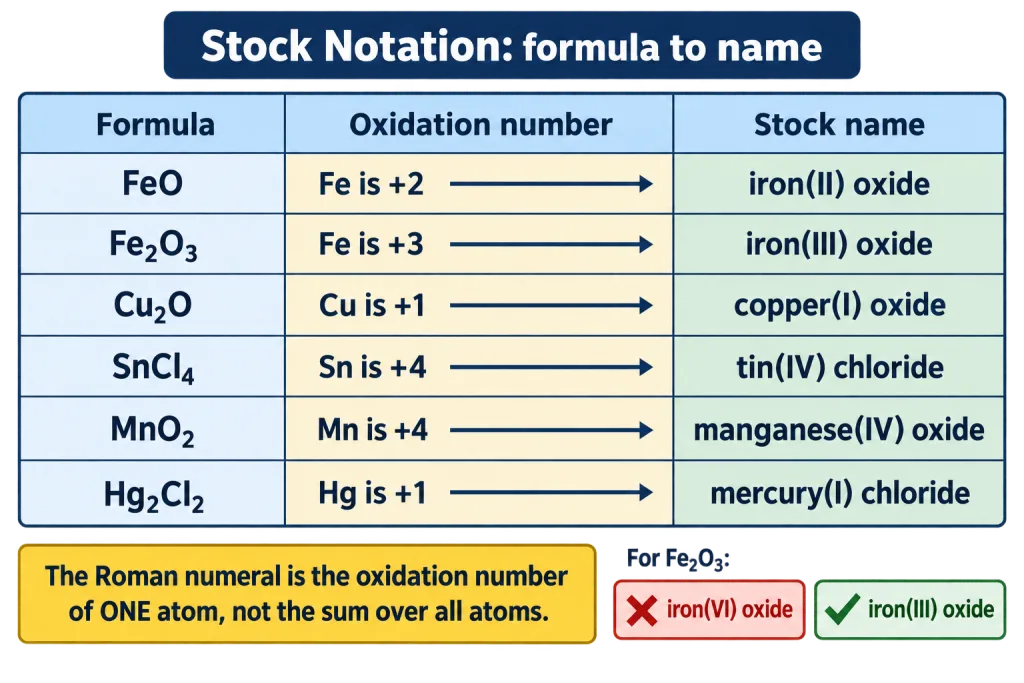
The reference table
| Formula | Oxidation number | Stock name | Stock form |
|---|---|---|---|
| Fe is | iron(II) oxide | ||
| Fe is | iron(III) oxide | ||
| Cu is | copper(I) oxide | ||
| Cu is | copper(II) oxide | ||
| Sn is | tin(II) chloride | ||
| Sn is | tin(IV) chloride | ||
| Mn is | manganese(IV) oxide | ||
| Mn is | potassium manganate(VII), commonly potassium permanganate | ||
| Hg is | mercury(I) chloride | ||
| Au is | gold(III) chloride | ||
| Au is | hydrogen tetrachloridoaurate(III) | ||
| Tl is | thallium(I) oxide |
In one oxygen at is shared by two thallium atoms, so each is — the same trap as and .
The reverse direction: name to formula
The numeral hands you the charge on the metal ion. Read it as the positive charge on one atom, write the charge on the anion, combine so the total is zero, then reduce to the lowest whole numbers.
| Stock name | Ions | Formula |
|---|---|---|
| chromium(III) chloride | , | |
| copper(I) sulphide | , | |
| lead(IV) oxide | , | |
| iron(III) sulphate | , | |
| tin(II) fluoride | , | |
| mercury(II) nitrate | , | |
| copper(II) phosphate | , |
The reduction step matters: lead(IV) oxide crosses to , which reduces to . Mercury(I) chloride is the one place the recipe misleads. Crossing with suggests , which does not exist: mercury in the state is the dimeric ion , two mercury atoms bonded to each other, so the compound is . The numeral (I) is still right, because each mercury atom is ; what fails is the assumption that the cation must be a lone atom.
[JEE Main] Naming is rarely asked alone. It arrives folded into an oxidation-number question, so treat the numeral as one.
Where Fractional Oxidation Numbers Come From
The rules of oxidation number make no promise that the answer will be a whole number. They set up one equation — the sum is for a neutral molecule and equals the charge for an ion — and you solve it. If the number of atoms of that element does not divide the total cleanly, the answer is a fraction.
Key Point: A fractional oxidation number is an average over all the atoms of that element in the formula unit. It is arithmetic, not physics. No electron is ever shared or transferred in fractions.
Fractions arise in three distinct situations, and telling them apart is the whole of this topic.
Situation 1 — mixed oxides. The solid holds the same metal at two oxidation states on two different crystallographic sites. , and are the standard trio. The fraction hides two whole numbers.
Situation 2 — chains in which atoms of one element sit in different chemical environments. and belong here: the molecule is one covalent unit, but a terminal atom is bonded to oxygen while a middle atom is bonded only to its own kind, which is worth nothing and leaves that middle atom at . belongs to the same situation for a slightly different reason: every bromine in it is bonded to oxygen, but the central bromine carries fewer oxygen atoms than the two terminal ones, so the values come out , , with an average of . Again the fraction hides whole numbers.
Situation 3 — species in which every atom of the element is genuinely equivalent. The superoxide ion has an odd electron spread over two identical oxygen atoms, so oxygen in is per atom with no whole numbers underneath. The dioxygenyl cation gives the same way.
Situations 1 and 2 are where the phrase "the paradox of fractional oxidation number" belongs, and the paradox dissolves the moment you look at the structure. If all atoms of that element are in identical environments the fraction is real per atom; if they are not, the structure hands you the whole numbers.
Case 1: , Magnetite
The average, by the rules
Let iron be . Oxygen is and the compound is neutral:
Iron in has an average oxidation number of . As a value for a real atom this is meaningless: an iron atom cannot lose two and two-thirds of an electron.
The structure, and the individual assignment
is magnetite. It crystallises as an inverse spinel, and per formula unit it contains one iron(II) and two iron(III). It is often written as a double oxide, , which says the same thing at a glance.
In Stock form the compound is , and that one line carries which iron is which and how many of each.
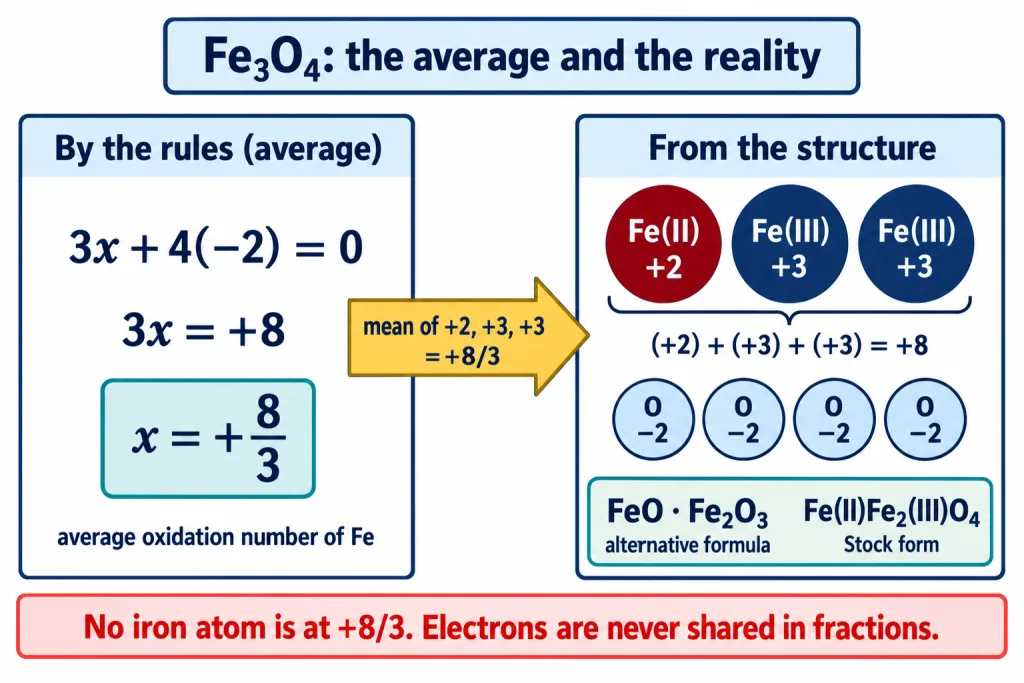
The distinction is chemically real
Dissolve in dilute sulphuric acid and the solution contains and in a ratio, which is testable on a bench: the fraction decolourises acidified and the fraction does not. Two iron environments, not one averaged environment, are why magnetite can act as either oxidant or reductant.
The stoichiometry still works with the average
Oxidise completely to the state. Counting individual atoms: the two do not change and the single loses one electron, giving one electron per formula unit. Counting by the average: each of three iron atoms rises from to , a rise of each, and electron.
The two routes agree, and they always will, because the average was constructed to make the total come out right. That is the whole justification for using it in n-factor and equivalent-mass arithmetic.
[JEE Main] The n-factor of oxidised to is , not . Only the one iron(II) per formula unit is available to be oxidised.
Case 2: , Sodium Tetrathionate
The average, by the rules
Sodium is , oxygen is , the compound is neutral. Let sulphur be :
The same arithmetic on the ion alone must give the same answer. For the sum of oxidation numbers equals the charge: , so and
The structure, and the individual assignment
The tetrathionate ion is a four-sulphur chain with an group at each end:
Two sulphur environments exist, and they could hardly be more different.
The two middle sulphurs are bonded only to other sulphur atoms. A bond between two atoms of the same element is split equally by the rules, so it contributes nothing to either atom. Each middle sulphur is at .
The two terminal sulphurs each sit in an group carrying , since the ion has spread over two identical ends:
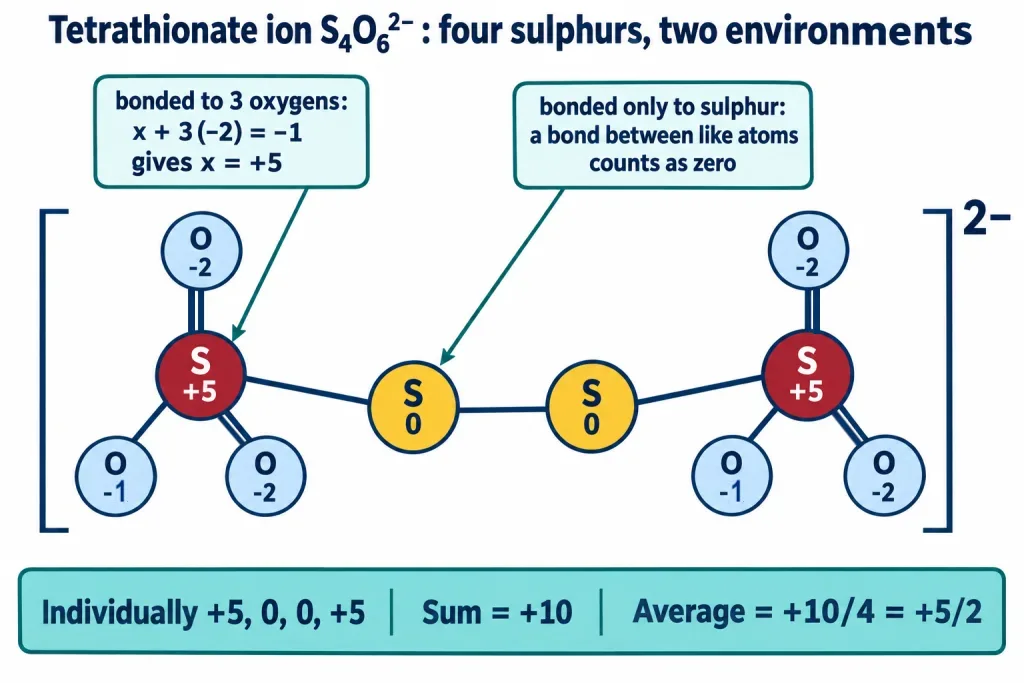
The reality is ; the reported number is . Neither is wrong, and they answer different questions.
The connection to iodometry
Tetrathionate is what thiosulphate becomes when iodine oxidises it, in the reaction every iodometric estimation ends with:
Charge: left , right ; atoms: I, S and O on each side .
In thiosulphate, gives an average sulphur of ; in tetrathionate it is . The rise is per sulphur across four sulphurs in the product, so the total is electrons for the thiosulphate ions consumed — one electron per thiosulphate ion. That is why the n-factor of here is and the mole ratio is .
[NEET] Two numbers get confused constantly. Average sulphur in is ; average sulphur in is . Read the subscripts before you start.
Case 3: , and the Other Mixed Oxides
Carbon suboxide,
The structure is a linear chain of cumulated double bonds, . Each terminal carbon has two bonds to oxygen, worth , and two bonds to carbon, worth nothing, so it is . The middle carbon has four bonds and all four go to carbon, so it is .
Tribromooctaoxide,
From the structure the two terminal bromines are each and the middle bromine is : against . A value of describes no bromine atom in the molecule.
Red lead,
gives . Structurally is : two lead(II) and one lead(IV), since against from the oxygens.
Red lead reacts differently with two acids, and the mixed oxidation states are the reason:
Hydrochloric acid supplies chloride, which the lead(IV) portion oxidises to chlorine gas while itself falling to lead(II). Atoms: Pb , Cl , H , O on each side; charge .
Nitrate cannot be oxidised here, so the two lead(II) units dissolve as lead(II) nitrate and the lead(IV) is left as brown . Atoms: Pb , N , H , O on each side . Only the first reaction is a redox reaction.
Hausmannite,
gives again, and structurally it is : one manganese(II) and two manganese(III), since . Same fraction as and , but splits while the other two split .
Fractions that are not averages
Potassium superoxide gives , so oxygen is . The two oxygen atoms are identical: the superoxide ion carries one extra electron beyond neutral dioxygen, spread over both. No structure will split into two whole numbers, because there is nothing to split. The same holds for , where oxygen is .
Keep this straight: in and the fraction is a disguise; in and it is the answer.
The same effect runs through organic chemistry, where nobody calls it a paradox: ethanol, , gives an average carbon of , while its methyl carbon is and its carbinol carbon is , and only the carbinol carbon changes when ethanol is oxidised to ethanal.
Average or Individual: Which Does the Question Want
Both answers are correct for the same compound, so the marks go to whoever reads the wording. The sorting rule is short.
| Wording | What to give | Example answer |
|---|---|---|
| "the oxidation number of Fe in " | the average, as a fraction | |
| "the oxidation states of Fe present in " | the individual whole numbers | and |
| "in how many different oxidation states does S occur in " | count the environments | two, namely and |
| " may be written as …" | the double-oxide form | |
| n-factor, equivalent mass, titration arithmetic | the average, which is safe and faster | n-factor of to is |
| "which atom is oxidised in …" | the individual values, from the structure | the carbinol carbon in ethanol |
Three signals mean the question wants the structure: the word states in the plural, any mention of a mixed or double oxide, and any request to count atoms.
Key Point: Report the average when the question asks for the oxidation number. Report whole numbers from the structure when it asks for the oxidation states, for a count of atoms, or for which atom changes.
One safeguard costs nothing. Whenever you quote a fraction, add the whole numbers in a half-sentence: ", an average of one and two ." That protects you when the wording is ambiguous.
The Limits of the Oxidation Number Concept
Oxidation number is the most useful bookkeeping device in inorganic chemistry, and every one of its rules is a convention. Knowing where it stops being informative is part of using it.
1. It is not the real charge on the atom
Manganese in is , yet no ion exists in the solid or in solution: the bonds in are substantially covalent and the negative charge is spread over the four oxygens. The answers the question "what would the charge be if every bond were fully ionic?", a fiction chosen because the arithmetic it produces is consistent. Carbon in is for the same reason, though the real charge on carbon is a small fraction of an electron.
Oxidation number and formal charge are different quantities, and they routinely disagree. In carbon monoxide, , the oxidation number rule gives every bonding pair to the more electronegative atom, so oxygen is and carbon is . The formal charge rule splits every bonding pair equally, giving carbon and oxygen . Carbon is by one rule and by the other; neither is the measured charge, and conflating them costs marks.
2. A high oxidation number does not make a strong oxidising agent
The pattern "high oxidation number, strong oxidant" holds just often enough to be believed.
Chlorine reaches in , its maximum, yet cold dilute perchloric acid is a feeble oxidising agent, sitting happily with reductants that hypochlorous acid destroys on contact — and in chlorine is only at . Carbon reaches in , which puts fires out rather than feeding them, and aluminium reaches in , one of the most inert oxides known.
The medium matters too, at fixed oxidation number. Chromium is in both and , but in acid the dichromate ion is a strong oxidant, for
while chromate in alkali is far weaker. Oxidising strength is set by the free energy change of the whole half reaction, which the oxidation number does not contain. Permanganate says the same from the other side: starts at in every medium, yet gains electrons in acid, in neutral medium and in strong alkali.
3. It cannot separate atoms of the same element in different environments
reports and contains and ; reports and contains and . Only the structure tells you.
The effect is not confined to fractions. Ammonium nitrate gives , so the average nitrogen is — a respectable whole number that describes neither atom, since the ammonium nitrogen is and the nitrate nitrogen is . Their sitting at different oxidation states in one formula unit is why heating the salt gives dinitrogen oxide, in which nitrogen genuinely is :
Ammonium nitrite behaves the same way: average nitrogen , actual nitrogens and , decomposing to . Both are internal redox reactions between two nitrogen atoms in one formula unit, and the average gives no hint that anything is happening.
Isomers sharpen the point: acetic acid and glycolaldehyde share the formula and an average carbon oxidation number of , yet their carbons are and in one and and in the other.
4. It says nothing about rate or mechanism
A favourable change in oxidation number tells you a reaction can release free energy, not that it will happen in your lifetime. Hydrogen and oxygen sit together in a sealed flask for years at room temperature. The permanganate-oxalate titration is the laboratory version:
Charge: left ; right . Every oxidation number argument says this should run to completion, yet at room temperature the first drops of permanganate sit in the flask stubbornly purple. Warm the mixture to about and it proceeds at a usable rate, with identical oxidation numbers at both temperatures. Mechanism is equally absent: the number gives the net bookkeeping between reactants and products and stays silent on intermediates and on which bond broke first.
5. The ionic picture behind the rules is an approximation
The central rule — assign both electrons of a bond to the more electronegative atom — treats every bond as fully ionic. For that is close to the truth; for a or bond it is a convention rather than a statement about where the electrons are. Splitting a bond between two atoms of the same element equally is a second convention, and it is what makes the middle sulphurs of tetrathionate and the middle carbon of come out at exactly .
The concept is still moving. Modern usage describes oxidation as a decrease in electron density around an atom and reduction as an increase, a statement that survives where no clean whole-number oxidation state can be assigned.
Oxidation number is not valency either. Carbon has valency in , , , and alike, while its oxidation number runs , , , , . Valency counts bonds formed; oxidation number counts an imagined electron transfer.
[JEE/NEET] Assertion-reason items live on these limits. "Assertion: is a stronger oxidising agent than . Reason: chlorine is in a higher oxidation state in ." True reason, false assertion — that pairing is the trap.
Worked Questions
Question 1: Stock names for the common pairs
Name , , , , and in Stock notation.
Answer:
I find the oxidation number of the metal in each, then write it as a Roman numeral. : one oxygen at , so iron is . : three oxygens give shared by two irons, so each is . : one oxygen shared by two coppers, so each is . : copper is . and : tin is and .
Ans: iron(II) oxide, iron(III) oxide, copper(I) oxide, copper(II) oxide, tin(II) chloride, tin(IV) chloride. Watch out: Writing iron(VI) oxide for means adding the two iron atoms instead of taking one.
Question 2: The two faces of
Find the oxidation number of iron in , and state which oxidation states iron actually occupies.
Answer:
For the average I use neutrality with oxygen at : , so and .
For the reality I use the structure. Magnetite is an inverse spinel holding one iron(II) and two iron(III) per formula unit, written . Checking: against , and the mean of is .
Ans: average ; actual states for one iron and for two, giving . Watch out: If the question says "oxidation states", plural, give and , not the fraction.
Question 3: Sulphur in sodium tetrathionate
Calculate the oxidation number of sulphur in , then assign each sulphur individually.
Answer:
The ion is . The two middle sulphurs are bonded only to sulphur, and a bond between like atoms contributes nothing, so each is . Each terminal sulphur sits in an unit at , so and . Checking the ion: , which is its charge.
Ans: average ; individually , , , . Watch out: Dropping the two sodium atoms turns into and gives the wrong .
Question 4: Carbon suboxide and tribromooctaoxide
Find the average and individual oxidation numbers of the named element in and in .
Answer:
For : gives . The molecule is , so each terminal carbon has two bonds to oxygen and is , while the middle carbon has four bonds all to carbon and is ; checking, against .
For : gives , and the two terminal bromines are each with the middle one at , since against .
Ans: , average , individually ; , average , individually . Watch out: is about , and no bromine atom is close to that.
Question 5: Why red lead reacts differently with two acids
reacts with hydrochloric acid to give chlorine but with nitric acid to leave a brown residue. Account for both.
Answer:
The average is from , which already tells me the lead atoms are not alike. The structure is : two lead(II) and one lead(IV), checking as against .
Chloride can be oxidised, so the lead(IV) takes two electrons from it and falls to lead(II) while chloride rises from to :
Nitrate is already at and cannot be oxidised, so the two lead(II) units dissolve as the nitrate and the lead(IV) stays behind as brown :
Ans: holds lead at and . Only the reaction is a redox reaction, with lead(IV) oxidising chloride to chlorine; the nitric acid reaction is not. Watch out: The average explains nothing here. The whole answer rests on splitting it into .
Question 6: A fraction that is not an average
Find the oxidation number of oxygen in and explain why the structure cannot resolve it into whole numbers.
Answer:
gives . In or I could go to the structure and find atoms in different environments; here I cannot, because the superoxide ion has two identical oxygen atoms with the extra electron spread over both.
Ans: , and this is the genuine per-atom value rather than an average. Watch out: Oxygen is in peroxides such as and , and in superoxides such as .
Mistakes That Cost Marks
Adding the Roman numerals of all the atoms. is iron(III) oxide. The numeral describes one atom; the subscript already counted them.
Forgetting to reduce the criss-crossed formula. Lead(IV) oxide is , not .
Writing for mercury(I) chloride. The state of mercury is the bonded pair , so the formula is .
Dropping the cation from the neutrality equation. In , omitting the two sodiums turns into and gives instead of .
Quoting a fraction as the state of an atom. No iron atom in magnetite is at . Say "average" whenever you write a fraction for a mixed oxide or a chain species.
Treating every fraction as an average. Oxygen in really is per atom, because the two oxygens are identical.
Confusing oxidation number with formal charge. In the oxidation number of carbon is and its formal charge is .
Assuming a higher oxidation number means a stronger oxidant. beats , and and oxidise nothing.
Reading a favourable oxidation number change as a fast reaction. The permanganate-oxalate titration needs warming to about before it moves at a workable rate.
Quick Revision
- Stock notation: the oxidation number of an element as a Roman numeral in parentheses, immediately after the name or symbol, no space. is iron(II) oxide, .
- The numeral is the oxidation number of one atom, never the sum over all of them.
- Needed for Fe, Cu, Sn, Pb, Mn, Cr, Au, Hg. Not used for Na, K, Mg, Ca, Al, Zn, F.
- The ten to know: iron(II) oxide, iron(III) oxide, copper(I) oxide, copper(II) oxide, tin(II) chloride, tin(IV) chloride, manganese(IV) oxide, potassium manganate(VII) with Mn at , mercury(I) chloride, gold(III) chloride.
- Limits of the concept: it is not the real charge; a high value does not mean a strong oxidant; it hides atoms of one element in different environments; it says nothing about rate or mechanism; the fully-ionic assumption behind it is an approximation; and it is neither formal charge nor valency.
- Name to formula: the numeral gives the cation charge, combine to zero and reduce. Mercury(I) is the exception, , because the cation is .
- A fractional oxidation number is an average. Electrons are never shared in fractions.
- : average ; really one Fe(II) and two Fe(III); .
- : average ; really along the chain.
- : average ; really along .
- : average ; really .
- : average ; really two Pb(II) and one Pb(IV). : average ; really one Mn(II) and two Mn(III).
- Fractions that are not averages: oxygen is in and in , because the two atoms are identical.
- Singular "the oxidation number" wants the average; plural "the oxidation states" wants whole numbers from the structure.