
What Makes a Redox Reaction Titratable
An acid-base titration works because neutralisation is fast, complete and of fixed stoichiometry, and because an indicator flips colour within a drop of the equivalence point. A redox titration needs the same four things.
1. The reaction must go to completion. The two standard reduction potentials must be far apart. Permanganate sits at and the couple at , so
and the reaction runs to the last ion. Dichromate against iron(II) gives , still comfortably complete.
2. The stoichiometry must be single and known. If permanganate could end up as in one flask and in another, no calculation would be possible. Fixing the medium fixes the product, and the product fixes the mole ratio.
3. The reaction must be fast at the end point. A reaction that is complete but sluggish overshoots, because the last drop has not reacted when you decide the colour has stayed.
4. The end point must be visible. Either the reagent is itself coloured, or an indicator responds to the potential of the solution rather than to pH.
Key Point (Definition): A redox titration determines the strength of an oxidant or a reductant by reacting it with a solution of known strength of the opposite kind, the end point being detected by a colour change of the reagent itself or of a redox indicator.
The equivalence point is where oxidant and reductant have been mixed in exactly the mole ratio of the balanced equation. The end point is where you see the change. Good practice makes the two coincide to within a drop.
[JEE/NEET] Three families cover almost every question set: permanganometry (self-indicating), dichrometry (internal redox indicator) and iodometry with starch.
The Arithmetic: n-Factor, Equivalent Mass and Normality
Two routes exist to the same answer. Learn both, then pick one and stay with it inside a given problem.
The n-factor
Key Point (Definition): The n-factor of a species in a redox reaction is the number of electrons gained or lost per formula unit of that species in that particular reaction.
It is a property of the reaction, not of the bottle. The same permanganate has three different n-factors in three different media.
| Species | Change in the reaction | n-factor | Equivalent mass |
|---|---|---|---|
| , acidic | 5 | ||
| , neutral or weakly basic | 3 | ||
| , strongly alkaline | 1 | ||
| , acidic | 6 | ||
| 2 | |||
| 1 | |||
| Mohr salt | 1 | ||
| with iodine | 1 | for the pentahydrate | |
| 2 | |||
| as oxidant or as reductant | or | 2 |
The three relations
The last one says that at the equivalence point the equivalents of oxidant equal the equivalents of reductant. One equivalent of any oxidant consumes exactly one equivalent of any reductant, which is what makes the equation so short. Number of equivalents is also mass divided by equivalent mass, which gives you a way in from a weighed solid.
The mole-ratio route
The same statement written without the word "equivalent":
with and the n-factors. The mole-ratio route is the safer one: find moles of the reagent you know, multiply by the mole ratio straight off the balanced equation, and read off moles of the unknown.
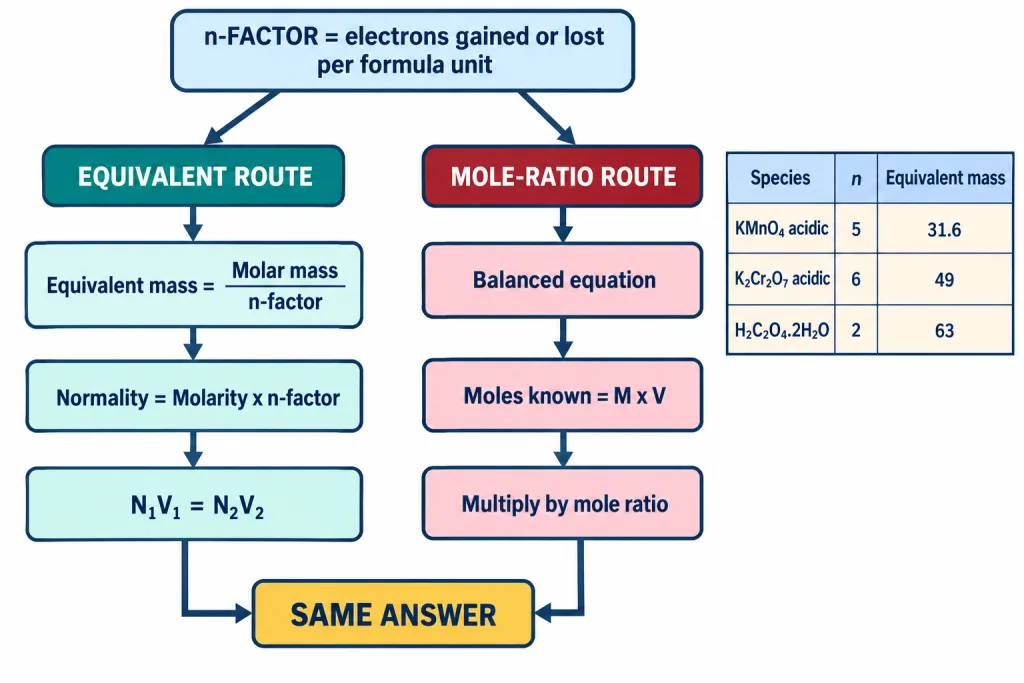
The two routes cannot disagree, because normality is only molarity carrying its n-factor around with it. Worked Question 1 runs the same titration both ways so you can see the numbers land on top of each other.
[JEE Main] When the medium is unstated, the mole-ratio route forces you to write the balanced equation first, which is what saves the mark.
Permanganate Titrations
Potassium permanganate is the standard oxidant of the school laboratory. In dilute sulphuric acid it is reduced to the almost colourless manganese(II) ion:
Against oxalate the balanced equation is
Charge on the left is ; on the right it is . The mole ratio is .
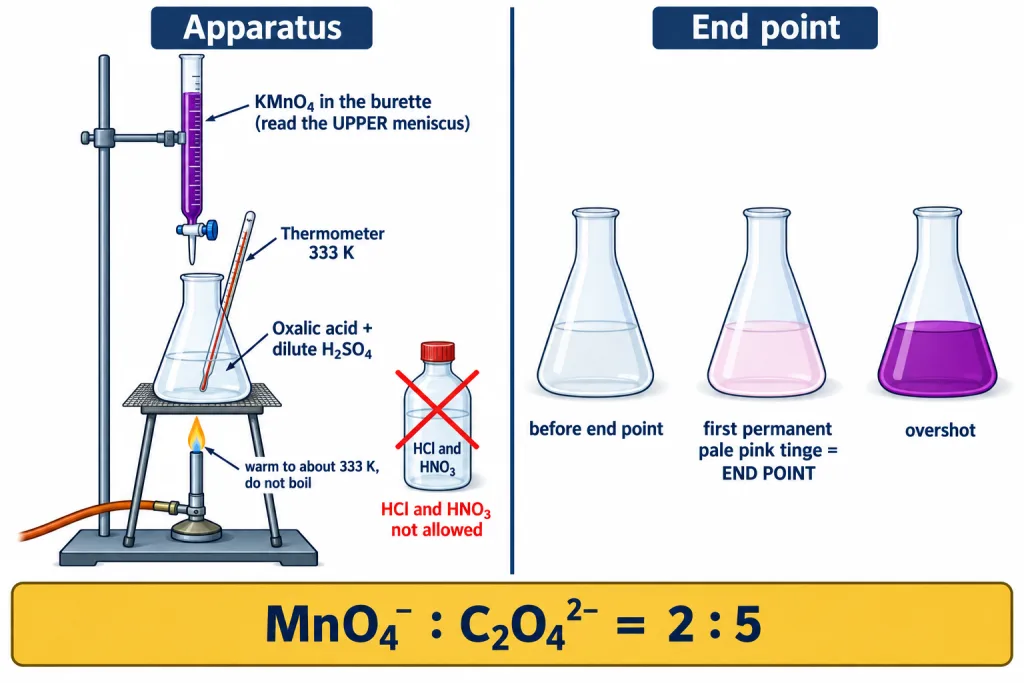
The conditions, and the reason behind each
Warm the flask to about (roughly ). At room temperature the reaction is slow and the first drops of permanganate sit unreacted. It is autocatalysed by the it produces, so once a little manganese(II) has formed it speeds up sharply; warming gets it past that sluggish start. Do not boil — above about oxalic acid decomposes and the result comes out low.
Use dilute sulphuric acid. Acid is needed because the half reaction consumes eight per permanganate. Without enough acid the product is brown , the n-factor drops from 5 to 3, and the calculation is wrong.
Never hydrochloric acid. Chloride is oxidised by permanganate, since stands at and permanganate at :
Permanganate is then used up by two reactions instead of one. More is run out of the burette, and the reductant is reported as stronger than it is — the error is always high.
Never nitric acid. Nitric acid is an oxidising agent in its own right. It oxidises part of the iron(II) or the oxalate before the titration begins, so less permanganate is needed and the result comes out low.
Permanganate goes in the burette. The solution is so deeply coloured that the lower meniscus is invisible; read the upper meniscus. Having the coloured reagent in the burette is what makes the self-indicating end point possible, since one drop of unreacted permanganate colours the whole flask.
The end point is the first permanent pale pink tinge. No indicator is added — permanganate is its own indicator. The colour shows at about , so the overshoot is negligible. A pink that fades within thirty seconds is not the end point.
Why permanganate must be standardised
Key Point: is a secondary standard. Commercial crystals always carry some , the solid is not obtainable pure, and its solutions decompose slowly in light and on traces of organic matter. A weighed mass therefore does not give a known concentration.
Standardise it against a primary standard on the day of use. Oxalic acid dihydrate, , and sodium oxalate, , are both suitable — pure, stable, non-hygroscopic and of known formula. Their equivalent masses are and .
Permanganate against Iron(II), and the n-Factor that Moves
The other everyday permanganate titration is against iron(II), from ferrous sulphate, from Mohr salt, or from an iron ore dissolved and reduced:
Charge on the left is , and on the right . The mole ratio is .
This one is run cold. Iron(II) reacts fast enough at room temperature, and warming would let air oxidise it. Warming is a rule for oxalate, not for permanganate titrations in general.
Mohr salt, , molar mass , is preferred over plain ferrous sulphate because the double salt resists aerial oxidation. Its n-factor is , so its equivalent mass is also — worth memorising, because candidates routinely divide it by something.
The medium decides the n-factor
Check the middle one for charge: on the left, on the right.
One bottle of is therefore in acid, in neutral or weakly basic solution and in concentrated alkali. Molarity never changes; normality changes with the reaction.
[JEE Main] Read the medium before you write an n-factor. "Faintly alkaline" means and equivalent mass ; "strongly alkaline" means and equivalent mass .
Dichromate Titrations
Potassium dichromate in acid is reduced to chromium(III):
so its n-factor is and its equivalent mass is . Against iron(II):
Left-hand charge ; right-hand charge . The mole ratio is the one to carry in your head.
Why dichromate is a primary standard
Key Point: is a primary standard: it is obtainable pure, it is stable in air, it is not hygroscopic, it does not decompose on drying or on storage in solution, and it has a high equivalent mass so weighing errors matter little. Weigh it, dissolve it, make up to the mark, and you know the concentration without titrating anything.
Permanganate is the stronger oxidant; dichromate is the more dependable standard.
It is not self-indicating
Dichromate is orange and the chromium(III) product green, but neither colour changes sharply at the equivalence point, and the green masks whatever is left.
Diphenylamine is the standard indicator. It is itself oxidised just past the equivalence point to an intensely blue-violet product, so the end point is green turning deep blue-violet. A little phosphoric acid is added; it complexes the being formed, lowers the potential of the couple and sharpens the change.
Dichromate tolerates hydrochloric acid
Dichromate stands at and the chlorine couple at . Dichromate is the weaker of the two, so it cannot oxidise chloride and hydrochloric acid may be used. That is why iron ores dissolved in hydrochloric acid are often finished with dichromate rather than permanganate.
| Standard reduction potential | ||
| n-factor in acid | 5 | 6 |
| Equivalent mass | ||
| Primary standard | no, secondary | yes |
| Indicator | none, self-indicating | diphenylamine |
| Acid permitted | dilute only | or |
| Solution stability | decomposes slowly | indefinitely stable |
Iodometry and Iodimetry
The two words look alike and mean different things. The examiner knows it.
Key Point (Definition): Iodimetry is the direct titration of a reductant against a standard solution of iodine. Iodometry is the liberation of iodine from an excess of iodide by an oxidant, followed by titration of that liberated iodine with standard sodium thiosulphate.
Iodimetry titrates iodine into the flask and measures a reductant directly; iodometry titrates iodine out of the flask and measures an oxidant indirectly.
Iodometry exists because sits at a middling . Almost any decent oxidant pulls electrons off iodide, so one reagent, thiosulphate, estimates copper(II), dichromate, chlorine, bromine, hypochlorite and hydrogen peroxide alike.
The copper(II) estimation
Excess potassium iodide is added to the acidified copper(II) solution:
Charge is zero on both sides. The white precipitate of copper(I) iodide is what drives the reaction, because removing from solution pulls the equilibrium across even though the bare couple at is weaker than the iodine couple.
The liberated iodine, brown in the excess iodide as the tri-iodide , is then titrated with standard thiosulphate:
Charge is on both sides. The mole ratio is fixed and never changes. Thiosulphate loses one electron per ion, so its n-factor is ; the sulphur goes from in to an average in .
Combining the two ratios gives a shortcut worth remembering: two coppers give one iodine, and one iodine takes two thiosulphates, so moles of copper equal moles of thiosulphate.
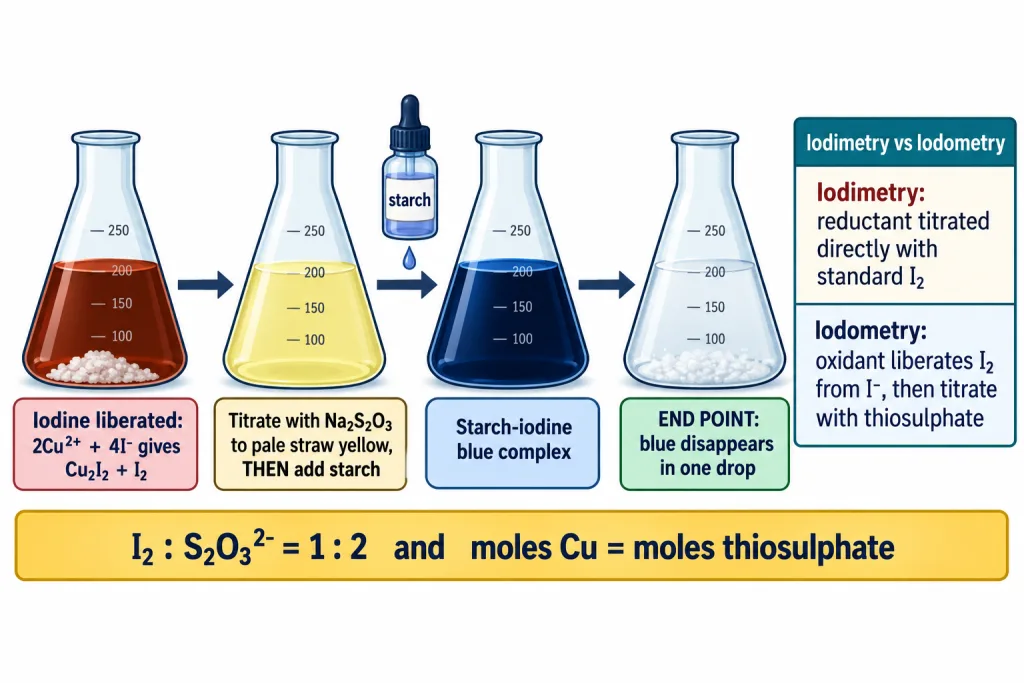
Starch, and when to add it
Iodine gives an intense blue colour with starch — a complex in which the iodine chain sits inside the helix of the amylose molecule. It shows at very low iodine concentration, which is what an end point needs.
Starch is added only near the end point, when the brown solution has faded to a pale straw yellow. Add it at the start, while iodine is still plentiful, and so much iodine is bound into the complex that it comes back out slowly; the blue then fades sluggishly and the reading is too high.
The end point is the disappearance of the blue colour, from deep blue to colourless in one drop — one of the sharpest end points in volumetric analysis.
Keep the solution only weakly acidic and titrate without delay, since iodide is slowly oxidised by air in acid, and keep the flask cool, since iodine is volatile.
[NEET] Iodimetry, direct, standard iodine in the burette. Iodometry, indirect, thiosulphate in the burette. The mole ratio belongs to iodine and thiosulphate in both cases.
Choosing the Method
| The problem says | Use | Ratio to write down |
|---|---|---|
| Oxalic acid, sodium oxalate, oxalate salt | warm acidified | |
| Ferrous sulphate, Mohr salt, iron ore | cold acidified | |
| Iron dissolved in hydrochloric acid | acidified , diphenylamine | |
| Copper in brass, bronze or an alloy | iodometry with , then thiosulphate | |
| Standardising thiosulphate | iodometry against | |
| Hydrogen peroxide strength | acidified , or iodometry |
The recipe for every calculation here:
- Write the balanced ionic equation, or at least the two n-factors.
- Convert the known reagent into moles: molarity times volume in litres, or mass over molar mass.
- Multiply by the mole ratio to get moles of the unknown.
- Scale for any dilution or aliquot.
- Convert to what was asked — molarity, strength in , percentage purity or volume strength.
Never skip step 4. An aliquot taken from a made-up volume is where most marks are lost.
Worked Questions
Question 1: Standardising permanganate against oxalic acid, both ways
of pure was dissolved and made up to . A portion, acidified with dilute sulphuric acid and warmed, required of solution. Find the molarity, the normality and the strength of the permanganate.
Answer:
First the oxalic acid. Its molar mass is , so I have in , which is .
Mole-ratio route. In the portion there are of oxalate. The ratio is , so
That sits in , so the molarity is , and the normality is .
Normality route. Oxalic acid has , so it is . Then gives , so , and the molarity is .
The two routes agree exactly, as they must. Strength is .
Ans: , , . Watch out: The is the dihydrate. Using for the anhydrous acid on crystals labelled inflates the answer by a factor of .
Question 2: Standardising against sodium oxalate
of pure was dissolved in dilute sulphuric acid, warmed and titrated; it needed of . Find the molarity and strength of the permanganate.
Answer:
Sodium oxalate has molar mass , so of oxalate, all of it in the flask with no aliquot to correct for.
Molarity is , so and .
Ans: , , . Watch out: Sodium oxalate is anhydrous. There is no water of crystallisation to add.
Question 3: Preparing a permanganate solution and predicting the burette reading
What mass of gives of a solution, and what volume of that solution will react with of oxalic acid in warm dilute sulphuric acid?
Answer:
Moles needed are , and .
Oxalate in the flask is . Permanganate required is , and
Ans: ; .
Question 4: Purity of an oxalic acid sample
of impure oxalic acid crystals was dissolved and made up to . A portion required of . Find the percentage purity, assuming the impurity is inert.
Answer:
Permanganate used is . Oxalate is times that, in the portion.
The portion is one fifth of the , so the whole solution holds . As the dihydrate that is .
Ans: . Watch out: Multiplying the aliquot up to the full volume is step four of the recipe. Skipping it here would give .
Question 5: Percentage purity of a Mohr salt sample
of impure Mohr salt was dissolved in dilute sulphuric acid and made up to . of this required of . Find the percentage purity.
Answer:
Permanganate is . The ratio gives in the portion.
The portion is one tenth of , so the whole sample holds of , and therefore of Mohr salt, since each formula unit carries one iron.
Ans: . Watch out: The equivalent mass of Mohr salt is , not or . Only the iron is oxidised, one electron per formula unit.
Question 6: Iron in an ore
of an iron ore was dissolved, all the iron reduced to iron(II), and the solution titrated with of in dilute sulphuric acid. Find the percentage of iron and the percentage of in the ore.
Answer:
Permanganate is , so iron(II) is five times that, .
Mass of iron is , which in of ore is .
For the oxide, two irons make one , so there are of it. With a molar mass of that is , or .
Ans: Fe; .
Question 7: The cost of using the wrong acid
The ore of Question 6 was analysed again by a student who acidified with hydrochloric acid instead of sulphuric. His burette reading was of the same . What iron percentage would he report, and by how much is he wrong?
Answer:
Working the numbers exactly as before: of permanganate, so of iron(II), which is , or .
The true value is , so he is percentage points high, a relative error of .
The extra went on oxidising chloride to chlorine, not iron. Permanganate at is above the chlorine couple at , so the side reaction is spontaneous.
Ans: he reports , which is too high in relative terms. Watch out: The chloride error is always high, never low. Nitric acid is the one that gives a low result, because it oxidises the reductant before you do.
Question 8: Dichromate against ferrous sulphate, both ways
of a ferrous sulphate solution required of in acid. Find the molarity and the strength of the ferrous sulphate solution.
Answer:
Mole-ratio route. Dichromate used is . The ratio is , so , and
Normality route. Dichromate has , so it is . Then , giving . Iron(II) has , so the molarity is also . Same answer.
Strength is .
Ans: , .
Question 9: Making up a primary standard
What mass of is needed for of a solution for use in acid? Why can this be weighed out directly, when cannot?
Answer:
In acid the n-factor is , so the equivalent mass is .
Number of equivalents wanted is , and
Checking by moles: , so , and .
Dichromate can be weighed directly because it is a primary standard — obtainable pure, stable in air, non-hygroscopic and stable in solution. Permanganate cannot, because commercial crystals contain and its solutions decompose slowly.
Ans: .
Question 10: Standardising thiosulphate iodometrically
of was dissolved, acidified and treated with excess . The liberated iodine needed of sodium thiosulphate solution. Find its molarity.
Answer:
The liberation step is
Charge on the left is , and on the right.
Dichromate taken is , which liberates three times as much iodine, . Each iodine takes two thiosulphates:
By equivalents instead: equivalents of dichromate, so equivalents of thiosulphate, and with that is and . Same number.
Ans: . Watch out: The chain is worth memorising: one dichromate, three iodines, six thiosulphates.
Question 11: Copper in brass
of brass was dissolved, the solution neutralised and treated with excess . The iodine set free required of sodium thiosulphate. Find the percentage of copper.
Answer:
Thiosulphate used is . Iodine is half of that, , from
Each iodine came from two coppers, so — the same number as the thiosulphate, which is the shortcut.
Ans: copper. Watch out: The two ratios cancel. Halving for iodine and then forgetting to double for copper gives , exactly half the right answer.
Question 12: An iodimetric titration
of a sodium thiosulphate solution required of iodine solution. Find the molarity of the thiosulphate and its strength as . Is this iodometry or iodimetry?
Answer:
Iodine used is , and each takes two thiosulphates, so of thiosulphate in .
Strength as the pentahydrate is .
Standard iodine is being run into a reductant directly, with no oxidant liberating it first, so this is iodimetry.
Ans: , ; iodimetry.
Question 13: Hydrogen peroxide, in volumes and in normality
of a hydrogen peroxide solution was diluted to . of the diluted solution required of in dilute sulphuric acid. Find the normality, the molarity, the strength in and the volume strength of the original solution.
Answer:
The reaction is
Here peroxide is the reductant and its n-factor is .
For the diluted solution, , so . The dilution was ten-fold, so the original is .
Molarity is . Strength is , which is also normality times the equivalent mass, .
For volume strength, means one litre of a solution holds of peroxide and yields of oxygen, which is at STP. So the label reads " volume". The standard shortcut is
Ans: , , , volume. Watch out: Volume strength is normality and molarity. Mixing the two constants is the standard slip.
Question 14: When the medium changes the n-factor
A bottle is labelled . (a) Give its normality in acidic, in neutral and in strongly alkaline medium. (b) What volume of it oxidises of in acid? (c) What volume would deliver the same number of equivalents in neutral medium?
Answer:
(a) Normality is molarity times n-factor. In acid , so . In neutral or weakly basic solution , so . In strongly alkaline solution , so . The molarity is in every case.
(b) Iron(II) is , and with that is equivalents. Permanganate needed is , so
(c) The same equivalents now need , so .
Ans: (a) , , ; (b) ; (c) . Watch out: The same bottle, three normalities. Anyone who treats normality as a fixed property of the solution loses this question.
Mistakes That Cost Marks
Treating normality as a property of the bottle. A permanganate solution is , or depending on the medium. Read the medium first.
Dividing Mohr salt by six. Its n-factor is , so the equivalent mass is . Only the iron is oxidised, and it loses one electron.
Using for oxalic acid dihydrate. The crystals are at . The anhydrous belongs to a different solid.
Forgetting the aliquot factor. A portion of a solution carries one tenth of the sample. Multiply back before quoting a purity.
Adding starch at the start of an iodometric titration. High iodine binds hard inside the starch helix and releases slowly, so the blue fades late and the reading is high. Wait for pale straw yellow.
Saying the iodometric end point is the appearance of blue. In iodometry the blue disappears. Blue appearing belongs to an iodimetric titration, where iodine is the titrant.
Warming a permanganate-iron(II) titration. Only the oxalate titration is warmed. Iron(II) is titrated cold, because warm iron(II) is oxidised by air.
Assuming the chloride error runs low. It runs high: permanganate is consumed by chloride as well as by the reductant, so the burette reading rises. Nitric acid is the one that gives a low result.
Calling a primary standard. It is a secondary standard, and must be standardised against oxalic acid or sodium oxalate. Dichromate is the primary standard.
Expecting dichromate to be self-indicating. The green chromium(III) masks any change. Diphenylamine is the indicator.
Losing the ratio. Two permanganates to five oxalates, but one permanganate to five iron(II). The oxalate ion carries two electrons, iron(II) only one.
Quick Revision
- Why it works: a large potential difference makes the reaction complete, a fixed medium makes the stoichiometry single, and a coloured reagent or an indicator makes the end point visible.
- n-factor: electrons gained or lost per formula unit in that reaction. Equivalent mass molar mass n-factor. Normality molarity n-factor. , or .
- Permanganate n-factors: in acid (equivalent mass ), in neutral or weakly basic (equivalent mass ), in strong alkali (equivalent mass ).
- Permanganate against oxalate: , ratio , warmed to about .
- Permanganate against iron(II): , ratio , run cold.
- Acid: dilute sulphuric only. Hydrochloric gives a high result because chloride is oxidised; nitric gives a low result because it oxidises the reductant itself.
- Self-indicating: the first permanent pale pink tinge is the end point; permanganate goes in the burette and the upper meniscus is read.
- is a secondary standard, standardised against oxalic acid dihydrate (equivalent mass ) or sodium oxalate.
- Dichromate: , ratio , , equivalent mass .
- is a primary standard — pure, stable, non-hygroscopic — but not self-indicating; use diphenylamine. It works with hydrochloric acid, because is below the chlorine couple at .
- Iodimetry: direct titration of a reductant against standard iodine. Iodometry: an oxidant liberates iodine from iodide, and that iodine is titrated with thiosulphate.
- Copper: , then . Ratio ; moles of copper equal moles of thiosulphate.
- Starch goes in only near the end point at pale straw yellow; the end point is the blue vanishing in one drop.
- Standardising thiosulphate: dichromate, iodine and thiosulphate in the ratio .
- Hydrogen peroxide: either way, equivalent mass ; volume strength normality molarity. An volume solution is , and .