
What balancing a redox equation actually means
A skeletal equation carries the correct formulae of the reactants and products and nothing else. Balancing it means forcing three quantities to agree on the two sides: the atoms of every element, the total electrical charge, and — underneath both — the electrons handed from the reducing agent to the oxidising agent.
Two methods do this. The oxidation number method tracks the rise and fall of oxidation numbers and never writes an electron on the page. The half-reaction (ion-electron) method splits the change into two halves and cancels the electrons at the end. This section covers the first, the next section the second, and both give the same answer.
The oxidation number method is usually quicker on a molecular equation — one written with whole compounds such as and — because it never forces you to invent ionic fragments. It rests on one arithmetic identity.
Key Point: Total increase in oxidation number = total decrease in oxidation number. Electrons are neither created nor destroyed in a chemical change, so every unit of oxidation number gained by one atom must be paid for by a unit lost by another.
That identity fixes the coefficients of the two species that change. Everything after it is book-keeping: spectator atoms, then oxygen, then hydrogen, then the charge check. That last check is not decoration. An equation can have every atom accounted for and still be wrong because the count is off, and charge is the only thing that catches it.
The procedure, step by step
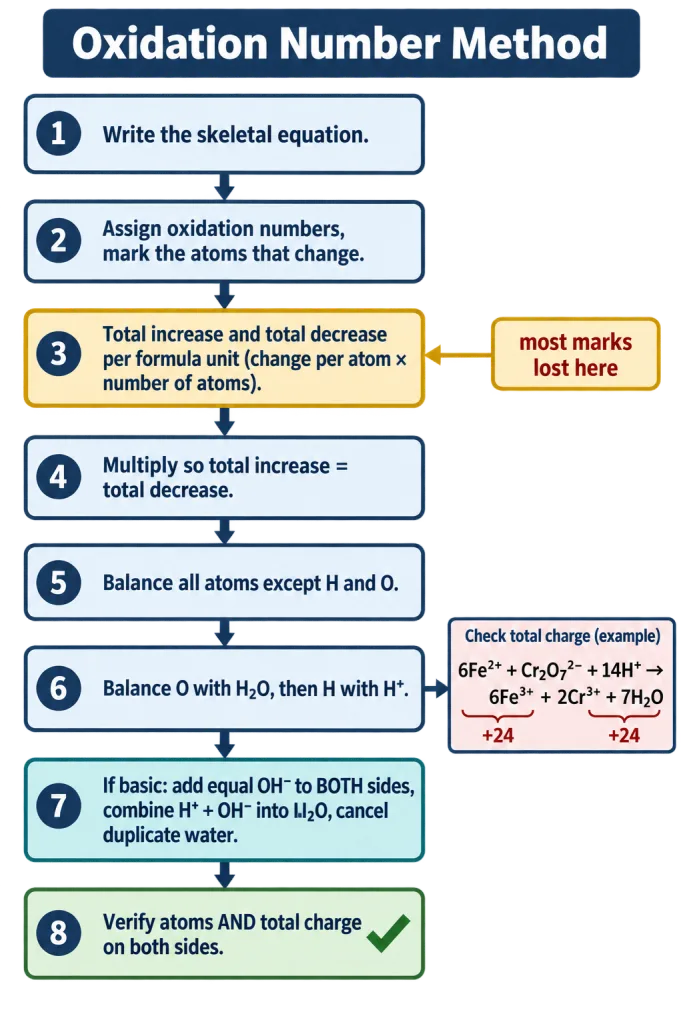
Work these steps in order every time. Balancing hydrogen before oxygen, or spectator atoms after adding water, produces a mess you then have to unpick.
Step 1 — Write the skeletal equation. Every reactant and product, with correct formulae. If a formula is wrong, no amount of balancing will save the equation.
Step 2 — Assign oxidation numbers to every atom and mark the ones that change. One element should be going up and one going down (in a disproportionation, the same element does both). If nothing changes, the reaction is not redox; if two things go down and nothing goes up, a formula is wrong.
Step 3 — Compute the total increase and the total decrease per formula unit. Change per atom, multiplied by the number of atoms of that element in the formula unit. This multiplication is where most marks are lost.
Step 4 — Equalise them. Multiply the oxidised and reduced species by whatever whole numbers make total increase equal to total decrease. The lowest common multiple of the two totals gives the smallest coefficients.
Step 5 — Balance every other atom except H and O. Metals, halides, sulphur in a spectator sulphate, and so on.
Step 6 — Balance oxygen with , then hydrogen with (acidic medium). Oxygen first, always: water carries hydrogen with it, so fixing hydrogen first means redoing it.
Step 7 — Convert to basic medium if the question says basic. Add as many ions to both sides as there are ions, combine each pair into one , then cancel water that now appears on both sides.
Step 8 — Verify. Count every element on both sides, then add up the charges on both sides. Both must match.
Key Point (Definition): A balanced redox equation conserves atoms and charge at the same time. Conservation of charge is the visible signature of conservation of electrons, which is why an atom-balanced but charge-unbalanced equation is wrong.
Step 3 in detail, because this is where marks go
Take dichromate reduced to chromium(III):
Each chromium falls from to , a change of per atom, and there are two chromium atoms in the ion. The total decrease per dichromate ion is , not .
Take oxalate oxidised to carbon dioxide:
Each carbon rises from to , a change of per atom, over two carbons. The total increase per oxalate ion is , not .
The rule is short: change per atom number of atoms in the formula unit. Write that product down rather than doing it in your head.
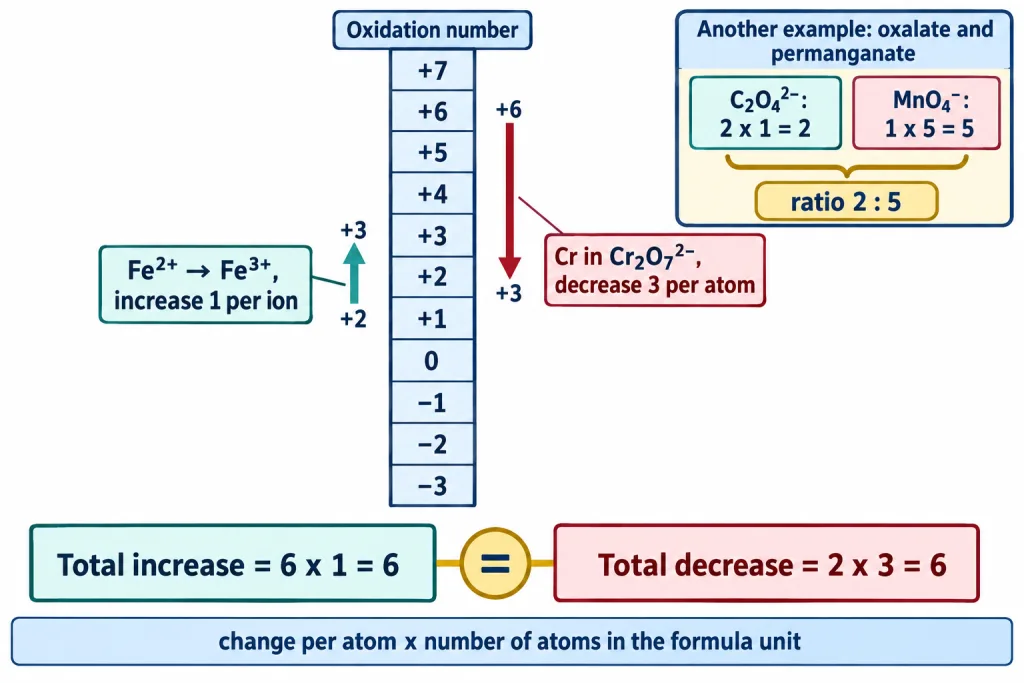
Once the two totals are in front of you the ratio follows. Iron gives per and dichromate takes , so six meet one . Permanganate takes and oxalate gives , whose lowest common multiple is , so two meet five — the ratio behind every permanganate titration.
[JEE Main] Coefficient questions are almost always testing this one multiplication. If a question asks for the coefficient of or , get the two totals right first; the rest is arithmetic that cannot go wrong.
Question 1: Iron(II) oxidised by dichromate in acid
Balance in acidic medium.
Answer:
First I put oxidation numbers on the atoms that matter. Iron goes ; chromium goes .
Increase: per . Decrease: per Cr atom, and two Cr atoms per ion, so per .
The smallest whole numbers making are , . Six iron ions per dichromate ion:
Fe and Cr are now balanced. Oxygen: seven on the left, none on the right, so seven waters on the right.
Fourteen hydrogens have appeared on the right, so I add fourteen on the left.
Atom check: Fe , Cr , O , H . Charge check: left . Right . Equal.
Ans: Watch out: Taking the decrease as instead of gives a ratio, and then the charges refuse to match no matter how you juggle the water.
Question 2: Permanganate and sulphite in acid
Balance in acidic medium.
Answer:
Manganese: , one Mn per ion, so the decrease is . Sulphur: , an increase of per ion.
The lowest common multiple of and is , so two permanganate ions and five sulphite ions.
Mn and S are already balanced. Oxygen: left , right , so three waters on the right.
Six hydrogens on the right, so six on the left.
Atom check: Mn , S , O , H . Charge check: left . Right . Equal.
Ans: Watch out: The coefficient here is , not . Sixteen is what the permanganate half reaction alone needs; the sulphite half reaction releases ten that cancel against it.
Question 3: Copper with dilute nitric acid
Balance .
Answer:
Copper starts as the free element, , and ends as in . Increase per Cu.
Nitrogen in is ; in NO it is , a decrease of per N. The nitrogen inside is still , so only the nitrogen that becomes NO counts in the arithmetic. This is the trap in every nitric acid balancing question.
Lowest common multiple of and is : three Cu atoms oxidised, two N atoms reduced.
Now count nitrogen on the right: inside the nitrate, plus in NO, giving . So eight on the left.
Eight hydrogens on the left means four waters on the right.
Atom check: Cu , N , H , O left , right . Charge check: both sides are made of neutral species, so the charge is . Writing it in net ionic form, , the left carries and the right carries . Equal.
Ans: Watch out: Six of the eight nitric acid molecules are behaving as an acid, not as an oxidant. Only two are reduced. Counting all eight as reduced gives a decrease of and a hopeless equation.
Question 4: Copper with concentrated nitric acid
Balance , and say why the product differs from the dilute case.
Answer:
Copper again rises , an increase of . Nitrogen now falls only from to in , a decrease of per N. To match an increase of I need two nitrogens reduced per copper atom.
Nitrogen on the right: in the nitrate plus in , giving . So four on the left, and four hydrogens means two waters.
Atom check: Cu , N , H , O left , right . Charge check: neutral on both sides. As a net ionic equation, gives left and right . Equal.
Concentrated acid supplies nitrate in such excess that the reduction stops one step earlier, at ; dilute acid carries it further, to NO. The reducing agent is the same copper, and the depth of reduction is set by the concentration.
Ans: ; the product is rather than NO because concentrated acid supplies nitrate in such excess that the reduction stops one step earlier. Watch out: Compare acid per copper, never the bare coefficients. The eight in the dilute equation is shared among three copper atoms, which is each, while the four here sits on a single copper, which is . Setting against without first dividing by the copper coefficient reverses the conclusion.
The same oxidant, three different products
A balanced equation is only correct for the medium it was written for. Permanganate is the standard illustration, and all three of its fates appear in exam papers.
| Medium | Half change | Mn goes | Electrons per Mn | Colour of product |
|---|---|---|---|---|
| Acidic | almost colourless | |||
| Neutral or weakly basic | brown solid | |||
| Strongly alkaline | green solution |
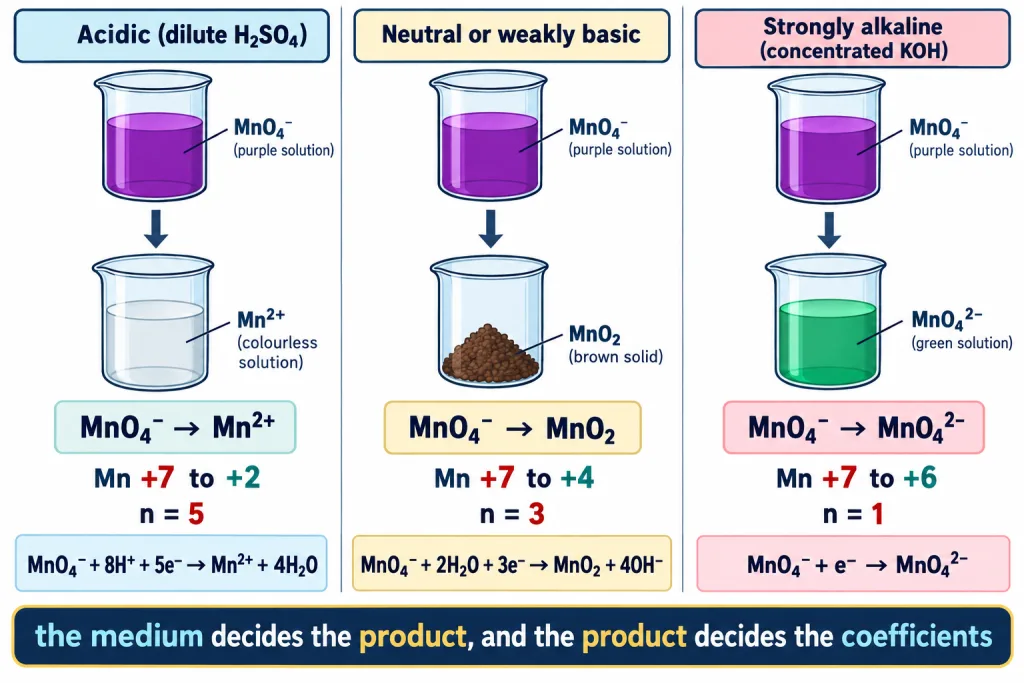
Written out as half changes with the medium's own species:
Check the middle one for charge: left , right . It balances, and it contains no , which is what a basic-medium equation must look like.
These electron counts are the n-factors of : in acid, in neutral or weakly basic solution, in strong alkali. With a molar mass of the equivalent masses are , and .
Key Point: A redox equation is not a property of the reactants alone. Change the medium and the products change, so the coefficients change. Read the words "in acidic medium" or "in alkaline medium" before you write anything.
[NEET] Question stems often hide the medium in a single word — "acidified", "in the presence of ", "neutral". That word decides the answer.
Question 5: The permanganate-oxalate reaction
Balance in acidic medium.
Answer:
Carbon in oxalate is ; in it is . That is per carbon over two carbons, so the increase is per oxalate ion. Manganese falls , a decrease of .
Lowest common multiple of and is : five oxalate ions and two permanganate ions.
Carbon is balanced at . Oxygen: left , right , so eight waters on the right.
Sixteen hydrogens on the right, so sixteen on the left.
Atom check: Mn , C , O , H . Charge check: left . Right . Equal.
Ans: , mole ratio . Watch out: Using as the oxalate increase instead of gives a ratio and destroys the titration arithmetic that depends on .
Question 6: Dichromate and sulphur dioxide
Balance in acidic medium.
Answer:
Chromium falls over two atoms, so the decrease is per dichromate ion. Sulphur rises , an increase of per .
To match I need three .
Cr is , S is . Oxygen: left , right . One water on the right.
Two hydrogens on the right, so two on the left.
Atom check: Cr , S , O , H . Charge check: left . Right . Equal.
Ans: Watch out: The coefficient is only , not . Fourteen belongs to the dichromate half reaction on its own; here the sulphur dioxide brings six oxygens of its own, so far less water — and therefore far less acid — is needed.
Basic medium: balance as if acidic, then neutralise
There is no separate procedure to learn for alkaline solution. Balance exactly as you would in acid, ending with some number of ions on one side, then convert.
The conversion, in three moves. Suppose you finish with hydrogen ions on the left.
- Add hydroxide ions to both sides. Adding the same thing to both sides changes nothing chemically, which is why this is legal.
- On the left, every now sits next to an . Combine each pair into one , giving waters on the left.
- Water may now appear on both sides. Cancel the smaller number from both, leaving water on one side only.
The right side keeps its hydroxide ions, and the finished equation contains no at all.
Key Point: A basic-medium answer must not contain , and an acidic-medium answer must not contain . If either appears, the neutralisation step was skipped or done on one side only.
The commonest error. Adding the hydroxide to one side only is not an identity operation — it shifts the charge on that side by and quietly breaks the equation. The charge check catches it immediately, which is the whole reason for doing the charge check.
[Board] Marks are given for the neutralisation step being shown, not just for the final equation. Write the intermediate line with and both visible before you collapse them into water.
Question 7: Permanganate and iodide in basic medium
Permanganate ion oxidises iodide ion in basic solution to iodine, while manganese ends up as . Balance the equation.
Answer:
Skeleton: .
Manganese: , a decrease of . Iodine: , an increase of per atom, and holds two of them, so per produced.
Lowest common multiple of and is . Two permanganate ions take six units; six iodide ions supply them and give three .
Now I pretend the medium is acidic. Oxygen: left , right , so four waters on the right and then eight on the left.
Charge here: left , right . The acidic version is sound, so the conversion will be sound too.
The medium is basic, so I add eight to both sides and collapse the eight pairs on the left into eight waters:
Water appears on both sides. Cancelling four from each:
Atom check: Mn , I , O left , right , H left , right . Charge check: left . Right . Equal.
Ans: Watch out: Forgetting that carries two iodine atoms makes the increase instead of , and the iodide coefficient comes out as rather than .
Question 8: Permanganate and bromide in basic medium
Permanganate ion reacts with bromide ion in basic medium to give manganese dioxide and bromate ion. Balance it.
Answer:
Skeleton: .
Manganese: , decrease . Bromine: , increase . To match I need two manganese atoms:
Balancing as if acidic: oxygen left , right , so one water on the right and two on the left.
Charge: left , right . Sound.
Adding two to both sides and collapsing the pair on the left gives two waters on the left and one on the right; cancelling one from each side:
Atom check: Mn , Br , O left , right , H left , right . Charge check: left . Right . Equal.
Ans: Watch out: Bromide going to bromate is a six-electron change, the largest common one in this chapter. Treating it as a one-electron or five-electron change is the usual slip.
When the same element is oxidised and reduced
In a disproportionation one element leaves the reactant in two directions at once — some atoms go up, some go down. The method still works, with one adjustment: increase and decrease are both computed for the same starting species, and the ratio you extract is the ratio of the two products, not of two reactants.
The procedure:
- Identify the intermediate oxidation state and the two products it splits into.
- Compute the rise per atom to the higher product and the fall per atom to the lower product.
- Equalise: if the fall is and the rise is , then for every one atom that falls, atoms must rise. Convert to whole numbers.
- Only then fix the coefficient of the reactant, so that its atom count covers both products.
- Finish with the usual oxygen, hydrogen and charge balancing.
Step 4 is the one that trips people up. In the coefficient is decided only after you know how many phosphorus atoms end up in each product, because all four come out of the same molecule.
Key Point: Disproportionation needs an element in an intermediate oxidation state — one with a higher state and a lower state both available. Fluorine has no positive oxidation state, so fluorine never disproportionates.
The standard cases worth recognising on sight:
- , oxygen at going to and to .
- in cold dilute alkali.
- in hot concentrated alkali.
- in aqueous solution.
- , manganese at splitting to and .
Question 9: White phosphorus in hot alkali
Balance in basic medium.
Answer:
Phosphorus in is a free element, so it is . In hydrogen is , so phosphorus is . In the two hydrogens are each and the two oxygens each, so gives . The same element goes both ways, which makes this a disproportionation.
Fall: , a decrease of per P atom going to . Rise: , an increase of per P atom going to .
For every one atom that falls by , three atoms must rise by , so the product ratio is .
Phosphorus check: the right side has atoms and the left has exactly four in one , so the coefficient of is — a lucky fit here, but always worth checking.
Oxygen next. The right has oxygens; the left has only what the hydroxide supplies. Charge fixes the hydroxide count: the right carries , so the left needs three .
Three hydroxides bring three oxygens, and six are needed, so I add three waters on the left.
Atom check: P ; O left , right ; H left , right . Charge check: left . Right . Equal.
Ans: Watch out: The two half changes here start from the same species, so you cannot look for "the oxidant" and "the reductant" as different reactants. is both. Hydroxide is neither — its oxidation numbers do not change.
Question 10: Dichromate and sulphite in acid
Write the net ionic equation for the reaction of potassium dichromate(VI) with sodium sulphite in acid solution, giving chromium(III) ion and sulphate ion.
Answer:
Potassium and sodium are spectators, so I drop them and keep the ions that react: .
Chromium is in dichromate and in the product, a fall of per atom over two atoms, total . Sulphur is in sulphite and in sulphate, a rise of . Dichromate is the oxidant, sulphite the reductant, and matching a decrease of needs three sulphite ions.
The charges are on the left and on the right. The medium is acidic, so I add eight on the left to close the gap.
Eight hydrogens on the left must reappear as four waters on the right.
Atom check: Cr , S , O left , right , H . Charge check: left . Right . Equal.
Ans: Watch out: This version uses the charge gap to fix the count and water afterwards, rather than oxygen first. Both routes give the same equation; pick one and stay with it so you do not add hydrogen twice.
Question 11: Permanganate with hydrochloric acid
Balance , and say what this tells you about running a permanganate titration.
Answer:
Manganese is in and in , a fall of . Chlorine rises from to , a rise of per atom.
I take two permanganates so that whole molecules come out: a total fall of , matched by ten chlorine atoms oxidised, which is five .
Chlorine on the right: in KCl, in , in , total . So sixteen HCl, and sixteen hydrogens give eight waters.
Atom check: K , Mn , O , H , Cl . Charge check: all species neutral, .
Since permanganate oxidises chloride, hydrochloric acid can never acidify a permanganate titration — permanganate would be spent on the acid instead of on the substance being estimated, and the titre would read high. Dilute sulphuric acid is used instead, nitric acid being an oxidant itself.
Ans: ; the acid for a permanganate titration must be dilute sulphuric acid. Watch out: Ten chlorine atoms are oxidised but only five molecules appear. Writing is the standard slip.
Question 12: Permanganate and hydrogen peroxide in acid
Balance in acidic medium.
Answer:
Manganese falls , a decrease of .
Oxygen in is , the peroxide value, not ; in it is . That is a rise of per oxygen atom over two atoms, so the increase is per , which is acting as the reducing agent.
Lowest common multiple of and is : two permanganate and five peroxide.
Oxygen: left , right , so eight waters on the right.
Hydrogen: right has , left has , so six on the left.
Atom check: Mn , O left , right , H left , right . Charge check: left . Right . Equal.
Ans: Watch out: Taking oxygen in as makes the peroxide look unchanged and the equation unbalanceable. Hydrogen peroxide acts either way — as a reductant it goes to , as an oxidant to — with an n-factor of in both roles.
The verification habit
Every equation in this section ended with two counts. Make that automatic.
Atom count. Go element by element, left then right, and write each pair down. Doing it in your head is how a stray water molecule survives to the end of a paper.
Charge count. Multiply each species' charge by its coefficient and add. Neutral molecules contribute zero, so a molecular equation always gives . In a net ionic equation it is the check that matters:
Left: ; ; . Sum . Right: ; ; water contributes . Sum .
If the two sums differ by , the count is almost always wrong by , since is the only species added on charge grounds. That makes the check a diagnosis, not just a verdict.
| Symptom | Usual cause |
|---|---|
| Atoms balance, charge does not | wrong number of , or hydroxide added to one side only |
| Two species both reduced, none oxidised | a product formula is wrong |
| Coefficients come out fractional and will not clear | the per-atom change was not multiplied by the atom count |
| left in a basic-medium answer | neutralisation step skipped |
| Oxygen refuses to balance at the end | hydrogen was balanced before oxygen |
When to use which method. Use the oxidation number method for molecular equations, for anything carrying a large excess of spectator ions such as the nitric acid and hydrochloric acid problems above, and whenever the oxidation numbers are visible at a glance. Use the half-reaction method when the question asks for the number of electrons transferred, or when you want the two halves for an electrochemical cell. The next section develops that method in full.
[JEE/NEET] For a purely numerical answer — "the coefficient of water is" — the oxidation number method is faster, because it never asks you to write electrons that you will only cancel again.