
What a zinc strip actually does in copper sulphate
Rub a strip of zinc with sandpaper until it is bright and stand it in a beaker of blue copper sulphate solution. Leave it an hour. Three things have changed, and each can be seen or felt without an instrument.
The blue has faded. Copper sulphate is blue because of the hydrated ion, so as the colour drains away that ion is leaving the solution. Given long enough, the liquid goes colourless.
The strip is coated. A soft, spongy, red-brown layer has grown on the zinc, thickest near the bottom. Scrape it and it smears like metal, because it is metal — copper.
The beaker is warm. The reaction gives out heat, the first hint that the change is running strongly downhill rather than sitting near equilibrium.
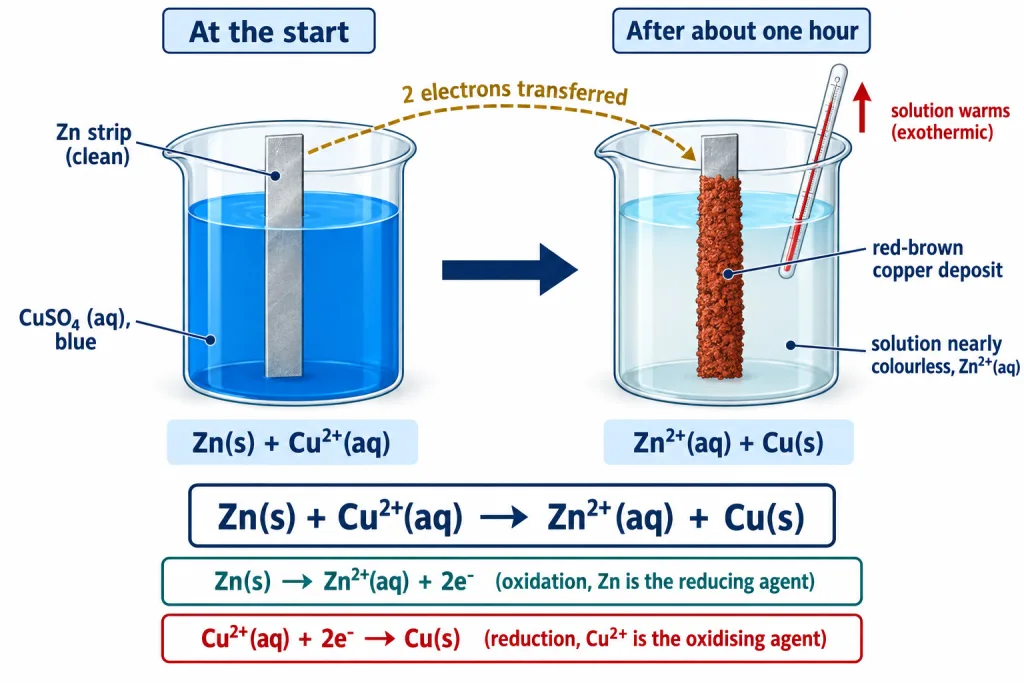
The change is:
Charge is on each side, so the equation balances for charge as well as atoms. Split it into halves — a half reaction being a bookkeeping device, not something that happens on its own:
Zinc has lost electrons, so zinc is oxidised and is the reducing agent. Copper ion has gained them, so it is reduced and is the oxidising agent. The species reduced is the oxidising agent — the commonest slip in this chapter is to say it the other way round.
A confirmatory test closes the case. Pass hydrogen sulphide through the decolourised solution and make it alkaline with ammonia: white zinc sulphide, , appears, so really is in solution. The matching test for the other ion gives black copper sulphide, , so insoluble that it detects minute traces of — which matters for the next experiment.
Key Point: In , zinc is oxidised (reducing agent) and is reduced (oxidising agent). The blue fading, the red-brown deposit and the warming are three separate pieces of evidence for the same electron transfer.
The experiment that refuses to happen
Run the same experiment backwards. Put a bright strip of copper into a colourless solution of zinc sulphate and leave it for an hour, or a day.
Nothing. The copper strip stays copper-coloured with no grey coating. The solution stays colourless — no blue develops, so no has been produced. The beaker stays at room temperature.
Now apply the sensitive test. Bubble through the solution. If even a trace of had formed, black would appear, since copper sulphide is so sparingly soluble that very little is needed to precipitate it. No black colour appears. The reverse change
does not go to any detectable extent.
This is a stronger statement than "the forward reaction happens". The two experiments together say that the equilibrium
lies so far to the right that the reactants are, for practical purposes, gone. Zinc hands over electrons far more readily than copper, and the gap is wide, not marginal.
Not every such competition is one-sided. Stand a strip of cobalt in nickel sulphate solution and the reaction
settles with both and present at moderate concentration. Neither side is strongly favoured, because cobalt and nickel are close together in electron-releasing tendency. A displacement reaction is a competition for electrons, and how far it goes depends on how far apart the two competitors are.
[Board] A common one-mark question asks why no reaction occurs when copper is placed in zinc sulphate. The answer is not "copper is unreactive" — copper simply releases electrons less readily than zinc, so cannot take them from copper.
Copper in silver nitrate — the same argument one step along
Coil a length of clean copper wire and hang it in colourless silver nitrate solution. Within minutes the changes start.
A blue colour appears and deepens over an hour. Blue means hydrated , so copper metal is going into solution as .
Glittering needles grow on the wire. Fine, feathery crystals of silver build outwards from the copper, sometimes as a dense grey fur, sometimes as a spray of shining spikes — the classic silver tree.
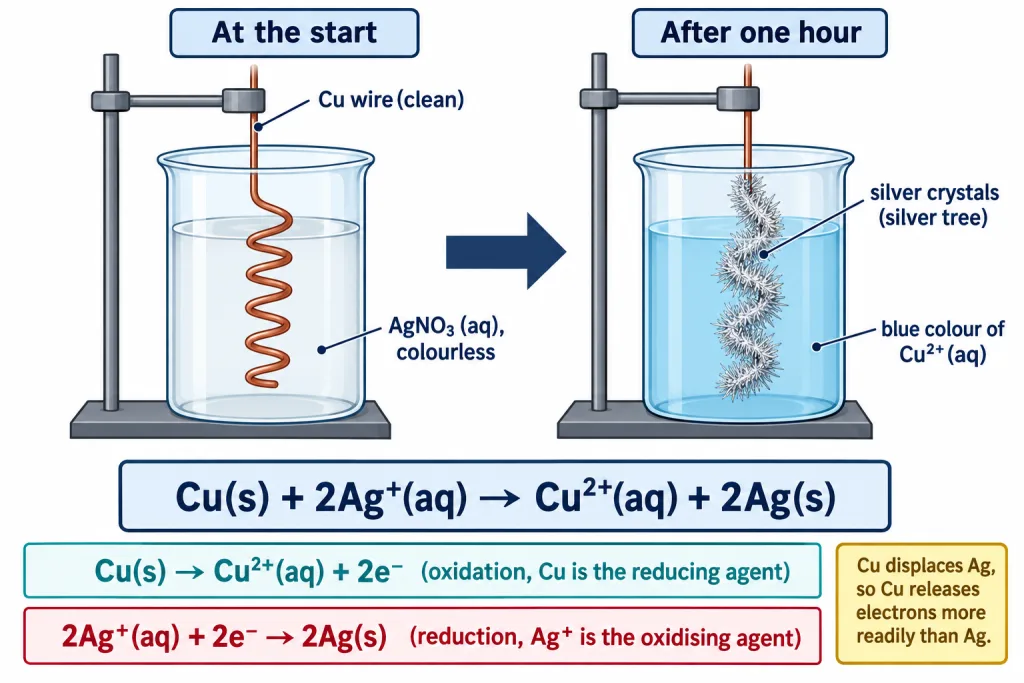
The reaction is:
Left-hand charge ; right-hand charge . Balanced for atoms and for charge. In halves:
Copper is oxidised, so copper is the reducing agent here. Silver ion is reduced, so is the oxidising agent. Equilibrium again lies heavily on the product side.
What matters is that copper has changed role. Against , zinc was the donor and copper metal was the product; against , copper metal is the donor. A metal is not "a reducing agent" in the abstract — it is a reducing agent relative to something else.
Key Point (Definition): A displacement reaction is one in which an ion or atom in a compound is replaced by an ion or atom of another element. In metal displacement, the more strongly electron-releasing metal goes into solution and the other is deposited.
Three experiments, one ranking
Line the three results up.
| Experiment | Result | What it proves |
|---|---|---|
| in | Blue fades, copper deposits, beaker warms | releases electrons more readily than |
| in | No change; test finds no | does not release electrons to |
| in | Blue appears, silver crystals grow | releases electrons more readily than |
The first two rows are a matched pair: one alone would only show a reaction is possible, and together they show it is possible in one direction only. The third row extends the chain downwards.
Reading them in order gives the electron-releasing tendency
and predicts, without any further experiment, that zinc will displace silver from silver nitrate. It does, vigorously, giving
This is the whole method in miniature. Each pairwise experiment gives one inequality; enough inequalities stacked together give an ordered list; the list then predicts every pair you have not tested. The competition for electrons among metals runs parallel to the competition for protons among acids, and is ranked the same way.
Force those electrons through a wire instead of letting them jump directly and the same competition becomes a galvanic cell. The zinc-copper reaction warms a beaker; split between two half cells it lights a bulb. Section 10 builds that apparatus.
Strong reducing agent, weak oxidising agent — do not invert this
This is the sentence students most often get backwards, so it is worth stating slowly and then from the other side.
A metal that gives up electrons easily is a strong reducing agent. Giving up electrons is being oxidised, so a strong reducing agent is a substance that is easily oxidised. Zinc is easily oxidised, so zinc is a strong reducing agent.
Once that metal has given up its electrons it becomes an ion, and that ion now has to be persuaded to take them back. By construction it does not want them — the metal parted with them readily because the ion is the comfortable state. An ion that accepts electrons reluctantly is a weak oxidising agent, so is a weak oxidising agent.
Run the argument the other way for a metal low in the series. Silver holds its electrons tightly, so it is a poor donor and a weak reducing agent. Its ion grabs electrons readily, so is a strong oxidising agent — which is why it strips electrons off copper metal.
Key Point: A metal high in the activity series is a strong reducing agent and its cation is a weak oxidising agent. A metal low in the series is a weak reducing agent and its cation is a strong oxidising agent. Strength of the metal and strength of its ion always run in opposite directions.
The same statement in four rows:
| Species | Position | Tendency | Role |
|---|---|---|---|
| , , , | High | Lose electrons very readily | Strong reducing agents |
| , , , | High | Accept electrons very reluctantly | Weak oxidising agents |
| , , | Low | Lose electrons reluctantly | Weak reducing agents |
| , , | Low | Accept electrons readily | Strong oxidising agents |
One consequence is exam material on its own. A metal at the top of the series is never found free in nature, because almost anything will oxidise it, while gold and silver at the bottom are found native.
[JEE/NEET] If a question gives you a metal and asks about its ion, flip the adjective. "Zinc is a strong reducing agent" and " is a strong oxidising agent" cannot both be true, and the second is false.
The activity series and the one rule for reading it
Repeat the pairwise experiments across the common metals and the inequalities assemble into one ordered list, the activity series (also called the reactivity series, and, with numbers attached, the electrochemical series):
Reactivity — the tendency to lose electrons and go into solution as a cation — decreases from left to right. Hydrogen is written in although it is not a metal, because it marks the line dividing metals that dissolve in ordinary acids from those that do not.
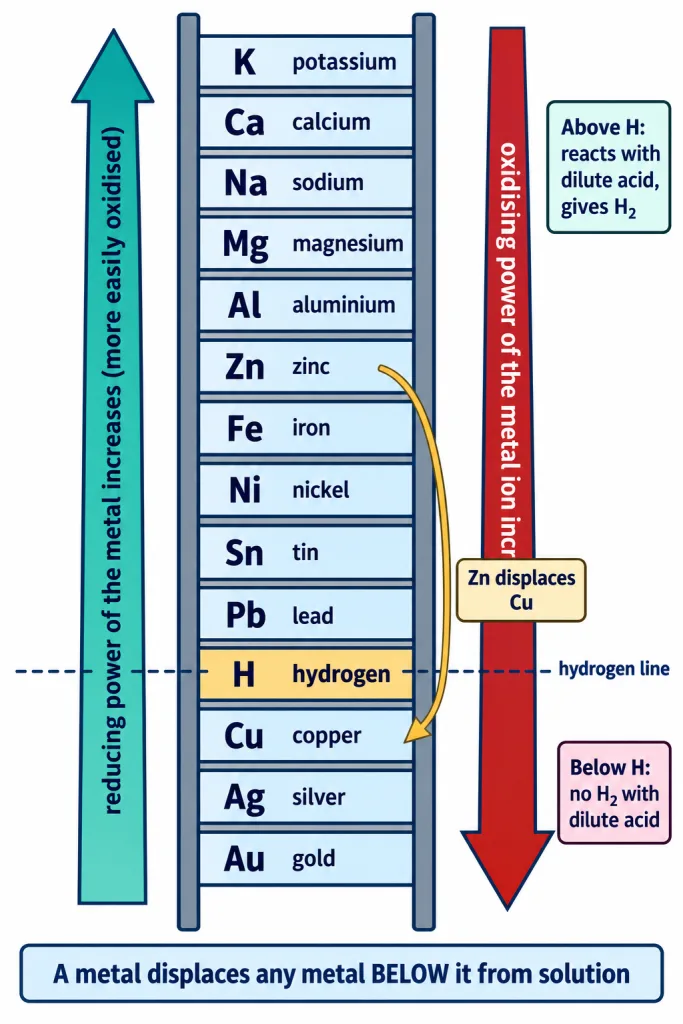
One rule does almost all the work.
Key Point: A metal displaces from solution any metal that lies below it in the series. It cannot displace a metal that lies above it.
Three cases:
- Iron in copper sulphate. is above , so goes: the blue fades and a copper coating appears, which is why a steel nail in copper sulphate turns copper-coloured.
- Copper in zinc sulphate. is below , so nothing happens.
- Silver in copper sulphate. is below , so nothing happens, and a silver spoon is safe in a copper salt solution.
The rule also runs in reverse. Since a metal high up displaces one lower down, the ions of the low metals are the ones discharged, so oxidising power of the cations increases along the list: is almost impossible to reduce in water, while and are reduced by almost anything.
A caution on the top of the list. Potassium, calcium and sodium attack the water itself before they can displace anything, so dropping potassium into copper sulphate solution does not demonstrate displacing . The series predicts thermodynamic tendency; whether a clean displacement can be shown also depends on whether a faster side reaction gets there first.
Hydrogen in the series, and why copper still dissolves in nitric acid
Hydrogen sits between lead and copper, and that single position settles a large family of questions.
Metals above hydrogen displace hydrogen from dilute acids. They release electrons readily enough to hand them to :
In ionic form all three are , charge on both sides. Rate tracks position in the series: magnesium fizzes hardest, zinc steadily, iron slowly. These are the standard laboratory preparation of dihydrogen.
The most reactive metals do not even need an acid. Sodium and calcium displace hydrogen from cold water, as in , while magnesium and iron need steam, as in .
Metals below hydrogen do not displace hydrogen from dilute acids. Copper, silver and gold are unattacked by dilute hydrochloric or dilute sulphuric acid however long you leave them, because is too weak an electron acceptor to take electrons from them.
Yet copper dissolves readily in hot concentrated nitric acid, giving a blue-green solution and brown fumes:
Atoms: , , and on each side. In ionic form,
with charge on the left and on the right.
Nothing there contradicts the position of copper. The oxidising species is not — it is the nitrate ion, in which nitrogen is at and falls to in . No hydrogen gas appears at any stage. Dilute nitric acid does the same job with a different nitrogen product:
Here nitrogen falls from to . Hot concentrated sulphuric acid attacks copper in the same way, being reduced to .
Key Point: "Copper is below hydrogen" forbids only one reaction — the displacement of from an acid by copper. It says nothing about oxidising anions such as , which attack copper through the nitrogen, never through .
[JEE Main] A question that offers hydrogen gas as a product of copper with nitric acid is testing exactly this confusion. Copper with any nitric acid gives an oxide of nitrogen, never .
Lithium at the top, and why caesium is not
Extend the series upward past potassium with electrode potential data and the metal on top in aqueous solution is lithium. This looks wrong at first sight and is a favourite assertion-reason item.
Group 1 ionisation enthalpy falls down the group: caesium loses its outer electron more easily than lithium, by a clear margin. In the gas phase caesium would be the better electron donor and lithium among the worst alkali metals.
But the reaction in a beaker is not . It is
and that overall change is the sum of three steps: sublimation of the metal, ionisation of the gaseous atom, and hydration of the gaseous ion. The third step is where lithium wins. is a very small cation of high charge density, so it binds water extremely tightly and its hydration enthalpy is far more negative than that of any other alkali metal ion. is large and diffuse and is hydrated only weakly.
The very large hydration enthalpy of more than pays back lithium's higher ionisation enthalpy, so the overall tendency to go from solid metal to hydrated ion is greatest for lithium.
Key Point: Lithium is the strongest reducing agent in aqueous solution because of its very large hydration enthalpy, even though caesium has the lower ionisation enthalpy. Ionisation enthalpy alone decides the gas-phase order; in water, hydration enthalpy decides the outcome.
Two guards against misreading this. First, "strongest reducing agent in aqueous solution" is a thermodynamic statement, not one about how violently the metal behaves — caesium reacts with water far more vigorously because it reacts faster, and speed is kinetics, not tendency. Second, this is why has a standard reduction potential of , more negative than for , even though potassium heads the school activity series.
The halogens, ranked the same way
Metals compete to lose electrons; non-metals compete to gain them, and the halogens give the cleanest example. Run the analogous displacement experiments with halogens and halide ions and the same kind of ordered list appears.
Add chlorine water to potassium bromide solution, shake with a little carbon tetrachloride or chloroform, and the organic layer turns orange-brown. Bromine has been set free:
Charge is on each side. Repeat with potassium iodide and the organic layer turns violet, because iodine has been set free:
These two reactions are the basis of the layer test used to identify and : the colour of the lower organic layer names the halogen released.
Bromine does only half of what chlorine does. It displaces iodide,
but adding bromine to a chloride solution produces no chlorine. Iodine displaces neither.
Fluorine displaces all three, and is too strong to demonstrate in water at all: it oxidises water itself, liberating oxygen.
Oxygen rises from in water to in , so water is the reducing agent. This is why fluorine displacements are not carried out in aqueous solution.
Stacking those results gives the oxidising power order
and, running the argument backwards as for the metals, the halide reducing power in the opposite order
The parallel with the metals is exact. A halogen high in its list is a strong oxidising agent and its anion is a weak reducing agent. Fluorine is the strongest oxidising agent among the halogens; is the strongest reducing agent among the halide ions. is so unwilling to give its electron back that no ordinary chemical oxidant converts it to , so fluorine is made by electrolysis, while , and can be oxidised chemically. Every industrial recovery of a halogen from its halide is the oxidation
[NEET] Memorise these as a pair: fluorine is the best oxidant among the halogens; iodide is the best reductant among the halide ions.
From an order to a number
The activity series is an ordering. It says zinc beats copper and copper beats silver, but not by how much.
Section 10 replaces the ordering with a measurement. Each metal-ion couple is set up as a half cell against a standard hydrogen electrode whose potential is fixed at exactly by definition, and the voltage is read off. That voltage, for the reduction half reaction under standard conditions at , is the standard electrode potential, .
Three values are worth carrying forward now, because they are the three metals of this section:
| Reduction half reaction | / V |
|---|---|
The order is the activity series order written with numbers. A more negative means the metal loses electrons more readily and is the stronger reducing agent; a more positive means the ion accepts electrons more readily and is the stronger oxidising agent.
Combining two values as
with both as reduction potentials gives a number whose sign predicts the reaction. For zinc displacing copper,
Positive, so the reaction is spontaneous — the beaker experiment agrees. For copper displacing silver,
Positive again. For copper attempting to displace zinc, the arithmetic gives , negative, so it does not go. Zinc against silver ion gives , the largest of the three.
One warning to carry into Section 10. is intensive: doubling a half reaction to make the electrons cancel does not double it. still has , not , so for copper and silver stays .
Question 1: Reading the zinc-copper beaker
A bright zinc strip is left in blue copper sulphate solution for one hour. List what you would see, and identify the oxidising and reducing agents.
Answer:
I list the three observations first. The blue colour of the solution fades because is being removed. A red-brown spongy deposit builds on the zinc strip, which is copper metal. The beaker feels warm, so the change is exothermic.
Now the chemistry. The equation is . Zinc goes from to , so it loses electrons and is oxidised, making zinc the reducing agent. Copper goes from to , so gains electrons and is reduced, making the oxidising agent.
Ans: Blue fades, red-brown copper deposits, solution warms; is the reducing agent, is the oxidising agent. Watch out: The species reduced is the oxidising agent. Calling zinc the oxidising agent because "it causes the change" is the standard error.
Question 2: Predicting a pair not yet tested
From , predict what happens when a zinc strip is placed in silver nitrate solution, and write the equation.
Answer:
Zinc is above silver, so zinc displaces silver. I expect grey-white silver crystals on the zinc and a colourless solution of zinc nitrate, with no blue at any stage because is colourless.
I balance charge as well as atoms. Zinc gives up two electrons; each silver ion takes one, so I need two silver ions.
Charge is on each side.
Ans: Silver deposits on the zinc; .
Question 3: Nail in copper sulphate
An iron nail turns copper-coloured in copper sulphate solution. Write the reaction and explain from the activity series.
Answer:
Iron lies above copper in the series , so iron displaces copper.
Charge is on each side. Iron is oxidised from to ; copper is reduced from to . The copper colour on the nail is deposited copper metal, and the blue of the solution fades as it is replaced by the pale green of .
Ans: ; iron is above copper, so the displacement is spontaneous.
Question 4: Strongest reductant, strongest oxidant
Among , , and , identify the strongest reducing agent and the strongest oxidising agent.
Answer:
A reducing agent donates electrons, so it must be a metal atom, not a cation already stripped of them. That leaves and , and zinc is higher in the series.
An oxidising agent accepts electrons, so it must be a cation here. comes from the lowest metal in the set, so it is the strongest oxidising agent; , from the highest, is the weakest.
Ans: is the strongest reducing agent; is the strongest oxidising agent. Watch out: High in the series means strong reducing agent and weak oxidising ion. The two adjectives always point in opposite directions.
Question 5: Copper, hydrochloric acid and nitric acid
Copper does not react with dilute hydrochloric acid but dissolves in hot concentrated nitric acid. Explain, and write the equation for the second reaction.
Answer:
In dilute the only possible oxidising species is . Copper lies below hydrogen in the activity series, so copper cannot hand its electrons to , and no reaction occurs.
Nitric acid brings a second, much stronger oxidising species, the nitrate ion, in which nitrogen is at . That ion oxidises copper and is itself reduced to at .
Checking: , and on each side.
Ans: cannot oxidise copper, but can; . Watch out: No dihydrogen is produced in either the concentrated or the dilute nitric acid reaction. The gas is always an oxide of nitrogen.
Question 6: The layer test
Chlorine water is added to two colourless solutions, one containing and one containing , and each is shaken with chloroform. What colours appear in the organic layer, and what is the underlying reaction?
Answer:
Chlorine is a stronger oxidising agent than both bromine and iodine, so it takes electrons from both halide ions and sets the free halogen loose.
Both balance for charge at on each side. The free halogen dissolves in the organic layer and colours it: orange-brown for bromine, violet for iodine.
Ans: Orange-brown layer means was present; violet means was present.
Question 7: The halogen displacement that fails
Explain why adding iodine to potassium bromide solution produces no bromine, and why fluorine displacements are not run in water.
Answer:
Oxidising power runs . Iodine is the weakest of the four, so it cannot take an electron from . Only a halogen above another in that order can displace it.
Fluorine sits at the top and is so strong an oxidising agent that it oxidises water before it gets to the halide, giving oxygen:
Oxygen rises from to , so water is oxidised.
Ans: is too weak an oxidant to displace ; attacks water itself, so its displacements are not done in aqueous solution.
Question 8: Lithium against caesium
Caesium has a lower ionisation enthalpy than lithium, yet lithium is the strongest reducing agent in aqueous solution. Resolve this.
Answer:
Ionisation enthalpy only measures the gas-phase step , and on that step caesium is easier.
The reaction in solution is , which also includes sublimation of the solid and hydration of the ion. is a very small ion with a high charge density, so its hydration enthalpy is exceptionally large and negative. That release of energy more than pays back lithium's higher ionisation enthalpy, so overall lithium goes from metal to hydrated ion most readily.
Ans: The very large hydration enthalpy of outweighs lithium's higher ionisation enthalpy, making lithium the strongest reducing agent in aqueous solution. Watch out: Caesium reacts with water far more violently. Violence is a rate; reducing strength is a tendency. The two are different questions.
Question 9: Turning the order into a voltage
Given , and , decide whether copper displaces silver and whether copper displaces zinc.
Answer:
For copper displacing silver, copper is oxidised so copper is the anode and silver is the cathode.
Positive, so the reaction is spontaneous.
For copper displacing zinc, copper would be the anode and zinc the cathode.
Negative, so it does not occur — which is the beaker result.
Ans: , spontaneous; , not spontaneous. Watch out: Two silver ions are needed to balance the electrons, but is intensive, so it stays and is never doubled.
Question 10: Ranking four displacements by EMF
Using the same data plus , order these by : , , , .
Answer:
I take each as cathode minus anode, both as reduction potentials.
: : : :
All four are positive, so all four occur, and the largest gap in the activity series gives the largest EMF.
Ans: , all in volts.
The traps in this section, collected
Swapping oxidising and reducing agent. The species reduced is the oxidising agent; the species oxidised is the reducing agent. In , zinc is the reducing agent and the oxidising agent, every time.
Inverting metal strength and ion strength. Zinc is a strong reducing agent, so is a weak oxidising agent. A metal and its own cation are never both strong.
Reading the series in the wrong direction. A metal displaces what lies below it. Silver never displaces copper; copper never displaces zinc.
Expecting hydrogen from copper and nitric acid. Copper below hydrogen forbids only reduction. Nitric acid works through , giving when concentrated and when dilute.
Confusing violence with reducing strength. Caesium reacts with water more violently, but lithium is the stronger reducing agent in aqueous solution.
Multiplying by the electron count. is intensive. still has .
Losing charge balance. is on both sides; is against and is simply wrong.
Carry these forward
- Zinc displaces copper from copper sulphate; copper does not displace zinc; copper displaces silver from silver nitrate. Those three results give .
- Activity series: .
- A metal displaces any metal below it. Above hydrogen gives with dilute acids; below does not.
- Halogens: oxidising power ; halide reducing power .
- Preview: , , .