
Oxidation started out as a word about oxygen
Dioxygen makes up about 20 per cent of the atmosphere, and almost every element left in contact with air combines with it sooner or later. That is the main reason most elements occur on the earth as their oxides rather than in the free state. The chemists who first studied these combinations named the process after the element itself: any change that put oxygen into a substance was called oxidation.
Magnesium ribbon held in a flame burns with a blinding white light and leaves a white powder:
Magnesium has been oxidised. Roll of sulphur burnt in air gives a sharp, choking gas:
Sulphur has been oxidised. Iron left in damp air slowly turns to a red-brown crust, and if the water of hydration is left out of the formula the change is:
Iron has been oxidised. In all three the test is the same and it is easy to apply: compare the two sides, and if the substance on the right carries oxygen that the substance on the left did not, the substance has been oxidised.
Key Point (Definition): In its earliest and narrowest form, oxidation meant the addition of oxygen to an element or a compound.
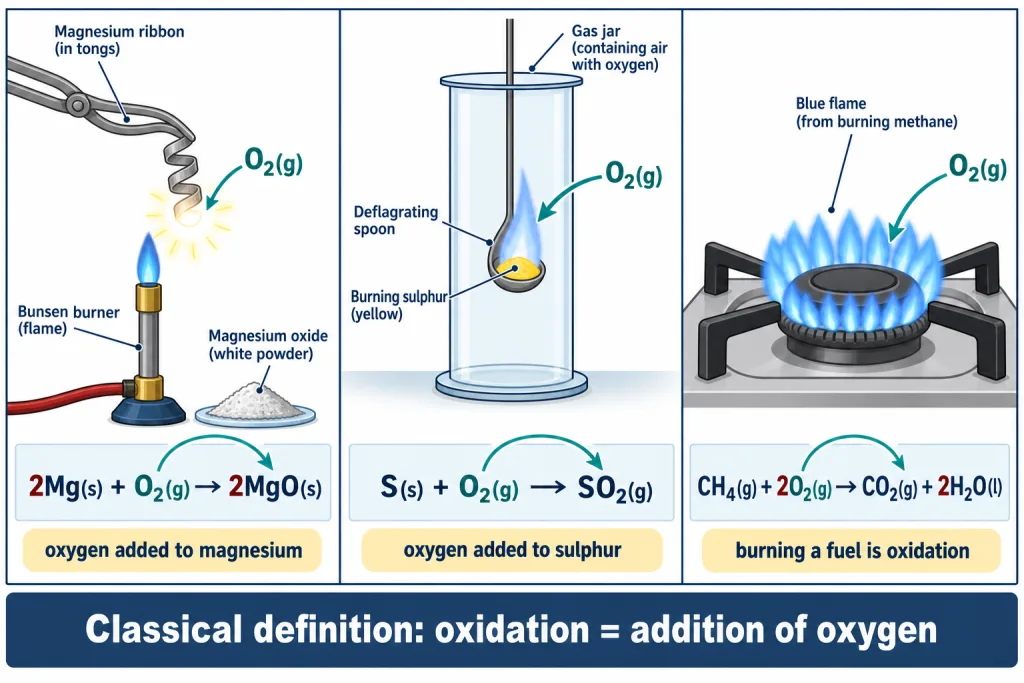
Burning a fuel is oxidation of this first kind
Every fuel you use releases its energy by being oxidised. Methane, the main component of piped natural gas and the bulk of CNG, burns as:
Propane, the fuel in an LPG cylinder along with butane:
Octane, a stand-in for petrol:
Each of these is oxidation of the fuel, and each one balances for atoms — check the octane equation for yourself: 16 carbon, 36 hydrogen and 50 oxygen atoms on both sides. The same chemistry, run slowly and in stages inside a cell, is how glucose gives you energy. Burning fuels for heat and transport, extracting metals, running a battery and corroding a bridge all sit inside the redox family, which is why this chapter is worth more than its page count suggests.
[Board] The full classical definition of oxidation, with one example of each of its four clauses, is a standard two-mark or three-mark question. The four clauses are built up over the next three blocks.
The definition widens: addition of any electronegative element
The oxygen-only definition did not survive contact with more data. Magnesium reacts with fluorine, with chlorine and with sulphur in ways that look chemically identical to its reaction with oxygen — the metal is consumed, a white or pale ionic solid is formed, and a great deal of heat comes out:
Nothing in these three involves oxygen, yet refusing to call them oxidations would mean giving four almost identical reactions two different names on the strength of one element. Chemists took the sensible route and widened the word. Oxygen is a strongly electronegative element; fluorine is more electronegative still; chlorine and sulphur are electronegative relative to magnesium. What magnesium is really doing in every case is handing its two outer electrons to a more electronegative partner.
Two more of the same kind:
Iron is oxidised by chlorine; potassium is oxidised by sulphur. Sodium behaves the same way with three different partners:
Key Point: Oxidation is the addition of oxygen or of any more electronegative element to a substance.
One caution about the word electronegative
"Electronegative" is a comparison, never an absolute label. Adding chlorine to a substance oxidises that substance only when chlorine is the more electronegative of the two partners. In chlorine is far more electronegative than iron, so iron is oxidised. Take a reaction in which chlorine meets fluorine instead and the verdict flips, because fluorine outranks chlorine. Carry the comparison, not the element name, and you will not be caught out.
Oxidation by removal: hydrogen, and electropositive elements
Look again at the burning of methane:
Carbon starts with four hydrogen atoms attached and ends with two oxygen atoms attached. Oxygen has been added, and hydrogen has been taken away. Both descriptions fit the same change, and that pushed chemists to add a third clause: removal of hydrogen is also oxidation.
A reaction where the hydrogen clause is the natural reading:
Hydrogen sulphide has lost its hydrogen and free sulphur is left behind, so has been oxidised. The same substance, treated with chlorine instead of oxygen, is oxidised in exactly the same sense:
Both sides carry 2 hydrogen, 1 sulphur and 2 chlorine atoms. No oxygen appears anywhere in this equation, and is still oxidised.
The fourth clause: removal of an electropositive element
If taking hydrogen out counts as oxidation, taking out a metal — an element even more electropositive than hydrogen — should count too. The standard illustration uses potassium ferrocyanide and hydrogen peroxide:
Count the potassium atoms: 8 on the left, and on the right. Two potassium atoms have been stripped out of the ferrocyanide before it becomes ferricyanide, and that removal of an electropositive element is the oxidation. Iron, cyanide, hydrogen and oxygen all balance as well — 2 iron, 12 cyanide, 2 hydrogen and 2 oxygen on each side.
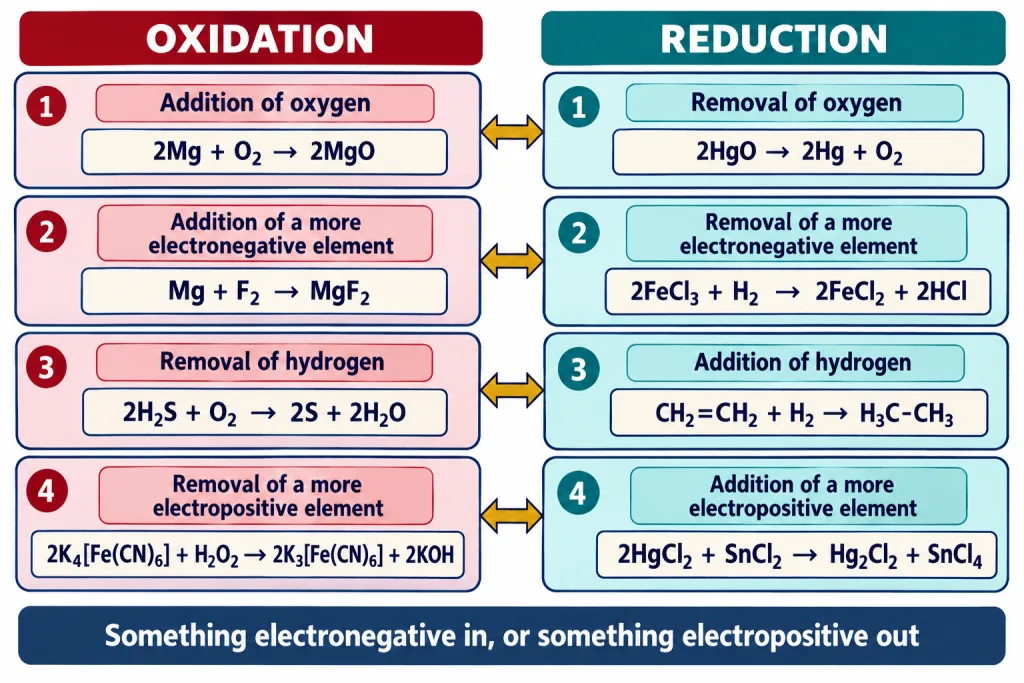
Key Point (Definition): Oxidation is the addition of oxygen or of a more electronegative element to a substance, or the removal of hydrogen or of a more electropositive element from a substance. Any one of the four is enough.
The four clauses are two ideas wearing four coats. Something electronegative comes in, or something electropositive goes out. Hold on to that and you will never have to memorise the list.
Reduction is the same four rules, run backwards
Reduction was first defined as the removal of oxygen from a compound, and it grew in step with oxidation until it became the exact mirror image.
Removal of oxygen. Mercuric oxide heated in a hard glass tube gives a mirror of liquid mercury and a gas that relights a glowing splint:
Mercuric oxide has been reduced. The same clause covers the blast furnace and the thermite reaction:
In the second of these there are 9 iron, 12 oxygen and 8 aluminium atoms on each side. Oxygen has been pulled out of the iron oxide, so the oxide is reduced; oxygen has gone into the aluminium, so aluminium is oxidised.
Removal of an electronegative element. Ferric chloride solution passed over with hydrogen loses one chlorine per formula unit:
Six chlorine atoms on the left, on the right. Ferric chloride has been reduced.
Mercuric chloride solution treated with stannous chloride is the same clause again, and it gives a white precipitate of mercurous chloride:
Chlorine balances at 6 on each side, mercury at 2 and tin at 1. The ratio of chlorine to mercury falls from to , so a more electronegative element has been removed from mercury and mercuric chloride is reduced. Note the structure: is , one molecule held together by a mercury-mercury bond. The textbook also describes this change as an addition of mercury to mercuric chloride — the same reduction seen from the direction shown below. Read off this equation the cleanest description is removal of chlorine from mercury, and both readings give the same verdict.
Addition of hydrogen. Ethene taken up on a nickel catalyst with hydrogen gives ethane:
Ethene has been reduced. Copper oxide in a hydrogen stream turns from black to salmon-pink:
Copper oxide has been reduced, by removal of oxygen and by addition of hydrogen at once — the two clauses agree, as they must.
Addition of an electropositive element. Mercuric chloride shaken with liquid mercury gives a white precipitate of mercurous chloride:
Two mercury and two chlorine atoms on each side. The electropositive element mercury has genuinely been added to mercuric chloride, so mercuric chloride is reduced. Potassium ferricyanide, , turning into potassium ferrocyanide, , is the same clause once more: one electropositive potassium has been added per formula unit, so the ferricyanide is reduced.
Key Point (Definition): Reduction is the removal of oxygen or of a more electronegative element from a substance, or the addition of hydrogen or of a more electropositive element to a substance.
| Oxidation is | Reduction is |
|---|---|
| addition of oxygen | removal of oxygen |
| addition of a more electronegative element | removal of a more electronegative element |
| removal of hydrogen | addition of hydrogen |
| removal of a more electropositive element | addition of a more electropositive element |
Learn one column properly and the other comes free.
The two never travel alone
Go back through every equation written so far and try to find one in which something is oxidised and nothing is reduced. There is none, and there cannot be one. If oxygen has entered a substance, that oxygen came from somewhere and the source lost it. If hydrogen has been stripped out of a molecule, some other species took the hydrogen up. Every clause of the oxidation definition creates a matching clause of the reduction definition in the same equation.
Because the pairing is unavoidable, the two words were pushed together and the class of reactions was named redox.
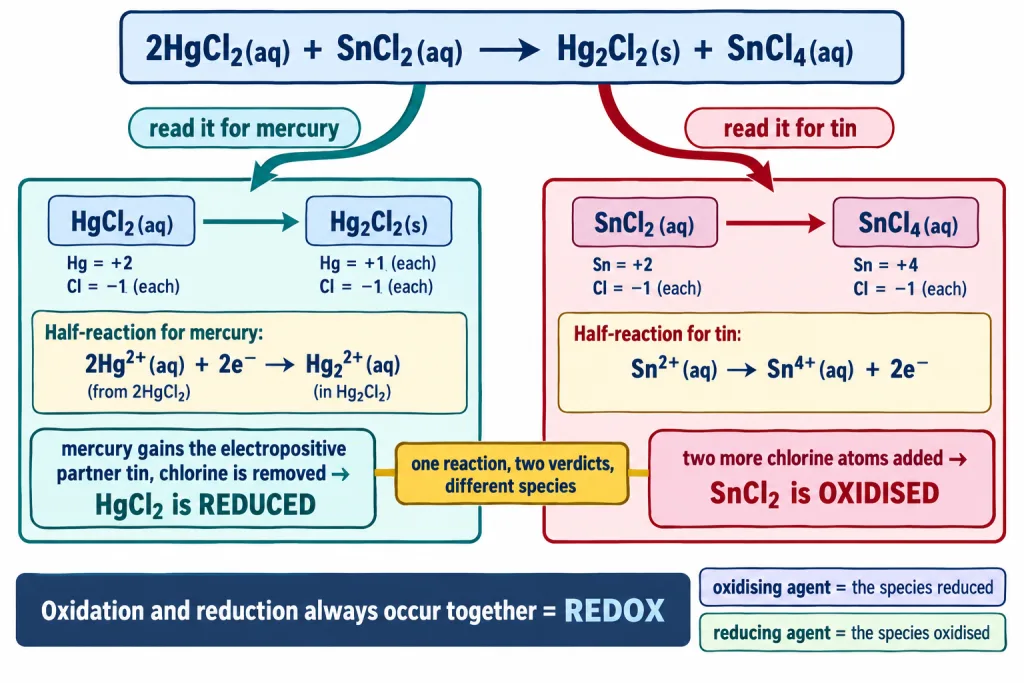
Take the mercuric chloride reaction again and read it twice:
Read it once for mercury: each mercury has gone from two chlorines to one, so a more electronegative element has been removed and mercuric chloride is reduced. Read it again for tin: two extra chlorine atoms have arrived on tin, so stannous chloride is oxidised. One equation, two verdicts, and the verdicts belong to different species.
The thermite reaction reads the same way twice:
Oxygen has left the iron oxide, so is reduced. That same oxygen has arrived on aluminium, so aluminium is oxidised. The oxygen is not created or destroyed — it is handed across, and the handover is what makes the reaction redox.
Key Point: Oxidation and reduction always occur together, in the same reaction, at the same time. A reaction in which only one of them happened would need oxygen, hydrogen or electrons to come from nowhere.
The species that brings about the oxidation of something else is the oxidising agent, and it is the species that gets reduced. The species that brings about a reduction is the reducing agent, and it is the one that gets oxidised. Those two sentences are examined more than almost anything else in this chapter, and they are also the most commonly reversed. In , hydrogen peroxide is the oxidising agent, so hydrogen peroxide is the species reduced.
[JEE/NEET] If a question asks you to name the oxidising agent, find the species that is reduced and name that. Chasing the word "oxidising" to the species that is oxidised is the single most expensive slip in the chapter.
Oxidised and reduced belong to a species, not to a reaction
A reaction is not "an oxidation". A reaction is a redox reaction, inside which one named species is oxidised and another named species is reduced. Writing "this reaction is an oxidation" without naming the species is the mark of an answer that has not been thought through, and it loses marks in a written paper.
The table below runs the classical test on a set of balanced equations. Read every row as a pair of verdicts.
| Balanced equation | Species oxidised | Species reduced | Classical reason |
|---|---|---|---|
| oxygen added to magnesium | |||
| oxygen added to sulphur | |||
| an electronegative element added to magnesium | |||
| electronegative chlorine added to iron | |||
| electropositive potassium added to sulphur | |||
| hydrogen removed from sulphur | |||
| hydrogen added to chlorine, removed from sulphur | |||
| electropositive potassium removed from the ferrocyanide | |||
| the oxide oxygen | oxygen removed from mercuric oxide | ||
| chlorine removed from iron, added to hydrogen | |||
| hydrogen added to the carbon skeleton | |||
| chlorine added to tin, mercury reduced by loss of chlorine | |||
| oxygen removed from the iron oxide, added to aluminium | |||
| oxygen removed from copper oxide, added to hydrogen | |||
| the more electronegative chlorine displaces iodine from potassium | |||
| hydrogen is the more electronegative partner here |
The mercuric oxide row deserves a second look
The classical description is "reduction of mercuric oxide by removal of oxygen", and the reduction is real. The oxygen that leaves is not a bystander, though: it goes from being combined oxide oxygen to free , and that is an oxidation. One compound has supplied both halves of the redox change. A reaction of this kind, where the same element or the same substance is oxidised and reduced at once, gets a name of its own in a later section.
The sodium hydride row is a trap
Applied carelessly, the clause "addition of hydrogen means reduction" says sodium is reduced. That reading is wrong. The clause about hydrogen was never about hydrogen atoms as such — it was shorthand for gaining a less electronegative partner. Hydrogen is more electronegative than sodium, so hydrogen behaves here the way chlorine behaves in : sodium is oxidised and hydrogen is reduced. The compound is an ionic hydride, .
This example is uncomfortable for the classical scheme, because you have to reach past the rules to electronegativity to get the right answer. It is a hint that the rules are not the real story.
Where the classical definitions run out
The four clauses are useful and they cover a lot of ground, but they all describe the appearance of a reaction rather than what is happening to the atoms. Put a strip of zinc into blue copper sulphate solution and the classical scheme has nothing to say at all.
The blue colour fades, red-brown copper settles on the zinc, and the beaker warms up. Something is unmistakably happening. Check the equation: 1 zinc and 1 copper on each side, and the charge is on the left and on the right, so it is properly balanced. Now apply the classical tests. No oxygen appears anywhere. No hydrogen appears anywhere. No electronegative element has been added to zinc and no electropositive element removed from anything. By every clause of the classical definition this is not a redox reaction, and yet it plainly is one — it is the reaction that drives the Daniell cell, and it will run a small motor.
The same problem appears in solution chemistry over and over:
Charge is on the left and on the right, so the equation is balanced. Nothing has been added and nothing removed. Only the charges have shifted.
The classical definitions were built by chemists who could weigh a product but could not see an electron, so they described what they could see: a substance going in and coming out heavier by so much oxygen. What is actually being moved in all of these reactions, including the ones with oxygen in them, is electrons. Zinc gives up two electrons; the copper ion takes them. That single idea covers every reaction in this section as well as the ones the classical rules cannot touch.
Key Point: The classical definitions are correct as far as they go, but they fail for reactions with no oxygen and no hydrogen — such as . The next section replaces them with a definition in terms of electron transfer, which handles every case.
Keep the classical rules anyway. They are the fastest way to read a combustion equation or a metallurgy equation at a glance, and every verdict they give is one the electron-transfer definition will confirm. They are a shortcut with a limited range, not a wrong answer.
Worked questions
Question 1: Reading a burning reaction
In , name the species oxidised and the species reduced, and give the classical reason for each.
Answer:
First I compare each reactant with what it has become. Magnesium starts as the free metal and ends up combined with oxygen, so oxygen has been added to magnesium.
Adding oxygen is oxidation, so magnesium is the species oxidised.
Now I look at the dioxygen. It has picked up magnesium, which is a strongly electropositive element, and adding an electropositive element is reduction.
Ans: Magnesium is oxidised (oxygen added to it); dioxygen is reduced (the electropositive element magnesium added to it). Watch out: Do not answer "the reaction is an oxidation". Both changes happen, and the marks are for naming which species undergoes which.
Question 2: A reaction with no oxygen in it
Identify the species oxidised and reduced in .
Answer:
I check the balance first: 2 hydrogen, 1 sulphur and 2 chlorine atoms on each side.
Sulphur begins bonded to hydrogen and ends up free, so hydrogen has been removed from it. Removal of hydrogen is oxidation, so is oxidised.
Chlorine begins free and ends up bonded to hydrogen, so hydrogen has been added to it. Addition of hydrogen is reduction.
I can also say the same thing the other way round: chlorine is more electronegative than sulphur, and it has been added to hydrogen, which oxidises the hydrogen sulphide. Both readings agree.
Ans: is oxidised; is reduced.
Question 3: The ferrocyanide oxidation
Explain, using the classical definition, why the change below is an oxidation of potassium ferrocyanide, and check that the equation balances.
Answer:
I count atoms first. Potassium: on the left, and on the right. Iron: 2 and 2. Cyanide groups: 12 and 12. Hydrogen: 2 and 2. Oxygen: 2 and 2. The equation is balanced.
Now I compare the complex before and after. Each ferrocyanide unit has lost one potassium.
Potassium is an electropositive element, and the removal of an electropositive element is oxidation.
Hydrogen peroxide takes up that potassium as , so hydrogen peroxide is the species reduced and is the oxidising agent here.
Ans: Potassium ferrocyanide is oxidised, by removal of the electropositive element potassium; hydrogen peroxide is reduced. Watch out: Hydrogen peroxide being a strong oxidant does not mean it is oxidised. The oxidising agent is always the species that gets reduced.
Question 4: Thermite
For , state which species is oxidised and which reduced, and verify the balance.
Answer:
Iron: on the left and 9 on the right. Oxygen: on the left and on the right. Aluminium: 8 and 8. Balanced.
Oxygen has been removed from the iron oxide, and removal of oxygen is reduction.
That oxygen has gone onto aluminium, and addition of oxygen is oxidation.
Ans: is reduced; aluminium is oxidised.
Question 5: The hydride trap
In , hydrogen has been added to sodium. Does that make sodium the reduced species?
Answer:
No, and this is where the rules have to be read with care.
The clause "addition of hydrogen is reduction" was written for cases where hydrogen is the less electronegative partner, as in .
Here the partner is sodium, and hydrogen is more electronegative than sodium. Hydrogen plays the part chlorine plays in .
The product is the ionic hydride , so sodium has handed its electron over.
Ans: Sodium is oxidised; hydrogen is reduced. Watch out: The four clauses are shorthand for electronegativity comparisons. When the shorthand and the electronegativity disagree, the electronegativity wins.
Question 6: Two verdicts from one equation
For , name the species oxidised and the species reduced.
Answer:
I check chlorine first: on the left, and on the right. Mercury 2 and 2, tin 1 and 1. Balanced.
Tin has gained two chlorine atoms. Chlorine is the more electronegative partner, so adding it oxidises the tin compound.
Mercury has lost chlorine, going from two chlorines per mercury to one. Removal of an electronegative element is reduction, so mercuric chloride is the species reduced. The textbook describes the same change as an addition of mercury to mercuric chloride — that is this reduction seen from the direction. Read off this equation the cleaner description is removal of chlorine, since is and mercury stands at 2 atoms on each side. Either way is reduced.
Ans: is oxidised; is reduced.
Question 7: Where the classical rules stop working
Show that is balanced, and explain why the classical definitions cannot classify it.
Answer:
Atoms: 1 zinc and 1 copper on each side.
Charge: on the left, and on the right. Atoms and charge both balance.
Now I run the four classical tests. No oxygen is present, so the oxygen clauses do not apply. No hydrogen is present, so the hydrogen clauses do not apply. Nothing electronegative has been added to zinc and nothing electropositive removed from the copper ion.
Every classical test comes back blank, yet the reaction visibly runs — the blue fades, copper deposits, and the beaker warms.
Ans: The equation is balanced for atoms and charge, but no clause of the classical definition applies, because the reaction contains neither oxygen nor hydrogen. A definition based on electron transfer is needed.
Question 8: Sorting a mixed list
For each reaction, name the species oxidised.
(i) (ii) (iii) (iv)
Answer:
(i) Hydrogen has picked up oxygen, so hydrogen is oxidised and copper oxide is reduced.
(ii) Iodide has lost potassium to the more electronegative chlorine, so potassium iodide is oxidised and chlorine is reduced.
(iii) Chlorine has been added to iron, so iron is oxidised and chlorine is reduced.
(iv) Carbon monoxide has taken on more oxygen, so carbon monoxide is oxidised and iron(III) oxide is reduced.
Ans: (i) (ii) (iii) (iv) Watch out: In every one of the four, the species you did not name is the one reduced. There is always exactly one of each.
The mistakes that cost marks here
Calling a whole reaction "an oxidation". Every redox equation contains one species oxidised and one reduced. An answer that does not name both is incomplete.
Swapping oxidising agent and oxidised species. The oxidising agent is reduced. The reducing agent is oxidised. Write those two lines at the top of your rough sheet in the exam and check every answer against them.
Applying the hydrogen clause without thinking about electronegativity. looks like a reduction of sodium and is not.
Assuming a reaction needs oxygen to be redox. , and are all redox reactions with no oxygen anywhere.
Not checking charge. An equation with ions in it must balance charge as well as atoms. carries on both sides. An equation that balances atoms but not charge is simply wrong.
Quick recap
- Oxidation, in the classical scheme: oxygen added, a more electronegative element added, hydrogen removed, or a more electropositive element removed.
- Reduction: the same four, reversed.
- Compressed to one line — oxidation is something electronegative coming in or something electropositive going out.
- The two always happen together, in the same equation, which is why the class is called redox.
- Oxidised and reduced describe a named species, never the reaction as a whole.
- The oxidising agent is the species reduced; the reducing agent is the species oxidised.
- Every clause is a comparison of electronegativity in disguise, which is why is an oxidation of sodium.
- The scheme breaks on , which contains no oxygen and no hydrogen, and that failure is what forces the electron-transfer definition in the next section.