
Splitting one beaker into two
Stand a zinc rod in copper sulphate solution and the familiar change runs:
Charge is on each side, so the equation balances for atoms and for charge. Zinc is oxidised and so is the reducing agent; is reduced and so is the oxidising agent. In that beaker the electrons jump straight from a zinc atom to a copper ion at the moment they touch, and all the energy comes out as heat. Nothing useful is extracted from it.
Now separate the halves so the electrons cannot take that short cut. Put copper sulphate solution with a copper strip in one beaker, zinc sulphate solution with a zinc strip in another. At each metal surface the metal and its own ion sit in contact — the oxidised and the reduced form of one substance.
Key Point (Definition): A redox couple is the oxidised and the reduced form of a substance taken together, as they appear in one half reaction. It is written with the oxidised form first, separated by a slash: and .
Each beaker with its electrode and solution is a half cell. On its own it does nothing measurable, because a half reaction is a bookkeeping device, not a reaction that proceeds by itself. Two half cells joined properly make a galvanic cell, also called a voltaic cell, in which a spontaneous redox reaction drives a current through an external wire.
Now join them. Connect the two strips by a wire carrying an ammeter and a switch, then dip an inverted U-tube into the two solutions, one arm in each. The tube holds potassium chloride or ammonium nitrate set into a jelly with agar. That U-tube is the salt bridge; the whole assembly is the Daniell cell.
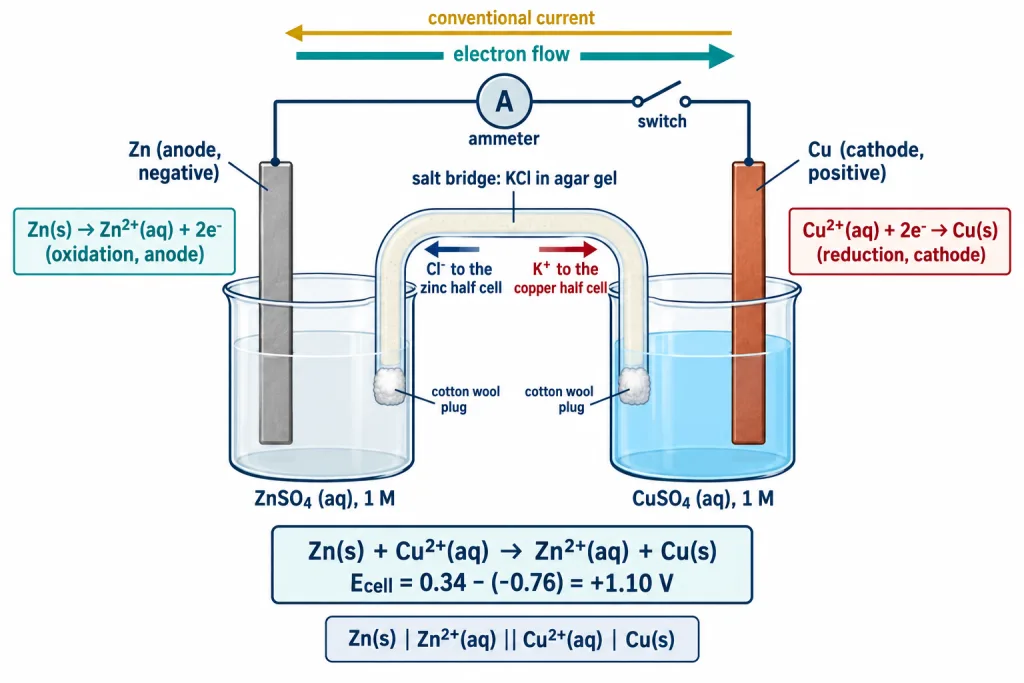
With the switch off nothing happens and the ammeter reads zero. Close the switch and the needle moves at once.
What happens once the switch is closed
Two movements start together.
In the external wire. Zinc atoms give up electrons and leave the surface as :
They cannot reach the copper ions through the solution, so they travel along the wire to the copper strip, where ions take them:
Electrons flow from zinc to copper through the wire, so conventional current, being the flow of positive charge, runs the other way. The zinc strip wastes away; the copper strip grows heavier.
Inside the cell. Without the salt bridge this would stop within moments. The zinc beaker produces and builds up positive charge; the copper beaker consumes , is left with excess and builds up negative charge. A positive solution will not release more positive ions and a negative one will not accept more electrons, so the current dies.
The salt bridge cancels that charge as fast as it appears. Its anions (chloride, or nitrate) migrate into the zinc beaker, where positive charge is accumulating, and its cations (potassium, or ammonium) migrate into the copper beaker. So inside the cell anions move towards the zinc and cations towards the copper.
Key Point: The salt bridge does three jobs. It completes the circuit, so charge can travel all the way round. It maintains electrical neutrality in both solutions, so the cell keeps working. It prevents the two solutions from mixing, so zinc metal never meets directly.
The jelly holds the electrolyte in place while still letting ions through. The salt is chosen so neither of its ions reacts with either solution and both travel at roughly the same speed; and qualify. Against a silver nitrate half cell, would precipitate and choke the bridge, so ammonium nitrate is used.
Anode, cathode, and the sign trap
The electrodes are named by the reaction on them, never by their sign.
Key Point (Definition): The anode is the electrode at which oxidation occurs. The cathode is the electrode at which reduction occurs. This holds in every cell of every kind, galvanic or electrolytic.
In the Daniell cell zinc is the anode and copper the cathode. Zinc pushes electrons into the wire, so the anode is the electron-rich end of the circuit and is the negative terminal; copper draws electrons out, so the cathode is the positive terminal. This is why the zinc case of a dry cell is its negative terminal.
Now the trap. In electrolysis an external source forces a non-spontaneous reaction, pulling electrons out of one electrode and pushing them into the other. The electrode wired to the source's positive terminal has electrons pulled out of it, so oxidation happens there — still the anode, but now positive. The electrode wired to the negative terminal is fed electrons, so reduction happens there — still the cathode, but now negative.
| Galvanic (spontaneous) | Electrolytic (driven) | |
|---|---|---|
| Anode | oxidation, negative | oxidation, positive |
| Cathode | reduction, positive | reduction, negative |
| Energy | chemical electrical | electrical chemical |
Read down the first two rows: oxidation stays at the anode and reduction at the cathode in both columns, and only the sign reverses. The memory hook survives both cases — an ox for anode-oxidation, red cat for reduction-cathode.
[JEE/NEET] A question that says "the anode is negative" is testing whether you noticed which kind of cell is described. Fix the reaction to the electrode name first, and get the sign afterwards from where the electrons are being pushed.
Writing a cell on one line
Drawing two beakers every time is slow, so a cell is written in shorthand.
Key Point: In cell notation the anode goes on the left and the cathode on the right. A single vertical bar marks a boundary between two phases. A double vertical bar marks the salt bridge. Species in the same phase are separated by a comma.
Reading left to right you travel the way the electrons travel in the external circuit: out of the anode, round the wire, into the cathode. The Daniell cell is:
The first bar separates solid zinc from its solution, the double bar is the salt bridge, and the last bar separates the copper solution from solid copper. Concentrations are shown only when they matter; under standard conditions they are all and are usually left out.
A cell built from zinc and silver half cells:
and one built from copper and silver:
In each case the metal being eaten away is written first. From the notation alone both half reactions follow: reverse the left-hand couple as an oxidation, keep the right-hand one as a reduction, add them so the electrons cancel. For the copper-silver cell:
Charge is on both sides. The silver half reaction was multiplied by two so the electrons cancel — remember that, because it matters shortly.
When neither form of a couple is a metal that can serve as its own electrode, an inert conductor is used, usually platinum or graphite, written at the far end:
Both iron species share one solution, so a comma separates them, not a bar.
Electrode potential, and why you can only measure a difference
Current flows in the Daniell cell only because there is a potential difference between the two rods, each electrode having a potential of its own from the equilibrium at its metal-solution interface.
Key Point (Definition): The potential associated with a single electrode, arising from the tendency of its redox couple to gain or lose electrons at the metal-solution interface, is its electrode potential.
At the zinc surface, atoms tend to leave as and dump electrons on the metal; at the copper surface, ions tend to settle and take electrons from it. Zinc releases electrons more readily, so the zinc rod ends up negative with respect to the copper rod, and that difference drives the current.
A single electrode potential cannot be measured on its own, and this is not a limitation of the instrument. A voltmeter has two leads. Touch one to the zinc rod and the other has to touch something, and the moment it does a second interface with its own potential appears. Every possible measurement returns the difference between two electrodes.
The way out is the trick used for altitude: sea level is defined as zero and peaks are quoted against it. Here the chosen sea level is the hydrogen electrode.
Key Point (Definition): The cell potential or EMF of a cell is the potential difference between the two electrodes of a galvanic cell when no current is being drawn.
The phrase "when no current is being drawn" matters: once appreciable current flows, the concentrations at the electrodes change and part of the potential is lost inside the cell, so the reading drops. EMF is measured with a potentiometer, or a digital voltmeter of very high resistance, so that almost no current passes.
The standard hydrogen electrode
The reference chosen by international agreement is the hydrogen electrode run under a fixed set of conditions.
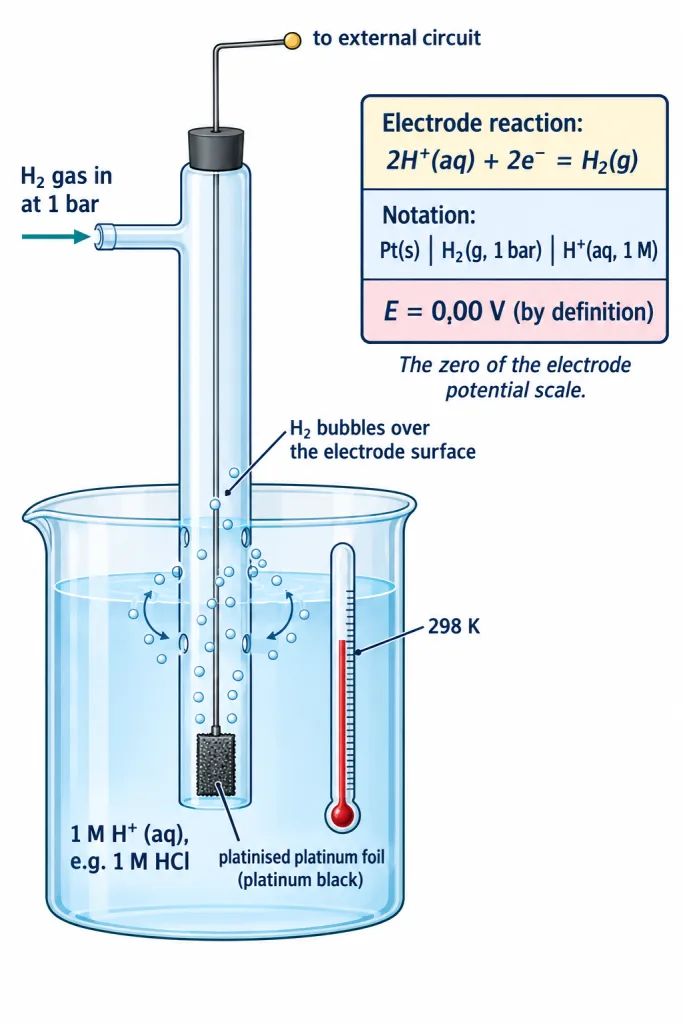
A small square of platinum foil is coated with finely divided platinum, called platinum black, by electrolysing chloroplatinic acid over it. The coated foil is platinised platinum; the black coating gives an enormous surface area on which hydrogen is adsorbed and the electrode reaction reaches equilibrium quickly. The foil is welded to a platinum wire sealed through a glass tube dipping in the acid, and pure hydrogen is bubbled down the tube so that it washes over the foil.
The standard conditions are:
- hydrogen gas at (older books write ; the difference is negligible here),
- at , usually from hydrochloric acid,
- temperature ,
- platinised platinum as the inert conductor, which only carries electrons and is not consumed.
The electrode reaction is
and it is written as an equilibrium because the electrode runs either way: forwards as a cathode against a couple that holds electrons tightly, backwards as an anode against one that releases them readily.
Key Point (Definition): The standard hydrogen electrode (SHE), written at , is assigned a standard electrode potential of exactly by convention. This is a definition, not a measurement.
Every other value in the tables was obtained by building a cell with the SHE as one half and measuring the EMF. Because the reference is zero, that EMF is the standard electrode potential of the other electrode, its sign saying which way the electrons went.
Standard electrode potential and what its sign means
Key Point (Definition): The standard electrode potential, , is the electrode potential measured against the standard hydrogen electrode when every dissolved species is at , every gas is at and the temperature is .
Two conventions govern how one is quoted.
Every half reaction in a table is written as a reduction, with the oxidised form and the electrons on the left. The zinc entry is , never the reverse, and belongs to that direction. Values quoted this way are standard reduction potentials, and "standard electrode potential" means the same thing.
Reversing the half reaction reverses the sign. The oxidation has an oxidation potential of . Older books tabulated oxidation potentials; modern practice tabulates reductions only, and mixing the two is a reliable way to lose the sign of an answer.
Reading a value:
- A large positive means the oxidised form takes electrons readily, so it is easily reduced and is a strong oxidising agent. Fluorine, at , is the strongest in the table.
- A large negative means the couple resists reduction and its reduced form gives up electrons readily. That form is easily oxidised and is a strong reducing agent. Lithium, at , is the strongest reducing agent in aqueous solution, because of its very large hydration energy, even though caesium has the lower ionisation enthalpy.
- A negative also means the couple is a stronger reducing agent than ; a positive means a weaker one.
is intensive — where most marks are lost
Multiplying a half reaction by any number does not change its .
Not . Potential is energy per unit charge, so doubling the reaction doubles the energy released and doubles the charge moved, leaving the ratio unchanged. Mass is extensive and density is intensive; sits on the density side.
The number of electrons does show up in the Gibbs energy, , which is extensive and does double. That relation comes in Class 12; for now take from it only that is never multiplied.
The electrochemical series
Arrange every couple in order of standard reduction potential, most positive at the top, and the result is the electrochemical series. Reading down it, oxidising power falls; reading up, reducing power falls.
| Reduction half reaction | / V |
|---|---|
Three things read off directly.
The metals in order. The metal couples in the table carry the activity series, quoted in every book as — exactly the reactivity series met earlier, not a separate fact to memorise. That quoted list leaves out two of the metals standing in the table above, and their potentials say where each belongs: lithium at sits above potassium, and chromium at sits between zinc and iron.
The halogens in order. as oxidising agents, so fluorine is the strongest of them. Turn each round and the halide ions rank the other way, iodide strongest as a reducing agent.
Why permanganate titrations use sulphuric acid. at sits above at , so it oxidises chloride and hydrochloric acid would be attacked along with the sample. Dichromate at sits just below the chlorine couple, so hydrochloric acid is acceptable there.
Getting the EMF of a cell from the table
Key Point: , with both values taken as reduction potentials, straight from the table, unmultiplied. A positive means the reaction is spontaneous as written.
Since the cathode is on the right of the cell notation, the rule also reads . In any pair, the couple sitting higher in the table becomes the cathode and the lower one becomes the anode.
The Daniell cell. . Copper is above zinc, so copper is the cathode.
Positive, so goes as written.
Zinc against silver. , for the reaction .
The silver half reaction was doubled to balance electrons, but its stays , so the answer is , not .
Copper against silver. , for .
Both couples are positive here, and the cell EMF is still positive because silver is the higher of the two.
Iron against copper. , for .
This is why an iron vessel cannot hold copper sulphate solution.
[JEE Main] Three errors account for nearly every wrong EMF: adding the potentials instead of subtracting, subtracting the wrong way round, and multiplying a potential by the number of electrons. Write out in full every time and none of the three can happen.
Predicting whether a reaction occurs
The procedure is fixed. Split the proposed reaction into its two couples and look both up as reductions. The species being reduced is the cathode, the one being oxidised is the anode. Subtract. Positive means the reaction goes; negative means it does not, and the reverse goes instead.
Iron(III) with iodide: . Iron(III) is reduced, so is the cathode value; iodide is oxidised, so at is the anode.
Positive, so it happens, and it underlies the iodometric estimation of iron(III).
Chlorine with bromide: . Chlorine reduced, at the cathode; bromide oxidised, at the anode. , so chlorine displaces bromine from a bromide.
Bromine with chloride: . Now bromine is reduced, at the cathode, and chloride oxidised, at the anode.
Negative, so this reaction does not occur. Bromine water added to sodium chloride solution gives nothing, and the value is the previous one with its sign flipped, because it is the same reaction run backwards.
Silver with copper(II): . , negative, so a silver spoon is safe in copper sulphate solution.
Why zinc gives hydrogen with dilute acid and copper does not
Dilute hydrochloric or sulphuric acid supplies , and the only oxidising agent present is itself, sitting at exactly . So a metal liberates hydrogen from dilute acid if and only if its own is negative — if it lies below hydrogen in the table.
Zinc, at , for :
Positive, so zinc dissolves with brisk effervescence. Copper, at :
Negative, so nothing happens, however long you wait. The same argument covers silver () and gold (), which are further out of reach still.
Copper does dissolve in concentrated nitric acid and hot concentrated sulphuric acid, but there the oxidising agent is the nitrate or sulphate ion, not , and the gas is an oxide of nitrogen or sulphur dioxide, never hydrogen.
Worked questions
Question 1: Reading a cell from its notation
For the cell , name the anode and the cathode, write both half reactions and the overall reaction, and calculate . Use and .
Answer:
The left-hand electrode is always the anode, so iron is the anode and silver the cathode.
At the anode iron is oxidised: . At the cathode silver ion is reduced, and since iron released two electrons I need two silver ions: .
Adding, the electrons cancel: . Charge is on both sides. For the EMF I use the tabulated reduction potentials as they stand.
Ans: Anode iron, cathode silver; ; Watch out: Doubling the silver potential to gives , which is wrong. Balancing electrons changes coefficients, never .
Question 2: Deciding which electrode is which
A cell is set up from a nickel electrode in and a lead electrode in . Which metal dissolves, what is the EMF, and how is the cell written? , .
Answer:
The more positive couple gets reduced, so lead at is the cathode and nickel at is the anode. Nickel dissolves.
Positive, so the cell works this way round, anode on the left:
Ans: Nickel dissolves; ; Watch out: Both potentials are negative, which tempts people to make the more negative one the cathode. Higher in the table always means cathode, negative or not.
Question 3: The intensive property, tested directly
For , . What is for , and what is it for ?
Answer:
Tripling the equation triples both the charge moved and the energy released, and is their ratio, so it is still . Reversing the equation reverses the electron flow, and that does flip the sign: as an oxidation, .
Ans: for the tripled reduction; for the reverse written as an oxidation Watch out: Multiplying changes nothing; reversing changes the sign. Each rule gets applied to the wrong case routinely.
Electrolysis: driving a reaction uphill
A galvanic cell lets a spontaneous reaction do electrical work. Electrolysis does the opposite: a direct-current source forces a reaction with a negative to run.
Key Point (Definition): Electrolysis is the decomposition of an electrolyte, molten or in solution, by passing a current through it, driving a non-spontaneous redox reaction. Oxidation still occurs at the anode and reduction at the cathode, but the anode is now positive and the cathode negative.
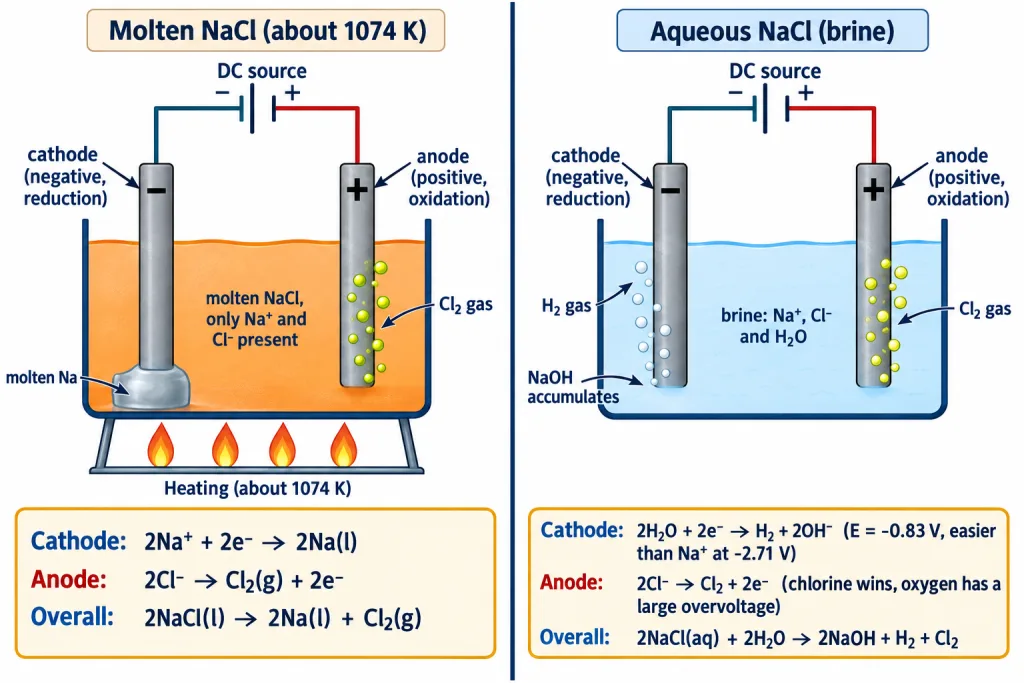
Cations move to the negative cathode and are reduced; anions move to the positive anode and are oxidised. The electrolyte must be molten or dissolved so the ions can move.
Molten sodium chloride
Melt the salt at about — calcium chloride is mixed in industrially to bring that down — and only and are present, so there is no choice about what reacts.
Molten sodium collects at the cathode and chlorine at the anode. This is how sodium metal is manufactured.
Aqueous sodium chloride
Dissolve the salt in water and water, present in huge excess, becomes a candidate at both electrodes, since it can be both reduced and oxidised. The easier species wins at each. At the cathode:
Water is far easier to reduce, so hydrogen is evolved and hydroxide left behind. No sodium is ever obtained from brine, which is why the metal is extracted from the melt. At the anode the competition is chloride against water:
On the numbers alone water should be oxidised first, being the lower value, but with reasonably concentrated brine chlorine comes off instead. Oxygen evolution is kinetically sluggish on most electrode surfaces and needs an extra voltage, the overvoltage or overpotential, before it runs at a useful rate. Electrode potentials say what is thermodynamically possible, not how fast it happens.
Brine electrolysis therefore gives hydrogen at the cathode, chlorine at the anode and sodium hydroxide in solution — the chlor-alkali industry, three products from one cheap raw material.
Two applications
Electrolytic refining purifies a metal. For copper, a slab of impure copper is the anode, a thin sheet of pure copper the cathode, and the electrolyte acidified copper sulphate. Copper dissolves from the anode as and plates onto the cathode at high purity. Impurities more reactive than copper, such as zinc and iron, dissolve but stay in solution because they are harder to reduce; less reactive ones such as silver and gold never dissolve and drop as anode mud, whose recovery often pays for the process.
Electroplating lays down a thin protective or decorative layer: the article is the cathode, a bar of the plating metal the anode, a salt of that metal the electrolyte — silver on cutlery, chromium on taps, nickel on steel.
More worked questions
Question 4: Sign of the electrodes
In a Daniell cell and in the electrolysis of molten sodium chloride, state for each electrode whether it is the anode or the cathode and whether it is positive or negative.
Answer:
Daniell cell, which is galvanic. Zinc is oxidised, so zinc is the anode; it pushes electrons into the wire, making it negative. Copper is reduced, so copper is the cathode; it draws electrons out, making it positive.
Electrolysis of molten , which is driven. Chloride is oxidised at the anode, joined to the positive terminal of the supply and so positive. Sodium ion is reduced at the cathode, joined to the negative terminal and so negative.
Ans: Daniell — anode , negative; cathode , positive. Electrolysis — anode positive, cathode negative. Watch out: The oxidation and reduction labels never move; only the signs swap.
Question 5: An electrode against the SHE
A copper electrode in is connected through a salt bridge to a standard hydrogen electrode at . The measured EMF is and the hydrogen electrode is found to be the anode. Write the cell and the overall reaction.
Answer:
The hydrogen electrode is the anode, so it goes on the left, and its potential is by definition:
Check: , matching the reading — which is how was measured in the first place. Adding to :
Charge is on each side.
Ans: , with
What carries forward to Class 12
Everything above assumed standard conditions: solutions, gases at , . Real cells rarely sit there, and a cell runs down because its concentrations drift as the reaction proceeds. The Nernst equation gives the potential at any concentration, and explains why the EMF of a Daniell cell falls from towards zero as zinc ion builds up and copper ion is used. At equilibrium the potential is zero and the battery is flat.
The second thread is thermodynamics. The electrical work a cell can deliver is the Gibbs energy change of its reaction:
with the number of electrons transferred in the balanced equation and the Faraday constant, the charge on one mole of electrons. This is where finally earns its place. A positive gives a negative , which is the formal reason a positive EMF means spontaneity. The same relation links to the equilibrium constant.
The third is Faraday's laws, relating the mass deposited at an electrode to the charge passed and to the n-factor met in the titration section.
The mistakes worth checking one last time
- , both as tabulated reduction potentials. Not the sum, not the other way round.
- is intensive. Balancing electrons changes coefficients, never the potential.
- Anode is oxidation and cathode is reduction in every cell; only the sign flips.
- A negative means the reverse reaction is the spontaneous one, not that nothing can happen.
- In an aqueous electrolysis, check whether water is the easier species to react before naming a product.