
Oxidation and reduction rewritten as electron bookkeeping
The classical definitions worked because oxygen and hydrogen happened to be convenient markers. They stop working the moment a redox reaction contains neither. Sodium burning in chlorine has no oxygen anywhere in it, and no hydrogen either, yet nobody doubts that it belongs in the same family as magnesium burning in air.
The escape route comes from chemical bonding. Sodium chloride is not a molecule with shared pairs; it is , a lattice of ions. Sodium oxide is and sodium sulphide is . Charges appeared during the reaction that were not there before. Sodium started neutral and ended up ; chlorine started neutral and ended up . Something moved between them, and that something is an electron.
Key Point (Definition): Oxidation is the loss of electrons by a species. Reduction is the gain of electrons by a species. Every reaction in which electrons pass from one species to another is a redox reaction, whether or not oxygen appears in it.
Two mnemonics carry this: OIL RIG — Oxidation Is Loss, Reduction Is Gain — and LEO the lion says GER — Loss of Electrons is Oxidation, Gain of Electrons is Reduction. Pick one, use it for a week until the definition is automatic, and then stop repeating it. Beyond the first fortnight the mnemonic is a crutch that slows you down in an exam.
The electronic definition does not throw the classical one away. It explains it. When magnesium takes on oxygen, magnesium is handing over electrons to oxygen. When copper oxide loses its oxygen to hydrogen, the copper is taking electrons back. Adding an electronegative element to a substance and taking electrons away from that substance are the same event described in two different vocabularies. Both definitions must agree on every example, and they do.
The gain here is range. The electronic definition covers reactions with no oxygen, no hydrogen, and no obviously electronegative partner: a zinc strip dropped into copper sulphate solution, a silver ion picking up an electron at an electrode, an iron(II) ion turning into an iron(III) ion in a titration flask. All of them are electron transfer, and all of them are now inside the definition.
[Board] The one-line answers examiners want are the two sentences in the callout above, stated in that order, with "by a species" left in. A definition that says only "oxidation is loss" without saying loss of what earns nothing.
Half reactions: splitting the electron traffic in two
An electron leaving one atom must arrive somewhere. Writing the whole reaction in one line hides that traffic, so the change is split into two pieces that each show the electrons explicitly.
Take sodium burning in chlorine.
Split it:
Each of these is a half reaction. Two electrons leave two sodium atoms; the same two electrons arrive at one chlorine molecule. Add the two lines and the electrons cancel because they appear on opposite sides in equal number:
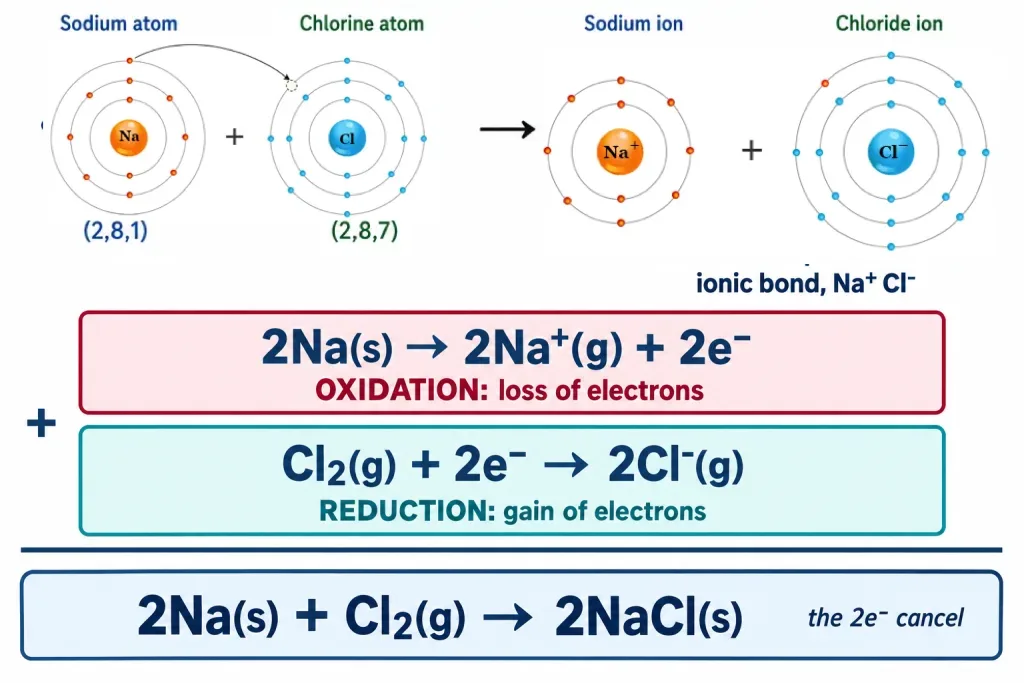
Sodium burning in oxygen goes the same way, only the electron count differs. Oxygen needs four electrons per molecule, so four sodium atoms are required.
Sodium and sulphur behave identically. Sulphur takes two electrons to become , so two sodium atoms feed one sulphur atom, giving .
Key Point: A half reaction is a bookkeeping device, not a reaction that happens on its own. No beaker ever contains only the oxidation half. Free electrons do not float about in solution waiting for a customer; they are handed over directly. The two halves are written separately so the electron count can be checked, and then they are added back together.
Two rules govern every half reaction you will ever write, and both are checked by arithmetic rather than by feel.
- Atoms balance. The same number of each kind of atom on both sides.
- Charge balances. Add up the charge on the left, add up the charge on the right, and include the electrons as each. The two totals must be equal.
Charge-check the chlorine half reaction. Left: . Right: . Equal. Charge-check the sodium half reaction. Left: . Right: . Equal. A half reaction that balances atoms but not charge is simply wrong, and this is the check that catches the great majority of balancing mistakes later in the chapter.
Magnesium: one metal, three non-metals, one pattern
Magnesium is the cleanest case to drill because the metal behaves the same way every time while the partner changes.
Magnesium burning in oxygen. The white light of a burning magnesium ribbon comes from this.
Two magnesium atoms release four electrons between them; one oxygen molecule absorbs all four. Magnesium is oxidised, oxygen is reduced.
Magnesium in fluorine. No oxygen anywhere, and the classical oxygen definition has nothing to say. The electronic definition handles it without a pause.
Magnesium in chlorine. Identical arithmetic, a different halogen.
Three reactions, one story. Magnesium loses two electrons in all three, so magnesium is oxidised in all three. Oxygen, fluorine and chlorine each accept electrons, so each is reduced. The classical definition would have called only the first one an oxidation of magnesium and would then have had to stretch itself to cover the other two through the electronegativity clause. The electronic definition covers all three with the same sentence.
The count of electrons is set by the partner, not by the metal. Oxygen wants four per molecule because each oxygen atom takes two; a halogen wants two per molecule because each halogen atom takes one. That single fact fixes the formula: but and .
[NEET] Ionic formula and electron count are the same question asked twice. If you can state how many electrons the non-metal takes per atom, you can write the formula without memorising it.
Working the zinc and copper case in full
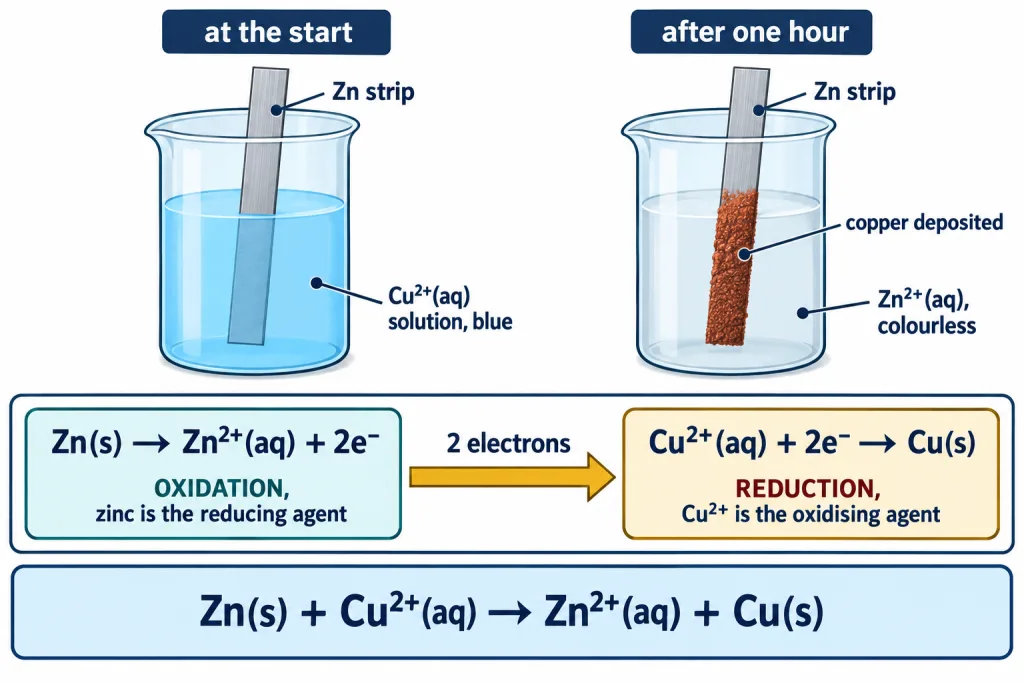
Drop a strip of zinc into an aqueous solution of a copper(II) salt and leave it for an hour. Three things change. The strip becomes coated with reddish-brown metallic copper. The blue colour of the solution fades, because blue is the colour of hydrated and the is disappearing. The beaker warms slightly. Test the colourless solution afterwards by passing hydrogen sulphide gas through it after making it alkaline with ammonia, and white zinc sulphide appears, which confirms is now present.
Now split it. Zinc went from a neutral metal atom to a doubly charged ion, so it gave away two electrons.
Charge check: left ; right . Balanced.
Copper went from a doubly charged ion to a neutral metal atom, so it took two electrons.
Charge check: left ; right . Balanced.
Both halves involve two electrons, so they add directly with nothing to multiply.
Charge check on the overall equation: left ; right . Balanced. The electrons cancelled completely, which is the signature of a correctly combined pair of half reactions. If any electrons survive in the final equation, the halves were not scaled properly.
Zinc lost electrons, so zinc was oxidised. gained electrons, so was reduced. The reaction runs almost to completion: putting a copper strip into zinc sulphate solution produces no visible change at all, and even the extremely sensitive test for using hydrogen sulphide, which would show black cupric sulphide, fails to detect anything. Electrons move from zinc to copper ions and not the other way.
Working the copper and silver case in full
Stand a copper wire in silver nitrate solution. Glittering silver crystals grow on the wire and the colourless solution turns blue, the blue again being hydrated .
The oxidation half is straightforward.
The reduction half has a complication worth meeting now, because it recurs in every balancing problem in the chapter. Silver ion takes only one electron.
One half supplies two electrons and the other consumes one. Added as they stand, an electron would survive into the final equation, which is meaningless. The reduction half is therefore multiplied throughout by .
Now add:
Charge check: left ; right . Balanced for atoms and for charge.
Key Point: Multiply each half reaction by whatever whole number makes the electron counts equal, then add. The electrons must cancel exactly. Multiplying a half reaction changes the number of moles it describes; it does not change the chemistry of that half, and it does not change the electrode potential associated with it, because potential is an intensive quantity.
Copper releases electrons to silver ions, and zinc releases electrons to copper ions. The electron-releasing tendency runs , which is the first fragment of the activity series that the next section builds properly.
Redox couples and what the slash means
Every half reaction ties together two forms of the same element: one with the higher oxidation state and one with the lower. That pair is a redox couple, and it is written as a fraction-like symbol with a slash.
Key Point (Definition): A redox couple is written oxidised form / reduced form. means the pair linked by . The species on the left of the slash is the one that would be reduced; the species on the right is the one that would be oxidised.
Three couples worth knowing on sight:
- — the half reaction . Two electrons.
- — the half reaction . Two electrons.
- — the half reaction . One electron, and both members are ions in solution, with no solid metal involved at all.
The last one matters because students often expect the reduced member of a couple to be a metal. It need not be. , , and are all perfectly ordinary couples in which both members stay dissolved. A couple only needs two forms of the same element differing by a definite number of electrons.
The order inside the symbol is a convention, not a decoration. Writing instead of is marked wrong, because the whole table of standard electrode potentials in Class 12 is built on the couple being written with the oxidised form first and the half reaction quoted as a reduction.
Any redox reaction is two couples reacting. The zinc and copper reaction is the couple meeting the couple ; the copper and silver reaction is meeting . Which way the electrons actually run is decided by the standard electrode potentials of the two couples, measured in volts: sits at , at , at and at . The more positive value is the couple that gets reduced. Section 10 does the full treatment; for now the couples themselves and their electron counts are what you need.
Oxidising agent and reducing agent: the one thing most people get backwards
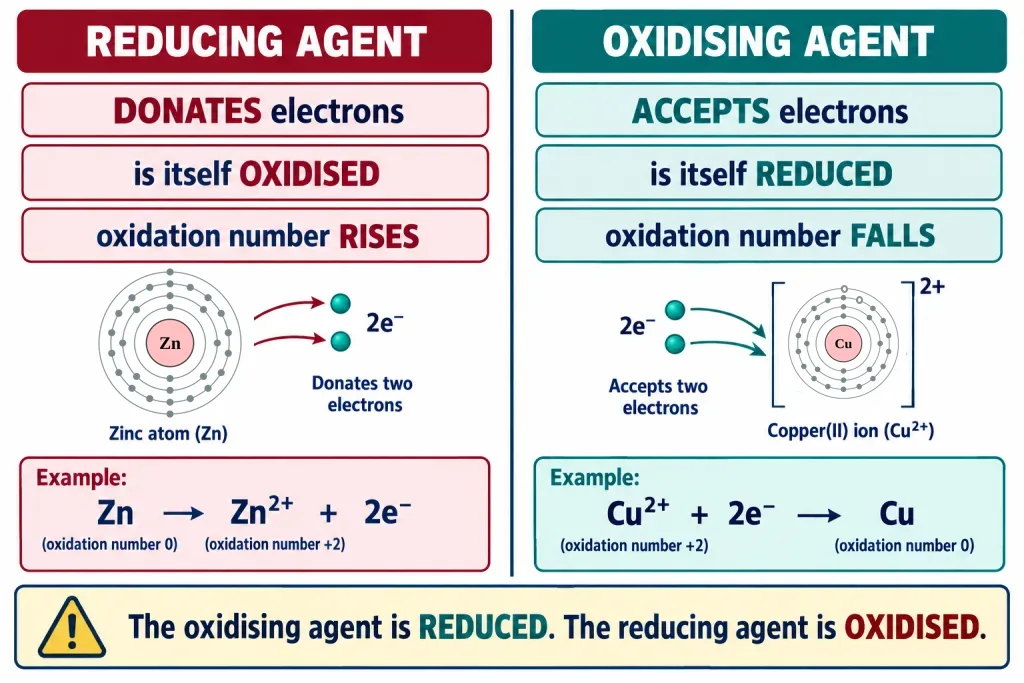
An oxidising agent oxidises something else. To do that it must take the electrons that the other species is losing. Taking electrons is reduction. The oxidising agent is therefore reduced.
Key Point: The oxidising agent is the electron acceptor and is itself REDUCED. The reducing agent is the electron donor and is itself OXIDISED. This is the single most-failed point in the chapter. Read it twice.
Nothing about the word "oxidising" describes what happens to the agent. It describes what the agent does to its partner. A reducing agent hands electrons over so that its partner may be reduced, and in handing them over it is oxidised itself.
Apply it to the two reactions already worked.
In : zinc donates the electrons, so zinc is the reducing agent and zinc is oxidised. accepts them, so is the oxidising agent and is reduced.
In : copper donates, so copper is the reducing agent and is oxidised. accepts, so is the oxidising agent and is reduced. Copper was the oxidising agent in the previous reaction and is the reducing agent in this one; the label belongs to the role a species plays in a particular reaction, not to the element itself.
In : sodium is the reducing agent, chlorine is the oxidising agent.
A three-step routine that never fails, and that survives into the balancing sections:
- Find the species whose electron count falls — that species lost electrons and was oxidised. It is the reducing agent.
- Find the species whose electron count rises — that species gained electrons and was reduced. It is the oxidising agent.
- Check that the number of electrons lost equals the number gained. If it does not, the equation is not balanced.
Common oxidants and reductants, and the change each undergoes
| Species | Role | Change it undergoes | Electrons per formula unit |
|---|---|---|---|
| oxidant | , F from to | gains 2 | |
| oxidant | , Cl from to | gains 2 | |
| oxidant | , O from to | gains 4 | |
| in acid | oxidant | , Mn from to | gains 5 |
| in acid | oxidant | , Cr from to | gains 6 |
| in acid | oxidant | , Mn from to | gains 2 |
| oxidant | gains 1 | ||
| oxidant | , I from to | gains 2 | |
| acting as oxidant | oxidant | , O from to | gains 2 |
| Na, K, Mg, Zn, Al | reductant | metal metal ion | loses 1, 1, 2, 2, 3 |
| reductant | loses 1 | ||
| reductant | , C from to | loses 2 | |
| reductant | loses 1 | ||
| reductant | loses 1 | ||
| reductant | , S from to | loses 2 | |
| reductant | loses 2 | ||
| acting as reductant | reductant | , O from to | loses 2 |
Hydrogen peroxide appears twice on purpose. Its oxygen sits at , halfway between and , so it can go either way depending on what it meets. Either way it exchanges two electrons per molecule.
Two entries from the reactivity picture that follow from the electron flow: fluorine is the strongest oxidising agent among the halogens, and iodide is the strongest reducing agent among the halide ions. Lithium is the strongest reducing agent in aqueous solution, because of its very large hydration energy, even though caesium has the lowest ionisation enthalpy.
[JEE/NEET] The commonest trap in a one-mark question is a stem that says "the oxidising agent in the reaction is" and an option list containing the species that was oxidised. Answer the question by asking which species gained electrons, never by matching the word in the stem to the word in the option.
Where the ionic picture works, and where it stops working
The electron-transfer definition works cleanly for electrovalent (ionic) compounds, because in those the electron really does move. In solid sodium chloride the outer electron of sodium is on the chloride ion, not shared with it. In the two electrons magnesium lost are on the two fluoride ions. Writing is a description of a physical fact, not a convenience.
Covalent compounds break that picture. Hydrogen burning in chlorine gives hydrogen chloride:
Every chemist calls this a redox reaction. But in the gas phase is a covalent molecule with a shared electron pair. No electron is completely transferred from hydrogen to chlorine. The shared pair is pulled towards chlorine because chlorine is more electronegative, so the electron density around hydrogen falls and the density around chlorine rises, giving . That is a shift of electron density, not a transfer of a whole electron. Splitting this reaction into and describes ions that do not exist in the product.
The same problem appears in water formation and in chlorination.
Water is covalent. Carbon tetrachloride is covalent. In neither case does an electron leave one atom entirely and land on another, yet both are redox reactions by any sensible reckoning: hydrogen ends up more positive, oxygen and chlorine end up more negative.
Key Point: The electron-transfer definition is exact for ionic compounds and only approximate for covalent ones. The fix is to pretend that the shared pair belongs entirely to the more electronegative atom, and then count charges as if the transfer were complete. That pretence, made systematic by a set of rules, is the oxidation number.
Under that pretence the reactions above get labelled atom by atom:
Hydrogen goes from to , so hydrogen is oxidised. Chlorine goes from to , so chlorine is reduced. The bookkeeping gives the right answer even though the physical transfer never happened.
The assumption is made for bookkeeping only. An oxidation number is not the real charge on an atom, and it is not the same thing as formal charge. It is a number assigned by rules so that redox changes can be tracked in molecules where charges are smeared out rather than localised. Section 4 sets out those rules in priority order and puts them to work; everything from that point on in the chapter — the four reaction types, both balancing methods, the n-factor arithmetic behind a titration — rests on them.
The three definitions side by side
| Oxidation | Reduction | |
|---|---|---|
| Classical | addition of oxygen or an electronegative element; removal of hydrogen or an electropositive element | removal of oxygen or an electronegative element; addition of hydrogen or an electropositive element |
| Electronic | loss of electrons | gain of electrons |
| Oxidation number | increase in oxidation number | decrease in oxidation number |
All three must agree on any reaction you meet. If your three answers disagree, one of the three has been applied wrongly, and it is almost always the classical one being stretched past its range.
Solved items
Question 1: Sodium hydride as a redox change
Justify that is a redox reaction.
Answer:
Sodium hydride is an ionic compound, better written as . That tells me charges appeared, so electrons moved.
One half reaction is
and the other is
Sodium lost electrons, so sodium is oxidised. Hydrogen gained electrons, so hydrogen is reduced. Both happen together, so the change is a redox change.
Ans: Redox. Sodium is oxidised and acts as the reducing agent; hydrogen is reduced and acts as the oxidising agent. Watch out: Hydrogen is here, not . In a metal hydride hydrogen carries the negative charge because the metal is less electronegative than hydrogen.
Question 2: Calcium and chlorine
Write the half reactions for and name the oxidising and reducing agents.
Answer:
Calcium ends up as , so it lost two electrons.
Chlorine ends up as two chloride ions, so one molecule took two electrons.
Two lost, two gained, so they add straight off with the electrons cancelling.
Ans: Calcium is oxidised and is the reducing agent. Chlorine is reduced and is the oxidising agent.
Question 3: Zinc and dilute hydrochloric acid
. Split it into half reactions and check the charge.
Answer:
Charge on the overall equation: left is , right is . Equal, so the equation is balanced for charge as well as for atoms.
Ans: Zinc is oxidised, hydrogen ion is reduced; zinc is the reducing agent and is the oxidising agent.
Question 4: Iron displacing copper
Iron nails left in copper sulphate solution turn brown and the blue colour fades. Write the half reactions and identify the agents.
Answer:
Charge check: left , right .
Iron gave the electrons away, so iron is oxidised and is the reducing agent. took them, so it is reduced and is the oxidising agent. Using the couple potentials, at and at , the cell EMF is , and the positive sign says the reaction runs as written.
Ans: Fe is oxidised (reducing agent), is reduced (oxidising agent); .
Question 5: How much silver from a given mass of copper
of copper is left in excess silver nitrate solution until the reaction is complete. Find the moles of electrons transferred and the mass of silver deposited. Take Cu and Ag .
Answer:
Moles of copper .
Each copper atom loses two electrons in , so electrons transferred .
Each silver ion takes one electron in , so of electrons deposits of silver.
Mass of silver .
Ans: of electrons; of silver. Watch out: The mole ratio is copper to silver, not to . Copper releases two electrons while silver ion accepts only one.
Question 6: Aluminium and copper ion
Combine the half reactions and .
Answer:
One half gives three electrons, the other takes two. The smallest common count is six, so I multiply the first by and the second by .
Charge check: left , right .
Ans: , with six electrons transferred.
Question 7: Magnesium and acid
Identify the oxidant and the reductant in .
Answer:
Magnesium goes from a neutral atom to , so it lost two electrons and was oxidised. A species that is oxidised is the reducing agent.
goes to , so each hydrogen ion gained an electron and was reduced. A species that is reduced is the oxidising agent.
Ans: Magnesium is the reductant, is the oxidant. Watch out: Magnesium is the reducing agent even though it is the species being consumed and looks like the "active" one. The label follows the electron flow, not the appearance of the experiment.
Question 8: Why the ionic split fails for hydrogen chloride
is a redox reaction. Explain why writing it as and is not a fair description.
Answer:
Gaseous hydrogen chloride is a covalent molecule. The bonding pair is shared between hydrogen and chlorine, and it is only pulled towards chlorine because chlorine is the more electronegative atom. The product contains , not and .
So the electron density shifts, but no whole electron is transferred, and the two half reactions describe ions that are not present.
The way round it is to assume the shared pair belongs entirely to chlorine. On that assumption hydrogen is and chlorine is in , both being in the elements, so hydrogen is oxidised and chlorine is reduced. That assumption is the oxidation number method.
Ans: The transfer is partial — an electron shift, not a complete loss and gain — so the ionic half-reaction picture is only a bookkeeping model here, and the oxidation number treatment is used instead.
Question 9: Naming the couples
Write the redox couples involved in and give the cell EMF from the couple potentials and .
Answer:
Zinc appears as metal and as , so one couple is . Silver appears as and as metal, so the other is . The oxidised form is written first in each.
Silver ion is the one being reduced, so its couple is the cathode.
Ans: Couples and ; . Watch out: The silver half reaction has to be doubled to balance electrons, but its potential is not doubled. Electrode potential is intensive.
Question 10: Two half reactions with different electron counts
Combine with .
Answer:
Tin releases two electrons and iron(III) takes one, so I double the iron half reaction.
Charge check: left ; right . Equal.
Ans: . is the oxidising agent, the reducing agent.
Question 11: Charge-checking a permanganate half reaction
Verify that is balanced.
Answer:
Atoms first. Manganese: one on each side. Oxygen: four on the left in , four on the right in four water molecules. Hydrogen: eight on the left as , eight on the right in four water molecules.
Charge next. Left: . Right: . Equal.
Ans: Balanced for atoms and for charge. Manganese falls from to , gaining five electrons per permanganate ion.
Question 12: Moles of electrons in a permanganate titration
of is completely reduced in acidic medium. How many moles of electrons does it accept, and what mass of is this? Take the molar mass of as .
Answer:
In acidic medium goes to , manganese falling from to , so each permanganate ion accepts five electrons.
Electrons accepted .
Mass .
Ans: of electrons; of . Watch out: Five electrons applies only in acidic medium. In neutral or weakly basic medium permanganate goes to and accepts three, and in strongly alkaline medium it goes to and accepts one.
What to carry forward
- Oxidation is loss of electrons; reduction is gain of electrons. Both always happen together.
- A half reaction shows the electrons explicitly. It is bookkeeping, never a reaction that occurs alone.
- Multiply the halves so the electron counts match, then add. Electrons must cancel completely.
- Check charge as well as atoms on every line. Charge imbalance is the fastest way to catch an error.
- A redox couple is written oxidised form first: , , .
- The oxidising agent is reduced. The reducing agent is oxidised. Never the other way round.
- The ionic picture is exact only for electrovalent compounds. For covalent ones the electron density merely shifts, and the oxidation number in Section 4 is the tool that handles them.