
Card 1 — The three definitions, lined up on one example
Classical. Oxidation is the addition of oxygen or of a more electronegative element to a substance, or the removal of hydrogen or of a more electropositive element from it. Reduction is the same four clauses reversed.
Electronic. Oxidation is the loss of electrons by a species. Reduction is the gain of electrons by a species.
Oxidation number. Oxidation is an increase in oxidation number. Reduction is a decrease.
All three must agree on any reaction. Run them on magnesium burning in air:
| Definition | Verdict on | Verdict on |
|---|---|---|
| Classical | oxygen added to it, so oxidised | electropositive Mg added to it, so reduced |
| Electronic | , lost, oxidised | , gained, reduced |
| Oxidation number | , a rise, oxidised | , a fall, reduced |
Three vocabularies, one verdict. If your three disagree, one has been applied wrongly, almost always the classical one stretched past its range.
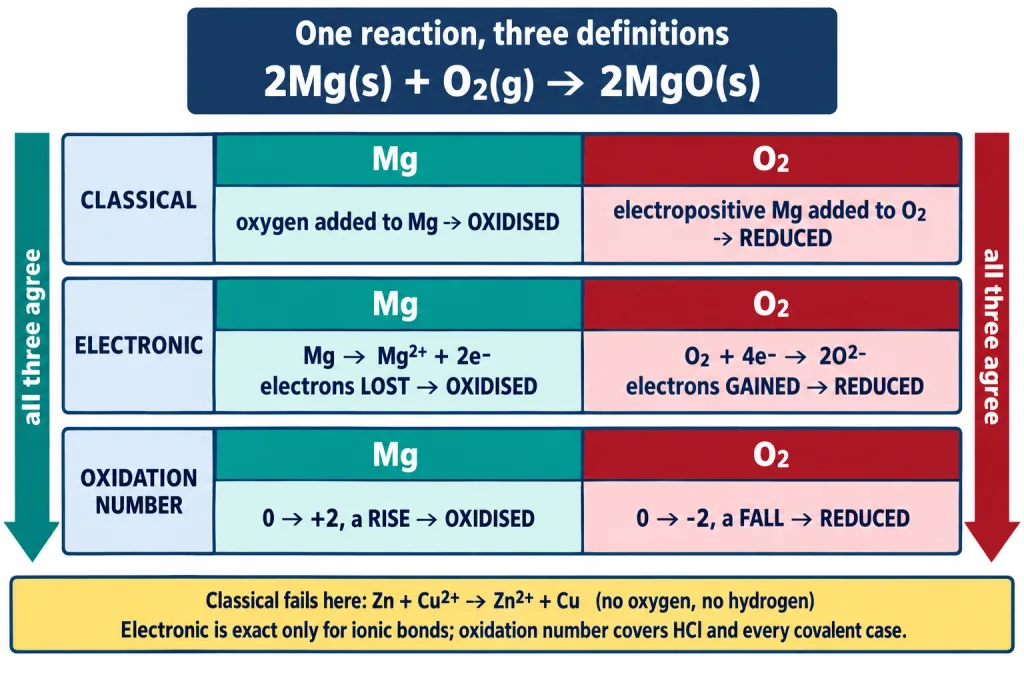
Where each stops. The classical scheme says nothing about , which holds no oxygen and no hydrogen; the electronic definition is exact only for ionic compounds, the shared pair in merely shifting. The oxidation number fixes both gaps by pretence: give every bonding pair to the more electronegative atom, then count charges as if the transfer were complete.
Key Point: Oxidation and reduction always occur together, in the same reaction, at the same time. A half reaction is a bookkeeping device, not a reaction that happens by itself.
Card 2 — The table students most often invert
Key Point: The oxidising agent is the electron acceptor and is itself REDUCED. The reducing agent is the electron donor and is itself OXIDISED.
| Oxidation | Reduction | |
|---|---|---|
| Electrons | lost | gained |
| Oxidation number | rises | falls |
| Classical test | oxygen or an electronegative element added; hydrogen or an electropositive element removed | oxygen or an electronegative element removed; hydrogen or an electropositive element added |
| In a half reaction, sits on the | right | left |
| The species doing this is the | reducing agent | oxidising agent |
| At which electrode | anode | cathode |
The word "oxidising" describes what the agent does to its partner, not what happens to it. Zinc is the reducing agent in and copper is in : the label belongs to the role, never to the element.
The strength rule alongside it. A metal high in the activity series is a strong reducing agent and its cation a weak oxidising agent; low in the series, the reverse. A metal and its own ion are never both strong. Fluorine is the strongest oxidising agent among the halogens, iodide the strongest reducing agent among the halide ions, and lithium the strongest reducing agent in aqueous solution, because of its very large hydration enthalpy, even though caesium has the lowest ionisation enthalpy.
[JEE/NEET] Answer "name the oxidising agent" by finding the species that gained electrons, never by matching the word in the stem to the word in an option.
Card 3 — The oxidation number rules, in priority order
Apply these top down. When two rules give different answers for the same atom, the one higher on the list wins.
Rule 1 — A free element is . , , and every elemental molecule: , , , , , , graphite.
Rule 2 — A monatomic ion equals its charge. is , is , is .
Rule 3 — Fluorine is , always, in every compound.
Rule 4 — Group 1 metals are , group 2 metals are , in all their compounds. Aluminium is always .
Rule 5 — Hydrogen is , except where it is the more electronegative partner, and there it is : bonded to a metal, as in , , , , or to boron, as in .
Rule 6 — Oxygen is , except in the four cases below.
| Situation | Oxygen gets | Examples |
|---|---|---|
| Ordinary compounds | , , , | |
| Peroxides, an O-O single bond | , , , | |
| Superoxides, the ion | , | |
| Bonded to fluorine | positive | gives , gives |
Rule 7 — The sum rule. The oxidation numbers in a neutral molecule add to ; in a polyatomic ion they add to the charge on the ion. totals , totals .
Rules 1 to 6 fix what you know; rule 7 is the equation you solve for what you do not.
The three clashes the priority settles. Rule 3 beats rule 6 in , forcing oxygen to ; rule 4 beats rule 6 in , pushing oxygen to ; rule 4 beats rule 5 in , driving hydrogen to .
The ceiling. A main-group element stops at its group number in groups 1 and 2, and at the group number minus from group 13 onwards: phosphorus at , sulphur at , chlorine at . A transition metal instead stops at the number of and electrons it can lose, which for chromium is six, giving the of chromate and dichromate. An answer above the ceiling means a peroxide linkage was missed. Only fluorine can never go positive.
Card 4 — The twelve trap species, with the one-line reason
| Species | Element | Value | The one-line reason |
|---|---|---|---|
| , Caro's acid | one peroxide linkage: three O at , two at . Blind gives | ||
| , Marshall's acid | one peroxide bridge in . Blind gives | ||
| butterfly : one O at , four at . Blind gives | |||
| superoxide ion , one extra electron over two identical oxygens | |||
| fluorine outranks oxygen and keeps , so oxygen absorbs the rest | |||
| same reason, two oxygens sharing the | |||
| average of one Fe(II) and two Fe(III); | |||
| average along : really | |||
| average along : really | |||
| average of two terminal Br at and one middle Br at | |||
| hydrogen is bonded to boron and beats it for electronegativity, so each H is | |||
| calcium is fixed at by rule 4, so hydrogen is driven negative |
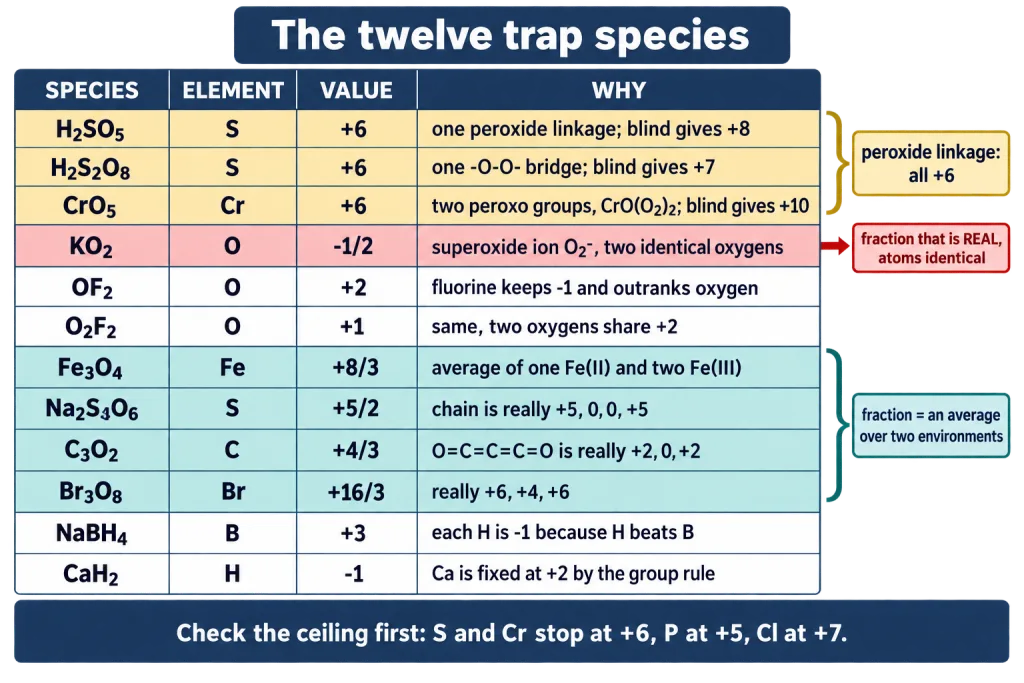
Two habits clear the list. Check the ceiling first, since for sulphur or for chromium should stop you dead and the missing piece is always an O-O bond. Then, whenever you write a fraction, add the whole numbers in half a sentence. The superoxide is the exception: the two oxygens in are identical, so is a genuine per-atom value, as is in .
Three near-traps need no correction. has an bridge, so sulphur is outright. averages but splits , where and split . Ammonium nitrate averages a whole describing neither nitrogen, and .
Card 5 — Stock notation
Key Point (Definition): In Stock notation the oxidation number of an element is written as a Roman numeral in parentheses, placed immediately after the name or symbol of that element, with no space before the bracket. is iron(II) oxide, written .
Roman numeral in capitals, never 2 or ii. No space before the bracket. No sign, though zero is written where it matters, as in nickel(0) tetracarbonyl. In a formula the numeral follows the symbol, . And the rule tested on its own: the numeral is the oxidation number of one atom, so is iron(III) oxide and never iron(VI) oxide, the subscript having already counted the atoms.
Used for Fe, Cu, Sn, Pb, Mn, Cr, Au and Hg; not for Na, K, Mg, Ca, Al, Zn and F, which have one common state each.
| Formula | Stock name |
|---|---|
| / | iron(II) oxide / iron(III) oxide |
| / | copper(I) oxide / copper(II) oxide |
| / | tin(II) chloride / tin(IV) chloride |
| manganese(IV) oxide | |
| potassium manganate(VII), commonly potassium permanganate | |
| / | mercury(I) chloride / mercury(II) chloride |
| gold(III) chloride | |
Name to formula. The numeral gives the charge on one cation: write the anion charge, combine to zero, reduce to lowest whole numbers, so lead(IV) oxide crosses to and reduces to . Mercury(I) chloride is the one place the recipe misleads, the state being the bonded pair , so the formula is .
Card 6 — The four types, with the criterion and one example each
Two questions get asked of any equation. Is it redox at all? Assign oxidation numbers on both sides, and if even one changes, it is. What shape does it have? That is what the four classes name.
| Class | General form | Redox when | Example |
|---|---|---|---|
| Combination | at least one reactant is a free element | ||
| Decomposition | at least one product is a free element | ||
| Displacement | a free element takes the place of a combined one | ||
| Disproportionation | one substance in, two products of the same element | that element ends in both a higher and a lower state |
Metal displacement runs down the activity series, , a metal displacing any below it; the metallurgical versions are , and the thermite . Non-metal displacement takes hydrogen from cold water with the alkali metals and Ca, Sr and Ba, from hot water with magnesium, from steam with iron, and from dilute acid with any metal above hydrogen. Halogen displacement follows , with values , , and , so , and go and no reverse does. Oxygen displacement is the rare one, .
One reaction can carry two honest labels: is a decomposition by shape and a disproportionation by oxidation number. The traps with an ordinary shape and no redox are , its reverse, and , with every neutralisation and precipitation.
[JEE/NEET] The commonest item here asks which of four equations is not redox. Run the oxidation numbers before you look at the shape.
Card 7 — Disproportionation, the fluorine exception, and the reverse
Key Point (Definition): In a disproportionation reaction, one element in a single oxidation state is simultaneously oxidised and reduced, part of it ending in a higher state and part in a lower one.
The two conditions, both worth writing out in an answer.
- The element must start in an intermediate oxidation state, not its highest and not its lowest.
- Both a higher and a lower oxidation state must be accessible to it.
So the substance needs an element with at least three states, sitting in a middle one.
The shortlist.
Cannot disproportionate: anything in its highest state, so , , and can only be reduced; anything in its lowest, so and can only be oxidised.
The fluorine exception. Fluorine never disproportionates, having no positive oxidation state: it is in and in every compound. With cold dilute alkali it gives , and fluorine is in both products; the element oxidised is oxygen, from to .
Key Point (Definition): In a comproportionation reaction, two species holding the same element in a higher and a lower oxidation state react to give one product in which that element is in an intermediate state. It is disproportionation run backwards.
[JEE Main] Two states in and one out is comproportionation; one state in and two out is disproportionation. Read the direction before you name it.
Card 8 — Balancing by the oxidation number method
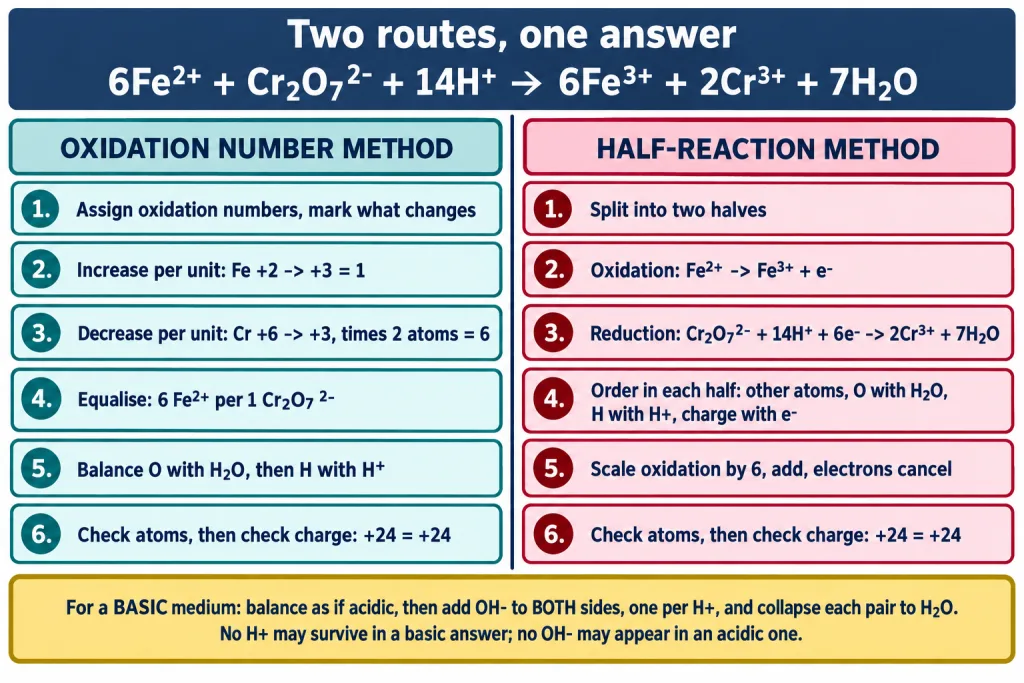
The whole method rests on one identity: total increase in oxidation number = total decrease in oxidation number.
Step 1. Write the skeletal equation with correct formulae for every reactant and product.
Step 2. Assign oxidation numbers to every atom and mark the ones that change. One element goes up and one goes down; in a disproportionation the same element does both.
Step 3. Compute the total increase and the total decrease per formula unit: change per atom multiplied by the number of atoms in the formula unit.
Step 4. Equalise the two totals by multiplying the oxidised and reduced species, the lowest common multiple giving the smallest coefficients.
Step 5. Balance every other atom except H and O.
Step 6. Balance oxygen with , then hydrogen with . Oxygen first, always, because water carries hydrogen with it.
Step 7. Convert to basic medium if the question says basic: add as many to both sides as there are , combine each pair into one , then cancel water now on both sides.
Step 8. Verify. Count every element on both sides, then total the charges on both sides. Both must match.
Step 3 decides the answer. In each chromium falls over two atoms, so the decrease is , not ; in the increase is , not . Iron gives against a dichromate demand of , fixing the ratio; permanganate takes against an oxalate supply of , whose lowest common multiple of fixes the ratio behind every permanganate titration.
If the charge check fails by , the count is almost always wrong by , being the only species added on charge grounds. Use this method for molecular equations and whenever the oxidation numbers are visible at a glance.
Card 9 — Balancing by the half-reaction (ion-electron) method
Step 1. Write the skeletal ionic equation, spectators left out, marking which species is oxidised and which reduced.
Step 2. Split into two half reactions, one line each, carrying only the species holding the atom that changed.
Step 3. Balance each half in this order: (a) every atom except H and O; (b) oxygen with ; (c) hydrogen with ; (d) charge with on the more positive side.
Step 4. Equalise the electrons by the lowest common multiple, then add the halves. Electrons must cancel completely, and so must any or common to both sides.
Step 5. Convert to basic medium if required.
Step 6. Verify atoms, then charge.
Which side the electrons go on. Oxidation is loss, so sits on the right, ; reduction is gain, so it sits on the left, . The fallback that never fails is the charge rule: electrons go on the more positive side.
How the acidic and basic routes differ. Not at all in the first four steps. In acid you balance oxygen with and hydrogen with and stop. In base you do that, then add to both sides as many as there are surviving , collapse each pair into one , cancel duplicated water and divide out any common factor.
Key Point: A basic-medium answer must contain no , and an acidic-medium answer no . Adding hydroxide to one side only is not an identity operation, and the charge check catches it at once.
Disproportionation. The same species is the reactant of both halves: alongside . After equalising, the two terms land on the same side and add rather than cancel.
Prefer this method when the product is unfamiliar, when an average is fractional, when the medium is basic, when the electrons transferred are wanted, and whenever you need the two halves for a cell.
Card 10 — n-factor and equivalent mass for every common reagent
Key Point (Definition): The n-factor of a species is the number of electrons gained or lost per formula unit of that species in that particular reaction. It is a property of the reaction, not of the bottle.
| Species | Change in the reaction | n | Molar mass | Equivalent mass |
|---|---|---|---|---|
| , acidic | ||||
| , neutral or weakly basic | ||||
| , strongly alkaline | ||||
| , acidic | ||||
| Mohr salt | ||||
| with iodine | ||||
| as oxidant | ||||
| as reductant | ||||
| oxidised to | only the one Fe(II) is available |
The mole-ratio form is , and the two routes cannot disagree, normality being only molarity carrying its n-factor around with it. One bottle of is in acid, in neutral or weakly basic solution and in strong alkali: molarity never changes, normality changes with the reaction. For hydrogen peroxide, volume strength normality molarity, so an volume solution is , and .
Card 11 — The three titrations, on one page
| Permanganate | Dichromate | Iodometric | |
|---|---|---|---|
| Reaction | , then | ||
| Mole ratio | ; against iron(II) it is | ; moles of Cu equal moles of thiosulphate | |
| Indicator | none, self-indicating | diphenylamine, an internal redox indicator, added to the flask and oxidised there; the genuine external indicator it replaced was potassium ferricyanide, spotted on a tile | starch, added only near the end point |
| End point | first permanent pale pink tinge | green turning deep blue-violet | the blue colour disappearing |
| Medium | dilute sulphuric acid only; warm to about for oxalate, cold for iron(II) | acid; or both allowed | weakly acidic, cool, titrated without delay |
| Standard | is a secondary standard | is a primary standard | thiosulphate standardised against dichromate |
Why the acid matters. Permanganate at sits above the chlorine couple at , so it oxidises chloride as well as the sample and the result comes out high. Nitric acid is an oxidant itself and attacks the reductant before the titration begins, so its result comes out low. Dichromate at sits just below the chlorine couple, cannot oxidise chloride, and tolerates hydrochloric acid.
Permanganate must be standardised on the day of use, against oxalic acid dihydrate of equivalent mass or sodium oxalate, since commercial crystals carry and the solutions decompose slowly. Dichromate needs no standardising.
Iodimetry against iodometry. Iodimetry titrates a reductant directly against standard iodine, iodine in the burette; iodometry liberates iodine from iodide with an oxidant, then titrates it with thiosulphate. Starch goes in only at pale straw yellow, since iodine added early binds inside the amylose helix, the blue fades late and the reading is high. Dichromate, iodine and thiosulphate react in the ratio .
Card 12 — Electrode processes
Cell notation. The anode goes on the left, the cathode on the right. A single bar is a phase boundary, a double bar the salt bridge, a comma a separation within one phase.
When neither form of a couple can serve as its own electrode, an inert conductor is written at the far end: .
Key Point (Definition): The anode is the electrode at which oxidation occurs; the cathode is the electrode at which reduction occurs. This holds in every cell of every kind.
| Galvanic (spontaneous) | Electrolytic (driven) | |
|---|---|---|
| Anode | oxidation, negative | oxidation, positive |
| Cathode | reduction, positive | reduction, negative |
| Energy | chemical to electrical | electrical to chemical |
The reaction labels never move; only the sign flips. An ox for anode-oxidation, red cat for reduction-cathode. The salt bridge completes the circuit, maintains neutrality in both solutions and keeps them from mixing, its anions going to the anode compartment and its cations to the cathode compartment.
The standard hydrogen electrode, at on platinised platinum, runs and is assigned exactly by convention, not by measurement. Every other value came from a cell built against it.
with both values taken as reduction potentials straight from the table, unmultiplied. Positive means spontaneous as written; negative means the reverse is.
Key Point: is intensive. still has , not , because potential is energy per unit charge and doubling the reaction doubles both. Reversing a half reaction flips the sign; multiplying it never does.
In electrolysis an external source drives a reaction with a negative . Molten gives sodium at the cathode and chlorine at the anode; brine gives hydrogen instead, water at being far easier to reduce than at , while chlorine still comes off at the anode because oxygen carries a large overvoltage.
Card 13 — The electrochemical series, and the three things to read off it
Standard reduction potentials at , most positive first.
| Reduction half reaction | / V |
|---|---|
One: strength. A large positive marks a strong oxidising agent, fluorine at heading the table; a large negative marks a strong reducing agent, lithium at being the strongest in aqueous solution.
Two: the reactivity series, free. The metal couples carry the activity series quoted in every book, ; that quoted list leaves out lithium, which its puts above potassium, and chromium, which its puts between zinc and iron. Among the non-metals the halogens rank as oxidants, the halide ions the other way round, .
Three: whether a reaction goes. Make the species reduced the cathode, subtract, read the sign. Daniell ; zinc with ; copper with ; iron with ; silver with , so a silver spoon is safe in copper sulphate. A metal liberates hydrogen from dilute acid only if its own is negative.
Card 14 — The fifteen mistakes that cost marks
- Swapping the two agents: the oxidising agent is the species reduced, the reducing agent the species oxidised.
- Calling a whole reaction "an oxidation" instead of naming which species is oxidised and which reduced.
- Applying rule 6 before rules 3, 4 and 5, so , and all come out wrong.
- Missing a peroxide linkage, giving for , for or for instead of every time.
- Ignoring the subscript on the unknown element, so gives and gives .
- Setting the sum to zero for a polyatomic ion, when sums to and to .
- Quoting a fractional average as the state of a real atom, when no iron in is at .
- Adding the Roman numerals of all the atoms, so becomes iron(VI) oxide instead of iron(III) oxide.
- Labelling a combination or decomposition redox without checking, when changes no oxidation number.
- Claiming a species in its highest state disproportionates, or calling the fluorine and alkali reaction a disproportionation when it is oxygen that is oxidised.
- Balancing hydrogen before oxygen, or adding electrons before the atoms are done, so every later count is stale.
- Leaving in a basic-medium answer, or adding to one side only.
- Treating normality as a property of the bottle, when the same permanganate is , or according to the medium.
- Dividing Mohr salt by six, using for oxalic acid dihydrate when the crystals weigh , or forgetting to multiply an aliquot back up to the full volume.
- Multiplying by the number of electrons, adding the two potentials instead of subtracting, or subtracting anode minus cathode.
Three more cost as much: assuming a reaction needs oxygen to be redox; expecting dihydrogen from copper and nitric acid, when the gas is an oxide of nitrogen; and saying the iodometric end point is the appearance of blue, when the blue disappears.
Card 15 — The last sixty seconds
Definitions. Oxidation: loss of electrons, oxidation number rises. Reduction: gain, oxidation number falls. Oxidising agent is reduced; reducing agent is oxidised. A half reaction is bookkeeping only.
Rules, in priority. Free element . Monatomic ion equals its charge. F always . Group 1 , group 2 , Al . H is except when bonded to a metal or to boron. O is except in peroxides, in superoxides, in and in . Sum for a molecule, charge for an ion.
Fractions and traps. , really ; , really ; ; ; , and that one is real. The peroxo trio , and all give .
Four types. Combination is redox if a reactant is a free element, decomposition if a product is; displacement runs from the more reactive element to the less; disproportionation needs an intermediate state with a higher and a lower both accessible, and fluorine never qualifies.
Balancing. Total increase total decrease, change per atom times number of atoms. Oxygen with , hydrogen with , charge with , in that order; for base add to both sides afterwards. Verify atoms, then charge.
Arithmetic. Equivalent mass molar mass ; normality molarity ; , or . Volume strength .
n-factors. , , with equivalent masses , , ; , equivalent mass ; oxalic acid dihydrate , equivalent mass ; and Mohr salt , equivalent masses and ; thiosulphate ; ; either way, equivalent mass .
Ratios. ; ; ; ; ; moles of Cu moles of thiosulphate.
Molar masses. , , , Mohr salt , , , , , .
Cells. Anode left, oxidation, negative in a galvanic cell and positive in electrolysis. , positive means spontaneous, is intensive, SHE is by definition. Daniell , with , with , with . Series: ; ; .
Card 16 — One question per topic, a five-minute self-check
Question 1: The three definitions
Which species is oxidised in ?
Answer:
Each ferrocyanide unit loses one potassium, and removal of an electropositive element is oxidation.
Ans: The ferrocyanide; hydrogen peroxide is reduced.
Question 2: Agent or victim
Is hydrogen peroxide oxidised or reduced when it acts as an oxidising agent?
Answer:
An oxidising agent takes the electrons its partner gives away, and taking electrons is reduction.
Ans: Reduced, to water, with an n-factor of .
Question 3: Rule priority
Why is oxygen in but in ?
Answer:
Fluorine is in every compound and outranks the oxygen rule; chlorine is less electronegative than oxygen, so no clash arises.
Ans: Only fluorine can force oxygen positive.
Question 4: A trap species
Sulphur in .
Answer:
All eight oxygens at would give , above the ceiling; the bridge puts two of them at .
Ans: .
Question 5: Stock notation
Name and .
Answer:
Each copper is and each mercury is , the cation being , and the numeral describes one atom.
Ans: Copper(I) oxide and mercury(I) chloride.
Question 6: Reaction type
Classify .
Answer:
A free element, aluminium, has taken the place of iron in its oxide.
Ans: Metal displacement, aluminium oxidised and reduced.
Question 7: Disproportionation
Which of , and cannot disproportionate?
Answer:
Chlorine is , and , and only has nowhere higher to go.
Ans: , which can only be reduced.
Question 8: Oxidation number method
In , what is the total decrease per dichromate ion?
Answer:
Each chromium falls , and the ion holds two of them.
Ans: , which fixes the ratio.
Question 9: Half-reaction method
How many electrons appear in in acid, and on which side?
Answer:
Three waters left and six right leave the right at against , so electrons go on the right.
Ans: Six, on the right, bromine climbing from to .
Question 10: Titration and cell arithmetic
Give the normality and equivalent mass of in strong alkali, then for .
Answer:
In strong alkali permanganate goes only to manganate(VI), so ; for the cell, silver is the cathode and the silver potential is not doubled.
Ans: , equivalent mass ; .