
What this chapter is worth in a NEET paper
Redox is a small chapter with a fixed shopping list. The paper does not want a derivation. It wants a number, fast and right the first time, because there is no second pass.
Ranked by the marks they carry:
- Assigning an oxidation number. The single biggest item. It appears on its own, and buried inside a p-block or d-block question where the redox step is only the first line of the working.
- Naming the oxidising agent and the reducing agent in a given equation.
- Sorting a reaction into one of the four types, with disproportionation the one actually tested.
- Recognising a standard oxidant or reductant and the product it gives — permanganate in three media, dichromate, nitric acid at two concentrations, hydrogen peroxide on both sides.
- Simple balancing, usually a coefficient of or a count of electrons, not a full ion-electron write-up.
- Reading the electrochemical series — which metal displaces which, which metals give hydrogen with dilute acid, and a one-subtraction cell EMF.
What comes up far less: long titration numericals with burette readings and percentage purity. The equivalent-mass arithmetic is worth knowing as a one-line recall, not as a half-page calculation. Short of revision time, drill oxidation numbers first and titration arithmetic last.
Key Point: The oxidising agent is reduced and the reducing agent is oxidised. Students lose a free mark by swapping these two. The agent that does the oxidising is the one whose own oxidation number falls.
[NEET] Every item here is written to be finished in under forty seconds. If a method takes you longer than that, it is the wrong method for this paper.
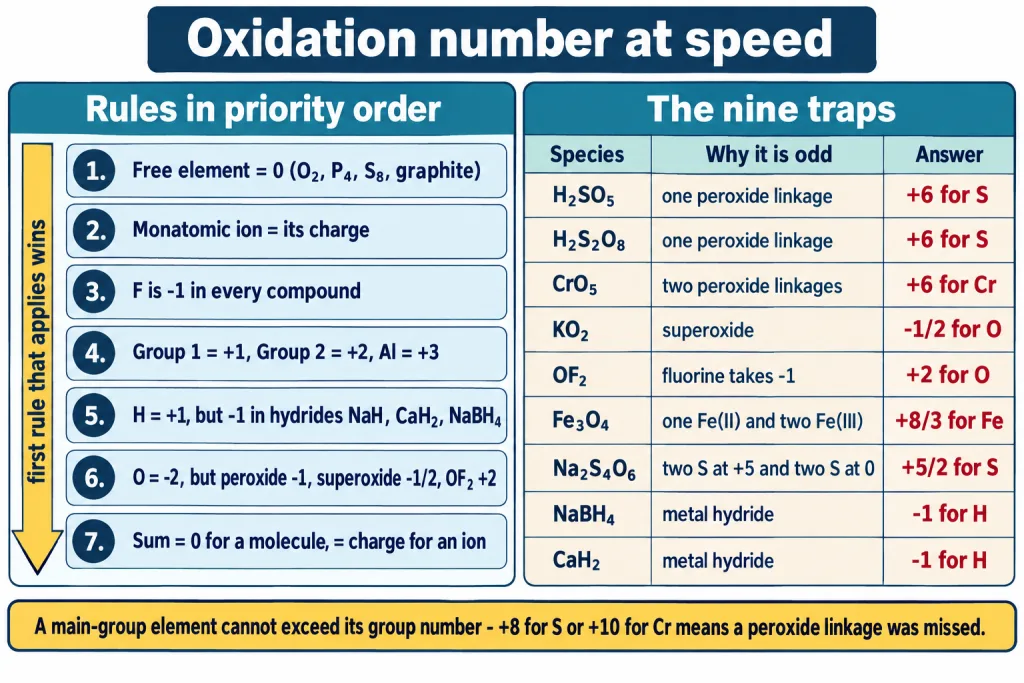
The rule card, in priority order
Apply these top down. The first rule that applies to an atom wins.
- Free element , including , , , and graphite.
- Monatomic ion its charge. is , is .
- Fluorine is in every compound. No exceptions ever.
- Group 1 metals , group 2 metals , aluminium .
- Hydrogen , except in a metal hydride (, , , ) where it is .
- Oxygen , except peroxides (, , ) , superoxides () , , .
- Sum the lot. Zero for a neutral molecule, the charge for an ion.
Three shortcuts that save real seconds:
- Fix halogen at and oxygen at , then solve for the leftover atom. In set and read straight off.
- A main-group element cannot exceed its group number in groups 1 and 2, or the group number minus from group 13 onwards. So sulphur, in group 16, stops at , and chlorine, in group 17, at . Getting for sulphur means a peroxide linkage has been missed. That one check catches most of the traps below.
- Neutral molecular ligands contribute nothing. In carbon monoxide is neutral, so nickel is .
Key Point: Oxidation number is a formal bookkeeping charge assigned by rules. It is not the real charge on the atom, and it is allowed to be fractional or zero.
The speed drill: twenty-nine species, one line each
Cover the right-hand column, work down, and time yourself. Anything slower than five seconds per row goes on a flashcard.
| Species | Working in one line | Answer |
|---|---|---|
| Cr in | ||
| Mn in | ||
| Mn in | ||
| Mn in | ||
| S in | ||
| S in | ||
| S in | ||
| S in | one peroxide link: | |
| S in | one peroxide link: | |
| Cr in | two peroxide links: | |
| O in or | peroxide | |
| O in | superoxide: | |
| O in | F wins at : | |
| Fe in | ||
| H in | metal hydride; boron is then | |
| H in | metal hydride | |
| N in | two environments, worked separately | and |
| N in | ||
| N in | ||
| C in | ||
| C in | ||
| Cl in | ||
| Cl in | two environments: | and |
| P in | ||
| Br in | ||
| Xe in | ||
| Os in | ||
| Fe in | ||
| Ni in | carbonyl is a neutral ligand |
The nine that decide the mark. and give , never or : one linkage each. gives , never : two peroxide linkages, one ordinary oxygen. gives , gives , gives , gives , and and both give hydrogen .
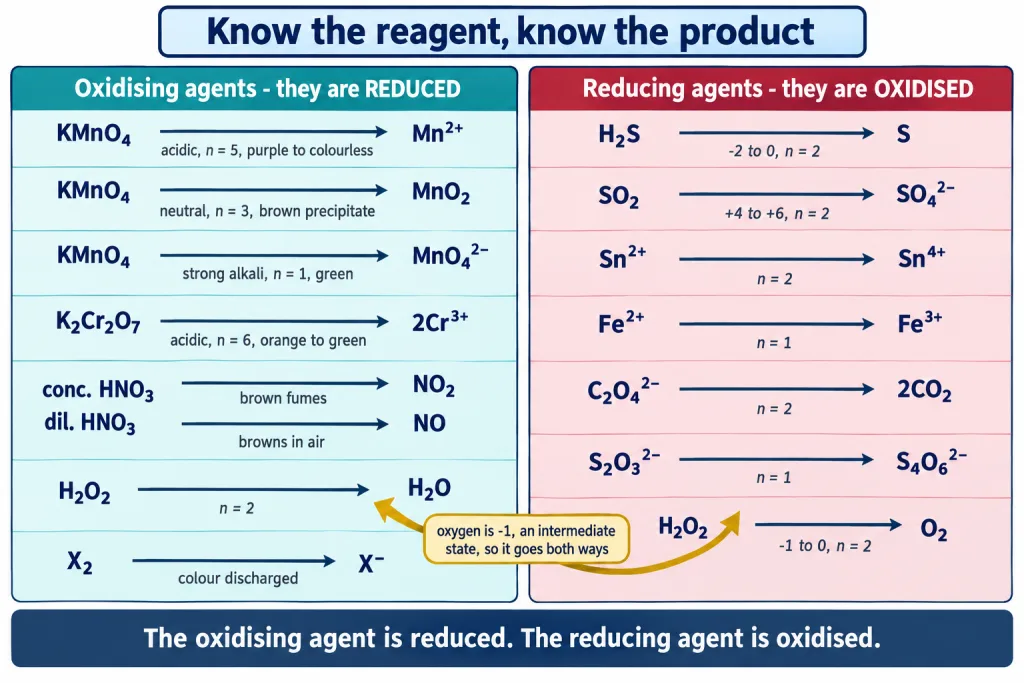
Oxidising agents and the product each one gives
Memorise the pair, not the reagent alone. The question usually gives the reagent and asks for the product, or gives the product and asks for the medium.
| Oxidising agent | Conditions | Product and cue | |
|---|---|---|---|
| acidic, dilute | , purple to colourless | ||
| neutral or weakly alkaline | , brown precipitate | ||
| strongly alkaline | , purple to green | ||
| acidic | , orange to green | ||
| conc. | with a metal | , brown fumes | |
| dil. | with a metal | , browns in air | |
| acting as oxidant | |||
| any | |||
| (halogen) | any | , colour discharged | |
| conc. | hot, with a metal | , choking gas | |
| aqueous | , yellow to pale green | ||
| conc. , warm | and |
The three permanganate rows are the ones that get confused. The more alkaline the medium, the smaller the drop: in acid, in neutral, in strong alkali. The -factor is the size of that drop, and the equivalent masses are , and .
Both should be writable from memory in ten seconds, and included. Coefficient questions live inside them.
[NEET] A high oxidation number does not by itself make a strong oxidising agent. Sulphur is in both and , and only one is an oxidant.
Reducing agents and the product each one gives
| Reducing agent | Product | Change | |
|---|---|---|---|
| or | |||
| metal | |||
Two rows repay attention. Oxalate loses two electrons per ion because it has two carbons, which fixes the permanganate to oxalate ratio at . Thiosulphate loses only one: two thiosulphate ions, four sulphurs at an average , become one tetrathionate ion, four sulphurs at an average , so one electron leaves per thiosulphate and . That fixes the iodine to thiosulphate ratio at .
Key Point: is the standard both-ways species. Oxygen in it is , an intermediate state, so it can fall to as an oxidant, giving water, or rise to as a reductant, giving oxygen gas. Its -factor is either way, and , and behave alike.
Worked at NEET pace
Question 1: The three sulphur traps in one go
Give the oxidation number of sulphur in , and .
Answer:
Caro's acid, , is : two peroxide oxygens at , three ordinary at . So and .
Marshall's acid, , has one peroxide link joining two sulphur centres: , so each sulphur is .
Tetrathionate has no peroxide link, so plain rules apply: gives .
Ans: , , . Watch out: Sulphur cannot pass . Getting or signals a missed peroxide linkage.
Question 2: Chromium in
Why is chromium in and not ?
Answer:
The blue peroxo compound has a butterfly structure: two side-on peroxide linkages, so four oxygens at , plus one doubly bonded oxygen at . That gives , so .
Treating all five oxygens as gives , impossible for a group 6 element.
Ans: .
Question 3: Oxidant and reductant named
In , name the oxidising and the reducing agent.
Answer:
Copper goes , so it rises, so it is oxidised, so copper is the reducing agent. Nitrogen goes in to in , so it falls, so nitric acid is the oxidising agent.
Only two of the eight nitric acid molecules are reduced; the other six leave as nitrate at .
Ans: is the oxidising agent, is the reducing agent. Watch out: The species that is reduced is the oxidising agent. Say that sentence once before ticking the box.
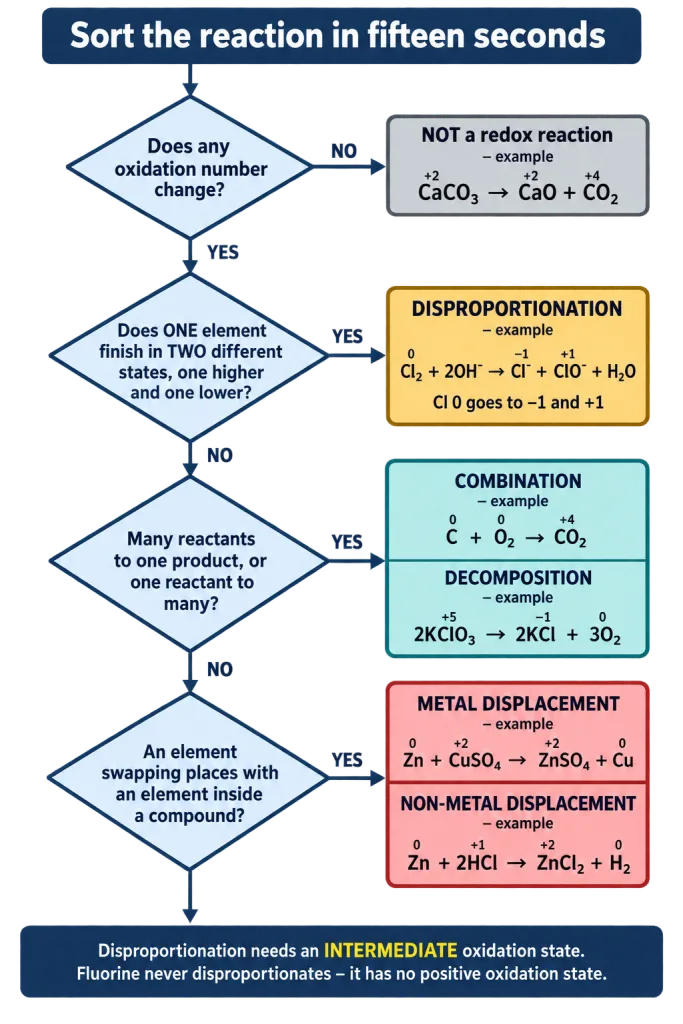
Sorting a reaction in fifteen seconds
Run these four checks in order and stop at the first one that fires.
Check 1 — is anything moving? Scan for a free element on either side, or a change in a familiar oxidation number. If nothing moves, the reaction is not redox and none of the four names apply. and both die here.
Check 2 — does one element finish in two places? If the element that changed started in a single state and appears in the products in two different states, one higher and one lower, the answer is disproportionation. This check comes second because it beats the other names when both would fit.
Check 3 — count the formulae. Several reactants to one product is combination; one reactant to several is decomposition. Either is redox only if a free element appears on the reactant side or the product side respectively.
Check 4 — element plus compound? An element swapping places with an element inside a compound is displacement: metal displacement if a metal is displaced, non-metal displacement if hydrogen or a halogen is.
Key Point: Disproportionation needs the element to start in an intermediate oxidation state — one with a higher state and a lower state both available to it. An element already at its maximum, or already at its minimum, cannot disproportionate.
Twenty on sight
| Reaction | Type | Reason in one line |
|---|---|---|
| combination | two elements in, one compound out | |
| combination | C | |
| combination | both reactants free elements | |
| combination, not redox | Ca , C , O throughout | |
| decomposition | Cl , O | |
| decomposition | both products free elements | |
| decomposition | H , Na | |
| decomposition, not redox | nothing changes | |
| decomposition | both products elemental | |
| metal displacement | zinc above copper | |
| metal displacement | iron above copper | |
| metal displacement | thermite; aluminium above chromium | |
| non-metal displacement | hydrogen from acid | |
| non-metal displacement | hydrogen from water | |
| non-metal displacement | stronger halogen displaces weaker | |
| disproportionation | Cl and | |
| disproportionation | O and | |
| disproportionation | Mn and | |
| disproportionation | Cu and | |
| disproportionation | P and |
Two rows are worth staring at. The calcium carbonate pair appears twice, forwards and backwards, and neither direction is redox. The thermite reaction is a metal displacement despite looking like a furnace process, because aluminium sits above chromium in the activity series.
The disproportionation shortlist
Learn these six as a block. Between them they cover almost everything asked.
The chlorine pair is a favourite because the product depends on conditions: cold and dilute gives hypochlorite, hot and concentrated gives chlorate. Charge balances in both, the second at each side.
Which species can. Anything in a middle state: , , , , , , , , , , .
Which cannot. Anything pinned at the top: (), (), (), (), (). Anything pinned at the bottom: , , .
The fluorine exception. Fluorine, the most electronegative element, has no positive oxidation state. It runs from down to and no further up, so it can never disproportionate. The trap is this reaction:
It looks exactly like chlorine in alkali, and it is not the same. Fluorine is in both and , so every fluorine atom has simply been reduced. The element oxidised is oxygen, climbing from in hydroxide to in .
Worked at NEET pace, continued
Question 4: Permanganate in three media
Potassium permanganate meets a reducing agent in (a) dilute sulphuric acid, (b) neutral solution, (c) strong alkali. Give the manganese product, its oxidation number, the colour and the -factor.
Answer:
(a) Acid takes manganese down to , . The drop is , so , and purple fades to colourless.
(b) Neutral or weakly alkaline stops at , . The drop is , so , and a brown precipitate forms.
(c) Strong alkali gives manganate, , . The drop is , so , and the solution turns green.
Ans: (a) , , colourless, ; (b) , , brown, ; (c) , , green, . Watch out: Equivalent masses follow at once: , and .
Question 5: Five reactions, sixty seconds
Classify: (a) , (b) , (c) , (d) , (e) .
Answer:
(a) One in, three out, oxygen appears free — decomposition, redox.
(b) One product from two reactants, but calcium stays , oxygen , hydrogen — combination, not redox.
(c) Copper starts at and finishes at both and — disproportionation.
(d) Chlorine has pushed iodine out of the iodide — non-metal displacement.
(e) Aluminium has pushed chromium out of its oxide — metal displacement.
Ans: (a) decomposition, (b) combination but not redox, (c) disproportionation, (d) non-metal displacement, (e) metal displacement.
Question 6: Which can disproportionate
From , , and , pick the ones that can disproportionate.
Answer:
Chlorine is , , and in that order. Perchlorate sits at chlorine's ceiling of , so it cannot rise. Chloride sits at the floor of , so it cannot fall. The other two are intermediate and can go both ways.
Charges check at and on both sides.
Ans: and . Watch out: A species at its highest state can still be a fine oxidising agent. It simply cannot disproportionate, which would need it to be oxidised as well.
The electrochemical series, read for marks
Reduction potentials at 298 K, the numbers the paper works with:
| Half reaction | / V |
|---|---|
The five facts the paper takes from this table.
1. Which metal displaces which. A metal displaces from solution any metal below it in the activity series . Zinc displaces copper from copper sulphate — blue fades, red-brown copper settles on the strip, the beaker warms. Copper does not displace zinc, but it does displace silver from silver nitrate.
2. Which metals give hydrogen with dilute acid. Any metal above hydrogen, meaning any with a negative : potassium through lead. Copper, silver and gold do not. Copper still dissolves in nitric acid, but there nitrate does the oxidising, not , and the gas is or .
3. The extremes. Fluorine, at , is the strongest oxidising agent here; lithium, at , the strongest reducing agent. Among halide ions iodide is the best reducing agent, since has the lowest potential of the four.
4. Why lithium and not caesium. Caesium has the lowest ionisation enthalpy, so in the gas phase it parts with its electron most easily. In water the whole cycle counts, including hydration, and the tiny lithium ion has an enormous hydration enthalpy that more than repays its larger ionisation enthalpy. Lithium is the strongest reducing agent in aqueous solution, and that qualifier is the whole answer.
5. Reading a cell. , both as reduction potentials, and positive means it runs as written.
Key Point: is intensive. Doubling a half reaction does not double its potential. Multiplying by the number of electrons is the most expensive single mistake in this part of the chapter.
Worked at NEET pace, continued
Question 7: Which metals give hydrogen
From , , and , which liberate hydrogen from dilute hydrochloric acid?
Answer:
Hydrogen is the reference at V. A metal liberates hydrogen only if its own is negative, since the cell then comes out positive.
Magnesium is V and zinc V, both negative, so both work. Copper is V and silver V, so neither does.
Ans: Magnesium and zinc.
Question 8: A cell EMF in one subtraction
Find for .
Answer:
Zinc is oxidised, so zinc is the anode; silver ion is reduced, so silver is the cathode.
Ans: V, spontaneous as written. Watch out: The silver half reaction was multiplied by two to balance electrons, and its stays V. Using gives V, which is wrong.
Question 9: Ferric ion against two halides
Will oxidise ? Will it oxidise ?
Answer:
is V. With at V, iron as cathode gives V, positive, so iodide is oxidised and iodine is released.
With at V, the same subtraction gives V, negative, so nothing happens.
Ans: Yes for iodide, no for bromide.
Question 10: Why the acid in a permanganate titration must be sulphuric
Explain, using potentials, why hydrochloric acid is not used to acidify a permanganate titration but is acceptable for a dichromate one.
Answer:
is V and is V. Permanganate as cathode against chloride as anode gives V, positive, so permanganate oxidises chloride to chlorine. Permanganate is then spent on the acid and the titre reads high.
is V, below V, so that cell is V and dichromate leaves chloride alone.
Ans: Permanganate oxidises chloride, dichromate does not. Watch out: Nitric acid is barred from both, because nitrate is itself an oxidising agent.
Assertion-reason: the seven that keep coming back
The four responses never change: both true with the reason explaining; both true with the reason not explaining; assertion true and reason false; assertion false and reason true. Work the assertion first, then the reason, and only then ask whether one causes the other.
1. A: Fluorine does not undergo disproportionation. R: Fluorine has no positive oxidation state. Both true, reason explains. Disproportionation needs one element to rise and fall at once; the most electronegative element can only fall, from to .
2. A: Sulphur is in . R: contains one peroxide linkage. Both true, reason explains. Two peroxide oxygens count each instead of , lifting the sum by and dropping sulphur from to .
3. A: Copper does not liberate hydrogen from dilute hydrochloric acid. R: The standard potential of is V. Both true, reason explains. A positive puts copper below hydrogen, so cannot oxidise it.
4. A: Lithium is the strongest reducing agent in aqueous solution. R: Lithium has the lowest ionisation enthalpy among the alkali metals. Assertion true, reason false. Caesium has the lowest ionisation enthalpy; lithium wins in solution on hydration enthalpy.
5. A: Multiplying a half reaction by two doubles its standard electrode potential. R: Standard electrode potential is an intensive property. Assertion false, reason true — and the reason is exactly why the assertion fails. Potential is energy per unit charge, and scaling the equation scales both.
6. A: Iron in has oxidation number . R: contains equal numbers of iron(II) and iron(III). Assertion true, reason false. Magnetite is , holding one iron(II) per two iron(III), and the average is .
7. A: Hydrogen peroxide can act as both an oxidising and a reducing agent. R: Oxygen in hydrogen peroxide is in the intermediate state . Both true, reason explains. Oxygen can drop to giving water, or climb to giving oxygen gas.
How a wrong reason is built. Almost every false reason here is a true statement about something else, moved one step sideways: caesium's ionisation enthalpy where hydration enthalpy belongs, "equal numbers" of two oxidation states where the ratio is . If the reason is a fact you recognise, check it is a fact about this assertion.
Worked at NEET pace, continued
Question 11: Electrons transferred without balancing anything
How many electrons are transferred when one mole of oxidises in acid, and how many moles of react?
Answer:
Chromium falls to , a drop of , and there are two chromium atoms, so six electrons per dichromate ion. Iron rises to , one electron each, so six iron(II) ions are needed.
Charge check: each side.
Ans: Six electrons, six moles of .
Question 12: The coefficient of
In the balanced acidic equation for oxidising , what is the coefficient of ?
Answer:
Permanganate takes five electrons each, oxalate gives two each, so the lowest common multiple is ten: two permanganate and five oxalate.
Eight oxygens are spare on the left once the products are set, and each takes two hydrogens, so sixteen . Charge check: on both sides.
Ans: .
Question 13: Both agents in one equation
In , is hydrogen peroxide the oxidant or the reductant?
Answer:
Oxygen in is and ends at in water, so it falls, so hydrogen peroxide is reduced and is the oxidising agent. Iodide rises from to , so iodide is the reducing agent.
Ans: Hydrogen peroxide is the oxidising agent here. Watch out: With acidified permanganate the same reagent goes the other way, , giving oxygen gas as the reducing agent. The label depends on the partner, never on the formula alone.
Sixty seconds before the paper
These go missing under time pressure, not for want of learning.
- Oxidising agent is reduced; its number falls. Reducing agent is oxidised; its number rises.
- Fluorine is in every compound, including , where oxygen is therefore . : . Peroxides: .
- Hydrogen is in , , , .
- and : sulphur . : chromium . Peroxide linkages, every time.
- gives ; gives ; gives ; gives .
- Permanganate: acid , ; neutral , ; strong alkali , .
- Dichromate in acid , , with in the equation.
- Concentrated nitric acid gives ; dilute gives .
- is an oxidant when it gives and a reductant when it gives ; either way.
- Thiosulphate loses one electron per ion, so . Oxalate loses two, so .
- Disproportionation needs an intermediate state. Fluorine never disproportionates.
- A decomposition or combination is redox only if a free element appears on one side.
- Metals with a negative liberate hydrogen from dilute acid; copper, silver and gold do not.
- Strongest oxidant in the table: at V. Strongest reductant: at V.
- Lithium wins in water on hydration enthalpy; caesium wins on ionisation enthalpy in the gas phase.
- , both as reduction potentials. Daniell cell V, and is never multiplied by the number of electrons.
- Balance atoms and charge, and leave no in a basic medium answer.
- Molar masses to have ready: , , Mohr salt , , .