
What This Set Is
Everything the chapter taught you meets here. Forty worked questions, numbered straight through, arranged so that each group leans on the one before it. The first few are one-line oxidation numbers. The last few are full back-titrations and cell EMFs.
Work them with a pen. Cover the answer, try the question, then read the working and see where your route differed from mine. A question you only read is a question you have not done.
Three habits are worth building while you work through this set.
Write the oxidation number over every atom that could change, before you do anything else. Half the mistakes in this chapter are made in the first ten seconds, by guessing which atom is the interesting one.
Check charge as well as atoms. An equation can have every atom matched and still be wrong. Add up the charge on the left, add it up on the right, and make the two agree before you call it balanced.
Say out loud which species is the oxidant. The oxidising agent is the one that is reduced. Students lose more marks to that single swap than to any calculation error in the chapter.
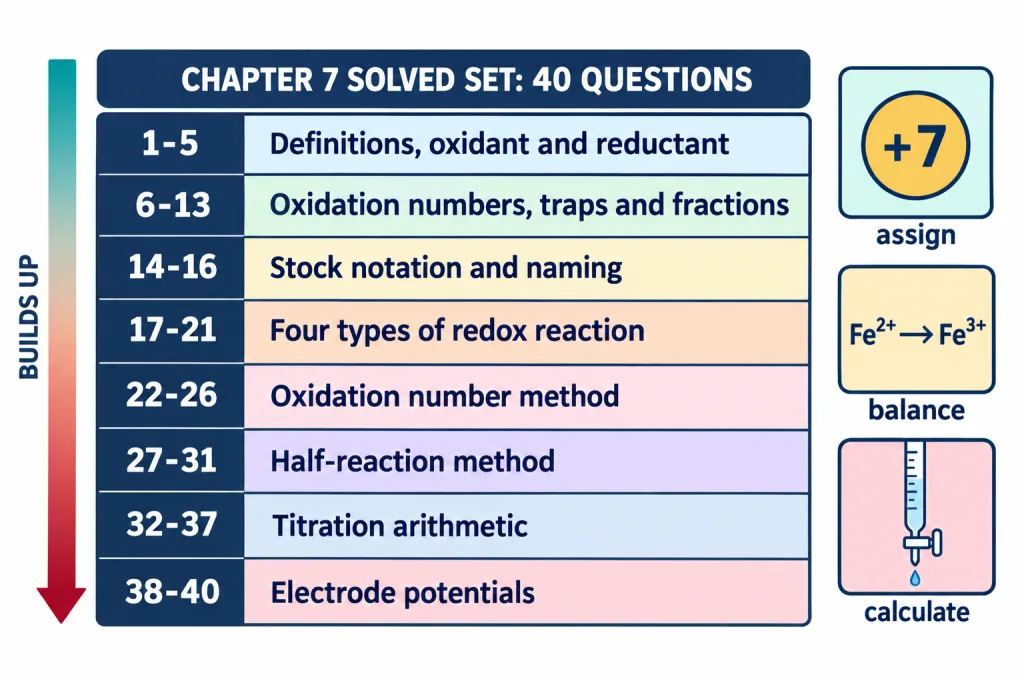
| Questions | Topic | What it tests |
|---|---|---|
| 1-5 | Classical and electronic definitions | Reading a reaction three ways and naming the oxidant and the reductant |
| 6-13 | Oxidation number assignment | The rules in priority order, the peroxide-linkage traps and the fractional cases |
| 14-16 | Stock notation and naming | Turning an oxidation number into a Roman numeral, and a name back into a formula |
| 17-21 | Types of redox reaction | Combination, decomposition, displacement, disproportionation and the non-redox impostor |
| 22-26 | Oxidation number method | Equalising rise and fall, then finishing with water, hydrogen ion or hydroxide |
| 27-31 | Half-reaction method | Splitting, balancing each half separately, matching electrons and adding back |
| 32-37 | Titration arithmetic | n-factor, equivalent mass, mole-ratio chains and a back titration |
| 38-40 | Electrode potentials | Cell EMF, spontaneity and why one acid is banned from a permanganate flask |
Key Point: The three definitions must agree on every example. If the classical reading says a species is oxidised, the electron count and the oxidation number must say the same thing. Whenever they disagree, one of them has been read wrongly.
[JEE/NEET] Oxidation number assignment and balancing carry the most marks per minute in this chapter. Questions 6 to 31 are the ones to repeat until they are automatic.
Classical and Electronic Definitions
Question 1: Magnesium burning in carbon dioxide
A strip of burning magnesium keeps burning when it is lowered into a jar of carbon dioxide, leaving white powder and black specks.
Read this reaction by all three definitions and name the oxidant and the reductant.
Answer:
Classical first. Magnesium picks up oxygen, so magnesium is oxidised. Carbon dioxide loses its oxygen and comes out as black carbon, so carbon dioxide is reduced.
Electronic next. Magnesium metal ends up as in magnesium oxide, so each magnesium atom hands over electrons. Those electrons go to carbon.
Oxidation number last. Magnesium goes from to , a rise. Carbon goes from in to in free carbon, a fall of . Oxygen stays at throughout.
All three readings agree. Two magnesium atoms rise by each, giving ; one carbon falls by . The electron count matches.
The species that is reduced is the oxidising agent, so carbon dioxide is the oxidant. The species that is oxidised is the reducing agent, so magnesium is the reductant.
Ans: is oxidised and is the reducing agent; is reduced and is the oxidising agent. Watch out: Carbon dioxide is normally thought of as a fire extinguisher. Here it is the oxidant, because magnesium is hungry enough for oxygen to strip it from carbon.
Question 2: Hydrogen sulphide and chlorine
Which reactant is oxidised? Answer once by the hydrogen rule and once by oxidation numbers.
Answer:
By the hydrogen rule: loses its hydrogen and comes out as sulphur, and removal of hydrogen is oxidation. Chlorine takes that hydrogen up as , and addition of hydrogen is reduction.
By oxidation numbers: sulphur in is , since hydrogen is and the molecule is neutral. Free sulphur is . So sulphur climbs by . Chlorine starts at as the free element and ends at in , a fall of per atom, or for the molecule.
Rise of against fall of . The two readings agree.
Ans: is oxidised and is the reductant; is reduced and is the oxidant.
Question 3: Tin(II) with iron(III)
Split this into half reactions, check the charge, and name the oxidant and the reductant.
Answer:
Tin goes from to , so it loses electrons. That is the oxidation half:
Iron goes from to , so it gains one electron per ion. Two ions are involved, so I write:
Two electrons released, two electrons absorbed. Adding the halves cancels them and gives back the overall equation.
Charge check on the overall equation. Left: . Right: . They match.
Neither half happens by itself. A half reaction is only a bookkeeping device that lets me count electrons; the electrons never appear in the real flask on their own.
Ans: is oxidised and is the reducing agent; is reduced and is the oxidising agent.
Question 4: Naming the agents in three reactions
Name the oxidising and the reducing agent in each.
(i)
(ii)
(iii)
Answer:
(i) Potassium goes , a rise, so potassium is oxidised. Chlorine goes , a fall, so chlorine is reduced. Each potassium hands one electron to chlorine.
(ii) Copper goes , a fall. Hydrogen goes , a rise. Classical reading agrees: copper oxide loses oxygen and hydrogen gains it.
(iii) Iron goes over two atoms, so electrons are gained in total. Carbon goes in to in , losing each, and there are three of them, so electrons are lost. The counts match.
In every case the reduced species is the oxidant.
Ans: (i) oxidant , reductant ; (ii) oxidant , reductant ; (iii) oxidant , reductant . Watch out: In (iii) carbon monoxide is the reductant even though it contains oxygen. What matters is the change in oxidation number, not whether the formula looks reduced.
Question 5: Hydrogen peroxide, both ways round
Decide what hydrogen peroxide is doing in each reaction.
(a)
(b)
Answer:
The oxygen in hydrogen peroxide is at , because it holds a peroxide linkage. That is an in-between value, so it can go either way.
(a) Iodide goes from to in , so iodide is oxidised. The oxygen of ends up in water at , a fall from . So hydrogen peroxide is reduced here, which makes it the oxidant. Electron count: two iodides lose each, two oxygens gain each. Balanced.
(b) Manganese falls from to , gaining electrons per manganese, so for the two. The oxygen of leaves as free at , a rise from . Each gives up electrons, and five of them give . So here hydrogen peroxide is oxidised, which makes it the reductant.
Ans: In (a) acts as the oxidising agent; in (b) it acts as the reducing agent. Watch out: Both roles are possible only because oxygen at sits between and . Read the other reactant before deciding which role peroxide has taken.
Oxidation Numbers, Traps and Fractions
Question 6: The two nitrogens of ammonium nitrate
Find the oxidation number of nitrogen in and in .
Answer:
If I treat all the nitrogen as one kind, I get an average. For there are two nitrogens, four hydrogens at and three oxygens at :
That is only an average. The salt is really and , so I do each ion on its own. In : , so . In : , so . The mean of and is , which matches.
For : gives , so the average is . Splitting the ions, ammonium nitrogen is and nitrite nitrogen is , since . The mean of and is , which matches.
Ans: : average , actual and . : average , actual and . Watch out: An average of in does not mean nitrogen is uncombined. When a salt has the element in two different ions, always split the ions.
Question 7: Chlorine in bleaching powder
Bleaching powder is written . Find the oxidation number of chlorine in it.
Answer:
Straight arithmetic first. Calcium is , oxygen is , and there are two chlorines:
An average of for a chlorine that is clearly combined should make me suspicious. The real structure is : one chlorine sits in the hypochlorite ion and the other is a plain chloride.
In : , so that chlorine is . The chloride is . The mean of and is , which is the average I calculated.
Ans: average ; actually one chlorine at and one at . Watch out: Zero here does not mean free chlorine. It is the mean of two chlorines in genuinely different environments, which is exactly why bleaching powder both bleaches and gives chloride.
Question 8: Two sulphur oxoanions that look alike
Find the oxidation number of sulphur in the peroxodisulphate ion and in the dithionate ion .
Answer:
I start with the naive way, taking every oxygen at :
Sulphur cannot exceed , since it has only six valence electrons to lose. That impossible answer tells me an oxygen assumption is wrong. This ion carries one peroxide linkage, , and those two oxygens are , not . Redoing it with six oxygens at and two at :
Now . Dithionate has a sulphur-sulphur bond, not a peroxide linkage, so every oxygen really is :
A bond between two like atoms contributes nothing to either atom, so the bond does not disturb the count.
Ans: in ; in . Watch out: The signal is a value above the group maximum. Getting for sulphur is a message from the arithmetic that a peroxide linkage is present.
Question 9: Manganese in hausmannite
Find the average oxidation number of manganese in , then give the real values.
Answer:
Average first, oxygen at :
No atom can lose two-thirds of an electron, so is a bookkeeping mean, not a real charge. The structure is , so one manganese is and two are .
Checking: against , and the mean of is .
Ans: average ; actual states for one manganese and for two. Watch out: If the question says "oxidation states" in the plural, give and . If it says "oxidation number", give .
Question 10: Nitrogen in the azides
Find the oxidation number of nitrogen in hydrazoic acid and in sodium azide .
Answer:
Hydrogen is , so for :
Sodium is too, so gives exactly the same equation and the same answer.
The three nitrogens in the azide ion are not identical in bonding, but there is no simple whole-number split of the kind that works for , so is the answer that is quoted.
Ans: in both. Watch out: A fraction is a perfectly legal oxidation number. Rounding it to or forcing it to is the error to avoid.
Question 11: Carbon in acetic acid
Find the average oxidation number of carbon in , then assign each carbon separately.
Answer:
Average, with hydrogen at and oxygen at :
Now the individual atoms. For each bond I hand both shared electrons to the more electronegative atom, and a carbon-carbon bond splits evenly and counts as nothing.
The methyl carbon is bonded to three hydrogens and one carbon. Each bond gives it and the bond gives , so it is .
The carboxyl carbon is bonded to one carbon (), to a doubly bonded oxygen () and to the oxygen of the group (). That is .
Mean of and is , matching the average.
Ans: average ; methyl carbon , carboxyl carbon . Watch out: An average of zero does not mean carbon is unoxidised. Organic redox questions almost always want the individual carbon, not the mean.
Question 12: Iodine in three of its own compounds
Find the oxidation number of iodine in , in and in .
Answer:
For the triiodide ion, all three atoms are iodine, so:
Structurally the ion is an molecule holding on to an , so two iodines are really and one is . The mean of is , as calculated.
For I compare electronegativities. Chlorine is more electronegative than iodine, so chlorine takes and iodine is .
For , three chlorines at give , so iodine is .
Ans: in ; in ; in . Watch out: In an interhalogen the less electronegative halogen carries the positive value. Iodine is positive here even though halogens are usually pictured as .
Question 13: The three oxoacids of phosphorus
Find the oxidation number of phosphorus in , and .
Answer:
Hydrogen , oxygen in all three, because none of them holds a peroxide linkage.
: , so and .
: , so .
: , so .
The rise of from one acid to the next is just an extra oxygen each time.
Ans: , and . Watch out: All three have three hydrogens, but they are not all tribasic. Basicity depends on how many hydrogens sit on oxygen, which is a different question from oxidation number, so do not read one off the other.
Stock Notation and Naming
Question 14: Six formulae into Stock names
Name , , , , and in Stock notation.
Answer:
Stock notation puts the oxidation number of the metal as a Roman numeral in brackets after its name, so I work out that number first.
: two chlorides give , shared over two mercuries, so each is .
: two chlorides on one mercury, so mercury is .
: one oxygen at , so manganese is .
: two oxygens give , so manganese is .
: three oxygens give , so chromium is .
: , so each thallium is .
Ans: mercury(I) chloride, mercury(II) chloride, manganese(II) oxide, manganese(IV) oxide, chromium(VI) oxide, thallium(I) oxide. Watch out: The Roman numeral belongs to one atom, never to the whole formula. Calling mercury(II) chloride adds the two mercuries together and names a completely different compound.
Question 15: Six Stock names into formulae
Write the formula for iron(III) sulphate, tin(IV) chloride, copper(I) iodide, chromium(III) oxide, nickel(II) nitrate and manganese(VII) oxide.
Answer:
I read the Roman numeral as the charge on the metal, then balance it against the anion.
Iron(III) with sulphate : two irons give , three sulphates give , so .
Tin(IV) with chloride: four chlorides, so .
Copper(I) with iodide: one each, so .
Chromium(III) with oxide : two chromiums give against three oxides at , so .
Nickel(II) with nitrate : two nitrates, so .
Manganese(VII) with oxide: two manganese give , seven oxides give , so .
Ans: , , , , , . Watch out: Brackets matter when the anion has more than one atom. Dropping them turns nickel(II) nitrate into a string of subscripts that means something else entirely, and the same goes for iron(III) sulphate.
Question 16: The compound Stock notation cannot name in one word
Red lead is . Find the oxidation number of lead, then say how the compound is named and why a single Roman numeral will not do.
Answer:
Average first:
Roman numerals only come in whole numbers, so cannot go into a Stock name at all.
The structure sorts it out. Red lead is , so two lead atoms are and one is . Checking the mean: , which agrees.
Because the atoms sit in two genuinely different states, the name has to carry both: dilead(II) lead(IV) oxide.
Ans: average ; two lead at and one at ; named dilead(II) lead(IV) oxide. Watch out: Stock notation only works when the element has one whole-number oxidation state in the compound. A fractional average is a signal that the formula unit contains atoms in more than one state.
Sorting Redox Reactions into Types
Question 17: Five reactions, five labels
Classify each as combination, decomposition, displacement, disproportionation or not a redox reaction at all.
(a)
(b)
(c)
(d)
(e)
Answer:
(a) Two elements combine into one compound, so it is combination. It is redox because sodium goes and hydrogen goes . Hydrogen is here because it is bonded to a metal.
(b) One compound splits into two products, so it is decomposition. Sodium falls from to and nitrogen rises from to . This is the airbag reaction.
(c) Chlorine takes bromine's place, and both are non-metals, so it is non-metal displacement. Chlorine goes and bromide goes . It runs because chlorine is the stronger oxidant, against .
(d) One species, copper(I), gives both products. Copper goes up to and down to in the same reaction, so it is disproportionation.
(e) No oxidation number changes anywhere. Barium stays , sulphate stays intact, sodium stays , chloride stays . It is a precipitation, not a redox reaction.
Ans: (a) combination; (b) decomposition; (c) displacement; (d) disproportionation; (e) not redox. Watch out: A reaction that forms a solid and looks dramatic is not automatically redox. Check the oxidation numbers before choosing a label.
Question 18: The reaction that looks like disproportionation and is not
Classify this reaction, and explain why it is not disproportionation.
Answer:
Oxidation numbers first. In , potassium is and oxygen is , so chlorine is . On the right, chlorine in is and the oxygen leaves as free at .
Chlorine falls from to , gaining electrons per atom, so for the two.
Oxygen rises from to , losing electrons per atom, and there are six of them, so lost. The counts match.
One compound breaks into two products, so the type is decomposition, and it is redox because oxidation numbers change.
It is not disproportionation because disproportionation needs one and the same element to be oxidised and reduced. Here chlorine is reduced and oxygen is oxidised. Two different elements, so two different roles.
Ans: Redox decomposition, with chlorine reduced and oxygen oxidised; not disproportionation. Watch out: Disproportionation is about one element, not one compound. A single reactant giving both an oxidised and a reduced product is not enough on its own.
Question 19: Nitrogen dioxide in water
Classify this and justify the label with numbers.
Answer:
Nitrogen in : , so .
Nitrogen in : , so .
Nitrogen in : , so .
One nitrogen has gone up to and the other down to , both starting from . Same element, both directions, one reaction, so it is disproportionation.
Electron count: one nitrogen loses , one gains . Balanced.
Atom check: two nitrogens on each side. Hydrogen: on the left in the water, and on the right. Oxygen: left ; right . Everything matches.
It is possible only because is an intermediate state for nitrogen, with available above and below.
Ans: Disproportionation; nitrogen goes from to and to .
Question 20: Running disproportionation backwards
What is special about the way sulphur behaves here?
Answer:
Sulphur in is , since each oxygen is . Sulphur in is , since each hydrogen is . On the right, all three sulphurs come out as the free element at .
So the sulphur that started high comes down, and the sulphur that started low goes up, and they meet in the middle.
Electron count: one sulphur falls from to , gaining . Two sulphurs climb from to , losing each, giving lost. Balanced.
Atom check: sulphur on the left and on the right; hydrogen on each side; oxygen on each side.
This is the opposite of disproportionation. Two different oxidation states of one element converge on a single intermediate state, which is called comproportionation.
Ans: The same element in two different states, and , converges to one state, . It is comproportionation, the reverse of disproportionation. Watch out: is the oxidant here and is the reductant, even though both contain sulphur. The roles are decided by which direction each sulphur moves.
Question 21: Two displacements, two different kinds
Classify each and check the electron count.
(a)
(b)
Answer:
(a) Aluminium goes , losing electrons each, so for two atoms. Chromium goes , gaining each, so gained. Balanced.
One metal has pushed another metal out of its compound, so this is metal displacement, the thermite type. It runs because aluminium is the stronger reductant: for is against for , so
which is positive, so the reaction is spontaneous as written.
(b) Sodium goes , losing each, so in all. Hydrogen falls from to , and two of the four hydrogens do so, gaining each, so gained. Balanced.
A metal has displaced hydrogen, which is a non-metal, so this is non-metal displacement.
Ans: (a) metal displacement, ; (b) non-metal displacement of hydrogen. Watch out: In (b) only half the hydrogen changes. The two hydrogens that end up in are still ; assuming all four are reduced gives a fall of against a rise of .
Balancing by the Oxidation Number Method
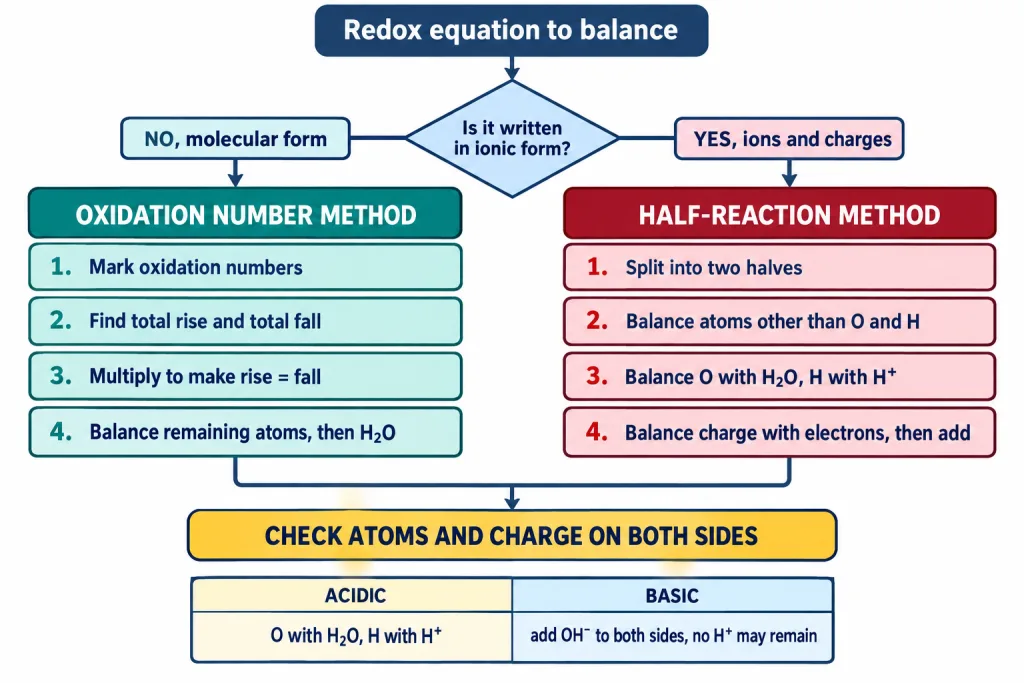
The routine never changes. Find the atoms whose oxidation number moves, work out the total rise and the total fall, multiply the two species so that rise equals fall, then tidy up the remaining atoms and finish with water and either hydrogen ion or hydroxide ion.
Question 22: Dichromate with hydrogen sulphide in acid
Balance in acidic medium.
Answer:
First I mark the changes. Chromium in is , since . It ends at , so each chromium falls by , and there are two of them, so the fall is per dichromate ion.
Sulphur in is and ends at as free sulphur, a rise of per sulphur.
To make rise equal fall I need three sulphurs against one dichromate: .
Now the leftovers. Seven oxygens on the left have nowhere to go except water, so I write on the right. That needs hydrogens on the left, and only come from the three , so I add :
Atom check: and ; and ; and ; on the left and on the right.
Charge check: left ; right . They match.
Ans:
Question 23: Dichromate with concentrated hydrochloric acid
Balance this molecular equation by the oxidation number method.
Answer:
Chromium goes from to , gaining each. Two chromiums per formula unit, so the fall is .
Chlorine is trickier. It starts at in , but only some of it changes. The chlorine in and is still ; only the chlorine that leaves as has risen to . Each of those loses .
To match a fall of I need six chlorines oxidised, which is :
Now I count the chlorine on the right: in , in and in , giving . So I need , which brings hydrogens and therefore :
Atom check: and ; and ; and ; and ; and .
Both sides are neutral molecules, so the charge balances at zero.
Ans: Watch out: Only of the chlorines are oxidised. Counting all as oxidised gives a rise of against a fall of and wrecks the whole balance.
Question 24: Iodine oxidised by concentrated nitric acid
Balance in acidic medium.
Answer:
Iodine starts as the free element at . In it is , so . That is a rise of per atom, and has two atoms, so the rise is per molecule.
Nitrogen in is and in it is , a fall of only per atom.
So I need ten nitrogens for one iodine molecule:
Hydrogen: on the left, in the two , so must go into water, giving .
Atom check: and ; and ; and ; on the left and on the right.
Everything is neutral, so charge is fine.
Ans: Watch out: The rise is , not , because carries two iodine atoms. Forgetting the subscript halves every coefficient on the right.
Question 25: Chromite oxidised by hypochlorite in alkali
Balance in basic medium.
Answer:
Chromium in : , so . In : , so . That is a rise of .
Chlorine in : , so . It ends at as chloride, a fall of .
The lowest common multiple of and is , so I take two chromiums and three chlorines:
Now I balance charge, because the medium is basic and hydroxide is what is available. Left: . Right: . The left needs to be more negative by , so I add to the left:
That brings hydrogens in, which have to leave as water, so I put on the right:
Atom check: and ; and ; and ; on the left and on the right.
Charge check: left ; right .
Ans: Watch out: No may survive in a basic answer. If you balanced as if the medium were acidic, neutralise every with on both sides before you write the final line.
Question 26: Zinc reducing nitrate to ammonia in alkali
Balance in basic medium.
Answer:
Zinc goes from to in the zincate ion, since . That is a rise of .
Nitrogen goes from in nitrate to in ammonia, a fall of .
Four zincs against one nitrate makes rise equal fall: .
Charge next. Left is ; right is . I need more negative charges on the left, so go there:
Hydrogen: on the left, in ammonia, so remain and go into :
Atom check: and ; and ; on the left and on the right; on the left and on the right.
Charge check: left ; right .
Ans: Watch out: A fall of for one nitrogen is the largest single change in this chapter. Writing to as a fall of is the standard slip, because the sign flip is easy to miss.
Balancing by the Half-Reaction Method
Question 27: Chlorate oxidising iodide in acid
Balance by the ion-electron method.
Answer:
I split it into two skeleton halves.
Reduction half: . Chlorine is already balanced. Three oxygens on the left need on the right, and those six hydrogens need on the left. Charge is then on the left and on the right, so I add to the left:
Oxidation half: . Charge is on the left and on the right, so two electrons leave:
The reduction half needs electrons and the oxidation half supplies , so I multiply the oxidation half by and add:
Atom check: and ; and ; and ; and .
Charge check: left ; right .
Ans:
Question 28: Hydrogen peroxide oxidising iron(II) in acid
Balance by the ion-electron method.
Answer:
Oxidation half is short: . Charge is on the left and on the right.
Reduction half: . The oxygens are balanced at two each side. Hydrogen is on the left and on the right, so I add to the left. Charge is then on the left and on the right, so join the left:
The reduction half takes electrons, so the iron half is doubled and added:
Atom check: and ; and ; and .
Charge check: left ; right .
Here the oxygen of the peroxide falls from to , so hydrogen peroxide is the oxidant, exactly as in Question 5(a).
Ans:
Question 29: Thiosulphate and iodine
Balance the reaction behind every iodometric titration.
Answer:
Oxidation half: . I need two thiosulphate ions to make one tetrathionate, since the product has four sulphurs. Oxygen is on each side, which is already right. Charge is on the left and on the right, so two electrons leave:
Reduction half: . Charge is on each side.
Both halves involve electrons, so I add them straight away:
Charge check: left ; right .
The oxidation numbers make the same point: sulphur goes from in thiosulphate to an average of in tetrathionate, a rise of per sulphur over four sulphurs, which is a total of electrons.
Ans: Watch out: The mole ratio here is , and every iodometry calculation rests on it. Reading it as halves the final answer.
Question 30: Permanganate and sulphite in alkali
Balance in basic medium.
Answer:
Reduction half: . Manganese falls from to , so three electrons are involved. In basic medium I balance oxygen by putting water on the side short of oxygen and hydroxide on the other. The left has four oxygens and the right has two, so I add on the left and on the right. Charge is then on the left and on the right, so join the left:
Oxidation half: . Sulphur climbs from to , so two electrons leave. The right needs one more oxygen, so go on the left and on the right. Charge: left ; right , so two electrons leave the right side:
To match electrons I take the reduction half twice and the oxidation half three times, giving each way. Adding:
Now I cancel what appears on both sides. Three waters cancel, leaving on the left, and six hydroxides cancel, leaving on the right:
Atom check: and ; and ; and ; on the left and on the right.
Charge check: left ; right .
Ans: Watch out: Permanganate stops at here, so the n-factor is , not . The medium decides the product and the product decides the electron count.
Question 31: Stannite reducing bismuth hydroxide
Balance in basic medium.
Answer:
Oxidation half: . Tin rises from to , so two electrons leave. The right needs one extra oxygen, so I add on the left and on the right. Charge: left ; right , so two electrons come off the right:
Reduction half: . Bismuth falls from to , so three electrons are needed, and the three hydroxide groups leave as . Charge: left ; right :
Six is the lowest common multiple of and , so the tin half is taken three times and the bismuth half twice:
Six hydroxides appear on both sides and cancel:
Atom check: and ; and ; and ; on the left and on the right.
Charge check: left ; right .
Ans: Watch out: Hydroxide that ends up on both sides must be cancelled. Leaving on each side is not wrong chemically, but it is an unfinished answer.
Titration Arithmetic
Question 32: n-factors and equivalent masses, all in one place
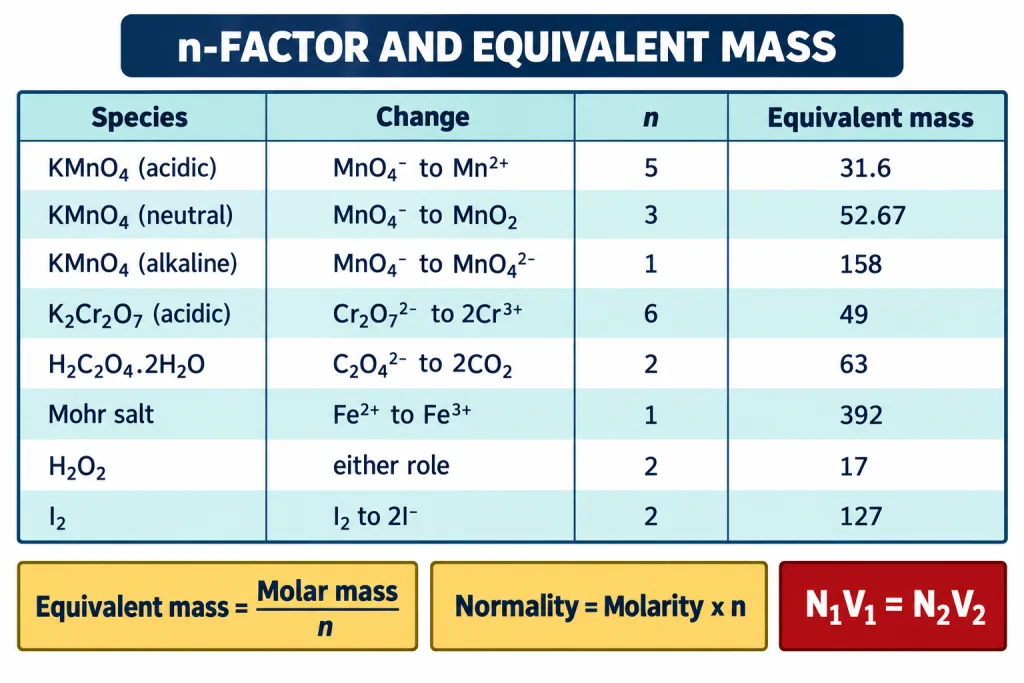
Give the n-factor and the equivalent mass of: in acidic, in neutral and in strongly alkaline medium; in acid; ; Mohr salt; ; and .
Answer:
The n-factor is just the number of electrons one formula unit gains or loses, and the equivalent mass is the molar mass divided by it.
in acid: , manganese , so and .
in neutral or weakly basic medium: , , so and .
in strongly alkaline medium: , , so and .
in acid: , over two chromiums, so and .
as a reductant: , two electrons lost, so and .
Mohr salt: , one electron, so and .
: whichever role it plays, so .
: , so and .
Ans: with equivalent masses , , , , , , and . Watch out: For oxalic acid as a reductant the n-factor is because two electrons are lost, and that happens to be the same as its basicity. The two ideas are different, and for permanganate they are nothing alike.
Question 33: A straight permanganate against iron(II)
What volume of is needed to oxidise of in dilute sulphuric acid?
Answer:
The balanced equation tells me the ratio.
One permanganate to five iron(II).
Moles of :
Moles of needed:
Volume:
Checking the same thing with normalities: the permanganate is and the iron(II) is . Then gives , so . The two routes agree.
Ans: .
Question 34: Available chlorine in bleaching powder
of bleaching powder was treated with dilute acid and excess potassium iodide. The liberated iodine needed of sodium thiosulphate. Find the percentage of available chlorine. Take .
Answer:
Three reactions run in order, so I follow the chain.
So one mole of chlorine gives one mole of iodine, which takes two moles of thiosulphate.
Moles of thiosulphate:
Moles of iodine , and moles of chlorine are the same, .
Mass of chlorine, with :
Percentage:
Ans: available chlorine. Watch out: Available chlorine is quoted as , not as chlorine atoms. Using instead of halves the answer to .
Question 35: Weighing out Mohr salt
What mass of Mohr salt is needed to make of a solution for titration against permanganate?
Answer:
Mohr salt supplies , which loses one electron, so .
When the n-factor is , normality and molarity are the same number, so the solution is .
Moles needed:
Mass, using a molar mass of :
The same result comes out of the equivalent route: the equivalent mass is , and equivalents weigh .
Ans: . Watch out: The mass is that of the whole double salt, water of crystallisation included. Using for instead of gives , which is far too little iron.
Question 36: Permanganate strength found through iodine
of an acidified solution was treated with excess potassium iodide. The iodine set free required of sodium thiosulphate. Find the molarity of the permanganate.
Answer:
Two equations carry the chain.
Moles of thiosulphate:
Moles of iodine .
The first equation gives , so
Molarity:
The electron count confirms it. The thiosulphate carried electrons, each permanganate takes , and .
Ans: . Watch out: The iodine is only a carrier. Trying to compare permanganate with thiosulphate directly, as if the ratio were , throws the factor of away.
Question 37: A back titration for hydrogen peroxide
of was acidified and added to of a hydrogen peroxide solution. The permanganate left over needed of oxalic acid. Find the molarity of the hydrogen peroxide and its strength in grams per litre.
Answer:
In a back titration I count electrons, because two different reductants have used up one oxidant.
Permanganate added:
Each permanganate takes electrons in acid, so the total oxidising capacity is
Oxalic acid used on the leftover permanganate:
Its n-factor is , so it supplied equivalents. That is how much of the permanganate was left over.
Equivalents used by the hydrogen peroxide:
Hydrogen peroxide acting as a reductant has , so
Molarity:
Strength, with :
Ans: , that is , or . Watch out: The oxalic acid measures what was left, not what reacted with the peroxide. Subtract before you divide, and never subtract moles of two species with different n-factors: convert to equivalents first.
Electrode Potentials and Spontaneity
Question 38: A cell built from nickel and silver
Using and , write the cell notation, the electrode reactions and the EMF of the cell built from these two half cells.
Answer:
The half cell with the more positive reduction potential is the one where reduction actually happens, so silver is the cathode and nickel is the anode.
Anode, where oxidation happens:
Cathode, where reduction happens, doubled so that the electrons match:
Overall:
Charge check: left ; right .
Cell notation puts the anode on the left:
EMF, with both values as reduction potentials:
Positive, so the reaction goes as written.
Ans: , with . Watch out: The silver half reaction was doubled, but its stays . Electrode potential is intensive, so multiplying a half reaction never multiplies its potential.
Question 39: Four predictions from one table
Decide whether each reaction is spontaneous under standard conditions.
(a)
(b)
(c)
(d)
Answer:
For each one I find which species is reduced, call that half cell the cathode, and subtract the potential of the half cell that is oxidised.
(a) Copper(II) is reduced, silver is oxidised.
Negative, so it does not happen. Silver sits below copper in the activity series and cannot displace it.
(b) Iron(III) is reduced to iron(II), tin(II) is oxidised to tin(IV).
Positive, so it happens. This is the reaction of Question 3.
(c) Bromine would have to be reduced and chloride oxidised.
Negative, so it does not happen. Chlorine displaces bromine, not the other way round.
(d) Hydrogen ion is reduced, zinc is oxidised.
Positive, so zinc dissolves in acid and gives off hydrogen.
Ans: (a) no, ; (b) yes, ; (c) no, ; (d) yes, . Watch out: Both potentials must be reduction potentials before you subtract. Flipping the sign of the anode value and then subtracting counts the flip twice.
Question 40: Why hydrochloric acid is banned from a permanganate flask
Using , , and , explain why a permanganate titration must be acidified with dilute sulphuric acid, while a dichromate titration tolerates hydrochloric acid.
Answer:
First the reaction the titration is supposed to measure. Permanganate oxidising iron(II):
Comfortably positive, so it runs to completion. Good.
Now the side reaction. Permanganate oxidising chloride to chlorine:
Still positive. So if hydrochloric acid is in the flask, permanganate attacks the chloride as well as the iron(II). Extra permanganate is used, the burette reading is too high, and the result is reported too high.
Dichromate against the same chloride:
Negative, so chloride is not oxidised and hydrochloric acid does no harm in a dichromate titration.
Sulphuric acid is safe with both, because sulphate is already at the top of sulphur's range and cannot be oxidised further. Nitric acid is barred for the opposite reason: it is itself an oxidant and would attack the reductant in the flask.
Ans: Permanganate oxidises chloride (, spontaneous), so hydrochloric acid inflates the reading; dichromate does not (), so it tolerates hydrochloric acid. Dilute sulphuric acid is safe for both. Watch out: A margin as small as is still positive, and positive means it happens. Size tells you how far the reaction goes, and sign tells you whether it goes at all.