
The reaction that breaks the electron-transfer definition
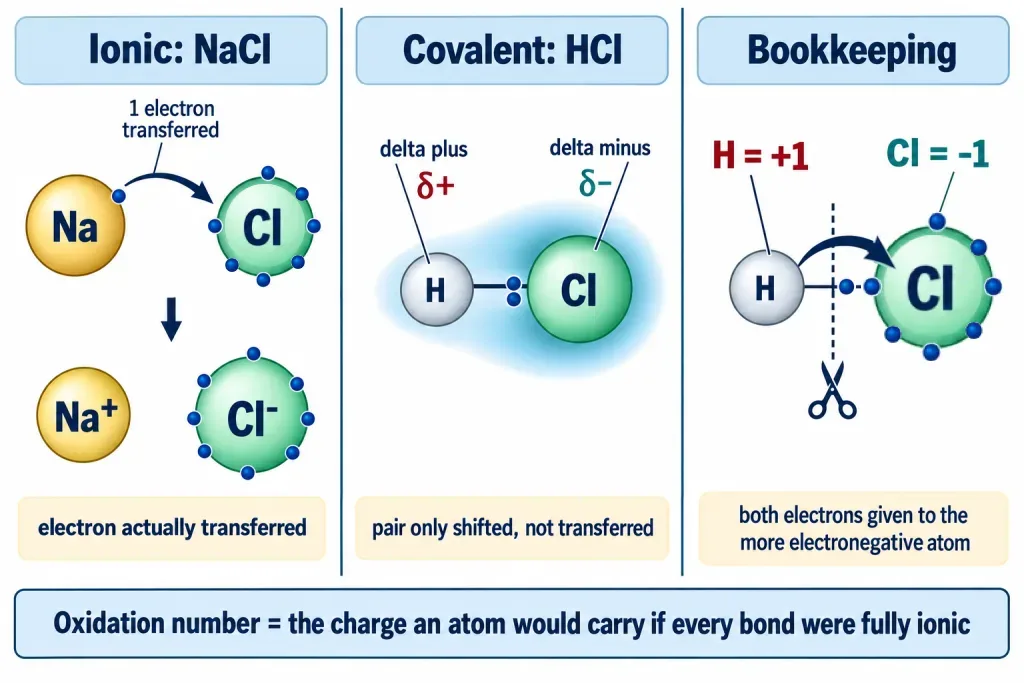
Sodium burning in chlorine is easy to describe. A sodium atom hands over one electron, a chlorine atom takes it, and the product is a lattice of and . The electron moved; you can point at it.
Now run hydrogen with chlorine.
Every chemical instinct says this is the same kind of reaction. But no electron has been transferred. Hydrogen chloride is covalent: the bonding pair is shared between H and Cl, not owned by Cl. There is no and no in a molecule of gas.
The same problem appears in water formation and in chlorination:
If oxidation means loss of electrons, nothing in these three equations is oxidised, because nothing loses an electron outright. Yet chemists have always called all three oxidations, and for good reason: in the shared pair sits much closer to chlorine, so hydrogen has been partly stripped.
A definition that works only when the transfer is complete stops at ionic compounds. What is needed is a way of counting that treats a partial shift as though it were a complete one, so the same arithmetic covers , and alike.
That counting device is the oxidation number.
What an oxidation number actually is
Key Point (Definition): The oxidation number of an atom is the charge it would carry if every bond it forms were broken with each shared pair handed over completely to the more electronegative of the two bonded atoms. A pair shared between two identical atoms is split evenly, one electron each.
Apply that to . Chlorine is the more electronegative, so the bonding pair goes entirely to chlorine, which now has one electron more than a neutral atom and scores ; hydrogen has one less and scores . In and the partners are identical, the pair splits one each, and every atom scores .
Written above the equation, the reaction becomes readable at a glance:
Hydrogen has gone from to , chlorine from to . Nothing was actually transferred, but the bookkeeping says hydrogen was oxidised and chlorine reduced — what the classical and electronic definitions both wanted to say.
And the chlorination:
Carbon climbs from to , a rise of , while eight chlorine atoms each drop from to , a total fall of . The books balance, and that is built into the definition rather than lucky.
Key Point: Oxidation is an increase in oxidation number, reduction a decrease. The oxidising agent is the species whose oxidation number falls; the reducing agent is the one whose oxidation number rises.
Oxidation state and oxidation number name the same quantity: in the oxidation state of carbon is , and so is its oxidation number.
Deciding which of two atoms is the more electronegative is slow for an unfamiliar pair and impractical for a large molecule, so the definition is never applied directly. A short list of rules encodes those comparisons in advance.
The rules, in priority order
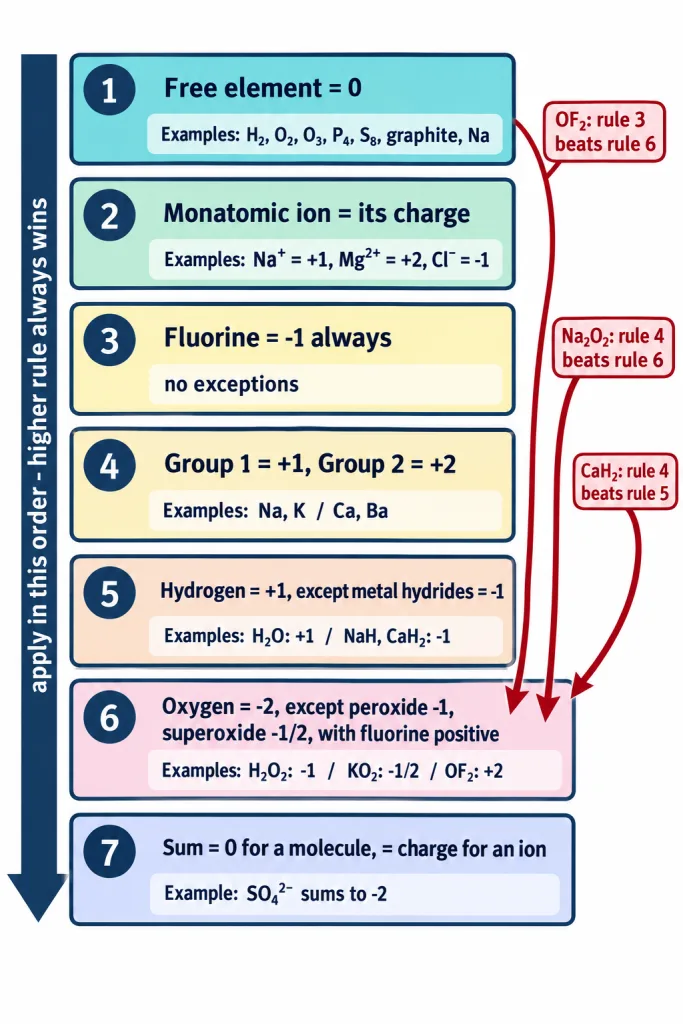
Apply these top down. When two rules give different answers for the same atom, the one higher on the list wins. That instruction is what makes the set work, and it is the part most students never learn.
Rule 1 — A free element is . Any atom bonded only to atoms of its own kind: , , , and every elemental molecule — , , , , , , graphite.
Rule 2 — A monatomic ion equals its charge. is , is , is , is .
Rule 3 — Fluorine is . Always, in every compound. Fluorine is the most electronegative element there is, so it can never be outpulled and can never be positive.
Rule 4 — Group 1 metals are , group 2 metals are , in all their compounds. Aluminium is always and belongs with them.
Rule 5 — Hydrogen is , except where hydrogen is the more electronegative partner, and there it is . That happens when hydrogen is bonded to a metal — , , , — and when it is bonded to boron, as in . Bonded to anything more electronegative than itself, which is everywhere else, it is .
Rule 6 — Oxygen is , except in the four situations below.
Rule 7 — The sum rule. The oxidation numbers in a neutral molecule add to ; in a polyatomic ion they add to the charge on the ion. totals , totals .
Rules 1 to 6 fix the atoms you know; rule 7 is the equation you solve for the one you do not.
Why priority matters: three clashes settled
Rules 3, 4, 5 and 6 collide constantly, and the ordering is what settles them.
. Rule 6 wants oxygen at , rule 3 wants each fluorine at , and both cannot hold since . Rule 3 sits higher, so fluorine keeps and oxygen is forced to .
and . Oxygen at would put sodium at and calcium at . Rule 4 sits higher and holds them at and , pushing oxygen up to . The structure agrees: these solids contain the peroxide ion .
and . Hydrogen's default of would drive sodium to . Rule 4 wins, sodium stays , and hydrogen takes — the metal-hydride exception written into rule 5 itself.
The higher rule is never negotiable; the lower one bends.
[JEE Main] The tell for a priority question is fluorine and oxygen together in one formula, or an alkali or alkaline-earth metal with an unit.
Chlorine, bromine and iodine take whenever they are bonded to a less electronegative partner, and that covers ionic and covalent compounds alike: chlorine is in the ionic , and equally in the covalent and , which is exactly what forces carbon up to in the latter. They take a positive value only when bonded to oxygen or to a more electronegative halogen: chlorine is in , in and in , and iodine is in because chlorine is the more electronegative of the two. Only fluorine can never go positive.
The ceiling on a main-group element
The highest oxidation number equals the group number for the first two groups and the group number minus for the rest, so across period 3 the ceiling climbs steadily: for in , for in , for in , for in , for in , for in and for in .
This ceiling is a sanity check. An answer of for sulphur or for chromium should stop you dead: neither has that many valence electrons to give away.
Working the rules: neutral molecules
Three steps every time: write down what the rules fix, set the total to zero, solve for the unknown.
Question 1: Manganese in potassium permanganate
Find the oxidation number of manganese in .
Answer:
Rule 4 fixes potassium at , rule 6 gives each of the four oxygens , and rule 7 sets the total to zero.
Ans:
Watch out: is the highest state manganese can reach, which is why permanganate is such a strong oxidant.
Question 2: Chromium in potassium dichromate
Find the oxidation number of chromium in .
Answer:
Two potassiums at , seven oxygens at , two chromiums at .
Ans:
Watch out: The is the whole question; writing gives , impossible for chromium.
Question 3: Manganese in potassium manganate
Find the oxidation number of manganese in .
Answer:
Two potassiums this time, not one.
Ans:
Watch out: Permanganate is and purple; manganate is and green. One subscript separates them.
Question 4: Manganese in manganese dioxide
Find the oxidation number of manganese in .
Answer:
Ans:
Question 5: Sulphur in sulphuric and sulphurous acid
Find the oxidation number of sulphur in and in .
Answer:
Hydrogen is in both, neither being a metal hydride, and oxygen is in both, neither containing an O-O bond.
Ans: in , in
Watch out: Sulphur at has nothing left to lose, so sulphuric acid cannot reduce anything. At it can go either way.
Question 6: Sulphur in sodium thiosulphate
Find the average oxidation number of sulphur in .
Answer:
Ans: (average)
Watch out: This is an average, not a description of either atom. Thiosulphate holds a central sulphur at and a terminal sulphur at , and the mean is . Rule 7 always returns an average when one element sits in two environments.
Question 7: Sulphur in hydrogen sulphide and sulphur dioxide
Find the oxidation number of sulphur in and in .
Answer:
In hydrogen is , sulphur being a non-metal, so and . In , and .
Ans: in , in
Question 8: Nitrogen in nitric acid
Find the oxidation number of nitrogen in .
Answer:
Ans:
Question 9: Carbon in methane and carbon tetrachloride
Find the oxidation number of carbon in and in .
Answer:
Carbon is more electronegative than hydrogen, so in each hydrogen is and gives . Chlorine is more electronegative than carbon, so in each chlorine is and gives .
Ans: in , in
Watch out: Swapping hydrogen for chlorine one atom at a time runs carbon across the full span: , , , , for , , , , . Carbon at does not mean uncombined; the pulls cancel.
Question 10: Hydrogen in sodium hydride and calcium hydride
Find the oxidation number of hydrogen in and in .
Answer:
Rule 4 pins sodium at , so and . Calcium is fixed at , so and again .
Ans: in both
Watch out: Hydrogen is negative in too; the clue is not a metal as such but a partner less electronegative than hydrogen — a metal here, boron there.
Working the rules: polyatomic ions
Only one thing changes. The sum equals the charge on the ion instead of zero.
Question 11: Nitrogen in the ammonium ion
Find the oxidation number of nitrogen in .
Answer:
Nitrogen is more electronegative than hydrogen, so each hydrogen is . The four contribute , and the total must be .
Ans:
Watch out: Setting the sum to zero here gives , the commonest slip on polyatomic ions.
Question 12: Nitrogen in the nitrate ion
Find the oxidation number of nitrogen in .
Answer:
Ans:
Nitric acid gave too: adding a proton to nitrate changes nothing about the nitrogen.
Question 13: Chlorine in chlorate and perchlorate
Find the oxidation number of chlorine in and in .
Answer:
Ans: in , in
Question 14: Chromium in chromate and dichromate
Find the oxidation number of chromium in and in .
Answer:
Ans: in both
Chromate and dichromate interconvert with pH and no change of oxidation state, so that interconversion is not a redox reaction.
Question 15: Phosphate and permanganate ions
Find the oxidation number of phosphorus in and of manganese in .
Answer:
Ans: ,
The potassium in only balanced the charge on the ion, which is why manganese comes out at either way.
Working the rules: the oxygen exceptions
Question 16: Oxygen in hydrogen peroxide
Find the oxidation number of oxygen in .
Answer:
Ans:
The structure confirms it: in the O-H pair goes to oxygen, worth , and the O-O pair splits evenly, worth nothing.
Question 17: Oxygen in sodium peroxide
Find the oxidation number of oxygen in .
Answer:
Rule 4 outranks rule 6, so sodium is and I solve for oxygen: , so .
Ans:
Watch out: Applying out of habit forces sodium to , a state it cannot have. That contradiction is the signal of a peroxide.
Question 18: Oxygen in potassium superoxide
Find the oxidation number of oxygen in .
Answer:
Potassium is and cannot move.
Ans:
A fractional oxidation number is not an error: the solid contains the superoxide ion , one negative charge over two oxygen atoms.
Question 19: Oxygen in the oxygen fluorides
Find the oxidation number of oxygen in and in .
Answer:
Rule 3 outranks rule 6, so fluorine takes in both and oxygen absorbs the rest.
Ans: in , in
Watch out: These are the only common compounds in which oxygen is positive, and only fluorine can force it. In oxygen is back to .
Question 20: Oxygen in calcium peroxide
Find the oxidation number of oxygen in .
Answer:
Calcium is group 2, fixed at by rule 4.
Ans:
Watch out: is calcium oxide, oxygen at ; is calcium peroxide, oxygen at . It is not a superoxide either — that needs calcium at .
The three traps: when the formula hides a peroxide linkage
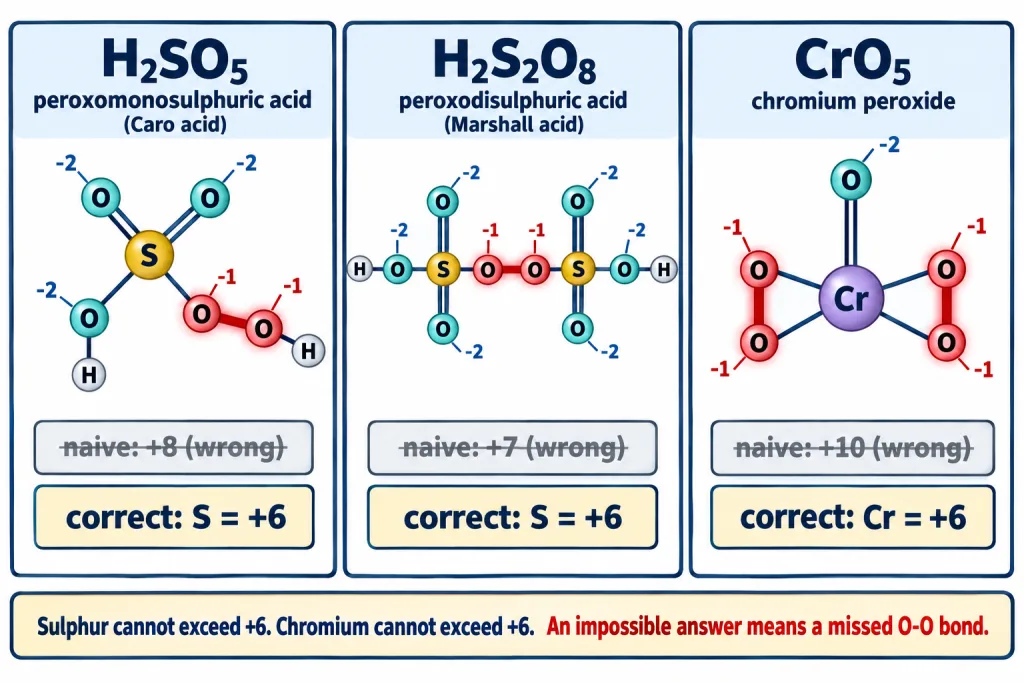
Three species are set repeatedly because the rules, applied blindly to the formula, give an answer that is not merely wrong but impossible. In each, some oxygen is locked into an O-O single bond, a peroxide linkage, where each oxygen is .
is a distorted tetrahedron about sulphur: two SO double bonds, one arm, and one arm, that fourth arm being the peroxide linkage. Three of the five oxygens are and two are .
is two groups joined through an bridge: . Six of the eight oxygens are ; the two in the bridge are .
is the blue species formed when hydrogen peroxide is added to acidified dichromate. Its shape is a butterfly: chromium carries one and two side-on peroxo groups, each an unit bound to the metal through both oxygens, so the structural formula is . One oxygen is and four are .
The physical check is quicker than the arithmetic. Sulphur and chromium each have six valence electrons and cannot exceed , so any answer above that ceiling means an O-O bond has been missed.
[JEE Main] Whenever a formula carries more oxygen than the central atom's group number can justify, look for a peroxide linkage before doing any algebra.
The trap species, worked
Question 21: Sulphur in Caro's acid
Find the oxidation number of sulphur in .
Answer:
Putting all five oxygens at gives , so . Sulphur has only six valence electrons, so cannot happen. One arm holds a peroxide linkage, so two oxygens are and three are .
Ans:
Watch out: Forgetting the peroxide linkage gives ; counting two linkages instead of one gives .
Question 22: Sulphur in Marshall's acid
Find the oxidation number of sulphur in .
Answer:
The skeleton is : six oxygens at , the two bridging ones at , and two sulphurs.
Ans:
Watch out: Treating all eight oxygens as gives , again above the ceiling. Both peroxo acids land at , the same as ordinary sulphuric acid, because the extra oxygen sits in an O-O bond rather than pulling on sulphur.
Question 23: Chromium in chromium peroxide
Find the oxidation number of chromium in .
Answer:
The blind calculation gives , so , which chromium cannot reach. The butterfly structure has one and two peroxo groups: one oxygen at and four at .
Ans:
Watch out: is also the chromium of the dichromate you started from, so this test involves no change of chromium oxidation state at all.
The underlined-element style
Papers often underline one element in a formula and ask only for that one. The method is unchanged; the extra work is spotting which rules are in play.
Question 24: Phosphorus in sodium dihydrogen phosphate
Find the oxidation number of phosphorus in .
Answer:
Sodium is ; the two hydrogens are each, being bonded to oxygen and not to a metal; the four oxygens are .
Ans:
Question 25: Sulphur in sodium hydrogen sulphate
Find the oxidation number of sulphur in .
Answer:
Ans: — sodium and hydrogen supply between them, exactly what the two hydrogens of supplied.
Question 26: Phosphorus in pyrophosphoric acid
Find the oxidation number of phosphorus in .
Answer:
Ans:
Watch out: The in must appear in the equation. Without it the answer is , past the phosphorus ceiling.
Question 27: Boron in sodium borohydride
Find the oxidation number of boron in .
Answer:
Hydrogen is bonded to boron, and hydrogen is the more electronegative of that pair, so rule 5 puts each hydrogen at . Sodium is .
Ans:
Watch out: Using for hydrogen gives , impossible for boron.
Question 28: Sulphur in pyrosulphuric acid
Find the oxidation number of sulphur in .
Answer:
This is oleum, . The bridge is a single oxygen between two sulphurs, not an O-O bond, so every oxygen is an ordinary .
Ans:
Watch out: has an bridge and needs no correction; has an bridge and does.
The payoff: a two-line test for a redox reaction
Key Point: A reaction is a redox reaction if, and only if, the oxidation number of at least one element changes between reactants and products.
That is the whole test, and it takes about twenty seconds:
- Assign oxidation numbers to every atom on each side.
- Compare element by element. If nothing moves, it is not a redox reaction.
- The element whose number rose was oxidised, and its species is the reducing agent; the element whose number fell was reduced, and its species is the oxidising agent.
The total rise and the total fall must be equal once each is multiplied by the number of atoms involved. A mismatch means the equation is not balanced, so the last step doubles as a free check.
The test also settles the thing students most often get backwards. The oxidising agent is the species that gets reduced; the reducing agent is the species that gets oxidised. With the numbers written above the equation the element going down marks the oxidant and the element going up marks the reductant.
[NEET] A "which of these is not a redox reaction" item appears constantly, and neutralisations, precipitations and carbonate decomposition are the standard negative answers. Check the numbers, not the look of the equation.
Applying the test to whole equations
Question 29: Manganese dioxide with concentrated hydrochloric acid
Decide whether this is a redox reaction and identify what is oxidised.
Answer:
On the left, manganese is and oxygen ; hydrogen is and chlorine . On the right, chlorine in is so manganese is , is free at , and water is unchanged.
Manganese falls from to , gaining electrons. Of the four chlorines, two stay at in and two climb to in , losing between them.
Ans: Redox. Chloride is oxidised, so is the reducing agent; is reduced and is the oxidant.
Watch out: Only half the chlorine changes. Assuming all four are oxidised gives a fall of against a rise of , and that mismatch exposes the error.
Question 30: Dichromate with iron(II)
Show that this is a redox reaction, and check the electron count and the charge.
Answer:
Chromium falls from to over two atoms, so electrons are gained. Iron rises from to over six ions, so are lost. Hydrogen stays , oxygen . Charge: the left carries , the right .
Ans: Redox. is oxidised and is the reducing agent; dichromate is reduced and is the oxidising agent.
Question 31: Sodium in water
Decide whether this is redox and identify both roles.
Answer:
Sodium starts free at and ends at in , so it is oxidised. Hydrogen is in water and stays in , but drops to in . Oxygen stays . Two sodiums lose each, a rise of ; two hydrogens fall from to , a fall of .
Ans: Redox. Sodium is oxidised and is the reducing agent; water supplies the hydrogen that is reduced, so it is the oxidising agent.
Watch out: Only two of water's four hydrogens are reduced; the rest cross over unchanged into hydroxide.
Question 32: Two reactions that are not redox at all
Decide whether these are redox reactions.
Answer:
In the neutralisation: sodium , oxygen , hydrogen and chlorine on the left, and every one of those values reappears unchanged in and water.
In the precipitation: silver on both sides, nitrogen in nitrate on both sides, and sodium, chlorine and oxygen holding , and throughout.
Ans: Neither is a redox reaction. In both, ions merely change partners.
Watch out: Heat, a precipitate or a gas is not evidence of redox. Only a changed oxidation number counts. keeps calcium at , carbon at and oxygen at , so it is a decomposition but not a redox one.
What an oxidation number is not
It is not the real charge on the atom. In hydrogen chloride the oxidation numbers are and , but the molecule is covalent: the chlorine end carries a partial negative charge worth a small fraction of one electron. The bookkeeping deliberately rounds that partial shift up to a full electron so the arithmetic stays simple.
It is not the same as formal charge. Both are bookkeeping charges read off the structure, but they split the bonding electrons in opposite ways.
They answer different questions. Formal charge asks which Lewis structure is the most reasonable; oxidation number asks whether electron density has shifted during a reaction.
It need not be a whole number. Where one element sits in two environments, rule 7 returns an average that can be a fraction: oxygen at in , iron at in , sulphur at in , carbon at in . A fraction signals more than one environment, not faulty arithmetic.
[Board] State plainly in an answer that oxidation number is a formal charge assigned by rules and not the actual charge on the atom. It is a standard one-mark point.
The errors that cost marks
Ignoring the subscript on the unknown element. has two chromiums, two phosphorus atoms, two sulphurs. Each needs .
Setting the sum to zero for an ion. sums to , to , to .
Applying rule 6 before rules 3, 4 and 5. Look for fluorine, for an alkali or alkaline-earth metal with an unit, and for an O-O bond, before defaulting oxygen to .
Missing a peroxide linkage. , and all give , and all three give impossible answers without the correction.
Confusing an average with a real value. Sulphur in averages , but no sulphur atom in the ion is at ; the central one is .
Swapping oxidant and reductant. The oxidising agent is reduced; the reducing agent is oxidised. The species whose element falls is the oxidant.