
The n-Factor, Defined Three Ways
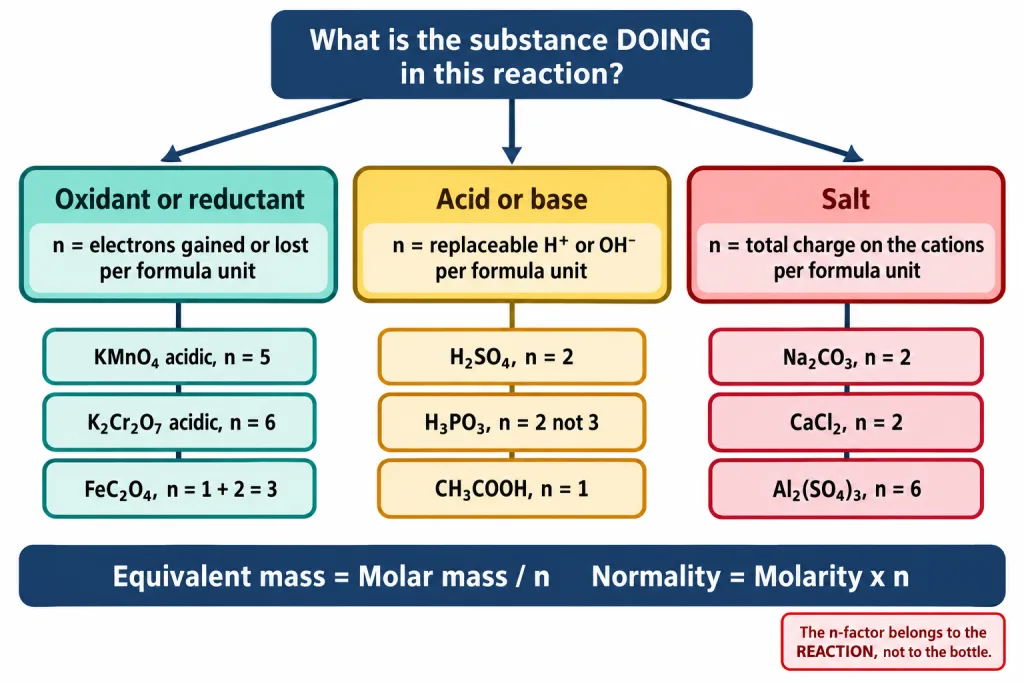
Section 9 gave you the n-factor as "electrons gained or lost per formula unit". That is correct for a redox reagent and useless for sodium carbonate. The full idea is wider, and JEE tests the wide version.
Key Point (Definition): The n-factor (valency factor) of a substance is the number of reactive units it supplies per formula unit in the reaction being considered. Which unit counts depends on the role the substance is playing.
Case 1 — an oxidant or a reductant. The n-factor is the number of electrons gained or lost per formula unit:
In in acid, chromium falls from to and there are two chromiums, so .
Case 2 — an acid or a base. The n-factor is the number of replaceable hydrogen or hydroxide ions actually given up in that reaction. fully neutralised has , but if it stops at . has , not : only two of its hydrogens sit on oxygen, the third being bonded straight to phosphorus. has for the same reason, and has because three of its four hydrogens are on carbon.
Case 3 — a salt in a non-redox reaction. The n-factor is the total positive charge carried by the cations in one formula unit: for and , for , for .
Key Point: The n-factor belongs to the reaction, not to the bottle. One crystal of has , or depending on the medium, and has against methyl orange and against phenolphthalein.
[JEE Main] A question that names a reagent but gives no product and no medium is asking whether you know that the n-factor is undefined until the product is fixed.
Every n-Factor You Will Be Asked For
The standard oxidants
| Species | Product | Change | n | Equivalent mass |
|---|---|---|---|---|
| , acidic | 5 | |||
| , neutral or weakly basic | 3 | |||
| , strongly alkaline | 1 | |||
| , acidic | , twice | 6 | ||
| , acidic | 2 | |||
| , twice | 2 | |||
| , twice | 2 | |||
| as oxidant | , twice | 2 | ||
| (Winkler) | , twice | 4 |
The standard reductants
| Species | Product | Change | n | Equivalent mass |
|---|---|---|---|---|
| 1 | ||||
| Mohr salt, | 1 | |||
| , twice | 2 | |||
| , twice | 2 | |||
| with iodine | , twice | 1 | (pentahydrate) | |
| with chlorine water | , twice | 8 | ||
| as reductant | , twice | 2 | ||
| oxidised | , thrice | 1 | ||
| both centres | 3 |
The four cases worth staring at
Hydrogen peroxide in both roles. Peroxide oxygen sits at , an intermediate value, so it can fall to or rise to . Either way two oxygens move one unit, so both times and whichever role it plays.
When it disproportionates, , two moles transfer two electrons between themselves, so per mole and .
Thiosulphate, two n-factors. Against iodine, sulphur climbs from an average to across two atoms, one electron in total, so and . Against chlorine water the same ion is driven to sulphate:
Charge is on the left and on the right, and two sulphurs each climbing four units gives eight.
Nitric acid, five n-factors. As an acid, . As an oxidant it depends entirely on the reduction product: gives , gives , gives , gives , gives . Concentrated acid with copper gives , dilute acid gives , and very dilute acid with an active metal such as zinc can reach .
Ferrous oxalate, two elements oxidised at once. In the iron is and each carbon , and acidified permanganate oxidises both, and . One electron plus two makes . Add the contributions; never take the larger. works the same way in reverse: oxidising all three irons from to moves electron, so , while reducing the same solid to gives .
Equivalent Mass, Normality and the Law of Equivalents
Key Point: Equivalents . Milliequivalents . Work in milliequivalents whenever volumes are in millilitres — it removes every factor of a thousand from the page.
At the equivalence point one equivalent of A has reacted with exactly one equivalent of B, whatever the mole ratio is:
Three generalisations
A chain of reactions. If A reacts with B and the product then reacts with C, equivalents run straight through: . One mole of is equivalents, liberates moles of iodine (also equivalents), and consumes moles of thiosulphate (again ). You never write the two balanced equations.
A mixture titrated by one reagent. Equivalents add: .
An excess reagent partly used. Equivalents subtract, which is the whole of back titration: eq(sample) eq(added) eq(left over).
When the equivalent method helps, and when it hurts
It is faster whenever the question is about how much: chained reagents, mixtures titrated by one solution, back titrations. It skips the balanced equation entirely. It is dangerous in four situations: a disproportionation, where one species carries two n-factors at once; a reagent in two roles, such as nitric acid dissolving a metal, part acid and part oxidant, which no single normality describes; a limiting-reagent question, since the law of equivalents assumes the reagents have exactly consumed each other; and any question where the product is not stated, because no product means no n-factor and no normality.
[JEE/NEET] A titration involving a mixture, an excess or two indicators is almost always faster in milliequivalents. A question about a product or a limiting reagent is not.
Back Titration
Key Point (Definition): In a back titration a measured excess of a standard reagent is added to the sample and allowed to react completely; the unreacted portion is then titrated with a second standard solution. The sample is measured by difference.
It is used when a direct titration is impossible: the sample is an insoluble solid (marble chips, an antacid tablet), the reaction is slow (manganese dioxide with oxalic acid needs warming, over minutes), there is no sharp end point (a weak acid titrated against a weak base gives a colour change too gradual to read to a drop), or the sample is volatile (ammonia distilled out of a digestion has to be caught in excess acid, since a gas cannot be titrated).
Two rules stop the marks leaking away.
The second burette reading measures the excess, not the sample. A bigger second reading means less sample, so the reading and the answer move in opposite directions.
Both standard solutions must be in the same currency. Convert both to milliequivalents before subtracting. Subtracting millilitres, or a molarity from a normality, is the standard way to lose the question.
Sanity check: the equivalents found in the second titration must always be fewer than the equivalents added in the first. A negative difference usually means a wrong n-factor or a dropped factor of ten somewhere in the arithmetic, and sometimes that the two concentrations have been swapped.
Double Titration: the Two-Indicator Problem
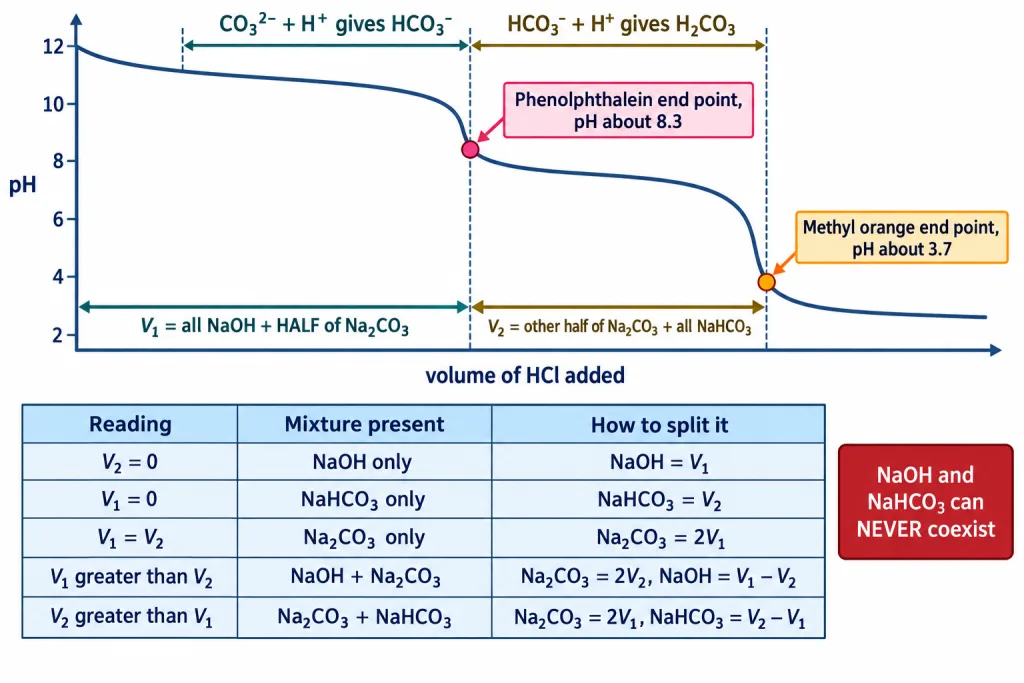
A solution may contain , , or a compatible pair. One titration against hydrochloric acid, read at two indicators, sorts out which and how much, because carbonate is neutralised in two separate steps at two separate pH values:
Phenolphthalein turns colourless near pH , exactly where the first step finishes; methyl orange turns near pH , where the second finishes. Hydroxide is strong and is fully neutralised before either carbonate step matters.
Let be the acid volume to the phenolphthalein end point and the further volume from there to the methyl orange end point. To phenolphthalein goes all the plus half the ; from there to methyl orange goes the other half of the carbonate plus all the original bicarbonate.
| Reading | Contents | Acid used by each |
|---|---|---|
| only | ||
| only | ||
| only | ||
| ; | ||
| ; |
Key Point: and cannot be present together — they react on mixing, . Any question offering that pair is offering an impossible mixture.
Two traps. Some papers quote the methyl orange volume from the start of the titration, in which case that total is and you must subtract before using the table. And the carbonate has up to phenolphthalein but up to methyl orange, so normality is treacherous here — count volumes and moles of acid instead.
[JEE Main] Identifying the mixture is worth as much as the arithmetic. Compare and , name the mixture, then calculate.
Redox Mixtures and Selective Titration
The same idea — one component reacts in one titration, both react in another — runs through redox analysis.
Oxalic acid with sodium oxalate. Both carry the oxalate ion, so permanganate oxidises both with ; only the oxalic acid is an acid, with against sodium hydroxide. Titrate one aliquot against standard alkali for the oxalic acid alone, a second against permanganate for the total oxalate, and subtract.
Iron(II) with iron(III) in one solution. Permanganate sees only the iron(II). For total iron the iron(III) must first be brought down with a reductor: a Jones reductor, a column of zinc amalgam, or stannous chloride in solution, , with the excess tin(II) then destroyed by mercury(II) chloride so that it does not consume permanganate itself. Titrate one portion untreated, reduce a second and titrate for total iron, subtract for iron(III).
The recipe for any mixture problem. Name what reacts in each titration; write one milliequivalent equation for each; solve the pair; then check that the two masses add back to the sample mass. That last step is free marks — a mixture answer that does not add up is wrong, and you can see it in five seconds.
Iodometric Estimations at JEE Level
All of these end on the same step, , with starch added only near the end point and the blue colour disappearing at the end.
Available chlorine in bleaching powder
Bleaching powder is written , molar mass , and its worth is quoted as available chlorine: the mass of chlorine, in grams, liberated by of the powder on treatment with excess acid.
One mole of chlorine gives one mole of iodine and consumes two moles of thiosulphate, so the equivalent mass of chlorine here is . Good bleaching powder runs at about to per cent available chlorine.
Copper in an alloy
Dissolve the alloy in nitric acid, boil off the oxides of nitrogen (they liberate iodine of their own), neutralise, acidify with acetic acid and never a strong acid, then add excess potassium iodide:
Two copper(II) ions liberate one iodine, which needs two thiosulphates, so . Moles of copper equal moles of hypo, even though the copper changes by one unit and the iodine by two.
Dissolved oxygen: the Winkler method in outline
Manganese(II) is fixed as the hydroxide, oxidised to manganese(IV) by the dissolved oxygen, then acidified with iodide so that the manganese(IV) liberates iodine, which is titrated with hypo. One mole of oxygen becomes four moles of thiosulphate, so and . A sample needing of hypo holds milliequivalents of oxygen, which is in , or .
Hydrogen Peroxide: Volume Strength
Key Point (Definition): An " volume" solution of hydrogen peroxide is one where volume of the solution liberates volumes of oxygen gas, measured at STP, on complete decomposition.
Start from and take one litre of an volume solution. By definition it releases litres of oxygen at STP, and one mole of gas occupies at STP, so
Two moles of peroxide are needed per mole of oxygen, so that litre held
That is per litre, so it is the molarity. Peroxide has in either redox role, so the normality is twice it:
The anchor: an volume solution is , and . Everything else scales from it.
Volume strengths mix by volume, because volume strength is proportional to normality and equivalents add:
Mixing of volume with of volume gives volume, not the plain average .
Dilution divides volume strength. A ten-fold dilution turns volume into volume. The oxygen a fixed mass of peroxide can give has not changed; the oxygen a fixed volume of solution can give has.
[JEE Main] The and the get swapped more often than any other pair in this chapter. Anchor on volume and rebuild.
Disproportionation Stoichiometry
In a disproportionation one element appears in both half reactions, so the same species is written twice on the left of your working. The rule is unchanged: electrons lost must equal electrons gained.
Take in acid. Oxidation is , so ; reduction is , so . For the electrons to cancel, two units are oxidised for every one reduced:
Manganese ; oxygen ; hydrogen ; charge on both sides.
Key Point: In a disproportionation the fractions oxidised and reduced are fixed by the two n-factors alone: oxidised : reduced .
Here that is , so two thirds becomes permanganate and one third manganese dioxide.
| Reaction | Oxidised | Reduced | Fraction oxidised |
|---|---|---|---|
Fluorine never appears in such a table. It has no positive oxidation state, so it cannot be oxidised, and a species that cannot be oxidised cannot disproportionate. The element must be in an intermediate oxidation state for disproportionation to be possible at all.
The equivalent mass in a disproportionation is the awkward part: count the electrons actually transferred and divide them among all the formula units present. In , five chlorines each gain one electron, so five electrons move per three : the n-factor per mole is and , not the usual .
Equivalent Weight Traps
The equivalent weight of an element in a compound of unknown formula
You do not need the formula. You need one weighed combination.
Key Point (Definition): The equivalent weight of an element is the mass of it that combines with or displaces parts by mass of oxygen, parts of chlorine, or parts of hydrogen.
Hydrogen collected as a gas gives the same thing by volume: occupies at STP, so the mass of metal that displaces of hydrogen at STP is one equivalent. Once is known, valency atomic mass , and the valency gives the formula.
When the medium changes mid-question
A permanganate solution standardised in acid and then used in a neutral flask is the standard trap. If it comes out as in the acidic standardisation, its molarity is fixed once and for all at . Carry that number, not the normality, into the second part. In neutral medium , so the same bottle is , not .
Key Point: Molarity is a property of the solution. Normality is a property of the solution and the reaction. When the medium changes, convert back to molarity, change the n-factor, and convert forward again.
The same discipline covers a reagent used first as an acid and then as an oxidant, and thiosulphate used first against iodine () and then against chlorine water ().
Electrode Potential: Combining Half Reactions
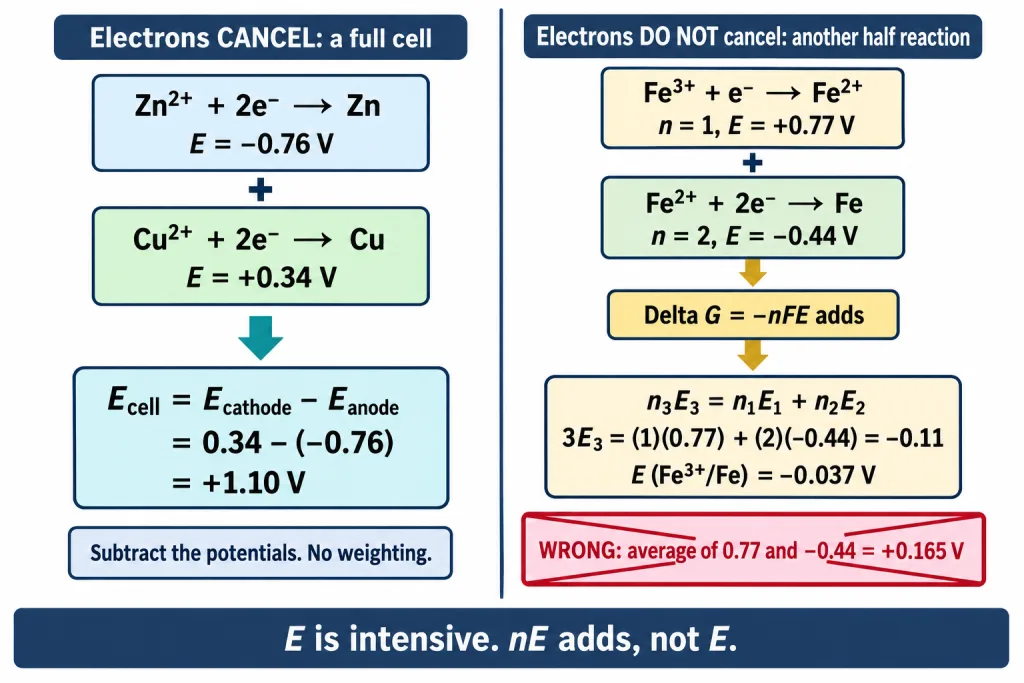
is intensive — doubling a half reaction leaves it alone, so and both carry . But is extensive, and free energies add exactly as Hess's law says. That one relation decides everything below.
Situation A: the electrons cancel completely. The two halves give a full cell reaction, and
with both written as reduction potentials and no weighting of any kind.
Situation B: the electrons do not cancel. The two halves give a third half reaction. Averaging the potentials is wrong. Add the free energies:
when the halves are added, and with when one is subtracted from the other.
Key Point: Never average electrode potentials. Weight them by the number of electrons, because it is , not , that adds. The two agree only when , which is exactly why the mistake survives so long — it happens to work sometimes.
Worked on the classic case, with and :
Adding gives with , so . Averaging and would have given — the wrong sign, and so the wrong answer about whether iron dissolves.
The same machinery predicts disproportionation. A species that can be both oxidised and reduced disproportionates when , and the last worked question runs that test on copper(I).
Worked Questions
Question 1: n-factor when two elements are oxidised together
Find the n-factor and equivalent mass of against acidified , and the volume of needed by of it. Take the molar mass as .
Answer:
First I check which atoms move. Iron is and goes to , one electron. Each oxalate carbon is and goes to in carbon dioxide, and there are two of them, two more electrons.
Permanganate is strong enough to take both, so I add: and .
is , which is equivalents. Acidified permanganate has , so is :
Ans: , , . Watch out: Taking the larger contribution instead of the sum gives and . Both centres are oxidised, so both count.
Question 2: Equivalents running down a chain
of pure was dissolved in dilute sulphuric acid, excess was added, and the liberated iodine was titrated with sodium thiosulphate. Find the moles of iodine liberated and the volume of thiosulphate used.
Answer:
I use equivalents all the way through and balance nothing. Moles of dichromate , and , so equivalents .
Iodine has , so the iodine liberated is , and the thiosulphate must supply the same equivalents, so .
Ans: of iodine; . Watch out: Thiosulphate has , so is of hypo — the familiar falls straight out.
Question 3: Back titration for the purity of limestone
of impure calcium carbonate was dissolved in of hydrochloric acid. The unused acid needed of sodium hydroxide. Find the percentage purity, the impurity being inert.
Answer:
I work in milliequivalents. Acid added ; acid left over ; so the acid that reacted with the carbonate is , and the carbonate itself is .
Calcium carbonate has molar mass and , so and the mass is .
Ans: . Watch out: The alkali reading measures the leftover acid, not the sample. Using as the carbonate gives and — the same numbers upside down.
Question 4: Manganese dioxide in pyrolusite
of pyrolusite was warmed with of oxalic acid in dilute sulphuric acid until all the had reacted. The unused oxalic acid required of . Find the percentage of .
Answer:
Oxalic acid added ; oxalic acid left ; so the ore used , and the is .
has molar mass , and as an oxidant manganese goes from to , so and .
Ans: . Watch out: A direct titration is impossible here — the dioxide is an insoluble solid and the reaction needs warming and time. That is exactly what back titration exists for.
Question 5: Sodium hydroxide with sodium carbonate
of a mixture of and was dissolved and made up to . A portion required of to the phenolphthalein end point and a further to the methyl orange end point. Find the mass of each component in the original sample.
Answer:
Here and , so , agreeing with the stated mixture. The carbonate is neutralised in two equal halves and is the second half, so the acid used by the carbonate is and the acid used by the hydroxide is .
In the aliquot the moles of carbonate equal the moles of acid in alone, one per carbonate in that step:
The aliquot is one tenth of the solution, so multiply both by ten:
, the sample mass, so the answer is self-consistent.
Ans: and . Watch out: The factor of two is already inside the volume . Using it again on the moles halves the hydroxide and doubles the carbonate.
Question 6: Oxalic acid with sodium oxalate
of a mixture of anhydrous oxalic acid and sodium oxalate was dissolved and made up to . A portion needed of ; a second portion, acidified and warmed, needed of . Find the mass of each.
Answer:
The alkali titration sees only the oxalic acid, since sodium oxalate is not an acid. The permanganate titration sees the oxalate ion from both.
Alkali. of oxalic acid in the aliquot. As an acid it has , so that is .
Permanganate. of total oxalate. As a reductant oxalate has , so that is altogether.
Sodium oxalate in the aliquot. Scaling by ten:
, matching the sample.
Ans: oxalic acid () and sodium oxalate (). Watch out: The oxalic acid here is anhydrous, molar mass . Using for the dihydrate pushes the total past the sample mass, and the check in the last line catches it.
Question 7: Iron(II) and iron(III) in one solution
A solution contains both and . A portion, acidified, needed of . A second portion was passed through a Jones reductor and then needed of the same permanganate. Find the molarity of each ion.
Answer:
Permanganate in acid has and each iron(II) gives one electron, so one mole of permanganate handles five of iron(II).
Untreated portion, iron(II) only. , so .
Reduced portion, all the iron. , so total iron , and .
Both sit in :
Ans: and . Watch out: The second titration gives total iron, not iron(III). Subtract.
Question 8: Available chlorine in bleaching powder
of bleaching powder was dissolved and made up to . A portion, acidified with acetic acid and treated with excess , liberated iodine that needed of sodium thiosulphate. Find the percentage of available chlorine.
Answer:
Equivalents run straight through from chlorine to iodine to thiosulphate. The aliquot holds , and it is one twentieth of , so the whole sample gives of chlorine. Chlorine as an oxidant has , so :
Ans: available chlorine. Watch out: Available chlorine is quoted as chlorine, not as bleaching powder. Dividing by somewhere in the middle is the usual way of losing it.
Question 9: Copper in an alloy
of a copper alloy was dissolved in nitric acid, the nitrous fumes boiled off, the solution neutralised and acidified with acetic acid, and excess added. The liberated iodine needed of sodium thiosulphate. Find the percentage of copper.
Answer:
The two reactions are
Two coppers make one iodine, and one iodine takes two thiosulphates, so copper and thiosulphate finish in a mole ratio.
Ans: copper. Watch out: Boiling off the oxides of nitrogen is not decoration — they oxidise iodide themselves and give a high result. The acetic acid matters too, since a strong acid would let air oxidise the iodide.
Question 10: Volume strength through a dilution
of a volume solution of hydrogen peroxide was diluted to . Find the volume strength and normality of the diluted solution, and the volume of acidified needed by of it.
Answer:
The original solution: and . Diluting to is a ten-fold dilution, so and the volume strength is volume.
Now the titration. of the diluted peroxide is , and acidified permanganate has , so is :
Ans: volume, , and of permanganate. Watch out: Peroxide is the reductant against permanganate, and its n-factor is in that role as well as in the other, so the same serves either way. That coincidence is peculiar to hydrogen peroxide.
Question 11: Fraction disproportionating, and an equivalent mass
For , find the fraction of chlorine atoms oxidised and the equivalent mass of in this reaction.
Answer:
Six chlorine atoms go in. Five come out as , each falling from to , so five electrons are gained; one comes out as , climbing from to , so five are lost. Five equals five, so the equation is electron-balanced, and the fraction oxidised is against reduced.
Five electrons are transferred in all for three moles of , so the n-factor per mole is :
Ans: oxidised; . Watch out: The familiar belongs to chlorine acting purely as an oxidant with . In a disproportionation the electrons are shared among all the formula units present, so the n-factor comes out fractional.
Question 12: Equivalent weight from a chloride of unknown formula
of a metal gave of its chloride on complete chlorination. Find the equivalent weight of the metal, and, if its atomic mass is , the formula of the chloride.
Answer:
The chlorine in the chloride is .
One equivalent of any element combines with parts of chlorine, so
A divalent metal gives .
Ans: , valency , formula . Watch out: Divide the metal mass by the chlorine mass, not the chloride mass. Using gives and a nonsensical valency of about .
Question 13: Combining two half reactions the right way
Given and , find .
Answer:
The two halves add to give a third half reaction, not a full cell, so I cannot subtract the potentials and must not average them. I add free energies.
Adding the equations gives with , and the free energies add:
Ans: . Watch out: Averaging gives , which is positive and would wrongly suggest that iron does not dissolve in acid. The weighting by is what flips the sign.
Question 14: Building a potential, then predicting a disproportionation
Given and , find and decide whether disproportionates in water.
Answer:
I want , which is the two-electron reduction minus the one-electron one.
Subtracting leaves with :
Now the disproportionation . Copper(I) is reduced in one place and oxidised in the other and the electrons cancel completely, so this is an ordinary cell calculation:
Positive, so it is spontaneous.
Ans: ; , so copper(I) does disproportionate in aqueous solution. Watch out: The two steps use two different rules. Building needed free energies because a half reaction came out; the disproportionation needed a plain subtraction because a full reaction came out. Deciding which situation you are in is the whole question.
Quick Revision
- n-factor: electrons transferred per formula unit (redox); replaceable or (acid-base); total cationic charge (salt). Always a property of the reaction, never of the bottle.
- ; ; equivalents . Work in milliequivalents.
- Law of equivalents: ; chains keep the same equivalents throughout; mixtures add; back titrations subtract.
- Back titration: sample excess added excess found. For insoluble solids, slow reactions and gases. The second burette reading measures the leftover reagent, so it moves opposite to the answer.
- Double titration: means hydroxide with carbonate (, ); means carbonate with bicarbonate (, ); means carbonate alone. Hydroxide and bicarbonate never coexist.
- Iodometry: ; available chlorine uses ; Winkler uses .
- Peroxide: , , strength ; volume is , , .
- Disproportionation: oxidised : reduced . Fluorine never disproportionates.
- Potentials: if the electrons cancel, subtract the potentials; if electrons are left over, add the free energies. from and , and is never multiplied by a coefficient.
- The three commonest slips: Mohr salt divided by six (its is ), thiosulphate given against iodine (it is ), and a normality carried unchanged across a change of medium.