
Sorting a Redox Reaction by Its Shape
Two separate questions get asked about any equation, and mixing them up costs marks. The first is whether the reaction is redox at all: assign an oxidation number to every atom on both sides and compare, and if even one changes, the reaction is redox. The second is what shape the equation has — how many species go in, how many come out, and whether anything swaps places. That is a matter of form, and it is what the four classes name.
Key Point (Definition): Redox reactions are sorted into four classes. Combination, . Decomposition, . Displacement, . Disproportionation, in which one element in a single substance is oxidised and reduced at the same time.
The first three are named from the shape of the equation. Only the fourth is named from the oxidation numbers themselves, which is why it is the class worth learning most carefully.
| Class | General form | Redox when | Example |
|---|---|---|---|
| Combination | at least one reactant is a free element | ||
| Decomposition | at least one product is a free element | ||
| Displacement | a free element takes the place of a combined one | ||
| Disproportionation | one substance in, two products of the same element | one element ends in both a higher and a lower state |
A reaction can carry two labels honestly: is a decomposition by shape and a disproportionation by oxidation number. The one label that is never optional is "not redox". Three heavily set traps have an ordinary shape and no oxidation number change at all: , and .
[JEE/NEET] The commonest item on this topic gives four equations and asks which is not redox. Run the oxidation numbers before you look at the shape.
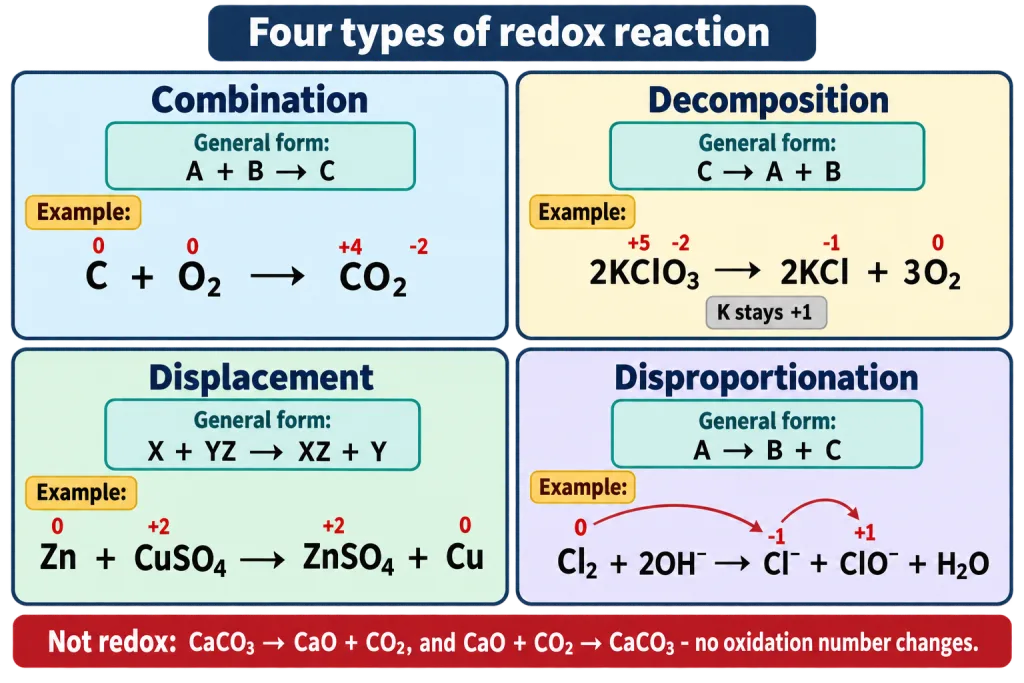
The four classes follow in order, with oxidation numbers written above the atoms that move.
Combination Reactions
Two or more substances come together to give one product.
Key Point: A combination reaction is redox when at least one of the reactants is in the free elemental form. A free element sits at oxidation number ; the moment it becomes part of a compound with a different element, that must change.
The standard examples
Carbon burning in dioxygen:
Carbon rises from to and each oxygen falls from to : four electrons lost, four gained. Magnesium burning in dinitrogen:
Three magnesium atoms lose two electrons each, six in all; two nitrogen atoms gain three each. Atoms: 3 Mg and 2 N on both sides. Methane burning in air:
Carbon climbs from to , a change of eight. The four oxygen atoms in each fall from to , gaining eight electrons between them. Hydrogen stays at on both sides and does not change at all, which is the detail examiners like to test. Atoms: 1 C, 4 H and 4 O on each side.
Every combustion reaction that uses elemental dioxygen is a redox combination reaction. So are these two, in which both reactants are free elements:
The combination reactions that are not redox
If both reactants are already compounds and every element keeps the oxidation number it had, nothing is oxidised and nothing reduced.
Calcium stays , carbon stays and oxygen stays . This is a combination and an acid-base reaction between a basic and an acidic oxide, but it is not redox. Two more of the same kind are , where nitrogen stays , and , where sulphur stays .
[Board] State the criterion in one line: a combination is redox only if a free element takes part, so is not.
Decomposition Reactions
A decomposition reaction is the reverse of a combination: one compound breaks down into two or more simpler substances.
Key Point: A decomposition is redox when at least one of the products is in the free elemental state. That product leaves with oxidation number , so whatever it was in the compound, it has changed.
Worked examples
Electrolysis of water:
Hydrogen falls from to and oxygen rises from to : four hydrogens gain one electron each, two oxygens lose two each. Sodium hydride heated:
Hydrogen here is a hydride ion at , so it is oxidised to , and sodium at is reduced to . This catches anyone who assumes hydrogen is always ; in a metal hydride it is .
Potassium chlorate heated with manganese dioxide as catalyst:
Chlorine drops from to , gaining six electrons per atom. Six oxygens rise from to , losing two each, twelve in all. Potassium is throughout and takes no part.
Two more that appear constantly, the second being the darkening of photographic film:
For lead nitrate: 2 Pb, 4 N and 12 O on each side. Nitrogen falls , gaining four electrons in all, and two oxygens rise , losing four. Lead never moves off .
The decompositions that are not redox
Calcium is , carbon is and oxygen is on both sides. Nothing changes, no product is a free element, and the reaction is not redox. The same holds for
One qualification to the free-element rule
"At least one product must be a free element" is a working test, not a law. A few decompositions are redox without releasing any element, because two oxidation states of one element meet in the middle:
Atoms: 2 N, 4 H and 3 O on each side. Nitrogen at in the ammonium ion is oxidised, nitrogen at in the nitrate ion is reduced, and both arrive at in . That pattern has its own name, at the end of this section.
Displacement Reactions: Metal Displacement
In a displacement reaction a free element pushes another element out of its compound and takes its place, . It splits into two families: metal displacement, where one metal replaces another, and non-metal displacement, where hydrogen, a halogen or (rarely) oxygen is displaced.
Key Point: In metal displacement a metal in a compound is displaced by a more reactive metal in the free state. The free metal is oxidised, the combined metal is reduced, and the anion is a spectator.
The classroom reaction
Drop a zinc rod into blue copper sulphate solution: the blue fades, red-brown copper settles on the zinc and the beaker warms.
Sulphate is unchanged on both sides, so the real reaction is
Charge: on each side. Zinc is oxidised, so zinc is the reducing agent; the copper(II) ion is reduced, so it is the oxidising agent. Copper will not reverse this and displace zinc from zinc sulphate.
Copper does the same to silver, with charge on each side: the solution turns blue as forms and silver crystals grow on the copper.
Which metal displaces which
The order is the activity series, most reactive first.
A metal displaces from solution any metal standing below it, so zinc displaces copper and copper cannot displace zinc.
The standard electrode potentials put a number on the same prediction. has and has , and with copper(II) reduced,
Positive, so the reaction goes as written; run the other way it gives , which is why nothing happens. Two more worth remembering: gives , and gives .
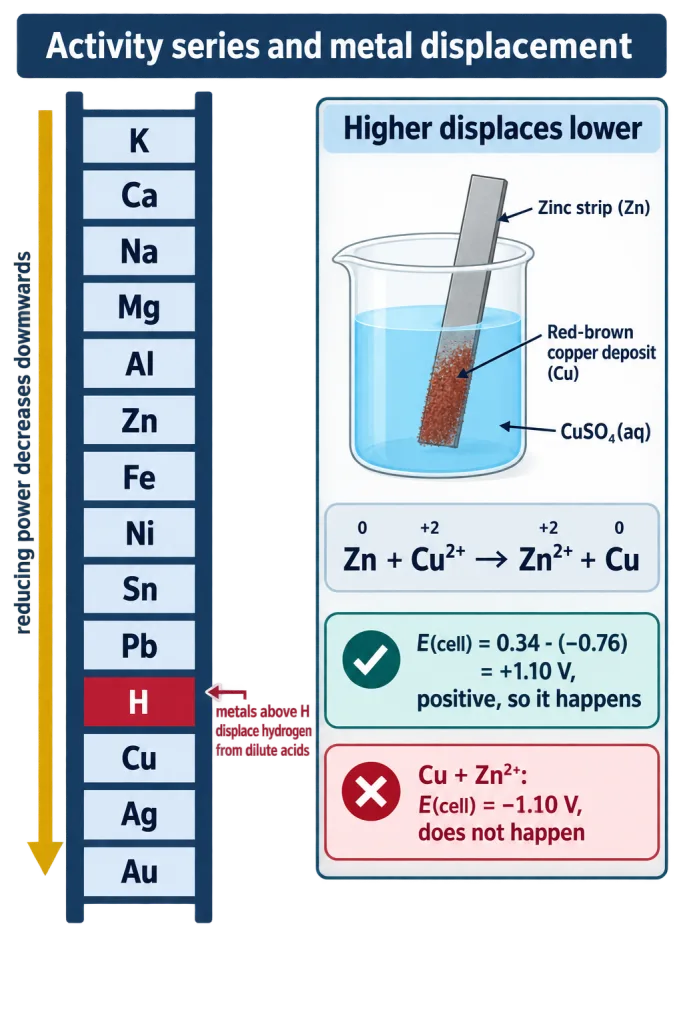
Metal displacement in metallurgy
Pure metals are pulled out of their compounds industrially by this reaction, using a cheap reactive metal as the reducing agent.
Two vanadium atoms gain five electrons each; five calcium atoms lose two each.
Titanium gains four electrons; two magnesium atoms lose two each. This is the Kroll process.
Two chromium atoms gain three electrons each; two aluminium atoms lose three each. All three equations balance for atoms as written. This is the thermite (aluminothermic) reaction, and the version with iron(III) oxide, , releases enough heat to weld rail tracks with the molten iron it produces.
In each case the reducing metal gives up electrons more readily than the metal being set free.
Displacement Reactions: Non-Metal Displacement
Hydrogen displaced from water
The alkali metals, and the alkaline earth metals calcium, strontium and barium, are strong enough reducing agents to take hydrogen out of cold water.
Atoms: 2 Na, 2 O and 4 H on each side. Sodium rises , losing two electrons in all; two of the four hydrogens fall , gaining two, and the other two stay at inside the hydroxide. Calcium behaves the same way, giving and .
Less active metals such as magnesium and iron leave cold water alone but react with hot water and steam. Magnesium gives , and iron with steam gives
Atoms: 3 Fe, 4 O and 8 H on each side. The product is magnetite, in which iron sits at an average , so the three iron atoms give up eight electrons between them and the eight hydrogens take one each.
Hydrogen displaced from acids
Many metals that ignore cold water still displace hydrogen from a dilute acid, and some that will not react even with steam, cadmium and tin among them, react with acid.
Magnesium and iron do the same, giving and . These reactions make dihydrogen in the laboratory, and the reactivity of the metal shows up as the rate of gas evolution: fastest with magnesium, slowest with iron. Silver and gold sit below hydrogen and do not react with hydrochloric acid at all. Dilute nitric acid is the exception to keep in mind: it is itself an oxidising agent and oxidises the hydrogen released to water, so a metal in nitric acid gives an oxide of nitrogen rather than .
Halogen displaced from a halide
A halogen displaces the halide ion of any halogen below it in group 17. Oxidising power falls down the group, , and the standard electrode potentials agree: , , and in that order.
Chlorine with potassium bromide gives , and with potassium iodide . Potassium is a spectator, so the ionic forms are cleaner, and bromine displaces iodide in the same way:
Each carries a charge of on each side. The reverse of the last, iodine plus bromide, does not happen: iodine is the weakest oxidising agent of the four and iodide the strongest reducing agent among the halide ions.
The liberated bromine and iodine dissolve in carbon tetrachloride, which is the basis of the layer test for and : add chlorine water, shake with and read the lower organic layer, orange-red for bromine and violet for iodine.
Recovering a halogen from its halide is an oxidation, . Chemical oxidants can do this for , and , but nothing can do it for , because fluorine is the strongest oxidising agent there is. Fluorine is obtained from fluoride only by electrolysis.
Oxygen displacement
Fluorine is so reactive that it attacks water itself and displaces the oxygen:
Atoms: 4 H, 2 O and 4 F on each side. Four fluorines fall from to and two oxygens rise from to , four electrons each way. This is the rare oxygen-displacement case, and it is why fluorine displacement reactions are not run in aqueous solution — the water reacts first.
Disproportionation Reactions
Key Point (Definition): In a disproportionation reaction, one element in a single oxidation state is simultaneously oxidised and reduced. Part of that element ends up in a higher oxidation state and part in a lower one.
Two conditions must be met, and both are worth writing out in an answer:
- The element must start in an intermediate oxidation state, not its highest and not its lowest.
- Both a higher and a lower oxidation state must be accessible to it.
So the reacting substance must contain an element with at least three oxidation states, sitting in a middle one.
Hydrogen peroxide
Oxygen in the peroxide linkage is at , intermediate between in water and in dioxygen. Two of the four oxygens fall to , gaining one electron each, and two rise to , losing one each. Hydrogen stays at and takes no part.
Chlorine in alkali
With cold dilute alkali:
Atoms: 2 Cl, 2 O and 2 H on each side; charge on the left and on the right. One chlorine gains an electron and one loses one. The hypochlorite formed is the active ingredient in household bleach, oxidising coloured stains to colourless products.
With hot concentrated alkali the higher product is chlorate instead:
Atoms: 6 Cl, 6 O and 6 H on each side; charge on the left and on the right. Five chlorines gain one electron each and one loses five, which is what fixes the awkward coefficients 5 and 1.
Phosphorus in alkali
Atoms: 4 P, 6 O and 9 H on each side; charge on each side. One phosphorus falls to in phosphine, gaining three electrons; three rise to in hypophosphite, losing one each. Sulphur behaves the same way in alkali, giving at and at .
Copper(I) in water
Charge on each side. Copper(I) sits between and and does not survive in aqueous solution: it collapses into copper(II) ions and copper metal. This is why has no existence in water while is stable, and why copper(I) survives only as an insoluble salt such as or in a complex.
Manganate(VI)
Atoms: 3 Mn, 12 O and 4 H on each side; charge on the left and on the right. Manganese at is intermediate: two atoms rise to , losing one electron each, and one falls to , gaining two. The green manganate ion turning purple on acidification is this reaction.
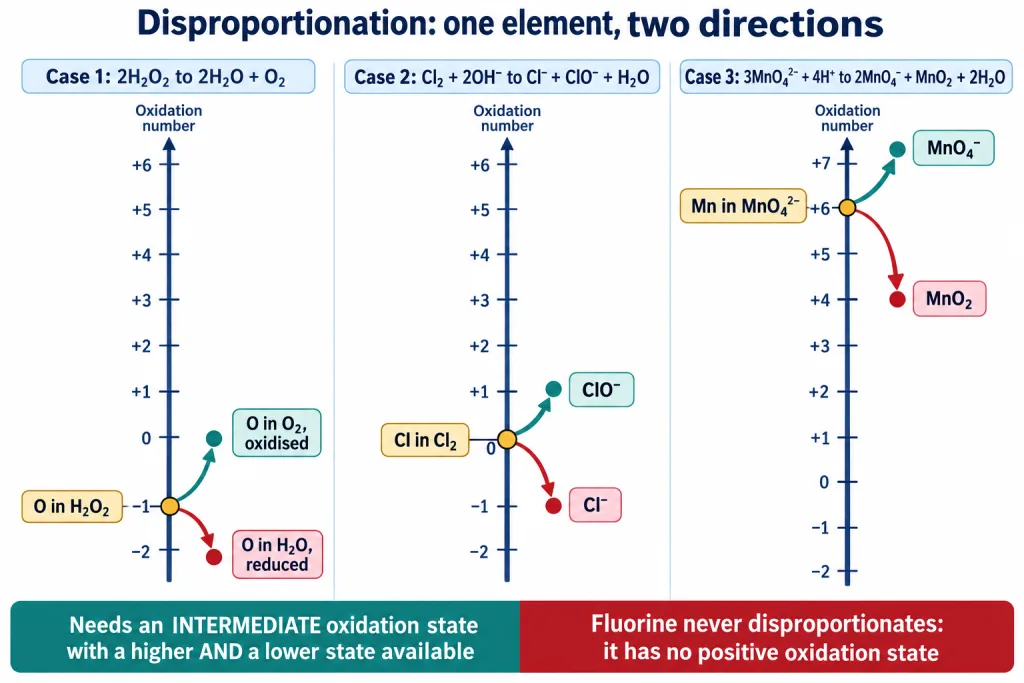
Which species can and cannot disproportionate
An element in its highest oxidation state has nowhere higher to go and can only be reduced; one in its lowest state can only be oxidised. Either way, no disproportionation.
Take the four oxoanions of chlorine, in which chlorine is , , and :
Charges: , and , and atoms balance in each. But does not disproportionate: chlorine in perchlorate is already at .
The same test disposes of , and , all at their highest states, and of and , at their lowest. One more is set often:
Atoms: 2 N, 6 O and 2 H on each side; charge on each side. Nitrogen at goes to and .
The Fluorine Trap and the Reverse Process
Why fluorine never disproportionates
Bromine and iodine behave like chlorine in alkali, giving with and with . Fluorine does not. It is the most electronegative element, so it is never the positive partner in a bond: its only oxidation numbers are in and in every compound. There is no positive state and therefore no intermediate one, so the second condition fails outright. What fluorine does with cold dilute alkali is this:
Atoms: 4 F, 2 O and 2 H on each side; charge on the left and on the right.
Now read the oxidation numbers. Fluorine is in and in both products, because fluorine is in every compound, oxygen difluoride included, where it beats even oxygen for electronegativity. Fluorine is only reduced. The element oxidised is oxygen, from in hydroxide to in — one of the two exceptions to oxygen being .
So the reaction is redox, but it is fluorine oxidising the oxygen of the alkali, not the halogen splitting into a higher and a lower state; the parallel with is only in the look of the equation. Fluorine also attacks the water present, liberating some dioxygen by , where again it only falls to .
Key Point: Among the halogens, fluorine alone shows no disproportionation tendency, because it has no positive oxidation state. With cold dilute alkali it gives and , and with water it gives and ; in both, fluorine is reduced and oxygen is oxidised.
Comproportionation
Disproportionation run backwards has its own name.
Key Point (Definition): In a comproportionation (or synproportionation) reaction, two species containing the same element in a higher and a lower oxidation state react to give a single product in which that element is in an intermediate state.
Atoms: 6 Cl, 3 O and 6 H on each side; charge on each side. Five chlorides lose one electron each and the chlorate chlorine gains five, and both end at .
Charge: on each side; atoms 6 I, 3 O and 6 H. This reaction generates a known amount of iodine in situ for a thiosulphate titration.
Two more worth knowing:
In the first, sulphide at loses two electrons per atom and sulphur at gains four; atoms are 3 S, 4 H and 2 O on each side. In the second, charge is on each side, two iron(III) ions gain one electron each and the metal loses two.
[JEE Main] One element in two oxidation states on the left and one on the right is comproportionation; one state on the left and two on the right is disproportionation. Read the direction before you name it.
Worked Questions
Question 1: Classify four reactions
Classify each of these as combination, decomposition, displacement or disproportionation.
(a) (b) (c) (d)
Answer:
(a) Two elements in, one compound out, so a combination; nitrogen goes and oxygen .
(b) One compound in, three out, so a decomposition; nitrogen falls and oxygen rises .
(c) The hydride ion has displaced a hydrogen from water, so a displacement. The hydride hydrogen is and the water hydrogen , and both leave as at .
(d) Nitrogen is on the left and comes out at in nitrite and in nitrate: one element, one starting state, two finishing states, so a disproportionation.
Ans: (a) combination, (b) decomposition, (c) displacement, (d) disproportionation. Watch out: In (c) the two hydrogens that pair up came in at and and met at , so this displacement is also a comproportionation. Either name is defensible if you show the oxidation numbers.
Question 2: Which oxoanion of chlorine will not disproportionate
Of , , and , which does not disproportionate, and why? Write the reaction for each one that does.
Answer:
First I find chlorine in each, with oxygen at and the ion charge : , , and respectively. Chlorine cannot go above , so perchlorate has no higher state available. The other three are all intermediate.
Each balances for atoms, and the charges are , and .
Ans: does not disproportionate; chlorine in it is already at its highest state, . Watch out: Only reduction is open to a species in its highest oxidation state, so perchlorate can act as an oxidising agent but never disproportionate.
Question 3: Fluorine with alkali
looks like the chlorine-in-alkali reaction. Is fluorine disproportionating?
Answer:
I check the atoms and charge first: 4 F, 2 O and 2 H on each side, and charge on each side.
Now the oxidation numbers. Fluorine is in , in , and again in , because fluorine is the most electronegative element and takes in every compound. Every fluorine atom has gone from to , so fluorine is only reduced. The element oxidised is oxygen, from in to in .
Ans: No. Fluorine is only reduced; oxygen is oxidised. Fluorine has no positive oxidation state, so it can never disproportionate. Watch out: Fluorine also attacks the water present, giving , where again fluorine only falls to .
Question 4: Two labels for one reaction
Show that is both a decomposition and a disproportionation.
Answer:
By shape, one compound gives two products, so it is a decomposition.
By oxidation number, the peroxide linkage puts each oxygen at , against in water and in dioxygen. Of the four oxygens on the left, two fall to , gaining one electron each, and two rise to , losing one each. Two electrons move, the same element is both oxidised and reduced, and hydrogen stays .
Ans: Decomposition by form, disproportionation by oxidation number; both descriptions are correct. Watch out: Using for oxygen in makes hydrogen come out at , which is impossible, and destroys the whole analysis.
Question 5: Chloride and chlorate in acid
Identify the reaction type in and count the electrons.
Answer:
Chlorine appears in two states on the left, in chloride and in chlorate, and one on the right, in . Two states in, one out, so it is a comproportionation.
Five chlorides rise from to , losing one electron each, and the chlorate chlorine falls from to , gaining five. Balance check: 6 Cl, 3 O and 6 H on each side, and charge on each side.
Ans: Comproportionation, with five electrons transferred. Watch out: Calling this a displacement is wrong. Only one element changes oxidation number, and no free element pushes anything out of a compound.
Mistakes That Cost Marks
Calling every combination or decomposition a redox reaction. and have the right shape and no oxidation number change. Run the numbers before you label.
Missing the free-element requirement. In a combination at least one reactant must be a free element for the reaction to be redox, and in a decomposition at least one product must be. fails the test.
Taking hydrogen as in a metal hydride, or oxygen as in a peroxide. In hydrogen starts at and is oxidised. In oxygen is ; use and hydrogen comes out at , and the disproportionation vanishes.
Swapping the two agents. The oxidising agent is the one reduced, the reducing agent the one oxidised. In the thermite reaction aluminium is the reducing agent.
Reversing a displacement that only goes one way. Copper does not displace zinc, and iodine does not displace chloride. Displacement runs from the more reactive element to the less reactive.
Expecting from nitric acid. Dilute nitric acid oxidises the hydrogen it releases, giving an oxide of nitrogen instead.
Calling the fluorine and alkali reaction a disproportionation. Fluorine goes to in both products; it is oxygen that is oxidised, from to in .
Claiming a species in its highest state disproportionates. , , and can only be reduced.
Confusing the two directions. Two states in and one out is comproportionation; one state in and two out is disproportionation.
Leaving the charge unchecked. carries on each side; if yours does not, the coefficients are wrong.
Quick Revision
- Test for redox first, class second. Assign oxidation numbers on both sides; only if something changes is it redox.
- Combination is redox when at least one reactant is a free element: , , . is not.
- Decomposition is redox when at least one product is a free element: , , . is not.
- Not every element in a redox equation moves: hydrogen stays in the methane combustion, potassium stays in the chlorate decomposition.
- Metal displacement: , , , (thermite). The free metal is oxidised, the combined metal reduced.
- Activity series: ; higher displaces lower. For zinc and copper(II), .
- Hydrogen displacement: alkali metals and Ca, Sr, Ba from cold water; Mg from hot water and Fe from steam; any metal above hydrogen from a dilute acid, fastest and slowest . and give nothing.
- Halogen displacement: , with values , , and . , and go; the reverses do not. is oxidised to only by electrolysis. Oxygen displacement is the rare one, .
- Disproportionation: one element in an intermediate state is oxidised and reduced at once, so it needs at least three accessible states. Memorise ; (cold dilute); (hot concentrated); ; ; .
- Cannot disproportionate: anything in its highest state (, , , ) or its lowest (, ).
- Fluorine never disproportionates, having no positive oxidation state. With cold dilute alkali, : fluorine falls to and oxygen rises from to .
- Comproportionation is the reverse: , , , .
- Every ionic equation must balance charge as well as atoms. Check both, every time.