Why Chemists Needed a Counting Unit
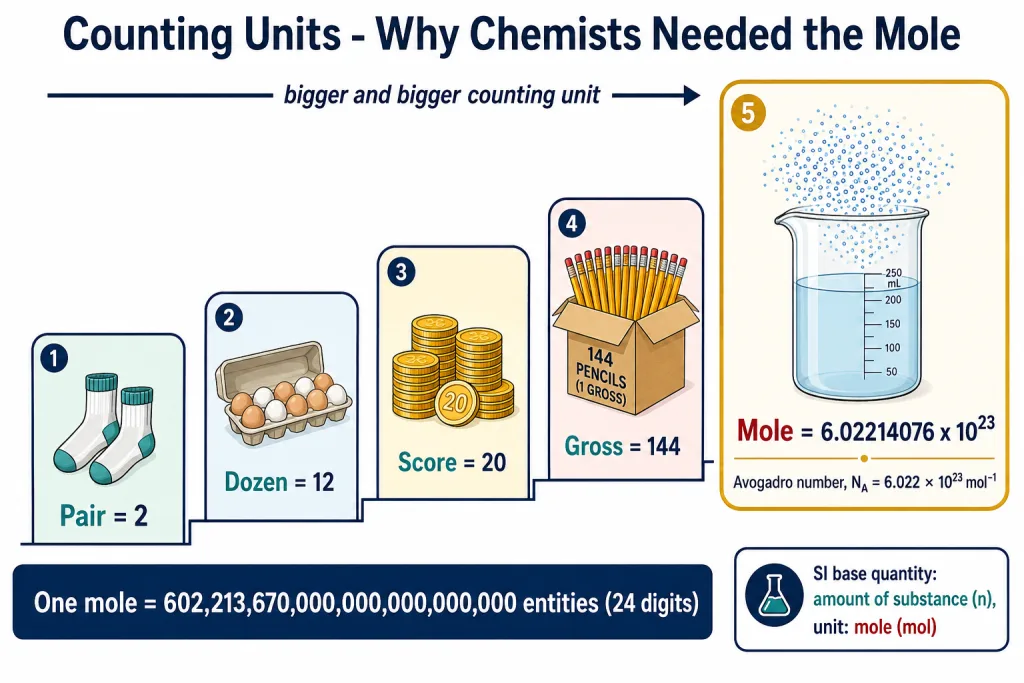
Eggs are sold by the dozen (12). A score is 20, a gross is 144. Each is a name for a fixed number. Atoms are so small that one drop of water holds more molecules than there are sand grains on Earth, so chemists needed a far bigger counting word: the mole.
Key Point: A dozen means 12, a score 20, a gross 144. A mole means a fixed, very large number of entities (atoms, molecules, ions, electrons, or any specified particle). It is a counting unit like a dozen, only far bigger.
The mole is an SI base quantity
The mole (symbol mol) is the seventh SI base quantity, for amount of substance (symbol n). It is not derived from the other six.
| Base quantity |
Symbol |
SI unit |
Unit symbol |
| Length |
l |
metre |
m |
| Mass |
m |
kilogram |
kg |
| Time |
t |
second |
s |
| Electric current |
I |
ampere |
A |
| Thermodynamic temperature |
T |
kelvin |
K |
| Amount of substance |
n |
mole |
mol |
| Luminous intensity |
Iv |
candela |
cd |
The exact definition (2019 SI)
Key Point (Definition): The mole, symbol mol, is the SI unit of amount of substance. One mole contains exactly 6.02214076×10²³ elementary entities. This number is the fixed numerical value of the Avogadro constant, NA, in mol−1, and is called the Avogadro number.
- "Exactly." Since 2019 the number is fixed by definition, not measured. Older books quote a measured 6.022×10²³ or 6.023×10²³. For calculations use 6.022×10²³.
- "Elementary entities." Atom, molecule, ion, electron, or a specified group of particles. A mole of electrons or of Na+ ions is valid, but say which.
- Same number for every substance. A mole of H atoms, of water molecules or of gold atoms holds 6.022×10²³ entities. Masses differ; counts do not.
How big is this number?
602,213,670,000,000,000,000,000
Twenty-four digits. If everyone on Earth (about 8×10⁹) counted one atom per second, one mole would take over two million years. So we weigh atoms and let the mole count them.
[Board] "Define mole" is a regular two-mark question. Write exactly, the full number 6.02214076×10²³, and "seventh SI base quantity, amount of substance".
Where the Avogadro Number Came From
The carbon-12 link
One 12C atom is exactly 12 u (1 u is one-twelfth of it). The mole was chosen so that one mole of carbon-12 atoms has a mass of exactly 12 g: same number, grams instead of u.
A mass spectrometer gives the mass of one atom:
mass of one 12C atom=1.992648×10⁻²³ g
Mass of a mole divided by mass of one atom gives the atoms in a mole:
NA=1.992648×10⁻²³ g atom−112 g mol−1=6.0221367×10²³ atoms mol−1
Check: 12÷1.992648=6.0221…, and 100÷10−23=1023.
Key Point: The Avogadro number is the number of 12C atoms in exactly 12 g of carbon-12. It bridges the atomic mass unit and the gram.
The u-to-gram bridge
Since 1 u =1.66056×10⁻²⁴ g,
NA×1 u=6.022×1023×1.66056×10−24 g=1.000 g
The Avogadro number of atomic mass units is one gram. So a mole of any entity has the same number of grams as one entity has in u. This is why molar mass in g mol−1 equals atomic or molecular mass in u.
Reciprocal: 1 u=NA1 g, so mass of one atom in grams is atomic mass divided by NA.
"One mole of …" names the entity
| Statement |
Entities counted |
Number |
| 1 mol of hydrogen atoms (H) |
atoms |
6.022×10²³ H atoms |
| 1 mol of hydrogen molecules (H2) |
molecules |
6.022×10²³ molecules =1.204×1024 H atoms |
| 1 mol of water molecules (H2O) |
molecules |
6.022×10²³ molecules |
| 1 mol of sodium chloride (NaCl) |
formula units |
6.022×10²³ formula units (Na+Cl− pairs) |
| 1 mol of Na+ ions |
ions |
6.022×10²³ ions |
| 1 mol of electrons |
electrons |
6.022×10²³ electrons |
NaCl is a lattice of ions with no discrete molecules, so we count formula units. One mole of NaCl holds 6.022×10²³ Na+ and 6.022×10²³ Cl− ions.
[NEET] "1 mole of hydrogen" is ambiguous: hydrogen gas means H2 (2 g), hydrogen atoms means H (1 g).
Molar Mass
Key Point (Definition): The mass of one mole of a substance in grams is its molar mass (symbol M), unit g mol−1. Molar mass in grams per mole is numerically equal to the atomic, molecular or formula mass in u.
Compute the molecular mass (Section 5), keep the number, change the unit to g mol−1.
| Substance |
Type of entity |
Atomic / molecular / formula mass |
Molar mass |
| Carbon, C |
atom |
12.011 u |
12.011 g mol−1 |
| Sodium, Na |
atom |
23.0 u |
23.0 g mol−1 |
| Dioxygen, O2 |
molecule |
2×16.00=32.00 u |
32.00 g mol−1 |
| Water, H2O |
molecule |
2(1.008)+16.00=18.02 u |
18.02 g mol−1 |
| Carbon dioxide, CO2 |
molecule |
12.011+2(16.00)=44.01 u |
44.01 g mol−1 |
| Methane, CH4 |
molecule |
12.011+4(1.008)=16.04 u |
16.04 g mol−1 |
| Glucose, C6H12O6 |
molecule |
180.16 u |
180.16 g mol−1 |
| Sodium chloride, NaCl |
formula unit |
23.0+35.5=58.5 u |
58.5 g mol−1 |
| Calcium carbonate, CaCO3 |
formula unit |
40.1+12.011+3(16.00)=100.1 u |
100.1 g mol−1 |
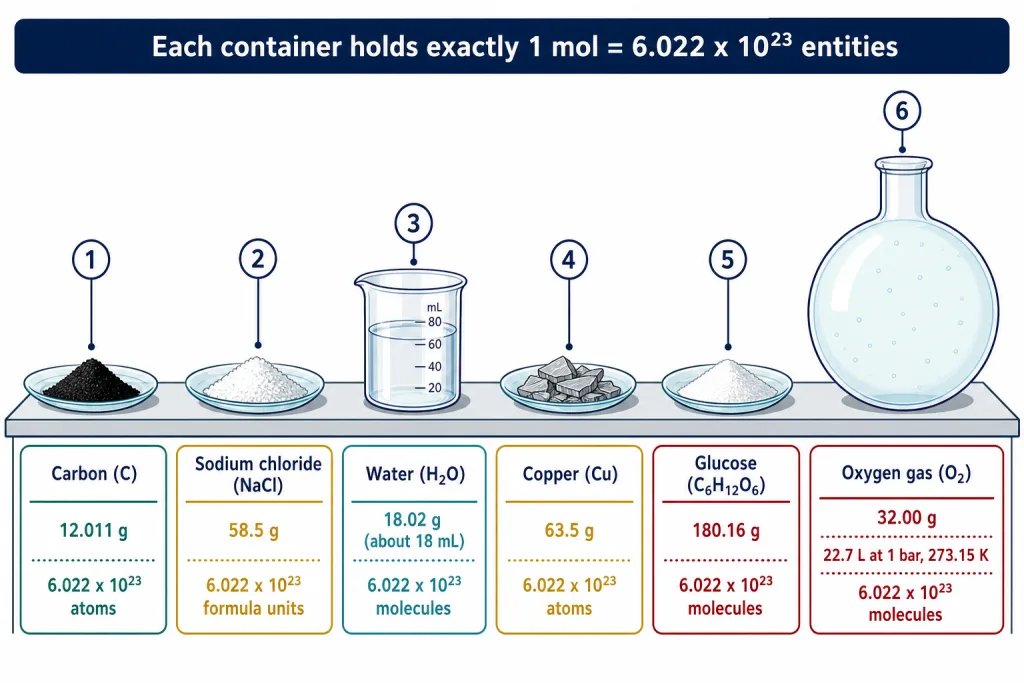
18.02 g of water, 58.5 g of salt, 32.00 g of oxygen gas and 12.011 g of carbon each contain one mole, 6.022×10²³ entities.
Three cautions
- Element versus molecule. O atoms: 16.00 g mol−1; O2 gas: 32.00 g mol−1. H2, N2, O2, F2, Cl2 are diatomic. Noble gases (He, Ne, Ar) are monatomic: helium is 4.00 g mol−1.
- Ionic compounds use formula mass: NaCl =58.5 g mol−1.
- Rounding. Boards accept H = 1, C = 12, O = 16, Na = 23, Cl = 35.5 unless precise values are given. Use the values supplied.
n=Mm⟺m=n×M
n in mol, m in g, M in g mol−1.
- Moles in 9.0 g of water: n=18.029.0=0.50 mol.
- Mass of 0.20 mol NaCl: m=0.20×58.5=11.7 g.
Given a mass, first divide by molar mass. Everything else follows from moles.
The Mole Map: Mass, Moles, Particles and Gas Volume
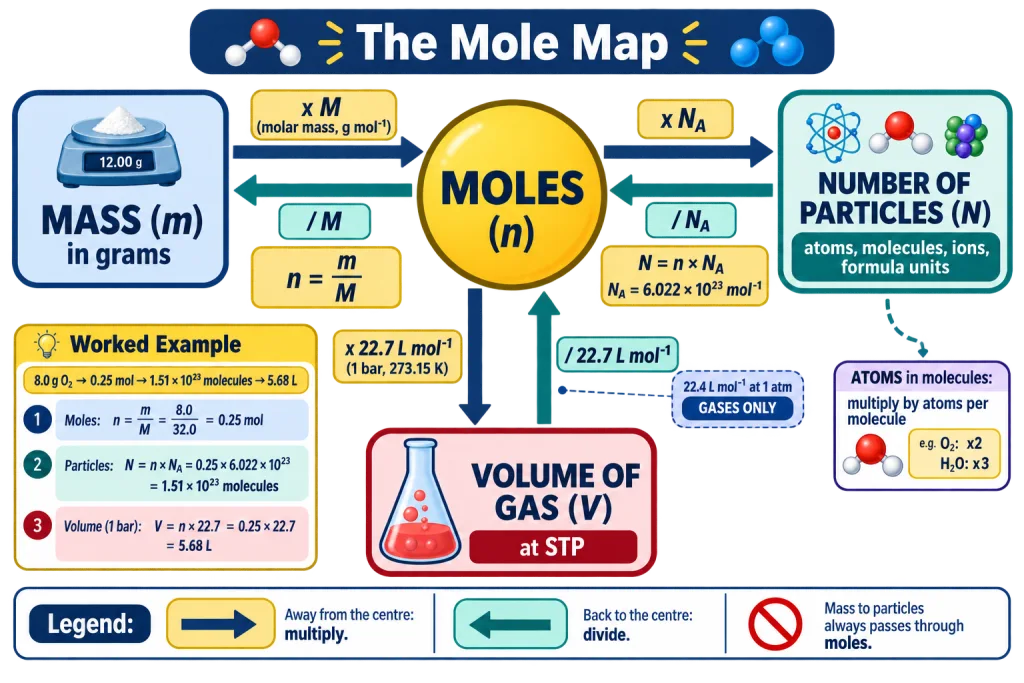
Three roads out of "moles"
| From moles to … |
Multiply by |
Formula |
Reverse |
| Mass (g) |
molar mass M |
m=nM |
n=m/M |
| Number of particles |
Avogadro constant NA |
N=nNA |
n=N/NA |
| Volume of a gas at STP (L) |
molar volume Vm |
V=nVm |
n=V/Vm |
Key Point: Away from the centre, multiply; back to the centre, divide.
Mass to particles goes through moles:
N=Mm×NA
Molecules in 4.4 g of CO2: 4.4/44.01=0.100 mol; 0.100×6.022×1023=6.022×10²².
Molar volume of a gas
By Avogadro's law (Section 4), one mole of any gas has the same volume at the same temperature and pressure: the molar volume, Vm.
| Convention |
Conditions |
Molar volume of an ideal gas |
| STP (IUPAC, current) |
1 bar (105 Pa), 273.15 K |
22.7 L mol−1 (22.71 L) |
| Older STP (many JEE/NEET keys) |
1 atm (1.013 bar), 273.15 K |
22.4 L mol−1 (22.41 L) |
| SATP |
1 bar, 298.15 K |
24.8 L mol−1 |
IUPAC moved standard pressure from 1 atm to 1 bar in 1982; at the lower pressure the gas expands slightly, so 22.4 L becomes 22.7 L. The textbook uses 22.7 L at 1 bar; competitive papers often still use 22.4 L at 1 atm.
[JEE Main] "At STP" with no pressure given: take 22.4 L unless the paper uses 1 bar. The two differ by about 1.3%; state the value used.
ngas=22.7 L mol−1V (L at STP)
11.35 L at 1 bar, 273.15 K is 0.500 mol; 5.6 L at 1 atm, 273 K is 0.25 mol.
Key Point: Molar volume is for gases only. For liquids and solids use mass and density.
A full circuit: 8.0 g of oxygen gas
- Moles: n=8.0/32.00=0.25 mol.
- Molecules: N=0.25×6.022×1023=1.51×10²³.
- Volume at STP (1 bar): V=0.25×22.7=5.68 L (5.6 L at 1 atm).
- Atoms: 2 per O2, so 3.01×10²³ O atoms.
The subscript is a mole ratio
One C2H6 molecule has 2 C and 6 H atoms, so one mole of ethane has 2 mol C and 6 mol H atoms. Subscripts in a formula are mole ratios of atoms to molecules.
1 mol C2H6 ⟹ 2 mol C atoms+6 mol H atoms=8 mol atoms in total
Three moles of ethane: C atoms =3×2=6 mol; H atoms =3×6=18 mol; molecules =3×6.022×1023=1.807×1024.
| One mole of … |
Contains |
| H2O |
2 mol H atoms, 1 mol O atoms, 3 mol atoms, 10 mol electrons, 10 mol protons |
| CO2 |
1 mol C, 2 mol O, 3 mol atoms, 22 mol electrons |
| H2SO4 |
2 mol H, 1 mol S, 4 mol O, 7 mol atoms |
| C6H12O6 |
6 mol C, 12 mol H, 6 mol O, 24 mol atoms |
| O2 |
2 mol O atoms |
| NaCl |
1 mol Na+, 1 mol Cl−, 2 mol ions |
| CaCl2 |
1 mol Ca2+, 2 mol Cl−, 3 mol ions |
| Al2(SO4)3 |
2 mol Al3+, 3 mol SO42−, 5 mol ions, 17 mol atoms |
(Electrons: H2O has 2+8=10, CO2 has 6+16=22.)
Key Point: Moles of an atom = (moles of compound) × (its subscript). Total moles of atoms = (moles of compound) × (sum of subscripts).
Atoms in a given mass
n=m/M, times the subscript, times NA. For 9.0 g of water: n=9.0/18.02=0.50 mol; O atoms =0.50×1=0.50 mol =3.01×10²³; H atoms =0.50×2=1.0 mol =6.02×10²³.
Diatomic gases: the double-count trap
Atoms in 1 g of Cl2: molecules =1/71.0=0.0141 mol; Cl atoms =2×0.0141=0.0282 mol =1.70×10²². Drop the factor of 2 and you get half, which will be among the options.
[NEET] "Atoms in X g of N2 / O2 / H2" always needs the factor of 2. Noble gases (He, Ne, Ar) are monatomic.
Hydrated salts: count the water. 0.1 mol of Na2SO4⋅10H2O: 2+1+4+10(2+1)=37 atoms per formula unit, so 0.1×37=3.7 mol =2.23×1024 atoms.
Comparing Samples and Single Molecules: Four Question Types
Type 1: Which sample has the most atoms?
Fixed mass: smaller molar mass, more moles, more particles. For atoms, also multiply by atoms per particle. Compare 1 g each of Au, Na, Li, Cl2:
| Sample |
Molar mass |
Moles of particles |
Atoms per particle |
Moles of atoms |
| 1 g Au |
197.0 |
5.08×10⁻³ |
1 |
5.08×10⁻³ |
| 1 g Na |
23.0 |
4.35×10⁻² |
1 |
4.35×10⁻² |
| 1 g Li |
6.94 |
1.44×10⁻¹ |
1 |
1.44×10⁻¹ |
| 1 g Cl2 |
71.0 |
1.41×10⁻² |
2 |
2.82×10⁻² |
Lithium wins: lightest atoms, most per gram. Cl2 passed Au only through the factor of 2.
Type 2: Moles, u, or grams?
Atoms in (i) 52 mol Ar, (ii) 52 u He, (iii) 52 g He:
- 52 mol Ar: 52×6.022×1023=3.131×1025 atoms (monatomic).
- 52 u He: one He atom is 4 u, so 52/4=13 atoms. A "u" is the mass of one atom, so this is a direct count.
- 52 g He: n=52/4.00=13 mol; atoms =13×6.022×1023=7.829×1024.
Key Point: Mass in u over atomic mass in u gives atoms. Mass in g over molar mass gives moles. They differ by NA.
Type 3: Mass of one molecule or atom
mass of one molecule=NAM
One water molecule: 6.022×102318.02=2.99×10⁻²³ g. One carbon-12 atom: 6.022×102312=1.993×10⁻²³ g, the mass-spectrometer value.
Type 4: Molecules in a drop of water
Twenty drops make 1 mL, so one drop is 0.05 mL, or 0.05 g (density ≈1 g mL−1).
n=18.020.05=2.77×10⁻³ mol,N=2.77×10−3×6.022×1023=1.67×10²¹ molecules
Common mistakes
| Mistake |
Fix |
| 16 for O2, 1 for H2 |
Diatomic: M(O2)=32, M(H2)=2.016, M(Cl2)=71 |
| Forgetting atoms per molecule |
Multiply moles of molecules by the sum of subscripts |
| 22.4 L / 22.7 L for a liquid or solid |
Molar volume is for gases at STP only |
| Mixing 22.4 L (1 atm) and 22.7 L (1 bar) |
Match the pressure in the question |
| "52 u" read as "52 g" |
u counts atoms directly; g needs division by molar mass |
| Mass straight to particles |
Always mass → moles → particles |
Before calculating, underline the entity asked for and the quantity given, then walk the map between them.
Solved Examples
Question 1: Moles and molecules in a glass of water
How many moles of water and how many water molecules are present in 36.0 g of water? (H = 1.008, O = 16.00)
Answer:
First the molar mass: M(H2O)=2(1.008)+16.00=18.02 g mol−1.
Moles: n=18.0236.0=1.998≈2.00 mol.
Molecules: N=2.00×6.022×1023=1.204×1024.
Ans: 2.00 mol of water, 1.20×1024 molecules.
Question 2: From moles to mass and formula units
What is the mass of 0.25 mol of sodium chloride, and how many formula units does it contain? (Na = 23.0, Cl = 35.5)
Answer:
M(NaCl)=23.0+35.5=58.5 g mol−1. NaCl is ionic, so I count formula units.
Mass: m=0.25×58.5=14.6 g.
Formula units: 0.25×6.022×1023=1.51×10²³.
That is also 1.51×10²³ Na+ and 1.51×10²³ Cl−, so 3.01×10²³ ions in total.
Ans: 14.6 g; 1.51×10²³ formula units.
Watch out: Each NaCl formula unit gives two ions, so "number of ions" is double the formula units.
Question 3: Three moles of ethane
In three moles of ethane (C2H6), calculate (i) the number of moles of carbon atoms, (ii) the number of moles of hydrogen atoms, (iii) the number of molecules of ethane.
Answer:
1 mol C2H6 has 2 mol C atoms and 6 mol H atoms.
(i) C atoms: 3×2=6 mol.
(ii) H atoms: 3×6=18 mol.
(iii) Molecules: 3×6.022×1023=1.807×1024.
Ans: (i) 6 mol C atoms; (ii) 18 mol H atoms; (iii) 1.807×1024 molecules.
Question 4: Mass of a single molecule and a single atom
Calculate (i) the mass of one molecule of water and (ii) the mass of one atom of carbon-12, in grams.
Answer:
One mole is M g and holds NA particles, so one particle is M/NA.
(i) Water: 6.022×102318.02=2.992×10⁻²³ g.
(ii) Carbon-12: 6.022×102312.00=1.993×10⁻²³ g.
The mass-spectrometer value for 12C is 1.992648×10⁻²³ g, matching to four figures.
Ans: (i) 2.99×10⁻²³ g; (ii) 1.99×10⁻²³ g.
Watch out: A single-molecule mass should be around 10−22 to 10−24 g.
Question 5: Molecules in a drop of water
Assuming 20 drops of water make 1.0 mL and the density of water is 1.0 g mL−1, find the number of water molecules and the total number of atoms in one drop.
Answer:
One drop =1.0/20=0.050 mL, so mass =0.050×1.0=0.050 g.
Moles: n=18.020.050=2.775×10⁻³ mol.
Molecules: 2.775×10−3×6.022×1023=1.671×10²¹.
Each H2O has 3 atoms: 3×1.671×1021=5.01×10²¹ atoms.
Ans: About 1.67×10²¹ molecules and 5.0×10²¹ atoms.
Question 6: Volume of a gas at STP — both conventions
Find the volume occupied by 8.0 g of oxygen gas (i) at STP (1 bar, 273.15 K) and (ii) at 1 atm and 273.15 K. Also state the number of molecules present.
Answer:
M(O2)=2×16.00=32.00 g mol−1, so n=8.0/32.00=0.25 mol.
(i) At 1 bar: V=0.25×22.7=5.68 L.
(ii) At 1 atm: V=0.25×22.4=5.6 L.
Molecules: 0.25×6.022×1023=1.51×10²³ (3.01×10²³ O atoms).
Ans: (i) 5.68 L; (ii) 5.6 L; 1.51×10²³ molecules.
Watch out: Match the molar volume to the pressure given.
Question 7: Which 1 g sample has the most atoms?
Which of the following will have the largest number of atoms: (i) 1 g Au(s), (ii) 1 g Na(s), (iii) 1 g Li(s), (iv) 1 g Cl2(g)? (Au = 197.0, Na = 23.0, Li = 6.94, Cl = 35.5)
Answer:
Au: 1/197.0=5.08×10−3 mol =3.06×10²¹ atoms.
Na: 1/23.0=4.35×10−2 mol =2.62×10²² atoms.
Li: 1/6.94=1.44×10−1 mol =8.68×10²² atoms.
Cl2 (M=71.0): 1/71.0=1.41×10−2 mol molecules; atoms =2×1.41×10−2=2.82×10⁻² mol =1.70×10²².
Li > Na > Cl2 > Au.
Ans: (iii) 1 g of Li, about 8.7×10²² atoms.
Watch out: Each Cl2 molecule has two atoms.
Question 8: Moles, u and grams
Calculate the number of atoms in (i) 52 moles of Ar, (ii) 52 u of He, (iii) 52 g of He. (He = 4.00 u)
Answer:
(i) Argon is monatomic: 52×6.022×1023=3.131×1025 atoms.
(ii) One He atom is 4 u, so 52/4=13 atoms. No NA needed.
(iii) n=52/4.00=13 mol; atoms =13×6.022×1023=7.829×1024, exactly NA times (ii).
Ans: (i) 3.131×1025 atoms; (ii) 13 atoms; (iii) 7.829×1024 atoms.
Watch out: "u" gives a direct count of atoms; "g" gives moles.
Question 9: Atoms of each kind in a mass of carbon dioxide
For 4.4 g of CO2 find (i) the number of molecules, (ii) the total number of atoms, (iii) the number of oxygen atoms. (C = 12.011, O = 16.00)
Answer:
M(CO2)=12.011+2(16.00)=44.01 g mol−1.
Moles: n=4.4/44.01=0.100 mol.
(i) Molecules: 0.100×6.022×1023=6.02×10²².
(ii) Each molecule has 1+2=3 atoms: 3×6.02×1022=1.81×10²³ atoms.
(iii) O atoms, 2 per molecule: 2×6.02×1022=1.20×10²³.
Ans: (i) 6.02×10²² molecules; (ii) 1.81×10²³ atoms; (iii) 1.20×10²³ O atoms.
Question 10: Ions and electrons in a pinch of salt
A 5.85 g sample of NaCl is taken. Calculate (i) the total number of ions present, (ii) the total number of electrons present. (Atomic numbers: Na = 11, Cl = 17)
Answer:
Moles of NaCl: 5.85/58.5=0.100 mol formula units.
(i) Each formula unit gives one Na+ and one Cl−, so 2 ions. Moles of ions =0.200; number =0.200×6.022×1023=1.20×10²³.
(ii) Electrons per formula unit: Na+ has 11−1=10, Cl− has 17+1=18, total 28. (Neutral Na + Cl also gives 11+17=28.)
Electrons: 0.100×28=2.8 mol =2.8×6.022×1023=1.69×1024.
Ans: (i) 1.20×10²³ ions; (ii) 1.69×1024 electrons.
Question 11: Identifying a gas from its particle count and mass
A sample of a gas contains 1.505×10²³ molecules and has a mass of 11.0 g. (i) How many moles of gas are present? (ii) What volume will it occupy at STP (1 bar, 273.15 K)? (iii) What is its molar mass, and suggest what the gas could be.
Answer:
(i) n=6.022×10231.505×1023=0.250 mol.
(ii) V=0.250×22.7=5.68 L at 1 bar.
(iii) M=0.25011.0=44.0 g mol−1.
Molar mass 44 fits CO2 (44.01), also N2O (44.01) or propane C3H8 (44.1). Without more data, CO2 is the usual answer.
Ans: (i) 0.250 mol; (ii) 5.68 L; (iii) 44 g mol−1, consistent with CO2.
Question 12: Just how big is a mole?
(i) How many moles and molecules of water are in 1.00 L of water (density 1.00 g mL−1)? (ii) If a machine could count 107 molecules every second, how many years would it take to count one mole?
Answer:
(i) 1.00 L=1000 mL, so mass =1000 g.
Moles: 1000/18.02=55.5 mol (pure water is 55.5 mol per litre).
Molecules: 55.5×6.022×1023=3.34×1025.
(ii) Seconds: 1076.022×1023=6.022×10¹⁶ s.
One year ≈365×24×3600=3.154×10⁷ s, so 3.154×1076.022×1016=1.91×10⁹ years.
Ans: (i) 55.5 mol, 3.34×1025 molecules; (ii) about 1.9 billion years.
