
Why Percentage Composition Matters
You cannot see the atoms in an unknown powder, but you can burn it, dissolve it and weigh the products. Each experiment asks what fraction of the mass is carbon, hydrogen, oxygen. That fraction, per hundred, is the percentage composition. It links the balance to the formula.
Key Point (Definition): The mass per cent of an element in a compound is the mass of that element in one mole of the compound, divided by the molar mass, times 100:
- It is a mass ratio, not an atom ratio. Water has two H atoms per O atom, yet hydrogen is only about 11% of its mass.
- The percentages must add to 100. Use this as a check.
First example: water
One mole of contains 2 mol of H atoms and 1 mol of O atoms.
- Molar mass
- Mass of hydrogen in one mole g
- Mass of oxygen in one mole g
Check: ; the shortfall is rounding. In 100 g of water, 11.18 g is hydrogen and 88.79 g is oxygen.
What the data is used for
| Situation | Known | Wanted | Direction |
|---|---|---|---|
| Unknown compound | mass % of each element (from analysis) | its formula | per cent formula (main recipe) |
| Known compound | its formula | mass % of each element | formula per cent (the reverse problem) |
| Purity check | formula and measured mass % of a sample | purity | compare measured % with theoretical % |
Pure must be 40.04% calcium by mass. A sample measuring 38.0% is impure, and gives its purity.
[Board] "Define mass per cent and calculate it for hydrogen in water" is a standard 2-mark question: formula, substitution with units, answer to two decimals.
Percentage Composition from a Formula
Formula to percentage composition is the easier direction:
- Count the atoms of each element in one formula unit.
- Find the molar mass (atoms atomic mass, summed).
- Mass of each element in one mole atoms atomic mass.
- Divide by the molar mass, multiply by 100.
- Check that the percentages add to 100.
Second example: ethanol
contains 6 hydrogen atoms (five in , one in ), not five.
| Element | Atoms | Mass in one mole (g) | Mass per cent |
|---|---|---|---|
| C | 2 | ||
| H | 6 | ||
| O | 1 | ||
| Total | 46.068 | 100.00% |
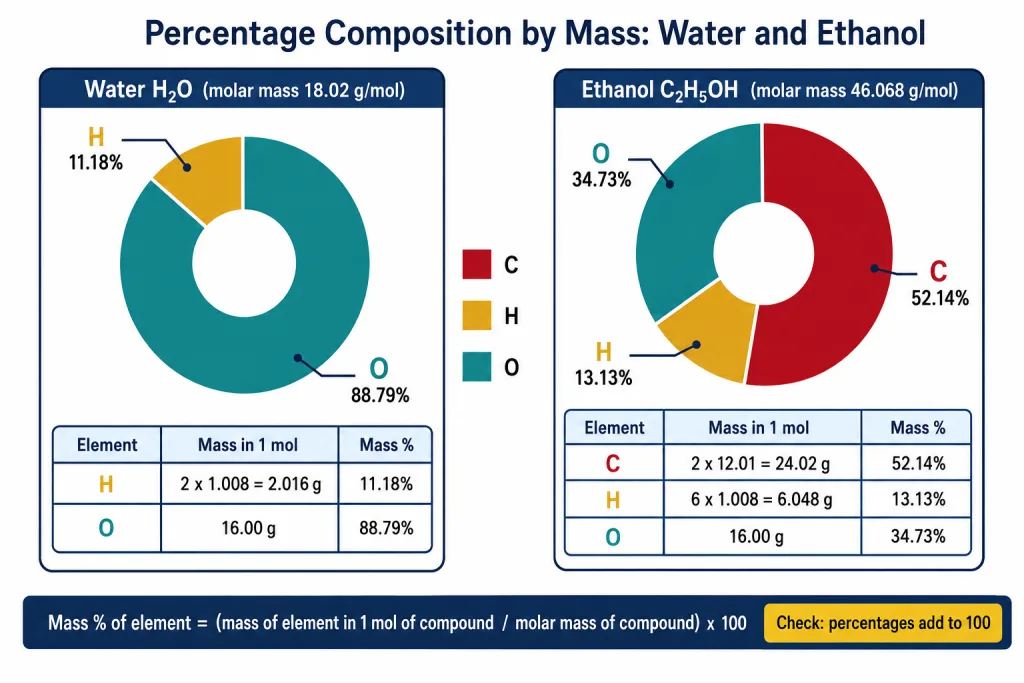
Reading the figure
In water, oxygen dominates (88.79%) because one O atom outweighs two H atoms eight to one. In ethanol, carbon leads (52.14%): two carbons, one oxygen. Percentage composition is a fingerprint of the compound, Proust's law of definite proportions in numbers.
Mass per cent versus atom per cent
| Quantity | Ethanol, hydrogen | Calculation |
|---|---|---|
| Atom (mole) per cent of H | atoms of H / total atoms | |
| Mass per cent of H | mass of H / total mass |
Questions mean mass per cent unless they say otherwise.
The commonest error is miscounting atoms in a condensed formula. has 2 C, 4 H, 2 O. has 2 N, 8 H, 1 S, 4 O. has 1 Cu, 1 S, 9 O, 10 H. Expand the formula first.
[NEET] "Which has the highest percentage of nitrogen?" (urea, ammonium nitrate, ammonium sulphate, ammonium chloride): urea, , at 46.7%.
Empirical Formula versus Molecular Formula
Now from percentages back to a formula. Percentages can give only the ratio of atoms.
Key Point (Definition): An empirical formula gives the simplest whole-number ratio of the atoms in a compound. A molecular formula gives the exact number of atoms of each type in one molecule.
Mass divided by atomic mass gives moles, so composition gives the atom ratio. But 1 : 2 : 1 fits , and equally: all three are 40.0% C, 6.7% H, 53.3% O. To fix the molecule you need the molar mass.
The relation between the two formulae
The empirical formula mass is the sum of atomic masses in the empirical formula. counts empirical units per molecule, so it is a whole number. Round 2.02 to 2; 2.5 means an arithmetic slip.
Families that share an empirical formula
| Empirical formula | Empirical formula mass | Compounds sharing it (molecular formula, molar mass, ) |
|---|---|---|
| 30.03 | formaldehyde (30, ); acetic acid (60, ); lactic acid (90, ); glucose (180, ) | |
| 13.02 | acetylene (26, ); benzene (78, ) | |
| 14.03 | ethene (28, ); propene (42, ); butene (56, ); cyclohexane (84, ) | |
| 17.01 | hydrogen peroxide (34, ) | |
| 46.01 | nitrogen dioxide (46, ); dinitrogen tetroxide (92, ) | |
| 15.03 | ethane (30, ) |
When the two formulae are the same
If the subscripts have no common factor other than 1, the molecular formula is the empirical formula and : , , , , , . Hydrogen peroxide , benzene and glucose are not.
Key Point: Ionic compounds such as , or have no discrete molecules, so their formula is always the empirical formula (formula unit). Exercises that ask for the "molecular formula" of iron oxide expect with .
[JEE Main] "Which pair has the same empirical formula?" Look for the same simplest ratio: benzene and acetylene, glucose and acetic acid, and . And "empirical formula , molar mass 42": , so .
The Five-Step Recipe
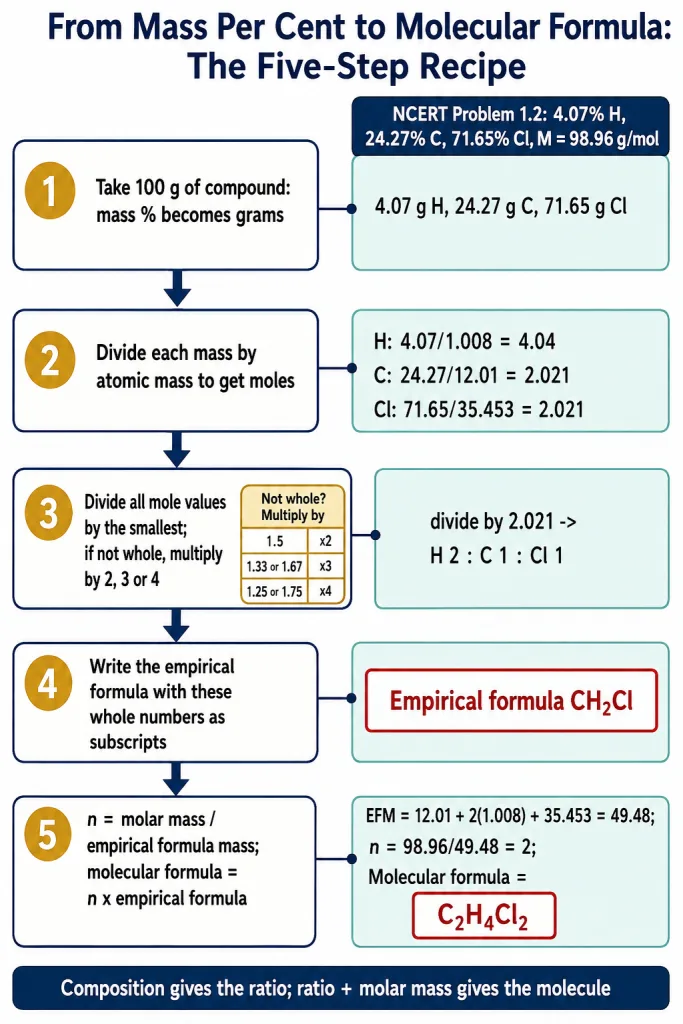
Key Point (The recipe):
Step 1 Take 100 g of the compound, so mass per cent becomes grams.
Step 2 Divide each mass by the element's atomic mass to get moles.
Step 3 Divide every mole value by the smallest to get the simplest ratio; if it is not whole, multiply through by a small integer.
Step 4 Write the empirical formula with those whole numbers as subscripts.
Step 5 Find the empirical formula mass, compute molar mass / empirical formula mass, and multiply the empirical formula by .
A worked problem
A compound contains 4.07% hydrogen, 24.27% carbon and 71.65% chlorine. Its molar mass is 98.96 g. Find its empirical and molecular formulas.
Step 1. In 100 g: 4.07 g H, 24.27 g C, 71.65 g Cl. They add to 99.99, so there is no fourth element.
Step 2.
Step 3. Divide by the smallest, 2.021.
| Element | Moles | 2.021 | Simplest ratio |
|---|---|---|---|
| H | 4.04 | 1.999 | 2 |
| C | 2.021 | 1.000 | 1 |
| Cl | 2.021 | 1.000 | 1 |
Step 4. H : C : Cl 2 : 1 : 1, so the empirical formula is .
Step 5. Empirical formula mass:
Molecular formula: .
Answer: Empirical formula ; molecular formula (1,2- or 1,1-dichloroethane; composition cannot distinguish isomers).
When Step 3 does not give whole numbers
A ratio like 1 : 1.5 means 2 : 3. Never round 1.5 to 2 or 1.33 to 1. Multiply the set by the smallest integer that clears the fraction:
| Ratio you get | Multiply all by | Whole-number ratio |
|---|---|---|
| 1.50 (or 2.50) | 2 | 3 (or 5) |
| 1.33 or 1.67 | 3 | 4 or 5 |
| 1.25 or 1.75 | 4 | 5 or 7 |
| 1.20 or 1.40 | 5 | 6 or 7 |
Round only small deviations: 1.98 is 2, 1.03 is 1, but 1.5 stays 1.5.
[JEE Main] Rounded atomic masses (H = 1, C = 12, O = 16, Cl = 35.5) are fine in Steps 2 and 3 (here H 4.07, C 2.02, Cl 2.02, still 2 : 1 : 1). Use precise values in Step 5 when the molar mass has three or four significant figures.
Where the Molar Mass Comes From, and Combustion Analysis
Problems supply the molar mass and the mass percentages in disguised forms.
Three ways a problem gives the molar mass
| Given | How to get molar mass | Example |
|---|---|---|
| Molar mass directly | use it | "molar mass is 98.96 g" |
| Mass of a known volume of gas at STP | (STP at 1 bar); 22.4 L for the 1 atm convention | "10.0 L at STP weighs 11.6 g" |
| Vapour density (VD) of a gas | VD |
[JEE Main] holds because VD is the gas density relative to (molar mass 2) at the same temperature and pressure.
Combustion analysis
A weighed sample is burned in excess oxygen and the masses of and formed are measured.
- All the carbon ends up in , and carbon is of its mass:
- All the hydrogen ends up in , hydrogen is of its mass, and each molecule carries two H atoms:
- Oxygen cannot be read from the products (the supply was in excess), so it is found by difference:
Key Point: Moles of C moles of ; moles of H moles of . Going straight to moles skips the percentages.
The welding-gas problem in outline
A C, H fuel gas gives 3.38 g and 0.690 g ; 10.0 L at STP weighs 11.6 g. Moles of C ; moles of H ; ratio 1 : 1, so . , , molecular formula (acetylene). Full working in Question 12.
"A hydrocarbon has 92.3% carbon; find its empirical formula": , , ratio 1 : 1, . Fingerprints: 92.3% C is ; 85.7% is ; 80.0% is ; 75.0% is .
Purity Checks and Common Mistakes
Composition as a purity test
A pure compound has a fixed mass per cent of each element (Proust's law). An impure sample has less of the element per gram, if the impurity contains none of it:
Equivalent form: mass of pure compound in the sample .
Pure is 40.04% Ca. Limestone with 38.0% Ca is calcium carbonate, if the impurity (silica or clay) has no calcium.
Extraction problems are the same calculation: copper from 100 g of is g.
Checklist
| Check | Why it catches errors |
|---|---|
| Do the given percentages add to about 100? | If they add to 60, the remaining 40% is a fourth element (often oxygen). |
| Divided by atomic mass, not molecular? | 71.65 g Cl divided by 70.9 () instead of 35.453 halves the mole count. |
| Is a whole number? | is 2; means a slip or a wrong empirical formula mass. |
| Empirical formula mass given molar mass? | Quick check on Step 5. |
| Kept 1.5 as 1.5 and multiplied by 2? | Rounding 1.5 to 2 turns into , which does not exist. |
| Counted hydrogens in condensed formulae? | has 6 H, has 4 H. |
Four traps
- Stopping at the empirical formula. If a molar mass is given, the molecular formula is wanted.
- Forgetting the factor of 2 for hydrogen in combustion analysis: one has two H atoms.
- Reading mass ratio as atom ratio. 24.27 g C and 71.65 g Cl look like 1 : 3 but are 1 : 1 in atoms. Convert to moles first.
- Sloppy significant figures. Keep three or four figures through the working; rounding 2.021 to 2 early can hide a 1 : 1.5 ratio.
Key Point: Composition gives ratio; ratio plus molar mass gives molecule.
[Board] Typical 3-mark question: "A compound contains 40.0% C, 6.7% H and 53.3% O and its molar mass is 60 g mol. Find its empirical and molecular formula." , then , so (acetic acid). Show all five steps for step marks.
Solved Examples
Question 1: Mass per cent of hydrogen and oxygen in water
Calculate the mass per cent of hydrogen and oxygen in water, . Atomic masses: H = 1.008, O = 16.00.
Answer: Molar mass . One mole holds g of H and 16.00 g of O.
Check: , fine within rounding.
Ans: Hydrogen 11.18%, oxygen 88.79%.
Question 2: Percentage composition of ethanol
Find the mass per cent of carbon, hydrogen and oxygen in ethanol, .
Answer: Atoms: 2 C, 6 H (5 + 1), 1 O. Molar mass .
Carbon: . Hydrogen: . Oxygen: .
Ans: C 52.14%, H 13.13%, O 34.73%.
Watch out: Count the hydroxyl hydrogen; has 6 H, not 5.
Question 3: Mass per cent of elements in sodium sulphate
Calculate the mass per cent of the different elements present in sodium sulphate, . (Na = 23.0, S = 32.1, O = 16.00)
Answer: Molar mass .
Sodium: . Sulphur: . Oxygen: .
Check: .
Ans: Na 32.37%, S 22.59%, O 45.04% (an answer key using other atomic masses gives 32.38%, 22.57%, 45.05%; rounding only).
Question 4: Copper from copper sulphate
How much copper can be obtained from 100 g of copper sulphate, ? (Cu = 63.5, S = 32.1, O = 16.00)
Answer: This is the mass per cent of Cu in . Molar mass ; 159.6 g contains 63.5 g of Cu. For 100 g:
Ans: About 39.8 g of copper (39.81 g with S = 32.0).
Question 5: The reverse problem, and a family resemblance
Calculate the percentage composition of glucose, , and compare it with that of acetic acid, . What do you conclude?
Answer: Glucose: molar mass . C ; H ; O .
Acetic acid: , molar mass . C ; H ; O .
Identical to two decimal places. Both reduce to : glucose is , acetic acid .
Ans: Both are 40.00% C, 6.71% H, 53.29% O; composition alone cannot separate compounds with the same empirical formula.
Question 6: From percentages to
A compound contains 4.07% hydrogen, 24.27% carbon and 71.65% chlorine. Its molar mass is 98.96 g. Find its empirical and molecular formulae.
Answer: In 100 g: 4.07 g H, 24.27 g C, 71.65 g Cl. Moles: H ; C ; Cl .
Dividing by 2.021: H , C , Cl , so the empirical formula is .
Empirical formula mass g; ; molecular formula .
Ans: Empirical formula ; molecular formula .
Question 7: Oxide of iron
An oxide of iron contains 69.9% iron and 30.1% oxygen by mass. (i) Determine its empirical formula. (ii) If its molar mass is 159.7 g mol, determine its molecular formula. (Fe = 55.85, O = 16.00)
Answer: In 100 g: 69.9 g Fe, 30.1 g O. Moles: Fe ; O .
Dividing by 1.252: Fe ; O . Not whole, so I multiply both by 2: Fe : O , .
Empirical formula mass g; ; molecular formula also .
Ans: (i) ; (ii) ().
Watch out: Multiply 1.5 by 2, never round it; rounding gives the non-existent .
Question 8: A ratio that needs clearing
A green oxide of chromium contains 68.4% chromium and 31.6% oxygen. Find its empirical formula. (Cr = 52.0, O = 16.00)
Answer: Moles in 100 g: Cr ; O .
Dividing by 1.315: Cr ; O . Times 2: Cr : O .
Reverse check: has molar mass ; mass % Cr , matching the data.
Ans: (chromium(III) oxide).
Question 9: Hydrocarbon from percentage and molar mass
A gaseous hydrocarbon contains 85.7% carbon and 14.3% hydrogen by mass and has a molar mass of 56 g mol. Find its empirical and molecular formulae.
Answer: Moles in 100 g: C ; H .
Dividing by 7.14: C ; H . Empirical formula , mass g. , so the molecular formula is .
Ans: Empirical formula , molecular formula (butene or cyclobutane).
Question 10: A purity check from percentage composition
A sample of limestone is analysed and found to contain 38.0% calcium by mass. Assuming the impurities contain no calcium, find the percentage purity of the limestone as . (Ca = 40.08, C = 12.01, O = 16.00)
Answer: Pure : molar mass ; mass % Ca . The sample has only 38.0% Ca:
Cross-check: 38.0 g Ca belongs to g of .
Ans: The limestone is about 94.9% .
Question 11: Combustion analysis of a compound containing oxygen
1.80 g of an organic compound containing only carbon, hydrogen and oxygen is burnt completely in excess oxygen to give 2.64 g of and 1.08 g of . The molar mass of the compound is 180 g mol. Find its empirical and molecular formulae.
Answer: Carbon from : mass of C g; moles of C mol.
Hydrogen from : mass of H g; moles of H mol.
Oxygen by difference: mass of O g; moles of O mol.
Dividing by 0.0599: C , H , O , so (mass 30.03). ; molecular formula .
Ans: Empirical formula ; molecular formula (glucose).
Watch out: Oxygen cannot be read from the products (the supply was in excess); subtract C and H from the sample mass.
Question 12: The welding gas (Textbook Exercise 1.34)
A welding fuel gas contains carbon and hydrogen only. Burning a small sample of it in oxygen gives 3.38 g carbon dioxide, 0.690 g of water and no other products. A volume of 10.0 L (measured at STP) of this welding gas is found to weigh 11.6 g. Calculate (i) the empirical formula, (ii) the molar mass of the gas, and (iii) the molecular formula.
Answer: All the carbon is in : moles of C mol (mass g). Each carries two H: moles of H mol (mass g). C : H , so the empirical formula is .
Molar mass: 10.0 L at STP weighs 11.6 g and one mole occupies 22.7 L at STP (1 bar):
(With 22.4 L, .) Empirical formula mass of ; ; molecular formula .
Ans: (i) ; (ii) about 26 g mol (26.3 with 22.7 L, 26.0 with 22.4 L); (iii) , acetylene (ethyne).