
How NEET Tests This Chapter
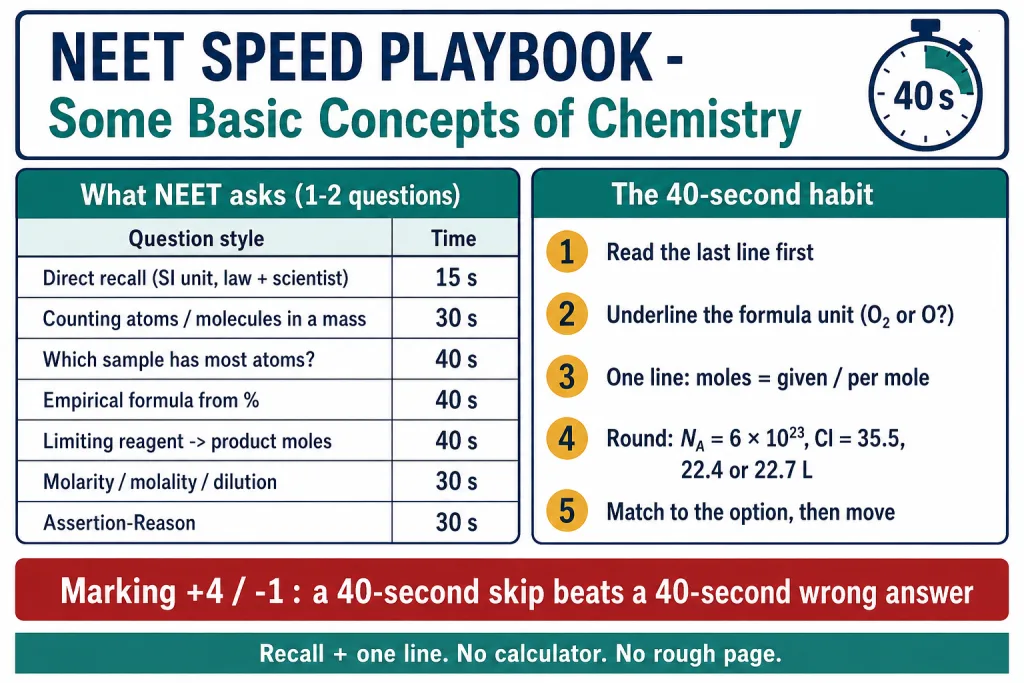
NEET gives this chapter 1 to 2 questions out of 45, and almost every one is a single-formula, single-step question in a plain sentence. The styles that appear:
| Question style | What it looks like | Time to spend |
|---|---|---|
| Direct recall | "Which of the following is the SI unit of amount of substance?" | 15 seconds |
| Counting | "The number of atoms in 4 g of helium is…" | 30 seconds |
| Compare samples | "Which of the following contains the maximum number of atoms?" | 40 seconds |
| Empirical formula | "A compound has 40% C, 6.67% H and 53.33% O. Its empirical formula is…" | 40 seconds |
| Limiting reagent | "3 mol of and 6 mol of give how many moles of ?" | 40 seconds |
| Concentration | "The molarity of a solution containing 4 g NaOH in 250 mL is…" | 30 seconds |
| Assertion-Reason | "Assertion: Molality does not change with temperature. Reason: …" | 30 seconds |
All seven can be done without a calculator or a rough page.
The 40-second mindset
NEET is 180 questions in 200 minutes, a little over one minute each. A Chapter 1 question is where you bank time for later, so the target is 40 seconds and move on.
- Read the last line first. It says what is wanted: moles, molecules, grams, molarity.
- Underline the formula unit. or O? or Ca? The usual trap hides here.
- Write one line. Every problem here is , then whatever is asked.
- Round before you multiply: , , , molar volume or L as the options suggest. Options are spaced far enough apart that rounding never changes the answer.
- Match to the options. If you have and the options are , , and , you are done.
Key Point: NEET rewards knowing which formula, not doing the longest calculation. This is a recall-plus-one-line chapter.
[NEET] With negative marking, a wrong answer is worse than a skip. If two lines in you are not converging on an option, mark for review and come back.
What NEET does not ask
- Normality and equivalent-mass problems: rare, and only the simplest form.
- Multi-step "purity, then yield, then gas volume" chains: no.
- Long dimensional-analysis conversions: at most a one-line prefix change.
- Percentage composition: usually the reverse direction (formula to percentage) or the plainest empirical-formula recipe.
If a question here takes more than 90 seconds, you are using the wrong method or it is the one odd question of the year. Move on.
The Verbatim-Recall Table
Definition and "who gave this law" questions earn the same as a numerical. Learn every row as a flash-card.
The seven SI base units
| Base quantity | Symbol | SI unit | Symbol |
|---|---|---|---|
| Length | metre | m | |
| Mass | kilogram | kg | |
| Time | second | s | |
| Electric current | ampere | A | |
| Thermodynamic temperature | kelvin | K | |
| Amount of substance | mole | mol | |
| Luminous intensity | candela | cd |
[NEET] "Amount of substance: mole" is the row that gets asked. The kilogram, not the gram, is the base unit of mass; kelvin takes no degree sign.
Prefixes
| Prefix | Symbol | Multiple | Prefix | Symbol | Multiple |
|---|---|---|---|---|---|
| pico | p | deci | d | ||
| nano | n | kilo | k | ||
| micro | mega | M | |||
| milli | m | giga | G | ||
| centi | c | femto | f |
Significant figures
- All non-zero digits are significant.
- Zeros before the first non-zero digit are not (0.03 has one; 0.0052 has two).
- Zeros between non-zero digits are (2.005 has four).
- Trailing zeros are significant only to the right of the decimal point (0.200 has three; 100 has one, so write to show three).
- Exact numbers (2 balls, 20 eggs) have infinite significant figures.
In multiplication and division the result keeps the fewest sig figs among the measurements; in addition and subtraction it keeps the fewest decimal places.
Key Point (Definition): Precision is the closeness of repeated measurements of the same quantity. Accuracy is the agreement of a value with the true value.
The five laws
| Law | Scientist | Year | Statement |
|---|---|---|---|
| Conservation of mass | Antoine Lavoisier | 1789 | Matter can neither be created nor destroyed |
| Definite proportions | Joseph Proust | 1799 | A given compound always contains the same elements in the same proportion by mass |
| Multiple proportions | John Dalton | 1803 | When two elements form more than one compound, the masses of one combining with a fixed mass of the other are in a simple whole-number ratio |
| Gaseous volumes | Joseph Louis Gay Lussac | 1808 | Gases combine in a simple ratio by volume at the same temperature and pressure |
| Avogadro's law | Amedeo Avogadro | 1811 | Equal volumes of all gases at the same temperature and pressure contain equal numbers of molecules |
Standard pairings: water and hydrogen peroxide, multiple proportions; "2 volumes hydrogen + 1 volume oxygen gives 2 volumes water vapour", Gay Lussac; "cupric carbonate from any source has 51.35% Cu", definite proportions.
Dalton's atomic theory (1808)
- Matter consists of indivisible atoms.
- All atoms of an element have identical properties, including mass; atoms of different elements differ in mass.
- Compounds form when atoms of different elements combine in a fixed ratio.
- Reactions reorganise atoms; atoms are neither created nor destroyed.
Postulate 2 fails for isotopes and postulate 1 for subatomic particles.
Mole, molar mass, formulae, concentration
| Term | Definition | Unit |
|---|---|---|
| Mole | Amount of substance containing exactly elementary entities (atoms, molecules, ions, electrons…) | mol |
| Avogadro constant | , the number of entities in one mole | |
| Atomic mass unit | the mass of one atom g | u |
| Molar mass | Mass of one mole in grams; numerically equal to atomic / molecular / formula mass in u | |
| Molar volume (STP) | Volume of one mole of any gas: 22.7 L at 273.15 K and 1 bar; 22.4 L at 273.15 K and 1 atm (older / many NEET keys) | |
| Empirical formula | Simplest whole-number ratio of atoms of each element | — |
| Molecular formula | Exact number of atoms of each element in one molecule | — |
| Mass per cent | % | |
| Mole fraction | ; all mole fractions add to 1 | none |
| Molarity | Moles of solute per litre of solution | |
| Molality | Moles of solute per kilogram of solvent |
Key Point: Molarity is per litre of solution, molality per kilogram of solvent. Volume expands on heating, so molarity falls with temperature; molality and mole fraction do not change.
Counting Shortcuts: Atoms, Molecules, Ions, Electrons
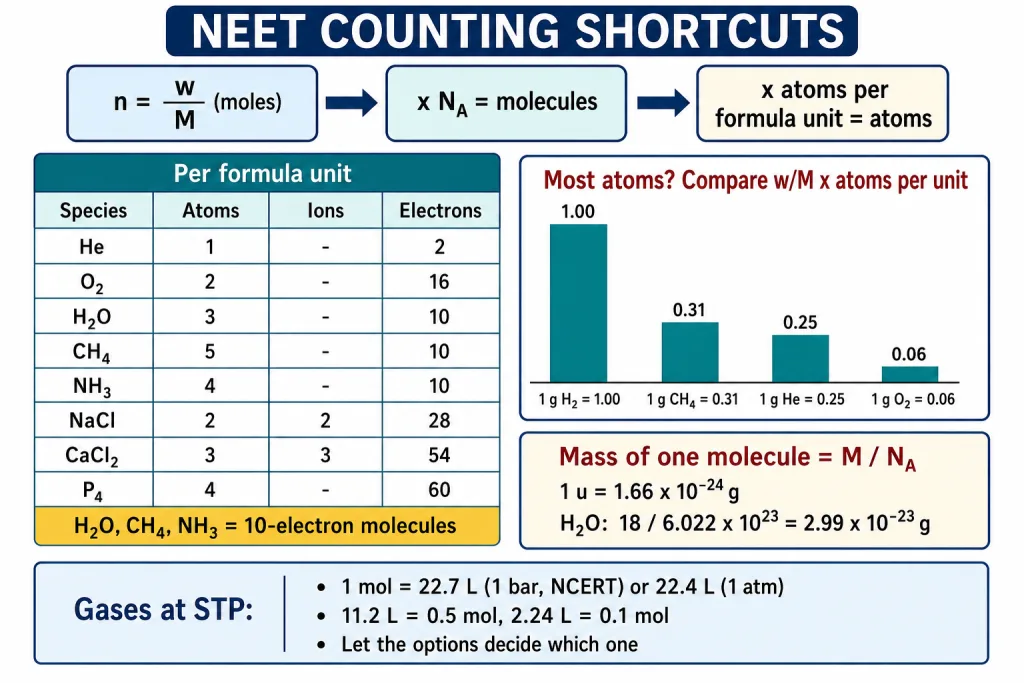
Every counting question is the same three-line machine:
Shortcut 1: the "per formula unit" multiplier
Count inside one formula unit, then multiply by moles .
| Substance | Molecules per mole | Atoms per molecule | Ions per formula unit | Electrons per molecule |
|---|---|---|---|---|
| 1 | — | 2 | ||
| 2 | — | 16 | ||
| 3 | — | 10 | ||
| 5 | — | 10 | ||
| 4 | — | 10 | ||
| 3 | — | 22 | ||
| formula units | 2 | 2 ( + ) | 28 | |
| formula units | 3 | 3 (1 + 2 ) | 54 | |
| formula units | 7 | 3 (2 + 1 ) | 70 | |
| 4 | — | 60 | ||
| 8 | — | 128 |
[NEET] , and are 10-electron molecules: 1.8 g water, 1.6 g methane and 1.7 g ammonia each hold 0.1 10 electrons.
Shortcut 2: "which sample has the most atoms?"
Skip ; compare
and pick the biggest.
| 1 g of… | (mol) | atoms per unit | Relative atoms |
|---|---|---|---|
| 1.000 | |||
| 0.250 | |||
| 0.3125 | |||
| 0.0625 | |||
| 0.0435 |
Key Point: For equal masses, the winner has the smallest , the mass per atom. Hydrogen (1 g per mole of atoms) beats everything; helium is second.
Samples in moles: moles atoms per unit. Equal gas volumes at STP: equal molecules, so only atoms per molecule matters ( beats beats ).
Shortcut 3: mass of one molecule or atom
| Species | (g/mol) | Mass of one particle |
|---|---|---|
| H atom | 1 | g (that is 1 u) |
| C-12 atom | 12 | g |
| 18 | g g | |
| 44 | g |
Since g is 1 u, mass in grams is molecular mass .
Shortcut 4: gases, 22.4 / 22.7
At STP, 1 mol of any gas occupies 22.7 L (1 bar) or 22.4 L (1 atm):
Handy fractions: 11.2 L 0.5 mol, 5.6 L 0.25 mol, 2.24 L 0.1 mol, 224 mL 0.01 mol (with 22.4); 11.35 L 0.5 mol, 2.27 L 0.1 mol (with 22.7).
Key Point: The options show which molar volume was used: 11.2 L means 22.4, 11.35 L means 22.7. Never mix the two.
Shortcut 5: ions in an ionic solid
1 mol gives 1 mol + 2 mol = 3 mol ions . 0.1 mol gives 0.2 mol + 0.3 mol = 0.5 mol ions.
Empirical Formula in 30 Seconds
The four-line recipe
| Step | Do this | Example (C 40%, H 6.67%, O 53.33%) |
|---|---|---|
| 1 | Treat % as grams in 100 g | 40 g C, 6.67 g H, 53.33 g O |
| 2 | Divide by atomic mass | C: ; H: ; O: |
| 3 | Divide by the smallest | C: 1; H: 2; O: 1 |
| 4 | Multiply to whole numbers if needed (1.5 2, 1.33 3, 1.25 4) | Already whole: |
If molar mass is given:
For (mass 30) with molar mass 180: , so , glucose.
[NEET] Decimal to whole number: 0.5 → ; 0.33 or 0.67 → ; 0.25 or 0.75 → . So 1 : 1.5 becomes 2 : 3 and 1 : 1.33 becomes 3 : 4.
Formula families to recognise on sight
Half the questions can be answered by matching the percentages:
| Empirical formula | EF mass | Family | Molecular formulae |
|---|---|---|---|
| 30 | Carbohydrates (40.0% C, 6.7% H, 53.3% O) | (30), (60), (180) | |
| 13 | Aromatics / alkynes (92.3% C, 7.7% H) | (26), (78) | |
| 14 | Alkenes / cycloalkanes (85.7% C, 14.3% H) | (28), (56) | |
| 15 | Ethane only (80% C, 20% H) | (30) | |
| 16 | Methane (75% C, 25% H) | (16) | |
| 46 | Nitrogen oxides (30.4% N) | (92) | |
| 17 | Hydrogen peroxide (5.9% H) | (34) | |
| 49.5 | Classic textbook case (24.27% C, 4.07% H, 71.65% Cl) | (98.96) |
Key Point: Same empirical formula means same percentage composition. Acetic acid (), formaldehyde () and glucose () all show 40% C, 6.67% H, 53.33% O. "40% carbon, 6.67% hydrogen" means at once.
Percentage from formula
Values to carry: water 11.11% H, 88.89% O; 27.27% C; ammonia 82.35% N; urea (60) 46.67% N; glucose 40% C.
Highest percentage of nitrogen
Urea (60, 2 N), ammonium nitrate (80, 2 N), ammonium sulphate (132, 2 N) and calcium cyanamide (80, 2 N) all have 2 N, so the smallest molar mass wins: urea, %. When numerators match, compare denominators only.
Limiting Reagent in One Line
The "divide by coefficient" test
Product formed (smallest value) (coefficient of product).
| Reaction | Given | Divide by coefficient | Limiting | Product |
|---|---|---|---|---|
| 3 mol , 6 mol | : ; : | mol | ||
| 10 g (5 mol), 64 g (2 mol) | : ; : | mol g water | ||
| 1 mol Zn, 1 mol HCl | Zn: ; HCl: | HCl | 0.5 mol | |
| 2 mol , 2 mol | : 2; : 1 | 1 mol |
Key Point: Convert grams to moles first. 10 g and 64 g looks like excess oxygen, but that is 5 mol against 2 mol and oxygen runs out first. Moles per coefficient decides, never mass.
[NEET] The usual second part is the leftover excess: used (limiting value) (coefficient of excess reactant); leftover given used. In the ammonia row, used mol, so 1 mol remains.
Mass-of-product shortcuts
With one reactant given (the other in excess) there is no limiting step:
| Reaction | Given | Moles | Ratio | Product |
|---|---|---|---|---|
| 50 g | 0.5 mol | 1 : 1 : 1 | 28 g CaO, 22 g , 11.2 L (22.4) | |
| 16 g | 1 mol | 1 : 1 | 44 g | |
| 24.5 g | 0.2 mol | 2 : 3 | 0.3 mol g | |
| 4.8 g Mg | 0.2 mol | 1 : 1 | 8.0 g MgO | |
| 160 g | 1 mol | 1 : 2 | 112 g Fe |
Gas volumes: coefficients as litres
For gases at the same and , coefficients are volume ratios (Gay Lussac + Avogadro). In , 10 L methane needs 20 L oxygen and gives 10 L ; no moles needed.
Air is about 20% oxygen by volume, so volume of air oxygen volume. 1 L propane () needs 5 L 25 L air.
Molar masses to carry (g/mol)
| 2 | 16 | 18 | 17 | 32 | 44 |
| 40 | 36.5 | 98 | 63 | 58.5 | 100 |
| 106 | 122.5 | 40 | 56 | 160 | 180 |
Concentration Formulas with Units
The formula card
| Quantity | Formula | Unit | Temperature dependent? |
|---|---|---|---|
| Mass per cent (w/w) | % | No | |
| Mole fraction | ; | none | No |
| Molarity | Yes (volume changes) | ||
| Molality | No | ||
| Moles from molarity | mol | — |
Key Point (Definition): Molarity is moles of solute per litre of solution; molality is moles of solute per kilogram of solvent. "1 molal aqueous" means 1 mol solute in 1000 g of water, not 1 L.
[NEET] Mass per cent, mole fraction and molality use only masses and moles; molarity uses a volume, which changes on heating. That is why molality is preferred for temperature-dependent studies.
Dilution and mixing
Both volumes in the same unit. Water to add is , not .
Mixing two solutions of the same solute:
| Ask | Numbers | Result |
|---|---|---|
| Dilute 100 mL of 0.5 M to 250 mL | M | |
| Volume of 2 M HCl for 500 mL of 0.5 M | mL | |
| Mix 200 mL 1 M + 300 mL 0.5 M NaOH | 0.7 M |
Molarity from percentage and density
For % by mass (w/w) with density in :
(100 g solution holds mol in mL L.)
| Solution | (g/mL) | Molarity | ||
|---|---|---|---|---|
| Concentrated | 98 | 1.84 | 98 | M |
| Concentrated HCl | 36.5 | 1.20 | 36.5 | M |
| Concentrated | 63 | 1.40 | 63 | M |
| 29.2% (w/w) HCl | 29.2 | 1.25 | 36.5 | M |
When equals the molar mass (first three rows), molarity is . For the 10 M HCl, volume for 200 mL of 0.4 M: , mL.
Molarity to molality (density given)
For dilute aqueous solutions () molality molarity.
Mole fraction
For g solute (molar mass ) in g water: , , . 18 g glucose in 90 g water: ; water's mole fraction is , which is often what is asked.
The NEET Traps List
Trap 1: u versus g
Molecular mass 18 u and molar mass 18 g/mol share a number, not a meaning. One water molecule weighs 18 u g g. For "mass of one molecule in grams", the small option is right.
Trap 2: atoms versus molecules
| Phrase | Means | Count |
|---|---|---|
| 1 mol of | 1 mol molecules | molecules, atoms |
| 1 mol of O atoms | 1 mol atoms | atoms |
| 1 mol of | 1 mol molecules | atoms |
| 32 g of oxygen | 1 mol | atoms |
| 32 g of sulphur | 1 mol S atoms mol | atoms |
[NEET] Atoms in 4 g of helium: . Atoms in 4 g of hydrogen: , not (4 g mol mol H atoms).
Trap 3: solution versus solvent
Molarity uses volume of solution. "4 g NaOH in 250 mL of solution" is 0.4 M. "4 g NaOH in 250 mL of water" gives no molarity without density, only molality m (water as 250 g). Read the noun after the volume.
Trap 4: molality uses solvent, in kilograms
"1 mol urea in 1000 g of water" is 1 m; "in 1000 g of solution" is m. 500 g water is 0.5 kg, so 0.1 mol in 500 g water is 0.2 m, not 0.1 m.
Trap 5: 22.4 or 22.7?
Current convention is 1 bar, 22.7 L; many NEET keys and older material use 1 atm, 22.4 L. The options decide: 11.2 L means 22.4, 11.35 L means 22.7.
Trap 6: significant figures in the options
6.022, 6.02, 6.0 and are the same number; pick the one matching the data. and are also the same option.
Trap 7: percentage of what?
"40% carbon" is by mass unless stated. "Air is 20% oxygen" in combustion is by volume. "10% NaCl" unqualified is w/w; use density if w/v or molarity is asked.
Trap 8: limiting reagent by mass
Larger mass is not excess. 10 g with 64 g : oxygen is limiting despite six times the mass. Moles, then divide by coefficients.
Trap 9: empirical versus molecular
Empirical is the simplest ratio: becomes ; and both become . If molar mass is given and the molecular formula asked, do not stop at the empirical one.
Trap 10: law and scientist
Multiple proportions: Dalton. Definite proportions: Proust. Gaseous volumes: Gay Lussac. Conservation of mass: Lavoisier.
Key Point: Most losses here are reading errors: atoms/molecules, solution/solvent, u/g, 22.4/22.7. Underline the noun, then compute.
The 40-second checklist
- Did I count atoms per formula unit?
- Solution or solvent, litres or kilograms?
- Grams converted to moles before comparing reactants?
- Answer in the unit asked for?
- Does my rounded number match exactly one option?
Solved Examples
Question 1: Molecules and atoms in a given mass [NEET]
Calculate the number of molecules and the total number of atoms in 4.4 g of carbon dioxide.
Answer: First the moles. , so mol.
Molecules: .
Each has 3 atoms: atoms.
Ans: molecules; atoms.
Question 2: Which sample has the most atoms? [NEET]
Which of the following contains the largest number of atoms: 1 g of , 1 g of He, 1 g of or 1 g of ?
Answer: I compare (atoms per molecule) with g, leaving out since it multiplies every option equally.
: . He: . : . : .
So .
Ans: 1 g of (1 mol of H atoms, atoms).
Watch out: Hydrogen has the lowest mass per atom of anything, so for equal masses it always wins.
Question 3: Mass of a single molecule [NEET]
What is the mass in grams of one molecule of water?
Answer: .
Divide by Avogadro's number: g.
Check via u: 18 g g.
Ans: g (about g).
Question 4: Counting electrons [NEET]
Find the number of electrons in 1.8 g of water.
Answer: Moles of water: mol.
Electrons per molecule: .
Total: electrons, exactly one mole.
Ans: electrons.
Question 5: Empirical and molecular formula in four lines [NEET]
A compound contains 40% carbon, 6.67% hydrogen and 53.33% oxygen by mass. Its molar mass is 180 g/mol. Find its empirical and molecular formulae.
Answer: Per 100 g: 40 g C, 6.67 g H, 53.33 g O.
Divide by atomic masses: C ; H ; O .
Divide by the smallest (3.33): C 1, H 2, O 1. Empirical formula , mass .
, so the molecular formula is .
Ans: Empirical ; molecular (glucose).
Question 6: Limiting reagent by the divide-by-coefficient test [NEET]
10 g of hydrogen and 64 g of oxygen are mixed and ignited. Which reactant is limiting, and what mass of water is formed?
Answer: .
Moles: ; .
Divide by coefficients: ; . Oxygen is smaller, so it is limiting.
Water mol g. Leftover hydrogen mol g.
Ans: Oxygen is limiting; 72 g of water forms; 2 g of hydrogen remains.
Watch out: Oxygen had six times the mass and still ran out first. Only moles per coefficient decides.
Question 7: Mass and volume of products from one reactant [NEET]
50 g of calcium carbonate is heated strongly. Find the mass of calcium oxide and the volume of carbon dioxide (at STP) produced.
Answer: , all coefficients 1.
, so mol.
CaO: g.
: L (1 bar), or L (1 atm).
Ans: 28 g of CaO and 11.35 L (1 bar) or 11.2 L (1 atm) of .
Watch out: Pick 22.4 or 22.7 by which value appears in the options.
Question 8: Molarity from mass and volume [NEET]
Calculate the molarity of a solution prepared by dissolving 4 g of NaOH in enough water to make 250 mL of solution.
Answer: , so mol.
250 mL L, so molarity .
Shortcut form: .
Ans: 0.4 M.
Watch out: It says "250 mL of solution". For "250 mL of water" the quantity to compute would be molality (0.4 m).
Question 9: Molarity from percentage and density, then dilution [NEET]
Concentrated sulphuric acid is 98% by mass and has density 1.84 g/mL. (a) Find its molarity. (b) What volume of it is needed to prepare 500 mL of 0.1 M acid?
Answer: (a) M.
(b) : , so mL.
Ans: (a) 18.4 M; (b) about 2.7 mL of the concentrated acid, made up to 500 mL.
Question 10: Molality and ions in solution [NEET]
5.85 g of NaCl is dissolved in 500 g of water. Find (a) the molality of the solution and (b) the total number of ions present.
Answer: , so mol.
(a) Solvent g kg, so .
(b) Each NaCl gives 2 ions ( and ): mol of ions ions.
Ans: (a) 0.2 m; (b) ions.
Watch out: 500 g is 0.5 kg, and one NaCl formula unit is two ions.