
How to Use This Section
You have finished the theory. Sections 1 to 9 took you from "what is matter" through units, significant figures, the laws of chemical combination, atomic and molecular mass, the mole, empirical formulae, stoichiometry and finally concentration of solutions — and each carried its own dozen worked examples. This section is different: it is one long problem set, 34 fully worked questions, arranged from the simplest to the hardest, and it deliberately covers every in-text problem and end-of-chapter exercise that boards, JEE Main and NEET keep recycling.
Marks in this chapter are rarely lost to hard chemistry. They go on dividing by 22.4 when the question was set at 1 bar, on forgetting that 1 g of holds two atoms per molecule, and on finding the moles of the wrong reactant and calling it the limiting reagent. Volume of practice is the only cure, so work these.
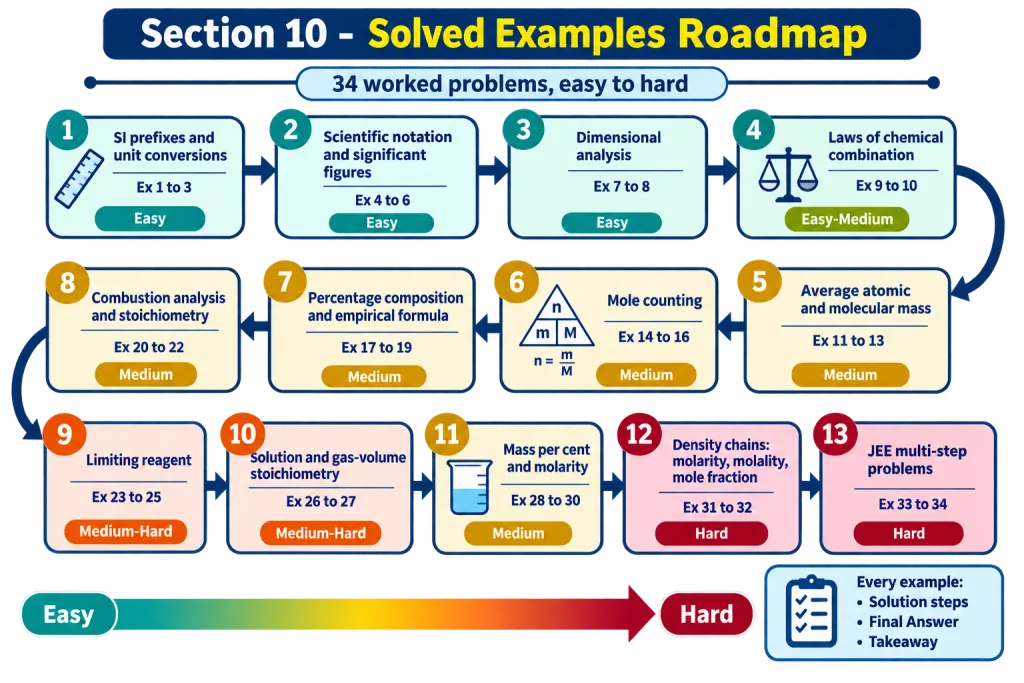
The working method
- Cover the solution. Attempt the question first, on paper, with a pen. Reading a solution feels like learning and is not.
- Compare your steps, not just your answer. If you got the right number by a longer route, note the shorter one.
- Read the Watch out line. Most questions end with one. That is the transferable part; the numbers are disposable.
A last piece of advice before you start. Write the units at every line, and write "mol of what" every time you write a mole. Half the errors in this chapter announce themselves the moment you carry units through — you end up with where you wanted mol, and you catch it instantly.
The six errors that cost the most marks in this chapter
| Error | Where it bites | The fix |
|---|---|---|
| Not squaring or cubing the prefix (, ) | Questions 3, 8 | Bracket the prefixed unit before applying the power |
| Mixing the multiplication rule and the addition rule for significant figures | Question 6 | Multiply: count significant figures; add: count decimal places |
| Forgetting that water carries two H atoms in combustion analysis | Question 20 | |
| Calling the reagent with the smaller mass the limiting one | Questions 23 to 25 | Divide moles by the coefficient; smallest quotient limits |
| Using mL where molarity wants L | Questions 26, 29 | , always |
| Dividing by the solvent mass for mass per cent, or by the solution mass for molality | Questions 28, 32 | Mass % uses solution; molality uses solvent (kg) |
Key Point: Atomic masses used throughout: H 1.008, C 12.01, N 14.01, O 16.00, Na 22.99, S 32.06, Cl 35.45, Fe 55.85, Cu 63.55, Ca 40.08, Mn 54.94; ; molar volume at STP = 22.7 L (1 bar) with 22.4 L (1 atm) noted wherever it changes the answer.
Solved Examples
Question 1: Prefixes and the three classic conversions
(a) Match the prefixes with their multiples: micro, deca, mega, giga, femto against , , , , . (b) Fill in the blanks: (i) 1 km = …… mm = …… pm (ii) 1 mg = …… kg = …… ng (iii) 1 mL = …… L = …… .
Answer:
(a) Each prefix is just a fixed power of ten stuck in front of the unit. I keep this table in my head:
| Prefix | Symbol | Multiple |
|---|---|---|
| micro | ||
| deca | da | |
| mega | M | |
| giga | G | |
| femto | f |
(b)(i) I never jump straight from one prefix to another; I go through the base unit. m and m, so Same idea for picometres. m, so pm.
(b)(ii) g, and a gram is kg, so kg kg. For nanograms, g, so ng.
(b)(iii) Milli means , so L. And since exactly, , which is the same thing as .
Ans: (a) micro , deca , mega , giga , femto . (b) (i) mm, pm (ii) kg, ng (iii) L, .
Watch out: The exponent of the answer is just (starting prefix exponent) minus (target prefix exponent), so km to pm is . Also worth keeping ready: mL.
Question 2: Into SI base units
Convert into basic SI units: (i) 28.7 pm (ii) 15.15 pm (iii) 25365 mg.
Answer:
(i) The base unit of length is the metre, and m, so
(ii) Same factor again:
(iii) Here I have to remember that the base unit of mass is the kilogram, not the gram. So it takes two steps: g and kg, which makes kg. Then
Quick check on significant figures: 28.7 has 3, 15.15 has 4, 25365 has 5, and each of my answers keeps exactly that many. Changing units never changes how many significant figures a number has.
Ans: (i) m (ii) m (iii) kg.
Watch out: In (iii) it's tempting to stop at grams, but kilogram is the SI base unit of mass, the only base unit with a prefix built into its name. I write the answer with one non-zero digit before the decimal point so the significant figures stay visible.
Question 3: Atmospheric pressure from the mass of the air column
Pressure is force per unit area, and . If the mass of air above sea level is , calculate the pressure in pascal. Take .
Answer:
First I make sure I read the data right. is a mass per unit area, not a pressure. It says every square centimetre of ground at sea level has a column of air weighing 1034 g sitting on it.
Now I put that in SI. The numerator is kg. The denominator is , and I have to square the , not leave it as it is.
Mass isn't force. The force the column exerts is its weight, , so
Before multiplying I check the units come out as pascal: . That works, which convinces me the belongs there.
Strictly, 9.8 has only 2 significant figures, so the honest answer is Pa. The answer key quotes the full product, Pa, so that's what I'd write in a board exam, adding that it's about Pa.
Ans: Pa, which is basically one atmosphere (1.013 bar).
Watch out: Converting needs , not , and the has to go in because mass is not force. Getting Pa, the value of 1 atm, is a nice sign I haven't slipped anywhere.
Question 4: Writing numbers in scientific notation
Express in scientific notation: (i) 0.0048 (ii) 234,000 (iii) 8008 (iv) 500.0 (v) 6.0012.
Answer:
The only rule I need: move the decimal point until exactly one non-zero digit is to its left. Moving it places left gives , moving it places right gives . And I keep every significant digit.
(i) 0.0048. Move 3 places right: .
(ii) 234,000. Move 5 places left: . The trailing zeros have no decimal point after them, so they aren't significant and they drop away.
(iii) 8008. Move 3 places left: . The two zeros are sandwiched between non-zero digits, so they're significant and stay.
(iv) 500.0. The decimal point makes all three zeros significant, so this has 4 significant figures. Move 2 places left and keep them: .
(v) 6.0012. The decimal point is already where it should be, so it's . In an exam I'd just write 6.0012.
Ans: (i) (ii) (iii) (iv) (v) .
Watch out: (ii) and (iv) both end in zeros, but 234,000 loses them and 500.0 keeps them, because a decimal point turns trailing zeros into measured digits. Writing 500.0 as throws away three significant figures.
Question 5: Counting significant figures and rounding to three
(a) How many significant figures are in (i) 0.0025 (ii) 208 (iii) 5005 (iv) 126,000 (v) 500.0 (vi) 2.0034? (b) Round up to three significant figures: (i) 34.216 (ii) 10.4107 (iii) 0.04597 (iv) 2808.
Answer:
(a) I go by the rules: non-zero digits always count, leading zeros never, sandwiched zeros always, trailing zeros only if there's a decimal point, and exact numbers have unlimited significant figures.
(i) 0.0025: the leading zeros are just placeholders, so only 2 and 5 count. That's 2. (ii) 208: the sandwiched zero counts. 3. (iii) 5005: two sandwiched zeros. 4. (iv) 126,000: trailing zeros with no decimal point don't count. 3. (v) 500.0: there's a decimal point, so every zero counts. 4. (vi) 2.0034: sandwiched zeros count. 5.
(b) For rounding I look at the first digit I'm dropping. Above 5, round up; below 5, leave it; exactly 5 with nothing after it, round to the nearest even digit.
(i) 34.216: I drop "16", and the first dropped digit is 1, less than 5. 34.2. (ii) 10.4107: I drop "107", first dropped digit 1. 10.4. (iii) 0.04597: the three significant digits are 4, 5, 9 and the dropped digit is 7, so the 9 rounds up to 10 and carries. That gives 0.0460, and I must write that trailing zero, otherwise it only shows two significant figures. (iv) 2808: significant digits 2, 8, 0, dropped digit 8, so round up to 2810. But 2810 on its own is ambiguous, it could be 3 or 4 significant figures, so I write it as .
Ans: (a) 2, 3, 4, 3, 4, 5. (b) 34.2, 10.4, 0.0460, .
Watch out: In (iii) the carry makes a zero I have to keep; in (iv) the rounding makes a zero I can't trust, which is exactly why scientific notation exists. Whenever I'm unsure about a trailing zero, I rewrite the number in scientific notation and the doubt disappears.
Question 6: Significant figures in a calculated result
How many significant figures should be present in the answer of each calculation, and what is the answer? (i) (ii) (iii) .
Answer:
(i) For multiplying and dividing, the answer gets as many significant figures as the least precise number in it. Counting: 0.02856 has 4, 298.15 has 5, 0.112 has 3, 0.5785 has 4. The smallest is 3, so the answer gets 3.
Working it out: , then , then . To 3 significant figures that's 1.65.
(ii) The 5 here is a counted, exact number, so it has unlimited significant figures and doesn't limit anything. Only 5.364, with 4 significant figures, matters. , 4 significant figures.
(iii) Addition is a different rule: the answer keeps as many decimal places as the term with the fewest. All three terms have 4 decimal places, so the sum keeps 4: , which is 4 significant figures.
Ans: (i) 3 significant figures, 1.65 (ii) 4 significant figures, 26.82 (iii) 4 significant figures, 0.8204.
Watch out: Multiplication counts significant figures, addition counts decimal places, and I mustn't mix the two up. And a pure counting number like the 5 in (ii) is exact, so if someone asks how many significant figures it has, the answer is infinite.
Question 7: Distance travelled by light in a nanosecond
(a) If the speed of light is , calculate the distance covered by light in 2.00 ns. (b) How long does light take to cross 1.0 km? Express the answer in microseconds.
Answer:
(a) First I put the time in SI. s, so s. Then distance is speed times time, and I carry the units along: The seconds cancel and I'm left with metres, so the units check out. For significant figures, 3.0 has 2 and 2.00 has 3, so the product keeps 2: m.
(b) Now I rearrange for time: s. To get microseconds I multiply by a unit factor: .
Ans: (a) Light travels 0.60 m (about 60 cm) in 2.00 ns. (b) About 3.3 s per kilometre.
Watch out: I write 0.60 m, not 0.6 m, because the trailing zero says "2 significant figures", and the data supports that. A handy fact to keep: light goes roughly 30 cm per nanosecond.
Question 8: The unit-factor method on four everyday conversions
Using unit factors, convert (a) 0.75 L to (b) the density of mercury, , to (c) 5.0 inches to centimetres (1 in = 2.54 cm) (d) 2 days to seconds.
Answer:
The idea is to write the given quantity and multiply it by fractions that equal 1 (unit factors), arranged so the units I don't want cancel diagonally. If a unit I didn't want survives, I've written a factor upside down.
(a) and m, so :
(b) I need two unit factors, one for the mass and one for the volume:
(c) Just one factor here:
(d) I chain three factors, and "day", "h" and "min" each show up once on top and once below, so they all cancel:
Ans: (a) (b) (c) 12.7 cm (about 13 cm to 2 s.f.) (d) s.
Watch out: The shortcut from (b) is worth remembering: to go from to , multiply by 1000.
Question 9: Which law does the nitrogen-oxygen data obey?
The following masses of dinitrogen and dioxygen combine to form different compounds: (i) 14 g N with 16 g O (ii) 14 g N with 32 g O (iii) 28 g N with 32 g O (iv) 28 g N with 80 g O. Which law of chemical combination is obeyed? State it.
Answer: Two elements making several different compounds is the sign of the law of multiple proportions. To test it I keep nitrogen fixed at 14 g and work out how much oxygen goes with it each time.
(i) 14 g N with 16 g O. Already fixed, so oxygen = 16 g.
(ii) 14 g N with 32 g O. Oxygen = 32 g.
(iii) 28 g N with 32 g O. Halving both, 14 g N goes with 16 g O. Oxygen = 16 g.
(iv) 28 g N with 80 g O. Halving, 14 g N goes with 40 g O. Oxygen = 40 g.
Now I compare the oxygen masses that combine with the same 14 g of nitrogen: 16 : 32 : 16 : 40. Dividing by 8, which is a simple whole-number ratio. Rows (i) and (iii) come out identical, so they're actually the same compound (NO) made in two batches, which is also the law of definite proportions showing up on the side.
The law is the law of multiple proportions (Dalton, 1803): if two elements combine to form more than one compound, the masses of one element that combine with a fixed mass of the other are in a ratio of small whole numbers.
Ans: Law of multiple proportions. The oxygen masses combining with 14 g of nitrogen are in the ratio 2 : 4 : 2 : 5 (the compounds are NO, , NO and ).
Watch out: Rows (i) and (iii) look different because one has 28 g of nitrogen, but once I scale them they're the same compound. Always fix one element first, then compare.
Question 10: Gay Lussac's law of gaseous volumes and conservation of mass
(a) If 10 volumes of dihydrogen react with 5 volumes of dioxygen, how many volumes of water vapour are produced? (b) When 10.00 g of calcium carbonate is heated strongly it gives 5.60 g of calcium oxide. What mass of carbon dioxide is released, and which law lets you say so without measuring the gas? (c) A 2.00 g sample of copper(II) oxide from an Indian mine contains 1.597 g of copper; a 5.00 g sample prepared in a laboratory contains 3.994 g of copper. Which law is illustrated?
Answer: (a) I start with the balanced equation for steam: Gay Lussac's law says gases react in volumes that are in a simple whole-number ratio, and that ratio is the same as the coefficients. So 2 volumes of and 1 volume of give 2 volumes of steam.
Scaling to the question: 10 volumes of need volumes of , which is exactly what's given, so nothing is left over. Water vapour volumes.
(b) This is the law of conservation of mass (Lavoisier). Matter isn't created or destroyed in a reaction, so the mass of what I started with equals the total mass of the products. I can check this with formula masses: , , . Out of 100.1, the split predicts 5.60 g and 4.40 g from 10.00 g. It matches.
(c) I compare the percentage of copper in each sample: Same number, even though the samples come from different places and have different sizes. That's the law of definite proportions (Proust): a compound always has the same elements in the same proportion by mass. The formula agrees too, because in CuO copper is .
Ans: (a) 10 volumes of water vapour, with all 10 volumes of and 5 of used up. (b) 4.40 g of , by the law of conservation of mass. (c) Law of definite proportions; both samples are 79.9% copper.
Watch out: Gay Lussac's law is only about gases at the same temperature and pressure, and it works because equal volumes hold equal numbers of molecules (Avogadro). In (a) the total volume drops from 15 to 10, so volume isn't conserved. Mass is.
Question 11: Average atomic mass of chlorine
Calculate the average atomic mass of chlorine from: , abundance 75.77%, isotopic mass 34.9689 u; , abundance 24.23%, isotopic mass 36.9659 u.
Answer: Average atomic mass is just a weighted mean, where the weights are the abundances:
First I turn the percentages into fractions: 0.7577 and 0.2423. They add up to 1.0000, which they should.
Then I weight each isotope:
And add:
Quick check: the answer sits between 34.97 and 36.97, and closer to 35 because there's a lot more . It's the 35.45 (or 35.5) I see on the periodic table.
Ans: Average atomic mass of chlorine u (35.4527 u).
Watch out: No single chlorine atom weighs 35.45 u; that's an average. If my answer ever falls outside the range of the isotopic masses, I've messed up the abundances. Rough mental check: .
Question 12: Molar mass of natural argon
Use the data to calculate the molar mass of naturally occurring argon: , 35.96755 , 0.337%; , 37.96272 , 0.063%; , 39.9624 , 99.600%.
Answer: First I check the abundances add to 100%: . Good.
Same recipe as chlorine, just three isotopes. Abundance as a fraction times the mass:
Adding them up:
That makes sense. is 99.6% of the sample, so the answer sits just under 39.96, and the two light isotopes only pull it down by about 0.015.
Ans: Molar mass of natural argon (39.948).
Watch out: The question says "molar mass" and gives the data in , but the number is the same as the average atomic mass in u. Also, argon (39.95) is heavier than potassium (39.10) even though it comes first in the periodic table, so the table isn't strictly ordered by mass.
Question 13: Molecular mass and formula mass
Calculate (a) the molecular mass of glucose, (b) the molar masses of , and (c) the formula mass of sodium sulphate, .
Answer: (a) Molecular mass is the atomic masses of every atom in one molecule added together. With C 12.011, H 1.008, O 16.00:
(b) Water: .
Carbon dioxide: .
Methane: .
(c) Sodium sulphate is ionic, so there's no actual molecule. I add up the atoms in one formula unit and call it the formula mass instead. With Na 22.99, S 32.06, O 16.00:
Ans: (a) 180.162 u (glucose) (b) 18.02, 44.01, 16.04 (c) 142.04 u.
Watch out: Molecular mass in u and molar mass in are the same number with different units. For ionic compounds like or NaCl I say "formula mass", not "molecular mass", because there are no molecules there.
Question 14: Moles of atoms and number of molecules in ethane
In three moles of ethane, , calculate (i) the number of moles of carbon atoms, (ii) the number of moles of hydrogen atoms, (iii) the number of molecules of ethane, (iv) the mass of one molecule of ethane in grams.
Answer: I read the formula as a recipe. One molecule of has 2 C atoms and 6 H atoms, so one mole of has 2 mol of C atoms and 6 mol of H atoms. The subscripts work as mole ratios too.
(i) Moles of C atoms mol.
(ii) Moles of H atoms mol.
(iii) Number of molecules molecules.
If I wanted total atoms, each molecule has 8, so that's atoms.
(iv) Molar mass of ethane . One mole is molecules, so one molecule weighs
Ans: (i) 6 mol C atoms (ii) 18 mol H atoms (iii) molecules of ethane (iv) g per molecule.
Watch out: I always write "mol of what". 3 mol of ethane is 6 mol of carbon atoms and 24 mol of atoms in total, and mixing those up is the easiest way to lose the mark.
Question 15: The mass of one atom, and atoms in 52 mol, 52 u and 52 g
(a) What is the mass of one atom in grams? (b) Calculate the number of atoms in (i) 52 mol of Ar (ii) 52 u of He (iii) 52 g of He.
Answer: (a) One mole of is exactly 12 g and holds atoms, so one atom is
(b)(i) Argon is monatomic, so atoms atoms.
(b)(ii) The unit here is u, not g. One He atom has a mass of 4 u, so 52 u of helium is just No Avogadro's number needed.
(b)(iii) Now it's grams. 52 g of He is mol, so
Ans: (a) g (b) (i) atoms (ii) 13 atoms (iii) atoms.
Watch out: 52 u is 13 atoms; 52 g is 13 moles. The two answers differ by exactly , which is really what the unit u means. Part (a) also gives g.
Question 16: Which 1 g sample has the most atoms?
Which will have the largest number of atoms: (i) 1 g Au(s) (ii) 1 g Na(s) (iii) 1 g Li(s) (iv) 1 g (g)? (Au 197.0, Na 22.99, Li 6.94, Cl 35.45.)
Answer: I convert each 1 g to moles of atoms. For the same mass, the smallest molar mass gives the most moles, but chlorine comes as molecules, so I have to count atoms, not molecules.
(i) Au: mol of atoms.
(ii) Na: mol of atoms.
(iii) Li: mol of atoms.
(iv) : mol of molecules. Each molecule has 2 atoms, so mol of atoms.
Ranking: Li () Na () () Au (). Multiplying everything by doesn't change the order. 1 g of Li has atoms.
Ans: (iii) 1 g of Li has the largest number of atoms, about .
Watch out: For equal masses, fewest grams per mole wins, but needs a factor of 2 for its two atoms. Even doubled it can't beat lithium. I do the moles-of-atoms column and don't guess from atomic number.
Question 17: Mass per cent of the elements in sodium sulphate
(a) Calculate the mass per cent of each element in . (b) What mass of iron is present in 100 g of ?
Answer: (a) I already know from Question 13 that , and that this comes from Na , S and O . Mass per cent just asks what share of that 142.04 each element takes:
Sodium: .
Sulphur: .
Oxygen: .
Quick check: . Good, nothing lost.
(b) Same idea for the iron oxide. . Iron's share is , so 100 g of the oxide has 69.9 g of iron in it.
Ans: (a) Na 32.37%, S 22.57%, O 45.06%. (b) 69.9 g of Fe per 100 g of .
Watch out: The percentages have to add up to 100, so I always add them at the end. It's a free check on the arithmetic.
Question 18: Empirical and molecular formula of an oxide of iron
An oxide of iron contains 69.9% iron and 30.1% oxygen by mass. Find (a) its empirical formula and (b) its molecular formula, given that its molar mass is 159.7 . (c) What mass of oxygen combines with 11.2 g of iron to form this oxide?
Answer: (a) Percentages are easiest to handle if I imagine 100 g of the compound. Then I have 69.9 g Fe and 30.1 g O. Convert both to moles:
Divide by the smaller one: Fe , O .
1 : 1.5 isn't a whole-number ratio, so I multiply both by 2 and get Fe : O . Empirical formula is .
(b) Empirical formula mass . Then , so the molecular formula is just as well.
(c) Now I use the formula as a mole ratio. mol. The formula says 3 O for every 2 Fe, so mol, which is g of oxygen. A faster way is straight from the percentages: g, the same within rounding.
Ans: (a) Empirical formula (b) Molecular formula () (c) About 4.8 g of oxygen.
Watch out: A ratio of 1.5 isn't "about 1" or "about 2", it's , so multiply by 2. Ratios ending in .5 need , .33 or .67 need , .25 or .75 need .
Question 19: A chloro-compound from mass per cent
A compound contains 4.07% hydrogen, 24.27% carbon and 71.65% chlorine. Its molar mass is 98.96 . Find its empirical and molecular formulae.
Answer: Same routine as the last one. I take 100 g of compound, so 4.07 g H, 24.27 g C and 71.65 g Cl. (They add to 99.99 g, which is fine.)
Moles of each element:
Divide everything by the smallest, 2.021: H , C , Cl . So the empirical formula is .
For the molecular formula I need the empirical formula mass: . Then , so the molecular formula is . That could be 1,2-dichloroethane or 1,1-dichloroethane; the formula alone can't tell me which.
Ans: Empirical formula ; molecular formula .
Watch out: I work out to two decimals. If I get 2.00 I trust it; if I get something like 1.8, I've slipped somewhere earlier and go back.
Question 20: Combustion analysis of a welding gas
A welding fuel gas contains only carbon and hydrogen. Burning a small sample gives 3.38 g , 0.690 g and nothing else. 10.0 L of the gas at STP weighs 11.6 g. Find (i) the empirical formula, (ii) the molar mass, (iii) the molecular formula.
Answer: (i) The idea is that every carbon atom in the gas ends up in and every hydrogen atom ends up in water. So I can count them from the products.
Carbon: one C per molecule, so
Hydrogen: each water molecule carries two H, so I have to double the moles of water:
C : H , which is 1 : 1 as near as makes no difference. Empirical formula CH, empirical formula mass .
(ii) The molar mass comes from the "10.0 L weighs 11.6 g" bit. At STP (1 bar) one mole of any gas takes up 22.7 L, so I scale the mass up to 22.7 L: With the older 22.4 L convention this comes out as 26.0. Either way the next step gives the same .
(iii) , so and the molecular formula is . That's acetylene (ethyne), the gas in oxy-acetylene welding.
Ans: (i) CH (ii) about 26 (iii) .
Watch out: Water carries two hydrogens, so don't forget the factor of 2. Without it I'd get , which is a good sign something's wrong, since real hydrocarbons never have fewer H than C.
Question 21: Mass and volume from the combustion of methane
(a) Calculate the mass of water produced by the combustion of 16 g of methane. (b) How many moles of methane are required to produce 22 g of ? (c) What volume of at STP is produced by burning 8.0 g of methane?
Answer: Everything here hangs on the balanced equation, so I write it first: 1 mol of gives 1 mol of and 2 mol of .
(a) 16 g of is mol. That gives 2 mol of water:
(b) I want mol of . Methane and are 1 : 1, so I need 0.50 mol of methane.
(c) 8.0 g of is mol, which gives 0.50 mol of . At STP (1 bar, 273.15 K) one mole of gas takes up 22.7 L: If the question meant 1 atm STP, it'd be L.
Ans: (a) 36 g of water (b) 0.50 mol of (c) about 11.4 L of at STP (11.2 L using 22.4 L).
Watch out: Every one of these is the same three moves: grams to moles, moles to moles using the coefficients, moles back to grams or litres. The only real choice is 22.7 L or 22.4 L, so I write down which one I used.
Question 22: How much copper is in copper sulphate?
(a) How much copper can be obtained from 100 g of copper sulphate, ? (b) How does the answer change if the sample is blue vitriol, ?
Answer: (a) This isn't a reaction question at all, it's just percentage composition. Molar mass of is , and one mole of it holds one mole of Cu, which is 63.55 g. So the copper fraction is Scale that to 100 g:
I could also go through moles: mol, and that's also , so g. Same thing. The mole route is the one I'd use if the formula had 2 Cu in it.
(b) Now the water of crystallisation counts in the molar mass. . There's still only one Cu per formula unit, so
Ans: (a) About 39.8 g of copper (39.81 g) from 100 g of anhydrous . (b) Only 25.5 g from 100 g of the pentahydrate.
Watch out: Those five water molecules add 90 g to every mole without adding any copper, so the yield drops by more than a third. I always check whether the formula I'm given includes water of crystallisation.
Question 23: Carbon burnt in limited oxygen
Calculate the mass of produced when (i) 1 mol of carbon is burnt in air (ii) 1 mol of carbon is burnt in 16 g of dioxygen (iii) 2 mol of carbon are burnt in 16 g of dioxygen.
Answer: The equation is , so everything is 1 : 1 : 1.
(i) Air has as much oxygen as I want, so carbon decides. 1 mol of C gives 1 mol of , which is 44 g.
(ii) 16 g of is mol. 1 mol of C would need 1 mol of , but I only have 0.5 mol. That means oxygen runs out first, so it's the limiting reagent. Product mol of g. Half the carbon (0.5 mol, 6 g) is left sitting there.
(iii) 2 mol of C but still only 0.5 mol of . Oxygen is limiting again, and even more so. Product is still mol g, with 1.5 mol of carbon unreacted.
Ans: (i) 44 g (ii) 22 g (iii) 22 g.
Watch out: Parts (ii) and (iii) give the same answer even though I doubled the carbon. That's what limiting reagent means: piling on more of the excess reagent changes nothing.
Question 24: Limiting reagent in five reaction mixtures
In the reaction , identify the limiting reagent, if any, in: (i) 300 atoms of A + 200 molecules of B (ii) 2 mol A + 3 mol B (iii) 100 atoms of A + 100 molecules of B (iv) 5 mol A + 2.5 mol B (v) 2.5 mol A + 5 mol B.
Answer: The reaction takes one A for every one , so here the rule is simple: whichever there's less of is limiting, and if they're equal, neither is. ("B" in the question means the molecule .)
(i) 300 A against 200 . 300 A would need 300 and there are only 200. is limiting; 100 atoms of A are left over.
(ii) 2 mol A against 3 mol . A is limiting; 1 mol of is left.
(iii) 100 : 100, exactly the right amounts. No limiting reagent; both get used up completely.
(iv) 5 mol A against 2.5 mol . is limiting; 2.5 mol of A left.
(v) 2.5 mol A against 5 mol . A is limiting; 2.5 mol of left.
Ans: (i) (ii) A (iii) none (iv) (v) A.
Watch out: Limiting doesn't mean smaller mass or smaller number. It means which one runs out relative to its coefficient. Here the coefficients are 1 : 1 so I can compare directly, but for I'd first divide the moles of by 3.
Question 25: Ammonia synthesis with the limiting reagent
(a) 50.0 kg of and 10.0 kg of are mixed to produce . Calculate the mass of ammonia formed and identify the limiting reagent. (b) If g of reacts with g of : what mass of ammonia is produced, and which reactant remains, and how much?
Answer: Balanced equation first:
(a) I convert both reactants to moles:
Which one runs out? mol of would need mol of , and I only have . So hydrogen is the limiting reagent, even though there's 50 kg of nitrogen and only 10 kg of hydrogen.
The product comes from the limiting reagent. 3 mol of gives 2 mol of :
(b) Moles again: mol and mol.
71.43 mol of needs mol of , and there's 496.0 mol available. This time nitrogen is limiting and hydrogen is in excess.
Ammonia: mol, so g.
Hydrogen left over: mol, which is g. (If I take H = 1 u so that is 2 g mol, I get 500 mol of and 571.4 g left over. The difference is just rounding of the atomic mass.)
Ans: (a) is limiting; 56.1 kg of . (b) is limiting; about g of ; yes, remains, about 568 g (571 g with = 2.0).
Watch out: Same reaction, two mixtures, two different limiting reagents. Mass ratios fool you (in (a) the 5 : 1 mass ratio is still less than the 6 : 1 the reaction needs), so I always divide moles by the coefficient and compare those numbers: (a) 1786 vs 1653, (b) 71.4 vs 165.
Question 26: Calcium carbonate and hydrochloric acid
Calcium carbonate reacts with aqueous HCl: . (a) What mass of is required to react completely with 25 mL of 0.75 M HCl? (b) What volume of at STP is released?
Answer: (a) I only know the HCl as a molarity and a volume, so the first job is turning that into moles. Molarity is moles per litre, so 25 mL has to become 0.025 L before I multiply:
Now the equation. Two HCl for every one , so the carbonate is half the HCl:
Molar mass of is , so
(b) One comes out for each , so mol as well. At STP (1 bar) a mole of gas takes 22.7 L: (210 mL if you use 22.4 L.)
Ans: (a) 0.938 g of (b) about 213 mL of at STP.
Watch out: Solution questions add just one new move, moles = molarity litres. If I'd done 0.75 25 I'd get 18.75 mol, a thousand times too big, so I always change mL to L first.
Question 27: Chlorine from manganese dioxide
Chlorine is prepared by . How many grams of HCl react with 5.0 g of , and what mass of chlorine gas is produced?
Answer: Start with the thing I'm given a mass of, . Its molar mass is , so
The equation says 4 HCl for every 1 , so I need mol of HCl. With :
Chlorine is 1 : 1 with , so mol and g of . If someone wants it as a volume at STP, L (1.29 L with 22.4 L).
I like to check with mass conservation. Reactants: g. Products: is g, is g, is 4.08 g; that totals 13.39 g, so nothing is lost.
Ans: About 8.4 g of HCl reacts with 5.0 g of (textbook key: 8.40 g), giving about 4.1 g (1.3 L at STP) of .
Watch out: The 4 in front of HCl is the whole question. Treat it as 1 : 1 and you get 2.1 g, which is completely wrong. I read the balanced equation before touching the calculator, and since the data has two significant figures I quote 8.4 g.
Question 28: Mass per cent, and 0.50 mol versus 0.50 M
(a) A solution is prepared by adding 2 g of a substance A to 18 g of water. Calculate the mass per cent of the solute. (b) How are 0.50 mol and 0.50 M different? (c) 36 g of glucose (, 180 ) is dissolved in 90 g of water. Find the mole fraction of glucose and of water.
Answer: (a) Mass per cent is The bottom is the whole solution, solute plus solvent, so it's g and not 18 g.
(b) These are two different kinds of quantity. 0.50 mol is an amount of stuff: g of the solid, wherever it is. 0.50 M is a concentration: 0.50 mol of solute in every litre of solution. A 0.50 M solution holds 0.50 mol only if I have exactly 1 L of it; 200 mL of it holds just 0.10 mol.
(c) First the moles of each: mol and mol.
Mole fraction is one component's moles over the total moles: Quick check: . Mole fractions always add up to 1, so if they don't I've slipped somewhere.
Ans: (a) 10% by mass. (b) 0.50 mol is a fixed amount (53 g); 0.50 M is a concentration (0.50 mol per litre of solution), and the moles it stands for depend on the volume taken. (c) , .
Watch out: In (a) dividing by 18 (the solvent) instead of 20 (the solution) gives 11.1%, which is a ratio, not a mass per cent. In (b) the answer needs the words "amount" and "concentration"; molarity belongs to the solution, not the solute. And in (c) it's worth noticing that a solution 28.6% glucose by mass is under 4% glucose by moles, so mass fraction and mole fraction are very different numbers.
Question 29: Molarity from mass and volume
(a) Calculate the molarity of NaOH in a solution prepared by dissolving 4 g of NaOH in enough water to form 250 mL of solution. (b) What is the concentration of sugar () in if 20 g are dissolved in enough water to make the volume up to 2 L?
Answer: (a) Moles first. , so The volume has to be in litres: L. Then
(b) Same idea with sucrose. Molar mass: . Moles: mol. The volume is already 2 L, so .
Ans: (a) 0.4 M NaOH (b) 0.0292 M sucrose.
Watch out: Both parts say "enough water to make the volume up to", which means the volume given is the solution volume, exactly what molarity wants. If a question gave the mass of water added instead, I'd need the density to get the solution volume (or I'd really be doing molality). The one-line form is handy to remember.
Question 30: Making a solution of given molarity
(a) Calculate the mass of sodium acetate (, molar mass 82.0245 ) required to make 500 mL of 0.375 M aqueous solution. (b) The density of methanol is 0.793 . What volume of methanol is needed to make 2.5 L of a 0.25 M solution? (c) What volume of 1.0 M NaOH stock solution must be diluted with water to prepare 1 L of 0.2 M NaOH?
Answer: (a) Moles needed mol. Mass g.
(b) Moles of methanol needed mol. With , I'm asked for a volume, so I use the density. is the same number as (both are 1000 times ), so no conversion needed:
(c) Diluting doesn't change how much NaOH there is, only how spread out it is. The final solution needs mol, and the stock has 1.0 mol in every litre, so I need 0.2 L of stock. As a formula that's : So I take 200 mL of the 1.0 M stock and top up with water to the 1 L mark.
Ans: (a) 15.38 g of sodium acetate (b) 25.2 mL of methanol (0.0252 L), then water to 2.5 L (c) 200 mL of 1.0 M NaOH made up to 1 L.
Watch out: is just "moles before = moles after", so any volume unit works as long as it's the same on both sides. And spotting that equals saves a pointless conversion in (b).
Question 31: Molarity of concentrated nitric acid from density and mass per cent
Calculate the concentration of nitric acid in in a sample of density in which the mass per cent of is 69%.
Answer: Molarity is moles per litre of solution, so I start with exactly 1 L of the acid. That way the denominator is already 1 and I only need the moles.
1 L is 1000 mL, and density tells me what that weighs:
Only 69% of that is actually , the rest is water:
Molar mass of is , so
All of that sits in 1 L, so the molarity is .
Ans: About 15.4 M.
Watch out: Every density-plus-mass-per-cent question is the same chain: 1 L, grams of solution, grams of solute, moles. If I compress it I get with in g/mL, and checks out.
Question 32: Molarity to molality, and molarity from mole fraction
(a) The density of a 3 M solution of NaCl is . Calculate the molality of the solution. (b) Calculate the molarity of a solution of ethanol in water in which the mole fraction of ethanol is 0.040 (take the density of water as 1 ).
Answer: (a) Molarity is given, so I take 1 L of solution. That holds 3 mol of NaCl.
Mass of that NaCl: g.
Mass of the whole litre, from density: g.
Molality wants kilograms of solvent, not solution, so I have to take the salt out: g of water kg. This subtraction is the whole difference between the two units.
(b) Here I'm given a mole fraction, so the easy basis is 1 mol of solution in total. Then mol and mol.
Mass of water: g, and at density 1 that's 17.30 mL.
I don't know the density of the mixture, but it's only 4% ethanol by moles, so I take the volume of the solution to be just the volume of the water, L.
Ans: (a) 2.79 m (b) about 2.31 M.
Watch out: Pick the basis from what's given: 1 L of solution when molarity is involved, 1 mol of solution when mole fraction is. In (a) the molality (2.79) came out less than the molarity (3), which is normal for a solution denser than water, so it's a quick sanity check. For (b) the exact answer would need the solution's density; with the volume-of-water approximation the answer key gets 2.314 M.
Question 33: Chloroform at 15 ppm — per cent and molality
A sample of drinking water is contaminated with chloroform, , at 15 ppm by mass. (i) Express this as per cent by mass. (ii) Determine the molality of chloroform in the sample.
Answer: 15 ppm by mass just means 15 g of in every g of the water sample. I'll work with exactly that much sample.
(i) Per cent is parts per hundred instead of parts per million:
(ii) Molar mass of is , so
For molality I need the mass of solvent. The sample is g and only 15 g of it is chloroform, so the water is g kg. Subtracting 15 from a million changes nothing.
The answer key says m because it uses 119.5 for the molar mass. That's just rounding.
Ans: (i) by mass (ii) about to m.
Watch out: ppm to per cent is a straight division by . In a solution this dilute the solvent mass is basically the solution mass, and 1000 kg of water is about 1000 L, so the molarity is also roughly M.
Question 34: A mixture of two salts — the mass-loss method
A 10.0 g mixture of sodium hydrogencarbonate and sodium carbonate is heated strongly until the mass is constant. The residue weighs 8.76 g. Calculate the mass per cent of in the original mixture. (Na 23.0, H 1.0, C 12.0, O 16.0.)
Answer: First I ask what actually happens on heating. Sodium carbonate doesn't decompose, only the hydrogencarbonate does: So all the mass that disappears is water and carbon dioxide coming out of the . That's my handle on the mixture.
Mass lost: g.
From the equation, 2 mol of , which is g, loses 1 mol + 1 mol g.
Now I scale that to the loss I actually saw. If there were g of :
Mass per cent:
Quick check by moles: 3.36 g of is 0.0400 mol. It gives 0.0200 mol of (0.36 g) and 0.0200 mol of (0.88 g), total 1.24 g. Matches.
Ans: 33.6% by mass (so 66.4% ).
Watch out: In a mixture problem, look for the one measurement that only one component affects, here the mass loss. Write the equation for that component alone and it turns into ordinary stoichiometry. The "168 g loses 62 g" ratio for bicarbonate is worth remembering; the version is 100 g loses 44 g.