
Stop Reading. Start Scoring.
Sections 1 to 11 taught you the chapter. This section finds out whether you can use it under a clock, which is a completely different skill. There is no new theory here — just 30 questions built to the JEE Main pattern on Some Basic Concepts of Chemistry, and a marking scheme that punishes the thing students do most: guessing.
The rules of engagement
Key Point: Do not treat this as a reading exercise. Sit down with a blank sheet, a pen and a timer, and attempt all 30 questions in one unbroken sitting before you look at a single explanation.
| The setup | What it is |
|---|---|
| Number of questions | 30 (26 single-correct MCQs + 4 numerical-value-type questions, all given with four options here) |
| Marking scheme | correct, incorrect, unattempted |
| Maximum score | marks |
| Minimum possible score | marks |
| Suggested time limit | 35 minutes (JEE Main pace is about 1 minute per question) |
| Allowed | rough sheet, your own brain, the atomic masses H = 1.008 (or 1), C = 12, N = 14, O = 16, Na = 23, Al = 27, S = 32, Cl = 35.5, K = 39, Ca = 40, Fe = 56, Cu = 64, Zn = 65 and |
| Not allowed | calculator, formula sheet, looking back at Sections 1 to 11 |
Unless a question says otherwise, take STP as 1 bar and 273 K so that one mole of an ideal gas occupies 22.7 L (the 1 bar convention). Where the older 1 atm figure of 22.4 L would change the answer, the question tells you which to use.
[Exam Tip] That is not decoration. In the real paper, four wild guesses that produce one lucky hit earn you mark for four minutes of work — a terrible trade. But a question you have narrowed down to two options is worth attempting: on average that gives marks per attempt. Narrow first, then commit. Leave blank only what you cannot narrow at all. For the numerical-value-type questions there is no negative marking in the actual JEE Main paper, but we keep here on purpose — it forces you to check your arithmetic instead of typing the first number you get.
What this set covers
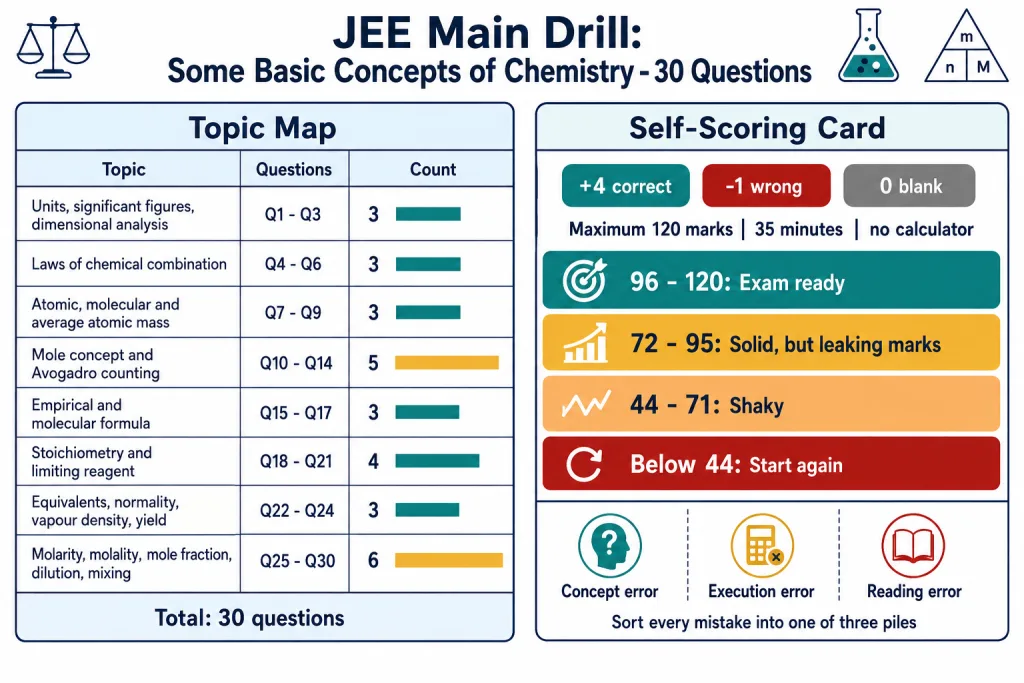
| Topic | Questions | How many |
|---|---|---|
| Units, significant figures and dimensional analysis | Q1 to Q3 | 3 |
| Laws of chemical combination | Q4 to Q6 | 3 |
| Atomic mass, molecular mass and average atomic mass | Q7 to Q9 | 3 |
| Mole concept and Avogadro-number counting | Q10 to Q14 | 5 |
| Empirical and molecular formula | Q15 to Q17 | 3 |
| Stoichiometry and limiting reagent | Q18 to Q21 | 4 |
| Equivalent concept, normality, vapour density, yield and purity | Q22 to Q24 | 3 |
| Molarity, molality, mole fraction, dilution and mixing | Q25 to Q30 | 6 |
That spread is deliberate — it mirrors how JEE Main actually samples this chapter. Mole counting, stoichiometry and concentration terms together account for 15 of the 30 questions, because in the real paper those three ideas account for almost everything that gets asked from this chapter. The difficulty mix is roughly 20% easy, 50% medium and 30% hard, so do not panic if a few feel brutal; they are meant to. Questions 12, 17, 21 and 28 are written in the numerical-value style: the answer is a number you must compute exactly, and the four options are there only so you can mark yourself.
Scoring Yourself Honestly
Mark your sheet with the real scheme — , , — and total it. Do not award yourself half marks for "I knew that one really" or "I only slipped on the last multiplication". The number you get is the number that matters.
The bands
| Your score (out of 120) | Verdict | What to do next |
|---|---|---|
| 96 to 120 | Exam ready. You are at 80% or above on a hard set. | Move on. Chapter 1 will not cost you marks. Revisit only the specific questions you missed. |
| 72 to 95 | Solid, but leaking marks. | These are almost always slips, not gaps — 22.4 used where 22.7 was asked, a molar mass off by one atom, molality confused with molarity. Redo every wrong question without looking at the explanation first. |
| 44 to 71 | Shaky. The ideas are there; the execution is not. | For each wrong answer, go back to the section it came from (use the topic map above) and re-work its solved examples before re-attempting. |
| Below 44 | Start again. | Work through Sections 1 to 9 properly, then Section 10's solved examples, then come back. Re-attempting this set now teaches you nothing. |
Read your own answer sheet
Before you touch the explanations, sort your mistakes into three piles. This is the most valuable ten minutes in the whole section.
- Concept errors — you did not know that normality of is twice its molarity, or that molecular mass equals twice the vapour density, or how a limiting reagent is identified. Fixable by revision, and quickly.
- Execution errors — right method, wrong arithmetic: you divided by 44 instead of 12 when pulling carbon out of , or rounded 0.3348 to 0.3 before the end. Fixable by slowing down for four seconds at the last step.
- Reading errors — you found the mass of the product when the question asked for the mass of the excess reagent left over, or reported molality when it asked for molarity, or counted molecules when it asked for atoms. These are the cheapest marks in the paper to win back, and the ones students refuse to take seriously.
Key Point: A student who scores 76 with three concept errors is in far better shape than one who scores 76 with nine reading errors. The first has three things to learn. The second has a habit to break, and habits take longer.
[Exam Tip] Every explanation below is written as a full step-by-step solution, so this set doubles as revision material. Read the explanation even for the questions you got right — sometimes you got there the slow way, and the fast way (mole ratio in one line, "1 L of solution, then everything else" for concentration conversions) is what you will need in the exam hall.