
Stoichiometry — Reading a Balanced Equation
Stoichiometry lets you predict how much product a reaction gives, or how much reactant it needs, from the balanced equation alone. The word comes from the Greek stoicheion (element) and metron (measure).
Key Point (Definition): Stoichiometry deals with the calculation of masses (and sometimes volumes) of the reactants and products in a chemical reaction.
Take the combustion of methane:
The parts of the equation
- Reactants (left): methane and dioxygen. Products (right): carbon dioxide and water.
- State symbols: (g) gas, (l) liquid, (s) solid, (aq) dissolved in water.
- Stoichiometric coefficients are the numbers before the formulae: 2 for and , 1 (unwritten) for and .
Key Point: Coefficients give the number of molecules, and equally the number of moles, reacting or formed.
The same equation, read four ways
Coefficients are a ratio, so the equation can be read at any scale:
| Reading | ||||
|---|---|---|---|---|
| Molecules | 1 molecule | 2 molecules | 1 molecule | 2 molecules |
| Moles | 1 mol | 2 mol | 1 mol | 2 mol |
| Gas volume at STP | 22.7 L | 45.4 L | 22.7 L | 45.4 L |
| Mass | 16 g | g | 44 g | g |
Two checks:
- Mass is conserved: 16 + 64 = 80 g in, 44 + 36 = 80 g out.
- Volume need not be. Here 68.1 L gives 68.1 L by coincidence; in , 3 volumes become 2. Volume ratios follow moles (Avogadro's law), not mass.
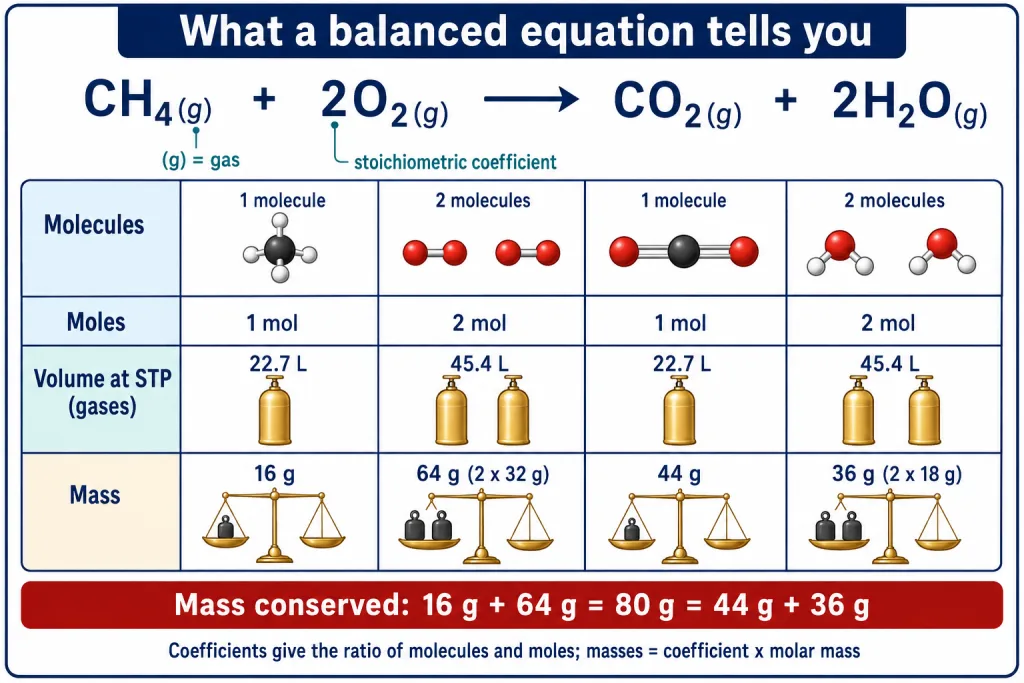
The volume row works only for gases at the same temperature and pressure. Molar volume is 22.7 L at STP (1 bar, 273.15 K); many JEE/NEET questions still use 22.4 L (1 atm). Check which the question expects.
The coefficients carry the ratio
The mass row is always coefficient molar mass: 16 g of methane is one molar mass, 64 g of oxygen is two. The equation says moles react in the ratio 1 : 2 : 1 : 2, never that equal masses react.
[JEE Main] "16 g of methane needs how much oxygen?" 64 g, not 32 g, because the coefficient of is 2.
Balancing Chemical Equations
An equation is balanced when each element has the same number of atoms on both sides: conservation of mass in shorthand.
The one rule never to break
Key Point: Change only the coefficients in front of formulae, never the subscripts. Writing to balance oxygen in the formation of water turns water into hydrogen peroxide, a different compound.
Balancing by inspection
Iron and oxygen: . O is 2 per and 3 per ; the LCM is 6, so and . That gives 4 Fe on the right, so 4Fe:
Check: Fe 4 = 4, O 6 = 6.
Magnesium and oxygen: . Two O need 2 MgO, which needs 2 Mg:
Phosphorus and oxygen: . P is already 4 = 4; ten O need five :
The step method: combustion of propane
Step 1. Skeleton equation:
Step 2. Carbon: 3 C gives 3 :
Step 3. Hydrogen: 8 H, 2 per , so 4 :
Step 4. Oxygen last: O on the right, so 5 :
Step 5. Verify. C 3 = 3, H 8 = 8, O 10 = 10.
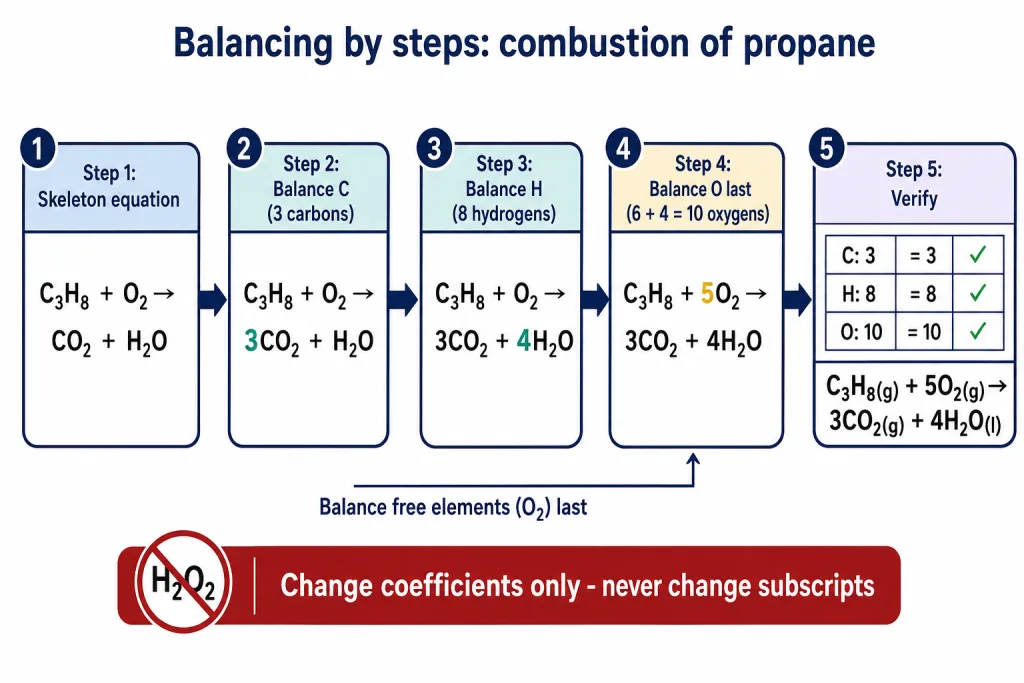
Why oxygen goes last
A free element (, , , Fe, Mg) can be set without disturbing anything else, so balance it last; balance elements that appear in only one compound per side first.
If the last element needs a fraction (say for butane), finish, then double the whole equation. Fractions are fine in thermochemistry; stoichiometry uses smallest whole numbers.
A balancing checklist
| Do | Don't |
|---|---|
| Write correct molecular formulae first (, not O) | Never alter a subscript to balance |
| Balance metals and carbon first, then H, then O | Don't leave a coefficient as 0 or omit a species |
| Use smallest whole-number coefficients | Don't forget polyatomic ions can be balanced as units () |
| Re-count every element at the end | Don't assume it looks balanced; count |
[NEET] Sum of coefficients for : .
Stoichiometric Calculations — The Conversion Chain
Every stoichiometry problem runs on the same three-link chain.
The chain
- Convert the given quantity to moles: mass molar mass, STP gas volume 22.7 L , or (solutions, Section 9) molarity litres.
- Use the coefficient ratio to get moles of the wanted substance. This is the only step that uses the equation.
- Convert to what is asked: molar mass for grams, 22.7 L for STP volume, for molecules.
Key Point: The coefficient ratio applies to moles only, never to grams. 1 mol : 2 mol is correct; "16 g : 2 g " is meaningless.
The mole ratio as a unit factor
From :
Each factor equals 1, so it changes nothing physically but swaps the unit. Water from 16 g of methane:
If the units do not cancel in pairs, a factor is upside down.
The three common problem types
| Type | Given | Wanted | Links used |
|---|---|---|---|
| Mass to mass | grams of A | grams of B | , ratio, |
| Mass to mole (or mole to mass) | grams of A | moles of B | , ratio |
| Mole to volume (gases) | moles or grams of A | litres of B at STP | ratio, L |
| Volume to volume (gases, same T and P) | litres of A | litres of B | ratio directly (Gay Lussac) |
Gases at the same T and P have volumes in the mole ratio: from , 10 L of propane needs 50 L of oxygen and gives 30 L of .
A problem through the chain
How many moles of methane are required to produce 22 g of after combustion?
- Link 1: 22 g mol.
- Link 2: , so 0.5 mol .
- Link 3: moles are asked, so stop.
Answer: 0.5 mol of methane ( g).
For a sequence A to B to C, chain the ratios: moles of C = moles of A (ratio 1) (ratio 2); intermediate masses are not needed.
[Board] Show the balanced equation, molar masses and mole ratio; a bare "36 g" earns little.
The Limiting Reagent
Reactants are rarely supplied in exactly the proportion the equation demands, and that changes which number controls the answer.
The sandwich picture
A sandwich needs 2 slices of bread and 1 of cheese. With 10 bread and 3 cheese you make 3 sandwiches, not 5: the cheese runs out and extra bread does not help. Cheese is the limiting ingredient, bread is in excess (4 slices left). In a reaction, the reactant that runs out first stops it; the rest stays unreacted.
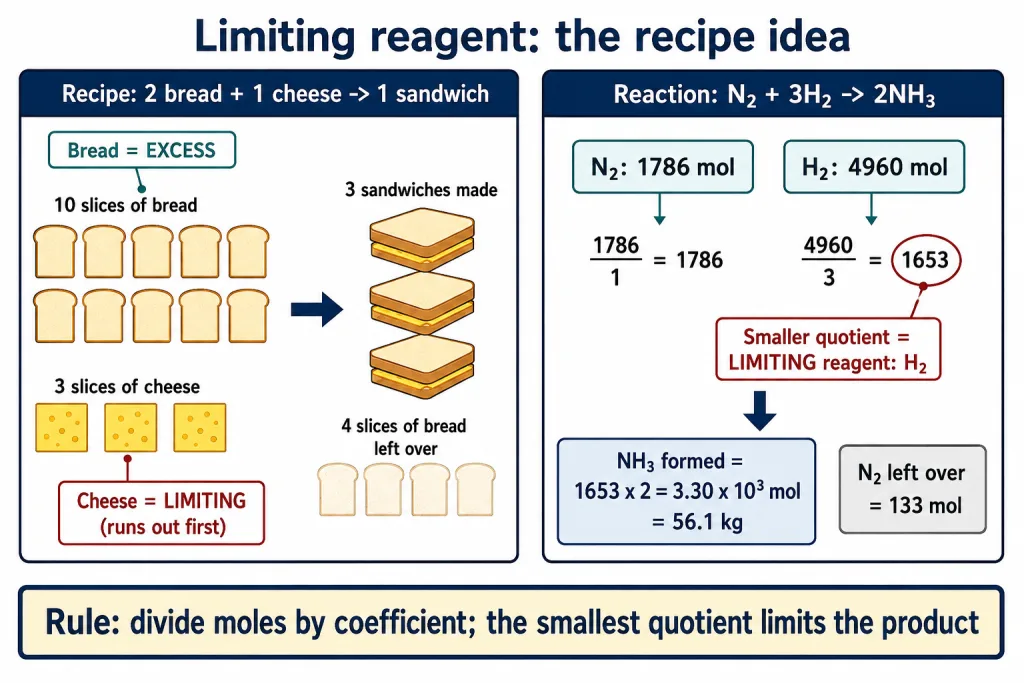
Key Point (Definition): When reactant amounts differ from those required by the balanced equation, the reactant present in the least amount (relative to its coefficient) is consumed first, after which no further reaction occurs whatever the amount of the other reactant. It limits the amount of product and is called the limiting reagent; the other reactant(s) are in excess.
Two cautions:
- "Least amount" is relative to what the equation needs, not the smallest mass or mole count. 3 mol exceeds 1 mol , yet in neither is limiting.
- Product is always calculated from the limiting reagent; using the excess reagent gives too large an answer.
Spotting the limiting reagent
Method A (required versus available). From one reactant, use the coefficient ratio to find how much of the other it requires; if that exceeds what is available, the other reactant is limiting.
Method B (divide by the coefficient). For each reactant compute
The smallest quotient marks the limiting reagent and is the number of times the equation runs, so moles of any product = (smallest quotient) (product's coefficient).
| Reaction mixture for | Limiting | formed | ||
|---|---|---|---|---|
| 1 mol + 3 mol | 1 | 1 | none (stoichiometric) | 2 mol |
| 1 mol + 2 mol | 1 | 0.667 | mol | |
| 2 mol + 3 mol | 2 | 1 | 2 mol | |
| 1 mol + 6 mol | 1 | 2 | 2 mol |
In row 3, hydrogen has the larger mole count and is still limiting, because each run uses three of them.
Excess reagent left over
Leftover = available minus consumed, where consumed follows the coefficient ratio. In row 4, 1 mol consumes 3 mol , leaving mol.
[JEE Main] When reactants are given in grams, convert both to moles before dividing by coefficients. 10 kg of hydrogen sounds like less than 50 kg of nitrogen, but the coefficient 3 makes hydrogen the limiting reagent, as the next block shows.
Ammonia Synthesis — A Limiting-Reagent Problem in Full
The Haber process, , is the standard limiting-reagent problem.
Problem 1.5. 50.0 kg of and 10.0 kg of are mixed to produce . Calculate the amount of formed. Identify the limiting reagent.
Step 1: Equation and molar masses
, , .
Step 2: Reactants to moles
Step 3: Limiting reagent
Method A: 1786 mol would need
Only mol is available, so dihydrogen is limiting and dinitrogen is in excess.
Method B: : ; : . Smaller quotient, so hydrogen limits.
Step 4: Product from the limiting reagent
Step 5: Mass
Answer: mol, i.e. 56.1 kg of ammonia; is the limiting reagent.
The follow-up examiners ask
Nitrogen consumed mol. Left mol g, about 3.7 kg.
Mass check: 50.0 + 10.0 = 60.0 kg in; 56.1 kg + 3.7 kg = 59.8 kg out, equal within rounding.
Hydrogen was 10 kg against 50 kg of nitrogen and still limiting: small molar mass (2.016), large coefficient (3). Only moles divided by coefficient decides.
[JEE Main] Variants: swap the masses (50 kg + 10 kg makes limiting); give moles; ask for the leftover; or ask what mass of exactly consumes 50.0 kg of (1786 mol 3 2.016 g = 10.8 kg).
Stoichiometry in Solutions and the Exam Checklist
A reactant in solution
For a dissolved reactant, given as molarity and volume,
Two exercises belong here because they are pure stoichiometry once the moles are known (concentration itself is Section 9).
Exercise 1.35. What mass of is required to react completely with 25 mL of 0.75 M HCl?
mol. Ratio 1 : 2, so mol ; with , mass g.
Exercise 1.36. How many grams of HCl react with 5.0 g of ? . mol; HCl mol g.
Only link 1 of the chain is new.
Gas-volume stoichiometry
For a gaseous product at STP, link 3 is L : 8 g of methane (0.5 mol) gives 0.5 mol L. If all gases are at the same T and P, coefficients give the volume ratio directly (Gay Lussac, Section 4).
The five errors that cost the most marks
| Error | What it looks like | The fix |
|---|---|---|
| Unbalanced equation | Using as written in Exercise 1.24 | Balance first |
| Ratio applied to grams | "16 g gives 2 16 g " | Ratio applies to moles only |
| Yield from the excess reagent | from 50 kg | Yield comes from the limiting reagent |
| Comparing masses or raw moles | "10 kg is less than 50 kg so limits" (right answer, wrong reason) | Divide moles by coefficients |
| Wrong molar volume | 22.4 L when 22.7 L is expected, or vice versa | Boards: 22.7 L at 1 bar; older JEE/NEET keys: 22.4 L at 1 atm |
A 30-second recipe
- Balance the equation.
- Moles of everything given (mass ; volume ; ).
- Divide each reactant's moles by its coefficient; smallest is limiting (skip if only one reactant is quantified).
- Smallest quotient product's coefficient = moles of product.
- Convert to grams, litres, molecules, or leftover excess as asked.
Key Point: Balanced equation, then moles, then ratio, then answer.
[NEET] NEET stoichiometry is usually one mole ratio with clean numbers (4.4 g , 5.6 L at STP, 3.4 g ); if you are dividing by 2.016, check whether is intended. JEE Main adds per cent yield and purity on top of the theoretical yield.
Solved Examples
Question 1: Reading a balanced equation four ways
For , state what the equation tells you in terms of (i) molecules, (ii) moles, (iii) volumes at STP, and (iv) masses. Then check mass conservation.
Answer: Molecules: 2 + 1 give 2 . Moles: 2 mol + 1 mol give 2 mol.
Volumes at STP: L + 22.7 L give 45.4 L of water vapour. 68.1 L becomes 45.4 L; volume is not conserved.
Masses: g + 32.0 g give g . Check: 4.03 + 32.0 = 36.03 g in, 36.0 g out, equal within rounding.
Ans: 2 : 1 : 2 in molecules and moles; 45.4 L : 22.7 L : 45.4 L at STP; 4.03 g : 32.0 g : 36.0 g.
Question 2: Balancing by inspection
Balance: (i) (ii) (iii) .
Answer: (i) O is 2 on the left, 3 on the right; LCM 6 gives and , then 4 Fe on the right needs . . Check: Fe 4 = 4, O 6 = 6.
(ii) P is 4 = 4 already; ten O needs . . Check: O 10 = 10.
(iii) Same as iron: . Check: Al 4 = 4, O 6 = 6.
Ans: (i) ; (ii) ; (iii) .
Question 3: The step method with a fractional coefficient
Balance the combustion of butane, , using the C, H, O order.
Answer: 4 C gives ; 10 H gives .
Oxygen last: O on the right needs : .
Doubling every coefficient clears the fraction: . Verify: C 8 = 8, H 20 = 20, O 26 = 16 + 10 = 26.
Ans: .
Watch out: Never fix the fraction by changing to O; double the whole equation.
Question 4: Water from 16 g of methane
Calculate the amount of water (in g) produced by the combustion of 16 g of methane.
Answer: .
, so 16 g is 1 mol, which gives 2 mol by the 1 : 2 ratio.
; mass g.
In one line: . Oxygen is in excess since no amount is given.
Ans: 36 g of water.
Question 5: Methane needed for 22 g of carbon dioxide
How many moles of methane are required to produce 22 g of after combustion?
Answer: From , .
mol, so 0.5 mol .
Check by mass: 44 g needs 16 g , so 22 g needs 8 g mol.
Ans: 0.5 mol of methane (8 g).
Question 6: Mole-to-volume — gas volumes at STP
8.0 g of methane is burnt completely in oxygen. Calculate (i) the volume of at STP required, (ii) the volume of at STP produced, and (iii) the volume of needed if the gases are measured at the same room temperature and pressure and the methane occupies 2.0 L.
Answer: ; mol.
(i) mol ; at STP (1 bar) L (22.4 L at 1 atm).
(ii) 0.50 mol L, about 11.4 L.
(iii) Same T and P, so volumes follow coefficients: 2.0 L needs L .
Ans: (i) 22.7 L; (ii) 11.4 L; (iii) 4.0 L.
Watch out: Molar volume is needed only to turn mass or moles into litres; gas to gas at the same conditions is just the coefficient ratio.
Question 7: Carbon burnt in limited oxygen
Calculate the amount of carbon dioxide produced when (i) 1 mole of carbon is burnt in air, (ii) 1 mole of carbon is burnt in 16 g of dioxygen, (iii) 2 moles of carbon are burnt in 16 g of dioxygen.
Answer: , ratio 1 : 1 : 1. , .
(i) Air means unlimited oxygen: 1 mol C gives 1 mol g.
(ii) Oxygen mol. C: ; : , so oxygen limits. mol g; 0.5 mol C (6 g) left.
(iii) Carbon 2 mol, oxygen still 0.5 mol and still limiting. mol g; 1.5 mol C (18 g) left.
Ans: (i) 44 g; (ii) 22 g; (iii) 22 g.
Watch out: Doubling the carbon changed nothing; extra excess reagent never raises the yield.
Question 8: Limiting reagent in A + B2 → AB2
In the reaction , identify the limiting reagent, if any, in: (i) 300 atoms of A + 200 molecules of ; (ii) 2 mol A + 3 mol ; (iii) 100 atoms of A + 100 molecules of ; (iv) 5 mol A + 2.5 mol ; (v) 2.5 mol A + 5 mol .
Answer: The ratio is 1 : 1, so the smaller count is limiting.
(i) 300 A, 200 : limits; 100 A left.
(ii) 2 mol A, 3 mol : A limits; 1 mol left.
(iii) 100 and 100: stoichiometric, none limiting.
(iv) 5 mol A, 2.5 mol : limits; 2.5 mol A left.
(v) 2.5 mol A, 5 mol : A limits; 2.5 mol left.
Ans: (i) ; (ii) A; (iii) none; (iv) ; (v) A.
Watch out: "Smaller amount limits" holds only for 1 : 1 coefficients; otherwise divide by the coefficient first.
Question 9: 50.0 kg N2 and 10.0 kg H2
50.0 kg of and 10.0 kg of are mixed to produce . Calculate the amount of formed and identify the limiting reagent.
Answer: .
mol; mol.
mol needs mol ; only mol is there, so limits. (Check: against .)
mol; mass g kg.
Ans: mol kg of ; dihydrogen is limiting.
Watch out: The smaller mass limits here only because ; always compare moles over coefficients.
Question 10: 2.00 × 10^3 g N2 with 1.00 × 10^3 g H2
Dinitrogen and dihydrogen react to produce ammonia. (i) Calculate the mass of ammonia produced if g of dinitrogen reacts with g of dihydrogen. (ii) Will any reactant remain unreacted? (iii) If yes, which one and what is its mass?
Answer: The given is unbalanced; I use .
mol; mol. against , so limits.
(i) mol ; mass g.
(ii) Yes, dihydrogen remains.
(iii) used mol g; left g (571 g with ).
Mass check: g.
Ans: (i) g of ; (ii) yes; (iii) about 568 g of .
Watch out: The equation in the question was not balanced. Check before using it.
Question 11: CaCO3 needed for 25 mL of 0.75 M HCl
Calcium carbonate reacts with aqueous HCl according to . What mass of is required to react completely with 25 mL of 0.75 M HCl?
Answer: mol.
2 mol HCl per mol , so mol.
; mass g (0.9375 g with ).
If asked: L mL at STP.
Ans: About 0.94 g of .
Watch out: The 2 : 1 ratio halves the HCl moles, not doubles.
Question 12: HCl consumed by 5.0 g of MnO2
Chlorine is prepared by . How many grams of HCl react with 5.0 g of manganese dioxide? Also find the volume of at STP.
Answer: ; mol.
mol; with , mass g.
is 1 : 1 with : L at STP (1.29 L at 1 atm, 22.4 L).
Ans: 8.40 g of HCl; about 1.3 L of at STP.
Watch out: Coefficient 4 on HCl multiplies the moles by 4; write the ratio as a fraction so units cancel.