Beyond the Textbook: The JEE Toolkit
JEE Main uses several terms the Class 11 syllabus never defines. This section builds them: the equivalent, vapour density, yield and purity, POAC, ppm and ppb, and the relations between molarity, molality, mole fraction and mass per cent.
Why 1 mol of H2SO4 is worth 2 mol of NaOH
1 mol of H2SO4 neutralises 2 mol of NaOH; 1 mol of HCl neutralises 1 mol. Moles do not react one-to-one; reactive units (protons, hydroxide ions, electrons) do. Equivalents count those units.
Key Point (Definition): The n-factor of a species is the number of reactive units it supplies or accepts per formula unit in a given reaction. The equivalent mass is
E=n-factorMolar mass (M)
and the number of gram equivalents in a sample is
Equivalents=Emass in g=moles×n-factor
Everything below is about finding the right n-factor.
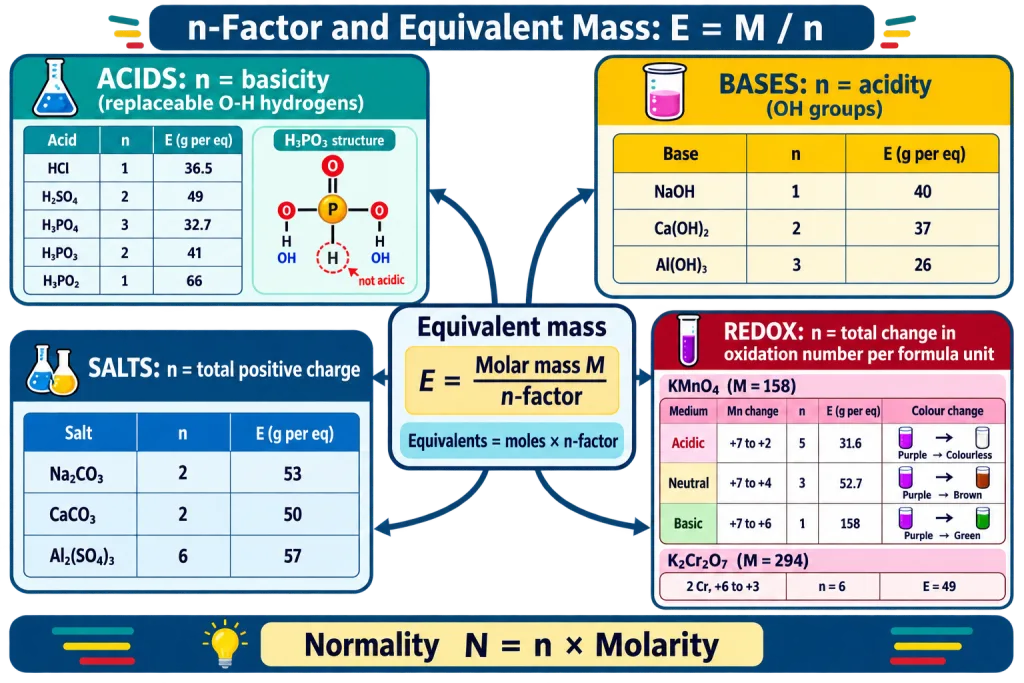
Acids: n-factor = basicity
| Acid |
Basicity (n) |
M (g mol−1) |
E (g eq−1) |
| HCl, HNO3, CH3COOH |
1 |
36.5, 63, 60 |
36.5, 63, 60 |
| H2SO4 |
2 |
98 |
49 |
| H2C2O4⋅2H2O (oxalic acid) |
2 |
126 |
63 |
| H3PO4 |
3 |
98 |
32.7 |
| H3PO3 (phosphorous acid) |
2 |
82 |
41 |
| H3PO2 (hypophosphorous acid) |
1 |
66 |
66 |
Basicity counts only hydrogens bonded to oxygen. H3PO3 has two P−OH and one P−H, so it is dibasic; H3PO2 has one P−OH and two P−H, so it is monobasic. Acetic acid has basicity 1 for the same reason.
The n-factor depends on the reaction. In H2SO4+NaOH→NaHSO4+H2O the acid is half-neutralised, n=1 and E=98.
Bases: n-factor = acidity
NaOH, KOH, NH4OH: n=1. Ca(OH)2, Ba(OH)2: n=2, so E of Ca(OH)2=74/2=37. Al(OH)3: n=3, E=78/3=26.
Salts (non-redox): n-factor = total positive charge
| Salt |
Cations |
n |
E |
| NaCl |
1×(+1) |
1 |
58.5 |
| Na2CO3 |
2×(+1) |
2 |
106/2=53 |
| CaCO3 |
1×(+2) |
2 |
100/2=50 |
| Al2(SO4)3 |
2×(+3) |
6 |
342/6=57 |
| Ca3(PO4)2 |
3×(+2) |
6 |
310/6=51.7 |
Key Point (The KMnO4 rule): The same oxidant has different n-factors in different media.
| Medium |
Half-reaction |
n |
E (M=158) |
| Acidic |
MnO4−+8H++5e−→Mn2++4H2O |
5 |
158/5=31.6 |
| Neutral / weakly basic |
MnO4−+2H2O+3e−→MnO2+4OH− |
3 |
158/3=52.7 |
| Strongly basic |
MnO4−+e−→MnO42− |
1 |
158/1=158 |
Colours: purple to colourless (acidic), brown MnO2 (neutral), green manganate (basic).
Potassium dichromate in acid: Cr2O72−+14H++6e−→2Cr3++7H2O. Two Cr atoms each drop +6→+3, so n=2×3=6 and E=294/6=49; n is per formula unit.
Common reductants: FeSO4 (Fe2+→Fe3+, n=1, E=152); Mohr's salt FeSO4⋅(NH4)2SO4⋅6H2O (n=1, E=392); oxalic acid as reductant (C2O42−→2CO2, C goes +3→+4 twice, n=2, E=63); FeC2O4 (Fe gives 1, oxalate 2, n=3, E=144/3=48); H2O2 as oxidant or reductant (n=2, E=17).
Key Point: For a species that changes in two places (like FeC2O4), add the changes. For disproportionation, treat the oxidised and reduced halves separately; write both half-reactions first.
Normality and the Law of Equivalents
Normality counts equivalents per litre, and equivalents react one-to-one, so titration arithmetic becomes simple.
Key Point (Definition): The normality N of a solution is the number of gram equivalents of solute per litre of solution:
N=volume in Lequivalents of solute=E×V(L)mass in g
Since equivalents = moles × n-factor,
N=n-factor×M
1 M H2SO4 is 2 N. 0.1 M KMnO4 is 0.5 N in acidic, 0.3 N in neutral and 0.1 N in strongly basic medium — same bottle, three normalities, which is why a normality is only meaningful alongside the reaction.
Normality is never smaller than molarity
Since n≥1, N≥M always, with equality only for monobasic acids, monoacidic bases and one-electron redox species.
The law of equivalents
Key Point (Law of Equivalents): In any reaction, reactants combine and products form in equal numbers of equivalents:
Equivalents of A=Equivalents of B=Equivalents of product
No balanced equation is needed; the n-factors carry the stoichiometry. For two solutions reacting completely, equivalents =N×V, so
N1V1=N2V2
The volumes may be in any unit, provided both sides use the same one.
| Form of reagent |
Equivalents |
| Solution |
N×V(L), or n×M×V(L) |
| Pure substance of mass w |
w/E, or (w/M)×n |
| Gas at STP (1 atm, 22.4 L) |
22.4V(L)×n |
For hydrogen liberated by a metal (H++e−→21H2), one mole of H2 is 2 equivalents, so 1 equivalent of any metal liberates 11.2 L of H2 at STP (1 atm), or 11.35 L at 1 bar. Use 22.7 L only when the question says 1 bar.
Back-titration and mixtures
Back-titration: excess reagent A is added to the sample and the leftover A is titrated with B.
Equivalents of sample=Equivalents of A added−Equivalents of B used
Two acids (or two reductants) titrated together:
NbaseVbase=N1V1+N2V2
[JEE Main] The titrant's n-factor is fixed by the medium: "acidified KMnO4" means n=5. When only a volume ratio is asked, V2V1=N1N2; equimolar H2SO4 and NaOH react in a 1 : 2 volume ratio.
Vapour Density and Relative Density of Gases
Early chemists compared gases by weighing equal volumes. That comparison is the vapour density, usually a disguised molar mass in a question.
Key Point (Definition): The vapour density (VD) of a gas is the ratio of the mass of a certain volume of the gas to the mass of the same volume of hydrogen at the same temperature and pressure:
VD=mass of V litres of H2mass of V litres of gas(same T,P)
VD has no units.
Deriving VD =M/2
- By Avogadro's law, equal volumes of gases at the same T and P contain equal numbers of molecules, N.
- The mass of N molecules of the gas is N×mgas, and of N molecules of hydrogen is N×mH2, so
VD=NmH2Nmgas=mH2mgas=MH2Mgas
- Hydrogen is diatomic, MH2=2 g mol−1 (2.016 more precisely), so
VD=2MorM=2×VD
| Gas |
M |
VD |
Gas |
M |
VD |
| H2 |
2 |
1 |
N2, CO |
28 |
14 |
| CH4 |
16 |
8 |
O2 |
32 |
16 |
| NH3 |
17 |
8.5 |
CO2, N2O |
44 |
22 |
| H2O(g) |
18 |
9 |
SO2 |
64 |
32 |
Relative density with respect to other gases
"x times as dense as air" means M=29x (air ≈29); "y times as dense as oxygen" means M=32y. In general
drefdgas=MrefMgas(same T,P)
because d=RTPM and P/RT is common. The factor of 2 belongs to hydrogen only.
Vapour density of a mixture
VD =Mavg/2, with Mavg the mole-fraction-weighted average molar mass. Equal moles of H2 and O2 give Mavg=17, VD =8.5; for equal masses, convert to moles first.
Degree of dissociation from vapour density
For A⇌nB, molecules multiply, so density falls. Let D be the theoretical VD of A, d the observed VD, α the degree of dissociation. From 1 mol of A: 1−α mol of A and nα mol of B, total 1+(n−1)α mol. Density is inversely proportional to moles, so
dD=1+(n−1)α⇒α=(n−1)dD−d
For PCl5⇌PCl3+Cl2 and N2O4⇌2NO2, n=2 and α=(D−d)/d.
[JEE Main] "Vapour density 32" means M=64; convert at once. "Density at STP in g/L" means M/22.4 (or M/22.7 at 1 bar).
Per Cent Yield and Per Cent Purity
Per cent yield
Key Point (Definition): The theoretical yield is the maximum product (mass or moles) the balanced equation predicts from the limiting reagent. The actual yield is what the experiment delivers.
% yield=theoretical yieldactual yield×100
Use grams or moles for both, consistently. Yield falls below 100% through side reactions, equilibrium, losses and unreacted material; a yield above 100% is a red flag for an impure or wet product, never a bonus.
Working backwards
For 50 g of product at 80% yield,
Theoretical yield needed=% yield/100required actual yield=0.8050=62.5 g
Divide by the yield fraction going backwards, multiply going forwards.
Sequential reactions: yields multiply
For A→B→C→D with step yields y1,y2,y3 (as fractions),
Overall yield=y1×y2×y3
Steps at 80%, 75% and 50% give 0.80×0.75×0.50=0.30. Yields never add or average.
Key Point: If the stoichiometry changes between steps (1 mol of B gives 2 mol of C), multiply the mole ratio in too: moles of D = moles of A × (mole ratios) × (yield fractions).
Per cent purity
Key Point (Definition): The per cent purity of a sample is the mass percentage of pure, reactive substance in it:
% purity=mass of impure samplemass of pure substance×100
Assume the impurity is inert and no product is lost. Work back from the product to the mass of pure reactant.
Example: 10 g of impure CaCO3 gives 3.52 g of CO2. CaCO3→CaO+CO2, so moles of CaCO3= moles of CO2=3.52/44=0.080; pure CaCO3=0.080×100=8.0 g; purity =80%.
Yield and purity together
Actual product=(sample mass)×100purity×(stoichiometric factor)×100yield
Purity applies to the reactant, yield to the product. Never add the percentages.
| Concept |
Formula |
Applied to |
| % yield |
actual / theoretical × 100 |
product, at the end |
| % purity |
pure / impure × 100 |
reactant, at the start |
| Overall yield |
product of step yields |
whole route |
| Reactant needed for a target |
target ÷ (yield fraction) |
working backwards |
[JEE Main] A reagent 20% in excess is taken at 1.2 times the amount the balanced equation demands, not 1.2 times the other reagent's mass.
POAC: The Principle of Atom Conservation
POAC lets you skip balancing.
Key Point (Principle of Atom Conservation): Atoms are neither created nor destroyed in a reaction. For every element, the total moles of its atoms on the reactant side equals the total on the product side, whether or not the equation is balanced.
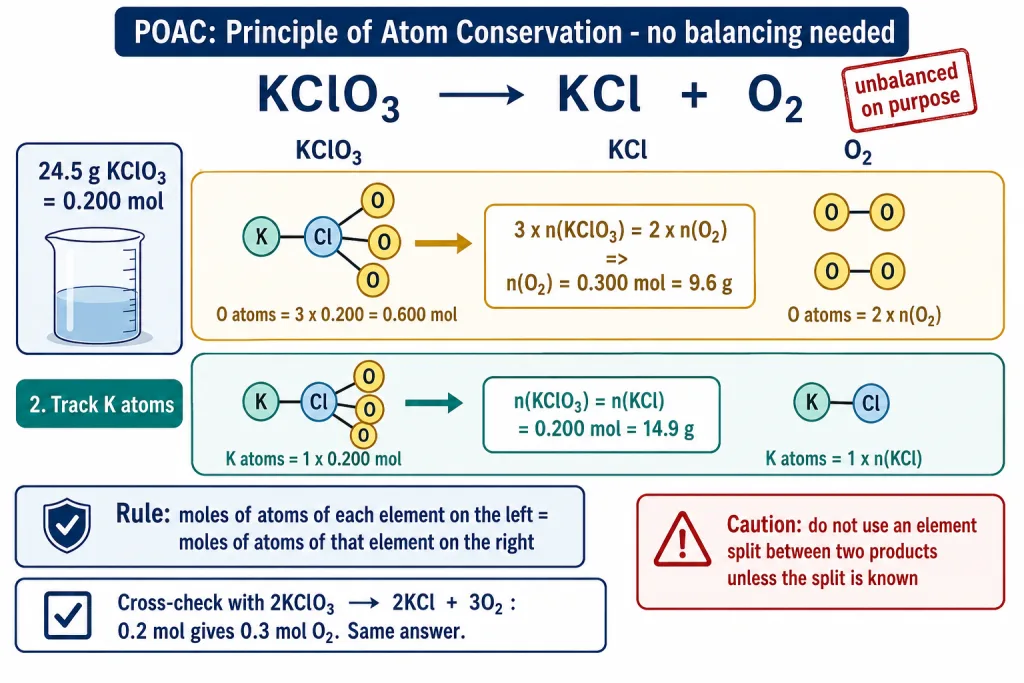
The recipe
- Write the reaction with only the species that matter, no coefficients.
- Pick an element that appears in exactly one reactant of interest and one product of interest.
- Write (moles of that element on the left) = (moles on the right), using
moles of atoms of X in a species=(moles of species)×(number of X atoms per formula unit)
- Solve for the unknown moles, then convert to mass or volume.
Worked case
Problem. How many grams of O2 are obtained by completely decomposing 24.5 g of KClO3?
KClO3→KCl+O2(unbalanced)
Moles of KClO3=122.524.5=0.200 mol. All O goes into O2, so POAC on oxygen:
3×nKClO3=2×nO2⇒nO2=23×0.200=0.300 mol
Mass of O2=0.300×32=9.6 g, the same as from the balanced 2KClO3→2KCl+3O2.
For KCl, use potassium: nKCl=nKClO3=0.200 mol =14.9 g.
Where POAC is most useful
- Conversions with no reagents given. "What mass of Fe2O3 from 240 g of FeS2?" Iron is conserved. FeS2 has one Fe per formula unit, so nFe=120240=2 mol, and since Fe2O3 holds two, nFe2O3=1 mol =160 g.
- Large equations where balancing takes longer than the problem.
- Solution reactions where one element matters (mass of BaSO4 from a sulphate mixture: POAC on sulphur).
- Combustion analysis: moles of C = moles of CO2; moles of H =2× moles of H2O.
Two conditions
- The element must not be split between two products (or two reactants) unless the split is known. In a reaction giving both CO and CO2, carbon needs the ratio.
- The reaction must go to completion. POAC counts atoms, not yield; apply the yield fraction afterwards.
Key Point: POAC and the law of equivalents both skip balancing. Use POAC when the question is about an element's mass in a product; use equivalents for a titration or a redox reaction between two reagents.
ppm, ppb and the Concentration Interconversion Web
Any concentration unit can be converted to any other, with density as the connector. Two more units cover trace amounts.
Parts per million and parts per billion
Key Point (Definition):
ppm=mass of solutionmass of solute×106,ppb=mass of solutionmass of solute×109
Both are mass-by-mass unless stated otherwise. 1 ppm =1 mg per kg, and dilute aqueous solutions have d≈1 g mL−1, so
1 ppm≈1 mg L−1≈1 mg kg−1,1 ppb≈1 μg L−1
1% =104 ppm; 1 ppm =1000 ppb. Water hardness in ppm is the mass of CaCO3 equivalent per 106 g of water; fluoride in drinking water is about 1 ppm.
The web
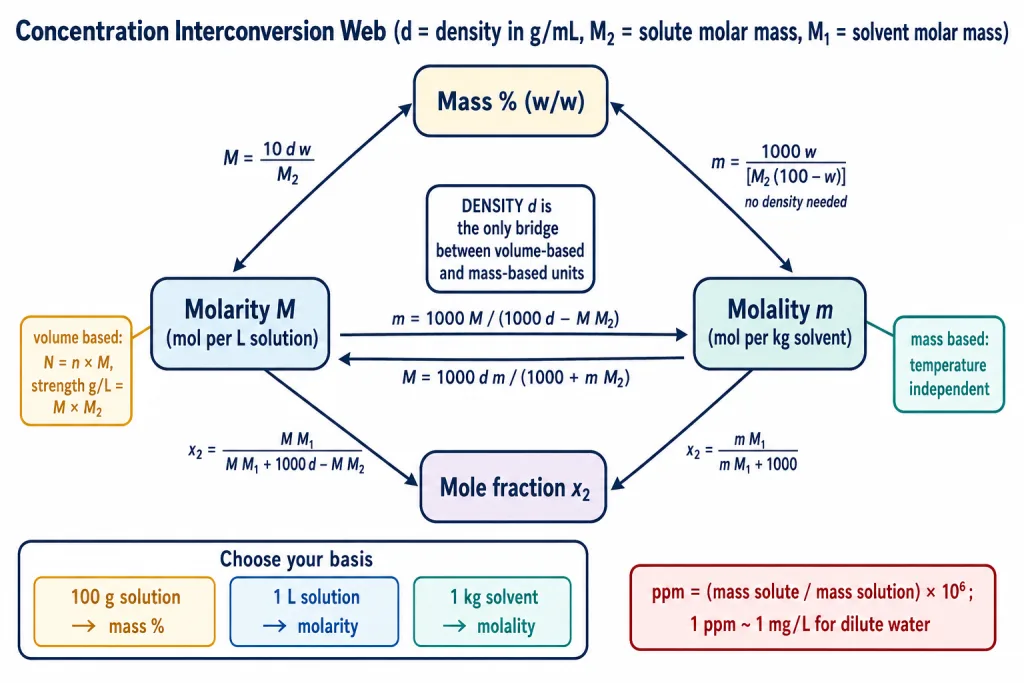
Symbols: solute molar mass M2, solvent molar mass M1 (18 for water), molarity M, molality m, density d in g mL−1, mass per cent w, solute mole fraction x2.
Route 1: mass per cent to molarity
Basis 100 g of solution: w/M2 mol of solute in 100/d mL.
M=100/(1000d)w/M2=M210dw
Check: 98% H2SO4, d=1.84, gives M=10×1.84×98/98=18.4 M.
Route 2: mass per cent to molality
Same basis; solvent =(100−w) g.
m=(100−w)/1000w/M2=M2(100−w)1000w
No density needed.
Route 3: molarity to molality
Basis 1 L of solution: M mol of solute (MM2 g) in 1000d g total, so solvent =(1000d−MM2) g.
m=(1000d−MM2)/1000M=1000d−MM21000M
Inverse, from 1 kg of solvent (total mass 1000+mM2 g, volume (1000+mM2)/d mL):
M=1000+mM21000dm
For dilute aqueous solutions d≈1 and MM2≪1000, so m≈M.
Route 4: molality to mole fraction
Basis 1 kg of solvent: m mol solute, 1000/M1 mol solvent.
x2=m+1000/M1m=mM1+1000mM1
For water, x2=18m+100018m; a 1 molal solution has x2=18/1018=0.0177. Inverse: m=x1M11000x2, x1=1−x2.
Route 5: molarity to mole fraction
From 1 L of solution, n2=M and n1=(1000d−MM2)/M1:
x2=MM1+1000d−MM2MM1
The master table
| From ↓ to → |
Molarity M |
Molality m |
Mole fraction x2 |
| Mass % w |
M210dw |
M2(100−w)1000w |
w/M2+(100−w)/M1w/M2 |
| Molarity M |
— |
1000d−MM21000M |
MM1+1000d−MM2MM1 |
| Molality m |
1000+mM21000dm |
— |
mM1+1000mM1 |
Also: strength in g L−1 =M×M2, and N=n×M, so strength =N×E.
Key Point: Do not memorise the table. Pick a basis (100 g of solution, 1 L of solution, or 1 kg of solvent), write the grams and moles of solute and solvent, and read off the unit asked.
[JEE Main] Density is the only bridge between volume-based units (molarity, normality, strength) and mass-based ones (mass %, molality, mole fraction, ppm). If no density is given and the question crosses that boundary, either the solution is meant to be dilute (d=1 g mL−1) or the conversion cannot be done at all.
Mixing, Dilution, Average Molar Mass, and Common Traps
Dilution
Solvent changes the volume, not the moles of solute:
M1V1=M2V2(and identically N1V1=N2V2)
Water added is V2−V1, not V2.
Mixing two solutions of the same solute
Moles add and (assuming additive volumes) volumes add:
Mmix=V1+V2M1V1+M2V2
The result always lies between M1 and M2 — a quick sanity check.
Mixing an acid with a base
Work in equivalents:
Nresultant=Vacid+Vbase∣NacidVacid−NbaseVbase∣
Acidic if the acid term is larger. For H+ or OH−, N=M.
Common ion from different solutes
For [Cl−] after mixing NaCl and CaCl2, count the ion: [Cl−]=V1+V2M1V1×1+M2V2×2.
Average molar mass of a gas mixture
Key Point (Definition): For gases with mole fractions xi and molar masses Mi,
Mavg=∑xiMi=total molestotal mass=n1+n2+⋯n1M1+n2M2+⋯
At the same T and P, mole fraction = volume fraction. VD of the mixture =Mavg/2.
Air: 0.79×28+0.21×32=22.1+6.7=28.8≈29.
Equal moles of H2 and O2: Mavg=(2+32)/2=17. Equal masses w: moles w/2 and w/32, so
Mavg=w/2+w/322w=17/322=1764=3.76
For equal masses of two gases, Mavg=M1+M22M1M2, the harmonic mean.
Common traps
| # |
Trap |
The fix |
| 1 |
n=5 for KMnO4 in every medium |
acidic 5, neutral 3, strongly basic 1 |
| 2 |
All H atoms counted as acidic (H3PO3, CH3COOH) |
only O−H hydrogens; H3PO3 dibasic, H3PO2 monobasic |
| 3 |
N<M |
N=n×M; never divide |
| 4 |
"VD =32 g/L" |
VD is unitless; M=2× VD |
| 5 |
Adding or averaging step yields |
multiply the fractions |
| 6 |
Purity and yield on the same substance |
purity to reactant, yield to product |
| 7 |
"1 L of water + solute" read as 1 L of solution |
molality basis (1 kg of solvent) |
| 8 |
Density in g L−1 in a g mL−1 formula |
1000d needs d in g mL−1 |
| 9 |
Water added = final volume |
added water =V2−V1 |
| 10 |
Averaging molarities of unequal volumes |
(M1V1+M2V2)/(V1+V2) |
| 11 |
Equal masses treated as arithmetic mean |
convert to moles; harmonic mean |
| 12 |
Mixing 22.4 L and 22.7 L |
22.4 L at 1 atm (most JEE questions); 22.7 L at 1 bar |
| 13 |
ppm per litre of concentrated solution |
per 106 g of solution; mg L−1 only for dilute aqueous |
| 14 |
Dropping the 2 in Cr2O72− or C2O42− |
per formula unit: 6 and 2 |
[JEE Main] Translate before computing: "VD 22" is M=44, "acidified" is n=5, "80% yield" is ×0.8, "1.2 g mL−1" is 1000d=1200.
Solved Examples
Question 1: n-factor and equivalent mass depend on the reaction
Find the equivalent mass of (a) H3PO3 when completely neutralised by NaOH, (b) H3PO4 in the reaction H3PO4+2NaOH→Na2HPO4+2H2O, and (c) H2SO4 in H2SO4+KOH→KHSO4+H2O. (Molar masses: H3PO3=82, H3PO4=98, H2SO4=98 g mol−1.)
Answer:
(a) H3PO3 has two P−OH and one P−H. Only O−H hydrogens are replaceable, so n=2.
E=282=41 g eq−1
(b) In this reaction H3PO4 gives up only 2 protons, so n=2:
E=298=49 g eq−1
(c) Only one proton is transferred, so n=1:
E=198=98 g eq−1
Ans: (a) 41, (b) 49, (c) 98 g eq−1.
Watch out: The n-factor belongs to the reaction, not the formula. H3PO4 can have n=1, 2 or 3 (E=98, 49 or 32.7).
Question 2: Equivalent mass of KMnO4 and K2Cr2O7 in different media
Calculate the equivalent mass of KMnO4 (M=158) in acidic, neutral and strongly alkaline media, and of K2Cr2O7 (M=294) in acidic medium.
Answer:
First the oxidation number of Mn in MnO4−: x+4(−2)=−1, so x=+7.
Acidic: Mn+7→Mn2+, change =5. E=158/5=31.6.
Neutral: Mn+7→MnO2 (Mn is +4), change =3. E=158/3=52.7.
Strongly alkaline: MnO4−→MnO42− (Mn is +6), change =1. E=158/1=158.
Dichromate: 2x+7(−2)=−2, so x=+6. Each Cr goes to +3 (change 3), and there are two Cr per formula unit, so n=6.
E=6294=49 g eq−1
Ans: KMnO4: 31.6 (acidic), 52.7 (neutral), 158 (alkaline); K2Cr2O7: 49 g eq−1.
Watch out: n is the total change per formula unit; the two chromiums are where a factor of 2 gets lost.
Question 3: A titration with the law of equivalents — no balanced equation required
25.0 mL of a Na2CO3 solution requires 20.0 mL of 0.15 M H2SO4 for complete neutralisation. Find (a) the normality and molarity of the Na2CO3 solution and (b) the mass of Na2CO3 (M=106) present per litre.
Answer:
H2SO4 is dibasic, so its normality is 2×0.15=0.30 N.
By the law of equivalents, N1V1=N2V2:
NNa2CO3×25.0=0.30×20.0⇒NNa2CO3=25.06.0=0.24 N
For Na2CO3 the n-factor is 2 (cationic charge 2×(+1)), so M=N/n=0.24/2=0.12 M.
Mass per litre: M×M2=0.12×106=12.72 g L−1, or N×E=0.24×53=12.72 g L−1.
Ans: (a) 0.24 N, 0.12 M; (b) 12.72 g L−1.
Question 4: Equivalent mass of a metal from the hydrogen it liberates
0.90 g of a metal reacts with excess dilute HCl to liberate 1.12 L of H2 at STP (1 atm). Find the equivalent mass of the metal. If the metal is trivalent, identify it.
Answer:
One mole of H2 (22.4 L at 1 atm STP) is 2 equivalents, so 1 equivalent is 11.2 L:
eq of H2=11.21.12=0.100
Equivalents of metal = equivalents of H2=0.100, so
E=equivalentsmass=0.1000.90=9.0 g eq−1
Trivalent: atomic mass =E×n=9.0×3=27, aluminium.
Ans: E=9.0 g eq−1; the metal is Al (atomic mass 27).
Watch out: 1 equivalent of any substance liberates or consumes 11.2 L of H2 at 1 atm STP (or 5.6 L of O2, n=4).
Question 5: Vapour density — molar mass, and the degree of dissociation of PCl5
(a) A gaseous compound has vapour density 32. What is its molar mass, and what volume does 6.4 g of it occupy at STP (1 atm)? (b) The vapour density of a PCl5 sample at a certain temperature is found to be 62. Calculate its degree of dissociation. (MPCl5=208.5.)
Answer:
(a) M=2×VD=2×32=64 g mol−1 (SO2). Moles =6.4/64=0.10, volume =0.10×22.4=2.24 L.
(b) Theoretical VD: D=208.5/2=104.25. In PCl5⇌PCl3+Cl2, n=2, so
α=(n−1)dD−d=62104.25−62=6242.25=0.681
Ans: (a) M=64 g mol−1, volume =2.24 L; (b) α≈0.68, about 68% dissociated.
Watch out: If α comes out negative, D and d are swapped. At 1 bar STP (22.7 L) the volume in (a) would be 2.27 L.
Question 6: Sequential reactions — overall yield and the mass you must start with
Benzene is converted to a product P in three steps with yields of 80%, 75% and 60%, each step being 1 : 1 in moles. (a) What is the overall yield? (b) What mass of benzene (M=78) must be taken to obtain 36.0 g of P (M=200)?
Answer:
(a) Yields multiply:
0.80×0.75×0.60=0.36=36%
(b) Moles of P =36.0/200=0.180 mol. Only 36% of the benzene becomes P, so
nbenzene=0.360.180=0.500 mol
Mass of benzene =0.500×78=39.0 g.
Ans: (a) 36%; (b) 39.0 g of benzene.
Watch out: Going backwards, divide by the yield fraction. Multiplying gives 0.180×0.36×78=5.1 g, too little even at 100% yield.
Question 7: Per cent purity from the volume of gas evolved
A 4.00 g sample of impure zinc reacts completely with excess dilute H2SO4 to give 1.12 L of H2 at STP (1 atm). The impurities are inert. Find the per cent purity of the zinc. (Zn=65.4.)
Answer:
Zn+H2SO4→ZnSO4+H2: 1 mol Zn gives 1 mol H2.
Moles of H2=1.12/22.4=0.0500, so pure zinc =0.0500×65.4=3.27 g.
% purity=4.003.27×100=81.75%≈81.8%
By equivalents: eq of H2=1.12/11.2=0.100, Zn =0.100×32.7=3.27 g.
Ans: The sample is about 81.8% pure zinc.
Question 8: POAC on an ugly reaction [Advanced]
Iron pyrites, FeS2 (M=120), is roasted in air: FeS2+O2→Fe2O3+SO2 (unbalanced). From 60.0 g of FeS2, find (a) the mass of Fe2O3 (M=160) formed, (b) the volume of SO2 at STP (1 atm), and (c) the mass of O2 consumed — without balancing the equation.
Answer:
Moles of FeS2=60.0/120=0.500 mol.
(a) POAC on iron; Fe2O3 has 2 Fe per formula unit:
1×nFeS2=2×nFe2O3⇒nFe2O3=0.250 mol=0.250×160=40.0 g
(b) POAC on sulphur:
2×nFeS2=1×nSO2⇒nSO2=1.00 mol=22.4 L
(c) POAC on oxygen, now that both products are known: O atoms =3×0.250+2×1.00=0.75+2.00=2.75 mol. Each O2 supplies 2:
nO2=22.75=1.375 mol=1.375×32=44.0 g
Mass check: reactants 60.0+44.0=104.0 g; products 40.0+1.00×64=104.0 g.
Ans: (a) 40.0 g Fe2O3; (b) 22.4 L SO2; (c) 44.0 g O2.
Watch out: Oxygen is split between two products, so balance Fe and S first. (Balanced: 4FeS2+11O2→2Fe2O3+8SO2.)
Question 9: Mass per cent to molarity, molality and mole fraction
An aqueous solution of H2SO4 is 29.4% by mass and has a density of 1.20 g mL−1. Calculate its molarity, molality and the mole fraction of H2SO4. (MH2SO4=98, MH2O=18.)
Answer:
Basis 100 g of solution: 29.4 g of H2SO4 (29.4/98=0.300 mol) and 70.6 g of water (70.6/18=3.922 mol).
Volume =100/1.20=83.33 mL =0.08333 L:
M=0.083330.300=3.60 M
(Check: 10dw/M2=10×1.20×29.4/98=3.60.)
Solvent =0.0706 kg:
m=0.07060.300=4.25 mol kg−1
xH2SO4=0.300+3.9220.300=4.2220.300=0.0711
Ans: M=3.60 M, m=4.25 m, xH2SO4=0.071.
Watch out: m≈M holds only for dilute aqueous solutions; here 3.60 and 4.25 differ a lot.
Question 10: Molarity to molality with the derived formula, and back
(a) A 2.00 M NaOH solution has density 1.08 g mL−1. Find its molality. (b) A 3.00 molal aqueous solution of NaCl (M=58.5) has density 1.10 g mL−1. Find its molarity.
Answer:
(a) Basis 1 L of solution: mass =1000×1.08=1080 g, NaOH=2.00×40=80 g, water =1080−80=1000 g =1.000 kg.
m=1.0002.00=2.00 mol kg−1
Check: 1000d−MM21000M=1080−802000=2.00.
(b) Basis 1 kg of solvent: NaCl=3.00×58.5=175.5 g, total mass 1175.5 g, volume =1175.5/1.10=1068.6 mL =1.0686 L.
M=1.06863.00=2.81 M
Check: 1000+mM21000dm=1175.53300=2.81.
Ans: (a) 2.00 m; (b) 2.81 M.
Watch out: In (a) m=M only because the solvent mass came out as exactly 1 kg; that is not a rule.
Question 11: Mixing an acid with a base — the resultant normality
100 mL of 0.30 M H2SO4 is mixed with 200 mL of 0.20 M NaOH. Assuming additive volumes, find (a) the normality and nature of the resulting solution and (b) the molar concentration of the ion in excess.
Answer:
Acid: N=2×0.30=0.60 N; equivalents =0.60×0.100=0.0600.
Base: N=0.20 N; equivalents =0.20×0.200=0.0400.
Acid is in excess by 0.0600−0.0400=0.0200 eq, so the solution is acidic.
(a) Total volume =300 mL =0.300 L:
N=0.3000.0200=0.0667 N
(b) For H+, one equivalent is one mole, so [H+]=0.0667 M ≈0.067 M. (Unreacted H2SO4: 0.0100 mol in 0.300 L =0.0333 M; 2×0.0333=0.0667.)
Ans: (a) 0.067 N, acidic; (b) [H+]≈0.067 M.
Watch out: By moles (0.030 vs 0.040) the base looks in excess; by equivalents (0.060 vs 0.040) the acid is.
Question 12: Average molar mass of a gas mixture and a ppm conversion
(a) A mixture of CH4 and C2H6 has vapour density 11.0. Find the mole fraction of methane. (b) A 500 mL sample of drinking water (density 1.00 g mL−1) contains 0.75 mg of fluoride ion. Express the fluoride concentration in ppm and in ppb.
Answer:
(a) Mavg=2×11.0=22.0 g mol−1. With mole fraction x of CH4:
16x+30(1−x)=22.0⇒30−14x=22.0⇒x=148.0=0.571
(b) Mass of water =500 g. Mass of fluoride =0.75 mg =7.5×10⁻⁴ g.
ppm=5007.5×10−4×106=1.5 ppm
ppb =1.5×1000=1500. (Check: 0.75 mg in 0.5 L is 1.5 mg L−1 ≈1.5 ppm.)
Ans: (a) xCH4=0.571 (about 4/7); (b) 1.5 ppm =1500 ppb.
Watch out: ppm divides by the mass of solution; mg L−1≈ ppm only because d=1 g mL−1.
