
What Chemistry Is and Why It Matters
Science is the systematic effort to describe and understand nature. Chemistry is one of its disciplines, alongside physics, biology and geology.
Key Point (Definition): Chemistry is the branch of science that studies the preparation, properties, structure and reactions of material substances.
Roald Hoffmann (Nobel Prize, 1981) called it "the science of molecules and their transformations. It is the science not so much of the one hundred elements but of the infinite variety of molecules that may be built from them." Chemistry is also called the science of atoms and molecules.
Curd from milk, sugarcane juice turning to vinegar, iron rusting: all chemistry. This chapter makes such observations quantitative.
Where chemistry reaches
Chemistry sits at the centre of science. Its principles apply to weather, the brain, the computer, and to the chemical industry: fertilisers, alkalis, acids, salts, dyes, polymers, drugs, soaps, detergents, metals, alloys and new materials.
Its contribution to human welfare comes under four headings.
| Sphere | What chemistry delivers | Examples to quote |
|---|---|---|
| Food and agriculture | Large-scale fertiliser production; better pesticides and insecticides | Fertilisers, pesticides, insecticides |
| Health care | Life-saving drugs isolated from natural sources and synthesised in the laboratory | Cisplatin and taxol (cancer therapy); AZT (Azidothymidine) for AIDS patients |
| New materials and national growth | Materials with specific magnetic, electric and optical properties | Superconducting ceramics, conducting polymers, optical fibres; industries making acids, alkalis, dyes, polymers, metals, generating employment |
| Environment | Safer replacements for hazardous chemicals; pollution management | Alternatives to CFCs (chlorofluorocarbons), which deplete stratospheric ozone; management of greenhouse gases such as methane and carbon dioxide |
[Board] Cisplatin and taxol are anti-cancer drugs; AZT helps AIDS patients. Do not swap them.
The unfinished agenda
Greenhouse gases (methane, ) remain a matter of grave concern, and three challenges wait for the next generation of chemists:
- understanding biochemical processes,
- using enzymes for large-scale production of chemicals,
- synthesising new exotic materials.
A developing country like India needs creative chemists for this. All of it starts with the concept of matter.
India's Chemical Heritage
Modern chemistry took shape in 18th-century Europe after centuries of alchemy, which sought the Philosopher's stone (Paras), to turn base metals into gold, and the Elixir of life, for immortality. Alchemy and Iatrochemistry (chemistry applied to medicine) flourished during 1300–1600 CE and reached Europe through the Arabs.
The name
Ancient Indian chemistry, Rasayan Shastra (also Rastantra, Ras Kriya, Rasvidya), covered metallurgy, medicine, cosmetics, glass and dyes.
Archaeological evidence
| Site / text | What it shows |
|---|---|
| Mohenjodaro (Sindh) and Harappa (Punjab) | Baked bricks; mass-produced pottery, the earliest chemical process (mixed, moulded, heated); glazed pottery; gypsum cement (lime, sand, traces of ); faience (a glass) for ornaments; copper hardened with tin and arsenic |
| Maski (South India, 1000–900 BCE); Hastinapur and Taxila (North India, 1000–200 BCE) | Glass coloured with metal oxides |
| Rigveda | Tanning of leather, dyeing of cotton, 1000–400 BCE |
| Kautilya's Arthashastra | Salt from the sea; many liquors |
| Atharvaveda (1000 BCE) | Dyestuffs: turmeric, madder, sunflower, orpiment, cochineal, lac |
| Sushruta Samhita | Importance of alkalies |
| Charaka Samhita | Sulphuric and nitric acid; oxides of copper, tin, zinc; sulphates of copper, zinc, iron; carbonates of lead and iron; bhasma (metal preparations, now shown to contain nanoparticles) for ailments |
| Rasopanishada | Gunpowder mixture; Tamil texts describe fireworks from sulphur, charcoal, saltpetre (), mercury, camphor |
| Varahmihir's Brihat Samhita (6th century CE) | Glutinous plaster for walls and roofs from plant extracts and resins; perfumes and cosmetics |
The people
- Nagarjuna: chemist, alchemist, metallurgist. Rasratnakar: mercury compounds; extraction of gold, silver, tin and copper.
- Rasarnavam (around 800 CE): furnaces, ovens, crucibles; identifying metals by flame colour.
- Chakrapani: discovered mercury sulphide; credited with inventing soap from mustard oil and alkalies.
- Acharya Kanda (born 600 BCE, originally Kashyap): first atomic theory. His Vaiseshika Sutras say all substances are aggregates of very small indivisible particles, the Paramanu: eternal, indestructible, spherical, suprasensible (beyond the senses), in motion in their original state. Different substances have different kinds of atoms, which combine into pairs or triplets under unseen forces.
Key Point: Kanda conceptualised the Paramanu about 2500 years before John Dalton (1766–1844). Write "comparable to atoms" in an answer.
[NEET] Ink was in use at Taxila from the 4th century; paper in India by the 17th century.
Why the tradition faded
Iatrochemistry plateaued after alchemy declined, then faded when the western medicinal system arrived in the 20th century. Indians took 100–150 years to adopt the new techniques; foreign products poured in and indigenous ones faded. Modern chemistry grew here from the mid-19th century, as European scientists arrived.
This chapter follows Kanda: understand matter through its basic constituents, atoms and molecules.
The Nature of Matter: Three States
Key Point (Definition): Matter is anything that has mass and occupies space: book, pen, water, air, every living being.
Light, heat and sound have no rest mass and no volume, so they are not matter.
The three physical states
Matter exists as solid, liquid and gas, differing in how the particles are arranged and how freely they move.
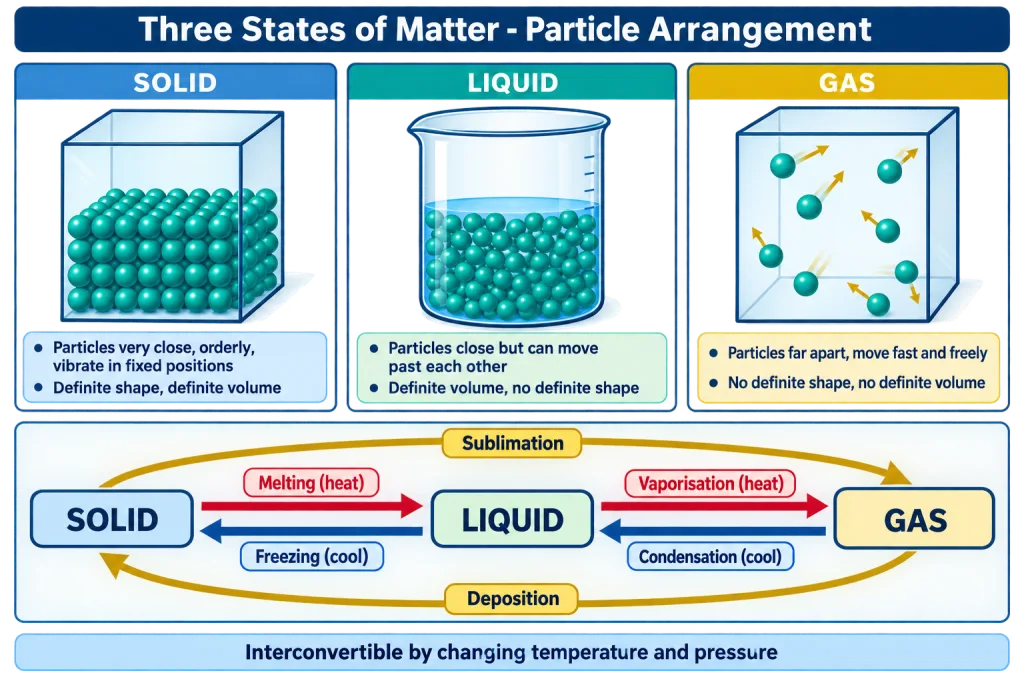
| Feature | Solid | Liquid | Gas |
|---|---|---|---|
| Particle spacing | Very close, orderly | Close, no fixed pattern | Far apart |
| Particle motion | Vibrate about fixed positions | Move past one another | Easy and fast |
| Shape | Definite | Takes the container's shape | Not definite |
| Volume | Definite | Definite | Fills the container |
| Example | Ice, iron, sugar | Water, oil, mercury | Air, steam, |
Key Point: A gas has no volume of its own; it takes the container's volume. That is why a gas compresses easily and a liquid or solid does not.
Interconversion of states
The three states are interconvertible by changing temperature and pressure:
Heating melts a solid (melting, fusion), then vaporises the liquid (vaporisation, boiling). Cooling liquefies a gas (condensation), then freezes the liquid. Some solids go straight to gas (sublimation): camphor, naphthalene, iodine, dry ice. The reverse is deposition.
| Change | Name | Example |
|---|---|---|
| Solid → Liquid | Melting (fusion) | Ice at 0 °C |
| Liquid → Gas | Vaporisation / boiling | Water at 100 °C |
| Gas → Liquid | Condensation (liquefaction) | Dew on grass; LPG in a cylinder |
| Liquid → Solid | Freezing (solidification) | Water in a freezer |
| Solid → Gas | Sublimation | Camphor, iodine, dry ice |
| Gas → Solid | Deposition | Frost from water vapour |
Pressure does the same job as temperature
Cooling a gas brings its particles closer; squeezing it does the same. LPG (largely butane) is liquid in the cylinder because it is under pressure, and becomes gas when the valve opens. Sprays, refrigerants and CNG work the same way.
[JEE Main] States are interconvertible by changing both temperature and pressure; write both words.
Gases have neither definite shape nor volume: particles far apart, negligible interparticle forces, fast free motion that fills the container.
Classification of Matter: Mixtures and Pure Substances
At the macroscopic (bulk) level, matter is either a mixture or a pure substance, and each splits once more.
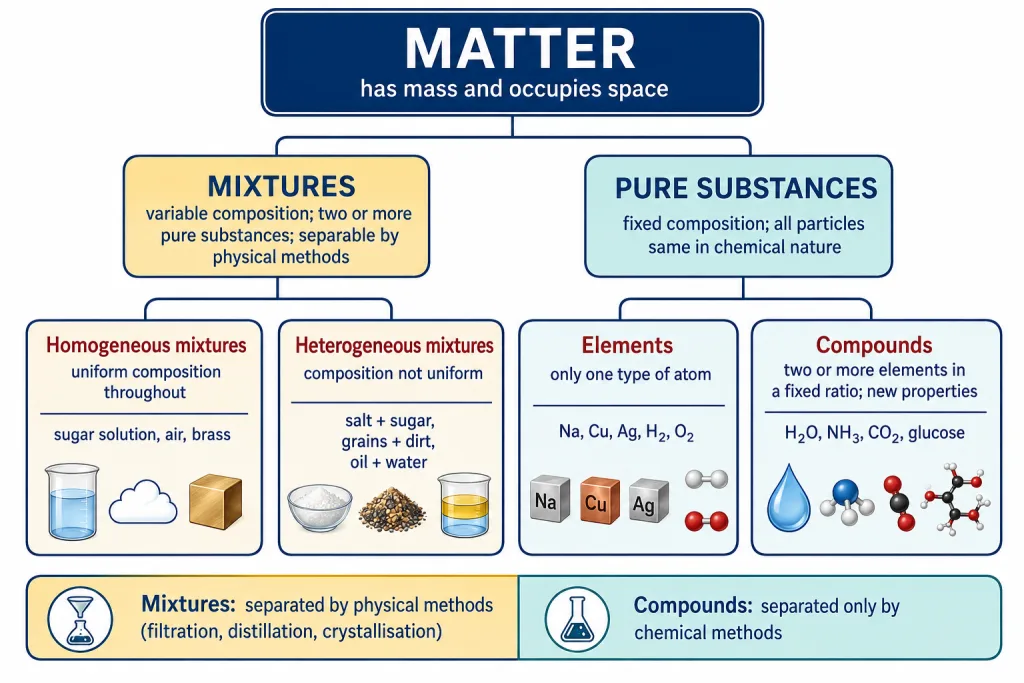
Key Point (Definition): When all the constituent particles of a substance are the same in chemical nature, it is a pure substance. A mixture contains many types of particles, from two or more pure substances, in any ratio.
Mixtures
The pure substances in a mixture are its components. They can be in any proportion, so a mixture has variable composition: sugar solution, air, tea.
| Homogeneous mixture | Heterogeneous mixture | |
|---|---|---|
| Composition | Uniform throughout | Not uniform |
| Components visible? | No; uniformly distributed | Often yes |
| Examples | Sugar solution, air, salt water, alloys (brass, steel), vinegar, filtered clear tea | Salt + sugar; grains and pulses with dirt and stones; sand + water; oil + water; muddy water; smoke; a salad |
A homogeneous mixture is also called a solution. Air is a gaseous solution; brass (copper + zinc) a solid one. "Homogeneous" is about uniform composition, not state.
The separation test
Key Point: The components of a mixture can be separated by physical methods (hand-picking, filtration, crystallisation, distillation, evaporation, magnetic separation, chromatography), since no chemical bonds need breaking. The constituents of a compound cannot be separated physically; that needs a chemical method.
Boil off the water from salt water and the salt stays: a mixture. itself gives sodium and chlorine only by electrolysis: a compound.
Pure substances
A pure substance has a fixed composition: copper, silver, gold, water, glucose. Glucose () has carbon, hydrogen and oxygen in a fixed ratio, and its constituents cannot be separated by simple physical methods.
| Property | Mixture | Pure substance |
|---|---|---|
| Kinds of particles | Two or more | One |
| Composition | Variable (any ratio) | Fixed |
| Separation | Physical methods | Not physical (compounds need chemical methods) |
| Properties | Those of the components | Characteristic and constant (fixed melting/boiling point) |
| Energy change on forming | None or small | Compounds form with a definite energy change |
[JEE Main] A pure substance has a sharp melting and boiling point; a mixture melts and boils over a range. "Pure milk" and "pure ghee" are mixtures in chemistry; only elements and compounds are chemically pure.
Elements and Compounds
Pure substances are elements or compounds; the difference lies inside the particle.
Elements
Key Point (Definition): An element consists of only one type of atom. Its particles may be single atoms or molecules of that one kind of atom.
| Element | Constituent particle | Formula |
|---|---|---|
| Sodium, copper, silver, iron | Individual atoms | Na, Cu, Ag, Fe |
| Helium, neon, argon | Individual atoms (monatomic gases) | He, Ne, Ar |
| Hydrogen, nitrogen, oxygen, chlorine | Diatomic molecules | , , , |
| Ozone | Triatomic molecule | |
| Phosphorus, sulphur | Polyatomic molecules | , |
"Molecule" does not mean "compound": is a molecule of an element, of a compound. Count kinds of atoms, not number.
Compounds
Key Point (Definition): When two or more atoms of different elements combine in a definite ratio, the molecule of a compound is obtained. Its constituents cannot be separated into simpler substances by physical methods, only by chemical methods.
Water, ammonia, carbon dioxide and sugar are compounds. Water is always H : O = 2 : 1; carbon dioxide C : O = 1 : 2. A different ratio is a different substance: is not water, is not .
A compound is nothing like its elements
The properties of a compound are different from those of its constituent elements. The standard example:
- Hydrogen is a gas that burns with a pop sound.
- Oxygen is a gas that supports combustion.
- Water, made only of hydrogen and oxygen, is a liquid used as a fire extinguisher.
Likewise sodium (a soft, violently reactive metal) and chlorine (a poisonous yellow-green gas) give sodium chloride, common salt. Forming a compound is a chemical change: atoms are rearranged into new particles, with a definite energy change.
A mixture of hydrogen and oxygen gases still explodes when lit, and can be separated physically (liquefy one gas before the other). Mixing changes nothing chemical.
| Element | Compound | Mixture | |
|---|---|---|---|
| Kinds of atoms | One | Two or more, fixed ratio | Two or more substances, any ratio |
| Broken into simpler substances? | No (by chemical means) | Yes, chemical methods only | Yes, physical methods |
| Properties | Its own | Entirely new | Those of the components |
| Energy change on formation | — | Definite (heat evolved or absorbed) | Little or none |
| Examples | Na, Cu, , | , , , sugar | Air, sea water, brass, tea |
[NEET] An alloy (brass, bronze, steel, 22-carat gold) is a homogeneous mixture, not a compound: its composition varies and its components keep their metallic character.
Physical and Chemical Properties
Every substance has characteristic properties that identify it, in two categories.
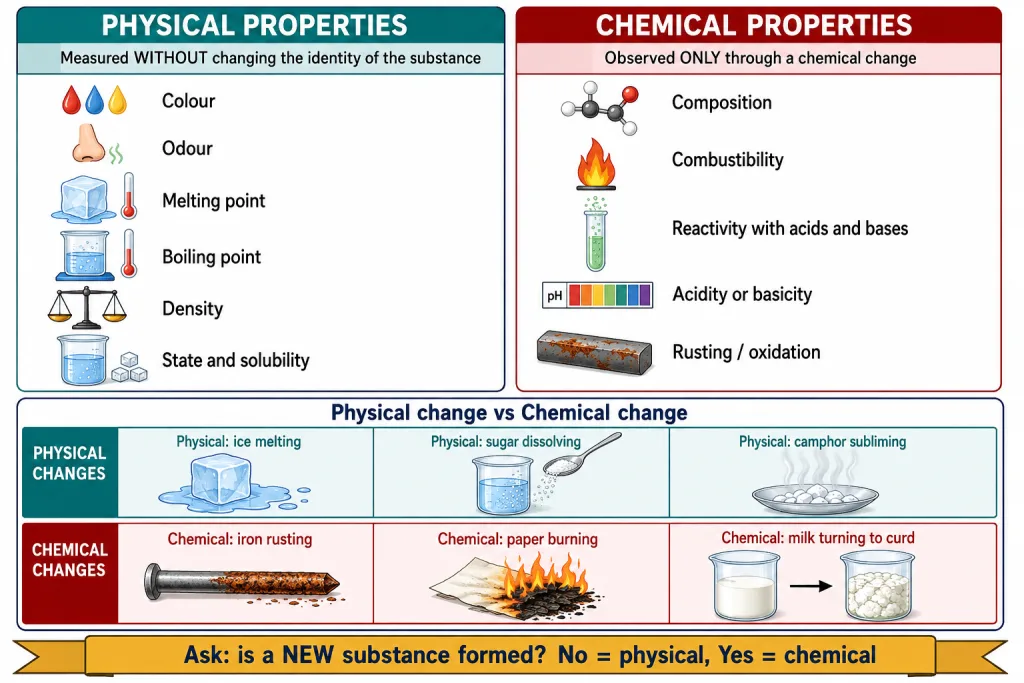
Key Point (Definition): Physical properties can be measured or observed without changing the identity or composition of the substance. Chemical properties are those whose measurement requires a chemical change.
| Physical properties | Chemical properties |
|---|---|
| Colour, odour, melting point, boiling point, density | Composition, combustibility, reactivity with acids and bases |
| State, solubility, hardness, conductivity, malleability | Acidity or basicity, oxidising/reducing tendency, toxicity, flammability |
| Measured without a chemical change | Measured only through a chemical change |
| Water boils at 100 °C at 1 atm, still water | Hydrogen is combustible; the test leaves water |
The "what is left?" test
Measure the property, then look at the sample. Same substance left: physical. New substance: chemical. Steam is still , so boiling point is physical; burning magnesium gives magnesium oxide, so combustibility is chemical.
Physical change versus chemical change
| Physical change | Chemical change |
|---|---|
| No new substance; only state, shape or size changes | New substances with new properties |
| Usually easily reversible | Usually not easily reversible |
| Little energy change | Definite energy change (heat, light) |
| Melting ice, boiling water, dissolving sugar, magnetising iron, sublimation of camphor, breaking glass | Rusting of iron, burning paper or fuel, curdling of milk, souring of sugarcane juice to vinegar, digestion, ripening of fruit, electrolysis of water |
Dissolving salt in water is physical (the salt returns on evaporation); dissolving zinc in hydrochloric acid is chemical (zinc chloride and hydrogen form). Cutting an apple is physical; its browning is chemical.
What chemists do with properties
Chemists describe, interpret and predict the behaviour of substances from these properties, found by careful measurement. Numbers and units come next.
Section 1 in one glance
| Concept | One line to remember |
|---|---|
| Chemistry | Preparation, properties, structure, reactions of substances; "science of atoms and molecules" |
| Drugs | Cisplatin, taxol (cancer); AZT (AIDS) |
| Materials | Superconducting ceramics, conducting polymers, optical fibres; CFC alternatives |
| India | Rasayan Shastra; Nagarjuna (Rasratnakar, mercury); Kanda (Paramanu, Vaiseshika Sutras, 600 BCE) |
| Matter | Mass and space; solid/liquid/gas; interconverted by temperature and pressure |
| Mixture | Variable composition, physical separation; homogeneous or heterogeneous |
| Pure substance | Fixed composition; element (one kind of atom) or compound (fixed ratio, new properties) |
| Physical vs chemical | Physical: identity unchanged; chemical: needs a chemical change |
Solved Examples
Question 1: Element, compound or mixture?
Classify each of the following as an element, a compound or a mixture: (i) sodium (ii) sea water (iii) glucose (iv) oxygen gas (v) brass (vi) ammonia (vii) air (viii) diamond.
Answer: I count the kinds of atoms. Sodium (Na), one kind: element. Oxygen gas (), a molecule of one kind of atom: element. Diamond, pure carbon: element.
Different atoms in a fixed ratio: glucose (), C : H : O = 6 : 12 : 6, and ammonia (), N : H = 1 : 3, are compounds.
Many kinds of particles in variable proportion: sea water (water plus dissolved salts), brass (copper and zinc; an alloy), air (, , Ar, , water vapour). All are homogeneous mixtures.
Ans: Elements: Na, , diamond. Compounds: glucose, ammonia. Mixtures: sea water, brass, air.
Question 2: Homogeneous or heterogeneous?
Sort the following into homogeneous and heterogeneous mixtures: (i) sugar solution (ii) a mixture of grains, pulses and stone pieces (iii) air (iv) muddy water (v) vinegar (vi) smoke (vii) 18-carat gold (viii) oil floating on water.
Answer: Homogeneous: sugar solution, air, vinegar (acetic acid dissolved in water), 18-carat gold (a uniform gold-copper-silver alloy).
Heterogeneous: grains, pulses and stones (stones can be hand-picked), muddy water (soil particles settle), smoke (carbon particles in air), oil on water (two layers).
Ans: Homogeneous: (i), (iii), (v), (vii). Heterogeneous: (ii), (iv), (vi), (viii).
Watch out: A homogeneous mixture can be solid, liquid or gas; the test is uniformity, not state.
Question 3: Physical or chemical property?
State whether each is a physical or a chemical property, with a one-line reason: (i) the density of mercury is 13.6 g (ii) sodium reacts vigorously with water (iii) iodine sublimes on gentle heating (iv) petrol is highly flammable (v) copper is a good conductor of electricity (vi) magnesium reacts with dilute HCl to give hydrogen.
Answer: (i) Physical: density is mass over volume; the mercury stays mercury. (ii) Chemical: ; new substances form. (iii) Physical: change of state; the vapour is still . (iv) Chemical: shown only by burning petrol to and . (v) Physical: conduction does not alter the copper. (vi) Chemical: magnesium is used up to form .
Ans: Physical: (i), (iii), (v). Chemical: (ii), (iv), (vi).
Watch out: Reacts, burns, corrodes, decomposes: chemical. A number measured on the untouched sample: physical.
Question 4: Why water does not behave like hydrogen or oxygen
Hydrogen burns with a pop, oxygen supports combustion, yet water is used to put out fires. Explain, and state what this tells you about compounds in general.
Answer: Water is a compound, not a mixture. In the hydrogen and oxygen atoms are chemically combined in a fixed 2 : 1 ratio, forming a new kind of particle.
Properties belong to particles. Water molecules are not hydrogen or oxygen molecules, so water need not inherit combustibility or support of combustion.
Water is also the product of burning hydrogen: . A fully oxidised substance cannot burn further, and as a liquid it cools the fire and cuts off oxygen.
A mixture of hydrogen and oxygen gases still explodes when lit, because mixing creates no new particles.
Ans: Water is a compound whose molecules are chemically new entities with their own properties; a compound's properties differ from those of its elements.
Question 5: Name the change of state
Name the process, and state whether heat is absorbed or released, for: (i) camphor disappearing from an open box (ii) dew forming on grass at night (iii) wax dripping from a lit candle (iv) water in an ice tray turning solid (v) frost forming on a cold window pane from water vapour.
Answer: (i) Sublimation: solid camphor goes directly to vapour. Heat absorbed. (ii) Condensation (liquefaction): water vapour becomes liquid on cooling. Heat released. (iii) Melting (fusion): solid wax becomes liquid near the flame. Heat absorbed. (iv) Freezing (solidification): liquid water becomes ice. Heat released. (v) Deposition: gas goes directly to solid, the reverse of sublimation. Heat released.
Ans: (i) sublimation, absorbed; (ii) condensation, released; (iii) melting, absorbed; (iv) freezing, released; (v) deposition, released.
Watch out: Solid to liquid to gas absorbs heat; the reverse releases it. Sublimation and deposition skip the liquid state.
Question 6: The role of pressure
LPG (mainly butane, boiling point about 0 °C at 1 atm) is stored as a liquid in a cylinder at room temperature. (i) How is this possible? (ii) Why does it emerge as a gas from the burner? (iii) Which two conditions, in general, are changed to interconvert the states of matter?
Answer: (i) High pressure. In the cylinder the gas is compressed to roughly 5 to 8 atm, pushing the butane molecules close enough to liquefy even at 25 to 30 °C. Raising pressure brings particles closer, as lowering temperature does.
(ii) Opening the valve drops the pressure to 1 atm. At room temperature, well above 0 °C, the liquid boils at once and gaseous butane flows to the burner.
(iii) Temperature and pressure.
Ans: LPG is liquefied by compression; releasing the pressure lets it vaporise; states are interconverted by changing temperature and pressure.
Watch out: Write both temperature and pressure, never temperature alone.
Question 7: Choosing a separation method
For each mixture, state whether it is homogeneous or heterogeneous, and name a suitable physical method to separate the components: (i) common salt dissolved in water (ii) sand mixed with water (iii) iron filings mixed with sulphur powder (iv) a mixture of ethanol and water (v) stone pieces in rice.
Answer: (i) Homogeneous. Evaporation or crystallisation: I evaporate the water and the salt crystals stay. Distillation if the water is also wanted. (ii) Heterogeneous. Filtration: sand stays on the paper. Sedimentation and decantation also work. (iii) Heterogeneous. Magnetic separation: a magnet lifts out the iron filings. Heated together they would have formed the compound FeS, which no magnet can separate. (iv) Homogeneous. Fractional distillation: ethanol boils at 78 °C, water at 100 °C. (v) Heterogeneous. Hand-picking.
Ans: (i) homogeneous, evaporation/crystallisation; (ii) heterogeneous, filtration; (iii) heterogeneous, magnetic separation; (iv) homogeneous, fractional distillation; (v) heterogeneous, hand-picking.
Question 8: Is air an element, a compound or a mixture?
Justify your classification of air with three pieces of evidence.
Answer: First, variable composition: water vapour, and dust in air change from place to place and day to day. A compound has a fixed composition.
Second, physical separation: air is liquefied by cooling under pressure, and , and Ar are separated by fractional distillation of liquid air, using their different boiling points. A compound cannot be separated this way.
Third, the components keep their properties: oxygen in air supports combustion as pure oxygen does, only more slowly because it is diluted. In a compound the constituents lose their properties.
Also, mixing nitrogen and oxygen involves no energy change, and air boils over a range, not at a sharp point.
Ans: Air is a homogeneous mixture of gases.
Question 9: Alloys and the "fixed ratio" trap
Brass contains about 60 to 90 % copper and the rest zinc; sodium chloride contains 39.3 % sodium and 60.7 % chlorine by mass in every sample. Which is a compound and which is a mixture? Give the reasoning.
Answer: Composition: brass has a range of compositions, chosen for the property wanted. NaCl has one composition in every sample.
Properties: brass is still metallic, still conducts, still copper-coloured. NaCl is nothing like soft metallic sodium or poisonous green chlorine.
Separation: copper and zinc can be separated physically (zinc boils at 907 °C and distils out of molten brass). Sodium and chlorine come out of NaCl only by electrolysis of the molten salt, a chemical method.
Ans: Sodium chloride is a compound; brass is a homogeneous mixture (a solid solution, an alloy).
Watch out: "Uniform" is not "fixed". A homogeneous mixture is uniform within one sample, but another sample can differ.
Question 10: Molecules of elements versus molecules of compounds
Classify each species as an atom of an element, a molecule of an element, or a molecule of a compound: He, , , , , , Fe, , .
Answer: Single atoms of an element: He (noble gases are monatomic), Fe (metals are a lattice of atoms).
Molecules of an element, several atoms of one kind: (2 O), (3 O; ozone is still oxygen), (8 S), (2 Cl).
Molecules of a compound, different atoms in a fixed ratio: , , .
Ans: Atoms of elements: He, Fe. Molecules of elements: , , , . Molecules of compounds: , , .
Watch out: and are both the element oxygen (allotropes).
Question 11: Kanda and Dalton
"Acharya Kanda proposed an atomic theory about 2500 years before Dalton." List three features of Kanda's Paramanu and state one way in which Kanda's idea and Dalton's theory agree.
Answer: Kanda (born 600 BCE, originally Kashyap) wrote the Vaiseshika Sutras; Dalton (1766–1844) published his theory in 1808, about 2500 years later.
Paramanu (any three): smallest indivisible particle of matter; eternal and indestructible; spherical; suprasensible (beyond the senses); in motion in its original state; different kinds for different substances; combine into pairs or triplets through unseen forces.
Agreement: both say matter is made of very small indivisible particles that differ between substances and combine in small whole-number groups. Dalton's "atoms are neither created nor destroyed" matches "eternal, indestructible".
Ans: Paramanu: indivisible, eternal/indestructible, spherical, suprasensible, in motion, of different kinds, combining in pairs and triplets. Agreement: matter consists of indivisible atoms that differ between substances and combine in small groups.
Watch out: Kanda's theory is philosophical; Dalton's is scientific, built on the laws of chemical combination.
Question 12: Is it matter?
Decide which of the following are matter, giving the reason: (i) chair (ii) air (iii) love (iv) smell of perfume (v) heat (vi) the moon (vii) a thought (viii) water vapour.
Answer: Matter has mass and occupies space; I test each against both.
Matter: chair; air (an inflated balloon weighs more than a deflated one, and air fills a container); the moon; water vapour (gaseous water, has mass and volume).
Smell of perfume: the smell is a sensation, but what reaches the nose is perfume molecules diffusing through air. They have mass and occupy space, so perfume vapour is matter. I write "the smell is due to perfume vapour, which is matter".
Not matter: love and a thought (no mass, no volume); heat (energy, no rest mass, no volume).
Ans: Matter: chair, air, moon, water vapour, perfume vapour. Not matter: love, thought, heat.
Watch out: Energy (heat, light, sound) is never matter. Anything that could in principle be put on a balance is.