Why Atoms Need a Relative Mass Scale
One hydrogen atom has a mass of about 1.67×10⁻²⁴ g. No balance can weigh a single atom, and such numbers are awkward to calculate with.
Chemistry does not need absolute atomic masses, only how heavy each atom is compared with a reference atom. The laws of chemical combination (Section 4) showed that oxygen is roughly 16 times heavier than hydrogen and carbon roughly 12 times, so chemists built a relative scale.
Hydrogen: the first standard
Hydrogen, the lightest atom, was assigned a mass of 1 (no units): carbon came out about 12, oxygen about 16, sodium about 23.
But hydrogen combines directly with few elements, so most masses came through chains of intermediate compounds and errors piled up. Oxygen (= 16) replaced it, but physicists used pure 16O while chemists used natural oxygen (a mixture of isotopes), giving two slightly different scales.
Carbon-12: the standard since 1961
In 1961 a single standard was agreed: the isotope carbon-12, 12C, assigned exactly 12 atomic mass units.
Key Point (Definition): One atomic mass unit is a mass exactly equal to one-twelfth of the mass of one carbon-12 atom.
1 u=121×(mass of one 12C atom)=1.66056×10⁻²⁴ g
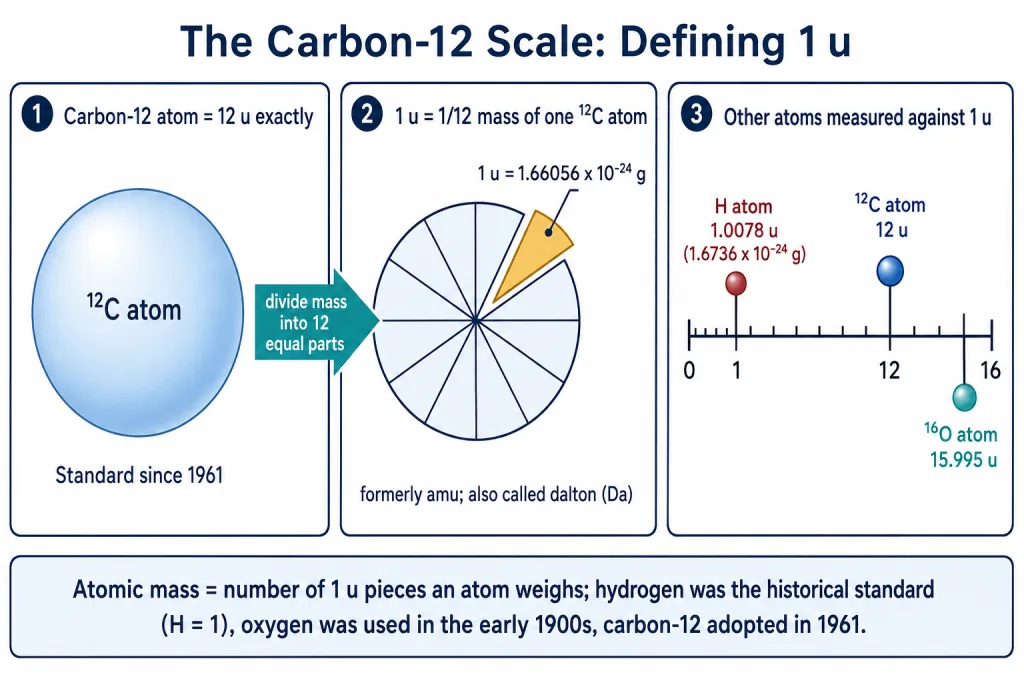
Hydrogen and oxygen on the new scale
The absolute mass of a hydrogen atom is 1.6736×10⁻²⁴ g:
Mass of H atom=1.66056×10⁻²⁴ g per u1.6736×10−24 g=1.0078 u≈1.0080 u
An oxygen-16 atom is 15.995 u, close to but not exactly 16. The deviation comes from nuclear binding energy, and it is why the old oxygen = 16 scale and the carbon-12 scale do not coincide exactly.
amu becomes u
The older abbreviation amu has been replaced by u, the unified mass unit. The value is identical. Biochemistry also uses the dalton (Da): 1 Da = 1 u.
[Board] For "define atomic mass unit", give the one-twelfth-of-carbon-12 definition and the value 1.66056×10⁻²⁴ g. Both carry marks.
Modern atomic masses are measured by mass spectrometry, which separates ions by mass-to-charge ratio. Only the name is needed at this level.
Working Between Grams and u
Converting between grams and u is ordinary factor-label conversion (Section 3).
1 u=1.66056×10⁻²⁴ g⟺1 g=1.66056×10−241 u=6.022×10²³ u
The second number is the Avogadro number: since 12C is exactly 12 u, 12 g of carbon-12 contains 12 g÷(12×1.66056×10−24 g)=6.022×10²³ atoms. Section 6 builds the mole on this.
The two conversions
| Task |
Recipe |
Example |
| g to u |
divide by 1.66056×10⁻²⁴ |
H atom: 1.66056×10−241.6736×10−24=1.0078 u |
| u to g |
multiply by 1.66056×10⁻²⁴ |
12C atom: 12×1.66056×10−24=1.9927×10⁻²³ g |
Key Point: The mass of a single atom in grams is always of the order 10−24 to 10−22 g. Any other exponent means a slip.
Atomic mass versus mass number
| Quantity |
What it is |
Units |
Chlorine-35 |
| Mass number (A) |
Protons + neutrons, a count |
none (integer) |
35 |
| Atomic mass of the isotope |
Measured mass relative to 12C |
u |
34.9689 u |
| Average atomic mass of the element |
Abundance-weighted mean over isotopes |
u |
35.45 u (natural Cl) |
The mass number is a whole number. The isotope's atomic mass is close to it but not equal (except 12C, exactly 12 by definition). The average can be far from any integer, as with chlorine's 35.45.
An unqualified "atomic mass" in a question means the periodic-table (average) value; 35Cl or 16O means that isotope.
Why periodic-table atomic masses are not integers
C 12.011, Cl 35.45, Cu 63.55, Ar 39.95: none is a whole number, for two reasons.
- Isotopes. Most elements are mixtures of isotopes; the table shows the weighted average (next block).
- Nuclear binding energy. Even a pure isotope such as 16O (15.995 u) or 1H (1.0078 u) is not an integer, because a nucleus has slightly less mass than its separate protons and neutrons (mass defect). This small effect belongs to nuclear physics; here you calculate with isotopes.
Average Atomic Mass
Isotopes are atoms of the same element (same protons) with different numbers of neutrons and so different masses. Natural carbon is mostly 12C with a little 13C and a trace of 14C. A lab sample is this mixture, so the useful atomic mass is the abundance-weighted average.
Key Point (Definition): The average atomic mass of an element is the mean of the masses of its naturally occurring isotopes, each weighted by its relative abundance (per cent occurrence):
mˉ=i∑(fractional abundance)i×(isotopic mass)i=100∑i(% abundance)i×mi
Carbon
| Isotope |
Relative abundance (%) |
Atomic mass (u) |
| 12C |
98.892 |
12 (exactly) |
| 13C |
1.108 |
13.00335 |
| 14C |
2×10⁻¹⁰ |
14.00317 |
mˉC=(0.98892)(12 u)+(0.01108)(13.00335 u)+(2×10⁻¹²)(14.00317 u)
=11.86704 u+0.14408 u+(≈3×10⁻¹¹ u)=12.011 u
The 14C term changes nothing. No single carbon atom has mass 12.011 u; each is 12 u or 13.00335 u (rarely 14.00317 u). The number describes the population.
Chlorine
| Isotope |
Natural abundance (%) |
Isotopic mass (u) |
| 35Cl |
75.77 |
34.9689 |
| 37Cl |
24.23 |
36.9659 |
mˉCl=(0.7577)(34.9689)+(0.2423)(36.9659)=26.4959+8.9568=35.4527≈35.45 u
Hence 35.45 (or 35.5) for chlorine. Three atoms in four are the lighter isotope, so the average sits three-quarters of the way from 37 down to 35.
Argon
| Isotope |
Isotopic molar mass (g mol−1) |
Abundance (%) |
| 36Ar |
35.96755 |
0.337 |
| 38Ar |
37.96272 |
0.063 |
| 40Ar |
39.9624 |
99.600 |
MˉAr=(0.00337)(35.96755)+(0.00063)(37.96272)+(0.99600)(39.9624)=0.1212+0.0239+39.8025=39.948≈39.95 g mol−1
Masses in g mol−1 give the same arithmetic: molar mass in g mol−1 equals atomic mass in u numerically (Section 6).
Key Point: Periodic-table atomic masses are average atomic masses: the abundance-weighted average of the isotopic masses relative to 12C=12 u.
Average Atomic Mass: Checks, Shortcuts and Reverse Problems
The forward problem (abundances and masses given, find the average) is arithmetic. Reverse problems need one formula and two checks.
Check 1: the average lies between the extremes
A weighted average cannot exceed the heaviest isotope or fall below the lightest. Chlorine's 35.45 lies between 34.97 and 36.97. An answer outside the range means a wrong percentage.
Check 2: the average leans towards the abundant isotope
Chlorine is 75.77% 35Cl, so the average must sit closer to 35: 35.45 is 0.48 above 34.97 but 1.52 below 36.97. This eliminates wrong MCQ options fast.
For two isotopes of masses m1 and m2, with the lighter at fractional abundance x and the heavier at (1−x):
mˉ=xm1+(1−x)m2⟹x=m2−m1m2−mˉ
Read it as: the distance of the average from the heavy isotope, as a fraction of the gap between the isotopes.
Boron: 10B 10.01 u, 11B 11.01 u, average 10.81 u.
x10B=11.01−10.0111.01−10.81=1.000.20=0.20
So boron is 20% 10B and 80% 11B; 10.81 does sit much closer to 11.
[JEE Main] Reverse problems often use mass numbers instead of exact isotopic masses (35 and 37 for chlorine, giving x=(37−35.5)/2=0.75). Use the numbers given.
Abundance as a ratio
If x=0.75 for 35Cl, then 35Cl:37Cl=0.75:0.25=3:1. Boron: 10B:11B=1:4.
Three isotopes with one unknown
If two abundances are given, the third is 100%−(sum of the other two); then it is a forward problem. If two are unknown, the question supplies another relation (such as a ratio between them).
Mass spectrometry
A mass spectrometer vaporises and ionises the sample, accelerates the ions and bends their paths with a magnetic field. Heavier ions bend less, so each isotope lands at a different spot on the detector, and each peak's height is proportional to that isotope's abundance. The average atomic mass is computed from the spectrum with the formula above.
Key Point: Forward problem: average =∑(fraction×mass). Reverse problem (two isotopes): x=m2−m1m2−mˉ. Check that the answer lies between the isotopic masses and leans towards the abundant one.
Molecular Mass
Key Point (Definition): Molecular mass is the sum of the atomic masses of the elements present in a molecule: multiply the atomic mass of each element by the number of its atoms in the molecule and add.
Read the atom counts from the formula, look up each (average) atomic mass, multiply, add.
Methane, water and glucose
CH4: one C, four H.
M(CH4)=(12.011 u)+4(1.008 u)=12.011+4.032=16.043 u
H2O: two H, one O.
M(H2O)=2(1.008 u)+16.00 u=2.016+16.00=18.02 u
C6H12O6: six C, twelve H, six O.
M(C6H12O6)=6(12.011 u)+12(1.008 u)+6(16.00 u)
=72.066 u+12.096 u+96.00 u=180.162 u
Errors come from counting atoms, especially with brackets and hydrates.
| Formula |
Atoms |
Molecular mass (u) |
| NH3 |
N 1, H 3 |
14.01+3(1.008)=17.03 |
| CO2 |
C 1, O 2 |
12.011+2(16.00)=44.01 |
| C2H5OH |
C 2, H 6, O 1 |
2(12.011)+6(1.008)+16.00=46.07 |
| H2SO4 |
H 2, S 1, O 4 |
2(1.008)+32.1+4(16.00)=98.1 |
| Ca(OH)2 |
Ca 1, O 2, H 2 |
40.1+2(16.00)+2(1.008)=74.1 |
| CuSO4⋅5H2O |
Cu 1, S 1, O 9, H 10 |
63.5+32.1+9(16.00)+10(1.008)=249.7 |
The bracket in Ca(OH)2 multiplies everything inside by 2. The dot in CuSO4⋅5H2O adds five water molecules (ten H, five O); it does not multiply.
Which atomic masses to use
H = 1.008, C = 12.011, O = 16.00 give 16.043 u for methane and 180.162 u for glucose. Exam questions usually round: H = 1, C = 12, N = 14, O = 16, Na = 23, S = 32, Cl = 35.5, giving 16, 18 and 180. Use the values given; otherwise the rounded set for JEE and NEET, the three-decimal values for board answers.
Molecular mass of glucose = 180 u is the mass of one molecule; molar mass = 180 g mol−1 is the mass of one mole (Section 6). Same number, different meaning.
[JEE Main] For a hydrocarbon CxHy with integer atomic masses, the molecular mass is 12x+y; this backs out x and y quickly (used again in Section 7).
Molecular mass assumes discrete molecules: one methane molecule is a carbon bonded to four hydrogens and nothing else. Not every substance is like that.
Sodium chloride has no molecules
In solid NaCl, Na+ and Cl− ions are packed in a three-dimensional lattice that extends to the edge of the crystal. Each Na+ is surrounded by six Cl− and each Cl− by six Na+ (6:6 coordination). No chlorine belongs to a particular sodium, so there is no Na–Cl pair to call a molecule.
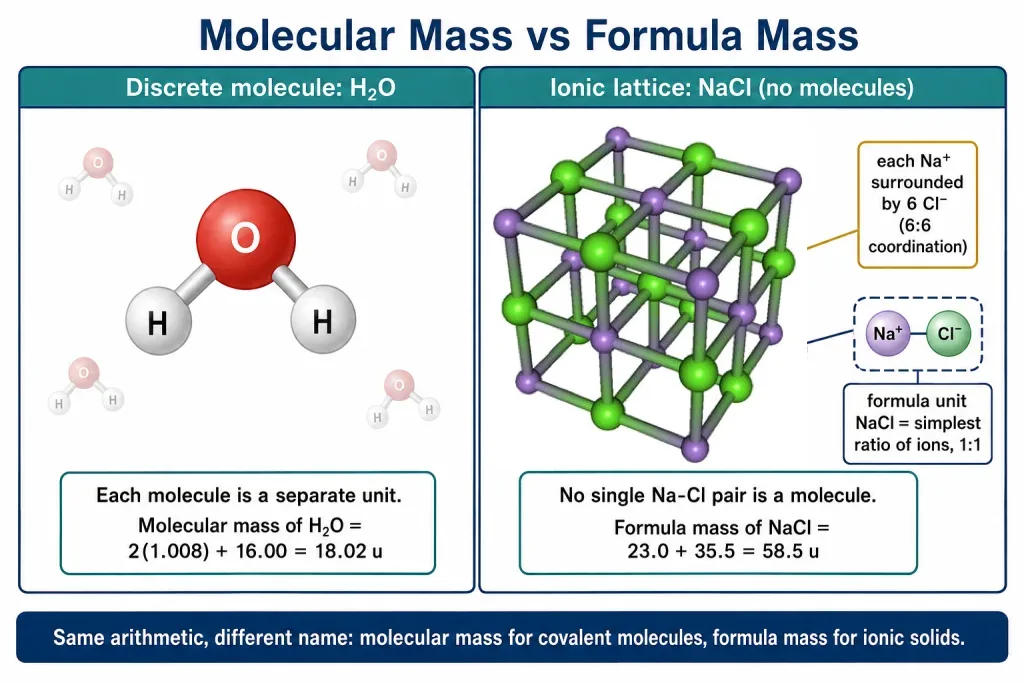
The formula NaCl gives the simplest whole-number ratio of ions, one Na+ per Cl−, which keeps the crystal neutral. This ratio is a formula unit.
Key Point (Definition): For substances without discrete molecules (ionic compounds such as NaCl, CaCl2, Na2SO4; also network solids like SiO2), we calculate the formula mass instead of the molecular mass: the sum of the atomic masses of all atoms in one formula unit.
Formula mass of NaCl=atomic mass of Na+atomic mass of Cl=23.0 u+35.5 u=58.5 u
Same arithmetic, different meaning
|
Molecular mass |
Formula mass |
| Applies to |
Covalent substances of discrete molecules (H2O, CH4, C6H12O6, CO2) |
Ionic and network solids (NaCl, KNO3, MgO, SiO2) |
| Unit weighed |
One molecule |
One formula unit (simplest ion ratio) |
| Calculation |
Sum of atomic masses in the molecular formula |
Sum of atomic masses in the formula-unit (empirical) formula |
| Example |
H2O: 18.02 u |
NaCl: 58.5 u |
| One mole contains |
6.022×10²³ molecules |
6.022×10²³ formula units |
"Molecular mass of NaCl" is loose usage; in a board answer write formula mass for ionic compounds.
| Compound |
Ions in one formula unit |
Formula mass (u) |
| NaCl |
1 Na++1 Cl− |
23.0+35.5=58.5 |
| MgO |
1 Mg2++1 O2− |
24.3+16.0=40.3 |
| CaCl2 |
1 Ca2++2 Cl− |
40.1+2(35.5)=111.1 |
| KNO3 |
1 K++1 NO3− |
39.1+14.0+3(16.0)=101.1 |
| Na2SO4 |
2 Na++1 SO42− |
2(23.0)+32.1+4(16.0)=142.1 |
| Al2(SO4)3 |
2 Al3++3 SO42− |
2(27.0)+3(32.1)+12(16.0)=342.3 |
[Board] "Why formula mass rather than molecular mass for sodium chloride?" (1) Solid NaCl has no discrete entity; its ions form a three-dimensional lattice, each surrounded by six of opposite charge. (2) So NaCl gives only the simplest ion ratio (the formula unit), whose mass is the formula mass, 58.5 u.
Both quantities are in u and both become molar mass in g mol−1 with the same number; stoichiometry (Sections 6 to 9) treats them identically.
The section in one table
| Term |
Meaning |
Value / example |
| 1 u |
121 mass of one 12C atom |
1.66056×10⁻²⁴ g |
| Atomic mass (of an isotope) |
Mass of one atom relative to 12C=12 u |
1H 1.0078 u; 16O 15.995 u |
| Average atomic mass |
Abundance-weighted mean over isotopes |
C 12.011 u; Cl 35.45 u; Ar 39.95 u |
| Molecular mass |
Sum of atomic masses in one molecule |
CH4 16.043 u; H2O 18.02 u; glucose 180.162 u |
| Formula mass |
Sum of atomic masses in one formula unit (ionic/network solids) |
NaCl 58.5 u |
Solved Examples
Question 1: From grams to u — the hydrogen atom
The mass of one hydrogen atom is 1.6736×10⁻²⁴ g. Express this in unified mass units, given 1 u =1.66056×10⁻²⁴ g.
Answer:
The factor taking grams to u is 1.66056×10⁻²⁴ g1 u, so
mH=1.6736×10−24 g×1.66056×10−24 g1 u=1.660561.6736 u
The powers of ten cancel: 1.6736÷1.66056=1.00785≈1.0078 u.
Ans: 1.0078 u (usually rounded to 1.0080 u).
Question 2: From u to grams — the oxygen-16 atom
The atomic mass of 16O is 15.995 u. What is the mass of one 16O atom in grams?
Answer:
From u to grams I multiply by the mass of 1 u:
m(16O)=15.995 u×1.66056×10−24 g u−1=26.561×10⁻²⁴ g
In proper notation, 26.561×10−24=2.6561×10⁻²³ g. The exponent −23 is in the expected 10−24 to 10−22 range for one atom.
Ans: 2.656×10⁻²³ g.
Watch out: Keep one non-zero digit before the decimal point; 26.56×10⁻²⁴ loses marks.
Question 3: Why the choice of standard matters
On the old hydrogen scale, hydrogen was assigned exactly 1. On that scale, what would be the relative mass of a 12C atom? Use m(1H)=1.0078 u on the carbon-12 scale.
Answer:
A relative scale only fixes ratios, and the ratio of a 12C atom to a 1H atom does not depend on the scale: 1.0078 u12 u=11.907.
If hydrogen is exactly 1, carbon-12 is 11.907×1=11.907.
Every atomic mass is rescaled by the same factor 1/1.0078≈0.9923; oxygen-16 would become 15.995/1.0078=15.871.
Ans: About 11.907 on the hydrogen = 1 scale.
Question 4: Average atomic mass of carbon
Natural carbon contains 98.892% 12C (12 u), 1.108% 13C (13.00335 u) and 2×10⁻¹⁰% 14C (14.00317 u). Calculate the average atomic mass of carbon.
Answer:
I turn the percentages into fractions (0.98892, 0.01108, 2×10⁻¹²) and multiply each by its isotopic mass:
- 0.98892×12=11.86704 u
- 0.01108×13.00335=0.14408 u
- 2×10−12×14.00317≈2.8×10⁻¹¹ u (negligible)
Sum: 11.86704+0.14408+0.00000=12.01112 u, rounded to 12.011 u for five-figure data.
Ans: 12.011 u.
Watch out: Forgetting the ÷100 gives 1201 u.
Question 5: Average atomic mass of chlorine
Calculate the average atomic mass of chlorine from: 35Cl, 75.77%, 34.9689 u; 37Cl, 24.23%, 36.9659 u.
Answer:
The abundances add to 75.77+24.23=100.00. I weight each mass:
- 0.7577×34.9689=26.4959 u
- 0.2423×36.9659=8.9568 u
Sum: 26.4959+8.9568=35.4527 u. This lies between 34.97 and 36.97, and closer to 35Cl, which is three times as abundant.
Ans: 35.45 u (35.4527 u before rounding). This is the "35.5" for chlorine: a population average, not the mass of any atom.
Question 6: Molar mass of natural argon
Calculate the molar mass of naturally occurring argon from: 36Ar, 35.96755 g mol−1, 0.337%; 38Ar, 37.96272 g mol−1, 0.063%; 40Ar, 39.9624 g mol−1, 99.600%.
Answer:
The abundances add to 0.337+0.063+99.600=100.000%. Fractions times masses:
- 0.00337×35.96755=0.12121
- 0.00063×37.96272=0.02392
- 0.99600×39.9624=39.80255
Sum: 0.12121+0.02392+39.80255=39.94768 g mol−1.
The data were molar masses, so this is the molar mass of natural argon; numerically it equals the average atomic mass in u. With one isotope at 99.6%, the average is almost that isotope's mass.
Ans: 39.95 g mol−1 (average atomic mass 39.95 u).
Question 7: Reverse problem — finding isotopic abundance (boron)
Boron has two isotopes, 10B (10.01 u) and 11B (11.01 u). Its average atomic mass is 10.81 u. Find the percentage abundance of each isotope.
Answer:
Let the fraction of 10B be x, so 11B is (1−x):
10.01x+11.01(1−x)=10.81
10.01x+11.01−11.01x=10.81⇒−1.00x=10.81−11.01=−0.20⇒x=0.20.
So 10B is 20% and 11B is 100−20=80%.
Check: 0.20×10.01+0.80×11.01=2.002+8.808=10.81 u.
The shortcut x=m2−m1m2−mˉ=(11.01−10.81)/(11.01−10.01)=0.20 does it in one step.
Ans: 20% 10B and 80% 11B (ratio 1:4).
Question 8: A JEE-style reverse problem with less friendly numbers (silver)
Silver consists of 107Ag (106.905 u) and 109Ag (108.905 u). If the average atomic mass of silver is 107.868 u, calculate the percentage of 107Ag, and express the abundance ratio 107Ag:109Ag in its simplest approximate form.
Answer:
With m1=106.905, m2=108.905, mˉ=107.868:
x107=m2−m1m2−mˉ=108.905−106.905108.905−107.868=2.0001.037=0.5185
So 107Ag≈51.85%, 109Ag≈48.15%, and the ratio 51.85:48.15≈1.077:1, roughly 13:12.
Check: the midpoint of the masses is 107.905; the average is 0.037 below it, so the lighter isotope should be slightly more abundant. It is.
Ans: 107Ag≈51.85%, 109Ag≈48.15%; ratio ≈13:12 (or 1.08:1).
Watch out: Denominator: gap between the isotopic masses. Numerator: gap between the heavy isotope and the average.
Question 9: Molecular masses of methane, water and glucose
Using H = 1.008 u, C = 12.011 u and O = 16.00 u, calculate the molecular masses of (i) CH4, (ii) H2O, (iii) C6H12O6.
Answer:
One C, four H:
M(CH4)=12.011+4(1.008)=12.011+4.032=16.043 u
Two H, one O:
M(H2O)=2(1.008)+16.00=2.016+16.00=18.016≈18.02 u
Six C, twelve H, six O:
M(C6H12O6)=6(12.011)+12(1.008)+6(16.00)=72.066+12.096+96.00=180.162 u
Check: glucose is 6×CH2O (12.011+2.016+16.00=30.027 u), and 6×30.027=180.162 u.
Ans: (i) 16.043 u; (ii) 18.02 u; (iii) 180.162 u.
Question 10: Molecular masses with brackets and hydrates
Calculate the molecular mass of (i) NH3, (ii) Ca(OH)2, (iii) CuSO4⋅5H2O. Use H = 1.008, N = 14.01, O = 16.00, S = 32.1, Ca = 40.1, Cu = 63.5 (all in u).
Answer:
NH3: 14.01+3(1.008)=14.01+3.024=17.034≈17.03 u.
Ca(OH)2: the bracket doubles everything inside, so Ca 1, O 2, H 2.
40.1+2(16.00)+2(1.008)=40.1+32.00+2.016=74.116≈74.1 u
CuSO4⋅5H2O: the dot adds five waters, so Cu 1, S 1, O 4+5=9, H 5×2=10.
63.5+32.1+9(16.00)+10(1.008)=63.5+32.1+144.0+10.08=249.68≈249.7 u
Or M(CuSO4)+5M(H2O)=159.6+5(18.016)=159.6+90.08=249.7 u.
Ans: (i) 17.03 u; (ii) 74.1 u; (iii) 249.7 u.
Watch out: Brackets multiply, dots add. Strictly (ii) and (iii) are ionic, so call these formula masses in a board answer.
Question 11: Formula masses of ionic compounds
Calculate the formula mass of (i) NaCl, (ii) CaCl2, (iii) Na2SO4, (iv) Al2(SO4)3. Use Na = 23.0, Cl = 35.5, Ca = 40.1, S = 32.1, O = 16.0, Al = 27.0 (u). Why is the term "formula mass" used here rather than "molecular mass"?
Answer:
These are ionic solids: the ions form a three-dimensional lattice with no discrete molecules (in NaCl each ion has six neighbours of opposite charge). The formula is only the simplest ion ratio, the formula unit, so I find the mass of a formula unit.
NaCl: 23.0+35.5=58.5 u.
CaCl2 (Ca2+, two Cl−): 40.1+2(35.5)=40.1+71.0=111.1 u.
Na2SO4 (two Na+, one SO42−): 2(23.0)+32.1+4(16.0)=46.0+32.1+64.0=142.1 u.
Al2(SO4)3 (two Al3+, three SO42−; Al 2, S 3, O 12):
2(27.0)+3(32.1)+12(16.0)=54.0+96.3+192.0=342.3 u
Ans: (i) 58.5 u; (ii) 111.1 u; (iii) 142.1 u; (iv) 342.3 u.
Watch out: In Al2(SO4)3 the 3 outside the bracket multiplies the S and all four O: 12 oxygens, not 4.
Question 12: Mass of one 12C atom, and counting atoms by mass
(i) What is the mass of one 12C atom in grams? (ii) How many atoms are there in 52 u of helium (He = 4 u)? (iii) How many water molecules are there in 180.2 u of water? (iv) How many atoms are there in 52 moles of argon and in 52 g of helium? (Take NA=6.022×10²³ mol−1.)
Answer:
(i) One 12C atom is exactly 12 u:
m(12C)=12×1.66056×10−24 g=19.927×10⁻²⁴ g=1.9927×10⁻²³ g
Check: 12 g÷6.022×1023=1.9927×10⁻²³ g.
(ii) One He atom is 4 u: 4 u per atom52 u=13 atoms. No Avogadro number here.
(iii) One H2O is 18.02 u: 18.02180.2=10 molecules.
(iv) 52 mol Ar: 52×6.022×1023=3.131×1025 atoms. 52 g He: 52/4=13 mol, so 13×6.022×1023=7.829×1024 atoms.
Ans: (i) 1.9927×10⁻²³ g; (ii) 13 atoms; (iii) 10 molecules; (iv) 3.131×1025 atoms of Ar and 7.829×1024 atoms of He.
Watch out: "52 u of He" and "52 g of He" differ by a factor of 6.022×10²³. Read the unit first.
