
Scientific Notation
Two grams of hydrogen gas contain about 602,200,000,000,000,000,000,000 molecules. One hydrogen atom has a mass of about 0.00000000000000000000000166 g. Arithmetic with such numbers is slow and it is easy to lose a zero. Scientific notation (exponential notation) fixes this.
Key Point (Definition): In scientific notation any number is written as , where is the digit term, a number between 1.000… and 9.999…, and is an exponent, a positive or negative integer.
Converting to scientific notation
Move the decimal point until one non-zero digit sits to its left. The number of places moved is the exponent: left gives a positive exponent, right gives a negative one.
- (two places left, )
- (four places right, )
| Number | Decimal moved | Scientific notation |
|---|---|---|
| 602,200,000,000,000,000,000,000 | 23 places left | |
| 232.508 | 2 places left | |
| 6.0012 | 0 places | |
| 0.00016 | 4 places right | |
| 0.00000000000000000000000166 | 24 places right |
The digit term must lie between 1 and 10. is not scientific notation; normalise it to .
Multiplication and division
Multiply (or divide) the digit terms and add (or subtract) the exponents. Re-normalise if the digit term leaves the range 1 to 10.
In the last step the digit term shrinks by 10 and the exponent grows by 1 (or the reverse). The value does not change.
Addition and subtraction
Rewrite both numbers with the same exponent, then add or subtract the digit terms:
Key Point: Multiply/divide: combine digit terms, add/subtract exponents. Add/subtract: equalise exponents first, then combine digit terms. Check that the digit term ends between 1 and 10.
[JEE Main] Most "off by a factor of 10" errors happen while re-normalising. Decimal one place left, exponent up by one; one place right, exponent down by one.
Significant Figures
Every measurement carries uncertainty, set by the instrument and the person using it. A platform balance gives 9.4 g; an analytical balance gives 9.4213 g for the same object. In 9.4 the 4 is uncertain; in 9.4213 the final 3 is. The number of digits written shows the uncertainty.
Key Point (Definition): Significant figures are the meaningful digits in a measured or calculated quantity: the digits known with certainty plus one last digit that is estimated or uncertain.
In 11.2 mL the "11" is certain and the "2" is uncertain. Unless stated otherwise the uncertainty is in the last digit, so the true volume lies between 11.1 mL and 11.3 mL. Writing 11.20 mL would claim a hundredths place that a burette reading to 0.1 mL cannot give.
[NEET] "What do you mean by significant figures?" is a direct definition question. Give the definition with the 11.2 mL example.
The five rules for counting significant figures
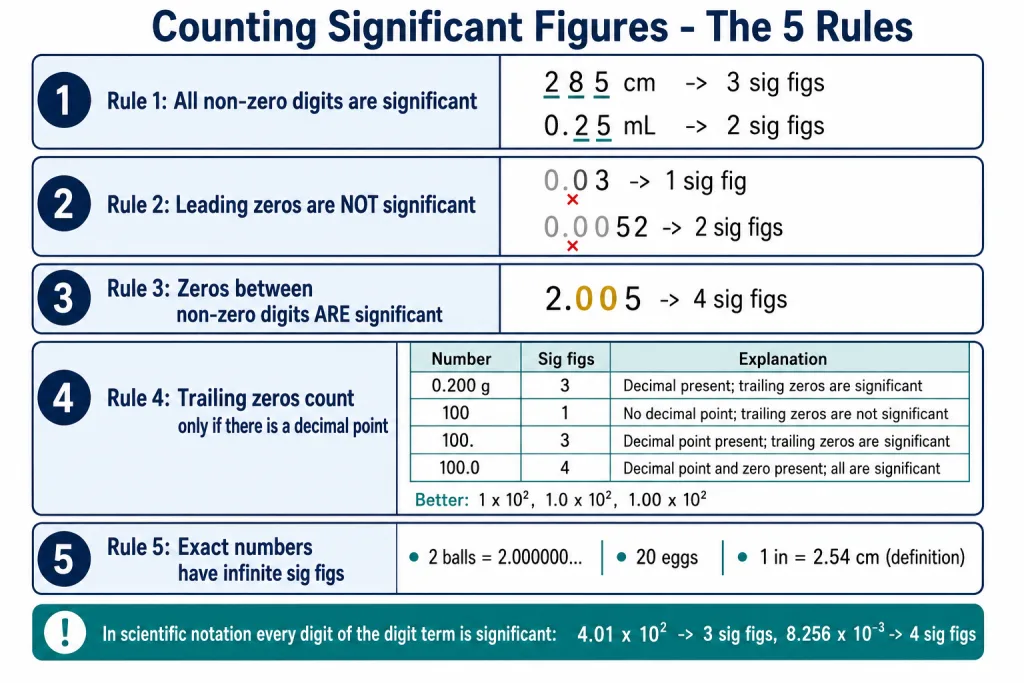
| Rule | Statement | Examples |
|---|---|---|
| 1 | All non-zero digits are significant. | 285 cm has 3; 0.25 mL has 2 |
| 2 | Leading zeros (before the first non-zero digit) are not significant; they only fix the decimal point. | 0.03 has 1; 0.0052 has 2 |
| 3 | Captive zeros (between two non-zero digits) are significant. | 2.005 has 4; 5005 has 4 |
| 4 | Trailing zeros are significant only to the right of a decimal point. Without a decimal point they are ambiguous and treated as not significant. | 0.200 g has 3; 100 has 1; 100. has 3; 100.0 has 4 |
| 5 | Exact numbers (counted objects and defined quantities) have infinite significant figures. | 2 balls, 20 eggs, "1 in = 2.54 cm" (definition) |
Rule 4 causes the most errors. A bare 100 could mean "between 50 and 150" or "between 99.5 and 100.5". Scientific notation removes the ambiguity:
| Intended precision | Write it as | Significant figures |
|---|---|---|
| Roughly a hundred | 1 | |
| A hundred, to the nearest ten | 2 | |
| A hundred, to the nearest unit | 3 | |
| A hundred, to the nearest tenth | 4 |
Key Point: In scientific notation all digits of the digit term are significant: has three, has four. The power of ten carries none.
Exact numbers
The 2 in "2 moles of hydrogen per mole of oxygen" comes from a balanced equation. It is exactly 2.000000… and never limits the significant figures of an answer. Definitions such as 1 km = 1000 m, 1 day = 24 h and 1 in = 2.54 cm are exact too. Only measured quantities carry uncertainty.
Quick count: write the number in scientific notation and count the digit-term digits. 0.004500 is , four. 120,000 is ambiguous; assume , two.
Precision versus Accuracy
In the laboratory these two words mean different, independent things.
Key Point (Definition): Precision is the closeness of various measurements of the same quantity to one another. Accuracy is the agreement of a particular value with the true value of the result.
Precision is reproducibility: the same answer every time. Accuracy is correctness: that answer being the right one. A stopped clock is perfectly precise and almost always inaccurate.
The three-student experiment
The true mass of an object is 2.00 g. Three students each weigh it twice.
| Student | Measurement 1 (g) | Measurement 2 (g) | Average (g) | Precise? | Accurate? |
|---|---|---|---|---|---|
| A | 1.95 | 1.93 | 1.940 | Yes | No |
| B | 1.94 | 2.05 | 1.995 | No | No |
| C | 2.01 | 1.99 | 2.000 | Yes | Yes |
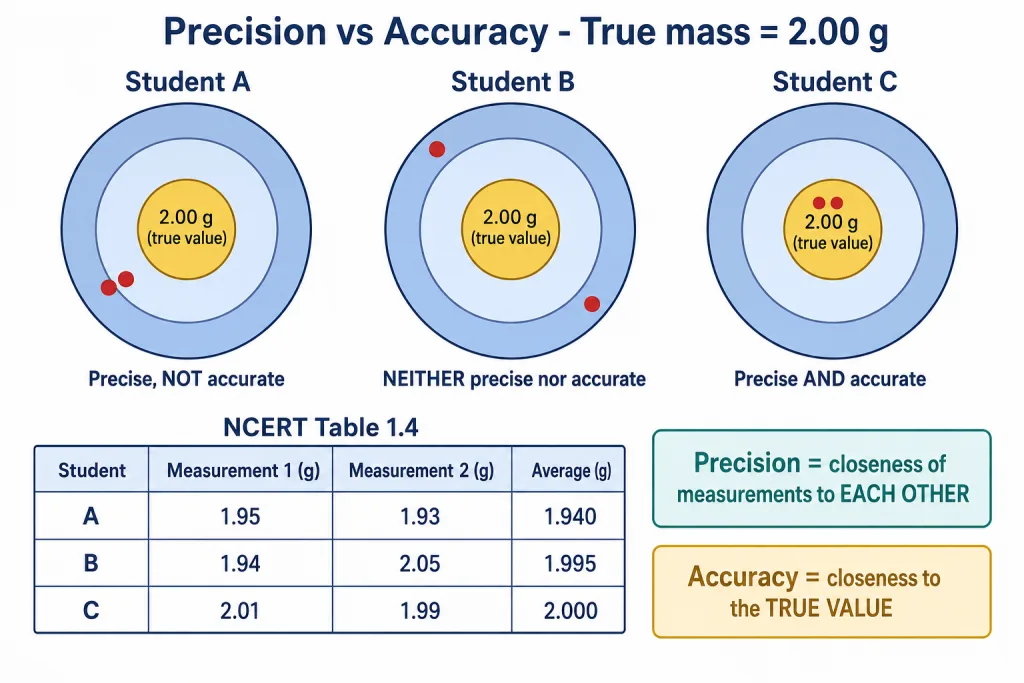
- Student A: readings 0.02 g apart, so precise. Both well below 2.00 g, so not accurate. This is the sign of a systematic error (mis-zeroed balance, wet sample, wrong calibration). Repeating does not help; the cause must be fixed.
- Student B: readings 0.11 g apart, so not precise, and neither dependably close to 2.00 g, so not accurate. B's average (1.995 g) is closer to the true value than A's, but that is one high and one low reading cancelling by chance. Averaging noise is not accuracy.
- Student C: readings within 0.02 g of each other and close to 2.00 g. Precise and accurate.
The four possibilities
| Close to true value | Far from true value | |
|---|---|---|
| Readings cluster tightly | Precise and accurate (C) | Precise, not accurate (A) |
| Readings scattered | Accurate on average but not precise (rare, unreliable) | Neither (B) |
Key Point: Precision says nothing about accuracy, and accuracy of a single reading says nothing about precision. A measurement can be one, both, or neither.
Link to significant figures
Significant figures encode precision. A balance reading 9.4213 g is more precise than one reading 9.4 g, but if it is badly calibrated it can still be 0.3 g off: precise, not accurate. Significant figures never tell you about accuracy.
[Board] "Distinguish between precision and accuracy with an example" is a standard 2-mark question. Give both definitions, then the table with the verdicts on A, B and C.
Significant Figures in Calculations and Rounding Off
A calculated result cannot be more certain than the least certain measurement that went into it. Two different rules enforce this.
Addition and subtraction: count decimal places
Key Point: In addition or subtraction the result cannot have more digits to the right of the decimal point than the original number with the fewest decimal places.
18.0 has one decimal place, so the sum is reported to one: 31.1. The uncertainty in 18.0 swamps the hundredths and thousandths from 12.11 and 1.012. Compare decimal places, not significant figures.
Multiplication and division: count significant figures
Key Point: In multiplication or division the result must have no more significant figures than the measurement with the fewest significant figures.
2.5 has two significant figures, 1.25 has three. The answer is limited to two: 3.1.
| Operation | What you compare | Governing quantity | Example | Reported answer |
|---|---|---|---|---|
| Addition / subtraction | Digits after the decimal point | Fewest decimal places | 31.1 | |
| Multiplication / division | Total significant figures | Fewest significant figures | 3.1 |
[JEE Main] In a multi-step problem carry one or two extra digits through the intermediate steps and round only at the end.
The three rules of rounding off
Look at the first digit being removed:
| Rule | Digit being removed | Action | Example |
|---|---|---|---|
| 1 | Greater than 5 | Increase the preceding digit by one | |
| 2 | Less than 5 | Leave the preceding digit unchanged | |
| 3 | Exactly 5 | Round to even: leave the preceding digit unchanged if it is even, increase it by one if it is odd | (3 is odd, goes up); (2 is even, stays) |
A 5 is exactly halfway. Always rounding it up would bias a long calculation upward; round-to-even sends half the fives up and half down. This is sometimes called banker's rounding.
Two clarifications:
- Rule 3 applies only when the digit removed is exactly 5 with nothing (or only zeros) after it. 6.351 is more than halfway, so rule 1 applies: .
- Rounding 2808 to three significant figures gives 2810, whose trailing zero is ambiguous. Write .
Worked pass through Exercise 1.20
Round each to three significant figures:
| Number | Third significant digit | Digit removed | Rule | Result |
|---|---|---|---|---|
| 34.216 | 2 | 1 | less than 5, unchanged | 34.2 |
| 10.4107 | 4 | 1 | less than 5, unchanged | 10.4 |
| 0.04597 | 9 | 7 | more than 5, increase | 0.0460 |
| 2808 | 0 | 8 | more than 5, increase |
For 0.04597 the significant digits are 4, 5, 9. Removing the 7 pushes 9 to 10, which carries: 0.0459 + 0.0001 = 0.0460. The trailing zero is the third significant figure; 0.046 is wrong.
A common one-liner: "6.25 rounded to two significant figures is (a) 6.3 (b) 6.2 (c) 6.20 (d) 6.30". The answer is 6.2.
Dimensional Analysis: The Unit-Factor Method
One method handles every unit conversion, chains several in one line and shows up mistakes by itself. It is called the factor label method, the unit factor method or dimensional analysis.
Multiplying by one
Take 1 in = 2.54 cm. Divide both sides by either side to get a fraction equal to 1:
Both fractions are unit factors. Multiplying by 1 changes nothing, so you may multiply by a unit factor freely.
Key Point: A unit factor is a fraction, equal to 1, built from two equal quantities in different units. Choose the unit factor whose numerator contains the desired unit; the unwanted unit then cancels like a number.
3 inches to centimetres
The other factor gives , meaningless units. Wrong units mean the factor was upside-down.
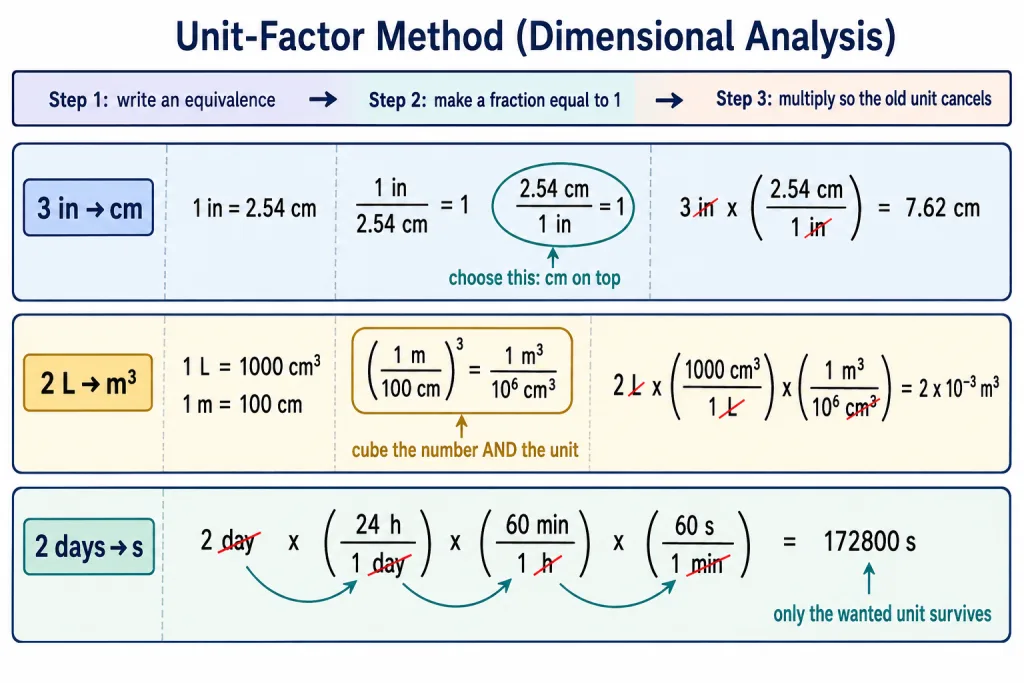
2 L of milk to cubic metres
Given 1 L = 1000 cm and 1 m = 100 cm. Cube the whole factor, numbers and units alike:
The usual error is : cubing the unit but not the 100.
2 days to seconds
1 day = 24 h, 1 h = 60 min, 1 min = 60 s. Multiply the unit factors in one line:
Only seconds survive, so every factor is set up correctly.
The recipe
- Write the given quantity with its unit.
- Write every equivalence you need.
- Turn each into the unit factor with the unwanted unit in the denominator.
- Multiply in series; raise a factor to a power if the unit is squared or cubed.
- Cancel units. If only the desired unit remains, do the arithmetic.
- Apply significant figures. Definitions are exact and never limit the answer.
SI prefixes are unit factors too: gives , and gives . See the Solved Examples for 28.7 pm, 15.15 pm and 25365 mg.
[JEE Main] For a squared or cubed unit, set up the linear factor and raise it to the power. Density: .
Common Traps
Most marks lost in this section go to a few recurring slips.
Trap 1: confusing the two arithmetic rules
| You are doing | You count | Not |
|---|---|---|
| Adding or subtracting | decimal places | significant figures |
| Multiplying or dividing | significant figures | decimal places |
: all three have four decimal places, so the answer keeps four. For the fewest significant figures is three (0.112), so the answer has three.
Trap 2: treating an exact number as a measurement
In , a counted 5 is exact and does not limit the result: 26.82, four significant figures, set by 5.364 alone. The textbook answer key takes it this way. "5.0 g" or "a mass of 5 g" is a measurement and would limit the answer.
Trap 3: zeros
- 0.200 g: three significant figures (trailing zeros after a decimal count).
- 0.002 g: one (leading zeros never count).
- 200 g: ambiguous; assume one, or write g if three are intended.
- 200.0 g: four.
- 2.0034: five (captive zeros count).
Trap 4: rounding a 5
but . Odd goes up, even stays. The rule applies only to an exact 5: , because it is more than halfway.
Trap 5: cubing the unit but not the number
, not . Likewise and .
Trap 6: normalising in scientific notation
is not finished: . Strictly, is limited to two significant figures, so the reportable answer is ; the textbook keeps because that passage is about notation. When asked for the correct number of significant figures, apply the arithmetic rules.
A speed-of-light check
Distance covered by light in 2.00 ns at :
Two significant figures in the speed, three in the time, so the answer is 0.60 m, not 0.6 m or 0.600 m.
Key Point: Scientific notation handles the size of a number; significant figures handle its certainty; dimensional analysis handles its unit. Every quantitative answer has to get all three right.
[Board] Expect one 1-mark question on counting significant figures, one 2-mark on rounding or precision versus accuracy, and one 2- or 3-mark unit conversion.
Solved Examples
Question 1: Writing numbers in scientific notation
Express the following in scientific notation: (i) 0.0048 (ii) 234,000 (iii) 8008 (iv) 500.0 (v) 6.0012
Answer: I move the decimal so one non-zero digit stands to its left and count the places: left is a positive exponent, right a negative one.
(i) 3 places right: .
(ii) 5 places left: . Only 2, 3, 4 are significant.
(iii) 3 places left: . The captive zeros stay.
(iv) 2 places left: . The zeros after the decimal are significant.
(v) Already between 1 and 10: .
Ans: (i) (ii) (iii) (iv) (v)
Watch out: 500.0 gives (four significant figures); a bare 500 would give (one).
Question 2: Multiplying and dividing in scientific notation
Evaluate: (i) (ii) (iii)
Answer: (i) I multiply digit terms and add exponents: , , so .
(ii) , , so .
(iii) I divide digit terms and subtract exponents: , , so .
Ans: (i) (ii) (iii)
Watch out: Decimal shifted left raises the exponent by one; shifted right lowers it by one.
Question 3: Adding and subtracting in scientific notation
Evaluate: (i) (ii)
Answer: (i) First I equalise exponents: . Then .
(ii) . Then .
Ans: (i) (ii)
Watch out: Never add digit terms with different exponents. Convert to the larger exponent first, add, then re-normalise if needed.
Question 4: Counting significant figures
How many significant figures are present in: (i) 0.0025 (ii) 208 (iii) 5005 (iv) 126,000 (v) 500.0 (vi) 2.0034
Answer: (i) 0.0025: leading zeros are placeholders; only 2 and 5 count: 2.
(ii) 208: the zero is captive: 3.
(iii) 5005: two captive zeros: 4.
(iv) 126,000: trailing zeros with no decimal point are not significant: 3, i.e. .
(v) 500.0: the decimal point makes the trailing zeros significant: 4.
(vi) 2.0034: captive zeros count: 5.
Ans: (i) 2 (ii) 3 (iii) 4 (iv) 3 (v) 4 (vi) 5
Watch out: Leading zeros never count; captive zeros always count; trailing zeros count only with a decimal point.
Question 5: What significant figures mean, and 100 versus 100.0
(i) What do you mean by significant figures? (ii) A student measures a volume as 11.2 mL. What does the notation imply? (iii) How many significant figures are in 100, 100. and 100.0? Rewrite each in scientific notation.
Answer: (i) Significant figures are the meaningful digits in a measurement: all the digits known with certainty plus one final digit that is estimated or uncertain. They show the precision of the measurement.
(ii) In 11.2 mL the 1 and 1 are certain and the 2 is estimated. The uncertainty is in the last place, so the true volume lies between 11.1 mL and 11.3 mL. Writing 11.20 mL would falsely claim the hundredths place.
(iii) 100 has no decimal point, so the trailing zeros are not significant: 1, . In 100. the decimal point says the zeros were measured: 3, . In 100.0 the extra zero is measured too: 4, .
Ans: (i) Certain digits plus one uncertain digit. (ii) 11.2 mL means 11.1 to 11.3 mL, uncertainty mL. (iii) 1, 3 and 4 significant figures; , , .
Question 6: Precision and accuracy from Table 1.4, plus a fourth student
The true mass of an object is 2.00 g. Students A, B and C report (1.95 g, 1.93 g), (1.94 g, 2.05 g) and (2.01 g, 1.99 g) respectively. A fourth student D reports (1.80 g, 2.20 g). (i) Find each average. (ii) Classify each student's data as precise, accurate, both or neither. (iii) What is misleading about D's average?
Answer: (i) A: g. B: g. C: g. D: g.
(ii) Spread of readings gives precision: A 0.02 g apart, precise; B 0.11 g apart, not precise; C 0.02 g apart, precise; D 0.40 g apart, badly imprecise.
Distance from 2.00 g gives accuracy: A both 0.05 to 0.07 g low, not accurate (systematic error); B 0.06 g low and 0.05 g high, not accurate; C both within 0.01 g, accurate; D each 0.20 g off, not accurate.
So A is precise but not accurate; B neither; C both; D neither.
(iii) D's average equals C's only because one big overshoot cancels one big undershoot. An average is trustworthy only when the readings behind it are precise; a third reading from D could land anywhere between about 1.8 and 2.2 g.
Ans: Averages 1.940, 1.995, 2.000, 2.000 g. A: precise only; B: neither; C: both; D: neither. D's perfect average is a coincidence of cancelling errors, not accuracy.
Watch out: An average of scattered readings proves nothing.
Question 7: Rounding to three significant figures
Round each number to three significant figures: (i) 34.216 (ii) 10.4107 (iii) 0.04597 (iv) 2808
Answer: (i) Keep 3, 4, 2. The first digit dropped is 1, less than 5: 34.2.
(ii) Keep 1, 0, 4 (the captive zero is significant). First digit dropped is 1: 10.4.
(iii) Leading zeros do not count, so I keep 4, 5, 9. The first digit dropped is 7, so 9 goes to 10 and carries: 0.0460. The trailing zero is the third significant figure and stays.
(iv) Keep 2, 8, 0. The first digit dropped is 8, so the 0 becomes 1: 2810. That trailing zero is ambiguous, so I write .
Ans: (i) 34.2 (ii) 10.4 (iii) 0.0460 (iv)
Watch out: Find the significant digits before rounding. Use scientific notation when rounding leaves an ambiguous trailing zero.
Question 8: The round-to-even rule
Round to two significant figures: (i) 6.35 (ii) 6.25 (iii) 6.251 (iv) 1.45 (v) 1.55 (vi) 0.0875 (to two significant figures)
Answer: (i) Dropped digit exactly 5, preceding 3 is odd, so up: 6.4.
(ii) Exact 5, preceding 2 is even, so it stays: 6.2.
(iii) The dropped portion is 51, more than a bare 5, so I round up as usual: 6.3.
(iv) Exact 5, preceding 4 even: 1.4.
(v) Exact 5, preceding 5 odd: 1.6.
(vi) Significant digits 8, 7, 5. Exact 5, preceding 7 odd: 0.088.
Ans: (i) 6.4 (ii) 6.2 (iii) 6.3 (iv) 1.4 (v) 1.6 (vi) 0.088
Watch out: Round-to-even applies only to an exact 5. Anything beyond an exact 5 rounds up.
Question 9: Significant figures in addition and subtraction
(i) Report correctly. (ii) A beaker has a mass of 25.36 g; 3.1 g of salt is removed from it. Report the remaining mass. (iii) Report .
Answer: (i) . 18.0 has the fewest decimal places, one, so I round to one place: 31.1.
(ii) . 3.1 has one decimal place. The dropped digit is 6, so 2 becomes 3: 22.3 g.
(iii) . All three have four decimal places, so the answer keeps four: 0.8204.
Ans: (i) 31.1 (ii) 22.3 g (iii) 0.8204 (four significant figures)
Watch out: Count decimal places, not significant figures. In (ii) the answer has three significant figures though the inputs had four and two.
Question 10: Significant figures in multiplication and division (Textbook Exercise 1.31)
How many significant figures should be present in the answer, and what is the answer? (i) (ii) (iii)
Answer: (i) 0.02856 has 4 significant figures, 298.15 has 5, 0.112 has 3, 0.5785 has 4. The fewest is 3. Computing: ; ; . To three significant figures: 1.65.
(ii) The 5 is a counting number, so it is exact; only 5.364 (four significant figures) limits the answer. . Had it been "5.0 g", a two-significant-figure measurement, the answer would be 27.
(iii) 2.5 has two, 1.25 has three. , reported to two: 3.1.
Ans: (i) 3 significant figures, 1.65 (ii) 4 significant figures, 26.82 (iii) 2 significant figures, 3.1
Watch out: Exact counting numbers and defined conversion factors never limit significant figures.
Question 11: Unit-factor conversions
(i) A piece of metal is 3 in long. Find its length in cm. (ii) A jug contains 2 L of milk. Find the volume in m. (iii) How many seconds are there in 2 days?
Answer: (i) 1 in = 2.54 cm, so I use with cm on top: .
(ii) 1 L = 1000 cm and 1 m = 100 cm. I cube the second: . Then .
(iii) 1 day = 24 h, 1 h = 60 min, 1 min = 60 s, each with the unwanted unit below: . Only s survives, so the setup is right.
Ans: (i) 7.62 cm (ii) m (iii) 172800 s s
Watch out: If the wrong unit survives, a factor was upside-down.
Question 12: Prefix conversions and the speed of light
(i) Convert into SI base units: (a) 28.7 pm (b) 15.15 pm (c) 25365 mg. (ii) If the speed of light is , calculate the distance covered by light in 2.00 ns.
Answer: (i)(a) 1 pm m: .
(b) .
(c) 1 mg g and 1 g kg, so 1 mg kg: .
(ii) 1 ns s, so . Then . The speed has two significant figures and the time three, so I report two: 0.60 m.
Ans: (i)(a) m (b) m (c) kg (ii) 0.60 m
Watch out: A prefix conversion is exact and never reduces the significant figures. The 0.60 m keeps its trailing zero on purpose.