
Concentration of Solutions
Most laboratory reactions are carried out in solution, where molecules move and collide freely and volumes are easy to measure. A solution then needs one more number a pure substance does not: its concentration.
Key Point (Definition): A solution is a homogeneous mixture of two or more substances. The component in larger amount (usually the liquid) is the solvent; the component dissolved in it is the solute. Concentration is the amount of solute in a given amount of solvent or solution.
Four standard ways to express it:
| # | Unit | In words | Symbol |
|---|---|---|---|
| 1 | Mass per cent (w/w %) | g of solute per 100 g of solution | % |
| 2 | Mole fraction | moles of one component / total moles | |
| 3 | Molarity | moles of solute per litre of solution | M |
| 4 | Molality | moles of solute per kg of solvent | m |
Most errors in this topic come from confusing solution with solvent in the denominator.
1. Mass per cent (w/w %)
The denominator is the whole solution (solute + solvent). For 2 g of a substance A added to 18 g of water, mass of solution = 20 g:
Dividing by 18 g (the water) gives 11.1%, which is wrong. "10% w/w" means 10 g solute + 90 g solvent in every 100 g of solution.
Related units
Class 11 defines only w/w %, but these appear in competitive papers:
| Unit | Definition | Where used |
|---|---|---|
| Mass per cent (w/w) | (mass solute / mass solution) 100 | Commercial acids: "69% " |
| Volume per cent (v/v) | (volume solute / volume solution) 100 | Alcoholic beverages, antiseptics |
| Mass by volume (w/v) | g of solute per 100 mL of solution | Medicines, IV drips: "0.9% saline" |
| Parts per million (ppm) | (mass solute / mass solution) | Pollutants, hardness of water |
[JEE Main] 1 ppm = 1 g of solute in g of solution . Chloroform at 15 ppm in drinking water is the standard question (see the examples).
Key Point: Mass per cent, ppm, mole fraction and molality use masses (or moles). Only molarity uses a volume. This decides which units change with temperature.
2. Mole Fraction
Chemistry happens molecule by molecule, so it is often more useful to ask what fraction of all the molecules belong to component A.
Key Point (Definition): The mole fraction of a component is the ratio of the moles of that component to the total moles of all components in the solution.
If A dissolves in B, with and moles,
- It is a pure number, no unit. " mol" is a mistake.
- The mole fractions add up to 1:
For many components, . If , then .
How to compute it
Convert every component to moles (including the water), add, divide.
18 g of glucose (, molar mass 180 g mol) in 90 g of water:
The solute's mole fraction is tiny although it is 1/6 of the solution by mass, because water molecules are light.
Where it is used
- Raoult's law () and Dalton's law of partial pressures ().
- It is independent of temperature.
- It treats solute and solvent symmetrically.
[JEE Main] Mole fraction to molality in water: take 1 mol of solution, with mol solute and mol water, i.e. g of water. Then
With , mol kg.
Key Point: Mole fraction has no unit, lies between 0 and 1, and sums to exactly 1 over all components.
3. Molarity
Molarity is the most used unit because in a lab you measure liquids by volume, and "moles per litre" turns a volume reading directly into moles.
Key Point (Definition): Molarity (M) is the number of moles of solute dissolved in one litre of the solution.
The unit is mol L (or mol dm, the same thing), written M, read "molar". 1 M NaOH has 1 mol (40 g) of NaOH per litre of solution.
Worked problem: molarity of NaOH
Calculate the molarity of NaOH in the solution prepared by dissolving 4 g of it in enough water to form 250 mL of the solution.
Molar mass of NaOH = 23 + 16 + 1 = 40 g mol:
250 mL = 0.250 L:
"To form 250 mL of solution"
This is how a volumetric flask is used: dissolve the solute in a little water, transfer, add water up to the mark. The final volume is that of the solution, not of the water added. If a problem says "dissolved in 250 mL of water", the solution volume is slightly more and strictly you need the density. In Class 11, unless told otherwise, take the stated volume as the solution volume.
Three forms of the formula
| You want | Formula | Notes |
|---|---|---|
| Molarity | in litres | |
| Moles in a given volume | the key line in titration problems | |
| Mass to weigh out | grams needed |
Combined:
Check: M.
Molarity of pure water
1 L of water is 1000 g, or mol, so pure water is about 55.5 M in itself. No aqueous solution can have a solute molarity near 55 M.
Most molarity problems reduce to : "25 mL of 0.1 M" should read as "0.0025 mol" at once.
[Board] Convert mL to L before dividing. The commonest error is M instead of M.
Dilution, Stock Solutions and
You have 1 M NaOH and need 0.2 M NaOH, so you dilute.
Reasoning it out
1 L of 0.2 M solution must contain 0.2 mol of NaOH. In the 1 M stock, 1 mol is in 1000 mL, so 0.2 mol is in
Take 200 mL of 1 M NaOH and add water up to 1 litre. That is 0.2 M.
The moles of solute did not change: 0.2 mol in the 200 mL taken, 0.2 mol in the 1000 mL after. The same moles now fill five times the volume, so the concentration is one fifth.
The dilution formula
Moles before = moles after, and moles = , so
with before dilution and after. Both volumes in the same unit; mL on both sides is fine.
Check: mL.
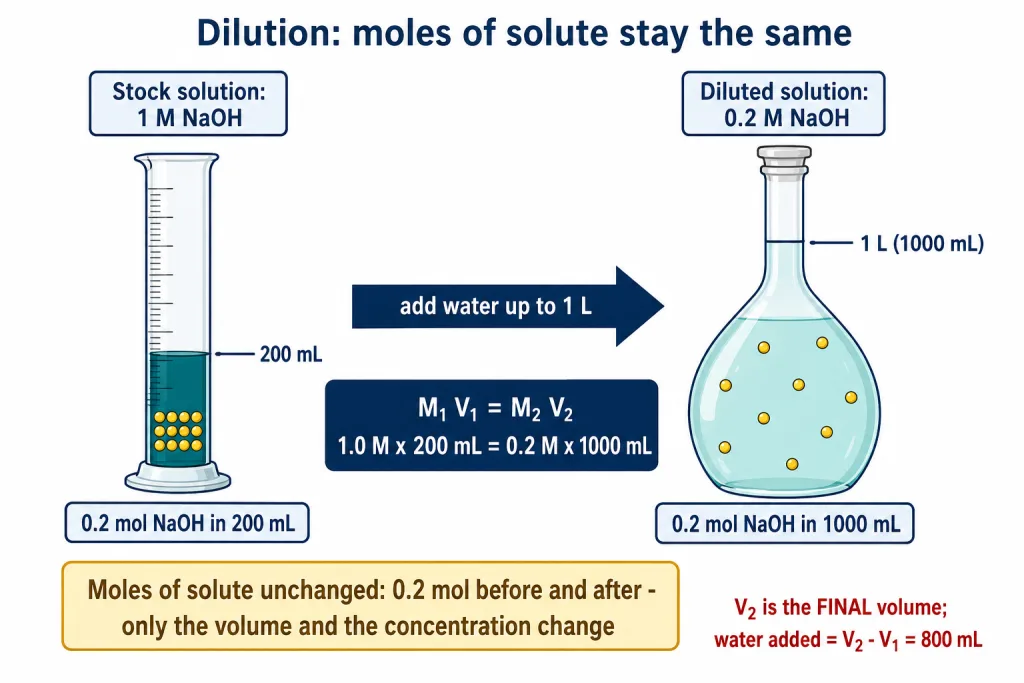
Key Point: Dilution changes volume and concentration but never the moles of solute. is "moles in = moles out".
Stock solutions
The concentrated solution you dilute from is a stock solution. Labs keep stocks at high, known concentration (1 M NaOH; commercial 69% , about 15.4 M) and dilute as needed, which is faster and more accurate than weighing small amounts each time.
Three traps
| Trap | What goes wrong | Fix |
|---|---|---|
| "Water added" vs "final volume" | is the final volume | Water added |
| Mixing two solutions of the same solute | does not apply | |
| Using it for a reaction (acid + base) | Only valid for a 1:1 mole ratio | with stoichiometric coefficients |
The mixing formula is just : 200 mL of 0.5 M NaCl + 300 mL of 0.2 M NaCl gives mol in 0.500 L M. Never average molarities.
[Board] Dilute concentrated acid by adding acid to water, slowly, with stirring, never water to acid; diluting is strongly exothermic and the reverse order spatters acid.
4. Molality
Molarity's denominator is a volume, and volumes change with temperature: warm a solution and its molarity drops although nothing was added. Colligative-property work in Class 12 needs a unit that ignores temperature.
Key Point (Definition): Molality (m) is the number of moles of solute present in one kilogram of the solvent.
The unit is mol kg, written m, read "molal". The denominator is the solvent, by mass. Both differ from molarity.
From molarity to molality using density
The density of a 3 M solution of NaCl is 1.25 g mL. Calculate the molality of the solution.
Basis: 1 L of solution, containing 3 mol of NaCl.
Mass of solute: g.
Mass of solution: g.
Mass of water: g kg.
(Some textbooks print "1250 – 75.5" in one line, a typographical slip; the subtraction is 1250 – 175.5 = 1074.5 g, the figure carried forward.)
Molality (2.79) is less than molarity (3), as is typical for an aqueous solution whose density exceeds 1 g mL and whose solute has an appreciable molar mass. For very dilute aqueous solutions, 1 L of solution is almost exactly 1 kg of water, so molarity molality; the chloroform (ppm) and ethanol problems below use this.
The general conversion recipe
For any conversion between these units: pick a basis (1 L of solution, 100 g of solution, or 1 mol of solution), use density to link volume and mass, and find moles of solute and mass of solvent. Every unit follows.
with in mol L, in g mL and in g mol. Check: .
Temperature
Key Point: Molarity depends on temperature because the volume of a solution changes with temperature. Molality does not, because mass is unaffected. Mole fraction and mass per cent are also temperature-independent.
"Which concentration term is independent of temperature?" is a common one-liner. Only molarity (and normality, in the JEE Corner) has a volume in its definition.
0.50 mol versus 0.50 M
How are 0.50 mol and 0.50 M different?
- 0.50 mol is an amount: g, containing formula units. It says nothing about a solution.
- 0.50 M is a concentration: 0.50 mol in every 1 L of solution; 100 mL of it holds only 0.05 mol.
[Board] Write both bullets, amount versus concentration, 53 g versus 0.5 mol per litre, for full marks.
The Concentration Card
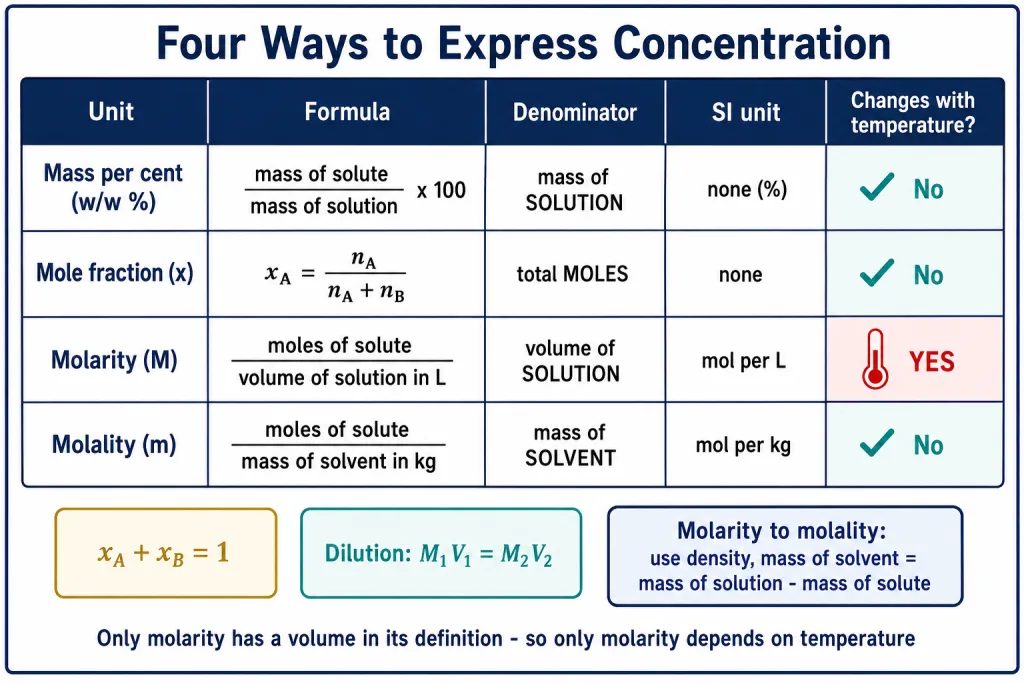
| Unit | Formula | Denominator | Unit | Temperature dependent? |
|---|---|---|---|---|
| Mass per cent | mass of solution | % | No | |
| Mole fraction | total moles | none | No | |
| Molarity M | volume of solution | mol L | Yes | |
| Molality m | mass of solvent | mol kg | No |
Which unit for which job
| Situation | Best unit | Why |
|---|---|---|
| Titrations, reactions in solution | Molarity | a burette measures volume |
| Colligative properties (Class 12) | Molality, mole fraction | temperature-independent |
| Commercial reagents | Mass per cent + density | "69% , d = 1.41 g/mL" |
| Trace pollutants, water quality | ppm | readable numbers |
| Gas mixtures, vapour pressure | Mole fraction | gives partial pressure directly |
The basis method
Choose a basis when a question mixes two units:
| Basis | Gives directly | Density then gives |
|---|---|---|
| 1 L of solution | moles of solute | mass of solution g |
| 100 g of solution | mass of solute mass % | volume of solution mL |
| 1 kg of solvent | moles of solute | mass of solution g |
| 1 mol of solution | mol solute, mol solvent | — |
The nitric acid problem (69% , density 1.41 g mL 15.44 M) uses the 100 g row; NaCl molality the 1 L row; ethanol mole fraction the 1 mol row.
Five mistakes that cost marks
- Mass per cent: dividing by solvent, not solution (20 g, not 18 g).
- Molarity: mL not converted to L.
- Molality: mass of solution used instead of mass of solvent.
- Mole fraction given a unit, or fractions not summing to 1.
- Mixed solutions: molarities averaged instead of moles added.
[NEET] Expect one question here, usually molarity to molality with density; marks are lost on the denominators.
Solved Examples
Question 1: Mass per cent
A solution is prepared by adding 2 g of a substance A to 18 g of water. Calculate the mass per cent of the solute. What would a student get by mistakenly dividing by the mass of water?
Answer: Mass of solution g. So .
Dividing by the water alone gives , which is not the definition.
Ans: 10% (w/w).
Watch out: The denominator is the whole solution.
Question 2: ppm to per cent and molality
A sample of drinking water is contaminated with chloroform, , at 15 ppm by mass. (i) Express this as per cent by mass. (ii) Determine the molality of chloroform in the water.
Answer: 15 ppm means 15 g of in g of sample.
(i) .
(ii) Molar mass of g mol, so moles mol. The sample is so dilute that g of it is essentially g kg of water.
mol kg.
Ans: (i) ; (ii) m.
Watch out: At ppm level, mass of solution mass of solvent.
Question 3: Mole fractions and their sum
18 g of glucose () is dissolved in 90 g of water. Find the mole fraction of glucose and of water, and verify that they add to 1.
Answer: Molar mass of glucose g mol, so mol. Moles of water mol. Total mol.
and . Check: .
Ans: , .
Question 4: Molarity from mass and volume
Calculate the molarity of NaOH in the solution prepared by dissolving 4 g of NaOH in enough water to form 250 mL of solution.
Answer: Molar mass of NaOH g mol, so moles mol. Volume mL L.
mol L.
Check: M.
Ans: 0.4 M.
Question 5: Mass needed for a solution of given molarity
Calculate the mass of sodium acetate () required to make 500 mL of 0.375 molar aqueous solution. Molar mass of sodium acetate is 82.0245 g mol.
Answer: Moles required: mol.
Mass: g.
I would dissolve this in a little water in a 500 mL volumetric flask and make up to the mark.
Ans: 15.38 g of sodium acetate.
Question 6: Molarity of a sugar solution
What is the concentration of sugar () in mol L if 20 g of sugar is dissolved in enough water to make a final volume of 2 L?
Answer: Molar mass of sucrose g mol, so mol.
mol L.
Ans: 0.0292 M (about mol L); 20 g of sugar is only about of a mole.
Question 7: Volume of a pure liquid needed for a solution
If the density of methanol is 0.793 kg L, what is its volume needed for making 2.5 L of its 0.25 M solution?
Answer: Moles needed: mol. Molar mass of g mol, so mass g.
Density kg L g mL, so
mL.
Ans: 25.22 mL of methanol, made up to 2.5 L with water. (With 32.04 g mol the answer is 25.25 mL; either is accepted.)
Question 8: Dilution and
(a) How much 1 M NaOH stock is needed to prepare 1 L of 0.2 M NaOH? (b) 50 mL of 6 M HCl is diluted to 1.5 M. What is the final volume, and how much water was added?
Answer: (a) Moles needed mol NaOH. 1 mol of stock is in 1000 mL, so 0.2 mol is in mL. By formula: mL. So I dilute 200 mL of stock to 1 L.
(b) mL. Water added mL, taking volumes as additive.
Moles check: before, after.
Ans: (a) 200 mL of 1 M NaOH; (b) final volume 200 mL, water added 150 mL.
Watch out: The formula gives the final volume; water added is the difference.
Question 9: Molarity to molality with density
The density of a 3 M solution of NaCl is 1.25 g mL. Calculate the molality of the solution.
Answer: Basis: 1 L of solution, containing 3 mol NaCl, i.e. g.
Mass of solution g, so mass of water g kg.
mol kg.
Ans: 2.79 m.
Watch out: 1250 g is the solution, not the water; subtract the solute first.
Question 10: Concentrated nitric acid
Calculate the concentration of nitric acid in moles per litre in a sample which has a density of 1.41 g mL and a mass per cent of nitric acid of 69%. As an extension, find its molality.
Answer: Basis: 100 g of solution, containing 69 g of and 31 g of water.
Molar mass of g mol, so moles of acid mol. Volume of 100 g: mL L.
mol L.
Check with 1 L: it weighs 1410 g, of which g is acid; mol.
Molality: mol kg.
Ans: Molarity 15.44 M; molality 35.3 m.
Question 11: From mole fraction to molarity
Calculate the molarity of a solution of ethanol in water in which the mole fraction of ethanol is 0.040 (assume the density of water to be one).
Answer: , so .
Basis: 1 L of water, which weighs 1000 g at density 1 g mL, so mol and mol.
The solution is dilute, so its volume is taken as the water's, 1 L: mol L.
Molality m, the same by the same approximation; the pocket formula agrees: .
Ans: 2.31 M.
Watch out: "Density of water is 1" means 1 L of water = 1 kg = 55.56 mol, and the solution volume is taken as the water volume.
Question 12: Amount versus concentration, and mixing solutions
(a) How are 0.50 mol and 0.50 M different? (b) 200 mL of 0.5 M NaCl is mixed with 300 mL of 0.2 M NaCl. Find the molarity of the mixture.
Answer: (a) 0.50 mol is an amount. Molar mass of g mol, so 0.50 mol g, containing formula units. 0.50 M is a concentration: 0.50 mol per litre of solution, so 250 mL holds only 0.125 mol.
(b) Moles: mol and mol, total mol in L.
M.
Ans: (a) 0.50 mol is 53 g of the substance itself; 0.50 M is a solution with 0.50 mol in each litre. (b) 0.32 M.
Watch out: Averaging the molarities gives 0.35 M, which is wrong. Add moles and volumes, then divide.