
How to Use This Section
Read this the night before the paper. Nothing new is taught here; each card compresses earlier sections in the same notation. If a line surprises you, reread that section instead of memorising the line. Screenshot the three figures.
| Card | Topic | Compresses | Who needs it most |
|---|---|---|---|
| 1 | Matter and its classification | 1 | Board, NEET |
| 2 | SI units, prefixes, volume, density, temperature | 2 | Board, NEET |
| 3 | Scientific notation, significant figures, rounding, unit-factor method | 3 | Board, JEE |
| 4 | Five laws of chemical combination, Dalton's theory | 4 | Board, NEET |
| 5 | Atomic mass, u, average atomic mass, molecular and formula mass | 5 | Everyone |
| 6 | Mole concept formula sheet | 6 | Everyone |
| 7 | Percentage composition, empirical formula, stoichiometry, limiting reagent | 7, 8 | Everyone |
| 8 | Concentration units, interconversions, JEE extras | 9, 11 | JEE, NEET |
Key Point: The whole chapter is one idea: a mole is a counted quantity ( entities) whose mass in grams equals its molar mass. Every formula on Cards 6 to 8 is that sentence rearranged.
Card 1 — Matter and Its Classification
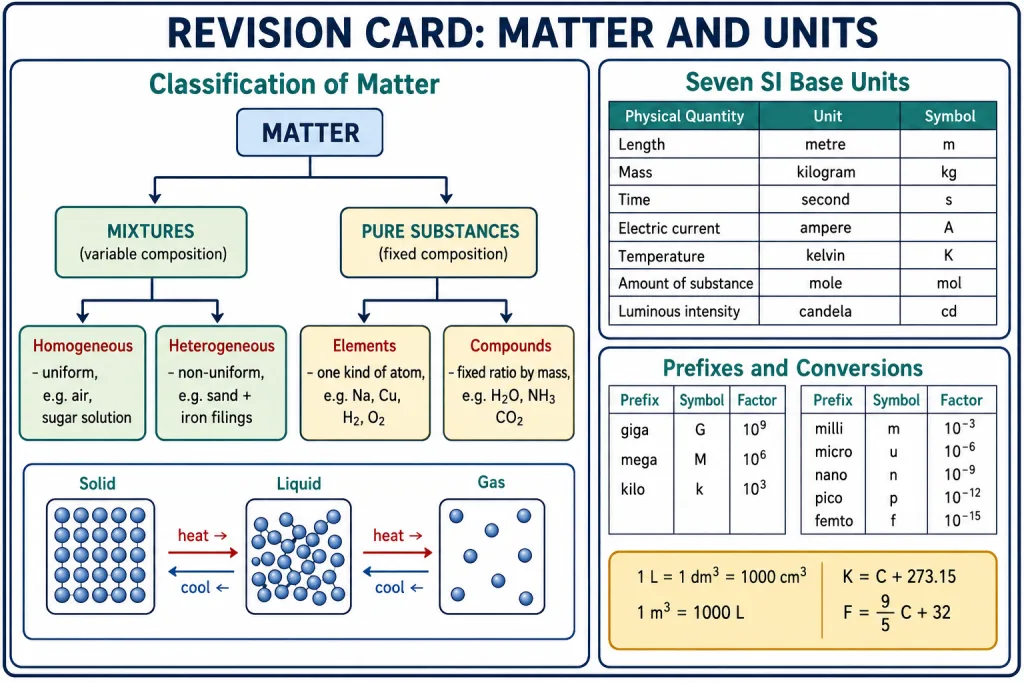
What chemistry is
Chemistry is the science of molecules and their transformations: the composition, structure and properties of matter and the changes it undergoes. Examples to quote: cisplatin and taxol (cancer), AZT (AIDS), fertilisers and pesticides, superconducting ceramics, optical fibres, CFC replacements. Indian heritage: Rasayan Shastra, and Acharya Kanda's indivisible Paramanu.
The three states
| State | Particles | Shape | Volume | Compressibility |
|---|---|---|---|---|
| Solid | close, fixed positions, vibrate only | definite | definite | negligible |
| Liquid | close, free to move past one another | of container | definite | very low |
| Gas | far apart, random rapid motion | fills container | fills container | high |
Solid liquid gas; reverse by cooling. A gas can also be liquefied by compression at a suitable temperature.
The classification tree
| Level 1 | Level 2 | Level 3 | Definition | Examples |
|---|---|---|---|---|
| Matter | Mixture (variable composition, separable by physical means) | Homogeneous | uniform throughout, one phase | sugar solution, air, brass |
| Heterogeneous | not uniform, visible boundaries | sand + iron filings, oil and water, smoke | ||
| Pure substance (fixed composition, not separable by simple physical methods) | Element | one kind of atom; cannot be broken down chemically | Na, Cu, Ag, H, O, S | |
| Compound | two or more elements in a fixed ratio by mass; broken down only chemically | , , , sugar |
Key Point: A compound's properties differ completely from those of its elements: hydrogen burns, oxygen supports burning, water puts fires out. A mixture keeps the properties of its components.
Physical versus chemical properties
| Physical property | Chemical property | |
|---|---|---|
| Measured without changing the substance's identity? | Yes | No, a chemical change must happen |
| Examples | colour, odour, melting point, boiling point, density | acidity, basicity, combustibility, reactivity |
[Board] "Classify as element, compound, homogeneous or heterogeneous mixture" is a standard 1-mark-per-item question: sodium, silver, sugar, air, tea, sea water, iron filings in sand.
Card 2 — SI Units, Prefixes, Volume, Density and Temperature
Systems of units
Two historic systems: English (FPS) and metric (decimal, France, late 18th century). The International System of Units (SI) was set up by the 11th General Conference on Weights and Measures (CGPM), 1960; its base units were redefined in terms of constants of nature in 2018.
The seven base units
| Quantity | Symbol | SI unit | Unit symbol |
|---|---|---|---|
| Length | metre | m | |
| Mass | kilogram | kg | |
| Time | second | s | |
| Electric current | ampere | A | |
| Thermodynamic temperature | kelvin | K | |
| Amount of substance | mole | mol | |
| Luminous intensity | candela | cd |
Key Point (Definition): The mole contains exactly elementary entities; this is the fixed value of the Avogadro constant in . The kelvin is fixed through the Boltzmann constant, the kilogram through the Planck constant, the metre through .
SI prefixes
| Multiple | Prefix | Symbol | Sub-multiple | Prefix | Symbol |
|---|---|---|---|---|---|
| yotta | Y | deci | d | ||
| zetta | Z | centi | c | ||
| exa | E | milli | m | ||
| peta | P | micro | μ | ||
| tera | T | nano | n | ||
| giga | G | pico | p | ||
| mega | M | femto | f | ||
| kilo | k | atto | a | ||
| hecto | h | zepto | z | ||
| deca | da | yocto | y |
[NEET] Most asked: femto (), pico (), nano (), micro (), and the pair zepto () / zetta ().
Mass versus weight
| Mass | Weight |
|---|---|
| amount of matter in a body | force of gravity on that mass |
| constant everywhere | changes with |
| SI unit kg (lab unit g) | SI unit newton (N) |
| analytical balance | spring balance |
Volume
The litre is not an SI unit but is accepted for use with SI. Burette and pipette deliver a volume; graduated cylinder and volumetric flask contain one.
Density
Temperature
| Point | °C | K | °F |
|---|---|---|---|
| Freezing point of water | 0 | 273.15 | 32 |
| Boiling point of water | 100 | 373.15 | 212 |
| Room temperature (typical) | 25 | 298.15 | 77 |
Key Point: Kelvin has no degree sign and no negative values. It is the SI scale, so gas-law and thermodynamics formulas want K. A temperature difference is the same number in °C and K.
Card 3 — Scientific Notation, Significant Figures, Rounding and the Unit-Factor Method
Scientific notation
Write any number as with and an integer: , . Moving the decimal left makes positive; moving it right makes negative.
| Operation | Rule | Example |
|---|---|---|
| Multiply | multiply the 's, add the exponents | |
| Divide | divide the 's, subtract the exponents | |
| Add / subtract | make the exponents equal first, then add or subtract the 's |
Significant figures
A result carries the digits known with certainty plus one uncertain digit. An uncertainty of in the last digit is understood: in 11.2 mL the 11 is certain, the 2 uncertain.
| # | Rule | Examples |
|---|---|---|
| 1 | All non-zero digits are significant | 285 cm → 3; 0.25 mL → 2 |
| 2 | Zeros before the first non-zero digit are not significant | 0.03 → 1; 0.0052 → 2 |
| 3 | Zeros between non-zero digits are significant | 2.005 → 4 |
| 4 | Trailing zeros are significant only if there is a decimal point | 0.200 g → 3; 100 → 1; 100. → 3; 100.0 → 4 |
| 5 | Counted (exact) numbers have infinite significant figures | 2 balls, 20 eggs |
In scientific notation all digits of are significant: → 3; → 4. So 100 is written , or for 1, 2 or 3 significant figures.
Precision versus accuracy
Key Point (Definition): Precision is the closeness of repeated measurements to each other; accuracy is the agreement of a value with the true value.
| Student (true value 2.00 g) | Reading 1 | Reading 2 | Average | Verdict |
|---|---|---|---|---|
| A | 1.95 | 1.93 | 1.940 | precise, not accurate |
| B | 1.94 | 2.05 | 1.995 | neither precise nor accurate |
| C | 2.01 | 1.99 | 2.000 | both precise and accurate |
B's average is close to 2.00, yet B is not accurate. Accuracy is judged reading by reading, not by a lucky mean.
Arithmetic with significant figures
| Operation | The answer keeps | Example |
|---|---|---|
| Addition, subtraction | the fewest decimal places among the inputs | (18.0 has one decimal place) |
| Multiplication, division | the fewest significant figures among the inputs | (2.5 has two figures) |
Rounding off
Key Point: Look only at the rightmost digit being removed.
- Greater than 5 → raise the preceding digit:
- Less than 5 → leave it:
- Exactly 5 → round to even: preceding digit even, leave it (); odd, raise it ()
[JEE Main] Carry one extra digit through the middle of a calculation and round once, at the end.
The unit-factor (factor-label) method
Any equality between units gives two unit factors, each equal to 1. Multiply by the one that cancels the unit you have and leaves the unit you want.
| Conversion | Unit factor(s) | Working |
|---|---|---|
| 3 in → cm | ||
| 2 L → | , | |
| 2 days → s |
Key Point: When a unit is cubed, the conversion factor is cubed too: , never .
Card 4 — The Five Laws of Chemical Combination and Dalton's Atomic Theory
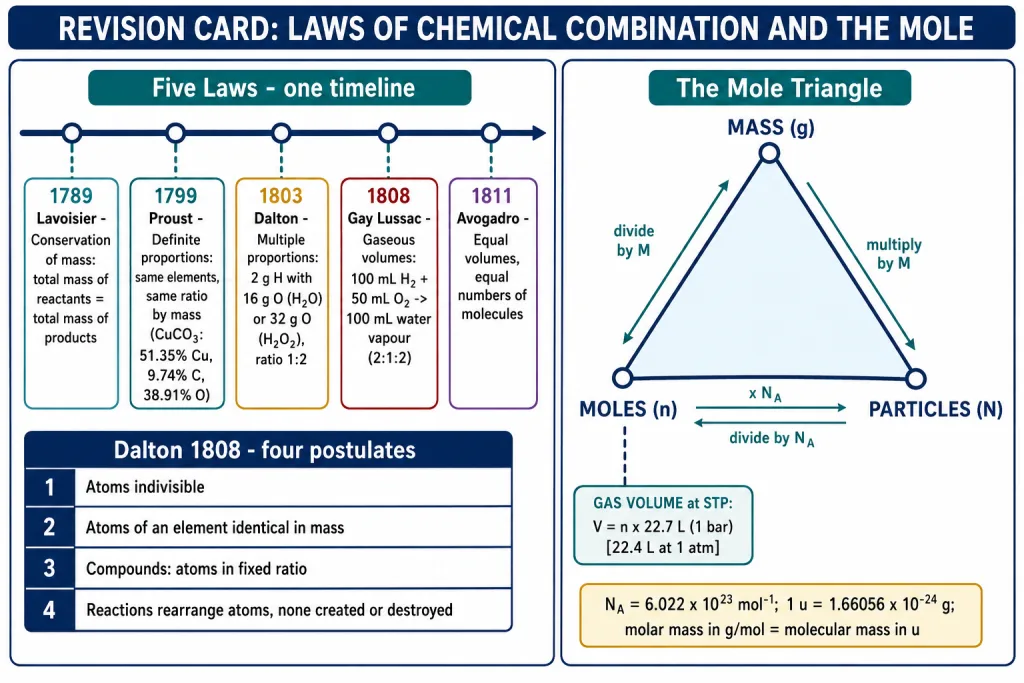
The five laws
| Law | Scientist | Year | Statement | Example |
|---|---|---|---|---|
| Conservation of mass | Antoine Lavoisier (French) | 1789 | Matter can neither be created nor destroyed; mass of reactants mass of products | combustion experiments in sealed vessels |
| Definite proportions | Joseph Proust (French) | 1799 | A given compound always contains the same elements in the same proportion by mass, whatever its source | natural and synthetic cupric carbonate both 51.35% Cu, 9.74% C, 38.91% O |
| Multiple proportions | John Dalton (English) | 1803 | If two elements form more than one compound, the masses of one element combining with a fixed mass of the other bear a simple whole-number ratio | 2 g H with 16 g O () or 32 g O (): O ratio |
| Gaseous volumes | Joseph Louis Gay Lussac (French) | 1808 | Gases combine, or are produced, in a simple ratio by volume at the same and | 100 mL + 50 mL → 100 mL water vapour, i.e. |
| Avogadro's law | Amedeo Avogadro (Italian) | 1811 | Equal volumes of gases at the same and contain equal numbers of molecules | explains Gay Lussac only if hydrogen and oxygen are diatomic (, ) |
Key Point: Gay Lussac's law is definite proportions by volume; Avogadro's law explains it. Avogadro's atom/molecule distinction was ignored for about fifty years until Cannizzaro revived it (1860, Karlsruhe).
[NEET] Law-scientist-year matching: Lavoisier 1789, Proust 1799, Dalton 1803, Gay Lussac 1808, Avogadro 1811, Dalton's atomic theory 1808.
Dalton's atomic theory (1808), "A New System of Chemical Philosophy"
| # | Postulate |
|---|---|
| 1 | Matter consists of indivisible atoms |
| 2 | All atoms of an element have identical properties, including identical mass; atoms of different elements differ in mass |
| 3 | Compounds form when atoms of different elements combine in a fixed ratio |
| 4 | Chemical reactions reorganise atoms; atoms are neither created nor destroyed |
| Explained | Could not explain |
|---|---|
| conservation of mass (postulate 4) | Gay Lussac's law of gaseous volumes |
| definite proportions (postulate 3) | why atoms of one element combine with each other (, ) |
| multiple proportions (postulate 3) | isotopes (same element, different mass), against postulate 2 |
| — | subatomic particles, against postulate 1 |
Isotopes contradict postulate 2; radioactivity and electrons contradict postulate 1.
Card 5 — Atomic Mass, the Unit u, Average Atomic Mass, Molecular and Formula Mass
The carbon-12 scale
Key Point (Definition): Since 1961 the reference is carbon-12, assigned exactly 12 u. One unified atomic mass unit (u), formerly amu, is one-twelfth the mass of one atom:
| Fact | Value |
|---|---|
| Mass of one atom | g |
| Mass of one atom | g u u |
| Mass of one atom | u u |
| Earlier standards | hydrogen (mass 1), then oxygen (mass 16) |
Atomic mass of an element (in u) is the mass of one atom relative to of a atom. It is a ratio; the unit u only marks the scale.
Average atomic mass
Most elements are mixtures of isotopes, so the tabulated atomic mass is the abundance-weighted average:
| Element | Isotope data (mass u, abundance %) | Working | Average |
|---|---|---|---|
| Carbon | C 12.000, 98.892; C 13.00335, 1.108; C 14.00317, | 12.011 u | |
| Chlorine | Cl 34.9689, 75.77; Cl 36.9659, 24.23 | 35.453 u | |
| Argon (Exercise 1.32) | Ar 35.96755, 0.337; Ar 37.96272, 0.063; Ar 39.9624, 99.600 | 39.948 u |
[JEE Main] Two-isotope shortcut: if the average lies a fraction of the way from the lighter mass to the heavier, the heavier isotope's abundance is . Chlorine: , i.e. 24.2% Cl.
Molecular mass versus formula mass
| Substance | Formula | Working | Result |
|---|---|---|---|
| Methane | 16.043 u | ||
| Water | 18.016 u ( 18.02 u) | ||
| Glucose | 180.162 u | ||
| Sodium chloride | NaCl | 58.5 u (formula mass) |
Key Point: Ionic solids like NaCl have no discrete molecules; each sits among six in a lattice. So NaCl is a formula unit and has a formula mass, computed the same way.
Atomic masses to carry: H 1.008, C 12.011 (12.0 for quick work), N 14.01, O 16.00, Na 23.0, Mg 24.3, Al 27.0, P 31.0, S 32.1, Cl 35.5, K 39.1, Ca 40.1, Fe 55.85, Cu 63.5, Zn 65.4, Ag 107.9.
Card 6 — The Mole Concept Formula Sheet
Key Point (Definition): One mole contains exactly elementary entities (atoms, molecules, ions, electrons, formula units; always say which). The number is the Avogadro constant .
Origin of the number: one C atom has mass g, so 12 g of carbon-12 contains
Molar mass
Key Point: Molar mass is the mass of one mole in ; it is numerically equal to the atomic, molecular or formula mass in u. Water: 18.02 u, 18.02 . NaCl: 58.5 u, 58.5 .
The formula sheet
| Want | Formula | Notes |
|---|---|---|
| Moles from mass | in g, in | |
| Particles from moles | say which particle | |
| Moles from particles | ||
| Moles of gas from volume at STP | STP: 1 bar, 273.15 K → 22.7 L; older/JEE convention 1 atm → 22.4 L | |
| Volume of gas at STP | any ideal gas | |
| Mass of one molecule | water: g | |
| Mass of one atom, u → g | multiply by | 1 u g |
| Moles of atoms in mol of molecules | 1 mol → 7 mol atoms | |
| Moles of one element in a compound | 0.5 mol → 2 mol H atoms |
The mole triangle
            mass (g)
          /          \
   divide by M     multiply by M
        /              \
   MOLES  <--------->  particles
   x N_A   divide by N_A
        \
     x 22.7 L (gas, STP)
Worked one-liners
| Question | Working | Answer |
|---|---|---|
| Moles in 9 g water | 0.499 ≈ 0.5 mol | |
| Molecules in 4.4 g | ||
| Atoms in 4.4 g | ||
| Volume of 8 g at STP (1 bar) | 5.675 L | |
| Mass of Na atoms | 11.5 g | |
| More atoms: 1 g Na or 1 g Li? | vs mol | Li, smaller molar mass |
[NEET] "Which sample has the largest number of atoms": convert every option to moles of atoms (moles of substance atoms per formula), not moles of molecules.
At the same and one mole of any gas has the same volume, so a volume ratio of gases is a mole ratio (Avogadro's law).
Card 7 — Percentage Composition, Empirical Formula, Stoichiometry and the Limiting Reagent
Percentage composition
| Compound | Molar mass | Working | Result |
|---|---|---|---|
| Water | 18.02 | H: ; O: | H 11.18%, O 88.79% |
| Ethanol | 46.068 | C: ; H: ; O: | C 52.14%, H 13.13%, O 34.73% |
Empirical versus molecular formula
| Empirical formula | Molecular formula |
|---|---|
| simplest whole-number ratio of atoms | actual number of atoms in one molecule |
| for glucose | |
| for benzene | |
| for hydrogen peroxide |
The five-step recipe (4.07% H, 24.27% C, 71.65% Cl, molar mass 98.96 g mol)
| Step | Do | Numbers |
|---|---|---|
| 1 | Take 100 g, so % becomes grams | 4.07 g H, 24.27 g C, 71.65 g Cl |
| 2 | Divide each mass by atomic mass → moles | H ; C ; Cl |
| 3 | Divide every mole number by the smallest | H ; C ; Cl |
| 4 | If not whole, multiply all by 2, 3, … (1.5 → ×2, 1.33 → ×3, 1.25 → ×4) | already whole: , mass |
| 5 | , multiply subscripts | → |
If the % values do not add to 100 and oxygen is not listed, the balance is oxygen. From combustion analysis: moles of C moles of , moles of H moles of .
What a balanced equation says
| Reading | Statement |
|---|---|
| Molecules | 1 molecule + 2 molecules → 1 molecule + 2 molecules |
| Moles | 1 mol + 2 mol → 1 mol + 2 mol |
| Masses | 16 g + 64 g → 44 g + 36 g (80 g each side) |
| Volumes at STP (gases) | 22.7 L + 45.4 L → 22.7 L + 45.4 L |
Key Point (Definition): The coefficients are stoichiometric coefficients: mole ratios, never mass ratios. Every stoichiometry problem is grams → moles → mole ratio → moles → grams (or litres).
Balancing checks: ; ; ; .
Limiting reagent
Key Point (Definition): When reactants are not in the exact stoichiometric ratio, the one consumed first is the limiting reagent; it fixes the amount of product. The other is in excess.
- Convert every reactant to moles.
- Divide each by its coefficient.
- The smallest quotient marks the limiting reagent.
- Compute product from the limiting reagent only.
- Excess left initial moles moles consumed.
Worked case: 50.0 kg + 10.0 kg . mol; mol. Quotients: : ; : , so is limiting. mol kg.
[JEE/NEET] The reactant with the smaller mass, or even fewer moles, is not automatically limiting. Only moles divided by coefficient decides.
Card 8 — Concentration Units, Interconversions and the JEE Extras
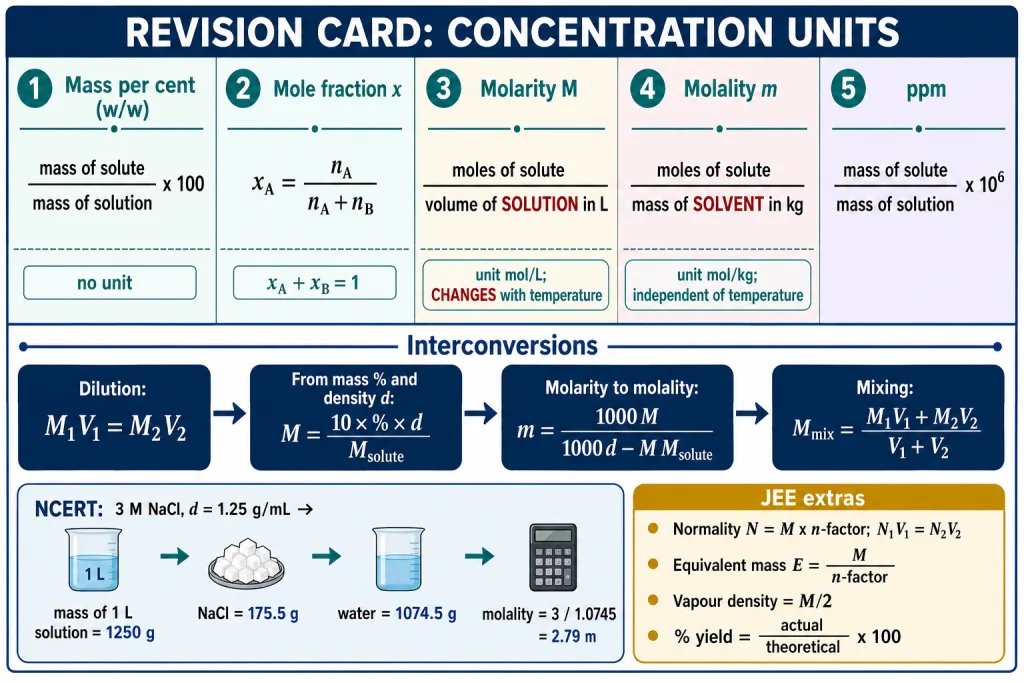
The four concentration units (plus ppm)
| Unit | Symbol | Formula | Unit | Depends on ? |
|---|---|---|---|---|
| Mass per cent (w/w) | % | none | No | |
| Mole fraction | ; | none | No | |
| Molarity | M | Yes (volume expands) | ||
| Molality | m | No | ||
| Parts per million | ppm | none | No |
Key Point: Molarity is per litre of solution; molality per kilogram of solvent. Only molarity changes with temperature. "0.50 mol NaOH" is an amount; "0.50 M NaOH" is a concentration, 0.50 mol in every litre.
Working formulas
| Task | Formula | Check |
|---|---|---|
| Dilution | moles of solute unchanged | |
| Molarity from mass | 4 g NaOH in 250 mL → M | |
| Molarity from mass % and density () | 10% solution, , → 1 M | |
| Molality from molarity and density | 3 M NaCl, → m | |
| Molality from mole fraction (solvent molar mass ) | dilute aqueous: | |
| Mixing two solutions of one solute | volumes assumed additive |
Behind every density formula: take 1 L of solution (for molarity) or 100 g of solution (for mass %), get its mass from density, subtract the solute mass to get the solvent mass, convert.
JEE extras (Section 11)
| Idea | Formula | Notes |
|---|---|---|
| Equivalent mass | n-factor: basicity of acid, acidity of base, total cation charge for salts, electrons per formula unit for redox | |
| Gram equivalents | ||
| Normality | always | |
| Titration / neutralisation | equivalents react 1 : 1 | |
| Vapour density | , i.e. | relative to ; dimensionless |
| Percentage yield | theoretical yield from the limiting reagent | |
| Percentage purity | use only the pure mass in stoichiometry | |
| Average molar mass of a gas mixture | mole fractions as weights | |
| ppb | 1 ppm mg per kg mg per L for dilute water |
[JEE Main] n-factors: HCl 1, 2, 3, NaOH 1, 2, in acid 5, in acid 6, 2 (as a base against strong acid).
The Mistakes That Cost the Most Marks
Ordered roughly by how often they appear in answer scripts.
1. Using the multiplication rule for an addition. is reported as 31.1 (fewest decimal places), not 31. Multiplication and division count figures; addition and subtraction count decimal places.
2. Counting leading zeros. 0.0052 has two significant figures, not four. And 100 has one unless written 100.0 or .
3. Rounding every trailing 5 upward. When the dropped digit is exactly 5, round to even: but .
4. Not cubing the conversion factor. L, not . Likewise to is a factor of 1000.
5. Using 22.4 L at 1 bar, or 22.7 L at 1 atm. STP is 1 bar, 273.15 K → 22.7 L mol; the 1 atm convention gives 22.4 L. Read the pressure in the question; if a Board paper gives none, use 22.7 L.
6. Stopping at moles of molecules when atoms are asked. 0.5 mol has 2 mol H atoms and 2.5 mol atoms in total. Atoms in 4.4 g : , not .
7. Calling the smaller-mass reactant limiting. Only moles divided by coefficient decides. In the ammonia example 10 kg is limiting, though it is both less mass and more moles than 50 kg .
8. Reading coefficients as mass ratios. means 1 mol : 3 mol : 2 mol, i.e. 28 g : 6.05 g : 34 g. Never "1 g with 3 g ".
9. Swapping the denominators of molarity and molality. Molarity: litres of solution. Molality: kilograms of solvent. In the density conversion, subtract the solute mass from the solution mass before dividing.
10. Forgetting that molarity changes with temperature. Volume expands on heating, so molarity falls. Molality, mole fraction and mass per cent use only masses and do not change.
11. Skipping or inverting the empirical-to-molecular step. must be a whole number. (49.48), molar mass 98.96: . If you get 0.5 you divided the wrong way.
12. Sloppy averages for atomic mass. Weight by fractional abundance, not a simple mean: chlorine is u, not u.
Key Point: Two more: "molecular mass of NaCl" is wrong (formula mass; no molecules in an ionic lattice), and the mole is not "6.022 × 10 grams". The mole is a number; its mass is the molar mass.
The 60-Second Revision
The minimum, for the queue outside the hall.
Matter. Mixtures (homogeneous, heterogeneous) versus pure substances (elements, compounds). Compounds: fixed ratio by mass, properties unlike their elements. Physical property: measured without changing identity; chemical property: needs a chemical change.
Units. Seven SI base units: m, kg, s, A, K, mol, cd (11th CGPM, 1960). 1 L ; L. Density SI , lab (). ; . Prefixes: femto , pico , nano , micro ; giga , tera .
Significant figures. Non-zero digits count; sandwiched zeros count; leading zeros never; trailing zeros only with a decimal point; counted numbers are exact. Add/subtract → fewest decimal places; multiply/divide → fewest significant figures. Dropped digit exactly 5 → round to even. Precision: readings agree with each other; accuracy: agree with the true value.
Laws. Lavoisier 1789 mass conserved; Proust 1799 definite proportions by mass; Dalton 1803 multiple proportions (simple whole-number ratio); Gay Lussac 1808 simple ratio by volume; Avogadro 1811 equal volumes, equal molecules. Dalton 1808: indivisible atoms, identical atoms of an element, fixed ratios, atoms rearranged not created; fails on isotopes, subatomic particles, gaseous volumes.
Atomic mass. 1 u mass of C g. Average atomic mass (fraction mass): C 12.011, Cl 35.453. Molecular mass = sum of atomic masses (glucose 180.16 u); ionic solids use formula mass (NaCl 58.5 u).
Mole. . ; ; gas at STP: L (1 bar) or 22.4 L (1 atm). Mass of one molecule . Molar mass in equals molecular mass in u. Atoms: moles atoms per formula.
Formulae. Mass % (water: H 11.18%, O 88.79%). Empirical: % → g → ÷ atomic mass → ÷ smallest → whole numbers; ; .
Stoichiometry. Coefficients are mole ratios. Grams → moles → ratio → moles → grams. Limiting reagent: smallest (moles ÷ coefficient); it alone fixes the product. 50 kg + 10 kg → limiting, 56.1 kg .
Concentration. Mass % ; , ; (changes with ); (does not); ppm . . ; (3 M NaCl, → 2.79 m). JEE: -factor, , -factor, VD , % yield actual/theoretical .