
Why Chemists Needed Laws of Combination
By the end of the 18th century chemists could make hundreds of compounds but could not say why elements combined as they did. The answer came from one habit: weighing everything carefully, before and after. Between 1789 and 1811 five quantitative laws came out of it. Together they are the laws of chemical combination, and they forced chemistry to accept atoms. Each is about measurable masses or volumes, and each came from a real experiment.
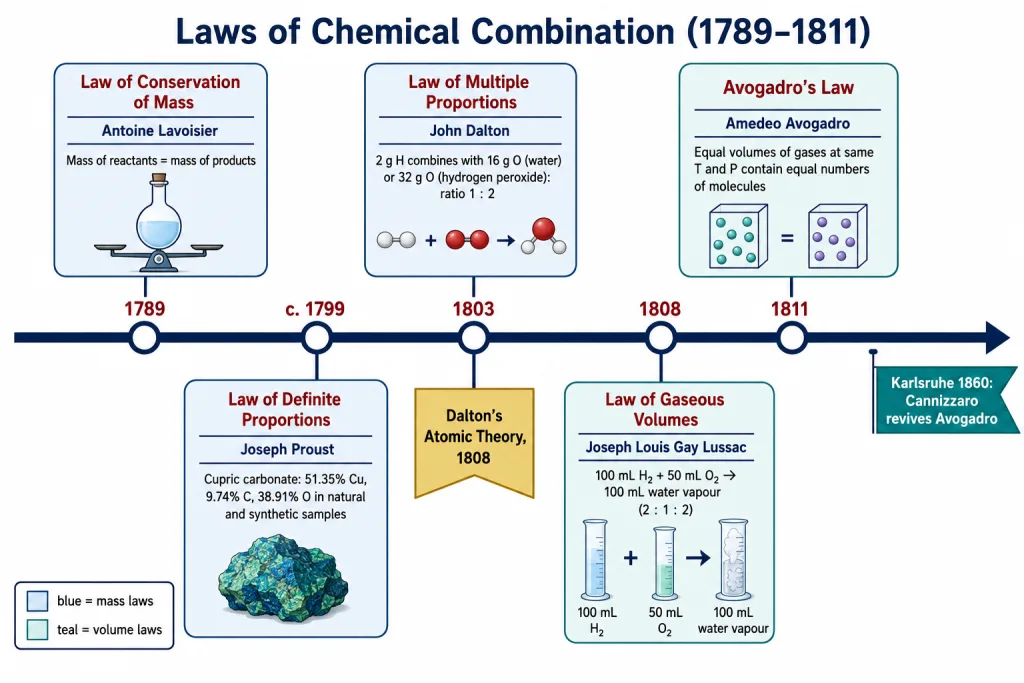
| # | Law | Scientist | Year | Deals with |
|---|---|---|---|---|
| 1 | Conservation of mass | Antoine Lavoisier | 1789 | Total mass of reactants and products |
| 2 | Definite proportions | Joseph Proust | 1799 (about) | Mass ratio of elements in one compound |
| 3 | Multiple proportions | John Dalton | 1803 | Mass ratios across compounds of the same elements |
| 4 | Gaseous volumes | Joseph Louis Gay Lussac | 1808 | Volumes of reacting gases |
| 5 | Avogadro's law | Amedeo Avogadro | 1811 | Volume versus number of gas molecules |
[Board] Scientist-year pairs are one-mark recall. For Proust only the name and the cupric carbonate experiment are asked, not the year.
1. Law of Conservation of Mass (Lavoisier, 1789)
Antoine Lavoisier (1743-1794) heated tin and mercury in sealed flasks and weighed the flask before and after. The total mass did not change, though the metal had turned into a powdery calx (an oxide). The metal gained mass; the air in the flask lost exactly as much.
Key Point (Definition): Law of conservation of mass — in all physical and chemical changes there is no net change in mass. Matter can neither be created nor destroyed.
This is why equations are balanced; an unbalanced one would create or destroy atoms, and so mass.
Why the law looks "broken" in open vessels
A burning candle disappears. Calcium carbonate heated in an open crucible gets lighter. In both cases a gas (carbon dioxide, water vapour) has escaped. In a closed vessel the balance reads the same before and after.
Strictly, says mass and energy are inter-convertible, and in nuclear reactions a measurable mass becomes energy. In chemical reactions the change is far below any balance's sensitivity (about g per kilojoule), so the law is treated as exact. The combined idea is sometimes called the "law of conservation of mass and energy".
Every stoichiometry calculation in Sections 8 and 9 rests on this law. It was the direct result of exact measurement of masses and carefully planned experiments.
2. Law of Definite Proportions (Proust)
The next question was whether a compound always has the same composition or depends on how it was made. The French chemist Joseph Proust (1754-1826) tested this with two samples of cupric carbonate, one a natural mineral and one made in the laboratory.
| Sample | % of copper | % of carbon | % of oxygen |
|---|---|---|---|
| Natural sample | 51.35 | 9.74 | 38.91 |
| Synthetic sample | 51.35 | 9.74 | 38.91 |
Identical to the second decimal place.
Key Point (Definition): Law of definite proportions — a given compound always contains exactly the same proportion of elements by weight (mass), irrespective of its source or method of preparation. Also called the law of constant composition or law of definite composition.
Water from any source is 11.11% hydrogen and 88.89% oxygen by mass, so H : O is always 1 : 8. In 9 g of water there is 1 g of hydrogen and 8 g of oxygen; in 90 g, 10 g and 80 g. The amount changes, the ratio does not.
Verifying the law from data
- For each sample, find the mass of each element (by subtraction if needed).
- Convert to a percentage, or to a ratio per gram of one fixed element.
- If it is the same in every sample, the law holds.
A classic pair of experiments on copper oxide:
- Experiment 1: 1.375 g of copper oxide, reduced by hydrogen, leaves 1.098 g of copper.
- Experiment 2: 1.179 g of copper, dissolved in nitric acid and the nitrate ignited, gives 1.476 g of copper oxide.
Percentage of copper: and . Same within experimental error. (Worked fully in Question 3.)
What the law does not say
- It does not say a pair of elements forms only one compound. Copper and oxygen form both and ; each has its own fixed composition. The relation between them is the next law.
- It does not apply to mixtures. Air, brass or sugar solution can have any composition (Section 1).
[JEE Main] Exceptions: (i) isotopic composition — heavy water is 20% hydrogen (as deuterium) by mass, not 11.11%; (ii) non-stoichiometric compounds such as (wüstite) or , where lattice defects give a variable composition. These are berthollides, after Berthollet, who argued with Proust and lost for ordinary compounds. Compounds obeying the law strictly are daltonides.
If a question quotes 51.35 / 9.74 / 38.91, the answer is Proust and definite proportions.
3. Law of Multiple Proportions (Dalton, 1803)
Proust's law handles one compound at a time. But the same two elements often form several compounds (water and hydrogen peroxide; five oxides of nitrogen). John Dalton (1766-1844) found the pattern in 1803, and it became the strongest evidence for atoms so far.
Key Point (Definition): Law of multiple proportions — if two elements can combine to form more than one compound, the masses of one element that combine with a fixed mass of the other element bear a ratio of small whole numbers.
Water versus hydrogen peroxide, with hydrogen fixed at 2 g:
The oxygen masses are 16 g and 32 g, ratio 1 : 2, as expected if water is and hydrogen peroxide is . Atoms come in whole numbers, so the mass ratios do too.
More examples
| Element pair | Compounds | Fixed mass | Mass of other element | Simple ratio |
|---|---|---|---|---|
| C and O | , | 12 g C | 16 g, 32 g O | 1 : 2 |
| S and O | , | 32 g S | 32 g, 48 g O | 2 : 3 |
| N and O | , , , , | 14 g N | 8, 16, 24, 32, 40 g O | 1 : 2 : 3 : 4 : 5 |
| Cu and O | , | 63.5 g Cu | 8 g, 16 g O | 1 : 2 |
| Cl and O | , , | 71 g Cl | 16, 64, 112 g O | 1 : 4 : 7 |
The nitrogen row is the standard exercise, solved in Question 4.
"Which law?" problems with two compounds
- Fix the mass of one element (1 g, or a convenient 12 g or 14 g).
- Scale every row to that mass and compare the masses of the other element.
- Divide by the smallest. Whole numbers (1 : 2, 2 : 3 …) mean multiple proportions.
| Definite proportions | Multiple proportions | |
|---|---|---|
| Compounds | One, many samples | Two or more, same elements |
| Compared | Mass % of each element per sample | Mass of B per fixed mass of A |
| Verdict | "51.35% copper in both samples" | "oxygen masses 1 : 2" |
[JEE Main] Two traps. (i) The ratio must be small whole numbers: 1 : 1.5 is fine (2 : 3), but 1 : 1.03 is scatter within one compound (definite proportions). (ii) The law is about masses, not moles or volumes; the volume version is Gay Lussac's law.
This law was Dalton's own discovery and the springboard for his atomic theory of 1808.
4. Gay Lussac's Law of Gaseous Volumes (1808)
The first three laws are about mass. In 1808 the French chemist Joseph Louis Gay Lussac (1778-1850) measured the volumes of reacting gases, all at the same temperature and pressure.
Key Point (Definition): Gay Lussac's law of gaseous volumes — when gases combine, or are produced, in a chemical reaction, they do so in a simple ratio by volume, provided all the gases are at the same temperature and pressure.
His headline result:
So is 2 : 1 : 2 by volume.
| Reaction | Volumes (same T, P) | Ratio |
|---|---|---|
| Hydrogen + chlorine → hydrogen chloride | 1 vol + 1 vol → 2 vol | 1 : 1 : 2 |
| Nitrogen + hydrogen → ammonia | 1 vol + 3 vol → 2 vol | 1 : 3 : 2 |
| Hydrogen + oxygen → water vapour | 2 vol + 1 vol → 2 vol | 2 : 1 : 2 |
This is the law of definite proportions by volume, with the extra point that the ratio is simple.
Using the law in problems
Scale the fixed ratio. If 10 volumes of dihydrogen react with 5 volumes of dioxygen: 2 vol + 1 vol → 2 vol , so 10 vol + 5 vol → 10 volumes of water vapour. The total shrinks from 15 to 10; gas reactions can change total volume (Question 7).
[JEE Main] Gay Lussac's law is the balanced equation read in volumes instead of moles, because equal volumes of gases contain equal numbers of molecules (Avogadro). The coefficients of a gas-phase equation are the volume ratios, provided every species is a gas at the same T and P. Liquids and solids contribute zero volume: the 2 : 1 : 2 result for water holds only above 100 C; if the water condenses, the product volume is essentially zero.
The puzzle Gay Lussac created
1 volume of hydrogen + 1 volume of chlorine gives 2 volumes of hydrogen chloride. If each volume holds atoms, joining them one-to-one gives "compound atoms", which is one volume, not two. Two volumes would need each hydrogen atom to split in half, but Dalton said atoms are indivisible. Dalton rejected Gay Lussac's data as inaccurate. The correct answer came three years later, from Italy.
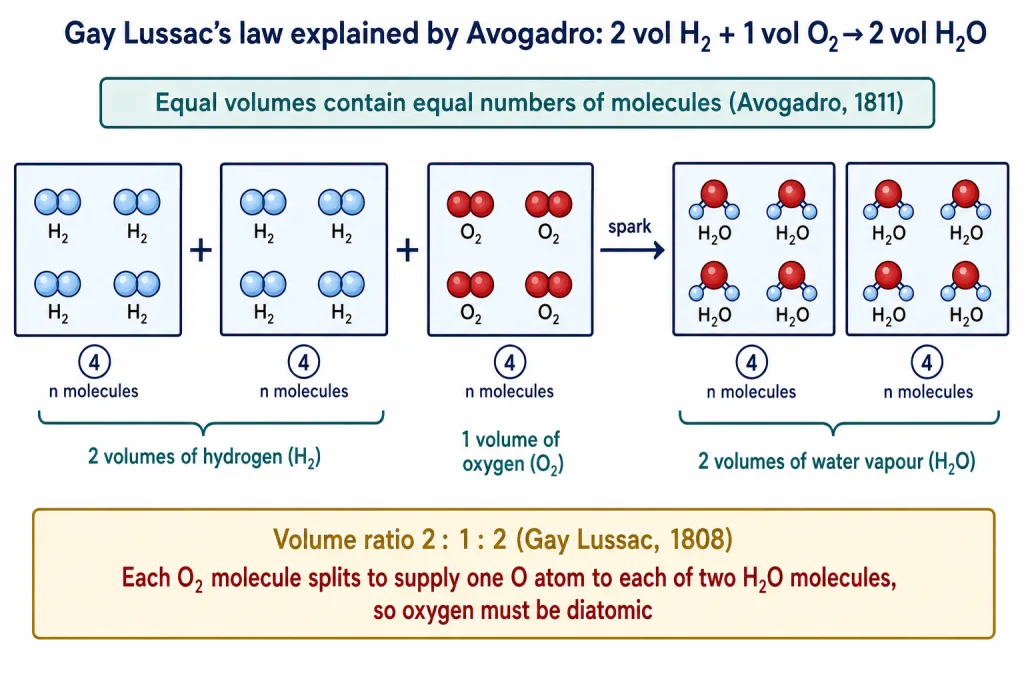
Each box is one volume with the same number of molecules. Hydrogen and oxygen are diatomic, so two boxes of and one of rearrange into exactly two boxes of with nothing left over.
5. Avogadro's Law (1811) and the Birth of the Molecule
In 1811 the Italian scientist Amedeo Avogadro (1776-1856) published a short paper in the Journal de Physique that settled Gay Lussac's puzzle.
Key Point (Definition): Avogadro's law — equal volumes of all gases at the same temperature and pressure contain an equal number of molecules.
Two ideas are packed in there:
- Equal volumes, equal numbers. A litre of hydrogen, oxygen or carbon dioxide at the same T and P contains the same number of particles, though the masses differ (about 0.09 g, 1.43 g and 1.96 g at STP).
- Atoms are not molecules. The atom is the smallest particle of an element that takes part in a reaction; the molecule is the smallest free-standing particle of a substance. Hydrogen gas is diatomic , not single H atoms; likewise , , .
Why diatomic molecules were necessary
Take 2 volumes of hydrogen + 1 volume of oxygen → 2 volumes of water vapour, no oxygen left over.
- Each volume contains molecules, so hydrogen molecules react with oxygen molecules to give water molecules.
- Each water molecule gets the oxygen from half an oxygen molecule, which is possible only if the oxygen molecule has at least two atoms: .
- Dividing by : 2 + 1 → 2 . The 2 : 1 : 2 volume ratio is the molecule ratio of the balanced equation.
Same for : 1 vol + 1 vol → 2 vol. Atoms stay intact; only molecules rearrange.
Dalton and most contemporaries believed like atoms could not combine, so Avogadro's hypothesis, though correct, did not gain much support for about 50 years.
Karlsruhe, 1860
Confusion over atomic and molecular masses grew until the first international chemistry conference met at Karlsruhe, Germany, in 1860. There Stanislao Cannizzaro circulated Sketch of a Course of Chemical Philosophy, showing that Avogadro's hypothesis gave consistent atomic and molecular masses for everything. Avogadro, dead four years by then, got his due; his name now labels (Section 6).
Consequences you will use later
| Consequence | Statement | Where |
|---|---|---|
| Molar volume | 1 mol of any gas occupies the same volume at given T, P: 22.7 L at STP (1 bar, 273.15 K); 22.4 L at 1 atm | Sections 6, 8 |
| Volume ratios = mole ratios | Coefficients of a gas-phase equation give volume ratios directly | Section 8 |
| Molecular mass = 2 x vapour density | Mass of a gas volume relative to the same volume of gives | JEE Corner, Section 11 |
| at constant T, P | The gas-laws form of Avogadro's law | Class 11 Chapter 5 |
[NEET] Avogadro's law speaks of molecules, not atoms; Gay Lussac's of volumes, not masses; Dalton's multiple-proportions law of masses. Questions swap these words on purpose.
A 3-mark answer on how Avogadro's law explains the water result needs: (i) equal volumes means equal molecules, (ii) hydrogen and oxygen are diatomic, (iii) the count giving 2 : 1 : 2.
Dalton's Atomic Theory (1808)
The idea of indivisible particles is ancient. Democritus (460-370 BC) called them a-tomio, "un-cuttable"; Acharya Kanad's Paramanu carried the same idea (Section 1). But these were guesses with no experiments behind them.
The laws of conservation of mass, definite proportions and multiple proportions all needed an explanation, and in 1808 John Dalton gave it in A New System of Chemical Philosophy. Learn the four postulates in this exact wording.
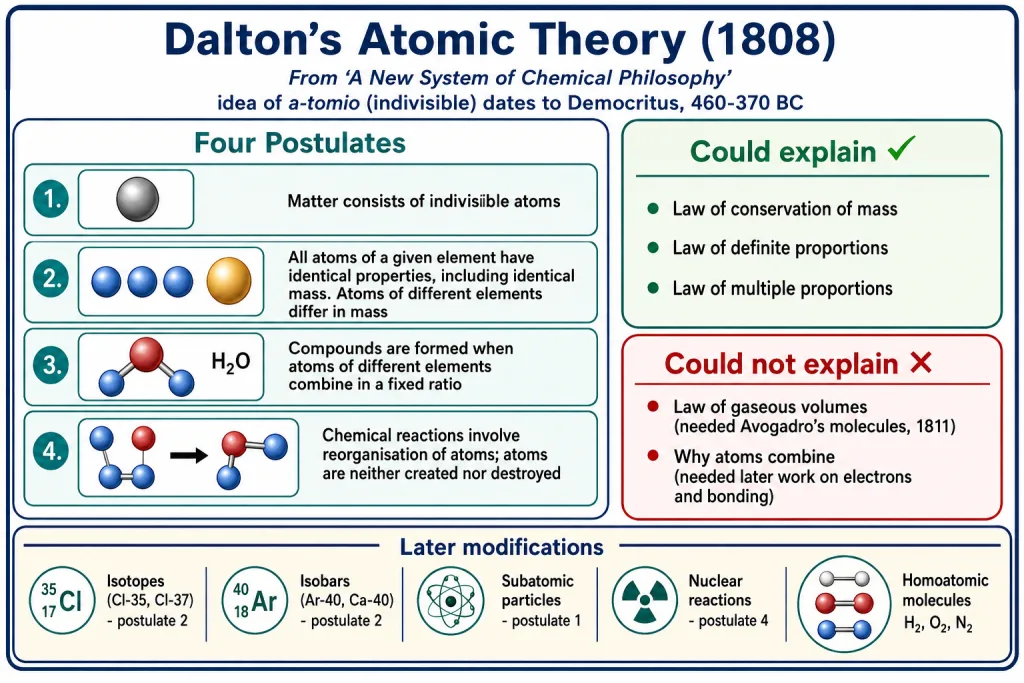
Key Point (Dalton's postulates, 1808):
- Matter consists of indivisible atoms.
- All atoms of a given element have identical properties, including identical mass. Atoms of different elements differ in mass.
- Compounds are formed when atoms of different elements combine in a fixed ratio.
- Chemical reactions involve reorganisation of atoms. These are neither created nor destroyed in a chemical reaction.
What the theory explained
| Law | Explained by | Reasoning |
|---|---|---|
| Conservation of mass | Postulate 4 (+1) | Atoms are only rearranged, and each keeps its mass. |
| Definite proportions | Postulates 2 and 3 | Fixed whole-number ratio of atoms, each of fixed mass, gives a fixed mass ratio. |
| Multiple proportions | Postulates 1, 2 and 3 | 1 and 2 oxygen atoms per fixed number of hydrogen atoms give oxygen masses 1 : 2; there is no half atom. |
The three mass laws follow from the theory, which is why it was accepted quickly.
What the theory could not explain
- The law of gaseous volumes. Dalton did not distinguish atoms from molecules and denied that like atoms could combine, so 1 vol + 1 vol → 2 vol HCl was inexplicable to him. Avogadro's molecules were needed.
- The reason for combining of atoms: why sodium combines with chlorine at all, and why 1 : 1. That answer (electrons, valence, bonding) came a century later.
Postulates later shown to be wrong
| Postulate | Later discovery that contradicts it |
|---|---|
| 1. Atoms are indivisible | Atoms contain electrons, protons and neutrons (Thomson 1897, Rutherford 1911, Chadwick 1932); atoms divide in nuclear reactions. |
| 2. All atoms of an element are identical in mass | Isotopes: and are both chlorine with different masses. |
| 2. Atoms of different elements differ in mass | Isobars: and are different elements with almost the same mass. |
| 3. Fixed ratio of atoms | Non-stoichiometric compounds such as ; the theory also gives no reason for the ratio. |
| 4. Atoms neither created nor destroyed | True for chemical reactions; in nuclear reactions atoms of one element change into another and mass converts to energy. |
| (Implicit) Like atoms cannot combine | , , , , exist; allotropes (diamond, graphite) have the same atoms, different properties. |
The whole story in one line
Careful weighing (Lavoisier) → fixed recipes (Proust) → whole-number recipes (Dalton's law) → atoms (Dalton's theory, 1808) → volumes puzzle (Gay Lussac) → molecules (Avogadro, 1811) → accepted (Karlsruhe, 1860).
[NEET] "Which is not a postulate of Dalton's atomic theory?" The distractors "atoms of the same element can combine to form molecules" and "equal volumes of gases contain equal numbers of molecules" are both Avogadro, not Dalton. Also: Dalton's theory could explain conservation of mass, definite proportions and multiple proportions, but not gaseous volumes.
Solved Examples
Question 1: Conservation of mass with an escaping gas
10.0 g of calcium carbonate is heated strongly in an open crucible until decomposition is complete, leaving 5.6 g of calcium oxide. (i) What mass of carbon dioxide was produced? (ii) Which law did you use? (iii) Would the crucible plus contents weigh less afterwards, and does that violate the law?
Answer: The change is . Mass of reactant = total mass of products, so and g.
The crucible is open, so the 4.4 g of escapes and the crucible weighs 4.4 g less. Crucible plus air still has the same total mass; in a sealed vessel the reading would not change.
Ans: (i) 4.4 g of ; (ii) law of conservation of mass; (iii) the crucible loses 4.4 g, but no mass is destroyed, so the law is not violated.
Question 2: A balance sheet for conservation of mass
In a closed flask, 5.3 g of sodium carbonate is reacted with 6.0 g of ethanoic acid. The products are 2.2 g of carbon dioxide, 0.9 g of water and 8.2 g of sodium ethanoate. Show that the data agree with the law of conservation of mass.
Answer: Reactants: g. Products: g. Equal, so no net change in mass. By Dalton's postulate 4 the Na, C, O and H atoms were only regrouped, none created or destroyed.
Ans: Mass of reactants = mass of products = 11.3 g; the law is verified.
Watch out: A question may omit one product (the water here) and ask you to find it by subtraction.
Question 3: Verifying the law of definite proportions (copper oxide)
In Experiment 1, 1.375 g of copper oxide was reduced by heating in a current of hydrogen and 1.098 g of copper was left. In Experiment 2, 1.179 g of copper was dissolved in nitric acid and the resulting copper nitrate was ignited to give 1.476 g of copper oxide. Show that these results illustrate the law of definite proportions.
Answer: I find the percentage of copper in the oxide from each experiment.
Experiment 1: so oxygen = 100 - 79.85 = 20.15%.
Experiment 2: so oxygen = 20.12%.
79.85% and 79.88% agree within experimental error, though the oxide was made by two different routes. Check: has .
Ans: Copper oxide is about 79.9% copper and 20.1% oxygen by mass however it is prepared; the law of definite proportions holds.
Watch out: Sample masses differ; compare percentages, not masses.
Question 4: Dinitrogen and dioxygen (Textbook Exercise 1.21)
The following data are obtained when dinitrogen and dioxygen react together to form different compounds:
| Mass of dinitrogen | Mass of dioxygen | |
|---|---|---|
| (i) | 14 g | 16 g |
| (ii) | 14 g | 32 g |
| (iii) | 28 g | 32 g |
| (iv) | 28 g | 80 g |
(a) Which law of chemical combination is obeyed by the above data? Give its statement. (b) Identify the simplest formula of each oxide.
Answer: First I fix nitrogen at 14 g by halving rows (iii) and (iv): the oxygen masses become 16, 32, 16, 40 g. Dividing by 16 gives , i.e. 2 : 4 : 2 : 5, small whole numbers.
This is the law of multiple proportions (Dalton, 1803): if two elements combine to form more than one compound, the masses of one element that combine with a fixed mass of the other are in the ratio of small whole numbers.
14 g N is 1 mol of N atoms and 16 g O is 1 mol of O atoms, so (i) N : O = 1 : 1, ; (ii) 1 : 2, ; (iii) again; (iv) 1 : 2.5 = 2 : 5, .
Ans: (a) Law of multiple proportions; oxygen per 14 g nitrogen is 16 : 32 : 16 : 40 = 2 : 4 : 2 : 5. (b) NO, , NO and .
Watch out: Rows (i) and (iii) are the same compound; the whole set, with different compounds, is multiple proportions.
Question 5: Multiple proportions from percentage composition (CO and CO)
Carbon monoxide contains 42.86% carbon and carbon dioxide contains 27.27% carbon by mass. Show that the data illustrate the law of multiple proportions.
Answer: In 100 g of carbon monoxide, C = 42.86 g and O = 57.14 g, so oxygen per gram of carbon is
In 100 g of carbon dioxide, C = 27.27 g and O = 72.73 g, so
Per 1 g of carbon the oxygen masses are . Per 12 g of carbon that is 16 g and 32 g, matching and .
Ans: Oxygen masses per fixed mass of carbon are in the ratio 1 : 2; the law of multiple proportions is obeyed.
Watch out: With percentage data, compare (mass of B)/(mass of A) across compounds.
Question 6: Volumes of water vapour
If 10 volumes of dihydrogen gas react with five volumes of dioxygen gas, how many volumes of water vapour would be produced?
Answer: . By Gay Lussac's law the gases react by volume in the ratio 2 : 1 : 2. 10 vol needs vol , exactly what is supplied, and gives 10 vol of water vapour.
Ans: 10 volumes of water vapour.
Watch out: 15 volumes became 10. Total volume is not conserved in a gas reaction; mass is.
Question 7: Volume after reaction — ammonia synthesis
20 mL of nitrogen and 80 mL of hydrogen, at the same temperature and pressure, are sparked together until reaction is complete: . Find (i) the volume of ammonia formed, (ii) the volume of the gas left unreacted, (iii) the total volume of the gas mixture after the reaction (measured at the same T and P), and (iv) the contraction in volume.
Answer: First I find which gas runs out. 20 mL needs mL ; there is 80 mL, so hydrogen is in excess and nitrogen is used up.
Ammonia: mL. Hydrogen left: mL. Final total: mL. Contraction: mL. Check: 4 vol of reactants give 2 vol of product, so the contraction is half the volume that reacted, mL.
Ans: (i) 40 mL ; (ii) 20 mL ; (iii) 60 mL; (iv) 40 mL.
Watch out: Find the gas that runs out first (Section 8).
Question 8: Why hydrogen must be diatomic
One volume of hydrogen reacts with one volume of chlorine to give two volumes of hydrogen chloride, all at the same temperature and pressure. (i) Show that this result cannot be explained if hydrogen and chlorine gases are made of single atoms. (ii) Show how Avogadro's hypothesis explains it.
Answer: Equal volumes contain equal numbers of molecules, say each. Then hydrogen particles + chlorine particles → hydrogen chloride particles.
If the gases were monoatomic, H atoms and Cl atoms pair into at most HCl particles, one volume. Getting would need each hydrogen atom split in two, contradicting indivisibility.
If the gases are diatomic, molecules of carry H atoms and molecules of carry Cl atoms. These regroup into molecules of HCl, two volumes, every atom intact:
The same argument on 2 vol + 1 vol → 2 vol makes oxygen diatomic too.
Ans: Monoatomic gases could give only one volume of HCl; Avogadro's law with diatomic and gives two, matching experiment.
Question 9: Molecular mass from gas densities (Avogadro's law)
At the same temperature and pressure, 1.00 L of hydrogen has a mass of 0.0899 g and 1.00 L of oxygen has a mass of 1.429 g. Taking the molecular mass of hydrogen as 2.016 u, find the molecular mass of oxygen.
Answer: Both litres hold the same number of molecules, . Mass of a litre = x mass of one molecule, so the mass ratio equals the molecular mass ratio:
So u. Both gases are diatomic, so an oxygen atom is 16 times an H atom, which is how the relative atomic mass scale was first built (Section 5).
Ans: u.
Watch out: In JEE this appears as vapour density = .
Question 10: Which postulate is contradicted?
For each observation below, state which postulate of Dalton's atomic theory (1808) it contradicts, or whether it is consistent with the theory: (i) chlorine consists of atoms of mass 35 u and 37 u; (ii) and have almost the same atomic mass; (iii) an atom emits an electron; (iv) 1 vol hydrogen + 1 vol chlorine → 2 vol HCl; (v) 12 g carbon always combines with 32 g oxygen to give carbon dioxide.
Answer: (i) Isotopes contradict postulate 2 (all atoms of an element have identical mass).
(ii) Isobars contradict the second half of postulate 2 (atoms of different elements differ in mass).
(iii) An emitted electron contradicts postulate 1 (atoms are indivisible).
(iv) Dalton did not recognise molecules of like atoms (, ), so the doubling of volume was inexplicable to him. Strictly this is a limitation (the theory cannot explain gaseous volumes), not a contradiction of a stated postulate.
(v) Consistent: postulate 3, fixed ratio of atoms and so of masses.
Ans: (i) postulate 2; (ii) postulate 2; (iii) postulate 1; (iv) limitation, cannot explain gaseous volumes; (v) consistent with postulate 3.
Question 11: Sort the data by law
Three sets of experimental data are given. Name the law each illustrates and justify with a calculation. (a) 4 g of hydrogen burns in 32 g of oxygen to give 36 g of water. (b) Water from a river, from a well and from a laboratory synthesis all contain 11.11% hydrogen and 88.89% oxygen. (c) 32 g of sulphur combines with 32 g of oxygen to form one oxide and with 48 g of oxygen to form another.
Answer: (a) Reactants g; product 36 g. Total mass unchanged: conservation of mass (Lavoisier).
(b) One compound, three sources, same mass percentage: definite proportions (Proust). H : O = 11.11 : 88.89 = 1 : 8 in every sample.
(c) Two compounds of the same elements. With sulphur fixed at 32 g, oxygen is 32 g and 48 g, ratio : multiple proportions (Dalton). They are and .
Ans: (a) law of conservation of mass; (b) law of definite proportions; (c) law of multiple proportions (oxygen ratio 2 : 3).
Question 12: Conservation of mass and definite proportions together
2.0 g of magnesium ribbon is burnt in air and 3.33 g of magnesium oxide is obtained. In a second experiment 1.2 g of magnesium gives 2.0 g of magnesium oxide. (i) Find the mass of oxygen consumed in each case. (ii) Show that the two experiments are consistent with the law of definite proportions. (iii) What mass of oxide would 6.0 g of magnesium give?
Answer: Oxygen by conservation of mass: Experiment 1, g; Experiment 2, g.
Mg : O in each oxide: Experiment 1, , i.e. 3 : 2; Experiment 2, , i.e. 3 : 2. Same ratio (60.0% Mg in both), so definite proportions holds. Check: has Mg : O = 24 : 16 = 3 : 2.
Magnesium is 3/5 of the oxide by mass, so 6.0 g Mg gives g of MgO, using 4.0 g of oxygen.
Ans: (i) 1.33 g and 0.8 g of oxygen; (ii) Mg : O = 3 : 2 in both, so the law holds; (iii) 10.0 g of MgO.
Watch out: The oxygen comes from the air, so it is found only by subtraction.