
A Measurement Is a Number Plus a Unit
Length, volume, mass, temperature and density are quantitative properties. To be reproduced and compared, an observation must be written as a number followed by a unit. A classroom is 6 m long: 6 is the number, m (metre) the unit. "The room is 6" means nothing.
Key Point (Definition): Any quantitative observation or measurement is a number followed by the unit in which it is measured. A unit is an agreed, internationally accepted reference standard against which the quantity is compared.
Change the unit and the number changes to compensate: 6 m = 600 cm = 6000 mm. Bigger unit, smaller number. This idea drives every unit conversion in the chapter.
Two systems, one problem
| System | Origin | Typical units | Character |
|---|---|---|---|
| English system (imperial / FPS) | Britain, medieval origins | inch, foot, yard, mile; ounce, pound; pint, gallon | Non-decimal: 12 inches = 1 foot, 3 feet = 1 yard, 16 ounces = 1 pound |
| Metric system | France, late eighteenth century | metre, gram, litre with prefixes | Decimal: every conversion is a power of ten |
The metric system won on convenience: 3.75 km is 3750 m by a decimal shift, while 3.75 miles to inches needs . International science needed one common standard system, established in 1960.
The road to SI: 1875 and 1960
- 1875, the Metre Convention. A treaty signed in Paris created an inter-governmental organisation whose decision-making body is the General Conference on Weights and Measures, CGPM (French: Conference Generale des Poids et Mesures); its laboratory is the International Bureau of Weights and Measures (BIPM) at Sevres near Paris.
- 1960, the 11th CGPM established the International System of Units (French: Le Systeme International d'Unites), abbreviated SI in every language.
[Board] "SI was established by the 11th CGPM in 1960": learn the year, the conference number and the full form of CGPM.
Who keeps India's standards? The NPL, New Delhi
When a new principle allows a much more accurate measurement, the member nations agree to redefine the unit.
Every industrialised country has a National Metrology Institute (NMI); India's is the National Physical Laboratory (NPL), New Delhi. The NPL realises the units experimentally, maintains the National Standards of Measurement, and compares them periodically with other NMIs and with the BIPM. A balance reading "1.000 g" in Hyderabad traces back, step by step, to the NPL standard.
Key Point: SI is an international agreement (1875 treaty, 1960 system) with a chain of custody from the BIPM in Paris to the NPL in New Delhi to your bench.
The Seven SI Base Quantities and Units
SI has seven base units. Every other quantity (speed, density, pressure, energy, concentration) is derived from them by multiplication and division.
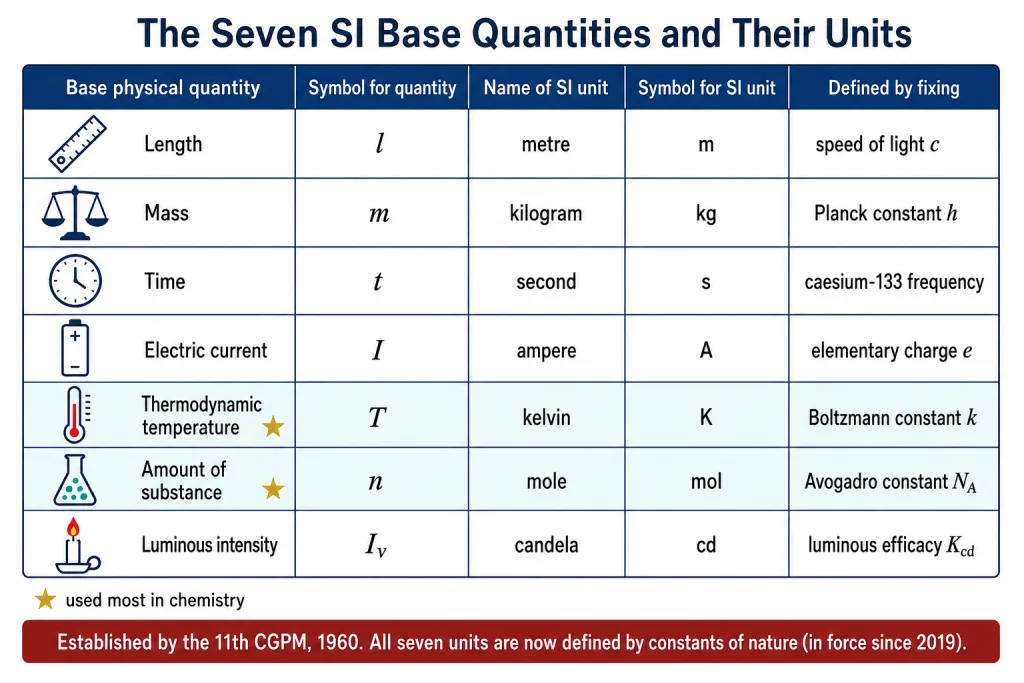
| Base physical quantity | Symbol for quantity | Name of SI unit | Symbol for SI unit |
|---|---|---|---|
| Length | metre | m | |
| Mass | kilogram | kg | |
| Time | second | s | |
| Electric current | ampere | A | |
| Thermodynamic temperature | kelvin | K | |
| Amount of substance | mole | mol | |
| Luminous intensity | candela | cd |
Reading the table
- Quantity symbols are italic (, ); unit symbols are upright (kg, K).
- Kilogram, not gram, is the base unit of mass; it is the only base unit with a prefix in its name.
- Kelvin takes no degree sign: 298 K, never 298 °K. Celsius keeps it: 25 °C.
- Unit names are lower case (kelvin, ampere); symbols named after people are capitals (K, A). Symbols are never pluralised and never take a full stop: 5 kg, not 5 kgs or 5 kg.
Key Point: Seven base quantities: length, mass, time, electric current, thermodynamic temperature, amount of substance, luminous intensity; units m, kg, s, A, K, mol, cd. Mnemonic: "My Kind Sister Always Keeps My Candles".
The two units chemists use most
- Mole (mol), unit of amount of substance, a base quantity separate from mass. It lets you count atoms by weighing them (Section 6).
- Kelvin (K), unit of thermodynamic temperature. Gas-law and thermodynamics calculations use kelvin, never °C.
Derived quantities
A derived quantity is a formula in the base quantities; its unit follows from the formula:
| Derived quantity | Formula | SI unit |
|---|---|---|
| Area | ||
| Volume | ||
| Speed | ||
| Density | ||
| Force | acceleration | (newton, N) |
| Pressure | force / area | (pascal, Pa) |
| Energy | force distance | (joule, J) |
| Molar mass | (chemists use ) | |
| Molarity | (chemists use ) |
The same reduction works for any unit, e.g. the gas constant : .
[NEET] "Which is not an SI base unit?" Distractors: litre, newton, joule, gram, degree Celsius; anything outside the seven-row table.
Modern Definitions of the Base Units: Constants of Nature, Not Artefacts
Old standards were physical objects, and objects scratch, corrode and lose atoms. The modern SI (adopted by the CGPM in November 2018, in force since 20 May 2019) removes every artefact: each base unit is defined by fixing the numerical value of a constant of nature, so any good laboratory can realise it independently.
| Unit | Defined by fixing… | Fixed numerical value | …expressed in the unit |
|---|---|---|---|
| second (s) | caesium frequency (ground-state hyperfine transition of ) | Hz | |
| metre (m) | speed of light in vacuum | ||
| kilogram (kg) | Planck constant | J s | |
| ampere (A) | elementary charge | C A s | |
| kelvin (K) | Boltzmann constant | ||
| mole (mol) | Avogadro constant | ||
| candela (cd) | luminous efficacy of Hz radiation |
How the definitions chain together
The second depends on nothing else: caesium-133 ticks times per second by definition. The metre uses the second: 1 m is the distance light covers in s. The kilogram uses both through the unit of (J s ); the ampere, kelvin and candela likewise build on units already fixed. Only the mole stands alone, a count of exactly entities.
Key Point (Definition): The mole is the SI unit of amount of substance. One mole contains exactly elementary entities. This is the fixed numerical value of the Avogadro constant in , called the Avogadro number. An elementary entity may be an atom, molecule, ion, electron, any other particle, or a specified group of particles.
Learn which constant defines which unit, , and ; not the nine-digit values.
Reference standards
A defined unit still needs reference standards against which every metre stick and balance is calibrated.
The kilogram. From 1889 the standard was the International Prototype Kilogram, a platinum-iridium (Pt-Ir) cylinder kept in an airtight jar at Sevres, France. Pt-Ir resists chemical attack, so its mass should stay constant for a very long time; even so, it drifted by tens of micrograms over a century relative to its copies. The replacement came from counting atoms: X-rays give the atomic density of ultra-pure silicon, hence the number of atoms in a known mass, to about 1 part in . This fixed the Avogadro constant and led to the 2019 redefinition through .
The metre. Originally two marks on a Pt-Ir bar at 0 °C (273.15 K); in 1960, wavelengths of the orange-red light of krypton-86 (a discharge lamp, not a laser). In 1983 the CGPM redefined it as the path travelled by light in vacuum in of a second.
| Standard | Old artefact | Intermediate | Modern |
|---|---|---|---|
| kilogram | Pt-Ir cylinder, Sevres (1889) | search via Avogadro constant / silicon sphere | Planck constant (2019) |
| metre | Pt-Ir bar at 0 °C | Kr-86 wavelengths (1960) | light in vacuum in s (1983) |
[NEET] Kilogram standard since 1889, Pt-Ir, kept at Sevres, France, chosen for resistance to chemical attack. Metre: 1960 krypton, 1983 light.
SI Prefixes: From yocto to yotta
A hydrogen atom is about 0.000 000 000 106 m across. SI prefixes mark multiples or sub-multiples of a unit by powers of ten and give handy sizes: 1 nm, 250 mL, 5 MPa.
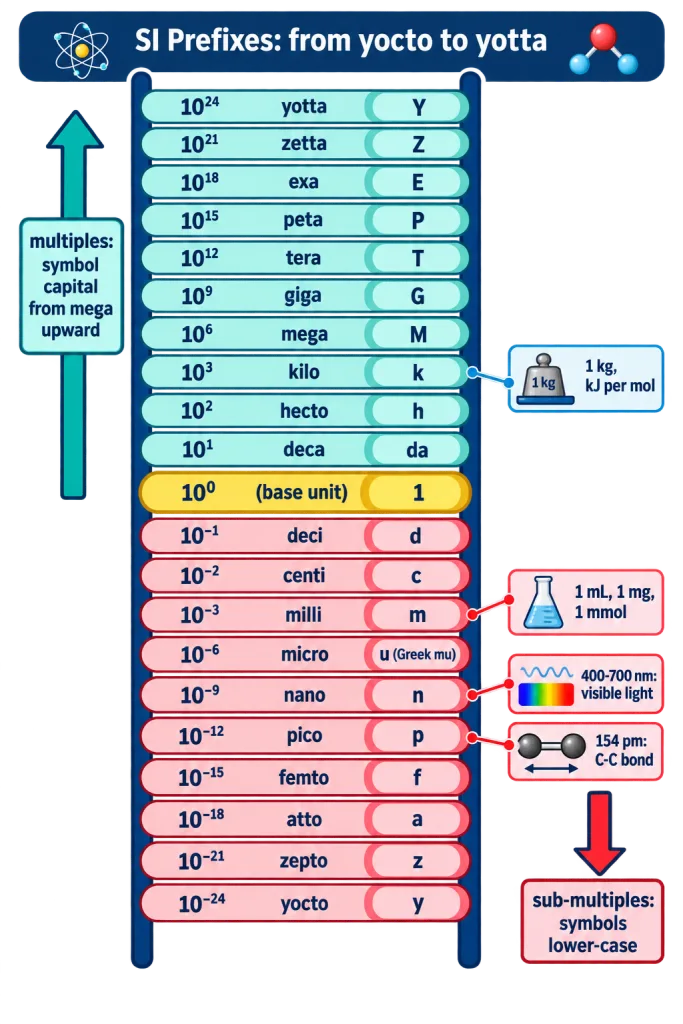
| Multiple | Prefix | Symbol | Multiple | Prefix | Symbol |
|---|---|---|---|---|---|
| yocto | y | deca | da | ||
| zepto | z | hecto | h | ||
| atto | a | kilo | k | ||
| femto | f | mega | M | ||
| pico | p | giga | G | ||
| nano | n | tera | T | ||
| micro | peta | P | |||
| milli | m | exa | E | ||
| centi | c | zetta | Z | ||
| deci | d | yotta | Y |
Patterns in the table
- Beyond the prefixes go in steps of ; only centi, deci, deca and hecto sit at and .
- Sub-multiple symbols are lower case; multiples from mega up are capitals, except kilo (k). So mg is a milligram, Mg a megagram (a tonne).
Prefixes chemistry uses every day
| Prefix | Example |
|---|---|
| nano (n, ) | light, 400–700 nm; nanoparticles |
| pico (p, ) | bond lengths: C-H 109 pm, O-H 96 pm |
| micro (, ) | micropipettes, 20 L; trace g |
| milli (m, ) | mL, mg, mmol: everyday laboratory units |
| centi / deci (c, d) | cm and dm for volume |
| kilo (k, ) | kg, kJ mol (enthalpies), kPa |
| mega / giga (M, G) | MPa (high pressure); GHz frequencies |
Rules for using prefixes
- Prefix attaches directly to the symbol: 5 nm, not 5 n m.
- No compound prefixes: 1 nm, never 1 mm; 1 pm, never 1 m.
- A power applies to the whole prefixed unit: , not . This is the commonest conversion error.
- Mass prefixes go on the gram, not the kilogram: 1 mg, never 1 kg.
Key Point: Replace the prefix by its power of ten, work in scientific notation, re-attach a prefix at the end: .
[JEE Main] Pure recall; the usual slips are zepto vs zetta and a (atto) vs A (ampere).
Mass, Weight and Volume: the Laboratory Quantities
Mass versus weight
| Mass | Weight | |
|---|---|---|
| Definition | amount of matter in a substance | force exerted by gravity on an object |
| Depends on location? | No, constant everywhere | Yes, varies with |
| Formula | none | |
| SI unit | kilogram (kg) | newton (N ) |
| Measured with | balance (against standard masses) | spring balance |
| On the Moon | same as on Earth | about one-sixth of the Earth value |
Key Point (Definition): Mass is the amount of matter in a substance; weight is the force exerted by gravity on it. Mass is constant; weight varies from place to place with gravity. A chemist "weighs" a sample, but the balance reports mass.
A balance compares the sample with standard masses in the same place, so cancels and it reads mass; an analytical balance reads to 0.1 mg. The gram is the working unit: 1 kg = 1000 g, 1 g = 1000 mg.
Volume
Volume is the space a substance occupies, with units of ; the SI unit is the cubic metre, m, about a thousand litres. Laboratories use cm, dm, and the non-SI litre (L) and millilitre (mL).
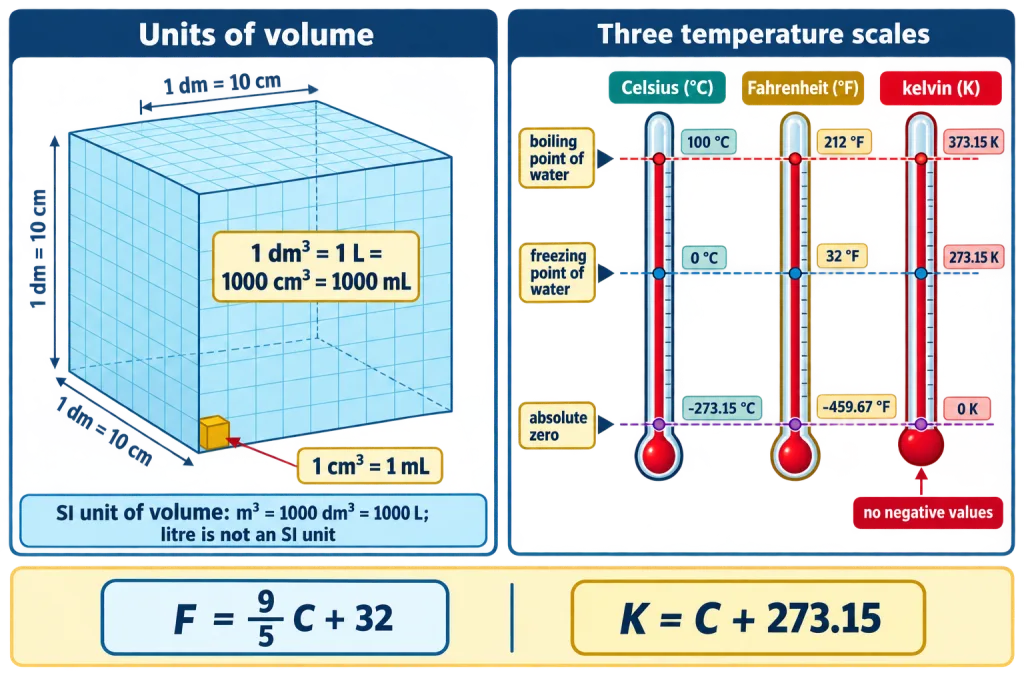
A 1 dm (10 cm) cube holds , one litre; and .
| Unit | Equals | Notes |
|---|---|---|
| 1 m | dm = cm = 1000 L | SI unit; too large for benchwork |
| 1 dm | 1 L = 1000 cm = 1000 mL | litre: non-SI, accepted with SI |
| 1 cm | 1 mL L m | "cc" in medicine |
| 1 L | mL L | micropipette volumes |
Glassware that measures volume
| Apparatus | What it does | Precision |
|---|---|---|
| Graduated (measuring) cylinder | rough liquid volumes | low, about 1% |
| Burette | delivers a variable, accurately known volume (titration) | high, 0.05 mL |
| Pipette | delivers one fixed, accurately known volume (10 mL, 25 mL) | high |
| Volumetric flask | prepares a known volume of solution: dissolve, make up to the mark | high, calibrated at 20 °C |
Burette and pipette deliver; a volumetric flask contains. "Prepare 250 mL of 0.1 M NaOH" means a 250 mL volumetric flask, never a beaker.
Convert a volume to the formula's unit before substituting: molarity uses L (dm), density in g cm uses cm (mL), SI gas-law work uses m; covers all three.
Density and Temperature
Density: mass per unit volume
Higher density means more tightly packed particles. The unit follows from the formula:
The SI unit is large (water: 1000 kg m), so chemists use g cm (= g mL):
| Substance | Density / g cm | Density / kg m |
|---|---|---|
| Water (4 °C) | 1.00 | 1000 |
| Ethanol | 0.79 | 790 |
| Mercury | 13.6 | 13 600 |
| Aluminium | 2.70 | 2700 |
| Air (STP) | 0.0013 | 1.3 |
Key Point: Density = mass / volume. SI unit kg m; laboratory unit g cm; .
Density links volume to mass: turns "10 mL of ethanol" into grams, and converts molarity to molality (Section 9). Liquids expand on heating, so density and molarity change with temperature.
Temperature: three scales
The scales are °C (degree celsius), °F (degree fahrenheit) and K (kelvin), the SI unit.
| Scale | Freezing point of water | Boiling point of water | Divisions between them | Unit symbol |
|---|---|---|---|---|
| Celsius | 0 °C | 100 °C | 100 | °C |
| Fahrenheit | 32 °F | 212 °F | 180 | °F |
| Kelvin | 273.15 K | 373.15 K | 100 | K (no degree sign) |
100 Celsius degrees span 180 Fahrenheit degrees, so one Celsius degree is Fahrenheit degrees; add the offset of 32:
The kelvin degree is the same size as the Celsius degree, but the scale starts at absolute zero, 273.15 degrees below the freezing point of water:
So 25 °C = 298.15 K (usually 298 K), 0 °C = 273.15 K, 100 °C = 373.15 K. A temperature difference is the same number in °C and K: 20 °C to 50 °C is a rise of 30 °C = 30 K.
Why negative kelvin is impossible
Negative Celsius values are ordinary (a freezer at °C). Zero kelvin is absolute zero, where particles have the minimum possible energy; nothing lies below it. Celsius uses an arbitrary zero, kelvin the true one, so thermodynamic formulae (gas laws, ), which need a scale proportional to particle energy, must use kelvin.
Key Point: Negative values are possible on the Celsius and Fahrenheit scales but not on the kelvin scale, because 0 K is absolute zero, the lowest attainable temperature. °C K.
[NEET] Gas-law and thermodynamic work uses K, never °C; is the one reading shared by the Celsius and Fahrenheit scales.
Solved Examples
Question 1: The number and the unit
The length of a laboratory bench is recorded as 6 m. (i) Identify the number and the unit. (ii) Express the same length in centimetres, millimetres and kilometres. (iii) State how the number changes as the unit changes.
Answer: In "6 m", 6 is the number and m (metre) is the unit.
1 m = 100 cm, so 6 m cm. 1 m = 1000 mm, so 6 m mm. 1 km = 1000 m, so 6 m km.
The length is unchanged: a smaller unit needs a larger number and vice versa.
Ans: 6 m = 600 cm = 6000 mm = km.
Question 2: Base or derived?
Classify the following as SI base quantities or derived quantities, and give the SI unit of each: (i) amount of substance (ii) density (iii) thermodynamic temperature (iv) volume (v) luminous intensity (vi) molar mass.
Answer: Base: (i) amount of substance, mole (mol); (iii) thermodynamic temperature, kelvin (K); (v) luminous intensity, candela (cd).
Derived, unit from the formula: (ii) density , ; (iv) volume , ; (vi) molar mass , (in practice ).
Ans: (i), (iii), (v) are base quantities; (ii), (iv), (vi) are derived.
Question 3: Prefix arithmetic
Express (i) 250 mg in g and in kg; (ii) 2.5 L in mL and in L; (iii) 154 pm (the C-C bond length) in nm and in m; (iv) 3 GPa in Pa; (v) 0.000 000 000 002 s using a suitable prefix.
Answer: (i) milli : 250 mg g g kg.
(ii) micro : 2.5 L L mL.
(iii) pico : 154 pm m m nm.
(iv) giga : 3 GPa Pa.
(v) s s ps.
Ans: (i) 0.25 g kg; (ii) mL L; (iii) 0.154 nm m; (iv) Pa; (v) 2 ps.
Question 4: Using the constant-based definitions
(i) How many oscillations of the caesium-133 hyperfine transition occur in exactly one minute? (ii) What distance does light travel in vacuum in 1 s? (iii) Which constant defines the kilogram, and in what unit is its value fixed?
Answer: (i) Hz, so in 60 s: oscillations.
(ii) exactly, so distance m m.
(iii) The Planck constant, in J s ; the metre and second are already fixed through and .
Ans: (i) oscillations; (ii) about 300 m; (iii) the Planck constant, in J s ().
Question 5: Mass versus weight on the Moon
A sample of sodium chloride has a mass of 5.0 kg on Earth, where . It is carried to the Moon, where . Find its mass and its weight in both places.
Answer: Mass does not depend on location: 5.0 kg on Earth and on the Moon.
Weight is . Earth: N. Moon: N. The ratio .
Ans: Mass 5.0 kg in both places; weight 49 N on Earth and 8.1 N on the Moon.
Watch out: Mass in kg, weight in N. A balance calibrated against standard masses still reads 5.0 kg on the Moon.
Question 6: Volume conversions across the whole ladder
(i) Express 2.5 L in mL, cm, dm and m. (ii) A gas cylinder has an internal volume of 0.045 m. Express this in litres. (iii) A burette delivers 23.60 cm of solution. Express this in L.
Answer: (i) 2.5 L = 2500 mL = 2500 cm (1 mL = 1 cm) = 2.5 dm (1 L = 1 dm). With 1 m = 1000 L, 2.5 L m.
(ii) 0.045 m 1000 L m = 45 L.
(iii) 23.60 cm = 23.60 mL L L.
Ans: (i) 2500 mL = 2500 cm = 2.5 dm m; (ii) 45 L; (iii) 0.02360 L.
Question 7: Density from a laboratory measurement
A student pipettes 15.0 mL of ethanol into a pre-weighed flask and finds its mass to be 11.85 g. (i) Calculate the density of ethanol in g cm. (ii) Convert it to kg m. (iii) Would the same volume of mercury (density 13.6 g cm) be heavier or lighter, and by how much?
Answer: (i) (1 mL = 1 cm).
(ii) , since .
(iii) Mercury: g, heavier by g, about 17 times the ethanol.
Ans: (i) 0.790 g cm; (ii) 790 kg m; (iii) mercury 204 g, about 192 g heavier.
Question 8: Density as the mass-volume bridge
(i) What mass of mercury (density 13.6 g cm) fills a 250 mL flask? (ii) What volume is occupied by 39.5 g of ethanol (density 0.79 g mL)? (iii) A sulphuric acid solution has density 1.20 g mL; what is the mass of 500 mL of it, in kg?
Answer: (i) g kg.
(ii) mL.
(iii) g kg.
Ans: (i) 3400 g (3.4 kg); (ii) 50.0 mL; (iii) 0.600 kg.
Question 9: Celsius to Fahrenheit and kelvin
Normal human body temperature is 37 °C. Express it (i) in °F and (ii) in K. (iii) A hot day in Delhi reaches 113 °F; what is this in °C?
Answer: (i) °F.
(ii) K.
(iii) °C.
Ans: (i) 98.6 °F; (ii) 310.15 K; (iii) 45 °C.
Watch out: To °F, multiply by 9/5 then add 32; back to °C, subtract 32 first.
Question 10: Kelvin to Celsius to Fahrenheit, and the crossing point
(i) Convert 300 K to °C and then to °F. (ii) At what temperature do the Celsius and Fahrenheit scales give the same reading? (iii) Liquid nitrogen boils at 77 K; express this in °C.
Answer: (i) °C. Then °F.
(ii) Let the common reading be : . Check: .
(iii) °C, usually quoted as °C.
Ans: (i) 26.85 °C = 80.33 °F; (ii) °C °F; (iii) °C.
Question 11: Temperature differences and the limits of the kelvin scale
(i) A solution is heated from 20 °C to 45 °C. Express the rise in temperature in °C, K and °F. (ii) A student claims to have cooled a gas to °C. Show why this is impossible.
Answer: (i) Rise °C. Kelvin and Celsius degrees are the same size, so K (; the 273.15 cancels). Each Celsius degree is Fahrenheit degrees, so °F.
(ii) In kelvin, K. Negative kelvin would mean less than the minimum possible energy; 0 K ( °C) is the lowest temperature that exists.
Ans: (i) 25 °C = 25 K = 45 °F; (ii) °C would be K, below absolute zero, so impossible.
Watch out: In a temperature difference the offset 32 cancels; do not add it.
Question 12: Choosing the apparatus and the unit
A student must prepare 250 mL of a sodium chloride solution containing exactly 5.85 g of NaCl, then titrate 25.0 mL portions of it. (i) Name the apparatus for weighing the salt, preparing the solution, taking the 25.0 mL portion and delivering the titrant. (ii) Express 250 mL in dm and m. (iii) If the solution's density is 1.014 g mL, what is its total mass?
Answer: (i) Weighing: analytical balance. Preparing the solution: 250 mL volumetric flask. Fixed 25.0 mL portion: pipette. Variable, accurately measured volume: burette.
(ii) 250 mL = 0.250 dm (= 0.250 L); with 1 m = 1000 dm, that is m.
(iii) g.
Ans: (i) analytical balance, volumetric flask, pipette, burette; (ii) 0.250 dm m; (iii) 253.5 g.
Watch out: Volumetric flask prepares, pipette takes a fixed volume, burette delivers a variable one; a graduated cylinder is for rough work only.