
What an Atomic Model Has to Explain
Section 1 left us with three pieces: the electron (negative, almost massless), the proton (positive, about 1836 times heavier) and the neutron (neutral, slightly heavier than the proton). The next question is how they are arranged inside the atom. Any model has to pass a short checklist:
| The model must explain… | Why it is non-negotiable |
|---|---|
| Neutrality — atoms carry no net charge | Positive and negative charges must exactly cancel |
| Stability — atoms last essentially forever | Opposite charges attract; something must stop them collapsing |
| The mass — almost all of it belongs to the positive part | Electrons contribute about of a proton's mass |
| Later experiments — scattering, spectra | A model that contradicts an experiment is finished |
Thomson's model passed the neutrality test and failed the experiment test. Rutherford's passed the experiment test and failed the stability test. That second failure is why the rest of this chapter exists.
Thomson's model (1898) — the plum pudding
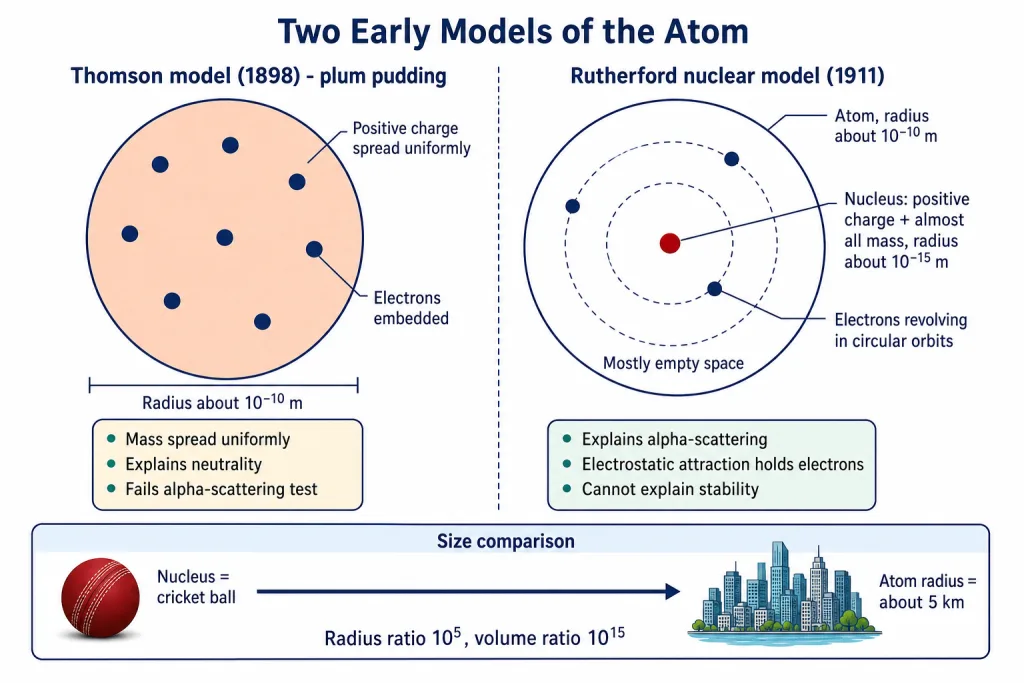
J. J. Thomson, who had discovered the electron a year earlier, proposed in 1898 that an atom is a sphere of radius roughly m in which the positive charge is spread uniformly, with the electrons embedded in this positive jelly at the positions of greatest electrostatic stability — like plums in a pudding, raisins in a cake, or seeds in a watermelon. All three names are used; plum pudding model is the one examiners expect.
Key Point: In Thomson's model (i) the positive charge is uniformly distributed over a sphere of radius m, (ii) the electrons are embedded in it, and (iii) the mass of the atom is assumed to be spread uniformly over the whole atom. There is no nucleus.
It explains neutrality: the embedded electrons' total negative charge equals the pudding's positive charge. It appears to explain stability too, since the electrons sit still at their equilibrium positions.
The fatal assumption is the one in bold — that mass and positive charge are smeared out. It predicts something very specific about firing a fast positive particle at an atom, and within a few years that prediction was tested and destroyed.
Thomson's Nobel Prize — a common trap
Thomson received the Nobel Prize in Physics in 1906 for his investigations on the conduction of electricity by gases — the cathode-ray work that led to the electron, not the plum pudding model. A question pairing "1906 Nobel Prize" with "for the plum pudding model" is setting a trap.
[Board] A two-mark answer on Thomson's model needs: sphere of uniformly distributed positive charge with embedded electrons, the alternative names, that it explains neutrality, and that it failed the scattering test.
[NEET] Keep the dates straight: electron discovered 1897, plum pudding proposed 1898, Nobel Prize 1906, Rutherford's scattering experiment 1909 to 1911.
Rutherford's -Particle Scattering Experiment
Ernest Rutherford, with Hans Geiger and Ernest Marsden, settled where the atom's mass and positive charge live. The method: throw something small and fast at an atom and watch where it comes out.
The set-up
| Component | Detail |
|---|---|
| Projectile | -particles (helium nuclei, : charge , mass 4 u) from a radioactive source |
| Beam | Narrowed by a lead block with a slit so the particles travel in a fine pencil |
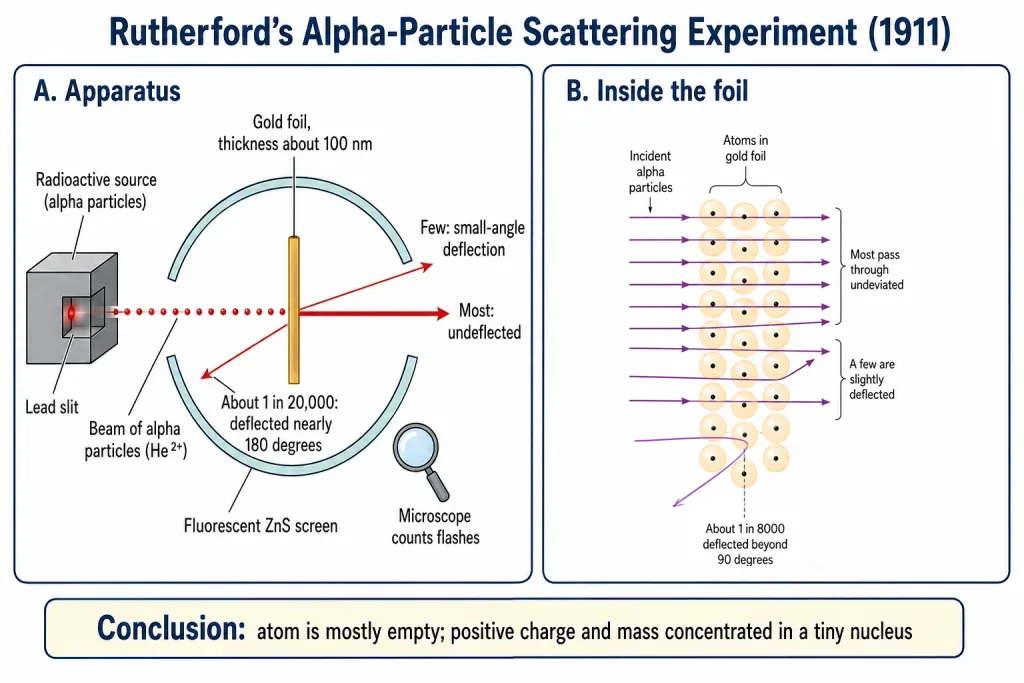
| Target | A very thin gold foil, thickness about 100 nm (only a few hundred atoms thick) |
| Detector | A circular fluorescent zinc sulphide (ZnS) screen surrounding the foil; each -particle striking it produces a tiny flash of light, counted through a microscope |
Gold was chosen because it beats into a foil thin enough for most particles to get through, and its atoms are heavy — which matters a great deal.
What Thomson's model predicted
If a gold atom's mass and positive charge were spread evenly through a sphere m across, an -particle passing through would feel only a feeble, diffuse push and be nudged by a small angle. Nothing in the pudding is dense enough or charged enough to stop a fast helium nucleus. Rutherford expected a slight blurring of the beam and nothing more.
The three observations
| Observation | What was seen |
|---|---|
| (i) | Most -particles passed straight through the gold foil undeflected |
| (ii) | A small fraction was deflected by small angles |
| (iii) | A very few — about 1 in 20,000 — bounced back, i.e. were deflected by nearly 180° |
Observation (iii) changed physics. In Rutherford's own words, it was as if you fired a 15-inch shell at tissue paper and it came back and hit you. A soft, uniform pudding cannot turn around a particle that heavy and fast. Something inside the atom is tiny, massive and intensely positive.
Key Point: Learn the three observations with their numbers: most undeflected, a few deflected by small angles, about 1 in 20,000 turned back through nearly .
Reading the observations correctly
Each observation carries a separate piece of information:
- "Most pass straight through" tells you about space — nearly all of the atom's volume holds nothing that can deflect an -particle.
- "A few are deflected by small angles" tells you about charge — those particles passed close enough to a concentrated positive region to be pushed sideways.
- "About 1 in 20,000 bounce back" tells you about mass and size — a head-on collision with something far heavier than the -particle, and the rarity says that something is extremely small.
[JEE Main] The deflection angle depends on how close the path passes to the nucleus (the impact parameter). A head-on approach gives ; a distant pass gives almost zero. Since the target is minuscule, the fraction deflected falls off steeply as the angle grows.
Rutherford's Conclusions and the Nuclear Model
From the three observations Rutherford drew three conclusions, and from those a model. Keep the chain — observation, conclusion, postulate — because examiners ask for any link of it.
The three conclusions
| Observation | Conclusion |
|---|---|
| Most -particles pass through undeflected | (i) Most of the space in the atom is empty. |
| A few positively charged -particles are deflected | (ii) The positive charge is not spread throughout the atom as Thomson presumed; the deflection needs an enormous repulsive force, so the positive charge must be concentrated in a very small volume. |
| Only about 1 in 20,000 bounce back | (iii) The volume of the nucleus is negligibly small compared with the volume of the atom. Rutherford's calculations gave an atomic radius of about m and a nuclear radius of about m. |
The size of the nucleus
The ratio of radii is , so the atom is a hundred thousand times wider than its nucleus. Volume scales as the cube of the radius, so the nucleus takes about 1 part in of the atom's volume. If a cricket ball represents the nucleus, the atom would have a radius of about 5 km.
Key Point: Radius of atom m (1 Å = 100 pm); radius of nucleus m (1 fm). Ratio in radius, in volume. Cricket ball : 5 km.
That packing makes the nucleus enormously dense: nearly all the atom's mass in of its volume gives nuclear matter a density of order kg m.
The nuclear model of the atom
Rutherford proposed the nuclear model:
- The positive charge and most of the mass of the atom are densely concentrated in an extremely small region, which he called the nucleus.
- The nucleus is surrounded by electrons that move around it at very high speed in circular paths called orbits — the solar-system picture, with the nucleus as the Sun.
- Electrons and the nucleus are held together by electrostatic forces of attraction (the Coulomb force), as planets are held by gravitation.
Postulate 2 answers the stability problem. Electrons in a pudding could sit still; electrons in a nuclear atom cannot, or they would fall straight in. So he set them moving, as the Earth's motion keeps it from falling into the Sun. The answer looks reasonable and is wrong, for a reason to do with charge, not gravity.
Thomson versus Rutherford at a glance
| Feature | Thomson (1898) | Rutherford (1911) |
|---|---|---|
| Positive charge | Uniformly spread over the atom | Concentrated in a tiny central nucleus |
| Mass | Uniformly spread | Almost entirely in the nucleus |
| Electrons | Embedded, stationary | Revolving in circular orbits |
| Empty space | None | Almost all of the atom |
| Explains neutrality | Yes | Yes |
| Explains -scattering | No | Yes |
| Explains stability | Apparently | No (see drawbacks) |
[NEET] The planetary or solar-system model is Rutherford's; the model with electrons embedded in positive charge is Thomson's; the nucleus was discovered by Rutherford from -scattering in 1911.
Atomic Number, Mass Number and the Notation
The nucleus gives every element two identifying numbers, and the bookkeeping that follows carries a large share of the marks in this section.
Atomic number,
The nucleus gets its positive charge from its protons, and the number of protons is the atomic number, . Hydrogen has 1 proton, so ; sodium has 11, so . In a neutral atom the electrons must exactly cancel the protons' charge, so there are electrons too.
Key Point (Definition):
is the identity card of an element. Change the proton count and you have a different element; change anything else and the element stays the same.
Mass number,
Protons and neutrons together are called nucleons. Each has a mass of about 1 u while an electron has about 0.00054 u, so nucleons carry essentially all the atom's mass. Their total number is the mass number, .
Key Point (Definition):
So the neutron count is . is a count and always a whole number; it is not the atomic mass in u (chlorine's is 35.45), though for a single isotope the two are close.
The notation
An atom's composition is written with the element symbol , the mass number as a left superscript and the atomic number as a left subscript:
Two practical points:
- Because fixes the element, the subscript is redundant once the symbol is written. and mean the same thing and both are acceptable.
- The positions are not interchangeable. Atomic number on top, or mass number below, gives a symbol that is simply wrong.
The counting recipe — neutral atoms, cations and anions
Every "count the particles" question uses the same three lines; only the electron line changes with charge:
| Species | Protons | Neutrons | Electrons |
|---|---|---|---|
| Neutral atom | |||
| Cation | |||
| Anion |
Three things never change when an atom becomes an ion: protons, neutrons and therefore the mass number. Ionisation is purely an electron transaction — a cation has lost electrons, an anion has gained them.
Key Point: Before using , decide whether the species is a neutral atom, a cation or an anion. If neutral, electrons . More protons than electrons means a cation; fewer means an anion. Neutrons are always , charged or not.
Check with : 12 protons, neutrons, electrons. And : 8 protons, 8 neutrons, electrons. Both have 10 electrons, so they are isoelectronic with neon.
[JEE Main] The reverse problem — "a species has 18 electrons, 16 protons and 16 neutrons; write its symbol" — is as common as the forward one. Protons give , sulphur; protons plus neutrons give ; electrons minus protons give a charge of 2 negative. Answer: .
Isotopes and Isobars
With and in hand, two relationships between atoms can be named — and one of them barely affects chemistry.
Isotopes — same , different
Key Point (Definition): Isotopes are atoms with the same atomic number but different mass numbers. They are atoms of the same element differing only in the number of neutrons.
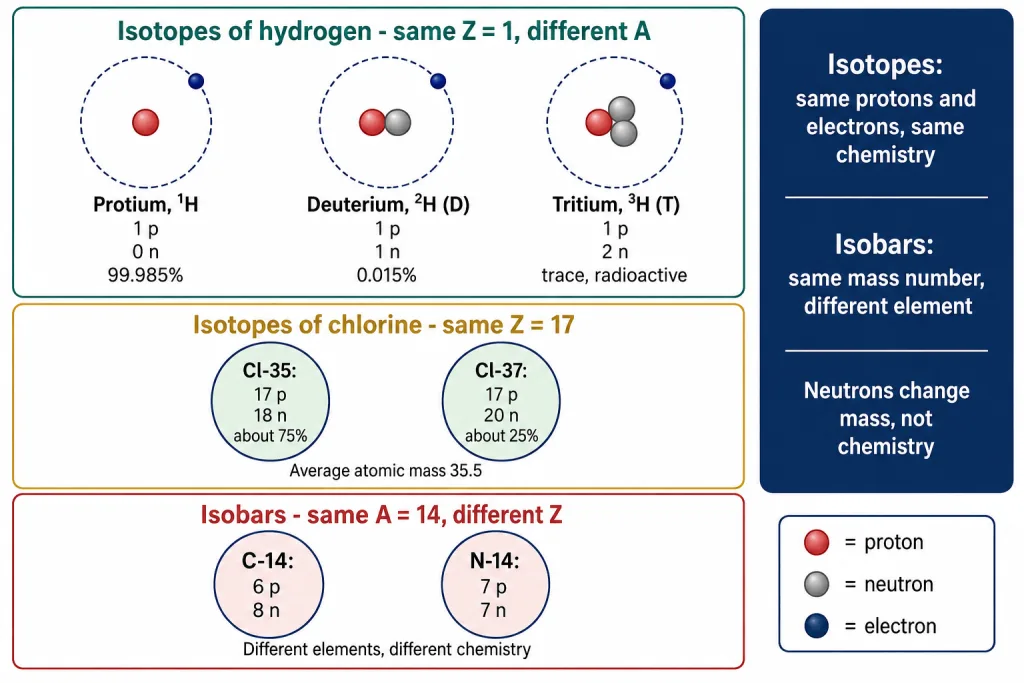
Since and is fixed, can differ only if differs. The classic examples:
| Element | Isotope | Protons | Neutrons | Electrons | Natural abundance / note |
|---|---|---|---|---|---|
| Hydrogen | Protium, | 1 | 0 | 1 | 99.985% |
| Deuterium, (D) | 1 | 1 | 1 | 0.015% | |
| Tritium, (T) | 1 | 2 | 1 | Trace amounts on Earth; radioactive | |
| Carbon | 6 | 6 | 6 | 98.9%; defines the atomic mass unit | |
| 6 | 7 | 6 | About 1.1%; used in NMR | ||
| 6 | 8 | 6 | Trace; radioactive, used in carbon dating | ||
| Chlorine | 17 | 18 | 17 | About 75% | |
| 17 | 20 | 17 | About 25% |
Hydrogen is the only element whose isotopes have their own names and symbols (D and T). Protium has no neutrons at all — a lone proton for a nucleus. The 3 : 1 mixture of and is why chlorine's atomic mass is 35.5, not a whole number.
Isobars — same , different
Key Point (Definition): Isobars are atoms of different elements with the same mass number but different atomic numbers.
The standard pair is and : both have 14 nucleons, but carbon-14 has 6 protons and 8 neutrons while nitrogen-14 has 7 and 7. Others: , and ; and . Isobars are different elements with entirely different chemistry; the equal mass number is a coincidence of nucleon count.
A memory hook: isotopes — same type of atom (same element, same ); isobars — same bulk (same mass number ).
Why isotopes of an element behave alike chemically
Chemical properties are controlled by the electrons — how many there are and how they are arranged — since chemistry is electrons being shared, lost and gained. The proton count fixes the electron count of a neutral atom, and neutrons, being uncharged, change neither that count nor the nucleus's pull on the electrons. So all isotopes of an element have the same number of electrons, the same electronic arrangement, and the same chemical behaviour.
Neutrons do affect mass, so isotopes differ slightly in mass-dependent physical properties: density, rate of diffusion, boiling and melting points, and reaction rates (marked for hydrogen, where the mass doubles from H to D). Heavy water, , boils at instead of and is about 11% denser than ordinary water, but reacts the same way.
Key Point: Isotopes have identical chemical properties because they have identical numbers of electrons and protons; they differ in physical properties that depend on mass, because their neutron numbers differ.
Three "iso-" words in one table
| Term | Same | Different | Example |
|---|---|---|---|
| Isotopes | (protons, electrons) | (neutrons) | , |
| Isobars | (nucleons) | , | |
| Isoelectronic species | number of electrons | , charge | , , Ne, , (10 e each) |
[NEET] For "which pair is isobaric / isotopic?", check the subscripts first: same subscript with different superscript means isotopes; same superscript with different subscript means isobars. A related term is isotones — same number of neutrons, different (for example and , both with 7 neutrons) — which turns up as a distractor.
Drawbacks of Rutherford's Model — Why the Atom Should Not Exist
Rutherford's atom looks like a miniature solar system, and the resemblance runs deeper than the picture. Gravitation gives ; the Coulomb force gives . Same mathematical form, so classical mechanics should hand the electron neat orbits just as it does the planets. The comparison holds in every respect but one, and that one destroys the model.
Drawback 1 — the radiating electron
An object moving in a circle is accelerating even at constant speed, because its direction keeps changing. Planets accelerate too and nothing goes wrong. But an electron is charged, and Maxwell's theory intervenes:
Key Point: According to Maxwell's electromagnetic theory, a charged particle that is accelerated must emit electromagnetic radiation. (Planets are uncharged, so the rule does not apply to them.)
The consequences follow step by step:
- The orbiting electron is a charged particle under acceleration, so it must continuously radiate energy.
- That energy comes from the electron's own motion.
- Losing energy, the electron cannot stay at the same distance; its orbit shrinks continuously.
- It spirals inward, emitting radiation of steadily increasing frequency, and falls into the nucleus.
- Calculations put the whole collapse at about s.
Ten nanoseconds. Every atom should have collapsed almost as soon as it formed, leaving no stable matter at all. Since that plainly does not happen, Rutherford's model cannot explain the stability of the atom.
Making the electrons stationary does not rescue it. A stationary electron has nothing to balance the nucleus's pull, so it is dragged straight in and you get a miniature Thomson model. Moving electrons radiate and fall in; stationary electrons simply fall in.
Drawback 2 — silence on the electrons
The model also says nothing about how the electrons are distributed around the nucleus or what energies they have. It places them "in orbits" without saying which orbits, how big, or how many electrons each holds, and it cannot explain why atoms emit light only at certain sharp frequencies — the line spectra of Section 5. A model silent on the arrangement and energies of electrons is silent on what decides chemistry.
| Drawback | One-line version |
|---|---|
| Stability | An accelerating charged electron must radiate (Maxwell), lose energy and spiral into the nucleus in about s |
| Electron distribution | Says nothing about how electrons are arranged around the nucleus or what their energies are |
What comes next
Niels Bohr found the way out in 1913, but only after physics accepted that light comes in packets and that atoms emit light only at particular frequencies. Those two developments — the dual nature of radiation and atomic spectra — fill the next three sections, and Bohr's first postulate answers the s spiral directly.
Exam playbook for this section
| Question type | What to write |
|---|---|
| Describe Thomson's model (2 marks) | Sphere of radius m; uniform positive charge; electrons embedded; explains neutrality; failed the scattering test |
| Observations of -scattering (3 marks) | Most undeflected; few small angles; about 1 in 20,000 back through nearly |
| Conclusions / nuclear model (3 marks) | Mostly empty; positive charge concentrated in tiny nucleus; nucleus m vs atom m; electrons revolve; electrostatic attraction |
| Drawbacks (2 marks) | Radiating accelerated electron spirals in within s; nothing about electron distribution and energies |
| Count , , | ; ; for neutral, for cation, for anion |
| Isotopes vs isobars | Same different / same different , with the standard examples |
[Board] In a "drawbacks of Rutherford's model" answer, name Maxwell and quote s. Those two details separate full marks from half.
Solved Examples
Question 1: Protons, neutrons and electrons in bromine-80
Calculate the number of protons, neutrons and electrons in .
Answer:
The subscript gives , the superscript gives , and no charge is written, so this is a neutral atom.
Protons , and for a neutral atom electrons protons . Neutrons .
Ans: 35 protons, 45 neutrons, 35 electrons.
Question 2: Assigning a symbol from particle counts
The numbers of electrons, protons and neutrons in a species are 18, 16 and 16 respectively. Assign the proper symbol to the species.
Answer:
The atomic number equals the proton count, so , which is sulphur. Mass number protons neutrons .
Protons (16) do not equal electrons (18), so the species is charged. Electrons are in excess, so it is an anion of charge units negative. That gives .
Ans: , the sulphide ion. Watch out: Decide neutral / cation / anion before writing the symbol — the electron-proton difference gives both the size and the sign of the charge.
Question 3: Neutrons and protons in five nuclei
How many neutrons and protons are there in the following nuclei: , , , , ?
Answer:
Protons , the subscript; neutrons . I apply that to each nucleus.
| Nucleus | (protons) | Neutrons | |
|---|---|---|---|
| 6 | 13 | ||
| 8 | 16 | ||
| 12 | 24 | ||
| 26 | 56 | ||
| 38 | 88 |
For the light nuclei (O, Mg) neutrons equal protons; as grows, nuclei need extra neutrons (Fe: 30 vs 26; Sr: 50 vs 38) to hold together against proton-proton repulsion.
Ans: C-13: 6 p, 7 n; O-16: 8 p, 8 n; Mg-24: 12 p, 12 n; Fe-56: 26 p, 30 n; Sr-88: 38 p, 50 n.
Question 4: Writing complete symbols from and
Write the complete symbol for the atom with the given atomic number () and atomic mass number (): (i) , ; (ii) , ; (iii) , .
Answer:
From : 17 is chlorine (Cl), 92 is uranium (U), 4 is beryllium (Be). The mass number goes on as the left superscript, the atomic number as the left subscript.
(i) — 17 protons, neutrons.
(ii) — 92 protons, neutrons.
(iii) — 4 protons, neutrons.
Ans: (i) ; (ii) ; (iii) . Watch out: on top, at the bottom, both on the left. Keep the first 30 elements and a few heavy ones (U = 92) memorised.
Question 5: An atom with 29 electrons and 35 neutrons
An atom of an element contains 29 electrons and 35 neutrons. Deduce the number of protons, identify the element and write its complete symbol.
Answer:
The question says "an atom", so the species is neutral and electrons equal protons: 29 protons, , which is copper. Mass number , so the symbol is .
Ans: 29 protons; the element is copper; . Watch out: "An atom" means neutral, so the electron count hands you directly. If the species were an ion, you would have to correct for the charge first.
Question 6: Counting electrons in molecules and ions
Give the number of electrons in each of the species: , , , , , .
Answer:
For a molecule or polyatomic ion I add the atomic numbers of all the atoms, then subtract a positive charge or add a negative one.
: electron.
: electrons.
: electrons.
: electrons.
: electrons.
: electrons.
Ans: : 1; : 2; : 15; : 32; : 10; : 50. Watch out: Total electrons with the charge taken with its sign, so a negative charge adds electrons. with 10 electrons is isoelectronic with , and Ne.
Question 7: 31.7% more neutrons than protons
An element with mass number 81 contains 31.7% more neutrons than protons. Assign the atomic symbol.
Answer:
Let the number of protons be . Then , and the mass number gives , so .
Neutrons . Checking: , close to 31.7% once the counts are rounded to whole particles.
is bromine, and "an element" means a neutral atom, so electrons .
Ans: . Watch out: " more neutrons than protons" means , not .
Question 8: An anion with 11.1% more neutrons than electrons
An ion with mass number 37 possesses one unit of negative charge. If the ion contains 11.1% more neutrons than electrons, find the symbol of the ion.
Answer:
One unit of negative charge means one extra electron, so . The neutrons are counted against the electrons: .
The mass number gives , so , giving and .
is chlorine. Electrons , neutrons . Check: , exact.
Ans: . Watch out: The percentage is stated relative to electrons, and for an ion electrons do not equal protons. Write the electron count in terms of before forming the equation.
Question 9: A cation with 30.4% more neutrons than electrons
An ion with mass number 56 contains 3 units of positive charge and 30.4% more neutrons than electrons. Assign the symbol to this ion.
Answer:
Three units of positive charge means three electrons lost, so and .
The mass number gives , so , giving and .
is iron. Electrons , neutrons . Check: , exact.
Ans: . Watch out: For a cation ; for an anion . Verifying the percentage at the end confirms both the arithmetic and the sign.
Question 10: Atoms along a length — three variations
(a) If the diameter of a carbon atom is 0.15 nm, how many carbon atoms can be placed side by side in a straight line across a 20 cm scale? (b) atoms of carbon are arranged side by side and the arrangement is 2.4 cm long. Calculate the radius of a carbon atom. (c) The diameter of a zinc atom is 2.6 Å. Calculate (i) the radius of the zinc atom in pm and (ii) the number of zinc atoms in a length of 1.6 cm if they are arranged side by side lengthwise.
Answer:
Atoms in a row touch each other, so the total length is (number of atoms) (diameter). I convert every length to metres first.
(a) Diameter m; length m.
(b) Length m spread over atoms.
(c)(i) Diameter Å, so radius Å. Since 1 Å pm, the radius is 130 pm.
(c)(ii) Diameter m; length m.
Ans: (a) carbon atoms; (b) radius m pm; (c) radius pm and zinc atoms in 1.6 cm. Watch out: Divide the length by the diameter, never by the radius. Unit conversions do the damage here: 1 nm m, 1 Å m pm, 1 pm m.
Question 11: What if the foil were aluminium?
In Rutherford's experiment, thin foils of heavy atoms like gold and platinum were bombarded with -particles. If a foil of a light element such as aluminium were used instead, what difference would be observed?
Answer:
The deflection comes from Coulomb repulsion between the positive -particle and the positive nucleus, and that force is proportional to the nuclear charge . Gold has and aluminium , so at the same distance an aluminium nucleus repels about six times more weakly.
Mass matters too. A gold nucleus (about 197 u) is far heavier than an -particle (4 u), so it acts as an immovable wall and can send the particle straight back. An aluminium nucleus (27 u) is only about seven times the -particle's mass, so it recoils on impact and even a head-on collision cannot reverse the particle completely.
With aluminium, then, fewer particles would be deflected through large angles, the angles would be smaller, and the fraction bouncing back would be well below 1 in 20,000.
Ans: Aluminium would scatter far less: fewer large-angle deflections, smaller angles, and almost no back-scattering compared with gold. Watch out: Large-angle scattering needs a nucleus that is both highly charged and heavy. Quoting only the charge, and ignoring recoil, gives an incomplete answer.
Question 12: Which bromine symbols are acceptable
The symbols and can be written, whereas and are not acceptable. Explain briefly.
Answer:
In the mass number is the left superscript and the atomic number the left subscript. Bromine has and its common isotope , so is correct.
is also fine because the element's name fixes the atomic number — every bromine atom has 35 protons. The subscript is redundant; the superscript carries the only variable information.
makes 35 the mass number and 79 the atomic number. An atom with 79 protons is gold, and a bromine atom with only 35 nucleons would need zero neutrons, impossible for .
fails because a lone subscript is read as the atomic number, and 79 is not bromine's. The mass number cannot sit in the subscript position.
Ans: and are correct; and are not. Watch out: can be dropped because the element symbol implies it, but can never move to the subscript and the two positions can never be swapped.