JEE Corner — Bohr Model Derivations, Spectral Lines, Photoelectric Graphs and Orbital Fine Print
Beyond the Board Syllabus: The Competitive Toolkit
Sections 1 to 10 cover what the Board exam wants. JEE asks for more: the velocity of the electron in the third orbit of Li2+, the number of spectral lines from a sample excited to n=5, the slope of a stopping-potential graph, the orbital angular momentum of a 3d electron, the magnetic moment of Fe3+, why palladium is 4d105s0. Textbooks hand you rn and En as finished formulae; this section builds the machinery behind them and then uses it in the worked questions.
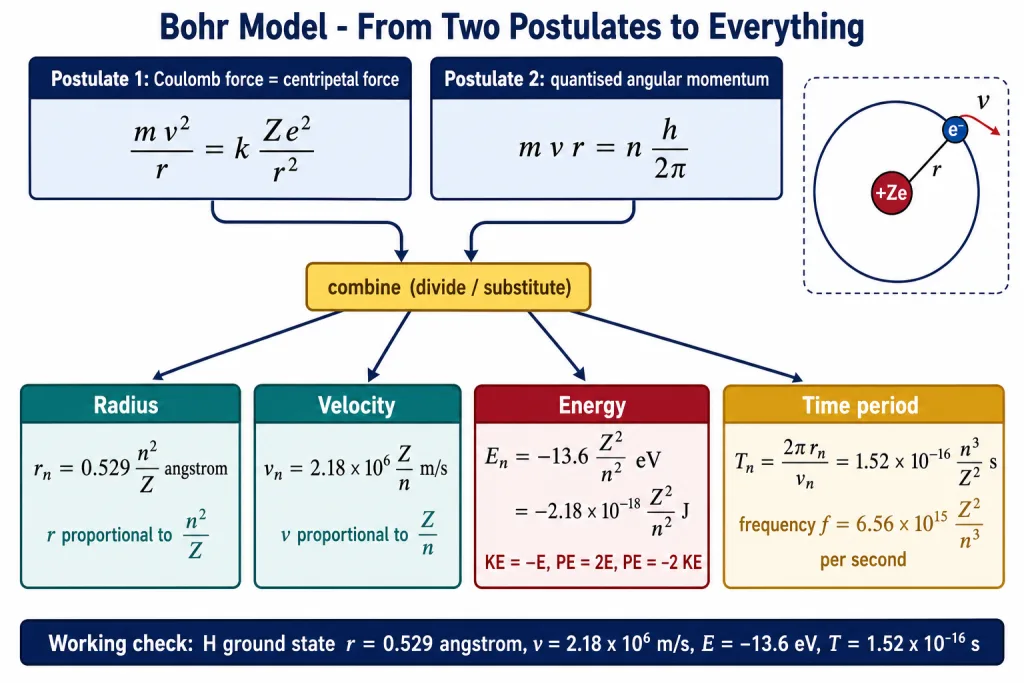
Bohr's two postulates as two equations
Take a nucleus of charge +Ze with a single electron of mass m moving in a circle of radius r at speed v. Bohr's model rests on two statements, each one line of algebra.
Postulate 1 — the Coulomb force supplies the centripetal force:rmv2=r2kZe2(k=4πε01=9×10⁹Nm2C−2)…(1)
Postulate 2 — angular momentum is quantised:mvr=2πnh,n=1,2,3,……(2)
Everything else is a consequence of these two.
Deriving the radius
Rewrite (1) as mv2r=kZe2 and square (2) to get m2v2r2=n2h2/4π2. Divide the second by the first — the v2 cancels:
mr=4π2kZe2n2h2⇒rn=4π2mkZe2n2h2=0.529Zn2A˚=52.9Zn2pm
The constant a0=0.529 Å is the Bohr radius; every other radius is a0 scaled by n2/Z.
Deriving the velocity
Divide (1) in the form mv2r=kZe2 by (2), mvr=nh/2π. Now r cancels:
vn=nh2πkZe2=2.18×10⁶nZms−1
For hydrogen in the ground state that is 2.18×10⁶ m s−1, about c/137 — fast, but not relativistic, which is why the non-relativistic model works. That ratio v1/c=1/137 is the fine-structure constant.
Deriving the energies
Kinetic energy from (1): KE=21mv2=2rkZe2.
Potential energy of a charge −e at distance r from +Ze (zero at infinity): PE=−rkZe2.
Key Point (The three energies): In any Bohr orbit
KE=−En=+13.6n2Z2eV,PE=2En=−27.2n2Z2eV,PE=−2KE
so KE:PE:E=1:−2:−1. The total energy is negative because the electron is bound, and its magnitude equals the kinetic energy (the virial theorem for an inverse-square force).
[JEE Main] "The kinetic energy of the electron in the second orbit of He+" is +13.6×4/4=13.6 eV; "its potential energy" is −27.2 eV; "its total energy" is −13.6 eV. Three near-identical sentences, three different answers. Read the noun.
Time period, frequency and revolutions per second
The electron goes once round a circumference 2πrn at speed vn:
Tn=vn2πrn=2.18×10⁶Z/n2π×0.529×10−10n2/Z=1.52×10−16Z2n3sTn∝Z2n3,fn=Tn1=6.56×1015n3Z2s−1
The frequency of revolution is also the number of revolutions per second: in 10−8 s (a typical excited-state lifetime) an electron in n=2 of hydrogen manages 6.56×1015×10−8/8=8.2×106 revolutions. Angular velocity ω=2πf∝Z2/n3 and centripetal acceleration v2/r∝Z3/n4 follow the same way.
The ratio table — memorise the exponents, not the numbers
Quantity
Depends on
Working value (H, n=1)
He+, n=2
Li2+, n=3
Radius rn
n2/Z
0.529 Å
1.058 Å
1.587 Å
Velocity vn
Z/n
2.18×10⁶ m s−1
2.18×10⁶
2.18×10⁶
Total energy En
Z2/n2
−13.6 eV
−13.6 eV
−13.6 eV
Kinetic energy
Z2/n2
+13.6 eV
+13.6 eV
+13.6 eV
Potential energy
Z2/n2
−27.2 eV
−27.2 eV
−27.2 eV
Time period Tn
n3/Z2
1.52×10⁻¹⁶ s
3.04×10⁻¹⁶ s
4.56×10⁻¹⁶ s
Angular momentum
n
h/2π
2h/2π
3h/2π
The n-th orbit of a species with Z=n has the same velocity and energy as hydrogen's ground state, but a bigger radius and a longer period. Questions are built on that coincidence.
The gap between levels shrinks fast: for hydrogen E1→E2 is 10.2 eV, E2→E3 is 1.89 eV, E3→E4 is 0.66 eV. So the gap between n=2 and n=3 of Li2+ is 9×1.89=17.0 eV — scale hydrogen's gap by Z2 instead of rederiving.
Spectral Lines: Counting Them, Ranking Them, Scaling Them
Section 5 gave the Rydberg formula and the five series. JEE asks three kinds of question on top: how many lines, which line is longest or shortest, and what changes when hydrogen becomes He+ or Li2+.
Counting the lines
Excite a sample of hydrogen atoms so that electrons reach level n. Different atoms fall by different routes, and every pair of levels below n contributes one line:
Nlines=2n(n−1)(from level n down to n=1)
For a drop that ends at a level n1 higher than 1, count only the levels between:
Nlines=2(n2−n1)(n2−n1+1)
So n=4→1 gives 6 lines, n=5→1 gives 10, and n=6→2 gives (4)(5)/2=10. For one particular series, count how many upper levels drain into that series' lower level: from n=5, Balmer gets 5→2, 4→2, 3→2 — 3 visible lines — while Lyman gets 4, Paschen 2 and Brackett 1, total 10 again.
Key Point: A single atom dropping from n can emit at most n−1 photons (one per step), and only 1 in the "all at once" case. The n(n−1)/2 formula is for a sample of many atoms. Exam keys almost always intend the sample answer even when the wording says "an electron"; use n(n−1)/2 unless the question insists on one atom.
First line, last line, and the series limit
Within any series (lower level n1 fixed), the wavenumber νˉ=RZ2(n121−n221) grows with n2. So:
First line (α line, n2=n1+1): smallest νˉ, longest wavelength, lowest energy.
Series limit (n2=∞): νˉlimit=RZ2/n12, shortest wavelength of the series, and its energy is exactly the energy needed to ionise from level n1.
Using 1/RH=1/109,677 cm =91.18 nm as the unit:
Series
n1
First line λ
Series limit λ
Region
Lyman
1
3R4=121.6 nm
R1=91.2 nm
UV
Balmer
2
5R36=656.5 nm
R4=364.7 nm
Visible
Paschen
3
7R144=1876 nm
R9=820.6 nm
Near IR
Brackett
4
9R400=4052 nm
R16=1459 nm
IR
Pfund
5
11R900=7460 nm
R25=2279 nm
Far IR
The series limits go as n12/R, so they are in the ratio 1:4:9:16:25. Each series occupies the window from its limit to its first line: Lyman 91 to 122 nm, Balmer 365 to 656 nm, Paschen 821 to 1876 nm, Brackett 1459 to 4052 nm. Lyman, Balmer and Paschen sit in separate windows, but the Brackett limit (1459 nm) lies inside the Paschen window, so Paschen and Brackett overlap, and so do all the higher series.
Wavelength ratios without a calculator
Since λ∝1/νˉ, ratios are ratios of the bracket factors:
λLyman αλBalmer α=4/336/5=527=5.4,λLyman limitλLyman α=14/3=34
Hydrogen-like ions: everything scales by Z2
For a one-electron species of nuclear charge Z,
νˉ=RZ2(n121−n221),ΔE=13.6Z2(n121−n221)eV,λ∝Z21
Every hydrogen line reappears in He+ at one-quarter the wavelength and in Li2+ at one-ninth. Inverted, the question becomes: which transition in He+ has the same wavelength as some transition in H? Match the whole bracket:
Z2(n121−n221) is unchanged if every n is multiplied by Z.
Hydrogen transition
Same λ in He+ (×2)
Same λ in Li2+ (×3)
2→1 (Lyman α, 121.6 nm)
4→2
6→3
3→2 (Balmer α, 656.5 nm)
6→4
9→6
3→1
6→2
9→3
4→2
8→4
12→6
Strictly the match is "almost the same wavelength", because the Rydberg constant changes slightly with nuclear mass (R∞=109,737 cm−1 versus RH=109,677). Exams ignore this unless they hand you the reduced-mass formula.
Ionisation energy, excitation energy, and their potentials
Key Point (Definitions):
Ionisation energy of a H-like species in state n: energy to take the electron from En to E∞=0: IE=13.6Z2/n2 eV. From the ground state, IE=13.6Z2 eV: H 13.6, He+ 54.4, Li2+ 122.4, Be3+ 217.6 eV (or 1312Z2 kJ mol−1).
Excitation energy to level n: En−E1=13.6Z2(1−n21) eV. For H: first excitation energy (to n=2) =10.2 eV, second (to n=3) =12.09 eV, third (to n=4) =12.75 eV, to n=5: 13.06 eV.
Excitation potential and ionisation potential are the same numbers in volts: the potential through which an electron must be accelerated to carry that energy. First excitation potential of H =10.2 V; ionisation potential =13.6 V.
Binding energy (or separation energy) of an electron in level n is just ∣En∣: 3.4 eV for H in n=2.
The hydrogen ladder you should be able to write blind: E1=−13.6, E2=−3.40, E3=−1.51, E4=−0.85, E5=−0.54, E6=−0.38 eV.
[JEE Main] A photon must match a gap exactly or it is not absorbed at all: a 12.5 eV photon does nothing to a hydrogen atom. An electron of 12.5 eV can hand over any part of its energy, so it excites the atom to the highest level whose excitation energy is at most 12.5 eV — n=3 (12.09 eV), giving 3 lines, with the electron keeping the 0.41 eV change.
De Broglie Inside the Orbit, and the Wavelength Formulae JEE Uses
Why angular momentum is quantised at all
Bohr's second postulate looks arbitrary until de Broglie explains it. Treat the orbiting electron as a wave of wavelength λ=h/mv. To survive going round the orbit the wave must join up with itself, so the circumference must hold a whole number of wavelengths; otherwise successive turns interfere destructively and the wave cancels:
2πr=nλ=nmvh⇒mvr=2πnh
That is Bohr's condition, derived. It also gives a favourite one-liner: the number of de Broglie waves in the n-th orbit is n.
The de Broglie wavelength of the orbiting electron
Put rn in:
λn=n2πrn=n2π×0.529n2/ZA˚⇒λn=3.32ZnA˚
Check via momentum: λ1=h/(mv1)=6.626×10−34/(9.1×10−31×2.18×106)=3.34×10−10 m, the same. So hydrogen's ground-state electron has a wavelength equal to its orbit's circumference, and in n=4 of He+ the wavelength is 3.32×4/2=6.64 Å with four waves round the loop.
Wavelength of a charged particle accelerated through a potential
A particle of charge q and mass m accelerated from rest through V volts gains KE=qV, so p=2mqV and
λ=2mqVh
Particle
m (kg)
q
λ
Electron
9.109×10⁻³¹
e
V12.27 Å
Proton
1.673×10⁻²⁷
e
V0.286 Å
α-particle
6.64×10⁻²⁷
2e
V0.101 Å
The electron line is worth memorising: 100 V gives 1.227 Å, 150 V gives 1.00 Å, 104 V gives 0.123 Å. Beyond about 50 kV the electron becomes relativistic and the formula drifts; exam problems stay below that.
Wavelength from kinetic energy, and thermal neutrons
Since KE=p2/2m,
λ=2mKEh
For a particle in thermal equilibrium at temperature T, the average kinetic energy is 23kT with k=1.38×10⁻²³ J K−1, so
λ=3mkTh
A thermal neutron at 300 K (m=1.675×10⁻²⁷ kg): 3mkT=3×1.675×10−27×1.38×10−23×300=2.08×10−47, root =4.56×10⁻²⁴, so λ=1.45 Å — an interatomic spacing, which is why neutron diffraction works. Since λ∝1/T, doubling the temperature shrinks the wavelength by 2.
The comparison table JEE actually tests
Two particles with the same …
Then λ goes as
Electron vs proton (mp/me=1836)
momentump
identical, λ=h/p
λe=λp
velocityv
λ∝1/m
λe/λp=1836
kinetic energy
λ∝1/m
λe/λp=1836=42.8
accelerating potential (same q)
λ∝1/m
42.8 again
Against a photon of the same energy: photon λ=hc/E, particle λ=h/2mE, so their ratio is c12mE — about 10−3 for a 1 eV electron, which is why electron microscopes beat optical ones.
[JEE Main] Two formats that look different but are the same fact: "an electron moving with velocity equal to α times the velocity in Bohr's first orbit" and "an electron accelerated through V volts". Convert both to momentum, then λ=h/p.
The Photoelectric Effect as JEE Draws It
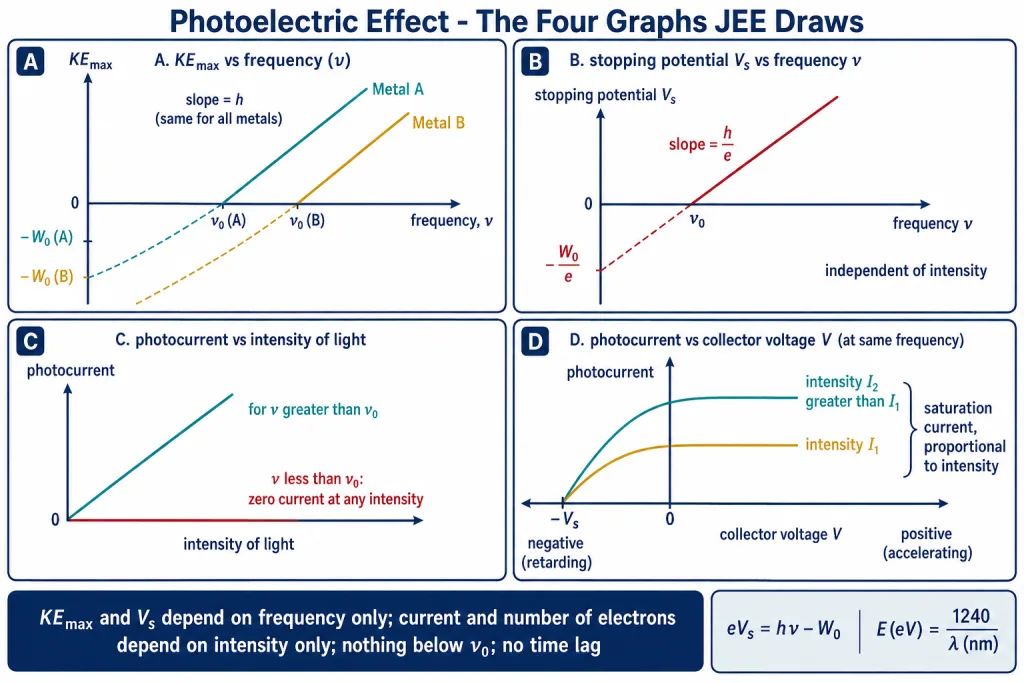
Section 4 gave Einstein's equation. JEE gives graphs — and every graph is one rearrangement of the same line.
KEmax=hν−W0=hν−hν0=hc(λ1−λ01)
Stopping potential
Apply a reverse voltage to the collector; the photocurrent falls to zero at the stopping potentialVs, when even the fastest electron is turned back:
eVs=KEmax=hν−W0⇒Vs=(eh)ν−eW0
If KEmax is 1.2 eV, Vs is 1.2 V: same number, different unit. Vs depends on frequency only, never on intensity.
The four graphs
Plot (y vs x)
Shape
Slope
Intercepts
What varies it
KEmax vs ν
straight line, starts at ν0
h (same for every metal)
x: ν0; y (extrapolated): −W0
different metals give parallel lines shifted along ν
Vs vs ν
straight line
h/e=4.14×10−15 V s
x: ν0; y: −W0/e
parallel lines for different metals; unchanged by intensity
Photocurrent vs intensity
straight line through origin (for ν>ν0)
∝ number of photons per second
passes through origin
zero for any intensity if ν<ν0
Photocurrent vs collector voltage
rises, then flat at the saturation current
—
cuts the negative-V axis at −Vs
higher intensity: higher plateau, sameVs; higher frequency (same intensity): same plateau, larger ∣Vs∣
Three consequences the examiners lean on:
Doubling the intensity doubles the photons per second, so it doubles the photocurrent and the number of photoelectrons, and does nothing to KEmax or Vs.
Doubling the frequency does not double KEmax: it goes from hν−W0 to 2hν−W0, so it more than doubles. Halving the wavelength does the same.
Two metals in a Vs vs ν plot give parallel lines: same slope h/e, different threshold frequencies. Non-parallel lines mean the graph is wrong.
[JEE Main] For the current-versus-voltage graph the standard convention is that the plateau depends on intensity and the cut-off voltage on frequency. Strictly, at fixed intensity in W m−2 a higher frequency means fewer photons and hence a slightly lower plateau — but exam keys follow the convention in the table.
A 400 nm photon carries 3.10 eV, a 620 nm photon 2.00 eV, a 200 nm photon 6.20 eV. Sodium (W0=2.3 eV) has λ0=1240/2.3=539 nm; caesium (W0=1.9 eV) has λ0=653 nm, which is why caesium is the photocell metal. With h=6.63×10⁻³⁴ and c=3×10⁸ you land on 1242 instead; either is fine to two figures.
Counting photons and electrons
A source of power P (in W) at wavelength λ emits
nphotons/s=hνP=hcPλ
photons per second. If a fraction η of the photons hitting the metal eject an electron (the quantum efficiency, usually given as a percentage), the number of photoelectrons per second is ηnphotons/s and the saturation current is
Isat=ηhcPλe
The λ sits in the numerator: at the same power, a longer wavelength means more photons per second, each carrying less energy. "Number of photoelectrons is proportional to intensity" is true at a fixed wavelength.
Finding h from two data points
Two frequencies, two stopping potentials — the Millikan experiment (1916):
eVs1=hν1−W0,eVs2=hν2−W0
Subtract:
h=ν2−ν1e(Vs2−Vs1),W0=hν1−eVs1,ν0=hW0
With wavelengths instead of frequencies, ν=c/λ, so the denominator becomes c(λ21−λ11). The result should come out near 6.6×10⁻³⁴ J s — if it does not, you have mixed J with eV somewhere.
Maximum velocity of the photoelectrons
vmax=me2KEmax=me2eVs=5.93×10⁵Vsms−1
A stopping potential of 1 V means the fastest electrons leave at 5.93×10⁵ m s−1; 4 V doubles that. The 5.93×10⁵ is the same 2e/me that sits inside 12.27/V.
Four clauses settle every statement-type question on this topic: KE and Vs answer to frequency; current and electron count answer to intensity; nothing happens below ν0 however bright the light; and there is no time lag (<10−9 s) however dim it is.
The Uncertainty Principle in Every Form the Paper Uses
Section 7 stated Heisenberg's principle once. JEE writes it four ways and expects you to switch between them freely.
Key Point (The forms):Δx⋅Δp≥4πh,Δx⋅Δv≥4πmh,ΔE⋅Δt≥4πh,Δx⋅Δp≥2ℏ(ℏ=2πh)
Numerically h/4π=5.27×10−35 J s. The first form is the principle; the second is the first with p=mv and the mass pulled out; the third pairs energy with time; the fourth is the first in the physicist's notation.
Some older problems use Δx⋅Δp≥h/2π or even ≥h — order-of-magnitude versions. Use h/4π unless the question states otherwise; if the options are a factor of 2 apart, the question's stated constant decides.
Working it
For an electron with Δx known,
Δv=4πmΔxh=9.1×10−31Δx5.27×10−35=Δx5.79×10−5ms−1
Situation
Δx
Minimum Δv
Meaning
Electron confined to an atom
10−10 m
5.8×10⁵ m s−1
comparable to the orbital speed itself (2.2×10⁶): a definite orbit is meaningless
Electron confined to a nucleus
10−14 m
5.8×10⁹ m s−1
about 20c — impossible
1 mg dust grain, Δx=10−6 m
10−6 m
5.3×10⁻²³ m s−1
unobservable: classical mechanics is safe
Why the electron cannot live in the nucleus
A nucleus has diameter about 10−14 m. If the electron were inside it, Δx≤10−14 m, so
Δv≥4π×9.1×10−31×10−146.626×10−34=5.8×10⁹ms−1
about twenty times the speed of light. (With 10−15 m for the nuclear radius the answer is 5.8×10¹⁰ m s−1, worse.) The corresponding kinetic energy, done properly, is tens of MeV, while nuclear binding energies for an electron would be at most a few MeV — the nucleus cannot hold it. So electrons sit outside the nucleus, and β-particles must be created at the moment of decay rather than pre-existing inside.
The special cases JEE likes
Equal uncertainties in position and momentum, Δx=Δp: then (Δx)2=h/4π, Δx=h/4π=7.26×10−18 (SI). Follow-up: the uncertainty in velocity is Δp/m=7.26×10−18/9.1×10−31=8.0×1012 m s−1.
Uncertainty in position equal to the de Broglie wavelength, Δx=λ=h/mv: then Δv≥4πmh⋅hmv=4πv, about 8% of the velocity itself.
Percentage uncertainty in velocity given: "an electron moves at 300 m s−1 known to 0.001%" means Δv=3×10⁻³ m s−1, so Δx=5.79×10⁻⁵/3×10−3=1.9×10−2 m — nearly 2 cm.
Same Δx for an electron and a proton: Δve/Δvp=mp/me=1836.
Energy and time
ΔE⋅Δt≥h/4π is why spectral lines have a natural width. An excited state that lives Δt=10−8 s has an energy uncertain by
ΔE=10−85.27×10−35=5.3×10⁻²⁷J=3.3×10⁻⁸eV
tiny, but measurable as a line width. The ground state, which lives forever, has a perfectly sharp energy.
[JEE Main] The uncertainty principle does not say Bohr was wrong about the energies — the levels are exactly right for hydrogen. It says the orbit, a simultaneous exact r and v, is not a meaningful object. That is the limitation of the Bohr model the principle exposes.
Orbital Fine Print: Radial Probability, Nodes, Angular Momentum, Magnetic Moment
Probability density versus radial probability
ψ2 at a point is the probability per unit volume of finding the electron there. For a 1s orbital ψ2 is largest at the nucleus and falls off exponentially. Asking instead at what distance the electron is most likely to be found needs the probability of lying anywhere in a thin shell between r and r+dr, and that shell has volume 4πr2dr:
P(r)=4πr2ψ2(radial probability distribution function, sometimes written r2R2)
At r=0 the shell has zero volume, so P(0)=0 for every orbital, including 1s. For 1s, P(r) rises, peaks and falls; the peak — the most probable distance — is at exactly a0=52.9 pm for hydrogen and at a0/Z for a H-like ion, Bohr's first-orbit radius reappearing in the quantum model. The average distance is a little larger, 1.5a0.
For the node-free orbitals of each shell (1s, 2p, 3d, 4f — those with l=n−1) the single maximum sits at n2a0/Z, Bohr's radius again. Orbitals with radial nodes (2s, 3s, 3p, …) have more than one hump; the outermost is always the tallest, and for 2s it lies at about 5.2a0, beyond the 2p maximum at 4a0. The small inner hump of 2s, which 2p lacks, is why 2s is more penetrating and lower in energy than 2p in multi-electron atoms.
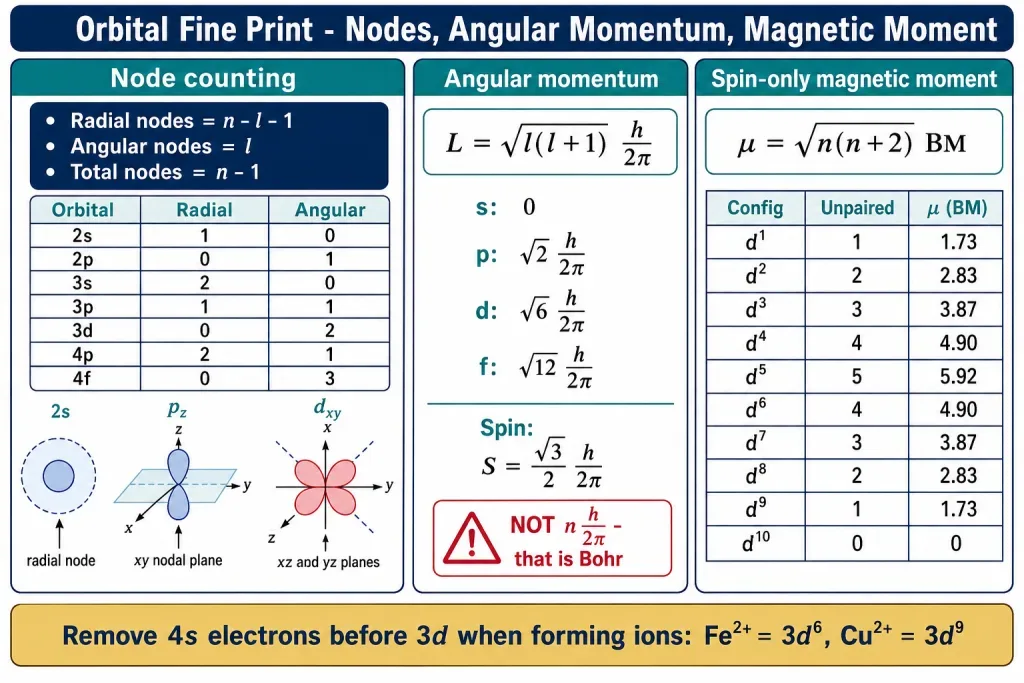
Node counting — the recipe
Key Point: For an orbital with quantum numbers n and l:
Radial (spherical) nodes=n−l−1 — spheres where R(r)=0
Angular nodes=l — planes (or cones) where the angular part is zero
Total nodes=n−1
An orbital with 2 radial nodes and 1 angular node is a 4p; one with 3 angular nodes and no radial node is a 4f; the first orbital of each type (1s, 2p, 3d, 4f) has no radial node.
Orbital
n
l
Radial
Angular
Total
1s
1
0
0
0
0
2s
2
0
1
0
1
2p
2
1
0
1
1
3s
3
0
2
0
2
3p
3
1
1
1
2
3d
3
2
0
2
2
4s
4
0
3
0
3
4p
4
1
2
1
3
4d
4
2
1
2
3
4f
4
3
0
3
3
The angular nodes of the p and d orbitals are specific surfaces, and JEE asks for them by name.
Orbital
Nodal surfaces
Count
px
yz-plane
1
py
xz-plane
1
pz
xy-plane
1
dxy
xz- and yz-planes
2
dyz
xy- and xz-planes
2
dxz
xy- and yz-planes
2
dx2−y2
the two vertical planes x=y and x=−y (at 45∘ to the axes)
2
dz2
no nodal plane; two nodal cones about the z-axis
2 nodes, 0 planes
The rule "nodal planes =l" is exactly right for every d orbital except dz2, where the two angular nodes are cones. The d orbital with no nodal plane is dz2; the one whose nodal planes do not contain the axes is dx2−y2.
So a 3d electron carries 6h/2π, not 3h/2π; hydrogen's ground-state (1s) electron carries zero, not h/2π; and the value depends on l only, so 2p, 3p and 4p electrons all carry 2h/2π. The component along a chosen axis is mlh/2π.
Spin angular momentum follows the same pattern with s=21:
S=s(s+1)2πh=21⋅232πh=232πh
with z-component msh/2π=±21h/2π. In numbers, h/2π=1.055×10−34 J s.
Spin-only magnetic moment
Each unpaired electron is a tiny magnet. For an atom or ion with n unpaired electrons the spin-only magnetic moment is
μ=n(n+2)BM(1Bohr magneton=9.27×10⁻²⁴JT−1)
Configuration
Unpaired n
μ (BM)
Example ions
d1
1
3=1.73
Ti3+, V4+
d2
2
8=2.83
V3+, Ti2+
d3
3
15=3.87
Cr3+, V2+
d4
4
24=4.90
Cr2+, Mn3+
d5
5
35=5.92
Mn2+, Fe3+
d6
4
4.90
Fe2+, Co3+
d7
3
3.87
Co2+
d8
2
2.83
Ni2+
d9
1
1.73
Cu2+
d10
0
0
Cu+, Zn2+
The usual question reads the table backwards: "a trivalent ion of a 3d metal has μ=3.87 BM" means three unpaired electrons, d3, M3+=[Ar]3d3, so M has 18+3+3=24 electrons: chromium. Watch the mirror symmetry — d4 and d6 both give 4.90 BM, so a magnetic moment alone cannot distinguish Cr2+ from Fe2+. (The table assumes Hund's-rule free ions; real complexes can differ — Class 12 territory.)
Zeeman and Stark
In a magnetic field each spectral line splits into several closely spaced lines — the Zeeman effect. Orbitals of different ml, degenerate in free space, now have slightly different energies; this is the experimental origin of the magnetic quantum number. The same splitting in an electric field is the Stark effect. Bohr's model, with its single number n, explains neither; the quantum model with l and ml does.
Exceptional Configurations, Exchange Energy, Ions, and Slater's Rules
The exceptions beyond Cr and Cu
Section 10 explained chromium and copper. The (n+l) rule fails the same way — and in a few new ways — further down the d block.
Element
Z
Expected by aufbau
Actual configuration
Why
Cr
24
[Ar]3d44s2
[Ar]3d54s1
half-filled d
Cu
29
[Ar]3d94s2
[Ar]3d104s1
full d
Nb
41
[Kr]4d35s2
[Kr]4d45s1
4d-5s gap small; more exchange
Mo
42
[Kr]4d45s2
[Kr]4d55s1
half-filled d
Ru
44
[Kr]4d65s2
[Kr]4d75s1
4d-5s gap small
Rh
45
[Kr]4d75s2
[Kr]4d85s1
4d-5s gap small
Pd
46
[Kr]4d85s2
[Kr]4d105s0
full d — the only ns0 case
Ag
47
[Kr]4d95s2
[Kr]4d105s1
full d
La
57
[Xe]4f16s2
[Xe]5d16s2
5d dips below 4f at Z=57
Gd
64
[Xe]4f86s2
[Xe]4f75d16s2
half-filled f
Pt
78
[Xe]4f145d86s2
[Xe]4f145d96s1
5d-6s gap small
Au
79
[Xe]4f145d96s2
[Xe]4f145d106s1
full d
Three patterns worth fixing in memory. Group 6 is Cr, Mo with d5s1, but tungsten is 5d46s2, regular. Group 11 (Cu, Ag, Au) is uniformly d10s1. Palladium is the lone d10s0. In the 4d series five elements (Nb, Mo, Ru, Rh, Ag) end in 5s1 and one (Pd) in 5s0 — the least regular row of the table, because 4d and 5s energies are nearly equal. Among the lanthanides, La, Ce (4f15d16s2), Gd and Lu carry a 5d1 electron; the rest do not.
Exchange energy — the counting formula
Electrons of the same spin in the same subshell can swap places, and each possible swap lowers the energy by a fixed amount K. The number of exchanges among p electrons of parallel spin is the number of pairs you can choose from them:
Number of exchange pairs=2p(p−1)=pC2
3d configuration
Parallel-spin sets
Exchange pairs
Exchange energy
d3
3 up
3×2/2=3
3K
d4
4 up
6
6K
d5
5 up
10
10K
d6
5 up, 1 down
10+0=10
10K
d7
5 up, 2 down
10+1=11
11K
d8
5 up, 3 down
10+3=13
13K
d9
5 up, 4 down
10+6=16
16K
d10
5 up, 5 down
10+10=20
20K
The chromium argument is now arithmetic. 3d44s2 has 6 exchange pairs within 3d; 3d54s1 has 10. The extra 4K (plus the symmetry and lower repulsion of a half-filled set) outweighs the small cost of promoting one electron from 4s to 3d. Copper gains the same 20K−16K=4K going d9→d10. Counting the 4s electron too, if its spin is parallel to the 3d set, adds a further 5 pairs for 3d54s1; either convention is accepted as long as you state it, and the difference argument comes out the same way.
Removing electrons from ions
Key Point: Electrons are removed from the orbital of highest principal quantum number first, then from the highest l within it. For transition metals this means 4s before 3d, even though 4s was filled first: once 3d has electrons in it, the 3d orbitals sit closer to the nucleus and lower in energy than 4s.
Atom
Configuration
Ion
Configuration
Unpaired
μ (BM)
Fe (26)
[Ar]3d64s2
Fe2+
[Ar]3d6
4
4.90
Fe3+
[Ar]3d5
5
5.92
Cu (29)
[Ar]3d104s1
Cu+
[Ar]3d10
0
0 (diamagnetic)
Cu2+
[Ar]3d9
1
1.73
Cr (24)
[Ar]3d54s1
Cr3+
[Ar]3d3
3
3.87
Ni (28)
[Ar]3d84s2
Ni2+
[Ar]3d8
2
2.83
Zn (30)
[Ar]3d104s2
Zn2+
[Ar]3d10
0
0
Ga (31)
[Ar]3d104s24p1
Ga+
[Ar]3d104s2
0
0
Two species with the same electron count need not share a configuration: Fe2+ (24 electrons) is [Ar]3d6, while a neutral Cr atom (also 24) is [Ar]3d54s1. And Cu2+ is paramagnetic while Cu+ is diamagnetic — the standard "which is coloured / paramagnetic" pair.
Slater's rules — a two-minute version (JEE Advanced only)
Section 9 defined Zeff=Z−σ. Slater gave a recipe for σ. Write the configuration in groups: (1s)(2s2p)(3s3p)(3d)(4s4p)(4d)(4f)(5s5p)… Then, for the electron of interest:
For an ns or np electron: every other electron in the same group contributes 0.35 (0.30 if the group is 1s); every electron in the (n−1) shell contributes 0.85; every electron in shell n−2 or lower contributes 1.00.
For an nd or nf electron: every other electron in the same group contributes 0.35; every electron in any group to the left contributes 1.00.
Electrons to the right of the group contribute nothing.
A 2p electron in nitrogen (Z=7, groups (1s2)(2s22p3)). Other electrons in the (2s2p) group: 4, at 0.35 each =1.40. The 1s electrons: 2, at 0.85 =1.70. So σ=3.10 and Zeff=7−3.10=3.90.
4s versus 3d in zinc (Z=30): (1s2)(2s22p6)(3s23p6)(3d10)(4s2). For a 4s electron: 1×0.35+18×0.85+10×1.00=25.65, Zeff=4.35. For a 3d electron: 9×0.35+18×1.00=21.15, Zeff=8.85. The 3d electron feels twice the pull of the 4s electron — the quantitative reason 4s is ionised first.
[JEE Main] JEE Main needs only the qualitative facts: σ rises down a group (more inner shells), Zeff rises across a period (same-shell electrons shield poorly at 0.35 each), and s>p>d>f in penetration. JEE Advanced has asked for an actual Zeff, so learn the 0.35 / 0.85 / 1.00 triple and the grouping.
The Traps JEE Sets
#
Trap
The fix
1
Using rn∝n2/Z but vn∝n/Z
velocity is Z/n: it falls with n, rises with Z
2
"Energy of the second orbit of He+" answered as −3.4 eV
E∝Z2/n2: −13.6×4/4=−13.6 eV
3
Writing KE =−13.6 eV
kinetic energy is positive; KE =−E, PE =2E, PE =−2 KE
4
Time period scaled as n2 or n/Z
T∝n3/Z2 (from 2πr/v); frequency ∝Z2/n3
5
Number of lines from n=5 to n=2 taken as n(n−1)/2=10
between two levels it is (n2−n1)(n2−n1+1)/2=6
6
"Visible lines" counted as all lines
only Balmer transitions (ending at n=2) are visible: 3 lines from n=5
7
Longest wavelength of a series taken as the series limit
the limit is the shortest; the α line (n1+1→n1) is the longest
8
12.5 eV photon exciting hydrogen to n=3
photons must match a gap exactly: nothing happens; a 12.5 eV electron excites to n=3
9
He+ transition matching H 3→2 written as 3→2
multiply both levels by Z: 6→4
10
Doubling frequency doubles KEmax
KEmax=hν−W0: it more than doubles; doubling intensity doubles current, not KE
11
Stopping potential quoted in eV, or read off as W0/e
Vs in volts, numerically =KEmax in eV; the Vs-axis intercept is −W0/e
12
Slope of Vs vs ν taken as h
slope is h/e; only the KE vs ν slope is h
13
Electrons with same velocity treated like same energy
same v: λ∝1/m; same KE or same V: λ∝1/m; same p: same λ
14
Δx⋅Δp≥h/2π when the paper means h/4π
use h/4π unless told otherwise; check whether options differ by a factor of 2
15
Orbital angular momentum of 3d written as 3h/2π
l(l+1)h/2π=6h/2π; Bohr's nh/2π is not the quantum-mechanical value
16
Angular momentum of the 1s electron =h/2π
l=0, so it is zero
17
dz2 assigned two nodal planes
it has two nodal cones and no nodal plane
18
μ of Fe2+ computed from 6 unpaired electrons
d6 has 4 unpaired: 24=4.90 BM
19
Cu2+ written as 3d104s−1 or 3d84s1
remove 4s first: Cu is 3d104s1, Cu+ is 3d10, Cu2+ is 3d9
20
Tungsten given as 5d56s1 like Cr and Mo
W is regular, 5d46s2; Pd is 4d105s0; Pt is 5d96s1
21
Exchange pairs of d5 counted as 5
5C2=10; of d10: 10+10=20
[JEE Main] Most questions from this section are a proportionality in disguise. Strip the wording first: "third orbit of Li2+" becomes n=3,Z=3; "series limit" becomes n2=∞; "stopping potential 2 V" becomes KEmax=2 eV; "3.87 BM" becomes n=3; "same kinetic energy" becomes λ∝1/m. After that the arithmetic is two lines. The translation is where the marks are, and where the traps live.
Solved Examples
Question 1: The full Bohr toolkit on Li2+ in its third orbit
For the electron in the n=3 orbit of Li2+, find (a) the radius, (b) the velocity, (c) the kinetic, potential and total energies in eV, (d) the time period of revolution, and (e) the energy needed to remove the electron from this orbit. Compare each with the ground state of hydrogen.
Answer:
Here n=3 and Z=3.
Radius: rn=0.529n2/Z Å =0.529×9/3=1.587 Å, three times the Bohr radius.
Velocity: vn=2.18×10⁶Z/n=2.18×106×3/3=2.18×106 m s−1, identical to hydrogen's ground state since Z/n=1.
Energies: En=−13.6Z2/n2=−13.6×9/9=−13.6 eV, so KE=+13.6 eV and PE=−27.2 eV. Again the same as hydrogen's ground state, since Z2/n2=1.
Time period: Tn=1.52×10⁻¹⁶n3/Z2=1.52×10−16×27/9=4.56×10−16 s, three times hydrogen's — the orbit is three times longer at the same speed. Frequency =1/T=2.19×1015 s−1.
Removal energy: from E3=−13.6 eV to E∞=0 needs 13.6 eV, the same as ionising hydrogen from its ground state. (From n=1, Li2+ would need 13.6×9=122.4 eV.)
Ans: (a) 1.587 Å; (b) 2.18×10⁶ m s−1; (c) KE =13.6 eV, PE =−27.2 eV, E=−13.6 eV; (d) 4.56×10⁻¹⁶ s; (e) 13.6 eV.
Watch out: Check the exponents first — r∼n2/Z, v∼Z/n, E∼Z2/n2, T∼n3/Z2. When n=Z the speed and energy match hydrogen's ground state, but the radius and period do not.
Question 2: Revolutions before the electron falls back
An electron in the n=2 orbit of a hydrogen atom stays there for 10−8 s before dropping to the ground state. (a) Find the time period and the frequency of revolution in the n=2 orbit. (b) How many revolutions does it complete before de-exciting? (c) What is the time period in the ground state of He+?
Answer:
(a) T2=T1×n3/Z2=1.52×10−16×8=1.22×10−15 s. From first principles: r2=4×0.529=2.116 Å, v2=2.18×10⁶/2=1.09×106 m s−1, T=2πr/v=2π×2.116×10−10/1.09×106=1.22×10−15 s. Frequency f2=1/T2=8.2×1014 revolutions per second.
(b) Revolutions = frequency × lifetime =8.2×1014×10−8=8.2×10⁶.
(c) For He+ with n=1, Z=2: T=1.52×10−16×1/4=3.8×10−17 s. The doubled charge halves the radius and doubles the speed, so the period drops fourfold.
Ans: (a) T2=1.22×10⁻¹⁵ s, f2=8.2×10¹⁴ s−1; (b) about 8×10⁶ revolutions; (c) 3.8×10⁻¹⁷ s.
Watch out: Number of revolutions is frequency times lifetime, not period times lifetime.
Question 3: Everything about a sample excited to n=5
A sample of hydrogen atoms is excited so that the electrons reach n=5. Find (a) the maximum number of spectral lines emitted, (b) the number of those lines in the visible region, (c) the longest wavelength line and its wavelength, (d) the shortest wavelength line and its wavelength, and (e) the minimum energy the sample must have absorbed per atom. (1/RH=91.18 nm.)
Answer:
(a) For a sample, n(n−1)/2=5×4/2=10 lines.
(b) Only transitions ending at n=2 (Balmer) are visible: 5→2, 4→2, 3→2, so 3 lines. The other seven are four Lyman in the UV, two Paschen and one Brackett in the IR.
(c) Longest wavelength means smallest gap, the adjacent pair highest up: 5→4, the first Brackett line.
νˉ=R(161−251)=R×4009⇒λ=9R400=44.44×91.18nm=4052nm
(d) Shortest wavelength means largest gap, 5→1.
νˉ=R(1−251)=2524R⇒λ=24R25=1.0417×91.18=94.98nm
(e) Excitation energy to n=5 is 13.6(1−251)=13.6×0.96=13.06 eV per atom. The 5→1 photon carries exactly that back: 1240/94.98=13.06 eV.
Ans: (a) 10; (b) 3; (c) 5→4, 4052 nm; (d) 5→1, 95.0 nm; (e) 13.06 eV.
Watch out: The longest wavelength is the top-most adjacent drop (n→n−1), not the n→1 line, and the visible count is the Balmer count only.
Question 4: Matching transitions across hydrogen-like ions
(a) Which transition in He+ produces the same wavelength as the first Balmer line (3→2) of hydrogen? (b) What is the wavelength of the 4→2 transition in He+? (c) Find the ionisation energy of Li2+ from its ground state and from its first excited state. (d) A hydrogen-like ion has ionisation energy 217.6 eV. Identify it.
Answer:
(a) Match the whole bracket. For hydrogen, 41−91=365. For He+ I need 4(n121−n221)=365, so n121−n221=1445=161−361, giving n1=4, n2=6: the 6→4 transition. Shortcut: multiply both hydrogen levels by Z=2.
(b) Dividing both levels by 2 gives hydrogen's 2→1, so the wavelength is Lyman α, λ=3R4=121.6 nm. Directly: νˉ=4R(41−161)=43R, so λ=4/(3R) again.
(c) Li2+ has Z=3. From n=1: 13.6×32=122.4 eV. From n=2, the first excited state: 13.6×9/4=30.6 eV.
(d) 13.6Z2=217.6⇒Z2=16⇒Z=4, so the ion is Be3+.
Ans: (a) 6→4; (b) 121.6 nm; (c) 122.4 eV and 30.6 eV; (d) Be3+.
Watch out: "First excited state" means n=2, so divide by n2=4. Matching wavelengths scales every level by Z; ionisation energy scales by Z2.
Question 5: Photon versus electron bombardment
Hydrogen atoms in the ground state are bombarded by (a) photons of energy 12.5 eV, and separately (b) electrons of kinetic energy 12.5 eV. In each case state which levels can be reached and how many spectral lines the gas can then emit. (c) If instead the gas is illuminated with 12.75 eV photons, how many lines appear and what is the longest wavelength among them?
Answer:
Excitation energies from n=1: to n=2, 10.2 eV; to n=3, 13.6×8/9=12.09 eV; to n=4, 13.6×15/16=12.75 eV.
(a) A photon is absorbed only if its energy equals a gap exactly. 12.5 eV matches none of 10.2, 12.09 or 12.75, so there is no absorption and no emission line.
(b) A colliding electron can give up any fraction of its energy. The highest level with excitation energy at most 12.5 eV is n=3 (12.09 eV), and the electron leaves with 0.41 eV. Atoms in n=3 (and some left in n=2) give 3×2/2=3 lines: 3→1 (102.6 nm), 2→1 (121.6 nm), 3→2 (656.5 nm).
(c) 12.75 eV is exactly the 1→4 gap, so atoms reach n=4 and emit 4×3/2=6 lines. The longest is 4→3 (Paschen α): λ=7R144=20.57×91.18=1876 nm.
Ans: (a) nothing; (b) up to n=3, 3 lines; (c) 6 lines, longest 1876 nm.
Watch out: Photons are all-or-nothing; electrons can hand over part of their energy. The same 12.5 eV gives zero lines or three depending on which is doing the hitting.
Question 6: De Broglie wavelengths — in the orbit, through a potential, and thermal
(a) Find the de Broglie wavelength of the electron in the n=4 orbit of hydrogen and the number of waves in that orbit. (b) An electron and a proton are each accelerated from rest through 100 V. Find their wavelengths and the ratio. (c) Find the de Broglie wavelength of a neutron (m=1.675×10⁻²⁷ kg) in thermal equilibrium at 300 K.
Answer:
(a) With Z=1, λn=3.32n/Z Å =3.32×4=13.3 Å. Check: the circumference is 2πr4=2π×16×0.529=53.2 Å, and 53.2/4=13.3 Å. Number of waves =n=4.
(b) Electron: λ=12.27/100=1.227 Å. From scratch, p=2meV=2×9.1×10−31×1.602×10−19×100=5.40×10⁻²⁴ kg m s−1, so λ=6.626×10⁻³⁴/5.40×10−24=1.227×10−10 m. Proton: λ=0.286/100=0.0286 Å. Ratio λe/λp=mp/me=1836=42.9 — same charge and potential means same kinetic energy, and then λ∝1/m.
(c) KE=23kT=1.5×1.38×10−23×300=6.21×10⁻²¹ J, so
λ=2mKEh=2×1.675×10−27×6.21×10−216.626×10−34=4.56×10−246.626×10−34=1.45×10⁻¹⁰m
Ans: (a) 13.3 Å, 4 waves; (b) 1.227 Å and 0.0286 Å, ratio 42.9; (c) 1.45 Å.
Watch out: The 12.27/V shortcut is for electrons only. For anything else find the momentum first — from the orbit, from qV, or from 23kT — and divide h by it.
Question 7: Planck's constant from two stopping potentials
When a metal surface is illuminated with light of frequency 6.0×10¹⁴ Hz the stopping potential is 0.62 V; at 8.0×10¹⁴ Hz it is 1.45 V. Find (a) Planck's constant, (b) the work function of the metal in eV, (c) the threshold frequency and threshold wavelength, and (d) the stopping potential for 300 nm light.
Answer:
(a) Subtracting the two Einstein equations removes W0:
h=ν2−ν1e(Vs2−Vs1)=(8.0−6.0)×10141.602×10−19×(1.45−0.62)=2.0×10141.602×10−19×0.83=6.65×10⁻³⁴Js
(b) W0=hν1−eVs1. In eV, hν1=6.65×10−34×6.0×1014/1.602×10−19=2.49 eV, so W0=2.49−0.62=1.87 eV. The second point agrees: 3.32−1.45=1.87 eV.
(c) ν0=W0/h=1.87×1.602×10−19/6.65×10−34=4.5×1014 Hz, and λ0=1240/1.87=663 nm.
(d) A 300 nm photon carries 1240/300=4.13 eV, so KEmax=4.13−1.87=2.26 eV and Vs=2.26 V.
Ans: (a) 6.65×10⁻³⁴ J s; (b) 1.87 eV; (c) 4.5×10¹⁴ Hz, 663 nm; (d) 2.26 V.
Watch out: If h does not land near 6.6×10⁻³⁴ J s, joules and electronvolts have been mixed somewhere.
Question 8: Photon counting and the saturation current
A 100 W lamp emits monochromatic light of wavelength 400 nm, all of which falls on a caesium surface (W0=1.9 eV). One photon in a hundred ejects an electron. Find (a) the number of photons per second, (b) the number of photoelectrons per second and the saturation current, (c) KEmax and the stopping potential, and (d) the maximum speed of the photoelectrons. (e) What changes if the lamp power is doubled?
Answer:
(a) Each photon carries E=1240/400=3.10 eV =3.10×1.602×10−19=4.97×10⁻¹⁹ J, so photons per second =P/E=100/4.97×10−19=2.01×1020.
(b) At 1% quantum efficiency, electrons per second =0.01×2.01×1020=2.01×10¹⁸, and the saturation current is 2.01×1018×1.602×10−19=0.32 A.
(c) KEmax=3.10−1.9=1.2 eV, so Vs=1.2 V.
(d) v=2KE/me=2×1.2×1.602×10−19/9.1×10−31=4.22×1011=6.5×105 m s−1, matching the shortcut 5.93×105×1.2.
(e) Doubling the power doubles the photons per second, electrons per second and current: 4.0×10²⁰, 4.0×10¹⁸ and 0.64 A. KEmax, Vs and vmax are unchanged, since they depend on the wavelength alone.
Ans: (a) 2.0×10²⁰ s−1; (b) 2.0×10¹⁸ s−1, 0.32 A; (c) 1.2 eV, 1.2 V; (d) 6.5×10⁵ m s−1; (e) counts and current double; energies and speed do not.
Watch out: Intensity controls how many electrons come out; frequency controls how fast they leave. Keep those two ledgers separate in part (e).
Question 9: Uncertainty principle in three settings
(a) The speed of an electron is measured as 600 m s−1 with an accuracy of 0.005%. Find the minimum uncertainty in its position. (b) Show that if the uncertainty in an electron's position equals its de Broglie wavelength, the uncertainty in its velocity is at least v/4π. (c) A 1 mg particle has the same velocity uncertainty as the electron in (a). Find its position uncertainty and comment.
Answer:
(a) First turn the percentage into an absolute uncertainty: Δv=0.005%×600=5×10−5×600=0.030 m s−1. Then
Δx≥4πmΔvh=4π×9.1×10−31×0.0306.626×10−34=3.43×10−316.626×10−34=1.93×10⁻³m
about 2 mm. With the speed known that well, the electron cannot be pinned down better than that.
(b) Put Δx=λ=h/(mv) into ΔxΔv≥h/4πm:
mvhΔv≥4πmh⇒Δv≥4πv
Both h and m cancel, so it holds for any particle: locating it to within one wavelength costs roughly 8% of its velocity.
(c) For the 1 mg particle, m=10−6 kg with the same Δv=0.030 m s−1:
Δx≥4π×10−6×0.0306.626×10−34=1.76×10⁻²⁷m
That is 10−12 times the size of a nucleus, so for anything visible the principle imposes no practical limit.
Ans: (a) 1.93×10⁻³ m; (b) Δv≥v/4π; (c) 1.8×10⁻²⁷ m, negligible.
Watch out: Convert a percentage accuracy to an absolute Δv before using the formula.
Question 10: Nodes, angular momentum and a magnetic-moment identification
(a) For the orbital with n=4, l=2, name it, count its radial, angular and total nodes, and find its orbital angular momentum in J s. (b) An orbital has 3 radial nodes and 2 angular nodes. Identify it. (c) A trivalent ion of a 3d-series element has a spin-only magnetic moment of 3.87 BM. Identify the element and give the ion's configuration. (d) Calculate the magnetic moments of Mn2+, Cu2+ and Zn2+.
Answer:
(a) n=4 with l=2 is a 4d orbital. Radial nodes =n−l−1=1; angular nodes =l=2; total =n−1=3. Its orbital angular momentum is
L=l(l+1)2πh=6×1.055×10−34=2.58×10⁻³⁴Js
(b) Angular nodes give l=2, and n−l−1=3 gives n=6: the 6d orbital.
(c) From n(n+2)=3.87, n(n+2)=15, so n=3 unpaired electrons. A trivalent ion with three unpaired 3d electrons and no 4s electrons is [Ar]3d3, which has 18+3=21 electrons; the neutral atom has 21+3=24, so the element is chromium and the ion is Cr3+. (Cr is [Ar]3d54s1; remove the 4s electron and two 3d electrons.)
(d) Mn2+ is [Ar]3d5, 5 unpaired, 35=5.92 BM. Cu2+ is 3d9, 1 unpaired, 3=1.73 BM. Zn2+ is 3d10, 0 unpaired, 0 BM and diamagnetic.
Ans: (a) 4d; 1, 2, 3 nodes; 2.58×10⁻³⁴ J s. (b) 6d. (c) Cr; Cr3+=[Ar]3d3. (d) 5.92, 1.73, 0 BM.
Watch out: The unpaired count comes from the ion's configuration, so remove the 4s electrons before counting.
Question 11: Exchange energy, paramagnetism and a quantum-number head-count
(a) Count the exchange pairs within the 3d subshell for 3d44s2 and for 3d54s1, and state the exchange-energy difference. (b) Which of Cu+, Cu2+, Ni2+, Zn2+ and Sc3+ are paramagnetic? (c) In a ground-state chromium atom, how many electrons have ml=0? How many have l=2? (d) Write the configuration of Pd and Ag+ and comment on their magnetic behaviour.
Answer:
(a) d4 has four parallel spins: 4C2=6 pairs, energy 6K. d5 has 5C2=10 pairs, energy 10K. The difference is 4K in favour of 3d54s1, chromium's actual configuration.
(b) Paramagnetism needs at least one unpaired electron. Cu+ is 3d10, none. Cu2+ is 3d9, one, so paramagnetic. Ni2+ is 3d8, two, so paramagnetic. Zn2+ is 3d10, none. Sc3+ is [Ar], none.
(c) Cr =1s22s22p63s23p63d54s1. Electrons with ml=0: every s electron (1s2,2s2,3s2,4s1: 7), the pz (ml=0) electrons of each filled p subshell (2p: 2, 3p: 2), and the one 3d electron in the ml=0 orbital, giving 7+4+1=12. Electrons with l=2: the five 3d electrons.
(d) Pd (46) =[Kr]4d105s0 and Ag (47) =[Kr]4d105s1, so Ag+=[Kr]4d10. Both have a filled 4d shell and no unpaired electrons, so both are diamagnetic and isoelectronic with each other.
Ans: (a) 6 and 10 pairs, difference 4K; (b) Cu2+ and Ni2+; (c) 12 and 5; (d) [Kr]4d10 for both, diamagnetic.
Watch out: In (c), ml=0 picks exactly one orbital from every subshell (s, pz, dz2), so count one orbital's worth from each, not the whole subshell.
Question 12: Slater's rules on copper — why 4s leaves before 3d
Using Slater's rules, calculate the effective nuclear charge experienced by (a) the 4s electron and (b) a 3d electron in a ground-state copper atom (Z=29, [Ar]3d104s1). (c) Repeat for a 2p electron of fluorine (Z=9). (d) Use (a) and (b) to explain which electron is lost first when Cu+ forms.
Answer:
Group copper's configuration first: (1s2)(2s22p6)(3s23p6)(3d10)(4s1).
(a) For the 4s electron there are no other electrons in the (4s4p) group. Shell 3 (3s3p3d, i.e. n−1) holds 8+10=18 electrons at 0.85 each =15.30; shells 1 and 2 hold 2+8=10 at 1.00 =10.00.
σ=25.30,Zeff=29−25.30=3.70
(b) For a 3d electron, the other 9 in the (3d) group give 9×0.35=3.15, and everything to the left (1s, 2s2p, 3s3p) gives 18×1.00=18.00. The 4s electron is to the right and contributes nothing.
σ=21.15,Zeff=29−21.15=7.85
(c) Fluorine is (1s2)(2s22p5). Others in the same group: 6 at 0.35 =2.10; the 1s pair: 2 at 0.85 =1.70. So σ=3.80 and Zeff=5.20. (Nitrogen's is 3.90 — across a period, 0.35-per-electron shielding fails to keep up with Z.)
(d) The 4s electron feels Zeff=3.70, a 3d electron 7.85. The 4s electron is far more weakly held, so it goes first: Cu+=[Ar]3d10, not 3d94s1.
Ans: (a) 3.70; (b) 7.85; (c) 5.20; (d) the 4s electron, giving Cu+=[Ar]3d10.
Watch out: The 0.85 factor applies only to the (n−1) shell of an ns or np electron. For a d electron every group to its left counts a full 1.00, and groups to the right count zero.
Ready to test your knowledge?
Take a quick interactive quiz on this topic —
free, works without login.