
How to Use This Section
This section is for the night before the paper, and again in the queue outside the hall. Nothing new is taught. Every card compresses something Sections 1 to 15 worked through, in the same notation and with the same numbers. If a line surprises you, go back and reread that section instead of memorising the line.
Eight cards, one mistake checklist, one 60-second list. Screenshot the three figures.
| Card | Topic | Sections it compresses | Who needs it most |
|---|---|---|---|
| 1 | Discovery of sub-atomic particles, the fundamental-particle table, the atomic-model timeline | 1, 2 | Board, NEET |
| 2 | Atomic number, mass number, isotopes, isobars, isoelectronic species | 2 | Board, NEET |
| 3 | Electromagnetic radiation, Planck's quantum, photoelectric effect | 3, 4 | Everyone |
| 4 | Atomic spectra, Rydberg formula, the five hydrogen series | 5 | Everyone |
| 5 | Bohr model formula sheet and its limitations | 6, 12 | Everyone |
| 6 | de Broglie wavelength and Heisenberg's uncertainty principle | 7 | JEE, NEET |
| 7 | Quantum numbers, orbital shapes, nodes, capacities | 8, 9 | Everyone |
| 8 | Orbital energies, aufbau order, filling rules, configurations, magnetic moment | 9, 10, 14 | Everyone |
Key Point: The chapter is one story in three acts. Act 1: the atom has parts (electron, proton, neutron) arranged around a tiny nucleus. Act 2: light comes in packets () and so do electron energies ( eV) — hence line spectra. Act 3: electrons are waves too, so orbits become orbitals, labelled by four quantum numbers and filled by three rules. Every formula on the cards belongs to one of those acts.
Card 1 — Discovery of Sub-atomic Particles and the Atomic-Model Timeline
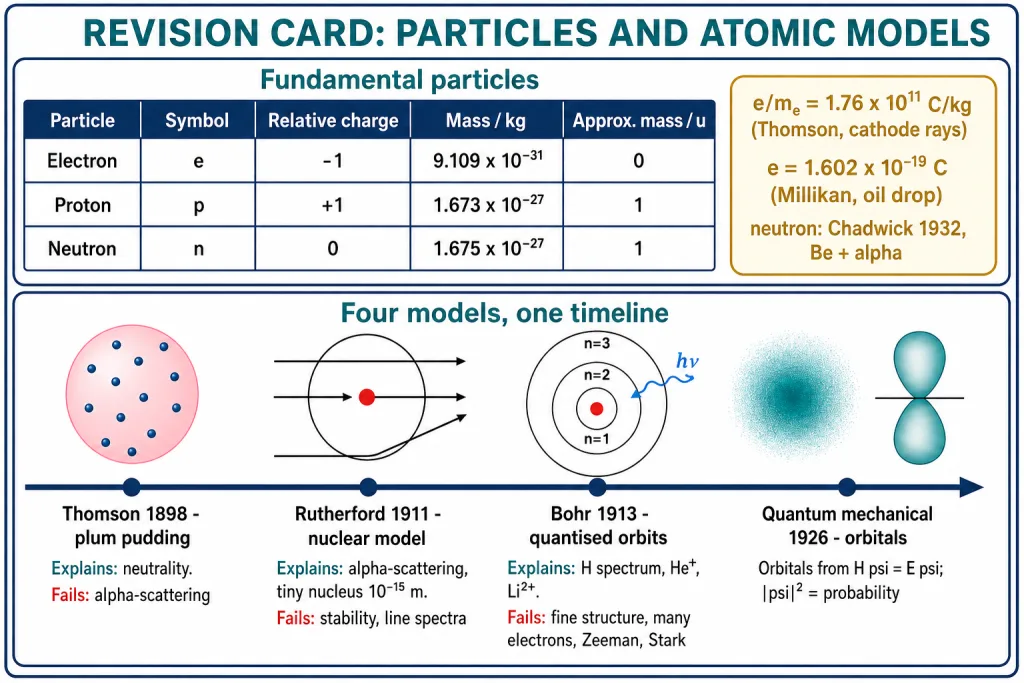
Who found what, and how
| Particle | Experiment | Key observation | Scientist and year |
|---|---|---|---|
| Electron | Cathode-ray discharge tube (low pressure, high voltage) | Rays travel from cathode to anode, cast shadows, deflected by electric and magnetic fields like negative charge; independent of the gas and the electrode metal | J. J. Thomson, 1897 (name "electron" from Stoney) |
| Electron charge | Oil-drop experiment | Charge on every drop is an integral multiple of C | R. A. Millikan |
| Proton | Canal rays (anode rays) in a perforated-cathode tube | Positive rays; depends on the gas; smallest and lightest positive ion is from hydrogen | Goldstein (canal rays), named proton by Rutherford |
| Neutron | Bombarding a thin beryllium sheet with -particles | Electrically neutral particles of mass slightly greater than the proton | James Chadwick, 1932 |
Key Point: Cathode rays are the same whatever the gas (they are electrons); canal rays differ for each gas (they are the leftover positive ions).
The fundamental-particle table
| Particle | Symbol | Absolute charge / C | Relative charge | Mass / kg | Mass / u | Approx. mass / u |
|---|---|---|---|---|---|---|
| Electron | 0.00054 | 0 | ||||
| Proton | 1.00727 | 1 | ||||
| Neutron | 0 | 0 | 1.00867 | 1 |
Three numbers to carry: (Thomson), C (Millikan), kg (the ratio of the two). A proton is about 1836 times heavier than an electron.
The four atomic models in one table
| Model (year) | Picture | What it explained | Where it failed |
|---|---|---|---|
| Thomson (1898) — plum pudding / watermelon | Positive charge spread uniformly through a sphere, electrons embedded in it | Overall electrical neutrality of the atom | Could not explain the -scattering results — most of the atom turned out to be empty |
| Rutherford (1911) — nuclear model | Tiny, dense, positive nucleus (radius m) at the centre; electrons circle it; atom radius m | Most -particles pass straight through, a few deflect, about 1 in 20,000 bounces back | An orbiting electron should radiate continuously and spiral into the nucleus in about s; also gave no account of line spectra |
| Bohr (1913) — quantised orbits | Electron in fixed stationary orbits with ; energy is emitted or absorbed only on jumping between orbits | Stability of the atom; the hydrogen line spectrum; , , ; Rydberg's constant from first principles | Fine structure (doublets), multi-electron atoms, Zeeman and Stark effects, chemical bonding; contradicts de Broglie and Heisenberg |
| Quantum mechanical (Schrodinger, 1926) | Electron is a wave; gives allowed energies and orbitals ( = probability density) | Everything Bohr explained plus multi-electron atoms, shapes, bonding | Cannot be solved exactly for more than one electron — approximations are used |
[NEET] The -scattering conclusions in three lines: (1) most of the atom is empty space; (2) all the positive charge and almost all the mass sit in a very small nucleus; (3) the nucleus radius is about of the atomic radius.
Card 2 — Atomic Number, Mass Number, Isotopes, Isobars and Isoelectronic Species
The two numbers on the symbol
Key Point (Definition): Atomic number fixes the identity of the element (Moseley); mass number is the total count of nucleons. Neither is a mass in grams — is a whole-number count.
The counting recipe
| Want | For a neutral atom | For an ion of charge (positive for cations, negative for anions) |
|---|---|---|
| Protons | (charge never changes the proton count) | |
| Neutrons | ||
| Electrons | : cation loses electrons, anion gains them |
| Species | |||||
|---|---|---|---|---|---|
| 17 | 35 | 17 | 18 | 17 | |
| 26 | 56 | 26 | 30 | 23 | |
| 8 | 16 | 8 | 8 | 10 | |
| 35 | 80 | 35 | 45 | 35 |
The "iso" family
| Term | Same | Different | Examples |
|---|---|---|---|
| Isotopes | (protons, hence chemistry) | (neutrons, hence mass) | protium, deuterium, tritium; , , ; , |
| Isobars | (different elements) | and ; , , | |
| Isotones (extra) | number of neutrons | and | and (8 neutrons each) |
| Isoelectronic | number of electrons | nuclear charge | , , , , , , (10 electrons each) |
Key Point: Isotopes of an element have identical chemical properties, because chemistry is decided by electrons and all isotopes share the same . They differ in mass-dependent physical properties (rate of diffusion, boiling point of ).
[JEE/NEET] In an isoelectronic series size falls as nuclear charge rises: . The same ten electrons are pulled by 7, 8, 9, 10, 11, 12, 13 protons.
Card 3 — Electromagnetic Radiation, Planck's Quantum and the Photoelectric Effect
The wave formula sheet
| Quantity | Symbol | Formula | SI unit | Notes |
|---|---|---|---|---|
| Wavelength | crest-to-crest distance | m (also nm, , pm) | m; m nm; m | |
| Frequency | waves per second | Hz | fixed by the source; does not change when light enters a medium | |
| Speed | in vacuum, same for all frequencies | |||
| Wavenumber | (usually ) | number of waves per unit length; |
Maxwell (1870): light is oscillating electric and magnetic fields, perpendicular to each other and to the direction of travel, needing no medium.
The spectrum in order of increasing wavelength (decreasing frequency and energy)
Visible light spans about 400 nm (violet) to 750 nm (red): VIBGYOR from short to long wavelength, so violet has the highest frequency and energy, red the lowest. Sample numbers: FM radio Hz; microwaves Hz; visible to Hz; X-rays Hz.
Where waves failed and quanta won
| Phenomenon | What the wave theory could not explain |
|---|---|
| Black-body radiation | The intensity-versus-wavelength curve has a maximum that shifts to shorter wavelength as rises; classical physics predicted ever-rising intensity at short wavelengths |
| Photoelectric effect | Instant emission, a threshold frequency, and kinetic energy depending on frequency not intensity |
| Line spectra | Atoms emit only certain discrete wavelengths |
Planck (1900) and Einstein (1905)
Key Point (Definition): Energy is exchanged in discrete packets called quanta (photons for light). The energy of one quantum is proportional to its frequency: A beam of frequency can carry only , with a whole number.
[JEE/NEET] The shortcut: . A 620-nm photon carries 2.0 eV, a 400-nm photon 3.1 eV, a 124-nm photon 10 eV. In joules, : a 580-nm photon carries J, and one mole of them kJ.
The photoelectric effect — three observations, one equation
| Observation | Meaning |
|---|---|
| Electrons are ejected without time lag as soon as light strikes the metal | Energy arrives in packets, not as a slowly accumulating wave |
| Number of electrons ejected is proportional to intensity | More photons per second, more electrons per second |
| Emission needs a minimum (threshold) frequency ; below it, no electrons whatever the intensity; above it, kinetic energy rises linearly with and is independent of intensity | One photon gives all its energy to one electron |
| Metal | Li | Na | K | Mg | Cu | Ag |
|---|---|---|---|---|---|---|
| / eV | 2.42 | 2.3 | 2.25 | 3.7 | 4.8 | 4.3 |
| Threshold / nm | 512 | 539 | 551 | 335 | 258 | 288 |
[Board] In words: red light (1.8 eV or less) cannot eject electrons from potassium because a single red photon carries less than eV; yellow light (2.1 eV) is just below; violet (3.1 eV) ejects electrons with about 0.85 eV of kinetic energy. Doubling the intensity doubles the number of electrons, never their energy.
Key Point: Light is a wave when it travels (interference, diffraction) and a particle when it interacts with matter (photoelectric effect, black-body radiation). Both are true — dual behaviour.
Card 4 — Atomic Spectra, the Rydberg Formula and the Five Hydrogen Series
Continuous versus line spectra
| Spectrum | How it arises | Looks like |
|---|---|---|
| Continuous | White light through a prism; hot solid | all colours merging, violet to red, no gaps |
| Emission line spectrum | Excited atoms (heated or in an electric discharge) drop to lower energy and radiate | bright lines on a dark background |
| Absorption line spectrum | White light passed through a cool gas; the gas absorbs the same wavelengths it would emit | dark lines on a bright continuous background — the photographic negative of the emission spectrum |
Each element has a unique line spectrum, a fingerprint used in spectroscopy. Rubidium, caesium, thallium, indium, gallium and scandium were discovered spectroscopically; helium was found in the Sun's spectrum before it was found on Earth.
The Rydberg formula
Key Point: Every line of the hydrogen spectrum fits one formula: Balmer's original (1885) formula is the case, , the only series in the visible region.
The five series in one table
| Series | Region | First line () | Series limit () | ||
|---|---|---|---|---|---|
| Lyman | 1 | 2, 3, 4, … | Ultraviolet | 121.6 nm ( eV) | 91.2 nm (13.6 eV) |
| Balmer | 2 | 3, 4, 5, … | Visible | 656.3 nm, red (1.89 eV) | 364.6 nm (3.4 eV) |
| Paschen | 3 | 4, 5, 6, … | Infrared | 1875 nm | 820.4 nm |
| Brackett | 4 | 5, 6, 7, … | Infrared | 4051 nm | 1458 nm |
| Pfund | 5 | 6, 7, 8, … | Infrared | 7458 nm | 2279 nm |
Where the numbers come from: series limit (Lyman, cm nm); first-line wavenumber (Balmer, , so nm).
Words that mean specific things
| Phrase in the question | Translate to |
|---|---|
| Longest wavelength / least energetic / first line of a series | |
| Shortest wavelength / series limit / most energetic line | |
| Second line of Balmer | (, 486.1 nm, blue-green) |
| Lines in the Balmer series that are visible | 656.3, 486.1, 434.0, 410.2 nm |
| Number of lines when electrons fall from level to the ground state | ; from to : |
[NEET] Lyman UV, Balmer visible, everything from Paschen onward infrared. The first line of any series is its longest-wavelength line; the limit is its shortest.
Card 5 — Bohr's Model: The Formula Sheet
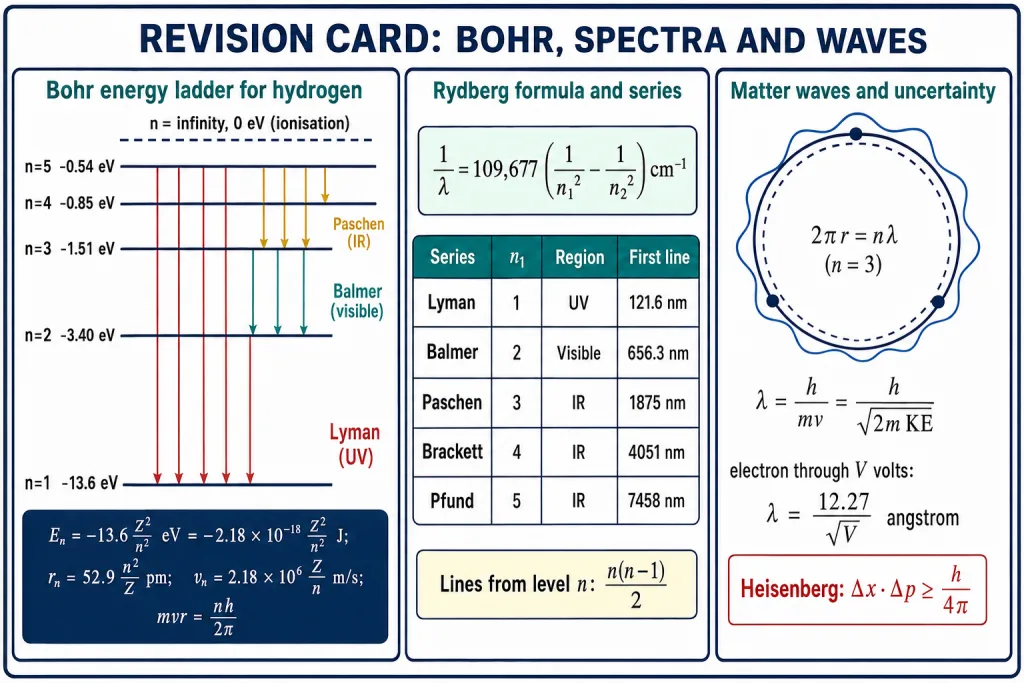
The postulates (1913)
| # | Postulate |
|---|---|
| 1 | The electron moves in circular orbits of fixed radius and energy (stationary states) around the nucleus |
| 2 | In a stationary state the electron does not radiate; energy changes only when it jumps between orbits |
| 3 | Frequency of the radiation absorbed or emitted is (Bohr's frequency rule) |
| 4 | Angular momentum is quantised: , — only orbits with a whole-number multiple of are allowed |
The formulas for hydrogen and hydrogen-like ions (, , ; nuclear charge )
| Quantity | Formula | Numbers to carry | Scaling |
|---|---|---|---|
| Radius | ; pm | ||
| Energy (J) | J per atom | ||
| Energy (eV) | eV | H: eV for to 5; J, J | |
| Velocity | |||
| Transition energy | J eV | in H: J eV | |
| Frequency, wavenumber | ; | ||
| Ionisation energy | eV | H 13.6 eV; 54.4 eV; 122.4 eV | |
| Number of lines | for a fall from to | : 6 lines; : 10 lines |
Key Point: The negative sign means the electron is bound: is a free electron at rest, and every bound state lies below zero. As increases becomes less negative, orbits get farther apart in radius () but closer in energy (). Energy is released when the electron falls inward and absorbed when it climbs.
[JEE Main] For hydrogen-like ions keep every hydrogen number and multiply: energies by , radii by , velocities by . has eV, pm, and its line has the same wavenumber as the line of hydrogen ( compensates the from the doubled quantum numbers).
Why Bohr's model had to go
| Limitation | What it means |
|---|---|
| Fine structure | Each hydrogen line is actually a doublet of closely spaced lines; Bohr predicts one |
| Multi-electron atoms | Fails even for helium — electron-electron repulsion is not in the model |
| Zeeman and Stark effects | Splitting of lines in a magnetic (Zeeman) or electric (Stark) field is unexplained |
| Chemical bonding | Cannot say why atoms combine into molecules |
| Wave nature of the electron | A definite orbit needs exact position and momentum at the same time, forbidden by Heisenberg; Bohr ignores de Broglie waves entirely |
Card 6 — de Broglie Waves and Heisenberg's Uncertainty Principle
de Broglie (1924): matter has a wavelength
Key Point (Definition): Every moving particle has a wave associated with it, of wavelength Wave character shows only when is comparable to the size of the obstacle, which is why it matters for electrons ( m) and is invisible for cricket balls ( m).
| Form | Formula | When to use |
|---|---|---|
| From velocity | mass and speed given | |
| From kinetic energy | energy given in J or eV | |
| Electron accelerated through volts | V gives 1.227 ; 10 kV gives 0.123 | |
| Bohr orbit as a standing wave | the th orbit fits exactly de Broglie wavelengths — Bohr's derived |
Worked numbers: an electron at has m; a 0.1-kg ball at 10 has m, unobservable.
[JEE Main] Same kinetic energy, lighter particle, longer wavelength (); same velocity, ; same wavelength, . Electron beams diffract (Davisson and Germer) — the experimental proof, and the basis of the electron microscope.
Heisenberg (1927): you cannot pin both down
Key Point (Definition): It is impossible to determine simultaneously the exact position and the exact momentum (or velocity) of a microscopic particle: J s.
| Object | Why the principle matters or not |
|---|---|
| Electron ( kg) | : fix at m and is already — an orbit is meaningless |
| Milligram dust particle ( kg) | ; pin at m and is — nothing |
| Physical reason | To see an electron you must hit it with a photon of smaller than the electron's size; such a photon carries enough momentum to change the electron's velocity unpredictably |
Why these two ideas killed the orbit
A Bohr orbit needs a definite radius and a definite velocity at the same instant, which the uncertainty principle forbids for something as light as an electron. A particle that is also a wave cannot follow a single line in space. The replacement is the orbital, a region where the probability of finding the electron () is high — usually the surface enclosing 90% probability.
Card 7 — Quantum Numbers, Orbital Shapes, Nodes and Capacities
The quantum mechanical model in three sentences
Schrodinger's equation is solved for the atom; each acceptable solution is a wave function (an orbital) with a definite energy. itself has no physical meaning; is the probability density of finding the electron at that point. Energy in an atom is quantised, and the electron has no fixed path.
The four quantum numbers
| Name | Symbol | Allowed values | What it tells you | Decided by |
|---|---|---|---|---|
| Principal | 1, 2, 3, … (K, L, M, N shells) | Size and energy of the orbital; number of orbitals in a shell , electrons | Schrodinger equation | |
| Azimuthal (angular momentum, subsidiary) | 0 to ( for ) | Shape of the orbital and the subshell; orbital angular momentum ; number of subshells in a shell | Schrodinger equation | |
| Magnetic | to including 0, i.e. values | Orientation of the orbital in space; number of orbitals in a subshell | Schrodinger equation | |
| Spin | or | Intrinsic spin of the electron; two electrons per orbital, opposite spins | Added (Uhlenbeck and Goudsmit); not from Schrodinger |
| Shell | Subshells () | Orbitals per subshell | Orbitals in shell () | Max electrons () | |
|---|---|---|---|---|---|
| K | 1 | 1 | 1 | 2 | |
| L | 2 | , | 1, 3 | 4 | 8 |
| M | 3 | , , | 1, 3, 5 | 9 | 18 |
| N | 4 | , , , | 1, 3, 5, 7 | 16 | 32 |
Key Point: A subshell holds electrons: 2, 6, 10, 14. Combinations that do not exist: , , (because ); in a subshell; .
Shapes
| Orbital | Shape | Lobes / orientation | Sign of |
|---|---|---|---|
| Spherical, non-directional | one; falls off with distance; larger than | positive everywhere in ; changes sign at its radial node | |
| Dumbbell, two lobes either side of the nucleus | , , along the three axes; nucleus at the nodal plane | opposite sign in the two lobes | |
| Double dumbbell (cloverleaf) for four of them | , , between axes; along and ; along with a ring (doughnut) in the plane | alternate lobes opposite |
All three orbitals of a subshell have the same energy and size (degenerate), and so do the five orbitals; they differ only in orientation.
Nodes — the counting rule
Key Point: A node is where (probability zero). Radial (spherical) nodes ; angular (planar) nodes ; total .
| Orbital | Radial nodes | Angular nodes | Total |
|---|---|---|---|
| 0 | 0 | 0 | |
| 1 | 0 | 1 | |
| 0 | 1 | 1 | |
| 2 | 0 | 2 | |
| 1 | 1 | 2 | |
| 0 | 2 | 2 | |
| 1 | 2 | 3 | |
| 0 | 3 | 3 |
[NEET] Orbitals with no radial node are those with : , , , . Two radial nodes and one angular node means with , so : the orbital.
Card 8 — Orbital Energies, the Filling Rules, Configurations and Magnetic Moment
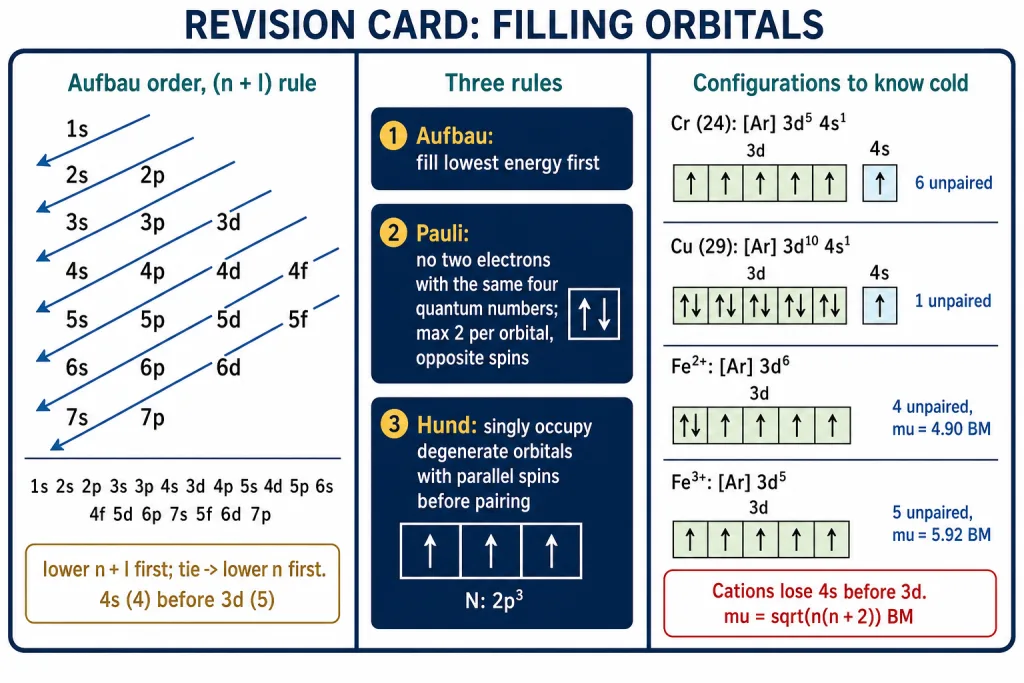
Orbital energies
| Atom | What fixes the energy of an orbital | Order |
|---|---|---|
| Hydrogen (one electron) | only | |
| Multi-electron atoms | ; electron-electron repulsion and shielding split the subshells of one shell |
Key Point: Lower , lower energy; equal , lower is lower. fills before ; fills before because is smaller. Within a shell, electrons penetrate closest to the nucleus and are shielded least, so and the effective nuclear charge felt by an electron is larger. Orbital energies fall with increasing for the same orbital: .
The three filling rules
| Rule | Statement | One-line consequence |
|---|---|---|
| Aufbau principle | Orbitals are filled in order of increasing energy ( order above) | is , not |
| Pauli exclusion principle | No two electrons in an atom can have the same set of four quantum numbers; an orbital holds at most two electrons with opposite spin | Shell capacity |
| Hund's rule of maximum multiplicity | Pairing in degenerate orbitals (, , ) begins only after each is singly occupied, and the single electrons have parallel spins | N is in , giving 3 unpaired electrons; O has 2, F 1, Ne 0 |
Configurations to know cold
| Element () | Configuration | Unpaired electrons |
|---|---|---|
| H (1), He (2) | ; | 1; 0 |
| Li (3), Be (4), B (5) | ; ; | 1; 0; 1 |
| C (6), N (7), O (8) | ; ; | 2; 3; 2 |
| F (9), Ne (10) | ; | 1; 0 |
| Na (11), Mg (12), Al (13) | ; ; | 1; 0; 1 |
| Si (14), P (15), S (16), Cl (17), Ar (18) | ; ; ; ; | 2; 3; 2; 1; 0 |
| K (19), Ca (20) | ; | 1; 0 |
| Sc (21), Ti (22), V (23) | ; ; | 1; 2; 3 |
| Cr (24) | (not ) | 6 |
| Mn (25), Fe (26), Co (27), Ni (28) | ; ; ; | 5; 4; 3; 2 |
| Cu (29) | (not ) | 1 |
| Zn (30), Ga (31) to Kr (36) | ; to | 0; 1, 2, 3, 2, 1, 0 |
For ions, remove from the highest first. Cations of transition metals lose the electrons before :
| Ion | Configuration | Unpaired | BM |
|---|---|---|---|
| , , , | 0 | 0 | |
| 4 | 4.90 | ||
| 5 | 5.92 | ||
| ; | ; | 0; 1 | 0; 1.73 |
| 3 | 3.87 | ||
| 0 | 0 |
Why Cr and Cu break the pattern — stability of half-filled and fully filled subshells
| Cause | Meaning |
|---|---|
| Symmetry | , , (half-filled) and , , (full) have a symmetrical charge distribution, which lowers the energy |
| Exchange energy | Electrons of the same spin in degenerate orbitals can exchange positions; more such pairs, more stabilisation. has exchanges, only 6 |
| Small - gap | Promoting one electron costs little and the gain in exchange plus symmetry pays for it |
The same idea explains why () is more stable than (), and why () is diamagnetic while () is paramagnetic.
Magnetic behaviour
| 1 | 2 | 3 | 4 | 5 | |
|---|---|---|---|---|---|
| / BM | 1.73 | 2.83 | 3.87 | 4.90 | 5.92 |
Paramagnetic — has unpaired electrons, attracted into a magnetic field (O, N, , ). Diamagnetic — all paired, weakly repelled (Ne, Zn, , ).
[Board] Two checks on any configuration you write: the superscripts must add up to the electron count, and the highest- subshell must be the one you empty first for a cation. is , never .
The Mistakes That Cost the Most Marks
Each of these was flagged somewhere in Sections 1 to 15, ordered roughly by how often they show up in answer scripts.
1. Writing as and as . Chromium is and copper — half-filled and fully filled subshells are extra stable (symmetry and exchange energy).
2. Removing electrons before when making a cation. Electrons leave from the highest first. is (4 unpaired, 4.90 BM), is (5 unpaired, 5.92 BM). Writing for also wrecks the unpaired count and the magnetic moment.
3. Forgetting the negative sign on Bohr energies, or ranking them upside down. eV. eV is the lowest energy, eV is higher (less negative). Energy is released on falling inward, absorbed on climbing out. Ionisation energy is eV, not eV.
4. Leaving out for and . Energies scale as , radii as , velocities as . ground state is eV and its first orbit has radius 26.45 pm. The Rydberg constant for is .
5. Mixing up "first line" with "series limit". The first (longest-wavelength, least-energy) line is ; the limit (shortest wavelength, most energy) is . Balmer: first line 656.3 nm, limit 364.6 nm. Lyman is UV, Balmer visible, the rest infrared.
6. Treating intensity as if it changed the kinetic energy of photoelectrons. Intensity changes the number of electrons per second; frequency alone sets . Below no electrons come out however bright the light. The equation needs and in the same unit — do not subtract eV from joules.
7. Unit slips in . must be in metres: 580 nm m, giving J. With in nm use eV instead. Wavenumber in needs in cm: .
8. Illegal quantum-number sets. runs from 0 to , from to . So is impossible ( does not exist); is impossible ( orbitals have only ); is impossible ( is ).
9. Counting nodes as instead of . Total nodes , angular , radial . : 1 radial, 1 angular. : 1 radial, 0 angular. : 0 radial, 2 angular.
10. Filling before (or ranking below in hydrogen). In multi-electron atoms decides: , so potassium is . In hydrogen all subshells of a shell are degenerate — — because there is no shielding.
11. Using (or ) instead of . The relation is , so ; J s. The de Broglie formula is — mass times velocity, never or alone.
12. Confusing isobars with isotopes, and cations with anions in electron counts. Isotopes share (same element), isobars share (different elements). For an ion, electrons : has electrons; has . Neutrons are always and never change with charge.
Key Point: Two more single-mark slips: writing "orbit" when the question is about the quantum mechanical model (an orbital is a probability region, an orbit is a fixed Bohr path), and quoting the photoelectric threshold as a wavelength above which emission happens — it is a minimum frequency (maximum wavelength).
The 60-Second Revision
The irreducible minimum, for the queue outside the hall.
Particles. Electron: cathode rays, Thomson 1897, ; charge C from Millikan's oil drops; mass kg. Proton: canal rays, depends on the gas. Neutron: Chadwick 1932, Be + . Proton and neutron are about 1 u each; a proton is about 1836 times an electron's mass.
Models. Thomson: plum pudding, explains neutrality only. Rutherford 1911: -scattering, tiny dense nucleus ( m) in a m atom; fails on stability and spectra. Bohr 1913: quantised orbits, ; explains H and hydrogen-like spectra; fails on fine structure, multi-electron atoms, Zeeman and Stark effects. Quantum mechanical: orbitals, .
Numbers on the symbol. = protons; ; neutrons ; electrons . Isotopes same ; isobars same ; isoelectronic same electron count (, , Ne, , all 10).
Radiation. ; ; . Order by rising : , X, UV, visible (400 to 750 nm), IR, microwave, radio. , J s; . Photoelectric: ; threshold frequency ; KE depends on , number on intensity, no time lag.
Spectra. . Lyman (, UV), Balmer (2, visible: 656.3, 486.1, 434.0, 410.2 nm), Paschen (3), Brackett (4), Pfund (5) — all IR. First line ; limit . Lines from level : .
Bohr. pm; J eV; ; eV; eV ; : on energy, on radius.
Waves and uncertainty. ; electron through volts: ; . ; . Both together forbid orbits and give orbitals (90% probability surface).
Quantum numbers. (size, energy; orbitals, electrons); to (; shape; ); to ( orbitals; orientation); . Capacity: 2, 6, 10, 14. Nodes: radial , angular , total . sphere, dumbbell, cloverleaf ( with a ring).
Filling. Order: — lower first, then lower . Hydrogen: energy depends on only. Aufbau, Pauli (no two electrons with the same four quantum numbers), Hund (singly occupy first, parallel spins). ; ; ; ; cations lose before . BM: 1.73, 2.83, 3.87, 4.90, 5.92 for to 5.
That is the whole chapter.