
Two Ideas That Bohr Never Had
Bohr's model worked for hydrogen and failed for almost everything else: no fine structure, no multi-electron spectra, no line splitting in fields, no account of bonding. A model that works for one element is not a model of the atom.
Between 1924 and 1927 two ideas appeared that Bohr did not have in 1913, and together they forced a rebuild of the atom:
- Dual behaviour of matter — de Broglie's proposal that electrons, like light, are both particles and waves.
- Heisenberg's uncertainty principle — you cannot know an electron's position and momentum precisely at the same time.
Both grew out of the dual nature of radiation you met in Section 4. Light refuses to be only a wave (black-body radiation, the photoelectric effect) or only a particle (interference, diffraction). If light can behave like a particle, a particle should be able to behave like light.
What a photon already carries
A photon has no rest mass, yet it carries momentum. Combine with for the energy-equivalent mass of a photon:
The product is the photon's momentum , so
A photon's wavelength is Planck's constant divided by its momentum. Every photon has a wavelength (wave property) and a momentum (particle property), and is the exchange rate between them.
Key Point: For a photon, and . The "mass" of a photon asked for in problems is the energy-equivalent mass — its rest mass is zero.
The road map for this section
| Development | Who and when | Central equation | What it tells us about the atom |
|---|---|---|---|
| Dual behaviour of matter | Louis de Broglie, 1924 | Electrons are waves too; Bohr's orbits are standing waves | |
| Uncertainty principle | Werner Heisenberg, 1927 | Electrons have no trajectories; orbits must give way to probability |
Everything else in this section follows from these two lines.
de Broglie's Matter Waves
In 1924 Louis de Broglie, then a doctoral student, argued that nature is symmetric: if radiation shows dual behaviour, matter should show dual behaviour too. A moving electron should have momentum and wavelength, just as a photon does.
He took the photon relation and asserted that it holds for any material particle:
where is the mass, the velocity and the momentum. This is the de Broglie relation, and is the de Broglie wavelength.
Key Point (Definition): Every moving material particle has a wave associated with it, of wavelength . The wavelength is inversely proportional to momentum — heavy or fast particles have short wavelengths, light or slow particles long ones.
The equation contains no charge. A neutron, a proton, an electron, a cricket ball — all obey it. Only mass and speed matter.
How the prediction was confirmed
A wave must diffract. A beam of electrons fired at a crystalline nickel target (Davisson and Germer, 1927) and, separately, through a thin metal foil (G. P. Thomson, 1927) produced diffraction patterns like those of X-rays — rings and spots only waves can make. The measured wavelengths matched .
The same wave behaviour runs the electron microscope. A light microscope is limited by the wavelength of visible light (about 400 to 750 nm), so it cannot resolve anything much smaller than a virus. An electron accelerated through a few thousand volts has a wavelength of a few picometres, a hundred thousand times shorter, and an electron microscope reaches a magnification of about 15 million times. Neutron diffraction maps atom positions in crystals on the same principle.
Why you have never seen a cricket ball diffract
Every moving object has a wave character, but is tiny and everyday masses are enormous. Compare:
| Object | Mass | Speed | Comparable to | |
|---|---|---|---|---|
| Electron in an atom | kg | m (332 pm) | size of an atom | |
| Slow electron (KE J) | kg | m (897 nm) | infrared light | |
| Neutron in a diffractometer | kg | m (800 pm) | spacing between atoms | |
| Cricket ball | 0.1 kg | m | nothing — times smaller than a nucleus | |
| Golf ball | 0.040 kg | m | nothing |
To detect a wave it must pass through a slit or grating whose spacing is comparable to its wavelength. Atomic planes in a crystal are a few hundred picometres apart, which suits electrons and neutrons. Nothing in the universe has a spacing of m, so the wavelength of a ball is real in principle and undetectable in practice. Wave properties of macroscopic objects are not zero; they are unobservable.
Key Point: The de Broglie wavelength of ordinary objects is immeasurably small because their mass is huge. For sub-atomic particles it is comparable to atomic dimensions, which is why their wave nature shows up in experiments — and why it must be built into any model of the atom.
de Broglie Meets Bohr — Orbits as Standing Waves
Bohr assumed that the angular momentum of the electron is quantised, , without giving a reason. de Broglie's idea supplies the reason.
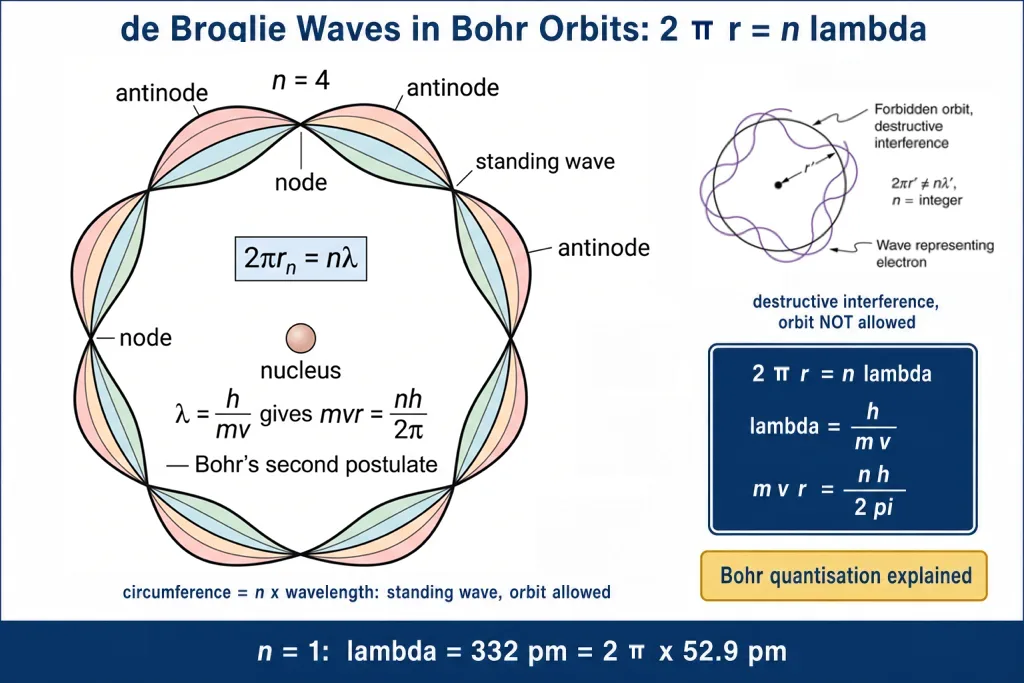
Picture the electron as a wave running around the circumference of its orbit. If the wave does not come back in step with itself after one lap, successive laps interfere destructively and cancel, so no such orbit can exist. Only orbits whose circumference holds a whole number of wavelengths survive, with the wave reinforcing itself lap after lap as a standing wave:
Substituting :
That is Bohr's quantisation condition, derived rather than assumed. The integer is the number of de Broglie wavelengths that fit around the orbit: one for the first orbit, two for the second, and so on. For the electron's wavelength is 332 pm and pm is also 332 pm.
Key Point: The circumference of the th Bohr orbit is an integral multiple of the de Broglie wavelength of the electron in it: . Quantisation of angular momentum is a consequence of the wave nature of the electron.
[JEE/NEET] "Show that the circumference of the Bohr orbit is an integral multiple of the de Broglie wavelength" is a three-line derivation: write , substitute , land on . Asked backwards, the number of waves in the th orbit is .
The working forms of
Velocity is rarely handed to you directly. Learn the three disguises.
1. Given the kinetic energy. Since , and
2. Given the accelerating voltage. A charge accelerated from rest through a potential difference gains kinetic energy , so
3. For an electron, in ångströms. Put kg and C into form 2:
An electron accelerated through 100 V has Å; through 10,000 V it has 0.123 Å, shorter than any laboratory X-ray tube produces.
| You are given | Use | Watch out for |
|---|---|---|
| mass and velocity | kg and ; convert g to kg first | |
| momentum | in | |
| kinetic energy | KE in joules; convert eV using J | |
| accelerating voltage (any charge) | use the charge and mass of that particle | |
| accelerating voltage (electron only) | Å | electrons only, at non-relativistic speeds |
Three comparisons worth fixing in memory. Same kinetic energy: , so an electron beats a proton by . Same momentum: identical wavelengths whatever the masses. Same speed: . Check which one a question fixes before comparing.
For a proton or an -particle through volts, do not use 12.27. Rebuild from : an -particle (mass , charge ) through the same has , and Å.
Heisenberg's Uncertainty Principle
The second idea came in 1927 from Werner Heisenberg, and it follows directly from the dual behaviour of matter and radiation.
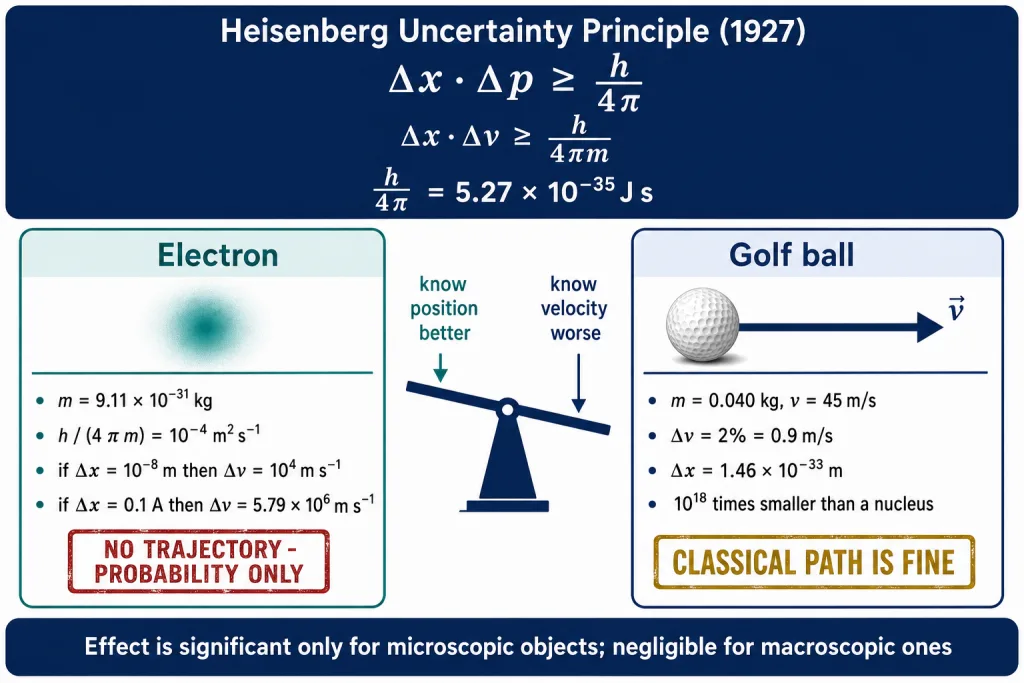
Key Point (Definition): Heisenberg's uncertainty principle: it is impossible to determine simultaneously the exact position and the exact momentum (or velocity) of an electron. Mathematically, where is the uncertainty in position and (or ) the uncertainty in momentum (or velocity) along the same direction.
The three forms are one statement. The right-hand side is fixed and tiny: , and the product of the two uncertainties can never fall below it. Pin down the position precisely ( small) and the momentum becomes uncertain ( large); fix the velocity precisely and the position blurs. Any measurement on an electron gives a fuzzy picture, sharp in one variable only at the cost of the other.
This is not about bad instruments
The limit is built into nature, not into our microscopes. Two pictures show why.
The unmarked metrestick. Measure the thickness of a sheet of paper with a metrestick that has no markings and whatever you report is meaningless — the instrument is far coarser than the thing measured. Any accuracy needs divisions smaller than the paper's thickness. To locate an electron you need a ruler with divisions smaller than the electron, and an electron is treated as a point charge with no size at all.
Illuminating the electron. Seeing anything means bouncing light off it, and detail smaller than the wavelength used cannot be resolved. Accurate position therefore needs radiation of very short wavelength. But short wavelength means large momentum, , and such a photon slams into the electron and changes its energy and velocity by an unknown amount. You learn where the electron was and lose how fast it is moving. A long-wavelength photon disturbs the electron less, so the velocity stays known, but the position is now blurred to within a wavelength. No photon is both gentle and precise.
| To measure position precisely | Consequence |
|---|---|
| use light of very short | photon momentum is large |
| the photon collides with the electron | electron's momentum changes unpredictably |
| small | large — the product stays |
The measurement itself is the disturbance, and since the trade-off follows from , it can never be engineered away.
[Board] The two-mark answer is the definition plus . The five-mark answer adds the illuminating-the-electron argument and the "no trajectory" consequence. Write , not : the principle sets a lower limit on the product.
Some books write the limit as , where ; that is the same as . If a question supplies or plain , use what it gives — the order of magnitude is the point.
What the Principle Means — No Trajectories, and Why Golf Balls Don't Care
Significance: it rules out definite paths
The path of a thrown ball is fixed by where it is and how fast it is going at each instant: know both, and Newton's laws give every later position. Position and velocity together fix a trajectory. For an electron you can never have both to arbitrary precision at the same instant, so the electron has no trajectory in the classical sense — no path, no orbit, no "the electron is here going that way". The most you can state is how probable it is to find the electron in a given region.
Key Point: The uncertainty principle rules out definite paths or trajectories for electrons and similar particles. Precise statements about position and momentum must be replaced by statements of probability — which is what the quantum mechanical model does.
Why the effect is invisible for everyday objects
The principle applies to everything; the number decides whether anyone notices.
An object of about a milligram ( kg):
Locate the speck to within a nanometre and its speed is uncertain by only about , which no instrument could detect. For milligram-sized or heavier objects the uncertainties are of no consequence.
An electron ( kg):
Try to locate the electron to within m, a hundred atomic diameters:
Ten kilometres per second of uncertainty in the speed. Tighten to the size of an atom, m, and climbs to — about the electron's speed in Bohr's first orbit. If you know an electron is inside an atom, you have no idea how fast it is moving, and the picture of an electron gliding along a fixed Bohr orbit at a definite speed cannot hold.
| Object | Mass | () | If m, | Verdict |
|---|---|---|---|---|
| Electron | kg | uncertainty dominates | ||
| Proton | kg | still significant | ||
| Milligram speck | kg | utterly negligible | ||
| Golf ball | 0.040 kg | utterly negligible |
A golf ball makes the same point from the other side: even with a sloppy 2% uncertainty in its speed, its position is pinned to m, roughly times smaller than a nucleus. For large particles the principle sets no meaningful limit and classical mechanics works.
Key Point: . Because is and sits in the denominator, the limit matters only for microscopic particles and is negligible for anything you can hold.
[NEET] Three numbers worth memorising: milligram object, ; electron, ; electron located to m, .
Why Bohr's Model Had to Go
With both ideas in hand, the failure of Bohr's model becomes a matter of principle rather than a list of unexplained spectra. Bohr's electron is a charged particle moving in a well-defined circular orbit with a definite radius and speed. That picture is wrong in two separate ways.
Reason 1: it ignores the wave nature of the electron
Bohr treats the electron purely as a particle. de Broglie showed that an electron in an atom has a wavelength of a few hundred picometres — the size of the atom itself. An object whose wavelength matches the space it occupies cannot be described as a little ball on a track; its wave character is the main event, and Bohr's model has no room for it.
Reason 2: it contradicts the uncertainty principle
An orbit is a defined path, and defining a path needs exact position and exact velocity at the same instant, which the uncertainty principle forbids. For an electron confined to an atom ( m) the velocity uncertainty is , comparable to the orbital speed itself. A "circular orbit of radius 52.9 pm with speed " is a claim the electron cannot make good on.
Key Point: Bohr's model of the hydrogen atom ignores the dual behaviour of matter and contradicts Heisenberg's uncertainty principle. Its exact orbits must be replaced by regions of probability — orbitals — in the quantum mechanical model.
The two lists side by side
| What Bohr assumed | What we now know |
|---|---|
| electron is a particle | electron is a particle and a wave () |
| electron moves on a fixed circular orbit | no trajectory can be defined () |
| radius and velocity in orbit are exact | only probability of finding the electron in a region is meaningful |
| is a postulate | it follows from |
| works only for one-electron species | quantum mechanics handles every atom |
Quantum mechanics does not discard Bohr entirely. His energy levels J for hydrogen survive exactly; his orbits become orbitals; his becomes the principal quantum number. What dies is the picture of a tiny planet circling a tiny sun.
Exam playbook for this section
| Question type | What to do |
|---|---|
| "Calculate the de Broglie wavelength of …" | identify (kg) and ; ; answer usually in m, nm, pm or Å |
| "…with kinetic energy " | first, then (or in one step) |
| "…accelerated through volts" | electron: Å; any other particle: |
| "Mass of a photon of wavelength " | |
| "Uncertainty in velocity given " | |
| "Uncertainty in position given % error in speed" | , then |
| "Why no trajectory / why Bohr fails" | wave nature ignored + uncertainty principle contradicted |
| "Circumference = " | , , hence |
Unit discipline wins these marks. Write as (since ), keep mass in kg and speed in , and the wavelength comes out in metres. Grams and centimetres are the usual way to lose a factor of a thousand.
Solved Examples
Question 1: Wavelength of a moving ball
(i) What is the wavelength of a ball of mass 0.1 kg moving with a velocity of ? (ii) A proton accelerated through a potential difference of 1000 V moves at . If a hockey ball of mass 0.1 kg could move at this same velocity, what would its wavelength be?
Answer:
I use with .
For the slow ball: m.
For the fast hockey ball: m.
A nucleus is about m across, so both wavelengths are more than times smaller than that. No slit or grating could reveal them.
Ans: (i) m; (ii) m. Watch out: Any macroscopic object gives a wavelength of order m or less. An answer near m for a ball means grams were used instead of kilograms.
Question 2: Wavelength of an electron from its kinetic energy
The mass of an electron is kg. If its kinetic energy is J, calculate its wavelength.
Answer:
First I find the velocity from :
Then de Broglie:
That is m nm.
The one-step form checks it: m.
Ans: and m nm. Watch out: A slow electron lands in the infrared. The same electron at would be down at 0.7 nm, so check the speed before trusting the size of the answer.
Question 3: The "mass" of a photon
Calculate the mass of a photon with wavelength 3.6 Å.
Answer:
The wavelength is Å m, and a photon travels at .
Rearranging de Broglie for mass, gives :
The exponent checks out: . This is about 150 times lighter than an electron.
Ans: kg (energy-equivalent mass; the photon's rest mass is zero). Watch out: Some printed solutions quote kg here; the mantissa is right but the power is a misprint. Carry the exponent arithmetic yourself.
Question 4: A fast electron
Calculate the wavelength of an electron moving with a velocity of .
Answer:
Here kg and .
The momentum is .
So m, which is pm or Å.
Ans: m (35.5 pm). Watch out: At about 7% of the speed of light relativistic corrections are still under 1%, so the simple formula is fine; at much higher speeds it is not.
Question 5: The electron microscope
Dual behaviour of matter proposed by de Broglie led to the discovery of the electron microscope, often used for highly magnified images of biological molecules. If the velocity of the electron in this microscope is , calculate the de Broglie wavelength associated with this electron.
Answer:
I use :
That is pm, or Å. Visible light is 400 to 750 nm, roughly a thousand times longer, and resolution scales with wavelength — which is why an electron microscope reaches a magnification of about 15 million.
Ans: m pm.
Question 6: Neutron diffraction
Similar to electron diffraction, a neutron diffraction microscope is used for determining the structure of molecules. If the wavelength used is 800 pm, calculate the characteristic velocity associated with the neutron. (Mass of a neutron kg.)
Answer:
I rearrange to get , with pm m.
An electron of the same wavelength would need , 1840 times faster because it is 1840 times lighter.
Ans: (about ). Watch out: For a fixed wavelength , so neutron speeds come out around the speed of sound, not near as for electrons.
Question 7: The electron in Bohr's first orbit
If the velocity of the electron in Bohr's first orbit is , calculate the de Broglie wavelength associated with it. Then compare it with the circumference of the first orbit ( pm).
Answer:
That is pm, or Å.
The circumference of the first orbit is pm pm. So the circumference equals one de Broglie wavelength, as requires for .
Ans: m pm, equal to the circumference of the first Bohr orbit. Watch out: For both sides change: doubles to 664 pm, and pm pm.
Question 8: Deriving Bohr's quantisation from de Broglie
Show that the circumference of the Bohr orbit for the hydrogen atom is an integral multiple of the de Broglie wavelength associated with the electron revolving around the orbit.
Answer:
I start from Bohr's postulate, that angular momentum in a stationary orbit is quantised:
Rearranging to isolate the circumference,
The electron of mass and velocity has de Broglie wavelength , so
The circumference of the th orbit is times the de Broglie wavelength: the orbit holds a whole number of waves, so the electron wave reinforces itself on every lap as a standing wave. An orbit with a fractional number of wavelengths would interfere destructively and cannot exist.
The logic runs both ways — start from , put , and Bohr's drops out.
Ans: ; the circumference of the th orbit is de Broglie wavelengths.
Question 9: Locating an electron to 0.1 Å
A microscope using suitable photons is employed to locate an electron in an atom within a distance of 0.1 Å. What is the uncertainty involved in the measurement of its velocity?
Answer:
From I get .
Here Å m and kg.
The electron in the first Bohr orbit moves at , so the uncertainty in the speed is nearly three times the speed itself. Locating the electron has cost all meaningful knowledge of its velocity.
Ans: . Watch out: Convert 0.1 Å to m, not m — one Å is m, so a tenth of it is m.
Question 10: The golf ball
A golf ball has a mass of 40 g and a speed of 45 m/s. If the speed can be measured within an accuracy of 2%, calculate the uncertainty in the position.
Answer:
The uncertainty in speed is 2% of 45 m/s:
The mass is g kg, and :
A nucleus is about m across, so this is roughly times smaller than a nucleus. The golf ball's position is exactly known for every practical purpose.
Ans: m. Watch out: The 2% applies to the speed, giving , not to the position. Convert 40 g to 0.040 kg before substituting.
Question 11: Uncertainty in momentum, and a momentum that cannot be defined
If the position of an electron is measured within an accuracy of nm, calculate the uncertainty in the momentum of the electron. Suppose the momentum of the electron is ; is there any problem in defining this value?
Answer:
First the conversion: nm m.
Now the momentum the question proposes:
The uncertainty is about 25 times larger than the momentum value itself. A quantity whose error bar is 25 times its size has no defined value.
Ans: ; the suggested momentum is smaller than this uncertainty, so it cannot be meaningfully defined. Watch out: Whenever exceeds , the momentum is not merely imprecise, it is undefined — the classical description has broken down.
Question 12: Electron accelerated through a potential difference
An electron, initially at rest, is accelerated through a potential difference of volts. (i) Derive an expression for its de Broglie wavelength in ångströms. (ii) Find the wavelength for V. (iii) Through what potential difference must the electron be accelerated for its wavelength to equal 1.0 Å?
Answer:
The work done on charge through volts is , so and . Then .
Putting in kg and C:
For 100 V: Å pm.
For Å: , so V, about 150 V.
Ans: (i) Å; (ii) 1.227 Å; (iii) about 150 V. Watch out: The constant 12.27 holds for electrons only. For any other charged particle rebuild from with that particle's mass and charge.