
The Aufbau Principle — Building an Atom One Electron at a Time
You now know which orbitals exist and how their energies are ordered. The next question is where the electrons of a real atom actually sit. Three rules answer it together — the aufbau principle, Pauli's exclusion principle and Hund's rule — working on top of the orbital energies from the last section.
The word aufbau is German for "building up". Start with a bare nucleus, add electrons one by one, and send each new electron into the lowest-energy orbital that still has room, until all electrons are placed.
Key Point (Definition): Aufbau principle: In the ground state of an atom, the orbitals are filled in order of their increasing energies. Electrons first occupy the lowest-energy orbital available to them and enter higher-energy orbitals only after the lower ones are filled.
The filling order
Orbital energy in a multi-electron atom depends on both and (through the effective nuclear charge and the rule), so the filling order is not simply shell by shell. The sequence that works for almost every element is:
Three places interrupt a lower shell with a higher one: before , before , and before and . These are exactly where the rule gives the higher- orbital the smaller value: has while has .
The diagonal-arrow trick
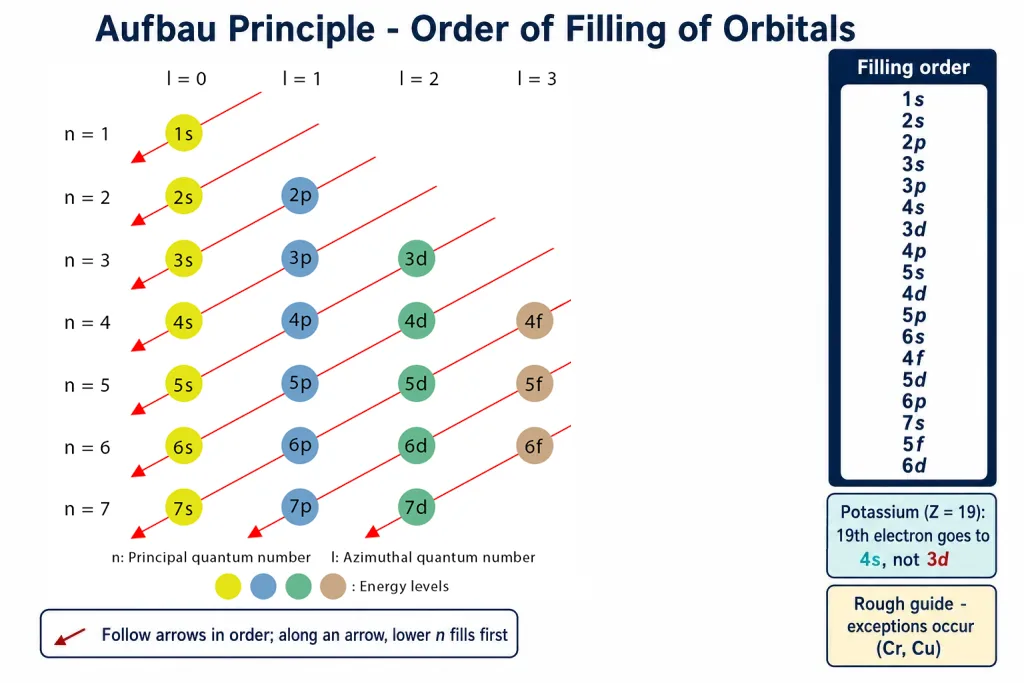
The string does not have to be memorised. Write the subshells in rows, one row per shell — in the first row, in the second, in the third, in the fourth — so each column is a fixed value of . Draw diagonal arrows running from top right to bottom left, and following them in order gives the filling sequence:
| Arrow | Subshells crossed (in order) | |
|---|---|---|
| 1 | 1 | |
| 2 | 2 | |
| 3 | 3 | |
| 4 | 4 | |
| 5 | 5 | |
| 6 | 6 | |
| 7 | 7 | |
| 8 | 8 |
Each arrow is a line of constant , starting at the lowest on that diagonal and ending at the highest. So along any arrow the orbitals come in order of increasing , which is why fills before and before : same , lower first. The arrow diagram is the rule drawn as a picture.
A test case: potassium
Potassium () is the first element where the interruption matters. After argon's , the nineteenth electron chooses between () and (). The sequence says , and spectroscopy agrees: potassium's outermost electron sits in , which is why it behaves like sodium, a Group 1 metal with one valence electron, and not like a transition metal.
A rough guide, not a law
Key Point: No single ordering of orbital energies is universally correct for all atoms, because orbital energy depends on the effective nuclear charge and different orbitals are affected to different extents. The aufbau sequence is a rough guide. Neighbouring orbitals such as and are often so close in energy that a small change in atomic structure changes the order of filling — so exceptions occur.
The two famous exceptions, chromium and copper, come later in this section. The sequence and the arrow diagram carry you correctly through the first 36 elements with only those two detours.
[Exam Tip] For "which orbital is filled after ?" or "which fills first, or ?", sketch the arrow diagram in the margin. The answers are and .
Pauli's Exclusion Principle and Hund's Rule
The aufbau principle says nothing about how many electrons an orbital can hold, or how electrons share a set of degenerate orbitals. Those two jobs belong to Pauli and Hund.
Pauli's exclusion principle (1926)
Wolfgang Pauli capped the number of electrons in any orbital. The principle has two equivalent statements, both worth knowing:
Key Point (Definition): Pauli exclusion principle (statement 1): No two electrons in an atom can have the same set of all four quantum numbers (, , , ).
Statement 2: Only two electrons may exist in the same orbital, and these two electrons must have opposite spins.
An orbital is fixed by , and . Two electrons in it share those three numbers, so they must differ in the only one left — the spin, for one and for the other. A third electron would repeat one of these sets, which is forbidden.
Counting capacities with Pauli
With at most two electrons per orbital, the capacity of every subshell follows by multiplication:
| Subshell | Number of orbitals | Maximum electrons | |
|---|---|---|---|
| 0 | 1 | 2 | |
| 1 | 3 | 6 | |
| 2 | 5 | 10 | |
| 3 | 7 | 14 |
A shell with principal quantum number contains orbitals (for : one + three + five = 9), so it holds at most electrons.
Key Point: The maximum number of electrons in a shell with principal quantum number is : 2 for (), 8 for (), 18 for (), 32 for ().
[NEET] Two consequences: (i) the maximum number of electrons in a subshell with the same spin is , so at most 5 electrons with in a subshell; (ii) the number with in a filled shell is half of , i.e. — for , that is 16.
Hund's rule of maximum multiplicity
In a subshell with its three degenerate orbitals , , , the second electron could pair with the first or take an empty orbital. Hund's rule decides.
Key Point (Definition): Hund's rule of maximum multiplicity: Pairing of electrons in the orbitals belonging to the same subshell (, or ) does not take place until each orbital belonging to that subshell has got one electron each, i.e. is singly occupied. The singly occupied orbitals have electrons with parallel spins.
Two electrons in the same orbital share a region of space and repel each other strongly; spreading them into different orbitals keeps them apart and lowers the energy. Parallel-spin electrons in different orbitals also gain an extra stabilisation called exchange energy, covered later in this section. Both effects push the same way: singly occupy first with parallel spins, pair only when forced to.
When pairing starts
There are three , five and seven orbitals, so:
| Subshell | Orbitals | Electrons that go in unpaired | Pairing starts with the … |
|---|---|---|---|
| 3 | 1st, 2nd, 3rd | 4th electron | |
| 5 | 1st to 5th | 6th electron | |
| 7 | 1st to 7th | 8th electron |
So nitrogen () has three unpaired electrons with parallel spin, and oxygen () is the first element in the row with a paired orbital. In the series, manganese () has five unpaired electrons and iron () is where pairing begins.
The three rules are easiest to keep straight through what each one forbids:
| Rule | What it decides | A configuration that violates it |
|---|---|---|
| Aufbau | Which subshell fills next | (skipping and ) |
| Pauli | Maximum two electrons per orbital, opposite spins | ; or a box with two same-direction arrows |
| Hund | Singly occupy degenerate orbitals first, parallel spins | drawn as one paired box and two empty boxes |
A configuration that breaks the aufbau order but obeys Pauli and Hund is not impossible — it is a legitimate excited state. A configuration that breaks Pauli is impossible for any state.
Writing Electronic Configurations — Two Notations, and the First Eighteen Elements
Key Point (Definition): The distribution of electrons into the orbitals of an atom is called its electronic configuration.
With the three filling rules in hand, writing a configuration is a matter of counting. There are two ways of writing one down.
Notation 1: the form
Each subshell is written as its principal quantum number, then the subshell letter, with the number of electrons as a superscript. Sodium is : two electrons in , two in , six in , one in . The superscripts must add to the total number of electrons, .
Notation 2: the orbital (box) diagram
Every orbital of a subshell is drawn as a box (or a short line), and each electron is an arrow: for and for . A subshell is three boxes side by side, a subshell five boxes.
The box diagram displays all four quantum numbers of every electron: the box gives , and , the arrow gives . The form hides the spins and hides whether electrons are paired, so questions on unpaired electrons, Hund's rule or magnetic behaviour are best answered with boxes.
Hydrogen to neon
Hydrogen's single electron goes into : . Helium's second electron also fits in , but only with the opposite spin (Pauli): , one box with . Lithium's third electron cannot enter the full , so it takes : . Beryllium completes : .
From boron to neon the three orbitals fill under Hund's rule. Boron puts one electron in ; carbon's second goes into a different orbital with the same spin; nitrogen's third does the same, giving three singly occupied orbitals with parallel spins. Pairing begins with oxygen's fourth electron. Fluorine pairs a second orbital, and neon fills all three.
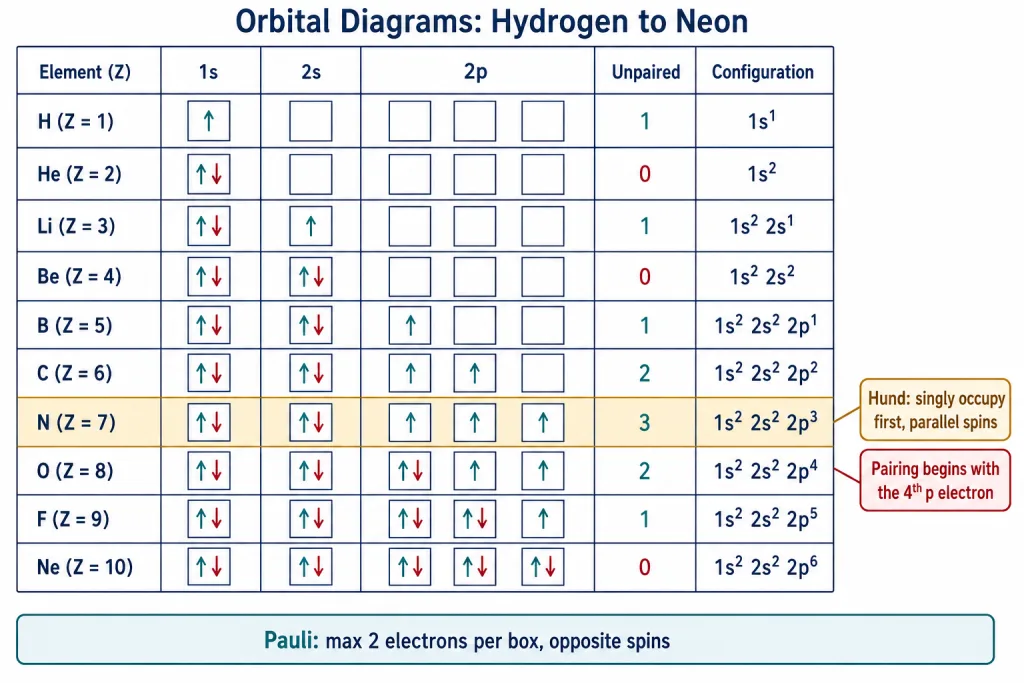
| Element | Configuration | Unpaired | ||||||
|---|---|---|---|---|---|---|---|---|
| H | 1 | ↑ | 1 | |||||
| He | 2 | ↑↓ | 0 | |||||
| Li | 3 | ↑↓ | ↑ | 1 | ||||
| Be | 4 | ↑↓ | ↑↓ | 0 | ||||
| B | 5 | ↑↓ | ↑↓ | ↑ | 1 | |||
| C | 6 | ↑↓ | ↑↓ | ↑ | ↑ | 2 | ||
| N | 7 | ↑↓ | ↑↓ | ↑ | ↑ | ↑ | 3 | |
| O | 8 | ↑↓ | ↑↓ | ↑↓ | ↑ | ↑ | 2 | |
| F | 9 | ↑↓ | ↑↓ | ↑↓ | ↑↓ | ↑ | 1 | |
| Ne | 10 | ↑↓ | ↑↓ | ↑↓ | ↑↓ | ↑↓ | 0 |
The unpaired counts across the row run 1, 0, 1, 0, 1, 2, 3, 2, 1, 0. Nitrogen, with three, has the most in the second period.
Sodium to argon — and the noble-gas shorthand
Sodium () to argon () repeat the lithium-to-neon pattern one shell up: fills first (Na, Mg), then the three orbitals (Al to Ar), with Hund's rule giving Si two unpaired electrons, P three, S two, Cl one and Ar none. In full, argon is .
Writing every time is tedious, so the ten electrons of the first two shells — exactly neon's configuration — are replaced by .
| Element | Full configuration | Shorthand | Valence electrons | |
|---|---|---|---|---|
| Na | 11 | 1 | ||
| Mg | 12 | 2 | ||
| Al | 13 | 3 | ||
| Si | 14 | 4 | ||
| P | 15 | 5 | ||
| S | 16 | 6 | ||
| Cl | 17 | 7 | ||
| Ar | 18 | 8 |
Key Point (Definition): Electrons in the completely filled inner shells are the core electrons; electrons added to the shell with the highest principal quantum number are the valence electrons. From sodium to argon, the ten neon-core electrons are the core and the and electrons are the valence electrons.
The shorthand is more than a convenience. Chemistry happens with the valence electrons, so shows at a glance that sodium has one loosely held electron outside a stable core — the reason it forms . The noble-gas symbol must be the one immediately before the element: for Li to Ne, for Na to Ar, for K to Kr, for Rb to Xe, for Cs to Rn.
[Board] Either the full form or the shorthand is accepted unless the question says otherwise. Check that the superscripts add to , or to minus the core count.
From Potassium to Krypton and Beyond — Where the and Electrons Go
Potassium and calcium: before
After argon the subshell is still empty, but the aufbau sequence puts first. So potassium () is and calcium () is . Both behave like their lighter cousins sodium and magnesium.
Scandium to zinc: filling
A new pattern begins at scandium (). The subshell lies below , so it fills next. Across scandium, titanium, vanadium, chromium, manganese, iron, cobalt, nickel, copper and zinc, the five orbitals are progressively occupied — the first-row transition elements.
| Element | Configuration | boxes | Unpaired | |
|---|---|---|---|---|
| Sc | 21 | ↑ | 1 | |
| Ti | 22 | ↑ ↑ | 2 | |
| V | 23 | ↑ ↑ ↑ | 3 | |
| Cr | 24 | (not ) | ↑ ↑ ↑ ↑ ↑ | 6 |
| Mn | 25 | ↑ ↑ ↑ ↑ ↑ | 5 | |
| Fe | 26 | ↑↓ ↑ ↑ ↑ ↑ | 4 | |
| Co | 27 | ↑↓ ↑↓ ↑ ↑ ↑ | 3 | |
| Ni | 28 | ↑↓ ↑↓ ↑↓ ↑ ↑ | 2 | |
| Cu | 29 | (not ) | ↑↓ ↑↓ ↑↓ ↑↓ ↑↓ | 1 |
| Zn | 30 | ↑↓ ↑↓ ↑↓ ↑↓ ↑↓ | 0 |
The chromium and copper puzzle
Chromium and copper carry five and ten electrons in rather than the four and nine their positions suggest. The reason is that fully filled and half-filled subshells have extra stability, meaning lower energy: , , , , and are more stable than their neighbours. Since and differ only slightly in energy, one electron shifts from to when the shift leaves exactly half-filled or completely filled. Chromium takes and copper . The next block explains why those subshells are special.
Key Point: Cr: , six unpaired electrons — the maximum in the series. Cu: , one unpaired electron. Both have a single electron. (Even this rule has exceptions elsewhere in the periodic table.)
On writing order: and are both accepted. Writing first groups subshells by shell and reflects that an occupied lies below ; writing first follows the filling order. Use one consistently.
Gallium to krypton, and the pattern repeats
With full at zinc, the orbitals start at gallium () and finish at krypton (, ). Krypton has 8 valence electrons (); the filled counts as core for the -block elements.
From rubidium () to xenon () the story repeats one shell up: (Rb, Sr), then (Y to Cd), then (In to Xe). Then : caesium () and barium (). From lanthanum () to mercury () filling takes place in and — the fourteen lanthanoids fill , the third transition series fills . After these come (Tl to Rn), (Fr, Ra), and finally (the actinoids) and . All elements after uranium () are short-lived and made artificially.
| Block of the periodic table | Subshell being filled | Elements |
|---|---|---|
| Period 4 -block | K, Ca | |
| First transition series | Sc to Zn | |
| Period 4 -block | Ga to Kr | |
| Period 5 | , , | Rb to Xe |
| Period 6 -block | Cs, Ba | |
| Lanthanoids and third transition series | , | La to Hg |
| Period 6 -block | Tl to Rn | |
| Period 7 | , , | Fr, Ra, actinoids … |
[JEE Main] The and series have more exceptions than , because the and energies are closer still. The ones worth knowing: Mo () and Ag () mirror Cr and Cu; Pd is with an empty ; Au is .
Why configurations matter
Modern chemistry explains behaviour almost entirely through electron distribution. Why atoms combine into molecules, why some elements are metals and others non-metals, why helium and argon are unreactive while the halogens are so reactive — each has a simple answer in terms of configuration, and no answer at all in Dalton's featureless ball. Sodium () loses one electron easily; chlorine () is one short of a filled shell and gains one; argon () has nothing to gain or lose. The periodic table is the configurations of the elements laid out in order.
Why Half-Filled and Fully Filled Subshells Are Extra Stable
The ground state of an atom is the arrangement with the lowest total electronic energy. For most atoms the aufbau sequence gives it directly. For chromium and copper it does not, because and sit so close in energy that a small extra stabilisation tips the balance. That stabilisation of and has three linked sources.
1. Symmetrical distribution of electrons
A subshell that is exactly half-filled or completely filled has a symmetrical distribution of electrons: every orbital carries the same number, one each or two each. Electrons in the same subshell (say chromium's five electrons) have equal energy but different spatial distributions, since each orbital points in a different direction. Their shielding of one another is therefore small, so each feels a larger effective nuclear charge and is held more tightly. A ninth electron in a set breaks the symmetry; completing it to restores it.
2. Smaller shielding and lower Coulombic repulsion
Electrons spread one per orbital, each in a different region of space, stay as far apart as the subshell allows. Their mutual electrostatic (Coulombic) repulsion is smaller than in any other arrangement of the same number of electrons, and because they shield each other poorly the nucleus holds them more tightly. Lower repulsion plus stronger attraction means lower energy.
3. Exchange energy
The third reason is quantum mechanical, with no classical analogue. When two or more electrons with the same spin occupy the degenerate orbitals of a subshell, they can exchange positions — electron A in orbital 1 with B in orbital 2 is indistinguishable from B in orbital 1 with A in orbital 2. Each possible exchange lowers the energy of the atom by a fixed amount, the exchange energy. More exchanges means lower energy and a more stable configuration.
Every pair of parallel-spin electrons counts as one exchange, so same-spin electrons give exchanges:
| Same-spin electrons in the subshell | Possible exchanges | Working |
|---|---|---|
| 2 | 1 | |
| 3 | 3 | |
| 4 | 6 | |
| 5 | 10 |
For with all five spins parallel: exchanges. A arrangement allows only . Going from to gains four extra exchanges — more than enough to pay for promoting one electron from into the slightly higher . Copper's has the most a subshell can offer: 10 among the five spin-up electrons and 10 among the five spin-down, 20 in all, against for .
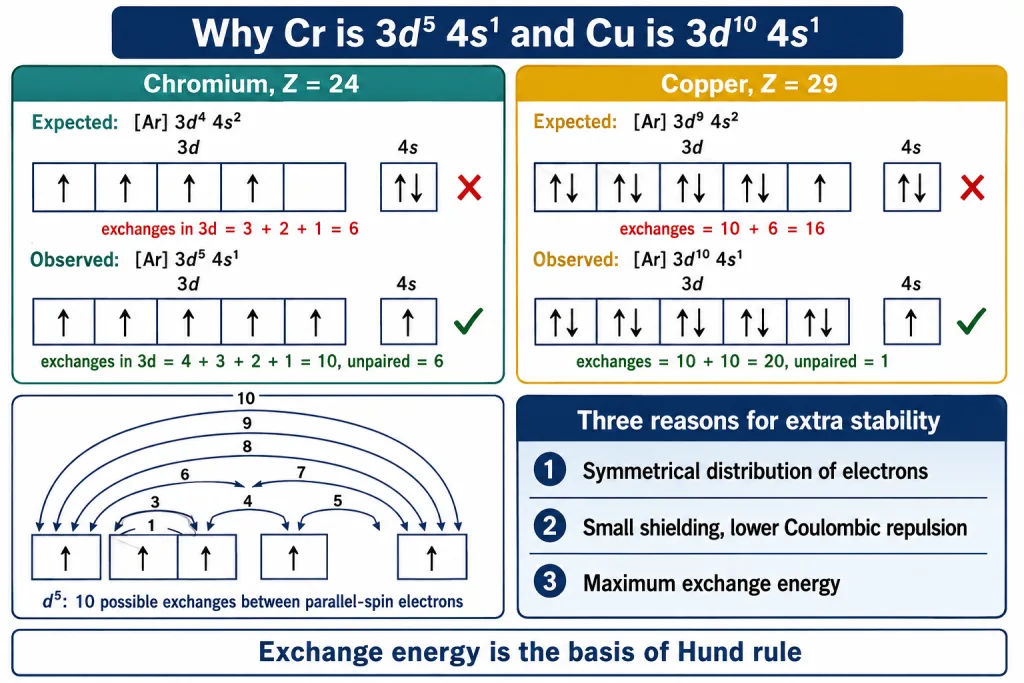
Key Point: The number of possible exchanges, and hence the exchange energy, is maximum when the subshell is either half-filled or completely filled. That maximum exchange energy is the biggest single reason and are preferred.
Exchange energy is the basis of Hund's rule
Exchange energy rewards electrons of the same spin in different orbitals — exactly what Hund's rule prescribes. Two electrons in a subshell placed in different orbitals with parallel spins gain one exchange; put in the same orbital with opposite spins they gain nothing, since opposite spins cannot exchange, and they pay a repulsion penalty for sharing a region of space. Hund's rule is therefore not an arbitrary convention — it says that electrons entering orbitals of equal energy keep their spins parallel as far as possible, because that arrangement has the most exchange energy and the least repulsion.
Key Point: The extra stability of half-filled and completely filled subshells is due to (i) relatively small shielding, (ii) smaller Coulombic repulsion energy, and (iii) larger exchange energy. Remember them as symmetry, shielding/repulsion, exchange. The counting rule covers everything you need now.
[JEE Main] "Which of the following has the maximum exchange energy?" is a standard question — count same-spin pairs. (Cr): 10 in . (Cu): . (Fe): , since the sixth electron is alone in its spin set. : . Maximum exchange energy is not the same as maximum unpaired electrons — Cu beats Cr on exchange energy, Cr beats Cu on unpaired electrons.
Configurations of Ions, Isoelectronic Species and Unpaired Electrons
Atoms gain or lose electrons to become ions, and writing an ion's configuration is easy apart from one subtle point.
Anions: keep adding
An anion has more electrons than the neutral atom, and the extra ones continue the aufbau filling. Chloride, , has electrons: , identical to argon. Oxide, , has : , identical to neon. Hydride, , has 2: , identical to helium. Anions of the -block almost always reach a noble-gas configuration, which is why they form.
Cations: remove from the highest first
Electrons are removed, but not in the reverse of the filling order. They leave from the orbital with the highest principal quantum number first. For - and -block elements this makes no difference: , and are all .
For transition metals it matters. Iron is . The last electrons added were , but the ones with the highest are the pair. Once is occupied it lies below in energy, because the electrons feel a larger effective nuclear charge, so the electrons are the outermost and least tightly held. They go first.
Key Point: When a transition-metal atom forms a cation, the electrons are removed before the electrons. : : : . Writing as is the most common error in this topic.
lands on the half-filled , part of why it is so stable. The same logic gives : ; : ; : ; : . A safe two-step method: write the neutral atom's configuration (remembering Cr and Cu), then remove electrons from the highest first — before ; for , first the , then one .
Isoelectronic species
Key Point (Definition): Species (atoms or ions) having the same number of electrons are called isoelectronic. They have identical electronic configurations.
To test for isoelectronic species, count: electrons , so a positive charge means fewer electrons and a negative charge more.
| Electron count | Isoelectronic set | Common configuration |
|---|---|---|
| 2 | , He, , | |
| 10 | , , , Ne, , , | |
| 18 | , , , Ar, , , |
Isoelectronic species share a configuration but differ widely in size, because their nuclear charges differ. In the 10-electron set, (13 protons pulling on 10 electrons) is the smallest and (7 protons) the largest.
Counting unpaired electrons — and paramagnetism
Draw the box diagram of the valence subshell under Hund's rule and count the singly occupied boxes.
| Species | Valence configuration | Unpaired electrons |
|---|---|---|
| N, P | 3 | |
| O, S | 2 | |
| Cr | 6 | |
| Mn, , | 5 | |
| Fe, | 4 | |
| Co, | 3 | |
| Ni, | 2 | |
| Cu, | , | 1, 1 |
| Zn, , Kr, Ar | all filled | 0 |
An unpaired electron behaves like a tiny magnet because of its spin. A species with one or more unpaired electrons is attracted into a magnetic field and is paramagnetic; one in which every electron is paired is weakly repelled and is diamagnetic. So (5 unpaired) is strongly paramagnetic and () is diamagnetic.
[JEE Main] The strength of paramagnetism is measured by the spin-only magnetic moment BM (Bohr magnetons), with the number of unpaired electrons. : 1.73; : 2.83; : 3.87; : 4.90; : 5.92 BM. A moment of 5.92 BM points straight to ( or ).
Ground state versus excited state
Every configuration so far has been a ground-state one, the lowest-energy arrangement. Give the atom energy and an electron jumps higher: is excited beryllium, is excited neon, is excited helium. These obey Pauli but break the aufbau order. They are real — an atom looks like this just after absorbing a photon — but unless a question says "excited", it wants the ground state.
Key Point: Ground state = obeys aufbau, Pauli and Hund together. Excited state = still obeys Pauli (always), but has at least one electron higher than aufbau/Hund would place it. Any configuration that violates Pauli is not a state of the atom at all.
Solved Examples
Question 1: Picking out isoelectronic species
Which of the following are isoelectronic species, i.e. have the same number of electrons? , , , , , Ar.
Answer:
I count electrons using electrons . A positive charge means electrons lost, a negative charge means electrons gained.
: , one lost, electrons. : , two lost, electrons. : , electrons. : , electrons. : , two gained, electrons. Ar: , neutral, 18 electrons.
Now I group by count. and both have 10 electrons, giving (the neon configuration). , , and Ar all have 18, giving (the argon configuration).
Ans: with 10 electrons each, and with 18 electrons each. Watch out: Subtract the charge from , so a charge adds two electrons. Count electrons, not protons.
Question 2: Configurations of ions
Write the electronic configurations of (a) , (b) , (c) and (d) .
Answer:
For each ion I count the electrons first, then fill by the aufbau order.
(a) : H has 1 electron and the hydride ion has gained one, so 2. Both fit in with opposite spins: , the helium configuration.
(b) : Na has 11 electrons, . The ion has lost the outermost electron, leaving 10: , the neon configuration.
(c) : O has 8 electrons, . The oxide ion gains two, which complete : .
(d) : F has 9 electrons, . The fluoride ion gains one: .
Ans: (a) : ; (b) : ; (c) : ; (d) : . Watch out: , and are all isoelectronic with neon. Simple ions of - and -block elements nearly always reach a noble-gas configuration, which is why those particular charges form.
Question 3: Reading atomic numbers and identities from configurations
(i) What are the atomic numbers of elements whose outermost electrons are represented by (a) , (b) and (c) ? (ii) Which atoms are indicated by the configurations (a) , (b) and (c) ?
Answer:
(i)(a) means everything below is full: . Total , so the element is sodium, .
(i)(b) gives , total . Nitrogen, .
(i)(c) gives , total . Chlorine, .
(ii)(a) : helium core (2 electrons) plus one . Lithium.
(ii)(b) : neon core (10) . Phosphorus.
(ii)(c) : argon core (18) . Scandium, the first transition element.
Ans: (i) (a) 11 (Na), (b) 7 (N), (c) 17 (Cl). (ii) (a) Li, (b) P, (c) Sc. Watch out: Fill in every subshell below the one stated before adding superscripts. For shorthand, add the core count (He 2, Ne 10, Ar 18, Kr 36, Xe 54).
Question 4: An element with 29 electrons and 35 neutrons
An atom of an element contains 29 electrons and 35 neutrons. Deduce (i) the number of protons and (ii) the electronic configuration of the element.
Answer:
(i) The atom is neutral, so protons equal electrons: 29 protons. That makes and the mass number , so the atom is , copper.
(ii) I fill 29 electrons by the aufbau sequence: , , , , , , and takes the remaining 9. That gives the expected .
But is copper, one of the two exceptions. A completely filled is more stable than , and and are close enough in energy that one electron moves across to complete the subshell.
Ground state: , i.e. . Check: .
Ans: (i) 29 protons; (ii) , i.e. (copper). Watch out: Whenever the electron count lands on 24 or 29 (or 42, 47 in the next row), apply the half-filled / fully filled correction before writing the answer.
Question 5: Chromium versus the expected configuration — counting exchanges
Write the ground-state configurations of Cr () and Cu (). Then count the number of possible exchanges in the subshell for and for , and use the result to justify chromium's configuration.
Answer:
Cr has 24 electrons. Aufbau gives , but the observed ground state is — half-filled , six unpaired electrons.
Cu has 29 electrons. Aufbau gives ; the observed state is — fully filled , one unpaired electron.
Exchanges in : all five electrons have parallel spin by Hund's rule, and any pair of same-spin electrons can exchange. Number of pairs among 5 electrons . Counting stepwise, electron 1 exchanges with 4 others, electron 2 with 3 new ones, electron 3 with 2, electron 4 with 1: .
Exchanges in : four parallel-spin electrons, pairs .
Moving one electron from to raises the exchange count from 6 to 10, so four extra exchanges each release exchange energy. Together with the symmetrical distribution (small mutual shielding, lower repulsion), that gain outweighs the small cost of putting an electron into the slightly higher orbital. So has the lower total energy.
The same logic covers copper: has exchanges, ten among spin-up and ten among spin-down, against for .
Ans: Cr: ; Cu: . Exchanges: gives 10, gives 6; the extra exchange energy, plus symmetry and reduced repulsion, makes more stable than . Watch out: Exchanges counts only same-spin electrons, so in the two spin sets are counted separately and added.
Question 6: Counting unpaired electrons
Indicate the number of unpaired electrons in (a) P, (b) Si, (c) Cr, (d) Fe and (e) Kr.
Answer:
For each element I write the configuration, apply Hund's rule to the partly filled subshell, and count singly occupied orbitals.
(a) P (): . The three electrons take three separate orbitals with parallel spins, ↑ ↑ ↑. 3 unpaired.
(b) Si (): . Two electrons in two different orbitals, ↑ ↑ ▢. 2 unpaired.
(c) Cr (): , the exception. Five singly occupied orbitals plus one singly occupied : 6 unpaired.
(d) Fe (): . Five electrons go in singly and the sixth pairs up, ↑↓ ↑ ↑ ↑ ↑. The pair adds none. 4 unpaired.
(e) Kr (): . Every subshell is full. 0 unpaired.
Ans: P: 3, Si: 2, Cr: 6, Fe: 4, Kr: 0. Watch out: Cr is 6, not 4, because of the exception; Fe is 4, not 6, because the sixth electron pairs.
Question 7: Configurations of transition-metal ions and a halide ion
Write the ground-state electronic configurations of , , , , and , and state the number of unpaired electrons in each.
Answer:
My method: write the neutral atom, then for cations remove electrons from the highest () first, and for anions add to the next available orbital.
Fe () is . Removing the two electrons gives : (24 electrons). In : ↑↓ ↑ ↑ ↑ ↑, 4 unpaired.
: one more electron leaves, now from , giving (23 electrons). Half-filled, ↑ ↑ ↑ ↑ ↑, 5 unpaired.
Mn () is , so is (23 electrons), 5 unpaired. and are isoelectronic.
Zn () is , so is (28 electrons), 0 unpaired and diamagnetic.
Ni () is , so is (26 electrons): ↑↓ ↑↓ ↑↓ ↑ ↑, 2 unpaired.
Cl () is . gains one electron to complete : (18 electrons), 0 unpaired.
Ans: : (4); : (5); : (5); : (0); : (2); : (0). Watch out: is , never . The electrons leave first because, once is occupied, is the outermost and highest-energy orbital.
Question 8: Spotting the rule that a configuration breaks
For each of the following, state whether it is a valid ground-state configuration, and if not, which rule it violates: (a) ; (b) drawn with the electrons as ↑↓ ▢ ▢; (c) ; (d) drawn as ↑ ↑ ↓; (e) drawn as ↑ ↑ ↑.
Answer:
(a) puts three electrons in . At most two can occupy one orbital, with opposite spins; a third would repeat a full set of four quantum numbers. This violates Pauli's exclusion principle, so it is not a possible state of any atom, ground or excited.
(b) as ↑↓ ▢ ▢ pairs two electrons in one orbital while two degenerate orbitals stay empty. Pairing must not begin until each orbital is singly occupied, so this violates Hund's rule. It obeys Pauli, so it is a legitimate excited state of carbon.
(c) for 19 electrons sends the nineteenth electron into while , which is lower and fills first, is empty. This violates the aufbau principle. It is an excited state of potassium; the ground state is .
(d) as ↑ ↑ ↓ has each orbital singly occupied but the spins are not all parallel. Hund's rule requires parallel spins in singly occupied orbitals, so this violates Hund's rule — nitrogen's ground state is ↑ ↑ ↑.
(e) as ↑ ↑ ↑ has the correct filling order, no over-filled orbital, and three singly occupied orbitals with parallel spins. Valid ground-state configuration — phosphorus.
Ans: (a) violates Pauli; (b) violates Hund; (c) violates aufbau; (d) violates Hund; (e) valid ground state (P). Watch out: Only a Pauli violation is physically impossible; aufbau and Hund violations still describe real excited states.
Question 9: Ground state or excited state?
Identify which of the following are ground-state configurations and which are excited states, and name the element in each case: (a) ; (b) ; (c) ; (d) ; (e) .
Answer:
I count the electrons to identify the element, then check whether the arrangement is the lowest-energy one.
(a) 4 electrons, so beryllium. Its ground state is ; here a electron has been promoted to . Excited state of Be.
(b) 12 electrons, so magnesium. Ground state is ; here one electron sits in . Excited state of Mg.
(c) electrons, so chromium. It looks like a break from aufbau, but it is the observed lowest-energy arrangement because of the half-filled . Ground state of Cr.
(d) 2 electrons, so helium. Ground state is . Excited state of He.
(e) electrons, so potassium. is , making this . Ground state of K.
Ans: Excited: (a) Be, (b) Mg, (d) He. Ground: (c) Cr, (e) K. Watch out: The Cr and Cu exceptions are ground states, not excited states — the exception is in the rule of thumb, not in the atom.
Question 10: Electrons of a given spin in a shell
(a) How many subshells are associated with ? (b) How many electrons will be present in the subshells having for ? (c) What is the maximum number of electrons that can have and with the same spin?
Answer:
(a) For , takes the values 0, 1, 2, 3, giving the , , and subshells. That is 4 subshells.
(b) The shell has orbitals (1 + 3 + 5 + 7). Each orbital holds at most two electrons, one with and one with , by Pauli. So there is one electron with per orbital, giving 16. That is also half of .
(c) , is the subshell, with orbitals. Electrons of the same spin cannot share an orbital, so at most one per orbital: 5 electrons.
Ans: (a) 4; (b) 16; (c) 5. Watch out: For "same spin" questions the answer is the number of orbitals, not twice it.
Question 11: Paramagnetism and magnetic moment
Among , , , and , which are paramagnetic and which diamagnetic? Which has the largest spin-only magnetic moment, and what is its value?
Answer:
I write each ion's configuration, removing first, and count unpaired electrons.
: , 4 unpaired, paramagnetic.
: , 5 unpaired, paramagnetic.
: Cu is ; removing leaves , 0 unpaired, diamagnetic.
: one more electron goes, this time from : , 1 unpaired, paramagnetic.
: Sc is ; removing all three leaves , 0 unpaired, diamagnetic.
The largest moment belongs to the ion with the most unpaired electrons, with : BM.
Ans: Paramagnetic: (4), (5), (1). Diamagnetic: (), (). Largest moment: , 5.92 BM. Watch out: Copper's own configuration is , so is and diamagnetic while is and paramagnetic.
Question 12: Identify the element and its neighbours from a valence configuration
An element has the valence-shell configuration . (a) Identify the element and its atomic number. (b) Write the configuration of its ion. (c) Name the element with one more proton and write its configuration, explaining any departure from the aufbau prediction.
Answer:
(a) The core below is , 18 electrons. Total , so the element is vanadium, .
(b) For I remove the two electrons first, then one : , with two unpaired electrons.
(c) One more proton gives , chromium. Aufbau predicts , but the observed ground state is . One electron shifts to because the half-filled is symmetric, with low mutual shielding and repulsion and 10 exchanges instead of 6, giving lower total energy — and the - gap is small enough for that gain to decide the outcome.
Ans: (a) Vanadium, ; (b) : ; (c) Chromium, rather than , owing to the extra stability of the half-filled subshell. Watch out: Valence configuration plus core count gives . Before writing any configuration, check whether the element is Cr or Cu.