
Why Bohr's Atom Had to Go — and What Replaced It
Two results from the last section leave Bohr's model with nowhere to stand. An electron behaves like a wave (de Broglie, confirmed by electron diffraction), and its position and momentum cannot both be known at once (Heisenberg). A model built on an electron running along a circular track at a known speed is not slightly wrong; it describes something that does not exist. What was needed was a theory built on wave-particle duality and the uncertainty principle from the start — quantum mechanics.
Classical mechanics versus quantum mechanics
Classical mechanics, built on Newton's laws, works for a falling stone, a cricket ball, an orbiting planet. Such objects behave as particles and their wave nature never shows up. The same laws fail for an electron in an atom, because they ignore dual behaviour and the uncertainty principle.
Key Point (Definition): Quantum mechanics is the theoretical science that deals with the motion of microscopic objects having both observable wave-like and particle-like properties. It specifies the laws of motion these objects obey.
Quantum mechanics does not contradict Newton. Applied to a macroscopic object, whose wave-like properties are insignificant, its results reduce to the classical ones. Newton's laws are a special case, valid whenever the de Broglie wavelength is too small to matter.
| Classical mechanics | Quantum mechanics | |
|---|---|---|
| Built on | Newton's laws of motion | Wave-particle duality and the uncertainty principle |
| Works for | Macroscopic objects (stone, planet, ball) | Microscopic objects (electron, atom, molecule) |
| Electron described by | A definite path (trajectory) with known position and velocity | A wave function giving probabilities |
| Applied to a cricket ball | Correct | Reduces to the classical result |
| Applied to an electron in an atom | Fails | Correct — predicts the full hydrogen spectrum |
1926 — Heisenberg and Schrödinger
Quantum mechanics was developed independently in 1926 by Werner Heisenberg, using matrices, and Erwin Schrödinger, using the ideas of wave motion. The two versions are equivalent, and chemists use Schrödinger's because it gives orbital shapes we can draw. His fundamental equation, which incorporates de Broglie's wave-particle duality, won the Nobel Prize in Physics in 1933 (shared with P.A.M. Dirac). Solving it needs mathematics beyond this course; what you need now is its form, its ingredients and its output.
The Schrödinger equation:
For a system such as an atom or molecule whose energy does not change with time,
- is a mathematical operator called the Hamiltonian. An operator is an instruction to do something to the function that follows it — differentiate it, multiply it by something. The hat marks it as an operator, not a number.
- (Greek psi) is the wave function of the electron, the unknown being solved for.
- is the total energy of the system, also delivered by the solution.
Schrödinger gave a recipe for building from the total energy of the system: the kinetic energies of all the sub-atomic particles (electrons and nuclei), the attractive potential energy between electrons and nuclei, and the repulsive potential energy among the electrons and among the nuclei.
Key Point: Solving the Schrödinger equation gives the allowed energies of the system and the corresponding wave functions . The wave function for an electron in an atom is an atomic orbital.
Only special functions satisfy the equation, each with its own energy , and those functions are the quantum states of the atom. Quantisation, which Bohr had to assume as a postulate, now falls out of the mathematics.
[JEE/NEET] Know the form , that is the Hamiltonian operator, that solving it gives and , and that quantum mechanics came from Heisenberg and Schrödinger in 1926.
The Hydrogen Atom Solved — Quantum Numbers, Wave Functions and
Hydrogen is the one atom for which the Schrödinger equation can be solved exactly, and its solution is the template for every other atom.
What the solution gives
The solution gives the possible energy levels the electron can occupy and the corresponding wave function(s) for each level.
The energy states are quantised — only certain energies are allowed — and this is not put in by hand. It arises from the mathematics: a wave confined near a nucleus can take only certain standing-wave forms.
Each allowed wave function is characterised by three quantum numbers: the principal quantum number , the azimuthal quantum number and the magnetic quantum number . These labels, and the restrictions on their values, come straight out of the solution.
Key Point: When an electron is in any energy state, the wave function for that state contains all the information about the electron. It depends on the coordinates of the electron in the atom, and itself carries no physical meaning.
Such wave functions of hydrogen, or of hydrogen-like species with one electron (, and so on), are called atomic orbitals. Species with a single electron are called one-electron systems.
Born's interpretation: is a probability density
Max Born supplied the physical meaning: the square of the wave function at a point gives the probability of finding the electron there.
Key Point (Definition): The probability of finding an electron at a point within an atom is proportional to at that point. is called the probability density — probability per unit volume — and it is always positive.
Since is a density, the probability of finding the electron in a small volume element around a point is , and adding these products over a region gives the total probability of finding the electron there.
The quantum mechanical treatment predicts all aspects of the hydrogen atom spectrum, including the fine structure of spectral lines and the splitting in magnetic and electric fields, which Bohr could not explain.
Multi-electron atoms: the same orbitals, slightly squeezed
For any atom with two or more electrons the Schrödinger equation cannot be solved exactly: the electron-electron repulsion term couples the electrons and the mathematics no longer separates. Approximate methods are used instead, and they show that orbitals in other atoms do not differ radically from hydrogen orbitals. The differences follow from the increased nuclear charge:
- All the orbitals are somewhat contracted. A larger positive charge pulls every electron closer.
- Orbital energies depend on both and . In hydrogen or a hydrogen-like ion the energy depends only on (2s and 2p are equal). In a multi-electron atom 2s and 2p differ, and within a shell the order is . Shielding and penetration, the reasons for this, come next.
| Hydrogen / one-electron ion | Multi-electron atom | |
|---|---|---|
| Schrödinger equation | Solved exactly | Solved approximately |
| Shape of orbitals | Reference shapes | Essentially the same shapes |
| Size of orbitals | Reference size | Contracted (higher ) |
| Energy depends on | only | and |
| Are 2s and 2p degenerate? | Yes | No: |
[JEE Main] In hydrogen (or , ) 3s, 3p and 3d have equal energy, since energy depends on alone. Only in multi-electron atoms is .
Five Features of the Quantum Mechanical Model, and Orbit versus Orbital
The quantum mechanical model of the atom is the picture that emerges when the Schrödinger equation is applied to atoms. It rests on five statements, and examiners ask for them as a set.
The five important features
- The energy of electrons in atoms is quantised — it can take only certain specific values — for example when electrons are bound to the nucleus in atoms.
- The existence of quantised electronic energy levels is a direct result of the wave-like properties of electrons, and these levels are the allowed solutions of the Schrödinger wave equation.
- Both the exact position and the exact velocity of an electron in an atom cannot be determined simultaneously (Heisenberg uncertainty principle). The path of an electron can never be determined accurately, so one speaks only of the probability of finding it at different points in an atom.
- An atomic orbital is the wave function for an electron in an atom. An electron described by a wave function occupies that orbital; many such functions are possible, so an atom has many atomic orbitals. In each orbital the electron has a definite energy. An orbital cannot contain more than two electrons. In a multi-electron atom electrons fill the orbitals in order of increasing energy. All the information about an electron is stored in its , and quantum mechanics can extract it.
- The probability of finding an electron at a point within an atom is proportional to the square of the orbital wave function, , at that point. is known as the probability density and is always positive. Its values at different points predict the region around the nucleus where the electron will most probably be found.
Orbit and orbital are not synonyms
The two words sound alike and mean opposite things, and confusing them is the commonest conceptual error in this chapter.
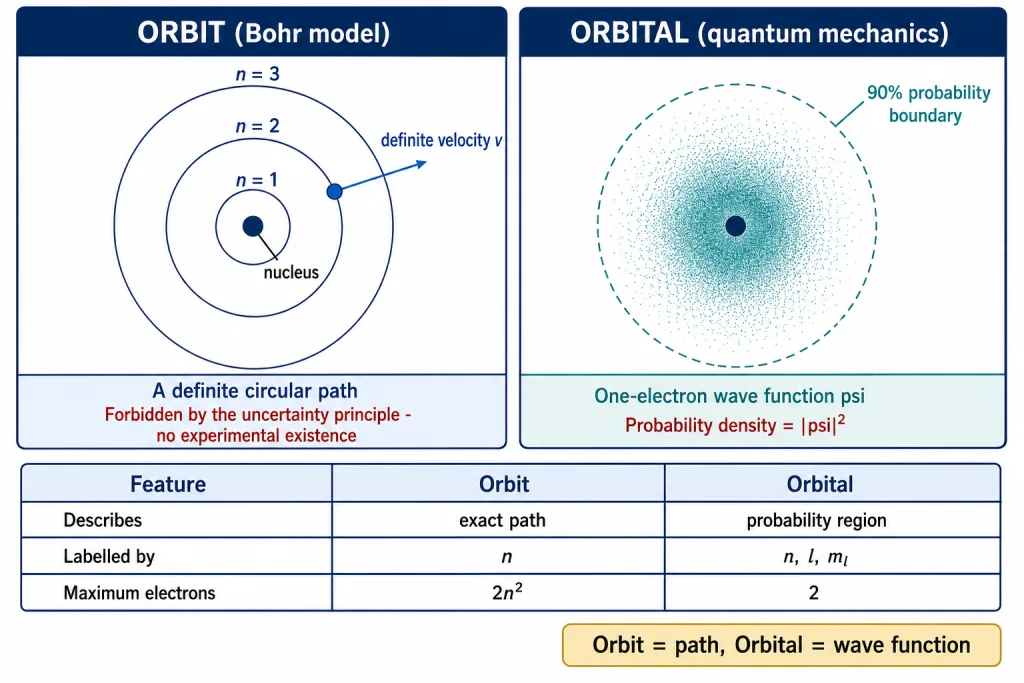
An orbit, as proposed by Bohr, is a circular path around the nucleus in which an electron moves. The uncertainty principle makes a precise description of this path impossible, so Bohr orbits have no real meaning and can never be demonstrated experimentally.
An atomic orbital is a quantum mechanical concept: the one-electron wave function in an atom. It is characterised by three quantum numbers (, , ) and depends on the coordinates of the electron. by itself has no physical meaning; does. at any point gives the probability density there, and times a small volume element gives the probability of finding the electron in that volume — small, because varies from region to region but is nearly constant within a small enough element. Summing (volume element) over a region gives the total probability of finding the electron there.
| Feature | Orbit (Bohr) | Orbital (quantum mechanics) |
|---|---|---|
| What it is | A definite circular path of the electron | A one-electron wave function |
| Describes | Exact position and velocity at every instant | Probability of finding the electron in a region |
| Shape | Always circular (planar) | Spherical (s), dumbbell (p), double-dumbbell (d), etc. — three-dimensional |
| Labelled by | One number | Three quantum numbers , , |
| Maximum electrons | in the orbit | 2 (with opposite spins) |
| Consistent with uncertainty principle? | No | Yes |
| Physical meaning | None — cannot be demonstrated experimentally | gives probability density |
Key Point: Orbit = path; orbital = wave function. An orbital is not a region where the electron moves around; it is the function whose square tells you where the electron is likely to be found.
[NEET] "The orbital wave function has no physical significance; has" — true. So is "Bohr orbits have no experimental existence".
The Principal and Azimuthal Quantum Numbers — and
An atom has many possible orbitals, differing in size, shape and orientation. A smaller orbital means a greater chance of finding the electron near the nucleus; shape and orientation make some directions more likely than others. An orbital is pinned down by three quantum numbers, , and , with a fourth, , describing the electron rather than the orbital.
The principal quantum number, — size and energy
The principal quantum number is a positive integer: It determines the size of the orbital and, to a large extent, its energy. For hydrogen and hydrogen-like species (, , …) energy and size depend only on .
also identifies the shell. All orbitals with a given make up one shell, and the shells are named by letters:
| 1 | 2 | 3 | 4 | … | |
|---|---|---|---|---|---|
| Shell | K | L | M | N | … |
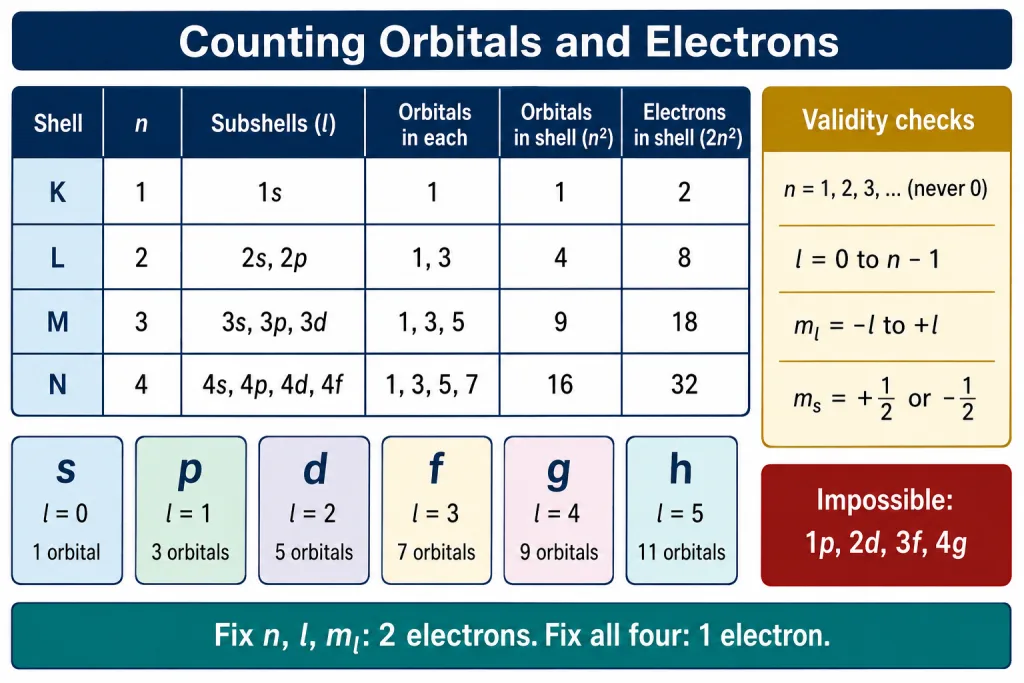
Key Point: In the shell with principal quantum number , the number of orbitals is and the maximum number of electrons is (each orbital holding at most two).
So K has 1 orbital and 2 electrons, L has 4 orbitals and 8 electrons, M has 9 orbitals and 18 electrons, N has 16 orbitals and 32 electrons.
Orbital size increases with : a 3s electron is on average further from the nucleus than a 1s electron. Since energy must be supplied to move a negative electron away from the positive nucleus, the energy also increases with , becoming less negative, as in Bohr's .
The azimuthal quantum number, — shape and subshell
The azimuthal quantum number is also called the orbital angular momentum or subsidiary quantum number. It defines the three-dimensional shape of the orbital. For a given , takes values, from 0 up to :
For the only value is ; for , or 1; for , , 1 or 2. can never equal .
Each shell consists of subshells (sub-levels), one for each allowed value of , so the number of subshells in a shell equals . The subshells carry letter symbols:
| Value of | 0 | 1 | 2 | 3 | 4 | 5 | … |
|---|---|---|---|---|---|---|---|
| Subshell notation | s | p | d | f | g | h | … |
The first four letters come from the appearance of spectral lines — sharp, principal, diffuse, fundamental — and after f they continue alphabetically (g, h, i, …). A subshell is named by writing followed by the letter for : , is 3p.
The subshell notation table
| Subshell notation | ||
|---|---|---|
| 1 | 0 | 1s |
| 2 | 0 | 2s |
| 2 | 1 | 2p |
| 3 | 0 | 3s |
| 3 | 1 | 3p |
| 3 | 2 | 3d |
| 4 | 0 | 4s |
| 4 | 1 | 4p |
| 4 | 2 | 4d |
| 4 | 3 | 4f |
The table also explains the missing names. A 1p subshell would need with , but can be at most ; the same rule kills 2d and 3f.
Key Point: A subshell exists only if . The lowest shell containing an s, p, d, f, g subshell is respectively.
[Board] For the shell: subshells (4s, 4p, 4d, 4f); orbitals ; electrons .
The Magnetic and Spin Quantum Numbers — and
and fix the size, energy and shape of an orbital. Two labels remain: one for the direction the orbital points, one for the electron itself.
The magnetic orbital quantum number, — orientation
gives the spatial orientation of the orbital with respect to a standard set of coordinate axes. For a given there are values of , in integer steps from to :
- : only , i.e. — one s orbital.
- : , i.e. — three p orbitals.
- : , i.e. — five d orbitals.
- : — seven f orbitals.
| Value of | 0 | 1 | 2 | 3 | 4 | 5 |
|---|---|---|---|---|---|---|
| Subshell notation | s | p | d | f | g | h |
| Number of orbitals () | 1 | 3 | 5 | 7 | 9 | 11 |
The dependence runs one way: comes from , and from . Each orbital is defined by a set of values of , and . An orbital with , , is one of the three orbitals of the p subshell of the second shell — a 2p orbital.
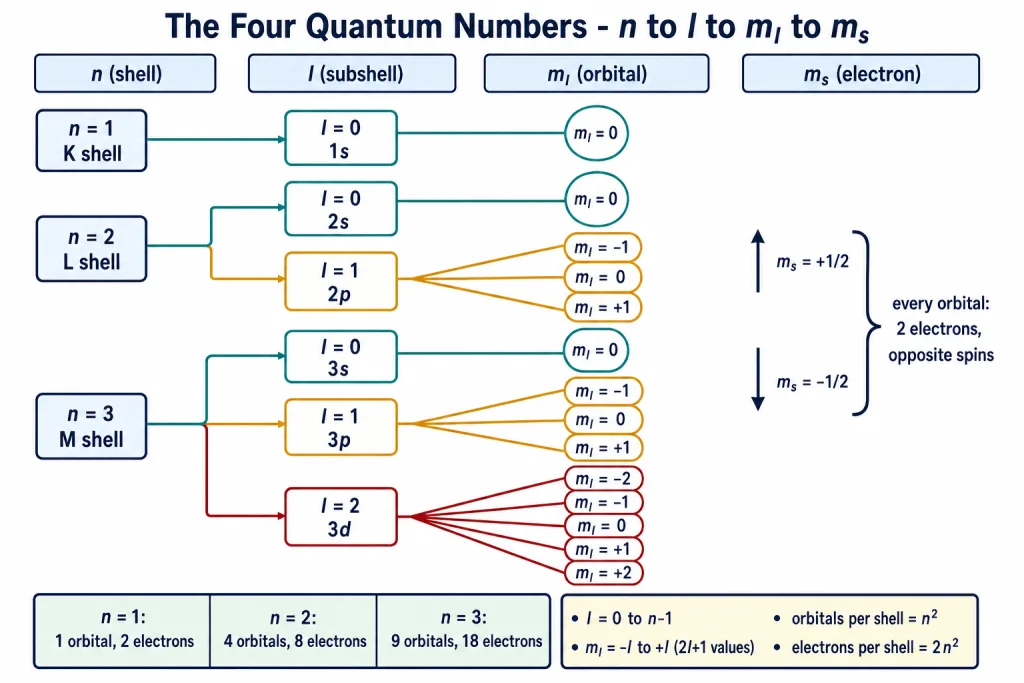
Two cautions. The count does not depend on : a 2p, a 3p and a 6p subshell each contain three orbitals. And do not force a particular onto a particular , or — only corresponds neatly to .
The electron spin quantum number,
Three quantum numbers cannot explain the line spectra of multi-electron atoms. Under high resolution some lines that ought to be single turn out to be doublets (two closely spaced lines) or triplets (three), and extra lines mean extra energy levels.
In 1925, George Uhlenbeck and Samuel Goudsmit proposed a fourth quantum number, the electron spin quantum number . The picture: an electron spins about its own axis, as the Earth spins while revolving around the Sun. Besides charge and mass, it has an intrinsic spin angular momentum, a vector with only two orientations relative to a chosen axis:
These are the two spin states, drawn as (spin up) and (spin down). Two electrons with different values have opposite spins.
Key Point: An orbital cannot hold more than two electrons, and those two must have opposite spins. This becomes Pauli's exclusion principle in Section 10.
The spinning-ball picture is a model, not a fact: an electron is not a rotating sphere. What is real is the two spin states, which double the electrons each orbital can hold.
| Quantum number | Symbol | Belongs to | Allowed values | Number of values |
|---|---|---|---|---|
| Principal | Orbital | Unlimited | ||
| Azimuthal | Orbital | |||
| Magnetic | Orbital | |||
| Spin | Electron | 2 |
[NEET] Attributions: spin quantum number — Uhlenbeck and Goudsmit, 1925; quantum mechanics — Heisenberg and Schrödinger, 1926; probability interpretation — Max Born. does not come out of the Schrödinger equation; it was added to explain doublets and triplets.
What the Four Quantum Numbers Tell You — and How to Count with Them
Together the four quantum numbers give a complete address for any electron in any atom.
The summary
- defines the shell, determines the size of the orbital and, to a large extent, its energy.
- There are subshells in the th shell. identifies the subshell and determines the shape of the orbital. A subshell has orbitals: one s orbital (), three p orbitals (), five d orbitals (). In a multi-electron atom also affects the energy.
- designates the orientation of the orbital. For a given , has values — the number of orbitals equals the number of ways they can be oriented.
- refers to the orientation of the spin of the electron.
An electron is completely specified by ; an orbital by ; a subshell by ; a shell by alone.
The counting toolkit
| Question | Rule | Example |
|---|---|---|
| Subshells in shell | : 4s, 4p, 4d, 4f — four | |
| Orbitals in subshell | 4d (): five | |
| Orbitals in shell | : | |
| Electrons in subshell | 4f: | |
| Electrons in shell | : 32 | |
| Electrons with given and | , : 16 | |
| Electrons with given | 2 | , , : two |
| Electrons with all four fixed | 1 | one and only one |
Behind the last three rows: each orbital holds two electrons, one of each spin. Fix and there are orbitals; fix the spin too and half of the electrons qualify, . Fix and you have named one orbital, holding two electrons; fix as well and you have named one electron.
The validity checklist
A set of quantum numbers is possible only if it passes all four tests, run in order.
- Is a positive integer ()? is never allowed.
- Is ? ( fails; fails.)
- Is ? ( fails.)
- Is or ? ( or fails.)
Key Point: The commonest impossible sets are ; ; ; and anything other than . Every valid subshell name — 1s, 2s, 2p, 3s, 3p, 3d, 4s, 4p, 4d, 4f, 5g — obeys ; the impossible ones — 1p, 1d, 2d, 2f, 3f, 4g — break it.
Naming orbitals from quantum numbers, and vice versa
From numbers to a name: write , then the letter for . , is 5f; , is 4d. From a name to numbers: 3d means , , with any of and — ten possible addresses, which is why 3d holds ten electrons.
[JEE Main] Same means same orbital, and then the two electrons must differ in ; same means same subshell; same means same shell. Energy ordering in a multi-electron atom needs , which is the next section's business.
Solved Examples
Question 1: Total orbitals for
What is the total number of orbitals associated with the principal quantum number ?
Answer:
For the allowed values run from 0 to , giving the 3s, 3p and 3d subshells.
For 3s (), only: one orbital. For 3p (), : three orbitals. For 3d (), : five orbitals. Total , matching the shell rule .
Ans: 9 orbitals (one 3s, three 3p, five 3d). Watch out: If the question says "explain", show the subshell breakdown; the shortcut alone may not earn full marks.
Question 2: Naming orbitals from and (set A)
Using s, p, d, f notation, describe the orbital with the following quantum numbers: (a) , ; (b) , ; (c) , ; (d) , .
Answer:
The name is followed by the letter for : s, p, d, f. Each pair passes : , , , .
| Orbital | |||
|---|---|---|---|
| (a) | 2 | 1 | 2p |
| (b) | 4 | 0 | 4s |
| (c) | 5 | 3 | 5f |
| (d) | 3 | 2 | 3d |
Ans: (a) 2p, (b) 4s, (c) 5f, (d) 3d. Watch out: Strictly, and name a subshell, not one orbital, and an examiner may slip in a pair that breaks .
Question 3: Naming orbitals from and (set B)
Using s, p, d notation, describe the orbital with the following quantum numbers: (a) , ; (b) , ; (c) , ; (d) , .
Answer:
(a) 1s, the only subshell the first shell can have. (b) 3p. (c) 4d. (d) 4f — the first shell in which an f subshell can appear, since needs . All four pass .
Ans: (a) 1s, (b) 3p, (c) 4d, (d) 4f. Watch out: These subshells have orbitals — 1, 3, 5 and 7 — holding 2, 6, 10 and 14 electrons.
Question 4: The lowest shell with g orbitals
What is the lowest value of that allows g orbitals to exist?
Answer:
Matching letters to : s, p, d, f, g are , so a g orbital has . The constraint means . The lowest such is 5, giving the 5g subshell with orbitals.
Ans: . Watch out: The first shell containing a subshell of azimuthal number is always : s from 1, p from 2, d from 3, f from 4, g from 5.
Question 5: Quantum numbers of a 3d electron
An electron is in one of the 3d orbitals. Give the possible values of , and for this electron.
Answer:
The label 3d fixes two numbers: the digit gives and the letter d gives . For , runs from to : , one for each of the five 3d orbitals. The electron sits in one of them, so its is any one of the five, with spin or .
Ans: ; ; or . Watch out: A subshell name fixes and but leaves with options. Five values times two spins is why 3d holds ten electrons.
Question 6: Possible values for , and which orbitals exist
(i) An atomic orbital has . What are the possible values of and ? (ii) List the quantum numbers and of electrons in a 3d orbital. (iii) Which of the following orbitals are possible: 1p, 2s, 2p, 3f?
Answer:
(i) For : , with ; ; . That is combinations, so nine orbitals.
(ii) For 3d: and .
(iii) I test each name against . 1p needs with , where is at most 0 — not possible. 2s () and 2p () are possible. 3f needs with , where is at most 2 — not possible.
Ans: (i) with from to for each (nine orbitals in all); (ii) , ; (iii) 2s and 2p are possible, 1p and 3f are not. Watch out: The impossible names to recognise on sight are 1p, 1d, 1f, 2d, 2f, 3f and 4g.
Question 7: Which sets of quantum numbers are not possible?
Explain, giving reasons, which of the following sets of quantum numbers are not possible.
| (a) | 0 | 0 | 0 | |
| (b) | 1 | 0 | 0 | |
| (c) | 1 | 1 | 0 | |
| (d) | 2 | 1 | 0 | |
| (e) | 3 | 3 | ||
| (f) | 3 | 1 | 0 |
Answer:
I run four tests in order: ; ; ; .
(a) . The principal quantum number is a positive integer and can never be zero — not possible.
(b) , , — possible, a 1s electron with spin down.
(c) allows only ; would mean a 1p subshell, which does not exist — not possible.
(d) , (within to ), — possible, a 2p electron.
(e) For the maximum is 2, so would mean "3f" — not possible.
(f) , , — possible, a 3p electron with spin up.
Ans: (a), (c) and (e) are not possible; (b), (d) and (f) are possible. Watch out: Apply the tests in order and stop at the first failure. In (e) the is consistent with , but has already broken its own rule.
Question 8: How many electrons can have these quantum numbers?
How many electrons in an atom may have the following quantum numbers? (a) , ; (b) , .
Answer:
(a) The shell has orbitals ( for 4s, 4p, 4d, 4f). Each holds one electron with and one with , so electrons are spin down — half of the shell's .
(b) , is the 3s subshell, with orbital holding a maximum of 2 electrons.
Ans: (a) 16 electrons; (b) 2 electrons. Watch out: Fixing halves any count; fixing narrows to one subshell with electrons; fixing alone gives .
Question 9: Subshells and spin-down electrons in the shell
(a) How many subshells are associated with ? (b) How many electrons will be present in the subshells having value of for ?
Answer:
(a) The number of subshells equals . For , : the 4s, 4p, 4d and 4f subshells, four in all.
(b) Their orbitals number , each taking one electron with , so 16 such electrons. By capacity: electrons in the shell, half of them spin down, .
Ans: (a) 4 subshells; (b) 16 electrons. Watch out: For one shell, "subshells" , "orbitals" , "electrons" and "electrons of one spin" — decide which is wanted before writing.
Question 10: Maximum electrons for progressively tighter sets
What is the maximum number of electrons in an atom that can have each of the following sets of quantum numbers? (a) ; (b) , ; (c) , , ; (d) , , , ; (e) , , .
Answer:
(a) The whole M shell: .
(b) The 3p subshell, orbitals, so .
(c) names one 3p orbital: 2 electrons, spin up and spin down.
(d) All four fixed names one electron: 1.
(e) The 3d subshell has 5 orbitals, and allows one electron per orbital: 5.
| Set | What it names | Max electrons |
|---|---|---|
| M shell | 18 | |
| 3p subshell | 6 | |
| one 3p orbital | 2 | |
| one electron | 1 | |
| 3d, spin down only | 5 |
Ans: (a) 18; (b) 6; (c) 2; (d) 1; (e) 5. Watch out: Each quantum number you fix narrows the address: shell subshell orbital electron, with counts .
Question 11: Orbital and electron bookkeeping across shells
(a) How many orbitals are there in the N shell, and how many electrons can it hold? (b) How many orbitals in an atom can have if only shells up to are considered? (c) How many orbitals in an atom have and ? (d) Which shell is the first to hold 18 electrons?
Answer:
(a) The N shell is , so orbitals and electrons .
(b) needs , so up to that is 3d and 4d, 5 orbitals each: .
(c) For , , and every subshell has one orbital with , since 0 lies in every range to : 4 orbitals in all.
(d) gives , so , the M shell.
Ans: (a) 16 orbitals, 32 electrons; (b) 10 orbitals; (c) 4 orbitals; (d) the M shell (). Watch out: In (c), belongs to every subshell, but only to p, d and f, and only to d and f.
Question 12: Orbit or orbital? Judging four statements
For each statement, say whether it describes a Bohr orbit, a quantum mechanical orbital, or neither, and correct any error. (i) "It is a region of space in which the probability of finding the electron is high." (ii) "The electron moves along it with a definite velocity at a definite distance from the nucleus." (iii) "It can hold up to electrons." (iv) " for a 1s electron gives the probability of finding it at a point."
Answer:
(i) A working description of an orbital. Strictly the orbital is , and the region of high probability is where is large.
(ii) A definite velocity at a definite distance is a Bohr orbit, a trajectory, which the uncertainty principle forbids.
(iii) is the capacity of a whole shell; an orbital holds at most 2 electrons.
(iv) has no physical meaning by itself; gives the probability density and the probability in a small volume.
Ans: (i) orbital, acceptable; (ii) Bohr orbit, with no physical existence; (iii) wrong for an orbital, which holds 2; (iv) wrong — " for a 1s electron gives the probability density at a point". Watch out: Three checks settle any orbit-versus-orbital question: path (orbit) or probability (orbital); capacity 2 (orbital) or (shell); probability attached to (wrong) or (right).