
Light Through a Prism — Refraction, Dispersion and the Continuous Spectrum
Why a prism bends light
The speed of light depends on the medium. It is fastest in vacuum () and slower in glass or water. When a beam crosses from one medium into another at an angle, the change of speed swings it away from its original path. This is refraction.
In glass the bending depends on wavelength: shorter wavelengths bend more. So when white light enters a prism, the violet part (about 400 nm) is deviated most and the red part (about 750 nm) least. The white light fans out into a band of colours. The spreading is dispersion and the band is a spectrum.
Key Point: Red light (longest ) is deviated least by a prism; violet light (shortest ) is deviated most. White light spreads into red, orange, yellow, green, blue, indigo and violet because it contains all visible wavelengths.
The continuous spectrum
The visible spectrum runs from violet at Hz to red at Hz, matching the wavelength limits:
This is a continuous spectrum — violet merges into blue, blue into green, with no gaps. Every wavelength between 400 nm and 750 nm is present. A rainbow is the same thing on a grand scale, millions of raindrops acting as tiny prisms.
| Colour | Approximate (nm) | Approximate (Hz) | Deviation by a prism |
|---|---|---|---|
| Violet | 400 | Most | |
| Blue | 450 | ||
| Green | 520 | ||
| Yellow | 580 | ||
| Orange | 620 | ||
| Red | 750 | Least |
Visible light is a thin slice of the electromagnetic spectrum. Ultraviolet lies just beyond violet, infrared just beyond red. Both matter for hydrogen, whose light is mostly invisible.
Hot solid versus hot gas
Sunlight, a tungsten filament and red-hot iron all give continuous spectra: in a dense solid the atoms are so crowded that their energy levels blur into a continuum, and every wavelength is emitted. A thin hot gas of atoms emits only a handful of sharply defined wavelengths instead. That contrast is the strongest early evidence that the energy of an electron inside an atom is quantized, restricted to discrete values only.
[Board] Two standard asks: which colour bends most in a prism and why (violet; shortest wavelength, largest deviation), and why white light's spectrum is called continuous (all wavelengths from violet to red present, each merging into the next).
Excitation, De-excitation and the Two Kinds of Spectra
When radiation meets matter
Atoms and molecules can absorb energy from radiation and jump to a higher energy state. The atom is then excited. An excited atom is unstable, so it returns to its lower-energy ground state and gets rid of the extra energy by emitting radiation — ultraviolet, visible or infrared, depending on the size of the gap.
Key Point: Absorption = atom goes up in energy (excitation). Emission = atom comes down (de-excitation). The same energy gap works in both directions, so the same wavelength appears in both spectra.
Emission spectrum
The spectrum of radiation emitted by a substance that has absorbed energy is an emission spectrum. Supply energy first — strong heating, an electric discharge through the gas, or irradiation — then record the wavelengths given out as the sample loses that energy.
Pass the emitted light through a slit and a prism and photograph it. A gas of atoms gives no rainbow. You get a black background crossed by a few sharp bright coloured lines, each at one definite wavelength: a line spectrum, or atomic spectrum.
Lines rather than a band because a real sample holds an enormous number of atoms. One atom sits in one excited state at a time, but the collection contains atoms in every possible excited state. Each kind of downward jump gives its own wavelength, so a line spectrum is a direct readout of the energy gaps inside the atom.
Absorption spectrum
Reverse the experiment. Send a continuum of radiation — white light, every wavelength present — through unexcited atoms of the same element, then through slit and prism. The atoms absorb exactly those wavelengths whose energy matches an allowed jump. Those wavelengths are missing from the transmitted light, so the record shows a continuous spectrum interrupted by dark lines exactly where the emission spectrum had bright ones.
Key Point (Definition): An absorption spectrum is the photographic negative of an emission spectrum: bright lines on a dark background become dark lines on a bright background, at the same wavelengths.
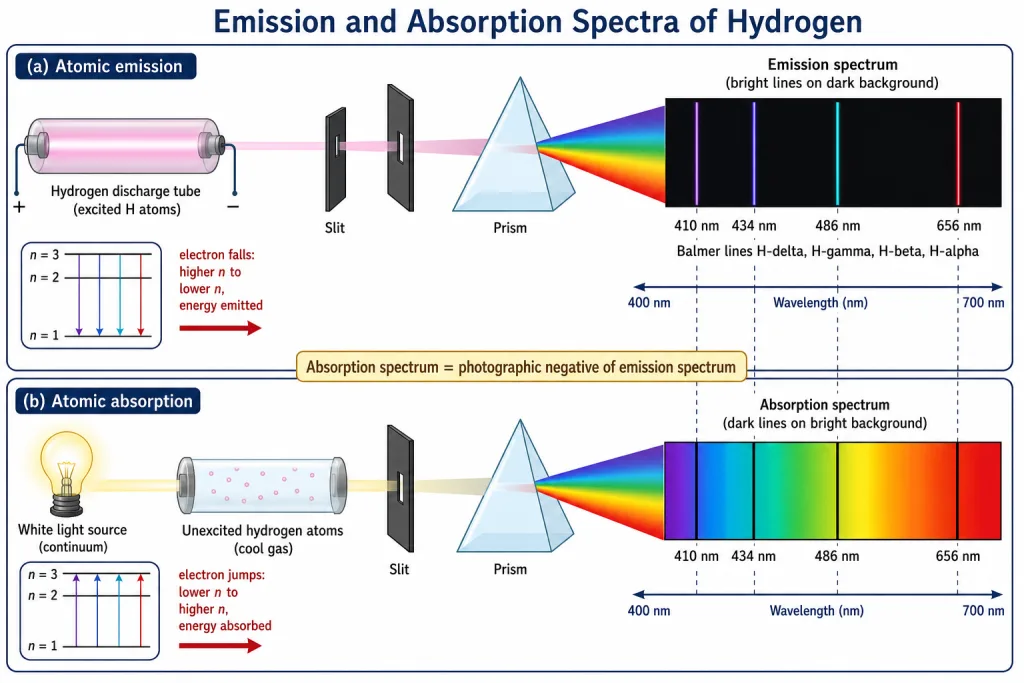
Emission versus absorption at a glance
| Feature | Emission spectrum | Absorption spectrum |
|---|---|---|
| How it is produced | Sample is heated, irradiated or electrically excited; light emitted is analysed | White light (continuum) is passed through the cool sample; light transmitted is analysed |
| Electron movement | Higher level to lower level (de-excitation) | Lower level to higher level (excitation) |
| Appearance | Bright coloured lines on a dark background | Dark lines on a bright continuous background |
| Positions of lines | At characteristic wavelengths of the element | At exactly the same wavelengths |
| Relation | Photographic positive | Photographic negative of the emission spectrum |
Spectroscopy
The study of emission or absorption spectra is spectroscopy, and the instrument that spreads light into its wavelengths and records them is a spectroscope. White light gives a continuous spectrum because all wavelengths from red to violet are present; a gas of atoms shows only specific wavelengths with dark spaces between.
[NEET] One line to memorise: the absorption spectrum is the photographic negative of the emission spectrum, with dark lines at the same wavelengths as the bright ones.
Line Spectra as Fingerprints — Bunsen and the Elements Found by Light
Every element has its own set of lines
Each element has a unique line emission spectrum. Sodium always shows its bright yellow pair near 589 nm; hydrogen always shows a red line at 656 nm and a blue-green line at 486 nm. No two elements share a pattern, so the lines identify unknown atoms much as fingerprints identify people. Record the spectrum of a known element, then that of the unknown sample; if the lines match position for position, the identity is settled.
Key Point: The line spectrum of an element is its fingerprint. Exact matching of the lines of a known element with those from an unknown sample establishes the identity of the unknown.
The German chemist Robert Bunsen (1811-1899), with the physicist Gustav Kirchhoff, built the first practical spectroscope in 1859, heating minerals in a colourless burner flame and analysing the light. The instrument began finding new elements at once.
Elements discovered by their spectra
| Element | Symbol | How its spectrum gave it away |
|---|---|---|
| Rubidium | Rb | Two deep red lines in a mineral spectrum (rubidus = deep red) |
| Caesium | Cs | Two bright blue lines (caesius = sky blue) |
| Thallium | Tl | A brilliant green line (thallos = green shoot) |
| Indium | In | An indigo-blue line, hence the name |
| Gallium | Ga | New violet lines in zinc ore |
| Scandium | Sc | Lines that matched no known element in Scandinavian minerals |
| Helium | He | A yellow line in the Sun's spectrum (1868) that belonged to no element on Earth; helios = Sun |
Rubidium, caesium, thallium, indium, gallium and scandium were all found by spectroscopic analysis of their minerals. Helium was found in the Sun — a dark absorption line in sunlight, and a bright line during an eclipse, matching nothing known on Earth — almost thirty years before anyone isolated it in a laboratory.
[Exam Tip] Rb, Cs, Tl, In, Ga and Sc were discovered spectroscopically; He was discovered in the Sun. Mnemonic for the six earth-bound ones: Rubidium and Caesium (Bunsen's pair), then Tl, In, Ga, Sc — "TIGS".
Two features every line spectrum shares
Hydrogen has the simplest line spectrum of all. Heavier atoms give more complex ones — iron shows thousands of lines. Two features are common to all:
- The line spectrum of an element is unique. No two elements share the same set of lines.
- There is regularity in the line spectrum of each element. The lines fall into families (series) whose positions obey simple mathematical patterns.
Both point to the arrangement of electrons inside the atom, and the explanation came from the simplest case, hydrogen.
Sodium and the yellow D-lines
The intense yellow of a sodium street lamp, or of a flame sprinkled with common salt, comes from a doublet — two very close lines at 589.0 nm and 589.6 nm, the D-lines. The same wavelengths appear as dark lines in sunlight (Fraunhofer's D-lines), which is how sodium was identified in the Sun's outer layers. Their tiny frequency and energy gap is calculated in the worked problems.
The Hydrogen Line Spectrum and Balmer's Formula
Making hydrogen glow
Fill a glass discharge tube with hydrogen at low pressure and apply a high voltage. The electrical energy breaks molecules into atoms, and collisions leave many of these atoms excited. As they drop back to lower states they emit radiation of discrete frequencies — a line spectrum. Through a prism the visible part shows four clear lines: red, blue-green, blue-violet and violet.
Key Point: In a hydrogen discharge tube, molecules dissociate and the excited hydrogen atoms so produced emit radiation of discrete frequencies. It is the atom, not the molecule, whose spectrum we study.
The four visible lines
| Line | Transition () | Wavelength (nm) | Colour |
|---|---|---|---|
| 656.3 | Red | ||
| 486.1 | Blue-green | ||
| 434.0 | Blue-violet | ||
| 410.2 | Violet |
The lines crowd together towards the violet: the gaps are 170 nm, then 52 nm, then 24 nm. Beyond they grow fainter and closer, piling up against a limit near 365 nm, just inside the ultraviolet.
Balmer's discovery (1885)
The hydrogen spectrum consists of several series of lines, each named after its discoverer. The Swiss schoolteacher Johann Balmer found the first pattern in 1885. Working from measured wavelengths, he showed that the visible lines expressed as wavenumber (waves per centimetre, ) obey a simple formula:
where is an integer of 3 or more. Put for the red line, for , and so on. The lines described by this formula make up the Balmer series.
A check on :
That agrees with the measured 656.3 nm to better than one part in a thousand; the tabulated value is measured in air, the formula gives the vacuum value.
Key Point: The Balmer series () is the only series of the hydrogen spectrum lying in the visible region. Every other series is ultraviolet or infrared.
The structure of the formula
Balmer had no theory; the formula was pattern-spotting. But its structure is a constant times the difference of two reciprocal squares, and a difference is what appears when an electron falls from a higher energy to a lower one and gives the gap away as a photon. Rydberg generalised the formula fourteen years later, and Bohr derived it twenty-eight years later, obtaining 109,677 cm from , , and alone. For now it stands as an experimental fact that any theory of the atom must explain.
[JEE Main] Wavenumber is the natural unit because (since ). Adding or subtracting wavenumbers is the same as adding or subtracting energies. Wavelengths do not add — never subtract two wavelengths hoping to get a third line.
Rydberg's General Formula and the Five Series
One formula for the whole spectrum
The Swedish spectroscopist Johannes Rydberg saw in 1888-1890 that Balmer's "" was not special. Replace it by , with any positive integer, and every series of the hydrogen spectrum — including the ultraviolet and infrared ones Balmer never saw — follows one expression:
with and (always , so is positive).
Key Point (Definition): is the Rydberg constant for hydrogen (), or in SI units. It is the largest wavenumber hydrogen can emit — the Lyman series limit — corresponding to 91.2 nm.
Each fixed gives one series of lines as runs through its allowed values. The first five series, to , are the Lyman, Balmer, Paschen, Brackett and Pfund series.
The spectral series of atomic hydrogen
| Series | (lower level) | (upper level) | Spectral region | First line (nm) | Series limit (nm) |
|---|---|---|---|---|---|
| Lyman | 1 | 2, 3, 4, … | Ultraviolet | 121.6 | 91.2 |
| Balmer | 2 | 3, 4, 5, … | Visible | 656.3 | 364.7 |
| Paschen | 3 | 4, 5, 6, … | Infrared | 1875.6 | 820.6 |
| Brackett | 4 | 5, 6, 7, … | Infrared | 4052 | 1459 |
| Pfund | 5 | 6, 7, 8, … | Infrared | 7460 | 2279 |
| Humphreys [JEE] | 6 | 7, 8, 9, … | Far infrared | 12,370 | 3282 |
The first five rows are the standard syllabus; Humphreys () is an extra JEE occasionally uses. All these values come from the Rydberg formula.
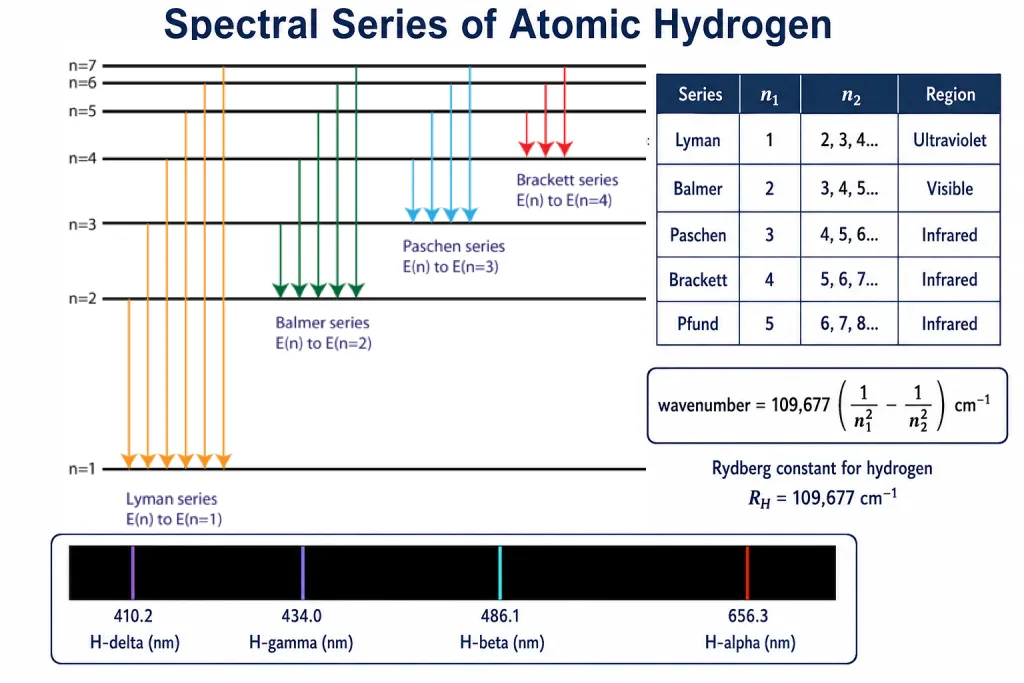
First line and series limit
- First line (the line): . The smallest jump in the series, so it has the smallest wavenumber, lowest frequency, lowest energy and longest wavelength.
- Series limit (last line): , so and . The largest jump, with the largest wavenumber and shortest wavelength. Lines crowd together approaching it, and beyond it the spectrum is a faint continuum, the electron now free of the atom.
For Lyman: (121.6 nm) and (91.2 nm), so every Lyman line lies between 91.2 nm and 121.6 nm.
Which series lies where
The lower level controls the region. Falling all the way to releases a lot of energy — ultraviolet (Lyman). Falling to releases less — visible (Balmer). Falling to releases progressively less, moving further into the infrared each time (Paschen, Brackett, Pfund).
Key Point: Larger means a smaller energy gap and longer wavelengths. That is why the series march from ultraviolet (Lyman) through visible (Balmer) into the infrared (Paschen, Brackett, Pfund).
Lyman (91.2 to 121.6 nm) and Balmer (364.7 to 656.3 nm) are cleanly separated, but the infrared series overlap: Paschen (821 to 1876 nm) overlaps Brackett (1459 to 4052 nm), which overlaps Pfund (2279 to 7460 nm). For exams the clean statement is Lyman = UV, Balmer = visible, rest = IR.
[NEET] Learn the order with values and regions: Lyman (1, UV), Balmer (2, visible), Paschen (3, IR), Brackett (4, IR), Pfund (5, IR) — "Little Boys Play Ball Poorly", and only Balmer is visible.
Working With the Rydberg Formula — Units, Shortcuts and Traps
The three unit systems
The same Rydberg constant appears in three costumes.
| Quantity | Formula | Constant |
|---|---|---|
| Wavenumber (cm) | ||
| Wavenumber (m) | same | |
| Frequency (Hz) | ||
| Energy (J) |
The chain: , and J. The J form is Bohr's energy constant in the next section. Same number, different units.
Key Point: in cm gives in cm (). Since 1 cm nm, . In m, .
Fraction shortcuts
Since and are small integers, the bracket is always a simple fraction. The common ones:
| Transition | (cm) | (nm) | |
|---|---|---|---|
| 82,258 | 121.6 | ||
| 109,677 | 91.2 | ||
| 15,233 | 656.5 | ||
| 20,564 | 486.3 | ||
| 27,419 | 364.7 | ||
| 5,332 | 1876 | ||
| 12,186 | 820.6 |
Ratio questions need no constant, because cancels. For the first Balmer line against the first Lyman line,
and for the series limits, , so (91.2 nm against 364.7 nm).
[JEE Main] The shortcut pairs with eV, giving . For : nm in one line.
For the number of lines when an electron falls from level to the ground state by every possible route: each pair of levels gives one line, so the maximum is — 6 lines from (three Lyman, two Balmer, one Paschen), 10 from . If the fall ends at level instead of 1, the count is .
Traps that cost marks
| Trap | Why it is wrong | Do this instead |
|---|---|---|
| Using | Gives a negative wavenumber | Always put the smaller number as |
| "Longest wavelength = series limit" | Limit is the shortest wavelength (largest ) | Longest = first line () |
| Forgetting the cm-to-nm step | cm is cm, not 656 nm | Multiply by |
| Saying "Balmer series is in the UV" | Only its limit region (365 nm) touches the UV; the named lines are visible | Balmer = visible |
| Assigning Paschen to the visible region | Paschen starts at 820 nm — infrared | Only Balmer is visible |
| Treating the Rydberg constant as an energy | 109,677 has units cm | Multiply by to get 13.6 eV |
| Thinking the discharge excites molecules that then emit the lines | The molecules dissociate first; the atoms emit the line spectrum | Say "excited hydrogen atoms" |
Key Point: In any series the first line has the longest wavelength and the series limit the shortest. Wavenumbers, frequencies and energies increase along a series; wavelengths decrease.
[Board] For a three-mark question on the hydrogen spectrum: (i) the Rydberg formula with , defined and ; (ii) the table of five series with regions; (iii) Balmer alone is visible. Add a labelled transition diagram.
Solved Examples
Question 1: The red line of hydrogen
Calculate the wavenumber and wavelength of the first line of the Balmer series (). State its colour.
Answer:
Balmer's formula gives . The bracket is , so .
Taking the reciprocal, ; multiplying by nm per cm gives 656.5 nm. That is between 620 and 750 nm, so the colour is red — the line, longest in the Balmer series.
Ans: ; nm (red, ). Watch out: in cm gives centimetres, not nanometres — multiply by before quoting nm.
Question 2: The blue-green line, two ways
What is the wavelength of light emitted when the electron in a hydrogen atom undergoes a transition from an energy level with to an energy level with ? Work it (a) with the Rydberg formula and (b) with the energy form J.
Answer:
(a) The bracket is , so and nm.
(b) J, so m nm.
The two agree, since J is .
Ans: nm — the blue-green line of the Balmer series. Watch out: Use the energy constant if the question gives energy, the Rydberg constant if it gives wavenumbers. Mixing the two in one line goes wrong.
Question 3: Sorting transitions into series
An electron in a hydrogen atom makes each of the following jumps: (i) , (ii) , (iii) , (iv) , (v) , (vi) . Name the series each line belongs to and the region of the spectrum in which it appears.
Answer:
The series is fixed by the lower level ; the upper level only decides which line within it.
- : — Balmer, visible (, 434 nm).
- : — Paschen, infrared.
- : — Lyman, ultraviolet (second Lyman line, 102.6 nm).
- : — Brackett, infrared.
- : — Lyman, ultraviolet (first Lyman line, 121.6 nm).
- : — Pfund, infrared.
Ans: Balmer (visible), Paschen (IR), Lyman (UV), Brackett (IR), Lyman (UV), Pfund (IR). Watch out: Read , not the upper level. Region rule: 1 is UV, 2 is visible, 3 and above are IR.
Question 4: Longest wavelength in the Balmer series
Calculate the wavenumber for the longest wavelength transition in the Balmer series of atomic hydrogen. Give the answer in .
Answer:
Longest wavelength means smallest wavenumber, so I want the smallest gap in the series. In Balmer () that is the jump from the nearest upper level, .
In SI units . The bracket is , so .
Checking: m nm, the red line.
Ans: (equivalently ). Watch out: "Longest wavelength" always points to . Picking the series limit gives the shortest wavelength instead.
Question 5: First line and series limit of the Lyman series
For the Lyman series of hydrogen, calculate (a) the wavelength of the first line and (b) the wavelength of the series limit. In which region of the spectrum does the whole series lie?
Answer:
(a) For the first line, , the bracket is , so and nm.
(b) For the limit, , the term and the bracket is exactly 1, so and nm.
Every Lyman line lies between 91.2 nm and 121.6 nm. Visible light starts at 400 nm, so the whole series is ultraviolet.
The limit wavenumber is the Rydberg constant itself: 109,677 cm is the largest wavenumber hydrogen can emit, from the very edge of the atom straight to the ground state.
Ans: (a) 121.6 nm; (b) 91.2 nm; ultraviolet. Watch out: For any series — Lyman gives itself, Balmer (364.7 nm), Paschen (820.6 nm).
Question 6: Which Paschen line is at 1285 nm?
Emission transitions in the Paschen series end at orbit and start from orbit , and can be represented as . Calculate the value of if the transition is observed at 1285 nm. Find the region of the spectrum.
Answer:
First I convert the wavelength to a frequency: Hz.
Substituting, , so the bracket is . Then , giving and .
1285 nm is well beyond 750 nm, so the line is infrared, as every Paschen line is.
A check in cm: , i.e. nm.
Ans: (the transition); infrared region. Watch out: The constant is , so convert to before substituting, and round to the nearest perfect square.
Question 7: Identify the series from a wavelength
A line in the hydrogen spectrum is observed at 102.6 nm. Identify the transition responsible for it and name the series.
Answer:
The wavenumber is .
102.6 nm lies between 91.2 nm (Lyman limit) and 121.6 nm (first Lyman line), and far below the 364.7 nm where Balmer begins. So .
For the upper level, , so , and .
Checking: , i.e. 102.6 nm.
Ans: The transition — the second line of the Lyman series (ultraviolet). Watch out: Fix first by bracketing the wavelength between a series' first line and its limit, then solve for .
Question 8: Ratio of two Balmer wavelengths
Without using the value of the Rydberg constant, find the ratio of the wavelengths of the () and () lines of hydrogen. Verify with the measured values 656.3 nm and 486.1 nm.
Answer:
The wavenumbers are and .
Wavelength is the reciprocal of wavenumber, so .
The measured values give .
Ans: . Watch out: cancels in a ratio, but the bracket fractions must be flipped, because .
Question 9: Series limits of Lyman and Balmer
Find the ratio of the shortest wavelength of the Lyman series to the shortest wavelength of the Balmer series. Then calculate the shortest Balmer wavelength and decide whether it is visible.
Answer:
The shortest wavelength of a series is its limit (), where : for Lyman , for Balmer . So .
For the Balmer limit, and nm. That is below 400 nm, so the limit lies just inside the near ultraviolet. The named lines to (656 nm to 410 nm) are visible; the faint lines crowding towards the limit slip out of the visible range.
Ans: (91.2 nm : 364.7 nm); the Balmer limit at 364.7 nm is just in the ultraviolet. Watch out: Series-limit wavelengths scale as : 91.2 nm, then nm, then nm.
Question 10: Reading a spectrum like a detective
Three observations are made. (i) The light from a hydrogen discharge tube, viewed through a spectroscope, shows a red line, a blue-green line and two violet lines on a black background. (ii) Sunlight viewed through the same spectroscope shows a continuous rainbow crossed by thin dark lines, two of them very close together in the yellow at 589.0 nm and 589.6 nm. (iii) A pinch of an unknown salt in a burner flame gives a spectrum with exactly those two yellow lines, now bright. Interpret each observation.
Answer:
(i) is an emission line spectrum. Excited hydrogen atoms fall to and emit the Balmer lines (656 nm), (486 nm), (434 nm) and (410 nm). Bright lines on a dark background mean emission.
(ii) is an absorption spectrum. The Sun's hot dense interior emits a continuum, and cooler sodium atoms in its outer atmosphere absorb their own wavelengths, leaving dark lines (Fraunhofer's D-lines).
(iii) is the emission spectrum of sodium. The bright doublet at 589.0/589.6 nm matches the dark doublet in (ii) position for position, so the salt contains sodium.
Ans: (i) hydrogen emission spectrum (Balmer lines); (ii) solar absorption spectrum showing sodium D-lines; (iii) sodium emission spectrum, so the salt contains sodium. Watch out: Bright lines mean emission, dark lines on a continuum mean absorption, and matching positions mean the same element.
Question 11: The sodium D-line doublet
The longest wavelength doublet absorption transition of sodium is observed at 589 nm and 589.6 nm. Calculate the frequency of each transition and the energy difference between the two excited states.
Answer:
For the 589 nm line, Hz. For the 589.6 nm line, Hz.
Both absorptions start from the same ground state, so the gap between the two upper states is the difference of the photon energies, .
The frequencies are very close, so I keep extra figures in the subtraction:
Then J, which is eV.
Subtracting the rounded frequencies instead gives Hz and J, the value many keys quote; the difference is only rounding.
Ans: Hz, Hz; J (about J with early rounding), roughly eV. Watch out: With two nearly equal wavelengths, subtract the reciprocals carrying enough significant figures, or the difference disappears in the rounding.
Question 12: From wavelength to frequency and photon energy
The line of hydrogen has nm. Calculate (a) its frequency, (b) its wavenumber in , and (c) the energy of one photon in joules and in electron-volts. Which is larger, this photon's energy or that of an photon?
Answer:
(a) Hz.
(b) , matching cm to within the air-vacuum correction.
(c) J, i.e. eV. The shortcut agrees: eV.
For at 656.3 nm, eV. The photon carries more, because it comes from a bigger drop, rather than .
Ans: (a) Hz; (b) ; (c) J eV, larger than the 1.89 eV of . Watch out: Shorter wavelength in a series means a bigger jump and a more energetic photon. (eV, nm) converts any spectral line straight to an energy.