
A Model Built on Planck's Idea
Rutherford's 1911 picture put the nucleus at the centre with electrons outside it, and it had a fatal flaw. Classical electromagnetic theory says a charged particle moving in a circle is accelerating, and an accelerating charge must radiate energy continuously. An orbiting electron would lose energy, spiral in and crash into the nucleus in about s, emitting light of every frequency on the way — a continuous spectrum. Real hydrogen atoms are stable and emit sharp, separate lines.
In 1913 Niels Bohr (1885–1962) found a way out. He took Planck's concept of quantisation of energy — energy is exchanged in discrete packets, — and applied it to the electron inside the atom. Bohr was the first to explain quantitatively the general features of the hydrogen atom and its spectrum. His theory is not modern quantum mechanics, but it gives the right numbers for hydrogen and still rationalises much about atomic structure and spectra. Bohr received the Nobel Prize in Physics in 1922.
The four postulates
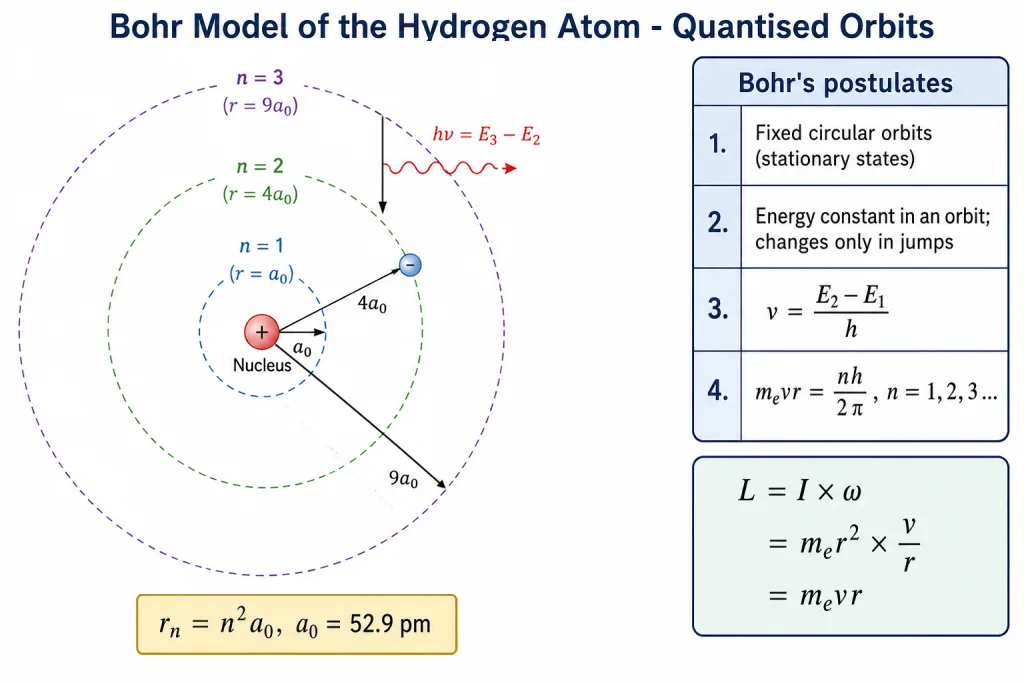
Postulate 1 — Fixed orbits. The electron in the hydrogen atom can move around the nucleus only in a circular path of fixed radius and fixed energy. These paths are called orbits, stationary states or allowed energy states, and they are concentric about the nucleus.
Postulate 2 — Energy is constant in an orbit; change happens in jumps. The energy of an electron in a given orbit does not change with time; the electron does not radiate while it stays there. It moves to a higher stationary state only by absorbing exactly the required energy, and drops to a lower one by emitting that energy. The change is never continuous — always a jump.
Postulate 3 — Bohr's frequency rule. For a transition between two stationary states differing in energy by , the frequency of the radiation absorbed or emitted is
where and are the energies of the lower and higher allowed states. One photon carries exactly the gap.
Postulate 4 — Angular momentum is quantised. In a stationary state the angular momentum of the electron is an integral multiple of :
with the electron mass, its velocity and the orbit radius. Only orbits satisfying this condition are allowed, and radiation is emitted or absorbed only when the electron jumps from one quantised value of angular momentum to another. This postulate decides which orbits survive, and it is why Maxwell's electromagnetic theory does not apply inside the atom.
Where comes from
Linear momentum is mass times linear velocity, . Angular momentum is the rotational analogue, moment of inertia times angular velocity:
For an electron of mass on a circle of radius , and , so
The quantity has its own symbol, ("h-bar"), so the postulate also reads .
Key Point: Bohr's model = Rutherford's nucleus + Planck's quanta + one new rule: angular momentum comes only in multiples of . The allowed radii, energies and spectrum all follow from that rule.
[Board] For "State the postulates of Bohr's model", write all four in order and include both equations, and . Missing the angular-momentum equation costs a mark.
[JEE Main] The integer in is the same that labels the orbit radius, the orbit energy and, later, the principal quantum number. It runs and never zero, because zero angular momentum would put the electron on the nucleus.
What the Model Predicts — Radii and Energies
The full derivation (balancing Coulomb attraction against the centripetal requirement, then imposing ) comes in higher classes. The results are simple.
(a) The principal quantum number
The stationary states are numbered outward from the nucleus. These integers are the principal quantum numbers, the ancestor of the used in the quantum-mechanical model later in this chapter.
(b) The radii of the orbits
is the Bohr radius. The first stationary state (), the Bohr orbit, has radius 52.9 pm, and the electron in a hydrogen atom is normally found there. Radius grows as , so the spacing between successive orbits grows too.
| Orbit | pm | In nm | |
|---|---|---|---|
| 1 | 1 | 52.9 pm | 0.0529 nm |
| 2 | 4 | 211.6 pm | 0.2116 nm |
| 3 | 9 | 476.1 pm | 0.4761 nm |
| 4 | 16 | 846.4 pm | 0.8464 nm |
| 5 | 25 | 1322.5 pm | 1.3225 nm |
| 6 | 36 | 1904.4 pm | 1.9044 nm |
Keep 52.9 pm, 211.6 pm and 1322.5 pm in your head; questions often give a radius and ask for .
(c) The energies of the orbits
The most important property of a stationary state is its energy:
where , the Rydberg constant in this context, is J. For the lowest state, the ground state,
and for ,
| (J) | (eV) | ||
|---|---|---|---|
| 1 | 1 | ||
| 2 | 1/4 | ||
| 3 | 1/9 | ||
| 4 | 1/16 | ||
| 5 | 1/25 | ||
| 6 | 1/36 | ||
| 0 | 0 | 0 |
With J, J is 13.6 eV — the ionisation energy of hydrogen.
The levels crowd together as grows: the to gap is J, while to is only J. Higher orbits are almost continuous.
The meaning of the negative sign
The energy is negative for every orbit. The zero of energy is a free electron at rest, infinitely far from the nucleus and no longer feeling its pull: , . That is the ionised hydrogen atom, .
When the electron is captured into an orbit , energy is emitted and the electron's energy falls below zero. A negative says the electron is bound — it has less energy than a free electron at rest. As decreases, becomes more negative, so the electron is more tightly bound and more stable. The most negative value, at , is the ground state.
Key Point: Negative energy = bound electron; the more negative, the more stable. at is the ionised atom. Ionising hydrogen from the ground state needs J, which is 13.6 eV per atom or about 1312 kJ per mole.
The energy level diagram
Plotting the allowed energies as horizontal rungs gives the energy level diagram of hydrogen: rungs far apart at the bottom, squeezing together towards . Every spectral line is a jump between two rungs.
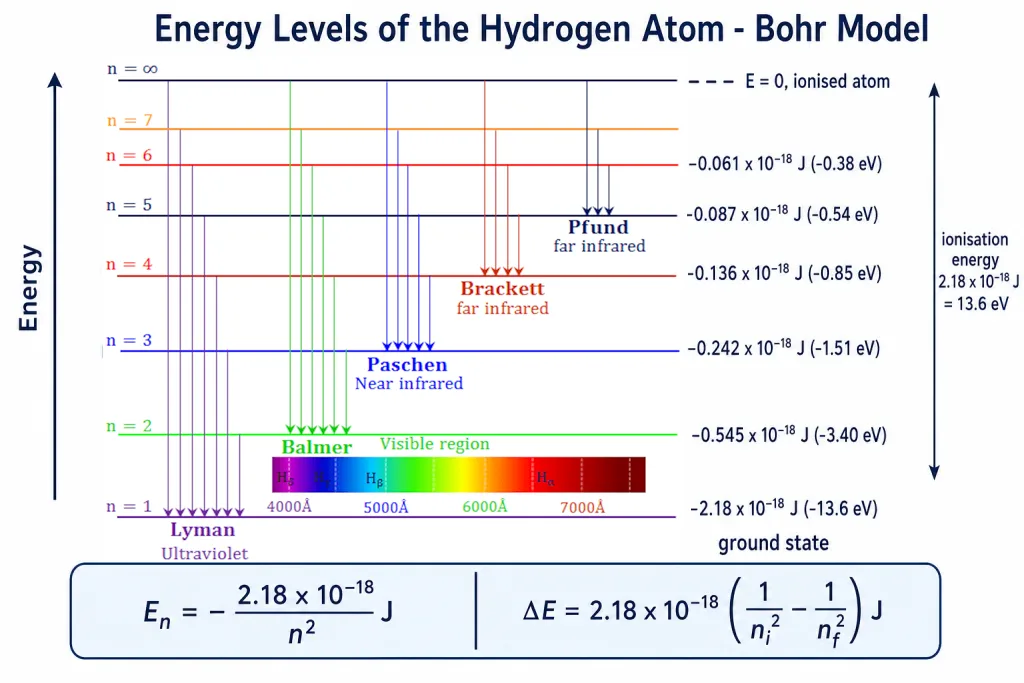
[NEET] As increases the radius increases as while the energy also increases (becomes less negative), so the magnitude falls as . "Energy increases with " and "binding decreases with " say the same thing.
Beyond Hydrogen — Hydrogen-like Ions and Velocity Trends
Bohr's theory works for any species with only one electron: a single Coulomb attraction, no electron-electron repulsion. Such species are hydrogen-like (or hydrogenic): (), (), (), and so on. The only change is a nuclear charge , pulling times harder.
Energy and radius with
A bigger nuclear charge pulls the electron closer and binds it more tightly: energy more negative, radius smaller.
| Species | (J) | (eV) | (pm) | ||
|---|---|---|---|---|---|
| H | 1 | 1 | 52.9 | ||
| 2 | 4 | 26.45 | |||
| 3 | 9 | 17.63 | |||
| 4 | 16 | 13.23 |
Check one: for at , J and pm nm — four times the binding of H at half the distance.
The velocity of the electron
The speed of the electron increases with the nuclear charge and decreases with increasing principal quantum number. The formula is
so the ground-state electron in hydrogen moves at about , roughly . It comes from with , giving . Here — the first power, not the square.
The ratio game
Every quantity is a clean power law in and , so ratio questions need no calculator:
| Quantity | Depends on | Ratio trick |
|---|---|---|
| Radius | ||
| Energy | ||
| Velocity | ||
| Ionisation energy from orbit | same as energy, sign flipped |
Two instances:
- 2nd orbit of versus 1st orbit of H: pm against 52.9 pm, ratio .
- The orbit matching the ground-state H radius: need , so — no integer solution, and "no such orbit" is the correct answer. For , gives , so its second orbit has radius exactly 52.9 pm.
Key Point: Same , bigger : smaller orbit, more negative energy, faster electron. Same , bigger : larger orbit, less negative energy, slower electron. Apply these formulae only to one-electron species — never to He, Li or anything with two electrons.
[NEET] The ionisation energy of is eV, which is the second ionisation energy of helium. Bohr's formula gives that step exactly, but says nothing about the first ionisation of neutral He (24.6 eV), which has two electrons.
Explaining the Line Spectrum of Hydrogen
Section 5 gave Rydberg's empirical formula for the hydrogen lines. Bohr's model derives it, with a physical picture attached.
The mechanism
Radiation is absorbed when the electron jumps from a smaller principal quantum number to a larger one, and emitted when it drops from a higher orbit to a lower one. The photon energy equals the gap:
where and label the initial and final orbits. Substituting :
Order inside the bracket: initial first, final second. Reversed, every sign in the problem flips.
Frequency and wavenumber
From Bohr's frequency rule, :
Dividing by gives the wavenumber :
That constant, , is exactly the Rydberg constant extracted from experimental data thirty years earlier. Bohr's theory reproduced it from , , and alone.
| Formula | Constant | Unit | Use it when the question asks for |
|---|---|---|---|
| J | energy | ||
| Hz | frequency | ||
| wavenumber or wavelength |
For hydrogen-like ions, multiply each right-hand side by .
Absorption versus emission — the sign
- Absorption: the electron goes up, , so ; the bracket is positive, .
- Emission: the electron comes down, ; the bracket is negative, .
Frequency and wavelength always come from the magnitude — a negative frequency means nothing. Use the sign of to say which way the electron went, then drop it.
One transition, one line
Every spectral line corresponds to one particular pair of orbits. A single atom makes one jump at a time, but a discharge tube holds an enormous number of hydrogen atoms, each excited to some level and each falling back by its own route, so all possible transitions appear together. The intensity of a line depends on the number of photons of that frequency emitted or absorbed — more atoms making a given jump means a brighter line.
Counting the lines
If atoms excited to level drop in every possible way to , the number of distinct emission lines is the number of pairs of levels:
For that is ; for it is 6. If the electron drops only to some lower level , use .
The series
| Series | Region | First line (longest ) | ||
|---|---|---|---|---|
| Lyman | 1 | 2, 3, 4, … | ultraviolet | : 121.6 nm |
| Balmer | 2 | 3, 4, 5, … | visible | : 656.5 nm |
| Paschen | 3 | 4, 5, 6, … | infrared | : 1875 nm |
| Brackett | 4 | 5, 6, 7, … | infrared | : 4051 nm |
| Pfund | 5 | 6, 7, 8, … | infrared | : 7458 nm |
Within a series the longest wavelength (smallest energy) is the jump from the next level up; the shortest (series limit) is the jump from .
Key Point: Each line is J, and the Rydberg constant is . Absorption has a positive bracket, emission a negative one.
[JEE Main] The fastest route from a transition to a wavelength in nm is with eV. For : eV, nm, with no powers of ten to handle.
Where the Model Breaks Down
Bohr's model was a large improvement on Rutherford's. It explained why the atom is stable and accounted quantitatively for the line spectra of hydrogen and hydrogen-like ions (, , ). As spectroscopes improved and physicists looked beyond hydrogen, it proved too simple.
1. Fine structure — the doublets
With sophisticated spectroscopic techniques, many "single" lines of the hydrogen spectrum turn out to be doublets: two closely spaced lines where Bohr predicts one. A model with a single energy for each cannot produce two slightly different photon energies from the same transition. Later theory traces the splitting to electron spin and relativistic effects, neither of which Bohr's model contains.
2. Multi-electron atoms
The model cannot explain the spectrum of any atom other than hydrogen — not even helium, with two electrons. Electron-electron repulsion changes every energy, and a picture of one electron feeling one nucleus offers no way to handle it. The formulae J and pm are strictly for one-electron species.
3. Zeeman effect
In a magnetic field, spectral lines split into several closely spaced components. Bohr's theory could not explain this splitting.
4. Stark effect
The corresponding splitting in an electric field is the Stark effect. Bohr's model fails here too.
5. Chemical bonding
The model says nothing about how atoms combine into molecules. A theory that describes an isolated hydrogen atom but cannot say why two of them make is incomplete.
| Observation | Bohr's model | Verdict |
|---|---|---|
| Stability of the atom | Electron in a stationary state does not radiate | Explains |
| Line spectrum of H | Explains, quantitatively | |
| Rydberg constant | Derived as | Explains |
| Spectra of , | Multiply by | Explains |
| Doublets (fine structure) | One energy per | Fails |
| He and heavier atoms | No way to treat repulsion | Fails |
| Zeeman effect (magnetic field) | No mechanism for splitting | Fails |
| Stark effect (electric field) | No mechanism for splitting | Fails |
| Chemical bonding | Not addressed | Fails |
The deeper problems
Two further objections, developed in Section 7, explain why the model fails rather than just that it fails:
- Wave-particle duality. de Broglie (1924) showed that an electron behaves as a wave as well as a particle. Bohr treats it purely as a charged particle on a circular track.
- Heisenberg's uncertainty principle (1927). A well-defined orbit means knowing the electron's position and momentum simultaneously and exactly, which the uncertainty principle forbids. Bohr's orbits, taken literally, cannot exist.
Key Point: Bohr's model succeeds wherever there is exactly one electron and no external field, and fails as soon as there is a second electron, a magnetic or electric field, a high-resolution spectroscope, or a chemical bond. Those failures pointed the way to the quantum-mechanical model.
[Board] For "give any two limitations of Bohr's model", pick from fine structure (doublets), multi-electron atoms, Zeeman effect, Stark effect, chemical bonding, and the neglect of dual nature and uncertainty. Name the effect correctly: Zeeman is magnetic, Stark is electric.
The Bohr Toolkit — Formulas, Numbers and Traps
Everything in this section reduces to a handful of formulas, collected here with the errors that cost the most marks.
The formula card
| Quantity | Hydrogen () | Hydrogen-like ion |
|---|---|---|
| Angular momentum | same | |
| Radius | pm | pm |
| Energy | J eV | J |
| Velocity | ||
| Transition energy | J | multiply by |
| Frequency | Hz | multiply by |
| Wavenumber | multiply by | |
| Ionisation energy from orbit | J | J |
| Lines on de-excitation from to ground | same |
Numbers to carry in your head
- pm nm
- J eV (ionisation energy of H)
- Hz;
- J m eV nm
- Lyman (): 121.6 nm; Balmer (): 656.5 nm; Balmer (): 434 nm
A worked mini-problem
Find the wavelength emitted when the electron in a hydrogen atom drops from to .
- J. Negative, so emission.
- m nm.
- Cross-check by the eV route: eV, nm. The red line of the Balmer series.
The traps
| Trap | What goes wrong | Fix |
|---|---|---|
| Bracket order | Writing flips the sign of | Initial first, final second; emission must come out negative |
| Forgetting | energies come out four times too small | Energy and frequency scale as ; radius as ; velocity as |
| versus | instead of | Radius goes as , energy as , velocity as |
| pm / nm / | 1322.5 pm reported as 1322.5 nm | 1 nm = 1000 pm = 10 ; 52.9 pm = 0.529 |
| Ergs | "Ground-state energy erg" looks unfamiliar | J, so erg J |
| "Energy of orbit" versus "energy to ionise" | Reporting J when asked how much energy is required | Ionisation energy from level is ; it is |
| Applying Bohr to He, Li, Na | Two-electron species have no Bohr formula | Only , , , … (one electron) |
| Counting lines | "gives 5 lines" | Every pair of levels is a line: |
| Which series? | Labelling as Lyman | The series is named by the final level: Lyman, 2 Balmer, 3 Paschen |
Key Point: Before writing any answer, settle three things — what is , what is (or and ), and is the question asking for an orbit energy, a transition energy, a frequency, a wavenumber or a wavelength? Those three answers select one row of the formula card.
[JEE Main] Given a radius and asked for the orbit number, divide by 52.9 pm and multiply by to get ; a clean perfect square confirms the units were read correctly. 1322.5 pm ; 211.6 pm .
Solved Examples
Question 1: The 5 to 2 transition in hydrogen
What are the frequency and wavelength of the photon emitted during a transition from the state to the state in the hydrogen atom?
Answer:
Here and . The final level is 2, so this is a Balmer line and I expect it in the visible region.
First I find the energy of the transition.
The negative sign confirms emission. For the frequency I use the magnitude.
434 nm is violet-blue, so visible, as a Balmer line should be. The shortcut Hz agrees.
Ans: J (emitted); Hz; nm. Watch out: Keep the sign while computing to fix the direction, then switch to for and .
Question 2: First orbit of the helium ion
Calculate the energy associated with the first orbit of . What is the radius of this orbit?
Answer:
has one electron, so Bohr's formulae apply with .
Compared with hydrogen, that is four times the binding energy at half the radius.
Ans: J; nm. Watch out: goes on the energy but on the radius; mixing them up is the usual slip.
Question 3: Fifth orbit of hydrogen
(i) The energy associated with the first orbit of the hydrogen atom is . What is the energy associated with the fifth orbit? (ii) Calculate the radius of Bohr's fifth orbit for the hydrogen atom.
Answer:
For (i) I use .
For (ii) I use .
The fifth orbit is 25 times wider than the first and the electron is bound 25 times less strongly.
Ans: (i) J; (ii) nm. Watch out: The exponent shifts when you divide: .
Question 4: Ionising hydrogen from the fifth orbit
How much energy is required to ionise a hydrogen atom if the electron occupies the orbit? Compare your answer with the ionisation enthalpy of the H atom (the energy required to remove the electron from the orbit).
Answer:
Ionisation means taking the electron from its orbit out to , where . So the energy required is .
From :
From the energy required is J, the ionisation enthalpy of hydrogen (13.6 eV per atom, 1312 kJ per mole). Comparing the two,
so ionising from needs one twenty-fifth of the ground-state value.
Ans: J from , which is of the ground-state ionisation energy J. Watch out: The energy required to ionise from level is positive, J — the orbit energy with the sign flipped.
Question 5: Counting emission lines
What is the maximum number of emission lines when the excited electron of a hydrogen atom in drops to the ground state?
Answer:
The electron can fall straight from 6 to 1 or step down through intermediate levels, so every pair of levels between 6 and 1 gives a line. Counting level by level: from to 5, 4, 3, 2, 1 is 5 lines; from , 4 lines; from , 3 lines; from , 2 lines; from , 1 line. That totals .
The formula agrees: .
Of these, 5 lines end at (Lyman), 4 at (Balmer), 3 at (Paschen), 2 at (Brackett) and 1 at (Pfund).
Ans: 15 emission lines. Watch out: The count applies to a sample of many atoms, each taking its own route down. A single atom cannot emit all 15 photons.
Question 6: From the first orbit to the fifth, and back
What is the energy in joules required to shift the electron of the hydrogen atom from the first Bohr orbit to the fifth Bohr orbit, and what is the wavelength of the light emitted when the electron returns to the ground state? The ground-state electron energy is erg.
Answer:
First I convert the given energy. Since J, J — the usual in an old unit.
Energy to go from to :
Positive, so energy is absorbed. On the return trip the same magnitude is emitted as one photon, so
The photon ends at , so this is a Lyman line, deep in the ultraviolet.
Ans: J absorbed; the emitted light has nm. Watch out: The erg is only a unit change — convert it first, then work as usual.
Question 7: Removing the electron from the second orbit
The electron energy in the hydrogen atom is given by J. Calculate the energy required to remove an electron completely from the orbit. What is the longest wavelength of light, in cm, that can be used to cause this transition?
Answer:
The energy of the orbit is
Removing the electron means going from to , so J.
The photon must carry at least this much energy. The minimum energy goes with the maximum wavelength, so the longest usable wavelength is
In centimetres that is cm, about 365 nm — the Balmer series limit, just into the ultraviolet.
Ans: J; longest usable wavelength cm. Watch out: "Remove completely" sets , so the bracket collapses to . Any shorter wavelength also works — the excess becomes kinetic energy of the freed electron.
Question 8: Matching a helium-ion line with a hydrogen line
What transition in the hydrogen spectrum would have the same wavelength as the Balmer transition to of the spectrum?
Answer:
For a hydrogen-like ion the wavenumber is with .
For () going :
For hydrogen () I need the same wavenumber:
Trying , gives , and it is the only integer solution. So the line coincides with the H line, at 121.6 nm.
Ans: The transition of hydrogen, the first Lyman line. Watch out: For , exactly cancels a doubling of both quantum numbers, since . So matches H as well.
Question 9: Second ionisation of helium
Calculate the energy required for the process . The ionisation energy of the H atom in the ground state is .
Answer:
This removes the only electron of from to infinity, and is hydrogen-like with .
Energy required J per ion.
Per mole that is , the second ionisation enthalpy of helium — four times that of hydrogen (1312 kJ mol).
Ans: J per ion, about 54.4 eV. Watch out: The ionisation energy of a hydrogen-like species is (ionisation energy of H) for the same .
Question 10: Identifying a transition from the orbit radii
Calculate the wavelength for the emission transition if it starts from the orbit having radius 1.3225 nm and ends at 211.6 pm. Name the series to which this transition belongs and the region of the spectrum.
Answer:
First I put both radii in the same unit: 1.3225 nm pm, and the final radius is 211.6 pm.
Now I find the orbit numbers from pm (hydrogen, ):
Both are perfect squares, so the units were read correctly. The wavenumber is
so m nm. The transition ends at , making it a Balmer line in the visible region (violet-blue).
Ans: nm; Balmer series; visible region. Watch out: Converting a radius to is a division by 52.9 pm, and is the square root of that quotient, not the quotient itself.
Question 11: The lithium dication, with a ratio
(i) Calculate the radius and the energy of the ground-state orbit of . (ii) Find the ratio of the radius of the second orbit of to the radius of the first orbit of hydrogen, and the ratio of the corresponding energies.
Answer:
For (i), has one electron, , and .
That is eV: nine times the binding of hydrogen at one-third the distance.
For (ii) I use .
Numerically pm against 52.9 pm. For the energies, .
So J.
Ans: (i) pm, J; (ii) radius ratio , energy ratio . Watch out: A larger orbit can still be more tightly bound when is large enough — the second orbit of is bigger than the first orbit of H yet holds its electron harder.
Question 12: Why helium defeats Bohr
Bohr's model reproduces the hydrogen spectrum to remarkable accuracy and works equally well for , yet it fails for neutral helium, which has just one more electron. Explain why, and list the other observations the model cannot account for.
Answer:
The model assumes a single electron moving in the Coulomb field of a nucleus of charge ; the formula J contains only that one attraction.
In neutral He the second electron adds a repulsion between the two electrons and partly shields each from the nucleus. The effective attraction is no longer , and it depends on where the other electron is. Bohr's postulates give no rule for this, so the model produces no energy levels for He, and therefore no spectrum.
Strip one electron away and the remaining one again sees only the nucleus, which is why works exactly with .
The model's other failures: (a) doublets, closely spaced pairs of lines that a single-energy-per- model cannot produce; (b) the Zeeman effect, line splitting in a magnetic field; (c) the Stark effect, line splitting in an electric field; (d) chemical bonding, with no account of how atoms join into molecules; and (e) at a deeper level, it treats the electron as a classical particle on a fixed path, ignoring its wave nature and Heisenberg's uncertainty principle.
Ans: Bohr's model is a one-electron, no-field, low-resolution theory: the electron-electron repulsion in He has no place in it, and it also fails for doublets, the Zeeman and Stark effects, chemical bonding and the electron's wave nature. Watch out: Zeeman is the magnetic-field effect and Stark the electric-field one; swapping them loses the mark.