
How NEET Tests This Chapter — and the 40-Second Mindset
NEET wants something different here than JEE does: no Bohr derivation, no ratios of time periods, no Schrödinger algebra. The chapter gives 2 to 3 questions out of 45 in Chemistry, and nearly every one is a direct formula or definition in a plain sentence.
What shows up:
| Question style | What it looks like | Time you should spend |
|---|---|---|
| Discovery / model recall | "The neutron was discovered by…" / "Which model could not explain the stability of the atom?" | 15 seconds |
| Quantum-number validity | "Which set of quantum numbers is not possible?" | 25 seconds |
| Electronic configuration | "The configuration of / / is…" | 25 seconds |
| Unpaired electrons and magnetism | "The number of unpaired electrons in is…" | 30 seconds |
| One-formula numerical | "The energy of the second Bohr orbit of hydrogen is…" / "Wavelength of an electron accelerated through 100 V is…" | 40 seconds |
| Spectral series | "Which series of hydrogen lies in the visible region?" / "Number of lines when the electron falls from to " | 30 seconds |
| Nodes and orbitals | "Number of radial nodes in a 3p orbital is…" | 20 seconds |
| Assertion-Reason / statements | "Assertion: 4s fills before 3d. Reason: 4s has lower …" | 40 seconds |
All eight can be finished without a rough page once the tables and shortcuts below are in your head.
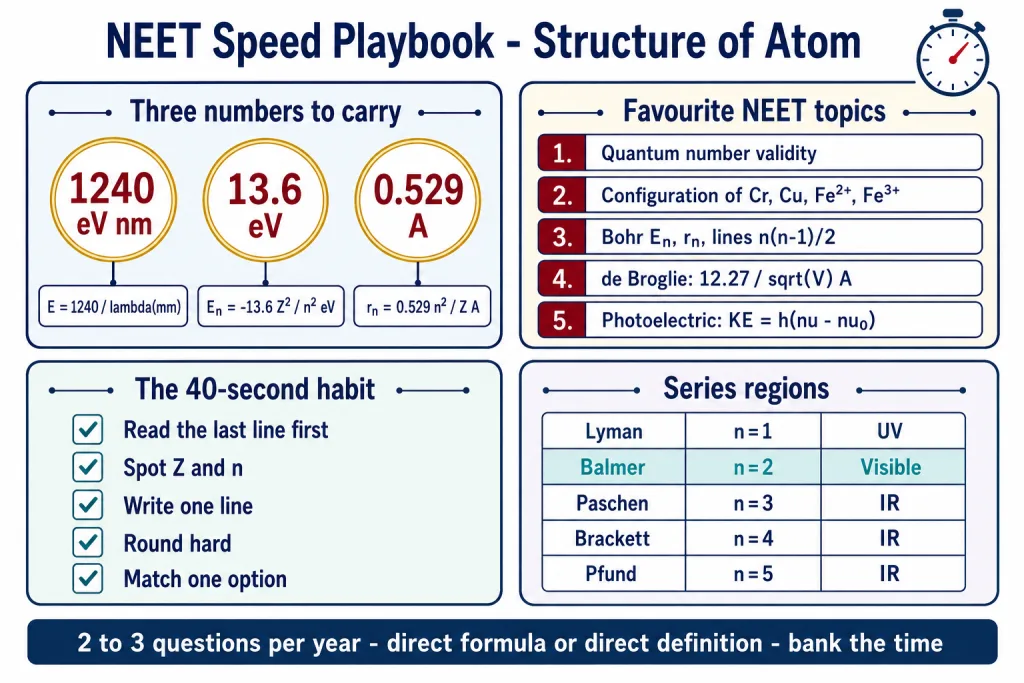
Favourite topics, ranked
- Quantum numbers — allowed ranges, "which set is impossible", how many orbitals or electrons a set describes.
- Electronic configuration of transition-metal ions — , , , , , , , and the unpaired-electron count.
- Bohr numbers — , , for hydrogen-like species and the number of spectral lines.
- de Broglie and Heisenberg — one-line plug-ins.
- Photoelectric effect — threshold frequency, work function, and what does and does not depend on intensity.
The 40-second mindset
NEET is 180 questions in 200 minutes, a little over a minute each. This chapter is where you bank time for Biology, so the target is not "solve it" but "solve it in 40 seconds and move on".
- Read the last line first. It names what is wanted — energy, radius, wavelength, number of lines, unpaired electrons.
- Spot the species and the shell. , or ? or ? The and the are the whole Bohr question.
- Write one line. eV; Å; eV.
- Round hard. , , . NEET options are usually spaced far enough apart that this rounding does not flip the answer.
- Match to the options. If your number is 3.4 and the options are , , and eV, bubble and go.
Key Point: NEET rewards knowing which formula and which configuration, not the longest calculation. Treat this as a recall-plus-one-line chapter.
[NEET] Negative marking () makes a 40-second wrong answer worse than a 40-second skip. If two lines in you are not converging on an option, mark for review and come back.
What NEET does not ask from this chapter
- Deriving Bohr's radius or energy from first principles.
- Time period, frequency of revolution, revolutions per second — rare, and only as a plug-in.
- The Schrödinger equation, wavefunction algebra, radial distribution curves in detail.
- Photoelectric problems needing three conversions — at most one: eV, then subtract .
More than 90 seconds on a question means either the wrong tool or the odd question of the year. Either way, move.
The Verbatim-Recall Tables — Discoveries, Models and the Definitions NEET Asks Word for Word
"Who did what, when" and "define this term" carry the same as a hard numerical. Learn these two tables as flash-cards.
Table 1: Discoveries and models — who, when, what
| Year | Scientist | What they found or proposed | The one line NEET asks |
|---|---|---|---|
| 1895 | Röntgen | X-rays from the anode of a discharge tube | X-rays are EM radiation, not deflected by fields |
| 1896 | Becquerel | Radioactivity (, , named later by Rutherford) | Spontaneous emission from uranium salts |
| 1897 | J. J. Thomson | Electron (cathode rays); measured | Cathode rays are the same whatever gas or metal is used |
| 1898 | J. J. Thomson | Plum-pudding (watermelon) model — positive sphere with electrons embedded; mass uniformly distributed | Explained overall neutrality, failed the -scattering test |
| 1909 | Millikan | Charge on the electron, oil-drop method: C; hence kg | Charge on any drop is an integral multiple of |
| 1909 | Rutherford (with Geiger and Marsden) | -particle scattering on gold foil | Most pass undeflected, a few deflect, ~1 in 20,000 bounce back |
| 1911 | Rutherford | Nuclear model — tiny dense positive nucleus ( m) with electrons in orbits; atom m | Could not explain stability of the atom or line spectra |
| 1913 | Bohr | Quantised orbits, , | Explained the hydrogen spectrum, failed for multi-electron atoms |
| 1919 | Rutherford | Proton (positive particle from hydrogen) | Mass kg, charge C |
| 1924 | de Broglie | Matter waves, | Every moving particle has an associated wavelength |
| 1925 | Uhlenbeck and Goudsmit | Electron spin — the fourth quantum number | Spin has only two values, and |
| 1926 | Schrödinger | Wave equation ; quantum mechanics of the atom | Solutions give orbitals, quantised energies, as probability density |
| 1926 | Pauli | Exclusion principle | No two electrons in an atom can have the same set of four quantum numbers |
| 1927 | Heisenberg | Uncertainty principle, | Position and momentum cannot both be known exactly |
| 1932 | Chadwick | Neutron ( on beryllium) | Neutral, mass kg, slightly heavier than the proton |
The three model one-liners that repeat: Thomson's model failed on Rutherford's scattering; Rutherford's failed on the stability of the atom (an accelerating electron should radiate and spiral in) and on the line spectrum; Bohr's failed on multi-electron spectra, the Zeeman and Stark effects, fine structure, and chemical bonding.
Also: Planck (1900) — energy is quantised, ; Einstein (1905) — photoelectric effect via photons; Hertz (1887) — first observed the photoelectric effect; Moseley — atomic number from X-ray frequencies.
Table 2: The definitions NEET asks verbatim
| Term | Definition as NEET wants it | Instant example |
|---|---|---|
| Atomic number | Number of protons in the nucleus number of electrons in a neutral atom | : |
| Mass number | Number of protons number of neutrons | : 11 p, 12 n |
| Isotopes | Atoms with the same atomic number but different mass number (same element, different neutrons) | , , ; , |
| Isobars | Atoms with the same mass number but different atomic number | and ; and |
| Isotones (extra) | Atoms with the same number of neutrons | and (8 neutrons each) |
| Isoelectronic species | Ions or atoms with the same number of electrons | , , , (10 electrons) |
| Threshold frequency | The minimum frequency of light below which no photoelectrons are emitted, however intense the light | Characteristic of the metal |
| Work function | The minimum energy needed to eject an electron from the metal surface; | Cs: 1.9 eV; Na: 2.3 eV; K: 2.25 eV |
| Photoelectric equation | KE | |
| Black body | A perfect absorber and emitter of radiation at all frequencies | Emission depends only on temperature |
| Quantum | The smallest packet of energy that can be absorbed or emitted, | Called a photon for light |
| Orbit | A fixed circular path (Bohr) at a definite distance from the nucleus; exact position and momentum known — violates Heisenberg | pm for H |
| Orbital | The three-dimensional region around the nucleus where the probability of finding the electron is maximum (~90%); a one-electron wavefunction | , , |
| Principal quantum number | Shell; size and energy of the orbital; | K, L, M, N |
| Azimuthal quantum number | Subshell; shape of the orbital; to | , , , |
| Magnetic quantum number | Orientation of the orbital; to , i.e. values | : |
| Spin quantum number | Intrinsic spin of the electron; or | Two electrons per orbital |
| Aufbau principle | Electrons occupy orbitals in order of increasing energy; lower first, and for equal , lower first | before |
| Pauli exclusion principle | No two electrons in an atom can have the same set of four quantum numbers; hence an orbital holds at most two electrons of opposite spin | , not |
| Hund's rule of maximum multiplicity | Pairing in degenerate orbitals does not begin until each orbital is singly occupied, with parallel spins | N: |
| Degenerate orbitals | Orbitals of the same energy | , , ; in hydrogen, all of , , |
| Effective nuclear charge | The net positive charge felt by an electron after shielding by inner electrons; | Reason lies below in multi-electron atoms |
| Shielding | Repulsion by inner electrons that reduces the attraction of the nucleus on the outer electron | in penetration |
Key Point (Definition): Four photoelectric observations: (i) electrons come out instantly, no time lag; (ii) no emission below , whatever the intensity; (iii) number of photoelectrons intensity; (iv) kinetic energy of photoelectrons frequency, independent of intensity.
[NEET] Two stock statements: isotopes have the same chemical properties because chemical properties depend on the number of electrons; isobars belong to different elements.
The Formula Shortcuts Card — Every Number NEET Needs in One Line Each
Each formula is in the form that fits a 40-second solve — eV, Å, nm, metres per second, no SI conversions unless the options force them.
Light and energy
| Want | Formula | Plug-and-play values |
|---|---|---|
| Photon energy from wavelength | 620 nm 2.0 eV; 400 nm 3.1 eV; 310 nm 4.0 eV; 248 nm 5.0 eV | |
| Same thing in joules | , J m | 1 eV J |
| Wavenumber | , unit or | 500 nm cm 20,000 |
| Photoelectric KE | 400 nm on Na (2.3 eV): eV | |
| Threshold wavelength | Cs (1.9 eV): 653 nm | |
| Number of photons | 100 W bulb, 1 s, 500 nm: |
Bohr model for hydrogen-like species (, , , )
| Want | Formula | Plug-and-play values |
|---|---|---|
| Energy of th orbit | eV J | H: eV for to 5 |
| Ground state of ions | eV | : eV; : eV |
| Ionisation energy | eV (from ); from : | H from : 3.4 eV |
| Radius of th orbit | Å pm | H : 2.116 Å; : 1.058 Å |
| Velocity in th orbit | H : ; : | |
| Angular momentum | : ; : | |
| Transition energy | eV | H, : 10.2 eV; : 1.89 eV |
| Wavenumber of a line | , | Balmer first line: |
| Number of spectral lines, | : 6; : 10; : 15 | |
| Number of lines, | : 10; : 3 |
[NEET] Ratios beat numbers. , , . "Ratio of radii of the second orbit of and the first orbit of H" is — no 0.529 needed.
Dual nature and uncertainty
| Want | Formula | Plug-and-play values |
|---|---|---|
| de Broglie wavelength | Electron at m/s: m Å | |
| Electron accelerated through volt | Å | 100 V: 1.227 Å; 10,000 V: 0.1227 Å |
| Heisenberg | , i.e. | For an electron, |
| Bohr's condition from de Broglie | Orbit is an integral number of wavelengths |
Orbitals, shells and counting
| Want | Formula | Values to memorise |
|---|---|---|
| Orbitals in a shell | 1, 4, 9, 16 for to 4 | |
| Electrons in a shell | 2, 8, 18, 32 | |
| Orbitals in a subshell | : 1, : 3, : 5, : 7 | |
| Electrons in a subshell | : 2, : 6, : 10, : 14 | |
| Subshells in shell | : | |
| Radial nodes | : 2; : 1; : 0; : 1 | |
| Angular nodes | : 0; : 1; : 2 | |
| Total nodes | : 3 (0 radial, 3 angular) | |
| Orbital angular momentum | : ; : 0 | |
| Spin-only magnetic moment | BM, unpaired electrons | 1: 1.73; 2: 2.83; 3: 3.87; 4: 4.90; 5: 5.92 |
Key Point: Three numbers open most NEET numericals here: 1240 (eV nm), 13.6 (eV) and 0.529 (Å). Add 12.27 (Å, for an electron through volt) and .
The unit guard
- Energy in joules: multiply the eV answer by . In kJ/mol: multiply by 96.5.
- Wavelength in metres: 1 nm m; 1 Å m; 1 Å nm pm.
- Wavenumber in is 100 times the value: .
The Series-Region Table — Hydrogen Spectrum Facts NEET Expects on Sight
One table and two habits answer every spectral-series question.
The five series of atomic hydrogen
| Series | Electron falls to | From | Region | First line () | Series limit () |
|---|---|---|---|---|---|
| Lyman | 1 | 2, 3, 4, … | Ultraviolet | ; nm | ; nm |
| Balmer | 2 | 3, 4, 5, … | Visible | ; nm (, red) | ; nm |
| Paschen | 3 | 4, 5, 6, … | Infrared | ; nm | ; nm |
| Brackett | 4 | 5, 6, 7, … | Infrared | ; nm | ; nm |
| Pfund | 5 | 6, 7, 8, … | Far infrared | ; nm | ; nm |
(Wavelengths computed with ; options often round to 121.5 or 122 nm, 656 nm, 365 nm.)
Habit 1: "first line" means the smallest jump, "limit" means the biggest
- First line () of any series: . Longest wavelength, lowest energy and frequency in that series.
- Series limit: . Shortest wavelength, highest energy; wavenumber .
- Second line (): . Third (): .
So the longest wavelength in Balmer is , 656 nm; the shortest in Lyman is the series limit, 91.2 nm; the longest in Lyman is , 121.6 nm — the two ends of one table row.
Habit 2: energy ordering of the series
Lyman lines are the most energetic (they end at , the deepest level), then Balmer, Paschen, Brackett, Pfund:
Cross-check: the Lyman limit (91.2 nm) is shorter than every Balmer line, the Balmer limit (364.7 nm) shorter than every Paschen line. Lyman, Balmer and Paschen occupy separate windows; the infrared series from Paschen onward overlap.
Ratio questions that need no constants
| Question | Set-up | Answer |
|---|---|---|
| Ratio of wavenumbers, Lyman first line : Balmer first line | ||
| Ratio of wavelengths, Balmer first : Lyman first | (about 5.4) | |
| Ratio of the series limits, Lyman : Balmer (wavenumber) | ||
| Same line in versus H | Wavenumber , wavelength | |
| Which transition matches the H line? | Need | in (the ladder maps to H) |
Counting lines in 10 seconds
An electron in level dropping to the ground state gives lines (every pair of levels from 1 to ). From only as far as : .
| Excited level | Total lines | Of which Lyman | Balmer | Paschen |
|---|---|---|---|---|
| 3 | 2 | 1 | 0 | |
| 6 | 3 | 2 | 1 | |
| 10 | 4 | 3 | 2 | |
| 15 | 5 | 4 | 3 |
Key Point: From level , lines ending at number ; lines ending at number . The total is just .
[NEET] "Hydrogen atoms are excited to ; the number of lines in the visible region is…" — visible means Balmer, ending at : and , so 2 lines. The total (6) is the distractor.
The absorption side
Hydrogen's absorption lines at room temperature are only Lyman: essentially all atoms sit in , so only jumps can absorb. Emission shows all series because excited atoms occupy many levels. Dark lines on a bright background is absorption, bright on dark is emission, and the two are exact negatives.
Configuration Quick-Checks — Cr, Cu, the Ions, Isoelectronic Sets and Quantum-Number Validity
Configuration questions are the most reliable here: a handful of memorised answers plus two rules.
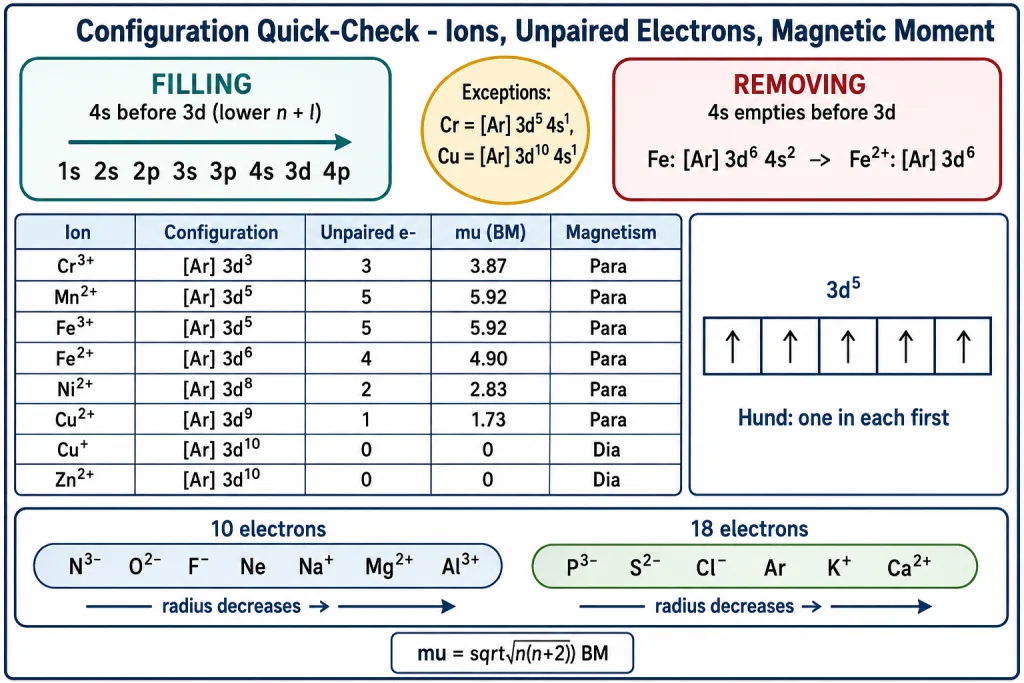
The two rules that decide every ion
- Filling: follow — . So fills before .
- Removing (making a cation): electrons leave the highest first — empties before . Write the neutral atom, then strip , then .
Two exceptions: chromium and copper. A half-filled or completely filled subshell is extra stable (symmetry plus exchange energy), so one electron moves into .
The atoms
| Element () | Configuration | Valence picture | Unpaired electrons |
|---|---|---|---|
| Sc (21) | 1 | ||
| Ti (22) | 2 | ||
| V (23) | 3 | ||
| Cr (24) | — not | half-filled and | 6 |
| Mn (25) | 5 | ||
| Fe (26) | 4 | ||
| Co (27) | 3 | ||
| Ni (28) | 2 | ||
| Cu (29) | — not | full , half | 1 |
| Zn (30) | 0 |
Same story one row down: Mo (42) is and Ag (47) is ; Au (79) ends .
The ions — the rows NEET actually asks
| Ion | Electrons | Configuration | Unpaired | (BM) | Magnetic behaviour |
|---|---|---|---|---|---|
| 18 | 0 | 0 | Diamagnetic | ||
| 19 | 1 | 1.73 | Paramagnetic | ||
| 20 | 2 | 2.83 | Paramagnetic | ||
| 21 | 3 | 3.87 | Paramagnetic | ||
| 22 | 4 | 4.90 | Paramagnetic | ||
| 23 | 5 | 5.92 | Paramagnetic (maximum for 3d) | ||
| 23 | 5 | 5.92 | Paramagnetic | ||
| 24 | 4 | 4.90 | Paramagnetic | ||
| 25 | 3 | 3.87 | Paramagnetic | ||
| 26 | 2 | 2.83 | Paramagnetic | ||
| 27 | 1 | 1.73 | Paramagnetic (coloured) | ||
| 28 | 0 | 0 | Diamagnetic (colourless) | ||
| 28 | 0 | 0 | Diamagnetic |
[NEET] and are both — isoelectronic, five unpaired, BM, the highest among common ions. and are both — zero unpaired, diamagnetic. "Which ion is colourless or diamagnetic?" means find the or option.
Unpaired electrons in main-group species — the box-diagram habit
Draw the boxes for the outermost subshell and apply Hund's rule:
| Species | Valence configuration | Unpaired |
|---|---|---|
| C, Si | 2 | |
| N, P | 3 (maximum for a block) | |
| O, S | 2 | |
| F, Cl | 1 | |
| Ne, Ar, , | 0 | |
| molecule | (from molecular orbital theory, Class 11 Bonding) | 2 |
Isoelectronic sets — recognise them by electron count
| Electron count | Set | Size order (radius) |
|---|---|---|
| 2 | , He, , | |
| 10 | , , , Ne, , , (also , , , HF, , ) | |
| 18 | , , , Ar, , , , (also , HCl, ) | |
| 36 | , Kr, , | anion atom cation |
Key Point: In an isoelectronic series more protons pull the same electrons closer, so the radius decreases as increases: the most negative ion is largest, the most positive cation smallest. and have 28 electrons, not 18 — isoelectronic with each other, not with .
Quantum-number validity — six one-liners
- can never equal or exceed : , , are impossible.
- can never exceed : , are impossible.
- is only or : or is impossible.
- or a negative is impossible; with is always fine (an orbital).
- A set names one orbital; names one electron; names a subshell of electrons; alone names a shell of electrons.
- "How many electrons have ?" — five orbitals in , one electron of that spin each: 5. "How many with ?" — 16 orbitals, so 16.
| Set | Verdict | Why |
|---|---|---|
| Valid | ||
| Valid | ||
| Valid | ||
| Valid | ||
| Invalid | ||
| Invalid | ||
| Invalid | ||
| Invalid | no |
The last electron of an element: Na — ; Cl — depending on convention; K — , not , because fills before .
The NEET Traps List — Where the Minus One Comes From
Trap 1: orbit versus orbital
An orbit is Bohr's fixed circular path; an orbital is a probability region from the wave picture. Orbits are well-defined paths and violate Heisenberg; orbitals have shapes ( spherical, dumbbell, double dumbbell) and nodes. "The shape of an orbit" is a trick — orbits are always circular, only orbitals have -dependent shapes. An orbital holds at most 2 electrons; an orbit holds .
Trap 2: the range versus the range
runs from to ( values); runs from to ( values). Students swap them under pressure: for , is (never 3); for , is (five values, not three). Orbitals in a subshell is , not .
Trap 3: 4s fills before 3d — but empties first
Filling follows : () before (). Once holds electrons it lies lower than , so a cation loses first. is , not ; is , not . Deleting from the right end of the written configuration (the end) is the commonest error here.
Trap 4: energy of 3d versus 4s — hydrogen versus everyone else
In hydrogen energy depends only on : , degenerate, all below . In multi-electron atoms it depends on , so lies below for filling. "In hydrogen, which is lower, or ?" wants ; the same question for potassium wants .
Trap 5: wavenumber units
. With in , is in cm; multiply by for nm. Options in metres against a number in centimetres puts you off by 100, and the option list usually carries both.
Trap 6: eV versus J
eV J, and both appear in the options, so read the unit in the last line. The joule figure is per atom; per mole it is kJ/mol (multiply by , divide by 1000). "1312 kJ/mol" and "13.6 eV per atom" are one fact.
Trap 7: kinetic energy depends on frequency, not intensity
Doubling the intensity doubles the number of photoelectrons but leaves their kinetic energy unchanged. Only a higher frequency raises the KE. Below , no electrons at any intensity. Assertion-Reason questions set this trap often.
Trap 8: the sign of energy and "higher" versus "lower"
is negative, so a larger is less negative, i.e. higher: eV is higher than eV, and releases the positive difference, 1.89 eV. The gap between consecutive levels shrinks as grows: eV, eV, eV.
Trap 9: number of lines versus lines in one series
"Lines when the electron returns from " is . Balmer lines from that level: . Lyman: . The question tells you which; read it.
Trap 10: Hund's rule versus Pauli's principle
Pauli says two electrons per orbital with opposite spins — a rule about the maximum. Hund says singly occupy degenerate orbitals first, parallel spins — a rule about the order. Nitrogen's is Hund; "an orbital cannot hold three electrons" is Pauli. Aufbau is a third rule, about which subshell fills first.
Trap 11: mass number is not atomic mass
Mass number is a whole number (protons + neutrons). Atomic mass (35.5 u for chlorine) is a weighted average of isotopes. Neutrons , always an integer. : 17 protons, 20 neutrons, 17 electrons; : 18 electrons.
Trap 12: nodes — radial, angular, total
Radial nodes ; angular nodes ; total . has one radial and one angular node; one radial and none angular; zero radial. "Nodes" without qualification usually means total, .
Key Point: Most NEET losses here are reading errors, not physics errors: orbit/orbital, /, fills/empties, eV/J, cm/m, lines/lines-in-a-series. Underline the noun, then compute.
The 40-second checklist (say it before you bubble)
- Which species () and which level () — and did I square the right one?
- Did I strip before for the cation, and remember Cr and Cu?
- Is the answer in the unit asked for — eV or J, nm or m, or ?
- Lines in a series or total lines; radial or total nodes?
- Does my rounded number match exactly one option?
Solved Examples
Question 1: Energy and radius of a Bohr orbit
Find the energy (in eV) and the radius (in Å) of the electron in the third orbit of a hydrogen atom.
Answer:
Here and .
eV, so eV.
Å Å.
Ans: eV; Å (476 pm). Watch out: Options in joules need J.
Question 2: Ground-state energy of a hydrogen-like ion
The ionisation energy of hydrogen is 13.6 eV. What is the energy of the electron in the ground state of , and what is its ionisation energy?
Answer:
Lithium has , and has one electron, so Bohr's formula applies.
eV.
Ionisation energy takes the electron from to : eV.
Ans: eV; ionisation energy eV. Watch out: IEs of , , go as — 13.6, 54.4, 122.4 eV.
Question 3: Photon energy from wavelength
Light of wavelength 400 nm falls on a sodium surface whose work function is 2.3 eV. Find the energy of a photon and the maximum kinetic energy of the ejected electrons.
Answer:
eV.
eV.
In joules, if asked: J.
Ans: Photon energy 3.1 eV; eV. Watch out: Check the photon energy clears the work function. At 600 nm, eV eV and no electrons come out.
Question 4: Threshold wavelength from work function
The work function of caesium is 1.9 eV. Find the threshold wavelength and the threshold frequency.
Answer:
nm m.
Hz.
Same number the other way: Hz.
Ans: nm; Hz. Watch out: Caesium's threshold sits in the visible (red), which is why it goes into photocells. Light longer than 653 nm ejects nothing from caesium, however bright.
Question 5: Number of spectral lines
Hydrogen atoms are excited to the level. How many spectral lines appear in total, and how many of them are in the visible region?
Answer:
Total lines: .
Visible means Balmer, ending at : , , , i.e. lines.
The rest: Lyman lines (UV), Paschen (IR), Brackett 1.
Ans: 10 lines in total, 3 in the visible region. Watch out: The total and the per-series count answer different questions; read which is asked.
Question 6: Wavelength of the first Balmer line
Calculate the wavelength of the first line of the Balmer series of hydrogen. ()
Answer:
The first Balmer line is .
.
cm cm nm.
Ans: About 656 nm — the red line. Watch out: The unit. With in , is in cm; multiply by for nm.
Question 7: de Broglie wavelength of an accelerated electron
An electron is accelerated from rest through a potential difference of 100 V. Find its de Broglie wavelength.
Answer:
For an electron through volt, Å Å.
From first principles: J; ; m.
Ans: Å m. Watch out: Å is for electrons only. For a proton or an particle, go back to .
Question 8: Uncertainty in velocity
If the position of an electron is known to within Å, what is the minimum uncertainty in its velocity? ( kg)
Answer:
Heisenberg gives , with Å m.
.
Ans: . Watch out: Convert to metres first. The package divided by gives the answer directly. The uncertainty beats the Bohr velocity itself ( m/s) — why fixed orbits make no sense for electrons.
Question 9: Configuration, unpaired electrons and magnetic moment of ions
Write the electronic configuration of and , and find the number of unpaired electrons and the spin-only magnetic moment of each.
Answer:
Fe () is . Removing three electrons, first, gives . By Hund's rule the five orbitals take one electron each: 5 unpaired, BM.
Cu () is (the exception). Removing the lone electron gives , all paired: 0 unpaired, , diamagnetic and colourless.
Ans: : , 5 unpaired, 5.92 BM; : , 0 unpaired, 0 BM. Watch out: Write the neutral atom first (with the Cr/Cu exception), then strip , then . Removing from first is the standard slip.
Question 10: Which set of quantum numbers is impossible?
Which of the following sets of quantum numbers is not allowed: (i) , (ii) , (iii) , (iv) ?
Answer:
(i) allows , and lies in to . Valid ().
(ii) allows only , so fails. Invalid.
(iii) allows (), fine. Valid.
(iv) , spin down. Valid.
Ans: Set (ii), because cannot equal . Watch out: Run the checks in order — , then , then .