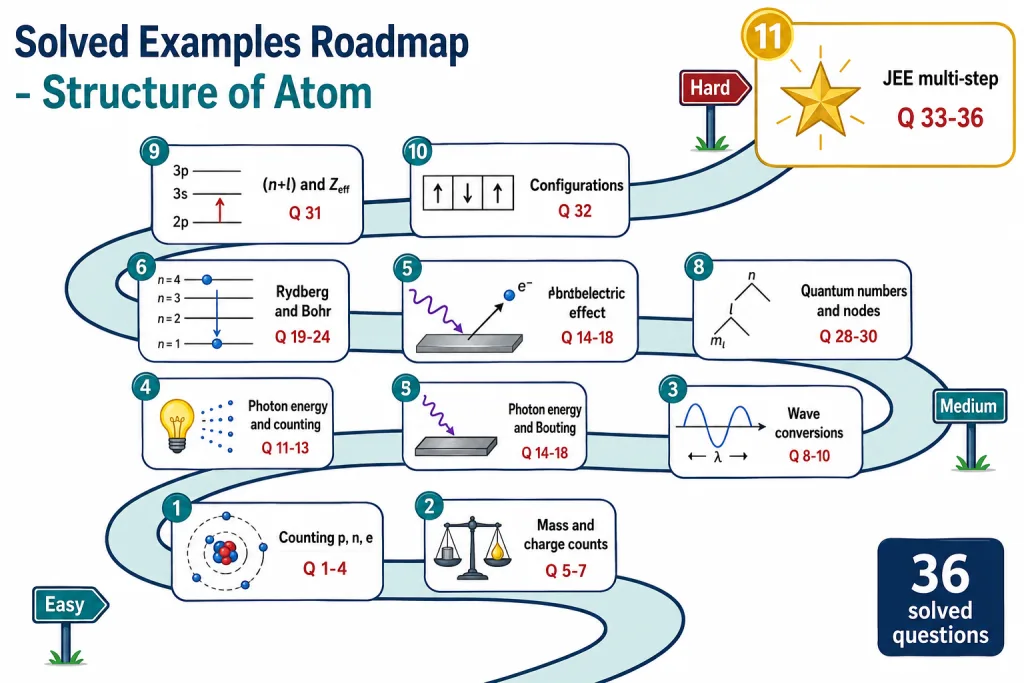
You have finished the theory. Sections 1 to 10 took you from the cathode ray tube to the electronic configuration of copper, and each carried its own dozen worked examples. This section is different: it is one long problem set — 36 fully worked questions arranged from the simplest to the hardest — and it deliberately covers every in-text problem and every end-of-chapter exercise that boards, JEE Main and NEET keep recycling, plus four harder multi-step problems of the kind JEE likes to build from this chapter.
Structure of Atom is not conceptually hard; the arithmetic is what costs marks. Wavelengths left in nanometres inside E=hc/λ, a forgotten Z2 in the Bohr energy, the electrons of the atom counted when the question asked about the ion, l=3 written for n=3 — those are the losses. Volume of practice, with units written at every line, is the only cure. So work these.
The working method
Cover the answer. Attempt the question first, on paper, with a pen. Reading a solution feels like learning and is not.
Compare your steps, not just your number. If you reached the right answer by a longer route, note the shorter one; if you reached the wrong answer, find the exact line where it went wrong.
Read the Watch out line. Most questions end with one. That is the transferable part; the numbers and the particular examples are disposable.
The constants used throughout
Key Point:h=6.626×10⁻³⁴ J s; c=3.0×10⁸ms−1; me=9.1×10⁻³¹ kg (9.1094×10⁻³¹ kg where the precision matters); e=1.602×10⁻¹⁹ C; NA=6.022×10²³mol−1; RH=2.18×10⁻¹⁸ J =13.6 eV; a0=52.9 pm; Rydberg constant =109,677cm−1; 1eV=1.602×10⁻¹⁹ J; and the exam shortcut hc=1240 eV nm. A few answers are quoted to one more digit than the data justify, simply so that you can compare with your textbook's answer key.
The seven errors that cost the most marks in this chapter
Error
Where it bites
The fix
Leaving λ in nm or Å inside E=hc/λ
Questions 11 to 16
Convert to metres first, every single time
Using the electron count instead of the proton count for an ion
Questions 2, 4
Protons =Z always; electrons =Z− charge
Forgetting Z2 for He+ and Li2+
Questions 22, 23, 33
En∝Z2/n2, rn∝n2/Z
Writing 1/n12−1/n22 with the levels the wrong way round
Questions 19 to 21
Put the smallern first; the wavenumber must come out positive
Mixing eV and joules in the photoelectric equation
Questions 15 to 18
Pick one unit before you subtract
Using Δx⋅Δp≥h/2π instead of h/4π
Question 27
The exam form is h/4π
Letting l reach n, or ml exceed l
Questions 28 to 30
l runs 0 to n−1; ml runs −l to +l
Solved Examples
Question 1: Protons, neutrons and electrons in a neutral atom
(a) Calculate the number of protons, neutrons and electrons in 3580Br.
(b) How many neutrons and protons are there in the nuclei 613C, 816O, 1224Mg, 2656Fe and 3888Sr?
Answer:
The symbol ZAX tells me everything. The bottom number Z is the atomic number, which is the number of protons. The top number A is the mass number, protons plus neutrons. Since it's a neutral atom, electrons equal protons.
(a) For 3580Br, Z=35 and A=80.
protons=35,electrons=35,neutrons=A−Z=80−35=45
(b) Same thing for each nucleus, neutrons =A−Z:
Nucleus
Z (protons)
A
Neutrons =A−Z
613C
6
13
7
816O
8
16
8
1224Mg
12
24
12
2656Fe
26
56
30
3888Sr
38
88
50
One thing I noticed: for the light ones n≈p, but by iron and strontium the neutrons are clearly ahead. Heavier nuclei need extra neutrons to hold together against all the proton-proton repulsion.
Watch out: The only way to mess this up is mixing up which number is A and which is Z. Bottom is protons, top is the total.
Question 2: From particle counts to the symbol, and electrons in molecular species
(a) The number of electrons, protons and neutrons in a species are 18, 16 and 16 respectively. Assign the proper symbol to the species.
(b) Write the complete symbol for the atom with (i) Z=17, A=35; (ii) Z=92, A=233; (iii) Z=4, A=9.
(c) Give the number of electrons in the species H2+, H2 and O2+.
Answer:
(a) The protons decide the element. 16 protons means Z=16, so it's sulphur. Mass number is A=p+n=16+16=32. There are 18 electrons but only 16 protons, so the species has 2 extra electrons and a charge of −2:
1632S2−
(b) I just find the element from Z and write the numbers on it. (i) Z=17 is chlorine, 1735Cl; (ii) Z=92 is uranium, 92233U; (iii) Z=4 is beryllium, 49Be.
(c) I add up the electrons of all the atoms first, then fix for the charge.
H2: 2×1=2 electrons.
H2+: one electron has been taken away, so 2−1=1 electron.
O2+: O2 has 2×8=16 electrons, minus one for the positive charge =15 electrons.
Watch out: I write charge = protons − electrons, and the sign comes out right by itself: 16−18=−2.
Question 3: An atom with 29 electrons and 35 neutrons
An atom of an element contains 29 electrons and 35 neutrons. Deduce (i) the number of protons and (ii) the electronic configuration of the element.
Answer:
(i) It says "atom", so it's neutral and protons = electrons =29. Z=29 is copper. The mass number is A=29+35=64, so this is 2964Cu.
(ii) I fill 29 electrons in the aufbau order 1s2s2p3s3p4s3d. 1s22s22p63s23p6 takes 18, so 11 are left for 4s and 3d. If I fill blindly I get 4s23d9.
But copper is one of the exceptions. A fully filled 3d10 is more stable than 3d94s2 (more symmetry, more exchange energy), so one 4s electron shifts into 3d:
Cu:1s22s22p63s23p63d104s1or[Ar]3d104s1
Ans: (i) 29 protons (2964Cu). (ii) [Ar]3d104s1.
Watch out: Whenever a count lands on Z=24 or Z=29, it's a check on the two exceptions. Cr is [Ar]3d54s1 and Cu is [Ar]3d104s1; I nearly wrote 3d94s2 for copper here.
Question 4: The "per cent more neutrons" puzzles
(a) An element with mass number 81 contains 31.7% more neutrons as compared to protons. Assign the atomic symbol.
(b) An ion with mass number 37 possesses one unit of negative charge. If the ion contains 11.1% more neutrons than the electrons, find the symbol of the ion.
(c) An ion with mass number 56 contains 3 units of positive charge and 30.4% more neutrons than electrons. Assign the symbol to this ion.
Answer:
I set up the algebra once and reuse it. Let p = protons, n = neutrons, e = electrons. Always p+n=A and e=p−(charge). "x% more neutrons than electrons" just means n=(1+100x)e.
(a) Neutral atom, so e=p. That gives n=1.317p, and p+n=81:
p+1.317p=81⇒2.317p=81⇒p=34.96≈35
So n=81−35=46. Z=35 is bromine: 3581Br.
(b) One negative charge means one extra electron, e=p+1. The percentage is on electrons, so n=1.111e=1.111(p+1), and p+n=37:
p+1.111(p+1)=37⇒2.111p=35.889⇒p=17.0
So e=18, n=37−17=20. Quick check: 20/18=1.111. Z=17 is chlorine: 1737Cl−.
(c) Three positive charges means three electrons missing, e=p−3. So n=1.304(p−3), and p+n=56:
p+1.304p−3.912=56⇒2.304p=59.912⇒p=26.0
So e=23, n=56−26=30. Check: 30/23=1.304. Z=26 is iron: 2656Fe3+.
Ans: (a) 3581Br (b) 1737Cl− (c) 2656Fe3+.
Watch out: In (b) and (c) the percentage is relative to the electrons of the ion, not the protons, so I have to write e in terms of p before substituting. p should come out within a few hundredths of a whole number; if I get something like 17.4, I've used the wrong sign for the charge.
Question 5: Electrons that weigh one gram, and one mole of electrons
(i) Calculate the number of electrons which will together weigh one gram. (ii) Calculate the mass and charge of one mole of electrons.
Answer:
(i) One electron has mass 9.1094×10⁻³¹ kg =9.1094×10⁻²⁸ g. I want to know how many of these add up to 1 g, so I divide:
N=9.1094×10⁻²⁸g1g=1.098×1027electrons
(ii) For the mass of a mole I multiply one electron's mass by Avogadro's number:
m=9.1094×10−31kg×6.022×1023mol−1=5.486×10⁻⁷kgmol−1=0.549mg
For the charge, each electron carries −1.602×10⁻¹⁹ C:
q=−1.602×10−19C×6.022×1023=−9.65×10⁴C
That's one faraday (96,500 C), with a negative sign because it's electrons.
So a mole of electrons weighs about half a milligram, which is why we ignore electron mass in atomic masses, but it carries 96,500 C, which is why we can't ignore it in electrochemistry.
Ans: (i) 1.098×1027 electrons. (ii) Mass 5.486×10⁻⁷ kg (about 0.55 mg); charge −9.65×10⁴ C.
Question 6: Electrons, neutrons and protons in a given mass of substance
(i) Calculate the total number of electrons present in one mole of methane.
(ii) Find (a) the total number and (b) the total mass of neutrons in 7 mg of 14C. (Mass of a neutron =1.675×10⁻²⁷ kg.)
(iii) Find (a) the total number and (b) the total mass of protons in 34 mg of NH3 at STP. Will the answer change if the temperature and pressure are changed?
Answer:
The route every time is mass, then moles, then molecules, then particles per molecule.
(i) One CH4 molecule has 6+4×1=10 electrons. One mole has 6.022×10²³ molecules:
Ne=10×6.022×1023=6.022×1024electrons
(ii) Molar mass of 14C is 14 g mol−1 and 7 mg =7×10⁻³ g:
n=147×10−3=5×10⁻⁴mol⇒5×10−4×6.022×1023=3.011×10²⁰atoms
Each 14C atom has 14−6=8 neutrons (from the mass number, not the atomic number):
Nn=8×3.011×1020=2.409×10²¹neutronsmn=2.409×1021×1.675×10−27kg=4.03×10⁻⁶kg
(iii) Molar mass of NH3 is 17 g mol−1:
n=1734×10−3=2×10⁻³mol⇒1.204×10²¹molecules
Each molecule has 7+3=10 protons (7 from N, 3 from H):
Np=10×1.204×1021=1.204×10²²protonsmp=1.204×1022×1.6726×10−27kg=2.01×10⁻⁵kg
Temperature and pressure don't matter here. The proton count depends only on the mass of ammonia (so the moles), not on what volume it takes up. The "at STP" is just there to distract.
Ans: (i) 6.022×1024 electrons. (ii) 2.409×10²¹ neutrons, 4.03×10⁻⁶ kg. (iii) 1.204×10²² protons, 2.01×10⁻⁵ kg; unchanged with temperature and pressure.
Watch out: Neutrons come from the mass number (14C has 8, not 6). And T and P only matter if the sample is given as a volume of gas, not a mass.
Question 7: Counting electrons from a measured charge (Millikan)
(a) A certain particle carries 2.5×10⁻¹⁶ C of static electric charge. Calculate the number of electrons present in it.
(b) In Millikan's experiment, static electric charge on the oil drops has been obtained by shining X-rays. If the static electric charge on the oil drop is −1.282×10⁻¹⁸ C, calculate the number of electrons present on it.
Answer:
Millikan's whole point was that charge comes in whole packets. Any charge on a drop is q=ne, where n is an integer and e=1.602×10⁻¹⁹ C. So I just divide: n=q/e.
(b)
n=1.602×10⁻¹⁹C1.282×10−18C=8.0
So the drop has 8 extra electrons. The minus sign only tells me the drop gained electrons instead of losing them; it doesn't change the count.
Both answers came out as (nearly) whole numbers, which is exactly what should happen. If I'd got 8.4, that would mean I slipped in the arithmetic, not that there's a fraction of an electron.
Ans: (a) 1560 electrons. (b) 8 electrons.
Watch out: The charge on a drop can only be ±1.602×10⁻¹⁹ C, ±3.204×10⁻¹⁹ C, ±4.806×10⁻¹⁹ C and so on. If a list of charges is given and one is impossible, it's the one that isn't a whole-number multiple of e.
Question 8: Radio waves and the visible window
(a) The Vividh Bharati station of All India Radio, Delhi, broadcasts on a frequency of 1,368 kHz. Calculate the wavelength of the electromagnetic radiation emitted by the transmitter. Which part of the electromagnetic spectrum does it belong to?
(b) The wavelength range of the visible spectrum extends from violet (400 nm) to red (750 nm). Express these wavelengths in frequencies (Hz).
Answer:
(a) Every electromagnetic wave travels at c in vacuum, so λ=c/ν. First I convert kHz to Hz: 1368kHz=1368×103s−1.
λ=1368×103s−13.0×10⁸ms−1=219.3m
A wavelength of a couple of hundred metres is a radio wave (the medium-wave AM band).
(b) Now I flip it to ν=c/λ, with wavelengths in metres:
νviolet=400×10−9m3.0×108ms−1=7.50×10¹⁴Hzνred=750×10−9m3.0×108ms−1=4.00×10¹⁴Hz
So visible light runs from 4.0×10¹⁴ Hz (red) to 7.5×10¹⁴ Hz (violet). Shorter wavelength, higher frequency.
Ans: (a) 219.3 m; radio waves. (b) Violet 7.5×10¹⁴ Hz, red 4.0×10¹⁴ Hz.
Watch out:c=νλ is the easy part; the marks go on the unit conversions (kHz to Hz, nm to m). Worth remembering the visible window both ways: 400 to 750 nm, and 7.5 down to 4.0×10¹⁴ Hz, with violet at the short-wavelength, high-energy end.
Question 9: Yellow sodium light, and a wave known only by its period
(a) Yellow light emitted from a sodium lamp has a wavelength of 580 nm. Calculate the frequency and wavenumber of the yellow light.
(b) Calculate the wavelength, frequency and wavenumber of a light wave whose period is 2.0×10⁻¹⁰ s.
Answer:
(a) λ=580nm=580×10−9m=5.80×10⁻⁷ m. Frequency first:
ν=λc=5.80×10⁻⁷m3.0×108ms−1=5.17×10¹⁴s−1
Wavenumber is just 1 over the wavelength, and it's usually quoted in cm−1. 580nm=5.80×10⁻⁵ cm:
νˉ=λ1=5.80×10⁻⁷m1=1.724×10⁶m−1=1.724×104cm−1
(Some versions of this problem say 5800 Å, which is the same 580 nm.)
(b) Here I only know the period, so I start from frequency. Frequency is oscillations per second, which is 1 over the period T:
ν=T1=2.0×10⁻¹⁰s1=5.0×10⁹s−1
Then wavelength:
λ=νc=5.0×10⁹s−13.0×10⁸ms−1=6.0×10⁻²m=6.0cm
And wavenumber:
νˉ=λ1=6.0×10⁻²m1=16.7m−1=0.167cm−1
A 6 cm wavelength at 5 GHz is a microwave.
Watch out: Wavenumber in cm−1 is 100 times smaller than in m−1, and I keep wanting to multiply instead of divide. Check with a 1 m wave: νˉ=1m−1=0.01cm−1.
Question 10: A neon sign — four questions about one wavelength
Neon gas is generally used in sign boards. If it emits strongly at 616 nm, calculate (a) the frequency of emission, (b) the distance travelled by this radiation in 30 s, (c) the energy of one quantum, and (d) the number of quanta present if it produces 2 J of energy.
Answer:
(a) First I put the wavelength in metres: λ=616nm=6.16×10⁻⁷ m. Then
ν=λc=6.16×10⁻⁷m3.0×108ms−1=4.87×10¹⁴s−1
(b) This part has nothing to do with the wavelength. Light moves at c whatever its colour, so I just multiply speed by time:
d=ct=3.0×10⁸ms−1×30s=9.0×10⁹m
(c) One quantum carries hν:
E=hν=6.626×10−34Js×4.87×1014s−1=3.23×10⁻¹⁹J
I checked it with the eV shortcut: E=1240/616=2.01 eV =3.22×10⁻¹⁹ J. Same thing.
(d) Total energy divided by energy per photon gives the count:
N=EphotonEtotal=3.23×10⁻¹⁹J2J=6.2×10¹⁸quanta
Watch out: In (d) keep the photon energy to three figures before dividing. If I'd rounded it to 3×10⁻¹⁹ J the count would come out 8% off.
Question 11: Photon energies across the spectrum, and a mole of photons
(a) Find the energy of each of the photons which (i) correspond to light of frequency 3×10¹⁵ Hz; (ii) have wavelength 0.50 Å.
(b) Calculate the energy of one mole of photons of radiation whose frequency is 5×10¹⁴ Hz.
(c) The longest-wavelength doublet absorption transition of sodium is observed at 589 and 589.6 nm. Calculate the frequency of each transition and the energy difference between the two excited states.
Answer:
(a)(i) I'm given the frequency, so E=hν straight away:
E=6.626×10−34Js×3×1015s−1=1.99×10⁻¹⁸J
(a)(ii) This time I'm given the wavelength, so E=hc/λ, with 0.50A˚=0.50×10⁻¹⁰ m:
E=0.50×10⁻¹⁰m6.626×10−34Js×3.0×108ms−1=3.98×10⁻¹⁵J
That's about 25 keV, an X-ray photon, roughly two thousand times more energetic than the ultraviolet photon in (i).
(b) I work out one photon first, then multiply by Avogadro's number:
Ephoton=6.626×10−34×5×1014=3.313×10⁻¹⁹JEmole=3.313×10−19J×6.022×1023mol−1=1.995×10⁵Jmol−1=199.5kJmol−1
(c) Two wavelengths, so two frequencies:
ν1=589×10−93.0×108=5.093×10¹⁴Hz,ν2=589.6×10−93.0×108=5.088×10¹⁴Hz
The energy gap between the two excited states is just the difference of the two photon energies:
ΔE=h(ν1−ν2)=6.626×10−34×(5.093−5.088)×1014=3.3×10⁻²²J
If I keep more digits, ν1−ν2=5.18×10¹¹ Hz and ΔE=3.43×10⁻²² J, about 2.1×10⁻³ eV. It's a tiny splitting, which is why the two lines sit so close together.
Ans: (a) (i) 1.99×10⁻¹⁸ J (ii) 3.98×10⁻¹⁵ J. (b) 199.5 kJ mol−1. (c) 5.093×10¹⁴ Hz and 5.088×10¹⁴ Hz; ΔE≈3.4×10⁻²² J.
Watch out: In (c) I'm subtracting two nearly equal numbers, so rounding the frequencies early wrecks the answer; I carry four figures. A cleaner route is ΔE=hcΔλ/λ2, which gives 1240×0.6/5892=2.1×10−3 eV in one line with no subtraction.
Question 12: Photons per second from a bulb
(a) A 100 watt bulb emits monochromatic light of wavelength 400 nm. Calculate the number of photons emitted per second by the bulb.
(b) A 25 watt bulb emits monochromatic yellow light of wavelength 0.57 μm. Calculate the rate of emission of quanta per second.
Answer:
A watt is a joule per second, so 100 W means the bulb gives out 100Js−1. Photons per second is just energy per second divided by energy per photon.
(a) Energy of one 400 nm photon:
E=λhc=400×10−96.626×10−34×3.0×108=4.969×10⁻¹⁹JRate=4.969×10⁻¹⁹J100Js−1=2.012×10²⁰photons per second
(b) Same idea, with 0.57μm=0.57×10⁻⁶ m:
E=0.57×10−66.626×10−34×3.0×108=3.487×10⁻¹⁹JRate=3.487×10⁻¹⁹J25Js−1=7.17×10¹⁹quanta per second
Quick check: the rate goes as Pλ. Bulb (b) has a quarter of the power but 1.425 times the wavelength, so it should give 0.25×1.425=0.356 times as many photons. 0.356×2.012×1020=7.17×10¹⁹, which matches.
Watch out:N/t=Pλ/hc. If a question says only 10% of the power goes into light, use 0.1P on top. And check the wavelength unit before anything else, since μm and Å both turn up here.
Question 13: Counting photons — a joule of X-rays, a starlight detector, a laser and a pulse
(a) What is the number of photons of light with a wavelength of 4000 pm that provide 1 J of energy?
(b) A photon detector receives a total of 3.15×10⁻¹⁸ J from radiation of 600 nm. Calculate the number of photons received.
(c) A nitrogen laser produces radiation at 337.1 nm. If the number of photons emitted is 5.6×1024, calculate the power of this laser.
(d) A pulsed radiation source has a duration of 2 ns and emits 2.5×10¹⁵ photons during the pulse. Calculate the energy of the source.
Answer:
(a) First the unit: 4000pm=4000×10−12m=4.0×10⁻⁹ m, which is 4 nm, a soft X-ray. Then one photon's energy and the count:
E=λhc=4.0×10−96.626×10−34×3.0×108=4.97×10⁻¹⁷JN=4.97×10⁻¹⁷J1J=2.01×10¹⁶photons
(b) 600nm=6.0×10⁻⁷ m:
E=6.0×10−76.626×10−34×3.0×108=3.313×10⁻¹⁹JN=3.313×10−193.15×10−18=9.5≈10photons
You can't have half a photon, so I round it to about 10. That's how faint starlight is.
(c) Energy of one 337.1 nm photon:
E=337.1×10−96.626×10−34×3.0×108=5.897×10⁻¹⁹J
Total energy of 5.6×1024 photons =5.6×1024×5.897×10−19=3.30×10⁶ J. The question calls this the power, so it's treating the photon count as per second:
P=3.3×10⁶Js−1=3.3×10⁶W
(d) The usual way of reading this one is to take the pulse duration as the period of the radiation, so ν=1/T=1/(2×10−9s)=5.0×108 Hz:
Ephoton=hν=6.626×10−34×5.0×108=3.31×10⁻²⁵JEsource=2.5×1015×3.31×10−25=8.28×10⁻¹⁰J
Strictly, how long a pulse lasts and the frequency of its light are two different things, but this is the convention the answer key uses, and the arithmetic is the point.
Ans: (a) 2.01×10¹⁶ photons (b) about 10 photons (c) 3.3×10⁶ W (d) 8.28×10⁻¹⁰ J.
Watch out: A count like 9.5 photons doesn't mean anything on its own. Round a photon count to a whole number and say you did.
Question 14: Threshold frequency and work function
(a) The threshold frequency ν0 for a metal is 7.0×10¹⁴s−1. Calculate the kinetic energy of an electron emitted when radiation of frequency ν=1.0×10¹⁵s−1 hits the metal.
(b) Electrons are emitted with zero velocity from a metal surface when it is exposed to radiation of wavelength 6800 Å. Calculate the threshold frequency and the work function of the metal.
Answer:
Einstein's equation is hν=W0+21mev2, with W0=hν0. So the kinetic energy is whatever's left over: KE=h(ν−ν0).
(a)
KE=6.626×10−34Js×(10.0×1014−7.0×10¹⁴)s−1=6.626×10−34×3.0×1014=1.988×10⁻¹⁹J
That's about 1.24 eV.
(b) "Zero velocity" tells me the light is exactly at threshold, so λ0=6800A˚=6.8×10⁻⁷ m and
ν0=λ0c=6.8×10−73.0×108=4.41×10¹⁴s−1
The work function is then
W0=hν0=6.626×10−34×4.41×1014=2.92×10⁻¹⁹J=1.602×10−192.92×10−19=1.82eV
Quick check with the shortcut: W0=1240/680=1.82 eV.
Watch out: "Emitted with zero kinetic energy" or "just sufficient to eject" means threshold: λ=λ0, ν=ν0, and hν0 is the work function. Also, KEmax depends on frequency only; brighter light just gives more electrons per second, not faster ones.
Question 15: Photon energy, kinetic energy and photoelectron velocity
(a) A photon of wavelength 4×10⁻⁷ m strikes a metal surface whose work function is 2.13 eV. Calculate (i) the energy of the photon in eV, (ii) the kinetic energy of the emission, and (iii) the velocity of the photoelectron. (1 eV =1.6020×10⁻¹⁹ J.)
(b) When radiation of wavelength 300 nm falls on the surface of sodium, electrons are emitted with a kinetic energy of 1.68×10⁵Jmol−1. What is the minimum energy needed to remove an electron from sodium, and what is the maximum wavelength that will cause a photoelectron to be emitted?
Answer:
(a)(i) Photon energy, then converted to eV:
E=λhc=4×10−76.626×10−34×3.0×108=4.97×10⁻¹⁹J=1.602×10−194.97×10−19=3.10eV
(a)(ii) The kinetic energy is what's left after paying the work function:
KE=3.10−2.13=0.97eV=0.97×1.602×10−19=1.55×10⁻¹⁹J
(a)(iii) For the speed I use KE=21mev2, and here the kinetic energy has to be in joules:
v=me2KE=9.1×10⁻³¹kg2×1.55×10−19J=3.41×10¹¹ms−1=5.84×10⁵ms−1
(b) The kinetic energy is given per mole, so I first bring it down to one electron:
KE=6.022×10²³mol−11.68×10⁵Jmol−1=2.79×10⁻¹⁹J
Energy of the 300 nm photon:
E=300×10−96.626×10−34×3.0×108=6.626×10⁻¹⁹J
The minimum energy to remove an electron is the work function, photon energy minus kinetic energy:
W0=E−KE=6.626×10⁻¹⁹−2.79×10−19=3.84×10⁻¹⁹J
The maximum wavelength is the threshold wavelength, where the whole photon goes into the work function and nothing is left for motion:
λ0=W0hc=3.84×10−196.626×10−34×3.0×108=5.17×10⁻⁷m=517nm
That's green light, so sodium responds to anything bluer than 517 nm.
Ans: (a) (i) 3.10 eV (ii) 0.97 eV =1.55×10⁻¹⁹ J (iii) 5.84×10⁵ms−1. (b) W0=3.84×10⁻¹⁹ J; λ0=517 nm.
Watch out: I do the energy subtraction in eV (3.10−2.13) but the velocity in joules and kilograms; mixing the two is the classic slip. A handy scale: 1 eV of kinetic energy gives an electron 5.93×10⁵ms−1, so 0.97 eV gives 0.97×5.93×105=5.84×10⁵ms−1 straight away.
Question 16: Ionisation energy of sodium, and caesium under 500 nm light
(a) Electromagnetic radiation of wavelength 242 nm is just sufficient to ionise the sodium atom. Calculate the ionisation energy of sodium in kJ mol−1.
(b) The work function for caesium is 1.9 eV. Calculate (i) the threshold wavelength and (ii) the threshold frequency of the radiation. If caesium is irradiated with light of wavelength 500 nm, calculate the kinetic energy and the velocity of the ejected photoelectron.
Answer:
(a) "Just sufficient" means one photon carries exactly the ionisation energy, no more. So I find the photon energy:
E=λhc=242×10−96.626×10−34×3.0×108=8.21×10⁻¹⁹Jatom−1
Then scale it up to a mole:
IE=8.21×10−19J×6.022×1023mol−1=4.945×10⁵Jmol−1=494.5kJmol−1
Shortcut check: 1240/242=5.12 eV, and 1eVatom−1=96.5kJmol−1, so 5.12×96.5=494 kJ mol−1.
(b)(i) I convert the work function to joules first: W0=1.9eV=1.9×1.602×10−19=3.04×10⁻¹⁹ J. Then
λ0=W0hc=3.04×10−196.626×10−34×3.0×108=6.53×10⁻⁷m=653nm
For the 500 nm light, the photon energy is 1240/500=2.48 eV, so the leftover kinetic energy is
KE=2.48−1.9=0.58eV=0.58×1.602×10−19=9.3×10⁻²⁰J
and the speed follows from 21mev2=KE:
v=9.1×10−312×9.3×10−20=2.04×1011=4.5×10⁵ms−1
Ans: (a) 494.5 kJ mol−1. (b) λ0=653 nm, ν0=4.59×10¹⁴ Hz; at 500 nm, KE=0.58 eV =9.3×10⁻²⁰ J and v=4.5×10⁵ms−1.
Watch out: Ionisation energy from a threshold wavelength is just the photoelectric effect on a gas atom; 1eVatom−1=96.5kJmol−1 converts it to the per-mole unit. Caesium's 1.9 eV is the lowest work function of the common metals, which is why even red light works on it and why it's used in photocells.
Question 17: Planck's constant from photoelectric data
Sodium metal is irradiated with three wavelengths, and the maximum speed of the photoelectrons is measured each time:
λ (nm)
500
450
400
v (×105ms−1)
2.55
4.35
5.35
Calculate (a) the threshold wavelength and (b) Planck's constant.
Answer:
The plan: Einstein's equation 21mev2=hν−hν0 is a straight line of kinetic energy against frequency, slope h and intercept −hν0. Two points fix the slope; the third is a check. The speeds are in multiples of 105ms−1; with any smaller unit the kinetic energies would be far below a photon's energy and the data wouldn't make sense.
Kinetic energies with me=9.1×10⁻³¹ kg:
KE1=21(9.1×10⁻³¹)(2.55×10⁵)2=2.96×10⁻²⁰JKE2=21(9.1×10⁻³¹)(4.35×10⁵)2=8.61×10⁻²⁰JKE3=21(9.1×10⁻³¹)(5.35×10⁵)2=1.30×10⁻¹⁹J
(b) I take the slope between the two extreme points, since that's the widest span:
h=ν3−ν1KE3−KE1=7.50×10¹⁴−6.00×10141.30×10−19−0.296×10−19=1.50×10141.006×10−19=6.7×10⁻³⁴Js
Very close to the accepted 6.626×10⁻³⁴ J s. The middle point gives slopes of 8.5 and 5.3×10⁻³⁴ with its neighbours, which is just scatter in real data, and that's why I use the widest span or a best-fit line.
(a) Threshold frequency from point 1 and this h:
ν0=ν1−hKE1=6.00×10¹⁴−6.7×10−342.96×10−20=6.00×10¹⁴−0.44×1014=5.56×10¹⁴Hzλ0=ν0c=5.56×10143.0×108=5.4×10⁻⁷m=540nm
The answer key usually quotes about 531 nm with h=6.66×10⁻³⁴ J s. The spread comes from the data, not from a mistake.
Ans: (a) λ0≈540 nm (about 530 to 540 nm depending on the fit). (b) h≈6.7×10⁻³⁴ J s.
Watch out: On a KEmax against ν graph, the slope is h for every metal; only the intercept (−W0, or ν0 on the x-axis) changes with the work function.
Question 18: Stopping potential, and a tightly bound inner electron
(a) The ejection of photoelectrons from silver can be stopped by applying a voltage of 0.35 V when radiation of 256.7 nm is used. Calculate the work function of silver.
(b) A photon of wavelength 150 pm strikes an atom and one of its inner bound electrons is ejected with a velocity of 1.5×10⁷ms−1. Calculate the energy with which it is bound to the nucleus.
Answer:
(a) If a reverse voltage Vs just stops the fastest electrons, then KEmax=eVs. With Vs=0.35 V, that's KEmax=0.35 eV, no conversion needed. That's the nice thing about working in eV.
Photon energy:
E=λhc=256.7×10−96.626×10−34×3.0×108=7.74×10⁻¹⁹J=1.602×10−197.74×10−19=4.83eV
Work function:
W0=E−KEmax=4.83−0.35=4.48eV=7.18×10⁻¹⁹J
(b) A 150 pm photon is a hard X-ray. Its energy:
E=150×10−126.626×10−34×3.0×108=1.325×10⁻¹⁵J
The electron carries away
KE=21mev2=21×9.1×10−31×(1.5×107)2=1.02×10⁻¹⁶J
The rest of the photon's energy went into freeing the electron, so that's the binding energy:
BE=1.325×10⁻¹⁵−0.102×10−15=1.22×10⁻¹⁵J=1.602×10−191.22×10−15=7.6×10³eV
Ans: (a) W0=4.48 eV =7.18×10⁻¹⁹ J. (b) Binding energy 1.22×10⁻¹⁵ J, about 7.6 keV.
Watch out:eVs=hν−W0: a stopping potential in volts is the kinetic energy in eV directly. Part (b) is the same equation with "binding energy" in place of the work function. Before subtracting in (b), I wrote both energies with the same power of ten (1.325 and 0.102×10⁻¹⁵ J); that's where the usual slip happens.
Question 19: Wavelength and frequency of hydrogen transitions
(a) What is the wavelength of light emitted when the electron in a hydrogen atom undergoes a transition from n=4 to n=2?
(b) What are the frequency and wavelength of a photon emitted during a transition from the n=5 state to the n=2 state in the hydrogen atom?
Answer:
(a) I use Rydberg's formula with the smaller level first, so the bracket comes out positive:
νˉ=109,677(n121−n221)cm−1=109,677(41−161)=109,677×163=20,564cm−1λ=νˉ1=20,564cm−11=4.863×10⁻⁵cm=486nm
That's the blue-green Balmer line, Hβ.
(b) This time I go through Bohr's energies instead, just to show both routes work. The energy released is
ΔE=2.18×10⁻¹⁸(ni21−nf21)=2.18×10⁻¹⁸(251−41)=2.18×10⁻¹⁸×(−0.21)=−4.58×10⁻¹⁹J
The minus sign just tells me energy is given out. The photon carries 4.58×10⁻¹⁹ J.
Frequency from E=hν:
ν=hΔE=6.626×10−344.58×10−19=6.91×10¹⁴Hz
Wavelength from c=νλ:
λ=νc=6.91×10143.0×108=4.34×10⁻⁷m=434nm
That's the violet Balmer line, Hγ. I checked with Rydberg too: 109,677×(1/4−1/25)=23,032cm−1, which gives λ=434 nm. Same answer, good.
Ans: (a) 486 nm. (b) ν=6.91×10¹⁴ Hz, λ=434 nm.
Watch out: Anything ending on n=2 is a Balmer line and sits in the visible range. The four visible ones are 3→2 at 656 nm (red), 4→2 at 486 nm (blue-green), 5→2 at 434 nm (violet) and 6→2 at 410 nm (violet).
Question 20: Energy and radius of the fifth orbit; ionising from excited states
(a) The energy associated with the first orbit in the hydrogen atom is −2.18×10⁻¹⁸ J atom−1. What is the energy associated with the fifth orbit? Calculate the radius of Bohr's fifth orbit.
(b) How much energy is required to ionise a hydrogen atom if the electron occupies the n=5 orbit? Compare your answer with the ionisation enthalpy of the H atom.
(c) The electron energy in a hydrogen atom is En=−2.18×10⁻¹⁸/n2 J. Calculate the energy required to remove an electron completely from the n=2 orbit. What is the longest wavelength of light, in cm, that can cause this transition?
Answer:
(a) Energy goes as En=E1/n2:
E5=25−2.18×10−18=−8.72×10⁻²⁰J
Radius goes the other way, rn=52.9n2 pm:
r5=52.9×25=1322.5pm=1.3225nm
(b) Ionising means taking the electron from n=5 all the way to n=∞, where the energy is zero. So the energy I need is just the size of E5:
ΔE=E∞−E5=0−(−8.72×10⁻²⁰)=8.72×10⁻²⁰J
From the ground state the ionisation enthalpy is 2.18×10⁻¹⁸ J. The ratio is 2.18×10⁻¹⁸/8.72×10−20=25, so ionising from n=5 takes only one twenty-fifth of the ground-state value. Makes sense, the electron is already most of the way out.
(c) Same idea from n=2:
ΔE=0−(4−2.18×10⁻¹⁸)=5.45×10⁻¹⁹J
The photon has to supply at least this much. Longer wavelength means less energy, so the longest wavelength that still works is the one with exactly ΔE:
λ=ΔEhc=5.45×10−196.626×10−34×3.0×108=3.647×10⁻⁷m=3.647×10⁻⁵cm
That's 364.7 nm, the Balmer series limit, in the near ultraviolet.
Ans: (a) E5=−8.72×10⁻²⁰ J; r5=1322.5 pm. (b) 8.72×10⁻²⁰ J, one twenty-fifth of the ground-state ionisation energy. (c) 5.45×10⁻¹⁹ J; λ=3.647×10⁻⁵ cm.
Watch out: Ionisation energy from level n is just ∣En∣=13.6/n2 eV, because the destination is E=0. In eV it's quick: E2=−3.4 eV, and λ(nm)=1240/3.4=365 nm without touching h or c.
Question 21: Longest Balmer line, counting lines from n=6, and the 1→5 round trip
(a) Calculate the wavenumber for the longest-wavelength transition in the Balmer series of atomic hydrogen.
(b) What is the maximum number of emission lines when the excited electron of a hydrogen atom in n=6 drops to the ground state?
(c) What is the energy in joules required to shift the electron of a hydrogen atom from the first Bohr orbit to the fifth, and what is the wavelength of the light emitted when the electron returns to the ground state? The ground-state electron energy is −2.18×10⁻¹¹ ergs.
Answer:
(a) Longest wavelength means smallest energy gap. In the Balmer series (n1=2) the smallest jump is 3→2:
νˉ=109,677(41−91)=109,677×365=15,233cm−1
That's λ=1/15,233=6.56×10−5 cm =656 nm, the red Hα line.
(b) From n=6 the electron can drop through every lower level in any order, and every pair of levels gives one line:
N=2n(n−1)=26×5=15
If I count by hand: 5 lines end on n=1, 4 on n=2, 3 on n=3, 2 on n=4, 1 on n=5. 5+4+3+2+1=15.
(c) First the erg. 1erg=10−7 J, so E1=−2.18×10⁻¹¹erg=−2.18×10⁻¹⁸ J, the usual number.
Energy to go up from n=1 to n=5:
ΔE=E5−E1=−2.18×10⁻¹⁸(251−1)=2.18×10−18×0.96=2.09×10⁻¹⁸J
On the way back (5→1 in one go) the same energy leaves as a photon:
λ=ΔEhc=2.09×10−186.626×10−34×3.0×108=9.50×10⁻⁸m=95nm
A Lyman line, deep in the ultraviolet.
Watch out: "Longest wavelength in a series" is always the jump from the very next level; "shortest wavelength" is from n=∞. And n(n−1)/2 only counts lines when the electron ends at the ground state. If it stops at level n1, the count is (n−n1)(n−n1+1)/2.
Question 22: The first orbit of He+ and its ionisation energy
(a) Calculate the energy associated with the first orbit of He+. What is the radius of this orbit?
(b) Calculate the energy required for the process He+(g)→He2+(g)+e−. The ionisation energy of the H atom in the ground state is 2.18×10⁻¹⁸ J atom−1.
Answer:He+ has only one electron, so Bohr's formulas still work. I just have to put in the nuclear charge Z:
En=−2.18×10⁻¹⁸n2Z2J,rn=52.9Zn2pm
(a) For He+, Z=2 and n=1:
E1=−2.18×10−18×1222=−8.72×10⁻¹⁸Jr1=52.9×212=26.45pm
So four times the energy of hydrogen's first orbit and half the radius. The doubled nuclear charge pulls the electron in closer and holds it much harder.
(b) Ionisation is n=1→n=∞, so the energy needed is just ∣E1∣:
IE(He+)=Z2×IE(H)=4×2.18×10−18=8.72×10⁻¹⁸Jatom−1
Per mole that's 8.72×10−18×6.022×1023=5.25×10⁶ J mol−1=5250 kJ mol−1, or 4×13.6=54.4 eV.
Watch out: Energy scales as Z2, radius as 1/Z. So the second ionisation energy of helium (54.4 eV) is exactly four times hydrogen's 13.6 eV, and the third ionisation energy of lithium is nine times, 122.4 eV.
Question 23: Matching a hydrogen transition to a helium-ion line
What transition in the hydrogen spectrum would have the same wavelength as the Balmer transition n=4 to n=2 of the He+ spectrum?
Answer:
First I write the He+ wavenumber with Z=2:
νˉHe+=RZ2(221−421)=R×4×(41−161)=R×4×163=43R
For hydrogen I don't know the levels yet:
νˉH=R(n121−n221)
Same wavelength means same wavenumber, so I set them equal and the R cancels:
n121−n221=43=1−41=121−221
So n1=1, n2=2. It's the 2→1 transition of hydrogen, the Lyman-α line at 121.6 nm.
There's a pattern here. Since Z2=4 multiplies the bracket, n24=(n/2)21. Any He+ transition n2→n1 with both levels even matches the hydrogen transition 2n2→2n1. So He+4→2 matches H 2→1, and He+6→4 would match H 3→2.
Ans: The n=2→n=1 transition of hydrogen.
Watch out: For hydrogen-like ions what matters is Z/n, not n alone. Halve both levels of a He+ transition to get the matching hydrogen one; for Li2+ divide by 3, so its 6→3 line sits on hydrogen's 2→1.
Question 24: Working backwards — finding n from a wavelength, and a transition from its radii
(a) Emission transitions in the Paschen series end at orbit n=3 and start from orbit n; they can be represented as ν=3.29×10¹⁵(321−n21) Hz. Calculate the value of n if the transition is observed at 1285 nm, and find the region of the spectrum.
(b) Calculate the wavelength for the emission transition that starts from the orbit of radius 1.3225 nm and ends at 211.6 pm. Name the series to which this transition belongs and the region of the spectrum.
Answer:
(a) The formula wants a frequency, so I convert the wavelength first:
ν=λc=1285×10−93.0×108=2.335×10¹⁴Hz
Now I solve for the bracket:
91−n21=3.29×10152.335×1014=0.0710n21=0.1111−0.0710=0.0401⇒n2=24.9⇒n=5
1285 nm is well past 750 nm, so this Paschen line is in the infrared.
(b) The radii tell me the levels. rn=52.9n2 pm, so n2=r/52.9:
start: n2=52.91322.5=25⇒n=5;end: n2=52.9211.6=4⇒n=2
So it's the 5→2 line:
νˉ=109,677(41−251)=109,677×0.21=23,032cm−1⇒λ=23,0321=4.34×10⁻⁵cm=434nm
It ends on n=2, so it's a Balmer line, in the visible (violet) region.
Watch out: The levels get hidden, as a wavelength to invert or radii to divide by 52.9 pm. Strip that off first and it's an ordinary Rydberg sum. Radii of 1.3225 nm and 211.6 pm should ring a bell as 25a0 and 4a0; the ratios 1:4:9:16:25 are worth knowing by heart.
Question 25: de Broglie wavelengths — a ball, a slow electron and a photon's mass
(a) What will be the wavelength of a ball of mass 0.1 kg moving with a velocity of 10ms−1?
(b) The mass of an electron is 9.1×10⁻³¹ kg. If its kinetic energy is 3.0×10⁻²⁵ J, calculate its wavelength.
(c) Calculate the mass of a photon with wavelength 3.6 Å.
Answer:
(a) Straight into de Broglie's relation λ=h/mv:
λ=0.1kg×10ms−16.626×10⁻³⁴Js=6.626×10⁻³⁴m
The units work because Js=kgm2s−1, and dividing by kgms−1 leaves m. This is about 1018 times smaller than a nucleus. No experiment could ever see it, which is why a cricket ball behaves like a particle.
(b) I'm given kinetic energy, not speed, so I get the speed first from KE=21mv2:
v=m2KE=9.1×10−312×3.0×10−25=6.59×105=812ms−1
Then the wavelength:
λ=mvh=9.1×10−31×8126.626×10−34=8.967×10⁻⁷m=896.7nm
A slow electron has a wavelength in the near infrared, comparable to light, so its diffraction is easy to see.
(c) A photon has no rest mass, so the "mass" here means the mass equivalent of its momentum. A photon moves at c, so λ=h/mc and
m=λch=3.6×10−10×3.0×1086.626×10−34=6.135×10⁻³³kg
About 1/150 of an electron's mass, for this X-ray photon.
Ans: (a) 6.626×10⁻³⁴ m. (b) 896.7 nm. (c) 6.135×10⁻³³ kg.
Watch out: When kinetic energy is given instead of velocity, skip the velocity step: λ=h/2mKE. Here 2×9.1×10−31×3.0×10−25=7.39×10⁻²⁸, and 6.626×10⁻³⁴/7.39×10−28=8.97×10−7 m in one go.
Question 26: Electron-microscope electrons, diffraction neutrons and a hockey ball
(a) Calculate the wavelength of an electron moving with a velocity of 2.05×10⁷ms−1.
(b) If the velocity of the electron in an electron microscope is 1.6×10⁶ms−1, calculate the de Broglie wavelength associated with this electron.
(c) A neutron diffraction microscope uses a wavelength of 800 pm. Calculate the characteristic velocity of the neutron. (Mass of neutron =1.675×10⁻²⁷ kg.)
(d) A proton accelerated through 1000 V has a velocity of 4.37×10⁵ms−1. If a hockey ball of mass 0.1 kg moved with this velocity, calculate the wavelength associated with it.
Answer:
All four parts are the same formula, λ=h/mv, used in different directions.
(b)
λ=9.1×10−31×1.6×1066.626×10−34=4.55×10⁻¹⁰m=455pm
That's about the spacing between atoms in a crystal, which is exactly why electrons can be diffracted by crystals and why electron microscopes work.
(c) Here I know λ and want v, so I flip it round: v=h/mλ.
v=1.675×10−27×800×10−126.626×10−34=4.94×10²ms−1
A neutron only needs about 500 m s−1 (a "thermal" neutron) to get an atomic-scale wavelength, because it's 1839 times heavier than an electron.
Ans: (a) 3.55×10⁻¹¹ m. (b) 4.55×10⁻¹⁰ m. (c) 494ms−1. (d) 1.52×10−38 m.
Watch out: At the same speed, the heavier the particle the shorter the wavelength, so an electron beats a proton, neutron or alpha particle. At the same kinetic energy it's λ∝1/m instead; same order, smaller gaps.
Question 27: Heisenberg's principle — an electron, a golf ball and a doubtful momentum
(a) A microscope using suitable photons is employed to locate an electron in an atom within a distance of 0.1 Å. What is the uncertainty involved in the measurement of its velocity?
(b) A golf ball has a mass of 40 g and a speed of 45 m s−1. If the speed can be measured within an accuracy of 2%, calculate the uncertainty in the position.
(c) If the position of an electron is measured within an accuracy of ±0.002 nm, calculate the uncertainty in the momentum of the electron. Suppose the momentum of the electron is h/(4π×0.05nm) — is there any problem in defining this value?
Answer:
The principle is Δx⋅Δp≥4πh. Since Δp=mΔv, I can write it in the velocity form I need for (a) and (b):
Δv≥4πmΔxh
(a) Δx=0.1A˚=1×10⁻¹¹ m and m=9.11×10⁻³¹ kg:
Δv=4×3.1416×9.11×10−31×1×10−116.626×10−34=1.145×10−406.626×10−34=5.79×10⁶ms−1
The speed is uncertain by nearly 6000 km s−1, which is more than the electron's orbital speed itself. If I pin down where the electron is, I lose all idea of how fast it's going.
(b) 2% of 45 m s−1 gives Δv=0.02×45=0.9ms−1. With m=0.040 kg:
Δx=4πmΔvh=4×3.1416×0.040×0.96.626×10−34=1.46×10⁻³³m
That's about 1018 times smaller than a nucleus. For a golf ball the principle puts no real limit on anything.
(c) With Δx=0.002nm=2×10⁻¹² m:
Δp=4πΔxh=4×3.1416×2×10−126.626×10−34=2.64×10⁻²³kgms−1
Now the momentum the question suggests:
p=4π×0.05×10−9h=6.28×10−106.626×10−34=1.05×10⁻²⁴kgms−1
This is smaller than the uncertainty Δp=2.64×10⁻²³kgms−1, by a factor of 25. If the error bar is 25 times bigger than the value, the value doesn't mean anything.
Ans: (a) Δv=5.79×10⁶ms−1. (b) Δx=1.46×10⁻³³ m. (c) Δp=2.64×10⁻²³kgms−1; yes, the stated momentum is far smaller than its own uncertainty, so it can't be defined.
Watch out: Use h/4π, not h/2π. The answer changes by a factor of 2 and the wrong option is usually sitting there waiting.
Question 28: Quantum numbers for n=3, the 3d electron, and when g orbitals appear
(a) What is the total number of orbitals associated with the principal quantum number n=3?
(b) An atomic orbital has n=3. What are the possible values of l and ml? List the quantum numbers (l and ml) of electrons in a 3d orbital.
(c) Which of the following orbitals are possible: 1p, 2s, 2p, 3f?
(d) What is the lowest value of n that allows g orbitals to exist?
(e) An electron is in one of the 3d orbitals. Give the possible values of n, l and ml for this electron.
Answer:
Only two rules are needed for the whole question. For a given n, l can be any integer from 0 up to n−1. For a given l, ml runs from −l to +l, which is 2l+1 values.
(a) For n=3, l=0,1,2. That is one 3s orbital (ml=0), three 3p orbitals (ml=−1,0,+1) and five 3d orbitals (ml=−2,−1,0,+1,+2). Total 1+3+5=9, which is just n2.
(b) l=0,1,2. For l=0, ml=0; for l=1, ml=−1,0,+1; for l=2, ml=−2,−1,0,+1,+2. A 3d electron has l=2 and ml equal to any one of −2,−1,0,+1,+2.
(c) I just check whether l≤n−1 each time.
1p: n=1 allows only l=0, so only s. Not possible.
2s: n=2, l=0. Fine.
2p: n=2, l=1≤1. Fine.
3f: n=3 but f means l=3, and the maximum here is 2. Not possible.
(d) The letter g stands for l=4. I need n−1≥4, so the lowest n is 5. (In the aufbau order 5g would fill only after 8s, so no known element actually has a g electron in its ground state, but the orbital exists in principle.)
(e) For a 3d orbital: n=3, l=2, and ml is one of −2,−1,0,+1,+2. The electron sits in one of the five, with spin +21 or −21.
Ans: (a) 9 orbitals. (b) l=0,1,2; ml from −l to +l; 3d: l=2, ml∈{−2,−1,0,1,2}. (c) 2s and 2p are possible; 1p and 3f are not. (d) n=5. (e) n=3, l=2, ml=−2,−1,0,+1,+2.
Watch out: Orbitals in a shell =n2, orbitals in a subshell =2l+1, subshells in a shell =n. The names that can't exist are 1p, 1d, 2d, 2f, 3f, 4g — I try to spot them on sight.
Question 29: Naming orbitals and spotting impossible quantum-number sets
(a) Using s, p, d, f notation, describe the orbitals with (i) n=2, l=1 (ii) n=4, l=0 (iii) n=5, l=3 (iv) n=3, l=2 (v) n=1, l=0 (vi) n=3, l=1 (vii) n=4, l=2 (viii) n=4, l=3.
(b) Explain, giving reasons, which of the following sets of quantum numbers are not possible:
(A) n=0, l=0, ml=0, ms=+21; (B) n=1, l=0, ml=0, ms=−21; (C) n=1, l=1, ml=0, ms=+21; (D) n=2, l=1, ml=0, ms=−21; (E) n=3, l=3, ml=−3, ms=+21; (F) n=3, l=1, ml=0, ms=+21.
Answer:
(a) The code is l=0,1,2,3→ s, p, d, f. I write n and then the letter.
n
l
Orbital
2
1
2p
4
0
4s
5
3
5f
3
2
3d
1
0
1s
3
1
3p
4
2
4d
4
3
4f
(b) I test each set against the four ranges: n=1,2,3,… (never 0); l=0 to n−1; ml=−l to +l; ms=±21.
(A) Not possible. n can't be 0; the lowest shell is n=1.
(B) Possible. n=1, l=0, ml=0 is a 1s electron with spin down.
(C) Not possible. With n=1 the only allowed l is 0; l=1 would be a "1p" orbital.
(D) Possible. n=2, l=1, ml=0 is a 2pz-type electron.
(E) Not possible. With n=3, l can be at most 2; l=3 would be "3f".
(F) Possible. n=3, l=1, ml=0 is a 3p electron.
Ans: (a) 2p, 4s, 5f, 3d, 1s, 3p, 4d, 4f. (b) (A), (C) and (E) are not possible; (B), (D) and (F) are.
Watch out: I check the ranges in order — n first, then l against n, then ml against l, then spin. The sneaky version has l fine but ml too big, like n=3, l=1, ml=2.
Question 30: Counting electrons by quantum number, subshells in n=4, and counting nodes
(a) How many electrons in an atom may have the quantum numbers (i) n=4, ms=−21; (ii) n=3, l=0?
(b) How many subshells are associated with n=4? How many electrons will be present in the subshells having ms=−21 for n=4?
(c) State the number of radial nodes, angular nodes and total nodes in the 3p, 4d, 5s and 4f orbitals.
Answer:
(a) (i) The n=4 shell has n2=16 orbitals (4s, 4p, 4d, 4f give 1+3+5+7), so it holds 2n2=32 electrons. Each orbital has one spin-up and one spin-down electron, so exactly half of them have ms=−21. That's 16 electrons.
(ii) n=3, l=0 is the single 3s orbital, and it holds 2 electrons with opposite spins.
(b) For n=4, l=0,1,2,3, so there are 4 subshells (4s, 4p, 4d, 4f). Electrons with ms=−21: one per orbital across 16 orbitals, so 16 electrons. It's the same count as (a)(i), just asked differently.
(c) Radial nodes =n−l−1, angular nodes =l, total =n−1.
Watch out: "How many electrons with ms=−21 in shell n" is just n2, one per orbital. The first orbital of each type (1s, 2p, 3d, 4f) has zero radial nodes, an s orbital has no angular node, and a p orbital always has exactly one angular node whatever n is.
Question 31: Ordering electrons by energy, and effective nuclear charge
(a) The quantum numbers of six electrons are given below. Arrange them in order of increasing energy, and state which have the same energy:
n=4, l=2, ml=−2, ms=−21; 2. n=3, l=2, ml=1, ms=+21; 3. n=4, l=1, ml=0, ms=+21; 4. n=3, l=2, ml=−2, ms=−21; 5. n=3, l=1, ml=−1, ms=+21; 6. n=4, l=1, ml=0, ms=+21.
(b) The bromine atom possesses 35 electrons. It contains 6 electrons in 2p, 6 in 3p and 5 in 4p orbitals. Which of these electrons experiences the lowest effective nuclear charge?
(c) Among the following pairs of orbitals, which will experience the larger effective nuclear charge: (i) 2s and 3s (ii) 4d and 4f (iii) 3d and 3p?
(d) The unpaired electrons in Al and Si are present in 3p orbitals. Which electron will experience more effective nuclear charge?
Answer:
(a) First I turn each set into a subshell and work out n+l. In a multi-electron atom energy goes up with n+l, and when n+l ties, the bigger n is higher. Only n and l matter here; ml and ms don't change the energy.
Electron
Subshell
n+l
1
4d
6
2
3d
5
3
4p
5
4
3d
5
5
3p
4
6
4p
5
Lowest is electron 5 (3p, n+l=4). Then come the three with n+l=5, where 3d (n=3) sits below 4p (n=4). Electrons 2 and 4 are both 3d, so they have the same energy; electrons 3 and 6 are both 4p, so they match too. Highest is electron 1 (4d).
5<2=4<3=6<1
(b) Effective nuclear charge drops as I move to outer shells, because more inner electrons are shielding. The 4p electrons are the outermost and are screened by all 28 electrons of the first three shells, so they feel the lowest Zeff. The 2p electrons feel the highest.
(c) (i) 2s, because it's closer to the nucleus and less shielded than 3s. (ii) 4d, because for the same n the lower l penetrates more, and 4f is the most shielded of all. (iii) 3p, because it penetrates closer to the nucleus than 3d and so feels a larger Zeff.
(d) Al (Z=13) and Si (Z=14) both have their unpaired electron in 3p with the same inner shielding. Silicon has one more proton, so its 3p electron feels the larger Zeff. This is the same reason ionisation energy goes up across a period.
Ans: (a) 5<2=4<3=6<1. (b) The 4p electrons. (c) 2s; 4d; 3p. (d) The 3p electron of silicon.
Watch out: For Zeff, in the same shell the penetration order is s > p > d > f, and in the same subshell more protons wins. Also, 4s fills before 3d in neutral atoms, but once 3d is occupied its electrons sit lower than 4s, which is why transition metals lose 4s electrons first.
Question 32: Isoelectronic species, configurations of ions and unpaired electrons
(a) Which of the following are isoelectronic species: Na+, K+, Mg2+, Ca2+, S2−, Ar?
(b) (i) Write the electronic configurations of H−, Na+, O2− and F−. (ii) What are the atomic numbers of elements whose outermost electrons are 3s1, 2p3 and 3p5? (iii) Which atoms are indicated by [He]2s1, [Ne]3s23p3 and [Ar]4s23d1?
(c) Indicate the number of unpaired electrons in P, Si, Cr, Fe and Kr.
Answer:
(a) I count electrons as Z minus the charge.
Species
Z
Charge
Electrons
Na+
11
+1
10
K+
19
+1
18
Mg2+
12
+2
10
Ca2+
20
+2
18
S2−
16
−2
18
Ar
18
0
18
So there are two isoelectronic sets: {Na+,Mg2+} with 10 electrons (the neon configuration) and {K+,Ca2+,S2−,Ar} with 18 electrons (the argon configuration).
(b) (i) I add or remove electrons from the neutral atom's configuration.
H−: 2 electrons, 1s2.
Na+: 10 electrons, 1s22s22p6.
O2−: 10 electrons, 1s22s22p6.
F−: 10 electrons, 1s22s22p6.
The last three are all isoelectronic with neon.
(ii) I complete the configuration and count. 3s1→1s22s22p63s1, Z=11 (Na). 2p3→1s22s22p3, Z=7 (N). 3p5→1s22s22p63s23p5, Z=17 (Cl).
(iii) [He]2s1 has 2+1=3 electrons, so Li. [Ne]3s23p3 has 10+5=15, so P. [Ar]4s23d1 has 18+3=21, so Sc.
(c) I write the valence configuration and fill each orbital singly before pairing (Hund's rule).
Atom
Z
Valence configuration
Unpaired
P
15
3s23p3
3 (one in each p orbital)
Si
14
3s23p2
2
Cr
24
3d54s1 (exception)
6
Fe
26
3d64s2
4
Kr
36
4s23d104p6
0
Ans: (a) Na+ and Mg2+ (10 e); K+, Ca2+, S2− and Ar (18 e). (b) (i) 1s2; 1s22s22p6 for each of Na+, O2−, F− (ii) 11, 7, 17 (iii) Li, P, Sc. (c) P 3, Si 2, Cr 6, Fe 4, Kr 0.
Watch out: Chromium is 3d54s1, not 3d44s2, so it has six unpaired electrons, the most in the first transition series. Also handy: Mn (3d54s2) has 5, Fe has 4, Fe3+ (3d5) has 5, Cu2+ (3d9) has 1 and Zn2+ (3d10) has 0.
Question 33: Ratio of wavelengths — hydrogen versus He+ and Li2+
(a) The first line of the Lyman series of hydrogen appears at 121.6 nm. Without using the value of the Rydberg constant, find the wavelength of the corresponding line (n=2→1) in He+ and in Li2+.
(b) Show that the series limit of the Balmer series of He+ coincides with the series limit of the Lyman series of hydrogen, and calculate it.
(c) The shortest-wavelength line of the Lyman series of a hydrogen-like ion is 10.13 nm. Identify the ion.
Answer:
(a) For a hydrogen-like ion the wavenumber is
νˉ=RZ2(n121−n221)
The bracket is the same for the same pair of levels, so νˉ∝Z2 and λ∝1/Z2. I don't need R at all, just the hydrogen value divided by Z2:
λHe+=Z2λH=4121.6=30.4nm,λLi2+=9121.6=13.5nm
(b) The Balmer limit of He+ is the transition ∞→2 with Z=2:
νˉ=R×4×(41−0)=R
The Lyman limit of hydrogen is ∞→1 with Z=1:
νˉ=R×1×(11−0)=R
Both come out to R, so they're the same line. Numerically λ=1/R=1/109,677cm−1=9.118×10−6 cm =91.2 nm.
(c) The Lyman limit of an ion with charge Z has νˉ=RZ2, so λ=Z291.2nm:
Z2=10.1391.2=9.0⇒Z=3
A one-electron species with Z=3 is Li2+.
Watch out: Same transition, any hydrogen-like ion: just divide the hydrogen wavelength by Z2. When I'm asked to find Z from a wavelength, Z must come out a whole number; if it doesn't, I've assumed the wrong transition.
Question 34: Exciting hydrogen and watching it cascade back
A hydrogen atom in its ground state absorbs a photon and is excited to n=3. (a) Calculate the energy of the absorbed photon in eV and in joules, and its wavelength. (b) The atom then returns to the ground state. How many different spectral lines can appear in the emission, and what are their wavelengths? (c) Which of these lines lies in the visible region?
Answer:
(a) I use En=−13.6/n2 eV. The photon has to supply exactly the gap between n=1 and n=3:
ΔE=E3−E1=−913.6−(−13.6)=13.6(1−91)=13.6×98=12.09eV
In joules that's 12.09×1.602×10−19=1.94×10⁻¹⁸ J. (Or directly, 2.18×10−18×8/9=1.94×10−18 J.)
For the wavelength I use the 1240 shortcut:
λ=12.09eV1240eVnm=102.6nm
Checking with Rydberg: 109,677×(1−1/9)=97,491cm−1, which gives λ=102.6 nm. This is ultraviolet, the Lyman-β line.
(b) From n=3 the electron can drop straight to n=1, or go 3→2 and then 2→1. So the distinct transitions are 3→1, 3→2 and 2→1:
N=2n(n−1)=23×2=3lines
Their wavelengths:
3→1: ΔE=12.09 eV, λ=102.6 nm. The absorbed photon just comes straight back.
2→1: ΔE=13.6(1−41)=10.2eV, λ=10.21240=121.6nm.
Quick check: 1.89+10.2=12.09 eV, so the two-step route gives back exactly what was absorbed.
(c) Only the 3→2 line at 656 nm (red, Hα) falls between 400 and 750 nm. The other two are ultraviolet.
Ans: (a) 12.09 eV =1.94×10⁻¹⁸ J; λ=102.6 nm. (b) 3 lines: 102.6 nm, 121.6 nm and 656 nm. (c) The 656 nm line (3→2).
Watch out: A common variant gives the electron 12.5 eV instead of 12.09 eV. Since 12.5 eV sits between E3−E1 (12.09 eV) and E4−E1 (12.75 eV), only n=3 can be reached and it's still three lines. An electron beam can hand over part of its energy; a photon can't.
Question 35: de Broglie wavelength of the electron in a Bohr orbit
(a) If the velocity of the electron in Bohr's first orbit is 2.19×10⁶ms−1, calculate the de Broglie wavelength associated with it, and compare it with the circumference of the orbit.
(b) Show that the circumference of the nth Bohr orbit of hydrogen is an integral multiple of the de Broglie wavelength of the electron in that orbit.
(c) Hence find the de Broglie wavelength of the electron in the third Bohr orbit of hydrogen, and in the second orbit of He+.
Answer:
(a) The de Broglie wavelength is
λ=mevh=9.1×10−31×2.19×1066.626×10−34=3.32×10⁻¹⁰m=332pm
The circumference of the first orbit is
2πr1=2×3.1416×52.9pm=332pm
They're equal. Exactly one wavelength fits around the first orbit.
(b) Bohr's quantisation condition is
mevr=2πnh⇒2πr=mevnh
From de Broglie, mevh=λ. Putting that in,
2πrn=nλ
So the circumference is n whole wavelengths. The orbit is a standing wave that closes on itself, and that's what makes only certain radii allowed.
(c) I use λn=2πrn/n with rn=52.9n2/Z pm:
λn=n2π×52.9×n2/Z=Z2π×52.9npm=Z332.4npm
Third orbit of hydrogen (n=3, Z=1): λ3=332.4×3=997 pm.
Second orbit of He+ (n=2, Z=2): λ=332.4×2/2=332 pm.
Ans: (a) λ=332 pm =2πr1. (b) 2πrn=nλ. (c) 997 pm for H (n=3); 332 pm for He+ (n=2).
Watch out: The wavelength λn=2πa0n/Z grows linearly with n, not as n2 like the radius. Number of waves in the nth orbit is n, but the number of nodes around it is 2n.
Question 36: Unpaired electrons and spin-only magnetic moment
(a) Calculate the spin-only magnetic moment of Fe3+, Cr3+, Cu2+ and Zn2+ (Fe 26, Cr 24, Cu 29, Zn 30).
(b) A divalent ion of a first-row transition metal has a magnetic moment of 4.90 BM. Identify the ion, given that it is one of Mn2+, Fe2+, Co2+ or Ni2+.
Answer:
For n unpaired electrons the spin-only moment is
μ=n(n+2)BM
I keep the values for n=1,2,3,4,5 in my head: 1.73, 2.83, 3.87, 4.90, 5.92 BM.
(a) I write the neutral atom, then remove the 4s electrons first and only then 3d.
Ion
Neutral atom
Ion configuration
Unpaired n
μ (BM)
Fe3+
[Ar]3d64s2
[Ar]3d5
5
35=5.92
Cr3+
[Ar]3d54s1
[Ar]3d3
3
15=3.87
Cu2+
[Ar]3d104s1
[Ar]3d9
1
3=1.73
Zn2+
[Ar]3d104s2
[Ar]3d10
0
0 (diamagnetic)
For Cr3+ I take three electrons out of 3d54s1: the 4s1 first, then two from 3d, leaving 3d3 with three singly occupied orbitals. For Cu2+ the 4s1 and one 3d electron go, leaving 3d9 with one unpaired.
(b) I work the formula backwards. n(n+2)=4.90 gives n(n+2)=24, so n=4. Now I count unpaired electrons in each candidate:
Mn2+: 3d5, 5 unpaired (5.92 BM).
Fe2+: 3d6, 4 unpaired (4.90 BM).
Co2+: 3d7, 3 unpaired (3.87 BM).
Ni2+: 3d8, 2 unpaired (2.83 BM).
The one with 4 unpaired is Fe2+.
Watch out: Always take 4s out before 3d when making the ion. Mn2+ and Fe3+ are both 3d5 and share the top moment of 5.92 BM; Sc3+, Ti4+, Cu+ and Zn2+ are the diamagnetic ones.
Ready to test your knowledge?
Take a quick interactive quiz on this topic —
free, works without login.