
Why an Atom Chapter Suddenly Talks About Light
Rutherford's nuclear atom carries a fatal flaw. An electron circling a nucleus is a charged particle under constant acceleration, and nineteenth-century electromagnetic theory says an accelerating charge must radiate energy. A radiating electron spirals inward and crashes into the nucleus in about s. Atoms are stable, so the classical picture was wrong. It also said nothing about where the electrons are or what energies they have.
Niels Bohr fixed this in 1913 using two lines of evidence on how radiation and matter interact:
- The dual character of electromagnetic radiation — radiation behaves like a wave in some experiments and like a stream of particles in others.
- Experimental results on atomic spectra — atoms emit and absorb light only at certain sharply defined wavelengths.
Key Point: Bohr's model rests on two pillars: (i) the wave-particle duality of radiation, and (ii) the line spectra of atoms. This section builds the wave picture of radiation; the particle picture comes in Section 4, and atomic spectra in Section 5.
Corpuscles or waves: a three-century argument
People argued about what light is long before anyone could measure it properly.
| Period | Who | What they believed |
|---|---|---|
| Late 1600s | Newton | Light is a stream of tiny particles — corpuscles. Reflection is corpuscles bouncing; refraction is corpuscles being pulled by the denser medium. |
| Late 1600s | Huygens | Light is a wave, spreading out as wavefronts. |
| 1801 | Thomas Young | The double-slit experiment: light through two slits produces bright and dark fringes (interference) — something only waves can do. |
| 1870s | James Clerk Maxwell | Light is an electromagnetic wave — oscillating electric and magnetic fields travelling together. |
| 1887 | Heinrich Hertz | Generates and detects electromagnetic waves (radio waves) in the laboratory, confirming Maxwell's theory experimentally. |
Newton's authority kept the corpuscular view alive for over a century, but by 1900 the wave nature of light looked settled. Interference, diffraction (the bending of a wave around an obstacle) and polarisation all had clean wave explanations and no particle explanation.
The wave picture then ran into three walls of its own — black-body radiation, the photoelectric effect and the heat capacities of solids (Section 4). Radiation needs both descriptions, which is what "dual character" means.
Where thermal radiation fits in
Mid-nineteenth-century physicists studied the absorption and emission of radiation by heated objects — thermal radiation. A hot iron rod glows red, then orange, then white as it heats; a warm object you cannot see still radiates in the infrared. Thermal radiation is a mixture of electromagnetic waves of many frequencies, and the way its intensity is spread over those frequencies is the black-body problem that broke classical physics. Study of thermal-radiation laws began in the 1850s; the theory of the waves arrived with Maxwell in the early 1870s.
[Board] "Name the two developments that led to Bohr's model" is a standard two-mark question. The answer is the numbered list above: dual nature of electromagnetic radiation, and atomic spectra.
Maxwell's Electromagnetic Waves
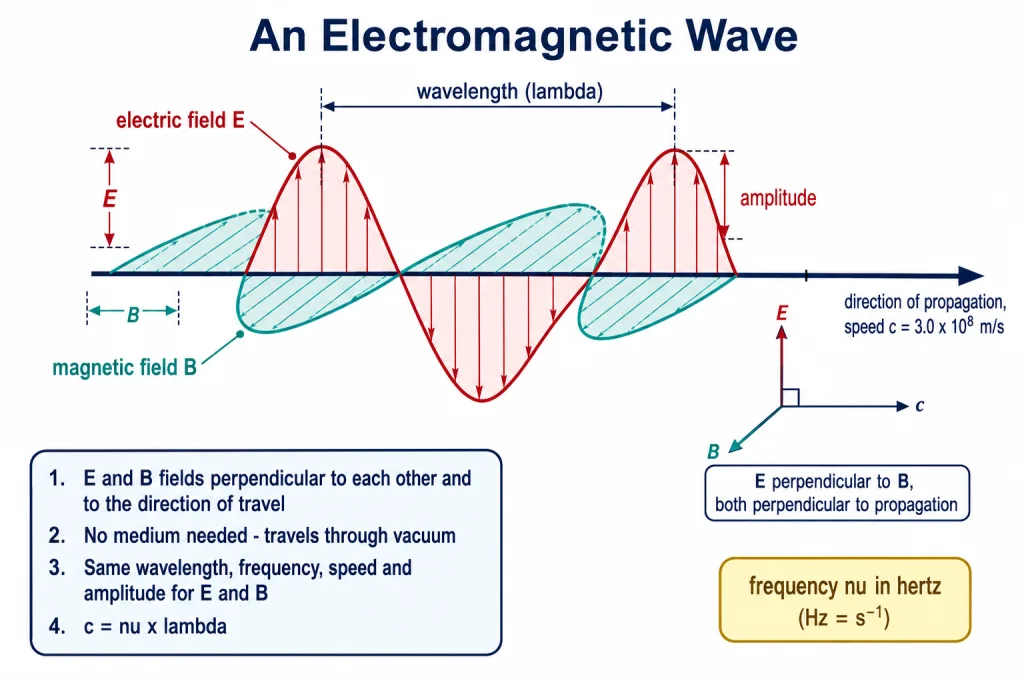
When an electrically charged particle moves with acceleration, it produces alternating electric and magnetic fields, and these fields are transmitted outward in the form of waves. Those waves are electromagnetic waves or electromagnetic radiation. This was James Clerk Maxwell's insight (1870). It also showed that light itself is one of these waves, with an oscillating electric character and an oscillating magnetic character travelling together.
Shake a charge back and forth and you create a ripple in the electric field around it. A changing electric field creates a magnetic field and a changing magnetic field creates an electric field, so the ripple regenerates itself as it travels.
The four properties you must know
(i) The two fields are mutually perpendicular, and both are perpendicular to the direction of travel. In the figure the electric field () oscillates up and down, the magnetic field () in and out of the page, and the wave travels to the right. The two components share the same wavelength, frequency, speed and amplitude.
(ii) Electromagnetic waves need no medium. Sound needs air and a water wave needs water, but an electromagnetic wave carries its own fields through a perfect vacuum. That is how sunlight crosses 150 million kilometres of empty space.
(iii) There are many kinds of electromagnetic radiation, and they differ only in wavelength (or frequency). Together they make up the electromagnetic spectrum — radio, microwave, infrared, visible, ultraviolet, X-ray, gamma. The physics is the same throughout.
(iv) Different kinds of units are used to describe the radiation. Frequency in hertz, wavelength in metres, nanometres or ångströms, wavenumber in cm.
Key Point: An electromagnetic wave is a pair of oscillating electric and magnetic fields, perpendicular to each other and to the direction of propagation, that needs no medium and travels through vacuum at the speed of light. All electromagnetic radiations differ from one another only in wavelength or frequency.
A wave is transverse
The fields oscillate across the direction of travel, so an electromagnetic wave is a transverse wave, like a wave on a rope; sound is longitudinal. Being transverse is why light can be polarised and sound cannot.
[JEE Main] It is the oscillating (accelerating) charge that radiates. A charge at rest produces a static electric field, and a charge in uniform motion produces a steady magnetic field; neither radiates.
The speed of light
In vacuum every electromagnetic radiation, whatever its wavelength, travels at the same speed:
This is the speed of light, symbol . Radio waves, gamma rays and yellow light all move at exactly this speed in vacuum. In glass or water the speed is lower, and different wavelengths slow by different amounts, which is why a prism spreads white light into colours.
Use m s unless a question supplies a different value; the precise value changes answers only in the fourth significant figure.
Describing a Wave: Wavelength, Frequency, Amplitude and Speed
Any wave is described by a handful of quantities. Every problem in this section is these definitions plus one equation.
The vocabulary
| Quantity | Symbol | Meaning | SI unit |
|---|---|---|---|
| Wavelength | (lambda) | Distance between two successive crests (or two successive troughs) | metre (m) |
| Frequency | (nu) | Number of complete waves that pass a fixed point in one second | hertz (Hz), i.e. s |
| Time period | Time taken for one complete wave to pass a point; | second (s) | |
| Amplitude | Maximum displacement of the field from its zero value (height of a crest) | depends on the field | |
| Velocity | Distance travelled by the wave in one second | m s | |
| Wavenumber | (nu-bar) | Number of wavelengths per unit length; | m (cm in practice) |
Key Point (Definition): The SI unit of frequency is the hertz (Hz, equal to s), named after Heinrich Hertz. One hertz means one complete wave passing a given point per second.
Amplitude controls the intensity (brightness) of the radiation, not its colour: a brighter red lamp has larger-amplitude waves of the same wavelength. This matters for the photoelectric effect later.
Time period is the reciprocal of frequency. If 5 waves pass per second ( Hz), each takes s to pass.
The one equation:
In one second, waves pass a point and each wave is long, so the distance the wave front moves in one second is times :
Rearranged in the two forms you will actually use:
Since is fixed in vacuum, frequency and wavelength are inversely proportional: double the wavelength and the frequency halves. That settles every "arrange in increasing order" question.
Key Point: with m s. Put in metres and you get in hertz — no other unit pair works without conversion.
Smaller units of wavelength
Electromagnetic wavelengths run from kilometres (radio) to less than a picometre (gamma rays), so smaller units are used constantly.
| Unit | Symbol | In metres | Typical use |
|---|---|---|---|
| micrometre (micron) | m | m | infrared |
| nanometre | nm | m | visible, ultraviolet |
| ångström | Å | m | atomic sizes, X-rays, older spectroscopy |
| picometre | pm | m | gamma rays, orbit radii |
The conversions between them:
Yellow sodium light can be written as 580 nm, 5800 Å, m or cm — all the same wavelength.
Units of frequency
Frequency uses the ordinary SI prefixes: 1 kHz Hz, 1 MHz Hz, 1 GHz Hz. AM radio broadcasts in kHz, FM in MHz, ovens and phones in GHz. Given "1368 kHz", write s first.
[Exam Tip] Before touching , convert everything to metres and seconds. Most wrong answers here come from leaving in nm or in MHz, or from taking Å as m instead of m.
Wavenumber: The Spectroscopist's Favourite
The wavenumber, written (read "nu-bar"), is the number of wavelengths per unit length — how many complete waves fit into one metre, or one centimetre, of the beam.
Key Point (Definition): . Wavenumber has units that are the reciprocal of the wavelength unit: the SI unit is m, but the unit used in practice is cm (not an SI unit).
Why chemists use it
Frequency decides the energy of a photon (Section 4), but light frequencies are around or Hz, awkward to write. Wavenumber is directly proportional to frequency () and gives friendlier numbers: visible light lies between about 13,000 and 25,000 cm, and the whole hydrogen spectrum runs on one constant, 109,677 cm. Infrared spectroscopy reports every peak in cm.
The three quantities together
Because , frequency, wavelength and wavenumber are locked together:
| Given | To get | To get | To get |
|---|---|---|---|
| — | |||
| — | |||
| — | |||
In an ordering question, "increasing wavenumber" means the same as "increasing frequency" and the opposite of "increasing wavelength".
Converting m to cm
Since 1 m cm, a wavenumber in m is 100 times larger than the same wavenumber in cm:
Students routinely multiply instead of divide. A centimetre is shorter than a metre, so fewer waves fit into it and the cm number must be smaller.
Yellow light of wavelength 5800 Å:
Same light, two units, a factor of 100 between them.
[JEE Main] For visible and nearby light, . Check with 580 nm: cm, which is cm.
A note on the symbol
Do not confuse the three "nu"s: is frequency, is wavenumber, and (Latin vee) is the velocity of a particle, from Section 4 onward. In handwriting, put a clear bar over the wavenumber and keep the Greek curly.
The Electromagnetic Spectrum
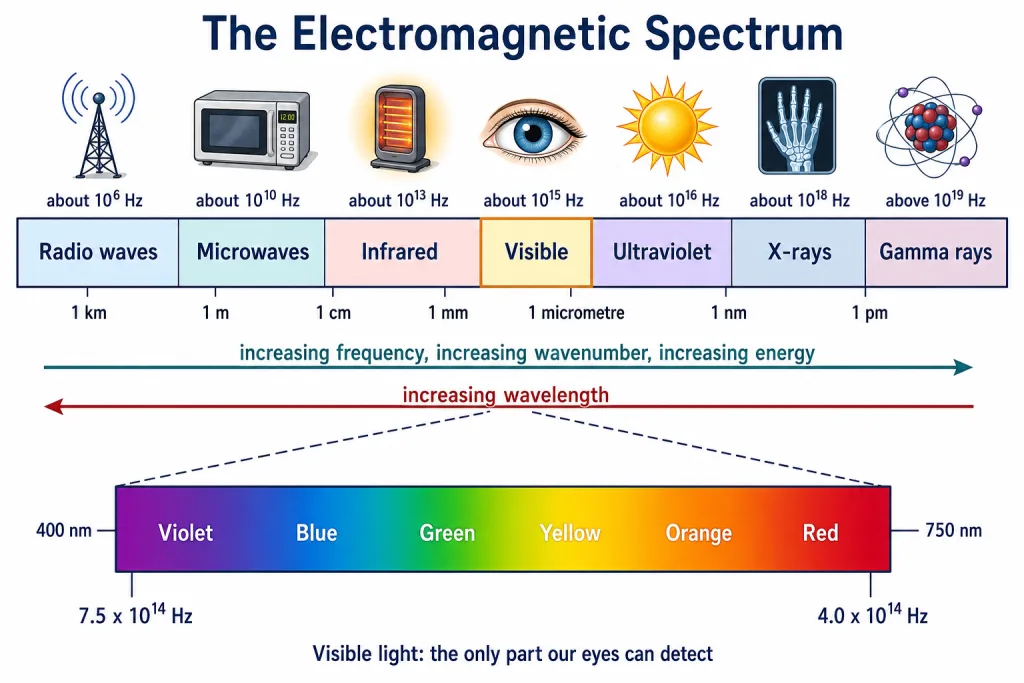
All electromagnetic radiations travel at and obey ; they differ only in wavelength and frequency. Laid out from longest wavelength to shortest, they form the electromagnetic spectrum. The boundaries between regions are conventions, but the order is fixed and you must know it in both directions.
The regions, with representative numbers
| Region | Typical frequency | Typical wavelength | Where you meet it |
|---|---|---|---|
| Radio waves | around Hz | metres to kilometres | AM/FM broadcasting, television |
| Microwaves | around Hz | mm to cm | radar, microwave ovens, mobile phones |
| Infrared (IR) | around Hz | m | heating, thermal imaging, IR spectroscopy |
| Visible | around Hz ( to Hz) | 400 nm to 750 nm | the only part our eyes detect |
| Ultraviolet (UV) | around Hz | 10 to 400 nm | a component of sunlight; sunburn |
| X-rays | around Hz | 0.01 to 10 nm | medical imaging, crystal structure |
| -rays | above Hz | below 0.01 nm (pm) | nuclear decay |
Cosmic rays from outer space are more energetic still and sit beyond gamma rays at the high-frequency end.
Memorise the powers of ten in the frequency column: radio , microwave , infrared , visible , ultraviolet .
Key Point: In order of increasing frequency (equivalently increasing wavenumber, and — as Section 4 shows — increasing energy per photon): Wavelength runs the opposite way: radio waves are the longest, gamma rays the shortest.
The visible window
The portion around Hz is visible light. Everything else needs an instrument: an antenna for radio, a thermal sensor for infrared, a detector for X-rays.
The visible range runs from violet at 400 nm to red at 750 nm. Converting with :
Visible light spans to Hz. Violet has the shortest wavelength and highest frequency; red the longest wavelength and lowest frequency. Inside the window the colours run in order:
| Colour | Approximate wavelength |
|---|---|
| Violet | 400 to 450 nm |
| Blue | 450 to 495 nm |
| Green | 495 to 570 nm |
| Yellow | 570 to 590 nm |
| Orange | 590 to 620 nm |
| Red | 620 to 750 nm |
VIBGYOR lists them from violet to red, short to long wavelength. Yellow sodium light at 580 nm and the neon line at 616 nm sit inside this window; a hydrogen line at 1285 nm is infrared and invisible.
Just beyond the window
Just shorter than violet is the ultraviolet, part of the Sun's radiation and the cause of sunburn. Just longer than red is the infrared, felt as heat from a fire. The visible band is a sliver in a spectrum spanning more than twenty powers of ten.
[NEET] Ordering questions usually mix one item from each region. Slot each into its region and read the order off the spectrum. Amber is visible (orange-yellow, roughly 590 nm), so it sits between infrared and ultraviolet.
[JEE Main] When wavelengths come in mixed units, convert them all to one convenient unit (nm for visible and UV, m for radio) rather than to metres, then compare. Long wavelength always means low frequency.
Working the Numbers: A Method That Never Fails
Every calculation here has one shape: you are given one of (, , , ) and asked for the others.
The four-step routine
- Convert what is given to SI. Wavelength to metres (nm , Å , cm ); frequency to hertz (kHz , MHz , GHz ); period in seconds.
- Pick the right form of , or if a period is given.
- Do the powers of ten separately from the digits. For : , , so Hz.
- Convert to the unit asked for and check the order of magnitude. A visible frequency must land around to Hz; a radio wavelength in metres.
Order-of-magnitude anchors
| Radiation | |||
|---|---|---|---|
| AM radio (1 MHz) | 300 m | Hz | m |
| FM radio (100 MHz) | 3 m | Hz | 0.33 m |
| Microwave oven (2.45 GHz) | 12.2 cm | Hz | 8.2 m |
| Red light | 750 nm | Hz | cm |
| Yellow (Na) light | 580 nm | Hz | cm |
| Violet light | 400 nm | Hz | cm |
| X-rays | 0.1 nm (1 Å) | Hz | cm |
Distance and time from the speed of light
Since is a speed, two more problem types appear:
- Distance travelled in time : . Light travelling for 30 s covers m. Wavelength is irrelevant; every electromagnetic wave covers the same distance in the same time.
- Time to cover distance : . The Sun is m away, so sunlight takes s, about 8.3 minutes.
The mistakes that cost marks
| Mistake | Why it happens | Fix |
|---|---|---|
| wavelength left in nm | always convert to m first | |
| Treating 1 Å as m | confusing Å with nm | 1 Å m nm |
| in cm larger than in m | multiplying by 100 instead of dividing | fewer waves fit in a cm, so the number is smaller |
| "Red has higher frequency than violet" | remembering wavelengths, not frequencies | short means high : violet is high |
| Writing in s and in Hz | swapping the reciprocals | is per second (Hz), is seconds |
| Using with in m | mixing cgs and SI | m s or cm s, never mixed |
Key Point: Convert to SI, apply , separate digits from powers of ten, and check the answer against the spectrum.
[Exam Tip] With (two significant figures) answers are good to two or three figures. Quote Hz, not .
Solved Examples
Question 1: The wavelength of a radio station
The Vividh Bharati station of All India Radio, Delhi, broadcasts on a frequency of 1368 kHz. Calculate the wavelength of the electromagnetic radiation emitted by the transmitter. Which part of the electromagnetic spectrum does it belong to?
Answer:
First the frequency in SI units: . I want wavelength, so I use :
Digits and powers separately: and , so m. A few hundred metres, or a frequency near Hz, is the radio-wave region.
Ans: m; radio waves. Watch out: The s must cancel to leave metres. If it does not, a unit conversion was skipped.
Question 2: Frequencies at the two ends of the visible spectrum
The wavelength range of the visible spectrum extends from violet (400 nm) to red (750 nm). Express these wavelengths in frequencies (Hz). (1 nm m)
Answer:
Both wavelengths into metres: violet m, red m. For violet:
For red:
The visible band therefore runs from Hz (red) to Hz (violet).
Ans: Violet: Hz; red: Hz; visible range to Hz. Watch out: The longer wavelength (red) gives the lower frequency, not the higher one.
Question 3: Wavenumber and frequency of yellow light in ångström
Calculate (a) the wavenumber and (b) the frequency of yellow radiation having wavelength 5800 Å.
Answer:
The wavelength in both units I need: m cm.
(a) Wavenumber in m:
In cm:
Dividing the m value by 100 gives the same number.
(b) Frequency:
The other route agrees: Hz.
Ans: (a) m cm; (b) Hz. Watch out: The wavenumber unit is the reciprocal of whatever unit the wavelength is in. Put in cm if the answer is wanted in cm; the two values differ by exactly a factor of 100.
Question 4: The sodium lamp in nanometres
Yellow light emitted from a sodium lamp has a wavelength of 580 nm. Calculate the frequency and the wavenumber of the yellow light.
Answer:
In metres, m.
Dividing by 100 gives cm, and the shortcut cm matches. 580 nm and 5800 Å are the same wavelength, so the answers match Question 3.
Ans: Hz; m ( cm).
Question 5: From time period to everything else
Calculate the wavelength, frequency and wavenumber of a light wave whose period is s.
Answer:
The period gives the frequency:
Then the wavelength:
And the wavenumber:
5 GHz with a wavelength of 6 cm sits in the microwave region.
Ans: Hz; m (6.0 cm); m ( cm). Watch out: "Light wave" in a question just means electromagnetic wave. This one is not visible light, so check the region yourself before naming it.
Question 6: Arranging radiations by frequency
Arrange the following types of radiation in increasing order of frequency: (a) radiation from a microwave oven, (b) amber light from a traffic signal, (c) radiation from an FM radio, (d) cosmic rays from outer space, (e) X-rays.
Answer:
I place each item in its region first. FM radio: radio waves, around Hz. Microwave oven: microwaves, around Hz. Amber traffic light: visible (orange-yellow, roughly 590 nm), around Hz. X-rays: around Hz. Cosmic rays: beyond gamma rays, above Hz.
Frequency increases from radio towards gamma, so the order is FM radio microwave oven amber light X-rays cosmic rays. The same list in increasing wavelength is exactly reversed.
Ans: (c) < (a) < (b) < (e) < (d). Watch out: Decide first whether the question asks for increasing frequency or increasing wavelength — the two orders are opposites.
Question 7: A neon sign — frequency and distance travelled
Neon gas is generally used in sign boards. If it emits strongly at 616 nm, calculate (a) the frequency of the emission, and (b) the distance travelled by this radiation in 30 s.
Answer:
In metres, m.
(a) . Digits: ; powers: . So . That lies between and Hz, so it is visible, orange-red as a neon sign should be.
(b) Light travels at whatever its wavelength, so
Ans: (a) Hz; (b) m. Watch out: Part (b) needs only and . The wavelength does not enter it at all.
Question 8: Wavelength inside a microwave oven
A domestic microwave oven operates at a frequency of 2450 MHz. Calculate the wavelength of the radiation in (a) metres and (b) centimetres, and state its wavenumber in m.
Answer:
In hertz, .
(a) m.
(b) In centimetres, cm. Wavenumber:
12 cm at Hz is squarely microwave.
Ans: (a) m; (b) 12.2 cm; m. Watch out: Microwave wavelengths are centimetre-sized. The oven door mesh has holes a few millimetres across, far smaller than 12 cm, so the radiation cannot escape while visible light (500 nm) passes through.
Question 9: An FM station and a mobile-phone band
(i) An FM radio station broadcasts at 100 MHz. What is the wavelength? (ii) A mobile-phone signal has a wavelength of 15 cm. What is its frequency in GHz? (iii) Which of the two has the greater wavenumber?
Answer:
(i) s, so m.
(ii) 15 cm is 0.15 m, so GHz.
(iii) FM: m. Phone: m. The phone signal has the shorter wavelength, so the greater wavenumber.
Ans: (i) 3.0 m; (ii) 2.0 GHz; (iii) the mobile-phone signal. Watch out: Wavenumber always ranks the same way as frequency, never the same way as wavelength. A useful anchor: 300 MHz is exactly 1 m, so 100 MHz is 3 m and 3 GHz is 10 cm.
Question 10: Same wavelength, four units
The strong red line of hydrogen (the first Balmer line) has a wavelength of 656.3 nm. Express this wavelength in (a) metres, (b) ångström, (c) centimetres and (d) picometres, and then find its wavenumber in cm.
Answer:
(a) m.
(b) 1 nm , so .
(c) cm.
(d) 1 nm pm, so pm.
Wavenumber, from the centimetre value:
The shortcut agrees: cm.
Ans: (a) m; (b) 6563 Å; (c) cm; (d) pm; cm. Watch out: Moving between nm, Å and pm shifts the decimal point by one place and by three places. This line reappears in Section 5 as the first line of the Balmer series.
Question 11: How long does sunlight take to reach us?
The average distance between the Sun and the Earth is m. (i) How long does light from the Sun take to reach the Earth? (ii) The Moon is m away; how long does moonlight take? (iii) Would ultraviolet radiation from the Sun arrive sooner or later than visible light?
Answer:
(i) Time is distance over speed:
That is min, about 8 minutes 20 seconds.
(ii) For the Moon, s.
(iii) Same time. In vacuum all electromagnetic radiations travel at whatever their wavelength, so ultraviolet and visible light arrive together after 500 s.
Ans: (i) 500 s (about 8.3 min); (ii) 1.28 s; (iii) neither — they arrive together. Watch out: Speed in vacuum is independent of wavelength. Only in a medium do different wavelengths travel at slightly different speeds.
Question 12: An X-ray and a gamma ray by the numbers
An X-ray used in a hospital has a wavelength of 0.50 Å and a gamma ray from cobalt-60 has a frequency of Hz. Find (i) the frequency of the X-ray, (ii) the wavelength of the gamma ray in picometres, and (iii) the ratio of their wavenumbers.
Answer:
(i) m, so
(ii) pm.
(iii) X-ray m; gamma m. The ratio gamma : X-ray is . Since , the frequencies give it directly: .
Ans: (i) Hz; (ii) 1.07 pm; (iii) about 47 : 1 (gamma : X-ray). Watch out: Ratios of wavenumbers equal ratios of frequencies, so skip the wavelengths whenever only a ratio is wanted.