
From Wave Function to Picture: Plotting and
An orbital is a one-electron wave function . But itself has no physical meaning — it is only a mathematical function of the electron's coordinates. What carries meaning is , the probability density, the probability of finding the electron per unit volume at a point. The "shape" of an orbital is a map of where is large.
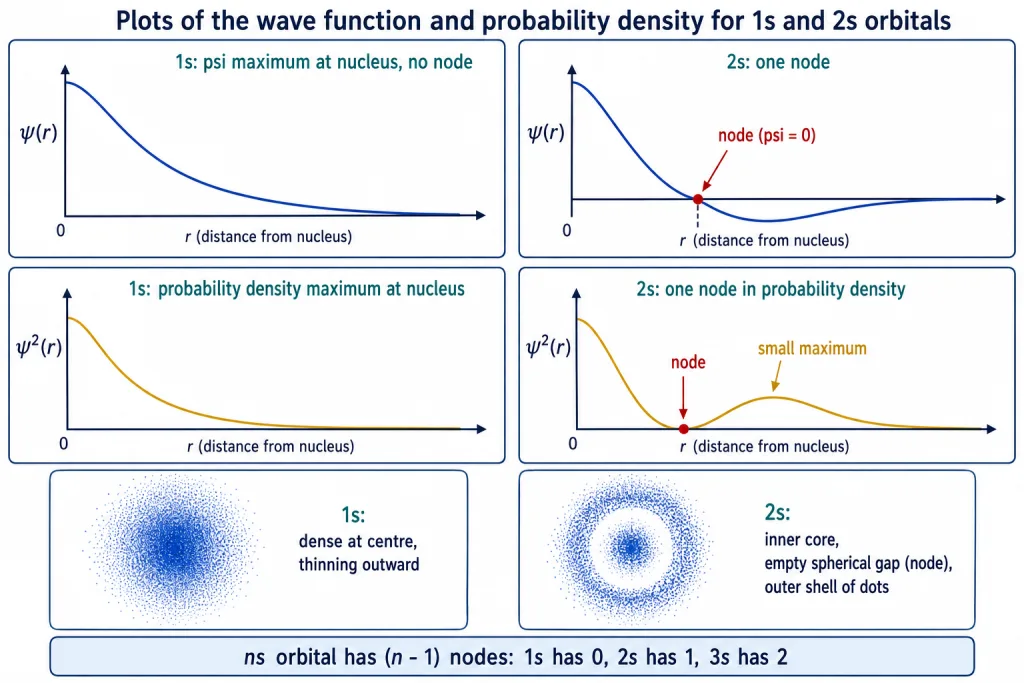
Plotting against (distance from the nucleus) still helps, because it shows where the wave function changes sign and where it vanishes. Compare the two simplest orbitals, 1s (, ) and 2s (, ).
The 1s orbital
- is largest at the nucleus () and falls off quickly as increases. It never crosses zero; it only decays towards zero as .
- is therefore also maximum at the nucleus and decreases sharply outward.
The 2s orbital
- starts positive at the nucleus, drops, passes through zero at a certain distance, becomes negative, reaches a small negative minimum, then creeps back to zero at large .
- is large at the nucleus, falls to zero, rises again to a small second maximum, and finally decays.
Key Point (Definition): The region (surface) where the probability density reduces to zero is called a nodal surface, or simply a node. The electron is never found on a node.
Nodes in an s orbital
From the plots: 1s has none, 2s has one. The pattern continues — 3s has two, 4s has three.
Every extra shell adds one more spherical shell of forbidden space inside the orbital.
Key Point: For an orbital, nodes : zero for 1s, one for 2s, two for 3s, and so on. The nodes of s orbitals are spherical surfaces (radial nodes), because depends on alone.
Charge-cloud (dot) diagrams
A charge-cloud diagram shows the same information as dots sprinkled in space, with the density of dots in a region representing the electron probability density there. For 1s this gives a fuzzy ball, thickest at the centre. For 2s it gives a dense inner core, an empty spherical gap (the node), then a thinner outer shell of dots.
[Board] A two-mark question asks for the plots of and versus for 1s and 2s with the node marked. Draw crossing the axis once into negative values, and touching zero without going below the axis — a squared quantity cannot be negative.
For hydrogen the 2s radial function is proportional to , so its node sits at pm.
Boundary Surface Diagrams and the s Orbitals
Dot diagrams are messy. What chemists actually draw are boundary surface diagrams.
What a boundary surface is
A boundary surface (or contour surface) is a surface in space on which the probability density has a constant value. Infinitely many such surfaces exist for one orbital — a tiny one near the nucleus where is large, bigger ones further out where it is smaller. Only one of them is drawn as "the shape of the orbital".
Key Point (Definition): The boundary surface diagram of an orbital is the surface of constant probability density that encloses a region in which the probability of finding the electron is very high — by convention about 90%.
If is constant on a surface, is constant there too, so the boundary surfaces drawn for and for are identical.
Why not the 100% surface
The probability density always has some value, however small, at any finite distance from the nucleus; it becomes zero only at . A surface enclosing 100% probability would have to be infinitely large, so a finite surface containing the electron with certainty does not exist. The 90% surface (95% in some books) is finite and still captures almost all of the probability.
Key Point: A boundary surface with 100% probability cannot be drawn because is non-zero at every finite . The 90% surface is a convention, not a physical wall — the electron spends about a tenth of its time outside it.
The s orbitals are spheres
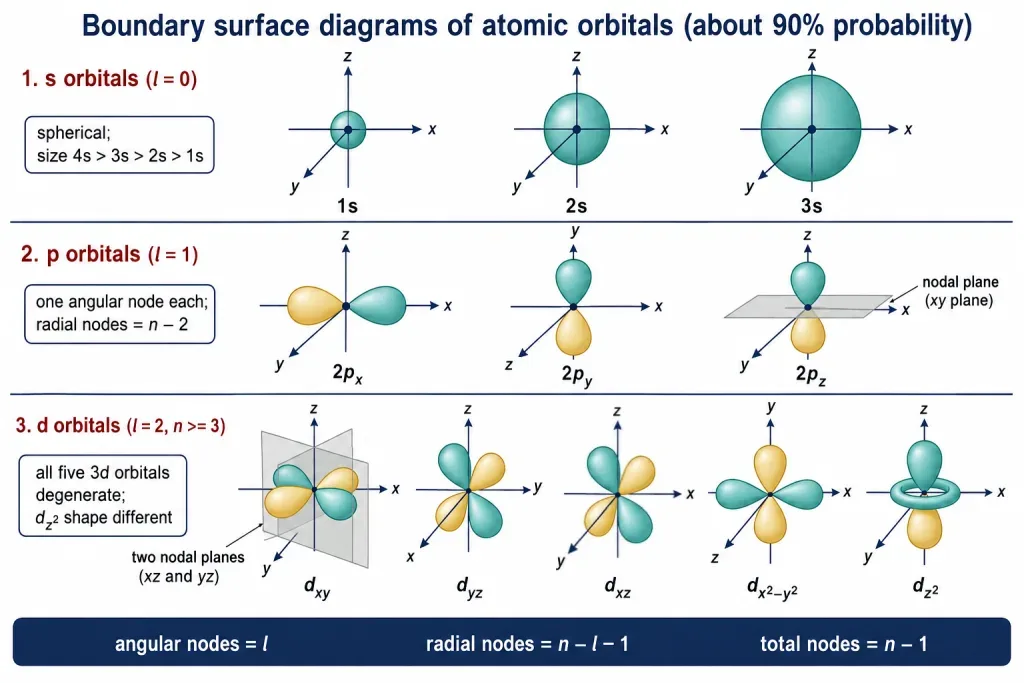
For an s orbital () the wave function depends on only, so the probability of finding the electron at a given distance is the same in every direction. The 90% boundary surface is a sphere centred on the nucleus — a circle in two dimensions. Every s orbital is spherically symmetric: 1s, 2s, 3s, all of them.
The 2s sphere is bigger than the 1s sphere, and the spherical node hides inside it (a boundary surface picture never shows nodes). As increases the electron is on average found further out, so
| Orbital | Shape of 90% surface | Nodes () | Relative size | |
|---|---|---|---|---|
| 1s | 1 | sphere | 0 | smallest |
| 2s | 2 | sphere (one spherical node inside) | 1 | larger |
| 3s | 3 | sphere (two spherical nodes inside) | 2 | larger still |
| 4s | 4 | sphere (three spherical nodes inside) | 3 | largest of these |
[NEET] Spherical symmetry belongs to every s orbital, not just 1s. Asked which of 2s, 2p, 3d, 4f is spherical, the answer is 2s. A 3s boundary diagram looks like a plain sphere even though two nodal spheres sit within it.
The p and d Orbitals
Once , the wave function depends on direction as well as distance, and the boundary surfaces stop being spheres.
p orbitals (): dumbbells
For there are three values of (), so three p orbitals in every shell from onward. Each has two lobes, one on either side of a plane through the nucleus. On that plane the probability density is zero — a nodal plane.
The three p orbitals of a shell have identical size, shape and energy and differ only in orientation. Their lobes can be taken to lie along the , or axis, so they are called , , — in the second shell, , , .
Key Point: There is no simple relation between the three values of () and the axes . Do not write " is ". Three values give three p orbitals with mutually perpendicular axes.
p orbitals grow in size and rise in energy with :
Their probability density also passes through zero at certain distances from the nucleus (besides and ). The number of these radial nodes is : none for 2p, one for 3p, two for 4p.
| Orbital | Lobes | Nodal plane | Radial nodes () |
|---|---|---|---|
| 2, along | plane | 0 | |
| 2, along | plane | 0 | |
| 2, along | plane | 0 | |
| 2, along (larger) | plane | 1 | |
| 2, along (larger still) | plane | 2 |
d orbitals (): five shapes, first appearing at
Since can be at most , needs : there is no 1d or 2d orbital. Five values () give five d orbitals per shell:
- , , : four lobes each, lying between the axes named in the subscript ( lobes point between the and axes, in the plane).
- : four lobes lying along the and axes.
- : two lobes along the axis plus a doughnut (torus) of density around the middle in the plane.
Key Point: The first four d orbitals are four-leaf clovers differing in orientation; looks different. All five 3d orbitals still have the same energy — they are degenerate. The 4d, 5d, … orbitals have similar shapes but larger size and higher energy.
Angular nodes
Besides radial nodes, p and d orbitals have nodal surfaces passing through the nucleus. These are angular nodes, and their number is .
- : one angular node, the plane. (For it is the plane; for the plane.)
- : two angular nodes — the and planes, both containing the axis, with the lobes in the quadrants between them.
- : two planes containing the axis at to the and axes.
- : two angular nodes as well, but conical surfaces, not planes — which is why has zero planar nodes yet angular nodes.
[JEE Main] For "number of nodal planes": ; each ; ; . For "number of angular nodes": . Read which is asked.
Counting Nodes: Radial, Angular and Total
Everything about nodes fits into three formulas.
Key Point:
- Angular nodes (planes or cones through the nucleus)
- Radial nodes (spherical surfaces at particular distances)
- Total nodes
They agree with the earlier rules. For , , so radial nodes and angular nodes . For , , so radial nodes and there is one angular node, the plane between the lobes.
The master table
| Orbital | Radial nodes | Angular nodes | Total nodes | ||
|---|---|---|---|---|---|
| 1s | 1 | 0 | 0 | 0 | 0 |
| 2s | 2 | 0 | 1 | 0 | 1 |
| 2p | 2 | 1 | 0 | 1 | 1 |
| 3s | 3 | 0 | 2 | 0 | 2 |
| 3p | 3 | 1 | 1 | 1 | 2 |
| 3d | 3 | 2 | 0 | 2 | 2 |
| 4s | 4 | 0 | 3 | 0 | 3 |
| 4p | 4 | 1 | 2 | 1 | 3 |
| 4d | 4 | 2 | 1 | 2 | 3 |
| 4f | 4 | 3 | 0 | 3 | 3 |
| 5s | 5 | 0 | 4 | 0 | 4 |
| 5d | 5 | 2 | 2 | 2 | 4 |
Two patterns come out of the table:
- Every orbital in a shell has the same total number of nodes, . All shell-4 orbitals have three nodes; they only split them differently between radial and angular.
- The first orbital of each type (1s, 2p, 3d, 4f) has zero radial nodes — all of its nodes are angular. So 3d has two angular nodes and no radial one, and 4f has three angular and none radial.
Working backwards from node counts
The formulas run in reverse: = angular nodes and = total nodes .
- 2 radial + 1 angular: , total , — 4p.
- 0 radial + 2 angular: , total , — 3d.
- 3 radial + 0 angular: , — 4s.
- 1 radial + 3 angular: , — 5f.
[JEE Main] "An orbital with 2 nodes" is not unique — 3s, 3p and 3d all have 2 total nodes. Both counts (or the total plus ) are needed to pin the orbital down. and are never counted as nodes.
Energies of Orbitals: Hydrogen versus Everything Else
The next question after shape is energy — which orbital lies lower than which — because that decides how electrons fill an atom.
Hydrogen: energy depends on alone
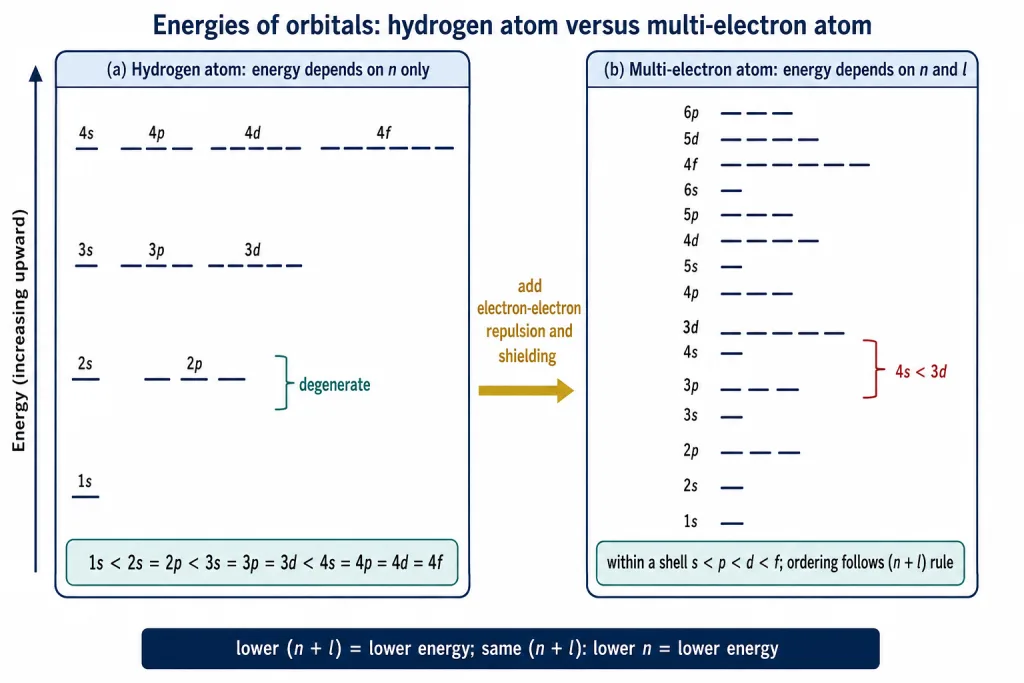
In hydrogen, or any one-electron species such as and , the electron's energy is fixed solely by the principal quantum number . The formula J contains no . So the orbital energies run:
The 2s and 2p orbitals have quite different shapes, yet the electron has the same energy in either. Orbitals of equal energy are called degenerate: 2s and 2p (4 orbitals), 3s, 3p and 3d (9 orbitals), and in general all orbitals of shell .
Key Point (Definition): Orbitals having the same energy are called degenerate orbitals. In hydrogen every orbital of a given is degenerate with every other orbital of that .
The 1s orbital of hydrogen is the ground state, where the electron is most strongly held. An electron in 2s, 2p or higher is in an excited state.
Multi-electron atoms: energy depends on and
Add a second electron and the degeneracy breaks. Energy now depends on both (the shell) and (the subshell), and within a shell the subshells split as
For higher shells the splitting is large enough that subshells of different shells overtake each other:
Electron-electron repulsion and shielding
Hydrogen has only the attraction between electron and nucleus. A multi-electron atom also has repulsions between every pair of electrons, which shift the energies, and shift them differently for different subshells.
The important repulsion is between an outer-shell electron and the inner-shell electrons. Inner electrons sit between the outer electron and the nucleus and partly cancel the nuclear charge, so the outer electron does not feel the full charge .
Key Point (Definition): The partial cancellation of the nuclear charge by inner-shell electrons is called shielding (or screening). The net positive charge actually experienced by an outer electron is the effective nuclear charge, , with .
Even with shielding, the attraction felt by an outer electron increases with nuclear charge, so the energy of a given orbital becomes more negative as increases:
Why : penetration
Attraction and repulsion both depend on the shape of the orbital. An s electron, spherical and with a small inner maximum of close to the nucleus, spends more time near the nucleus than a p electron of the same shell; the p electron more than a d electron. The s orbital penetrates more:
More penetration means less shielding and a larger . For a given shell, decreases as increases, so the s electron is most tightly bound, then p, then d, then f — the energy order . The argument runs outward too: s electrons shield outer electrons better than p, which shield better than d.
Key Point: Different shielding for different splits the energy levels within a shell. In multi-electron atoms orbital energy depends on and ; in hydrogen, with nothing to shield, on only.
[JEE Main] 2s and 2p are degenerate in H but not in Li because H has no inter-electronic repulsion or shielding. A 3s electron is lower than 3p because 3s penetrates closer, is shielded less and feels a higher .
The (n + l) Rule and the Energy-Ordering Table
The exact dependence of orbital energy on and in a multi-electron atom is mathematically complicated, but one simple rule reproduces the order in almost every case: the (n + l) rule, also called the Bohr-Bury rule or Madelung rule.
Key Point ((n + l) rule):
- The lower the value of for an orbital, the lower its energy.
- If two orbitals have the same , the one with the lower has the lower energy.
The full ordering
| Orbital | Position | Orbital | Position | ||||||
|---|---|---|---|---|---|---|---|---|---|
| 1s | 1 | 0 | 1 | 1 | 5s | 5 | 0 | 5 | 9 |
| 2s | 2 | 0 | 2 | 2 | 4d | 4 | 2 | 6 | 10 |
| 2p | 2 | 1 | 3 | 3 | 5p | 5 | 1 | 6 | 11 |
| 3s | 3 | 0 | 3 | 4 | 6s | 6 | 0 | 6 | 12 |
| 3p | 3 | 1 | 4 | 5 | 4f | 4 | 3 | 7 | 13 |
| 4s | 4 | 0 | 4 | 6 | 5d | 5 | 2 | 7 | 14 |
| 3d | 3 | 2 | 5 | 7 | 6p | 6 | 1 | 7 | 15 |
| 4p | 4 | 1 | 5 | 8 | 7s | 7 | 0 | 7 | 16 |
| 5f | 5 | 3 | 8 | 17 | |||||
| 6d | 6 | 2 | 8 | 18 | |||||
| 7p | 7 | 1 | 8 | 19 |
As a single line, the order of increasing energy in a multi-electron atom is
The rule at work
- 4s versus 3d. : ; : . So 4s lies below 3d despite its higher shell number, and potassium and calcium fill 4s before 3d.
- 3d versus 4p. Both give 5; the tie goes to lower , so 3d is below 4p.
- 4f, 5d, 6p, 7s. All give 7, so they order by : , which reproduces .
- 6s versus 5d. : 6; : 7. So .
The equal- groups are worth memorising: gives ; gives ; gives ; gives . Within each group, increasing is increasing energy.
Two cautions
- The rule is for multi-electron atoms. For hydrogen it fails: there lies below , because only matters.
- It gives the order in which orbitals are filled in a neutral atom being built up, not a law of nature. Once 3d is occupied (Sc onward), 3d dips below 4s, which is why 4s electrons are lost first in forming .
Section checklist
| If the question says | Think |
|---|---|
| "plot of / vs for 2s" | one node; crosses zero, touches zero |
| "boundary surface" | constant , encloses ~90%, 100% impossible |
| "shape of s / p / d" | sphere / dumbbell with one nodal plane / four-lobed (except ) |
| "radial / angular / total nodes" | / / |
| "degenerate in hydrogen" | same (energy depends on only) |
| "order of energy in multi-electron atom" | rule, tie-break by lower |
| " / shielding / penetration" | ; larger , more negative energy |
Solved Examples
Question 1: Node counts for 3p, 4d and 5s
For each of the orbitals 3p, 4d and 5s, find the number of radial nodes, angular nodes and total nodes.
Answer:
I use angular nodes , radial nodes , total .
3p: , . Radial , angular , total . The radial node is a sphere, the angular node the plane between the lobes.
4d: , . Radial , angular , total .
5s: , . Radial , angular , total , all spherical.
Each total equals : 2, 3, 4.
Ans: 3p: 1 radial, 1 angular, 2 total. 4d: 1 radial, 2 angular, 3 total. 5s: 4 radial, 0 angular, 4 total.
Question 2: 3d and 4f, then identifying orbitals from their nodes
(a) Count the radial, angular and total nodes of 3d and 4f. (b) Identify the orbital that has (i) 2 radial and 1 angular node, (ii) 0 radial and 2 angular nodes, (iii) 3 radial nodes and no nodal plane, (iv) 1 radial and 3 angular nodes.
Answer:
3d: , , so radial , angular , total .
4f: , , so radial , angular , total . Like 1s, 2p and 3d, the first orbital of its type has no radial node.
For (b) I run the formulas backwards: = angular nodes, = radial angular .
(i) , : 4p. (ii) , : 3d. (iii) No nodal plane means , so : 4s. (iv) , : 5f.
Ans: 3d: 0, 2, 2. 4f: 0, 3, 3. (i) 4p (ii) 3d (iii) 4s (iv) 5f. Watch out: Both counts are needed to fix the orbital. The total alone is not enough — 3s, 3p and 3d all have 2 nodes.
Question 3: Reading the 1s and 2s plots
Explain, with reference to the plots of against , (a) why the 1s probability density is maximum at the nucleus while the 2s density has a second small maximum, and (b) why the 2s orbital is said to have one node but the 1s none.
Answer:
decays with and never changes sign, so its square is largest at and falls off steadily.
starts positive, decreases through zero, becomes negative and returns to zero at large . Squaring removes the sign but keeps the zero, so falls to exactly zero, rises to a small second maximum from the negative part of , then decays.
The distance where is a spherical surface on which the electron is never found — a radial node. The 1s function never vanishes at finite , so it has no node. This matches nodes for an orbital: and .
Ans: 1s: maximum at the nucleus, no node. 2s: falls to zero at one radial node, then rises to a small second maximum; one node. Watch out: can never go negative. A sketch of dipping below the axis is wrong.
Question 4: Why 90% and not 100%
A boundary surface diagram is said to enclose a region where the probability of finding the electron is about 90%. Explain why we cannot draw a diagram that encloses 100% probability, and why every s orbital comes out spherical.
Answer:
What is drawn is a surface of constant , chosen so the volume inside holds about 90% of the probability.
decays with but is never exactly zero at any finite distance; it reaches zero only as . Enclosing all of the probability would need an infinitely large surface, so a finite 100% boundary is impossible.
For the wave function depends only on , so the probability at a given distance is the same in all directions and the constant- surface is a sphere centred on the nucleus. Larger pushes the probability outward, so the sphere grows: .
Ans: 100% is impossible because is non-zero at every finite ; s orbitals are spherical because depends on alone.
Question 5: Same orbitals, two different atoms
Arrange the orbitals 3s, 3p, 3d and 4s in order of increasing energy (a) in a hydrogen atom, (b) in a multi-electron atom such as potassium. Explain the difference.
Answer:
In hydrogen the energy depends on alone, so all orbitals are degenerate and lie below : .
In a multi-electron atom energy depends on and , so I use . : 3; : 4; : 4; : 5. The / tie goes to lower . Order: .
The difference comes from repulsion. Hydrogen has only electron-nucleus attraction, so subshells share one energy. In potassium the outer electron is repelled and shielded by inner electrons; s penetrates most and is shielded least, giving , with 3d pushed above 4s.
Ans: (a) ; (b) . Watch out: The same four orbitals give two different answers. Check first whether the atom is hydrogen (or a one-electron ion) or a multi-electron atom.
Question 6: Six electrons, six sets of quantum numbers
The quantum numbers of six electrons are given below. Arrange them in order of increasing energy in a multi-electron atom, and list any combinations that have the same energy.
- , , ,
- , , ,
- , , ,
- , , ,
- , , ,
- , , ,
Answer:
First I name each subshell from and : (1) 4d, (2) 3d, (3) 4p, (4) 3d, (5) 3p, (6) 4p. Energy here depends only on and , so and do not affect the ranking.
Now : 4d: 6; 3d: 5; 4p: 5; 3d: 5; 3p: 4; 4p: 5.
3p is lowest at 4, so electron 5 comes first. In the group with 5, 3d and 4p tie and lower wins, so 3d (electrons 2 and 4) sits below 4p (electrons 3 and 6). 4d at 6 is highest — electron 1.
Ans: , i.e. . Electrons 2 and 4 are degenerate (3d), as are 3 and 6 (4p). Watch out: and are decoys in an energy-ordering question. Strip each set down to its subshell label.
Question 7: Ordering with the (n + l) rule
Arrange the following orbitals in order of increasing energy in a multi-electron atom: 5p, 4f, 6s, 4d, 5d, 6p, 7s. Identify which of them are filled before 4f.
Answer:
for each: 5p: ; 4f: ; 6s: ; 4d: ; 5d: ; 6p: ; 7s: .
That gives two groups — value 6: ; value 7: .
Within each group lower comes first, so and . End to end: . Everything before 4f is 4d, 5p and 6s.
Ans: ; 4d, 5p and 6s are filled before 4f. Watch out: The result contains both and — sorting by alone would miss these.
Question 8: Lowest in bromine
The bromine atom has 35 electrons: 6 in the 2p subshell, 6 in 3p and 5 in 4p. Which of these electrons experiences the lowest effective nuclear charge?
Answer:
All three are p electrons, so the comparison is about distance from the nucleus and how many electrons lie in between.
The 2p electrons are shielded only by the two 1s electrons, and partly by their own 2s pair, while sitting close to the 35+ nucleus: large . The 3p electrons are shielded by all ten electrons plus 3s: smaller. The 4p electrons are outermost, shielded by the 28 electrons of shells 1, 2 and 3 plus the 4s pair, so they feel the smallest net attraction.
So .
Ans: The 4p electrons experience the lowest effective nuclear charge.
Question 9: Which orbital feels the larger
In each pair, state which orbital's electron experiences the larger effective nuclear charge: (i) 2s and 3s, (ii) 4d and 4f, (iii) 3d and 3p.
Answer:
(i) Same , different . The 2s electron lies closer to the nucleus with fewer electrons shielding it, so 2s feels the larger .
(ii) Same shell, different . Penetration falls as rises (), so the d electron gets closer and is shielded less. 4d wins.
(iii) Same shell, and p penetrates more than d, so 3p feels the larger .
As a check, larger means lower energy, and the ordering does give , and .
Ans: (i) 2s (ii) 4d (iii) 3p. Watch out: Two rules cover every such pair: for the same , lower wins; for the same , lower wins.
Question 10: Aluminium versus silicon
The unpaired electrons in Al () and Si () are present in 3p orbitals. Which electrons will experience more effective nuclear charge?
Answer:
The configurations are Al: and Si: .
In both atoms the 3p electron is shielded by the same ten inner electrons () and the pair, and electrons in the same 3p subshell shield one another only weakly. The shielding is essentially identical.
The nuclear charge is not. Silicon carries 14 units of positive charge against aluminium's 13, and that extra proton raises the net attraction. So for Si's 3p electrons is greater and they are more tightly bound, which is why silicon's first ionisation enthalpy is higher.
Ans: The 3p electrons of silicon experience the greater effective nuclear charge. Watch out: Across a period the shielding barely changes while climbs by one each step, so rises steadily from left to right.
Question 11: The 2s orbital in H, Li, Na and K
Arrange the 2s orbitals of H, Li, Na and K in order of increasing energy, and explain the trend. In which of these atoms is the 2s orbital degenerate with 2p?
Answer:
The energy of a given orbital becomes more negative as the atomic number increases, because the electron feels a larger .
The atomic numbers are H (1), Li (3), Na (11), K (19). A 2s electron is shielded only by the two 1s electrons in each case, and in H there is nothing to shield at all, so climbs steeply with . That gives .
Only hydrogen has a single electron, so only there does the energy depend on alone. 2s and 2p are degenerate in H and in none of the others.
Ans: Increasing energy: . 2s and 2p are degenerate only in hydrogen. Watch out: Two ideas run in opposite directions here: between atoms, more means lower orbital energy; within an atom, more means higher orbital energy.
Question 12: Nodal planes of specific orbitals
State the nodal plane(s) of , , and , and the number of planar nodes in . Then give the total number of nodes in each.
Answer:
has lobes along , so its nodal plane is the plane. Total nodes , since radial .
has the plane as its nodal plane. Total : one angular plus one radial ().
has lobes between the and axes, so the density vanishes on the and planes. Total , both angular; radial .
has lobes along and , so its two nodal planes contain the axis and bisect the axes: and . Total , both angular.
has zero planar nodes; its two angular nodes are conical surfaces around the axis. Total is still .
Ans: : plane (1 node). : plane (2 nodes: 1 angular + 1 radial). : and planes (2 nodes). : the planes (2 nodes). : 0 nodal planes, 2 conical angular nodes (2 nodes). Watch out: The nodal plane of is the plane not containing the axis . For the nodal planes are coordinate planes; for they are the diagonal ones.