
From "Uncuttable" to Divisible — Why the Atom Had to Be Opened Up
Around 400 B.C. Greek philosophers, and Indian thinkers of the same period, argued that cutting matter into smaller and smaller pieces must end at something that cannot be cut further. The Greek for "uncuttable" is a-tomio, which is where the word atom comes from. Nobody could test the idea, and it lay dormant for more than two thousand years.
It returned on a scientific footing in 1808, when John Dalton, a British school teacher, proposed his atomic theory. Dalton's atom was the ultimate particle of matter: hard, indivisible, indestructible. It explained the law of conservation of mass, the law of constant composition and the law of multiple proportions.
The crack in Dalton's atom
A theory that says atoms are indivisible cannot explain why matter ever carries an electric charge. Rubbing a glass rod with silk, or an ebonite rod with fur, charges the rod — a fact known in Dalton's own time.
Key Point: Dalton's atomic theory explained the laws of chemical combination but could not explain electrical phenomena such as the charging of glass or ebonite on rubbing. Explaining charge requires the atom to have charged parts, so it must be divisible.
One rule to carry through this section
Nearly every experiment ahead involves charged particles in electric or magnetic fields, and all of them are read with one rule:
Key Point: Like charges repel each other; unlike charges attract each other. A negatively charged particle is pulled towards a positive plate and pushed away from a negative plate. A positively charged particle does the opposite.
This is how Thomson knew cathode rays were negative, and how we know canal rays are positive.
Faraday (1830): electricity comes in particles
The first hint that electricity is made of particles came from chemistry. In 1830 Michael Faraday passed current through solutions of electrolytes and found matter liberated or deposited at the electrodes in amounts strictly fixed by how much electricity had flowed. These are Faraday's laws of electrolysis.
If a definite quantity of electricity always deposits a definite quantity of matter, electricity is not a continuous fluid — it comes in fixed packets attached to atoms. This is the particulate nature of electricity.
| Year | Person | What was shown | Why it mattered |
|---|---|---|---|
| ~400 B.C. | Greek and Indian philosophers | Matter is made of "uncuttable" atoms | Idea only; no experiment |
| 1808 | John Dalton | Atoms as indivisible ultimate particles | Explained laws of chemical combination |
| 1830 | Michael Faraday | Electrolysis: fixed electricity liberates fixed matter | Electricity is particulate |
| mid-1850s onwards | Faraday and others | Electrical discharge in partially evacuated tubes | The road to the electron |
From the mid-1850s many scientists, Faraday among them, studied electricity forced through gases in partially evacuated glass tubes. Those cathode ray discharge tubes are where the modern picture of the atom begins.
[Board] "Why did Dalton's atomic theory fail?" — it could not explain the electrical charging of substances such as glass and ebonite on rubbing, nor the later discovery of sub-atomic particles.
The Cathode Ray Discharge Tube
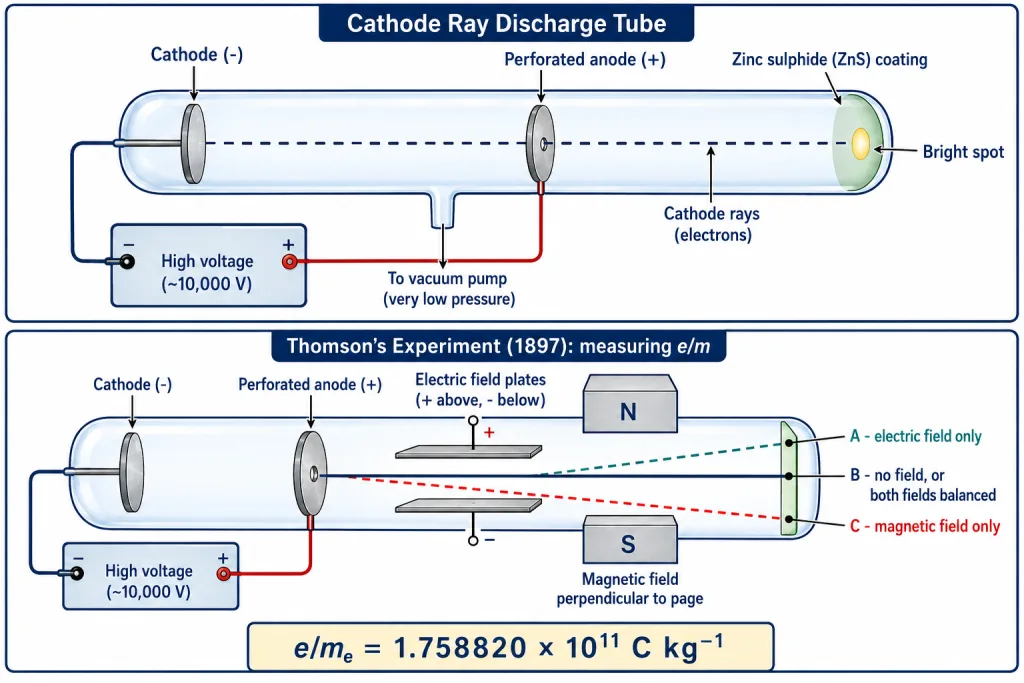
A cathode ray tube is a sealed glass tube containing two thin metal plates called electrodes. The plate joined to the negative terminal of a high-voltage source is the cathode; the one joined to the positive terminal is the anode. A side tube lets gas be pumped out to lower the pressure inside.
Two conditions are essential:
- Very low pressure. At ordinary pressure the gas insulates and nothing happens. Only when most of the gas is evacuated, typically to about 0.01 mm of mercury, do the few remaining particles allow a discharge.
- Very high voltage. About 10,000 volts across the electrodes.
Current then flows through the tube as a stream of particles moving from the cathode to the anode. These were named cathode rays, after the electrode they come from.
The perforated anode and the zinc sulphide glow
To show that something really travels from cathode to anode, a hole is made in the anode and the glass wall behind it is coated with a phosphorescent material, zinc sulphide (ZnS). Particles streaming towards the anode shoot through the hole and strike the coating, and a bright spot appears there.
Key Point: Cathode rays are invisible. We detect them only by what they do — a fluorescent or phosphorescent coating such as ZnS glows where they strike. Old television picture tubes worked this way.
The five properties of cathode rays
Different tubes, gases and electrodes all give the same results. Learn these five as a set.
| No. | Property | What it tells us |
|---|---|---|
| (i) | Cathode rays start from the cathode and move towards the anode. | They carry current through the tube. |
| (ii) | The rays are not visible; their behaviour is observed with fluorescent or phosphorescent materials that glow when hit. | Detection needs a screen (ZnS, TV phosphors). |
| (iii) | In the absence of electric or magnetic fields they travel in straight lines. | They behave like a beam of particles with momentum, not a diffuse discharge. |
| (iv) | In an electric or magnetic field they are deflected exactly as negatively charged particles would be — towards the positive plate. | Cathode rays are streams of negatively charged particles, later named electrons. |
| (v) | Their characteristics do not depend on the material of the electrodes or the nature of the gas in the tube. | The same particle comes out whatever atom you start with, so electrons are a basic constituent of all atoms. |
Property (v) is the one that changes chemistry. Iron electrodes or copper, hydrogen gas or neon — the cathode rays are identical. That can only happen if every atom of every element contains the same negatively charged particle. Dalton's uncuttable atom had just been cut.
Why "rays" and not "particles"
The name is historical. Early experimenters saw a glow travelling in straight lines like a beam of light and called it a "ray". J.J. Thomson later showed it is a stream of particles with a definite charge-to-mass ratio, but the name stuck.
[NEET] "The nature of cathode rays is independent of the gas in the tube" is the property proving the electron is universal. Canal rays are the contrast: their nature does depend on the gas.
[Board] To label the tube in a diagram: the cathode (negative), the anode (positive, with a hole), the side tube to the vacuum pump, the high-voltage supply, and the ZnS-coated glass behind the anode carrying the bright spot. Five labels, full marks.
Thomson (1897): Weighing the Electron by Its Charge
By 1897 cathode rays were known to be negatively charged particles. The open question was how much charge and how much mass. J.J. Thomson could measure neither separately, but he could measure their ratio, the charge-to-mass ratio , using a cathode ray tube fitted with electric and magnetic fields.
The apparatus and the three points A, B, C
A narrow beam of cathode rays travelled along the axis of the tube towards a fluorescent screen at the far end. Two fields could be applied across its path:
- an electric field between a pair of parallel plates, and
- a magnetic field from an electromagnet,
arranged perpendicular to each other and to the path of the electrons.
| Fields applied | Where the beam strikes | Why |
|---|---|---|
| Neither field | Point B (the undeflected, straight-line position) | Property (iii): straight-line travel |
| Only the electric field | Point A | Negative particles are pulled towards the positive plate |
| Only the magnetic field | Point C | The magnetic force pushes them the opposite way from the electric force |
| Both fields, carefully balanced | Back to point B | Electric and magnetic forces cancel exactly |
The last row is the heart of the experiment. With the beam back at B, the electric and magnetic forces on each electron are equal and opposite. From the field strengths needed for that balance, and the deflection produced by either field alone, Thomson worked out .
The three factors that decide how much a particle deflects
- The charge on the particle. More charge means a stronger interaction with the field and a larger deflection.
- The mass of the particle. A lighter particle deflects more; a heavy one has more inertia.
- The strength of the field. Deflection increases with the plate voltage or the magnetic field strength.
The first two explain why the experiment yields a ratio: at fixed field, deflection is proportional to charge mass, so measuring it measures and not or alone.
Key Point: By measuring deflections against the electric and magnetic field strengths, Thomson obtained where is the mass of the electron in kilograms and is the magnitude of its charge in coulombs. The electron being negative, its charge is written .
Reading the number
coulombs per kilogram is enormous. Electrolysis had already given about C kg for a hydrogen ion, so Thomson's value was roughly 1800 times larger. Either the electron carried 1800 times the charge of a hydrogen ion, or it had about 1/1800 of its mass. Thomson guessed correctly: same charge, tiny mass. The electron was the first particle found lighter than the lightest atom.
[JEE Main] "Two particles of the same charge but masses and enter the same electric field at the same speed — compare their deflections." Deflection at fixed field and speed, so the lighter one deflects 4 times as much.
[NEET] Memorise C kg, and that it does not depend on the gas in the tube or the electrode material — the same universality as the cathode-ray properties above.
Millikan (1906-14): The Oil Drop Experiment and the Charge on One Electron
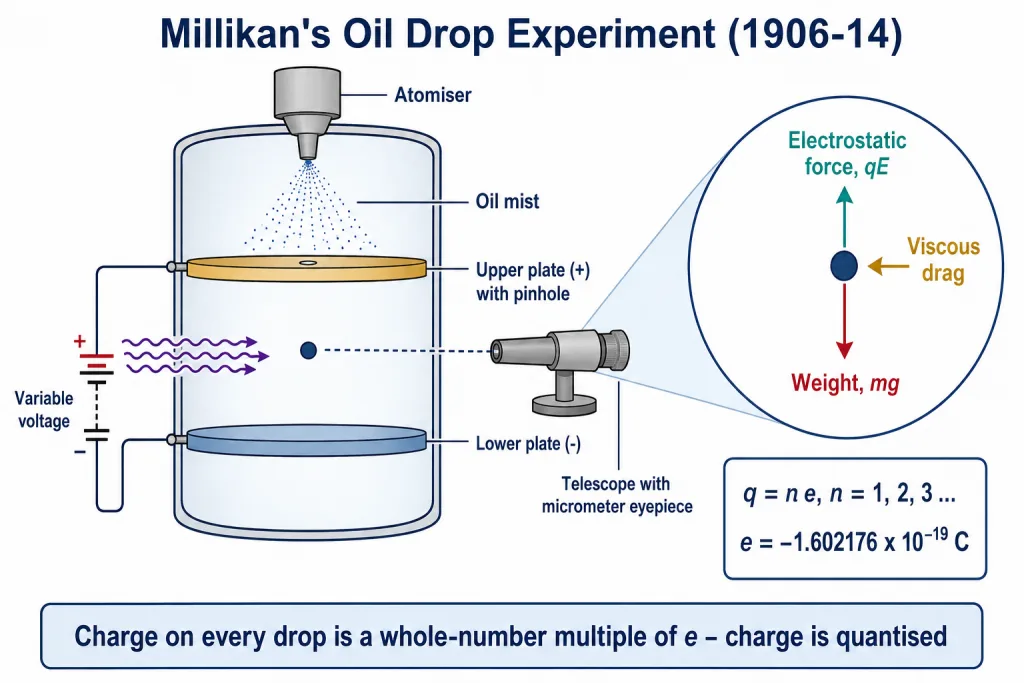
Thomson had the ratio; the charge itself was still missing. Between 1906 and 1914 the American physicist R.A. Millikan (1868-1953) measured the charge on a single electron directly with his oil drop experiment.
How it worked
- Make a mist. Oil is sprayed through an atomiser to give a fine mist of tiny droplets.
- Let one drop in. A few droplets fall through a tiny hole in the upper plate of an electrical condenser, a pair of horizontal metal plates that can be charged.
- Watch it fall. The fall is followed through a telescope fitted with a micrometer eyepiece. The rate of fall under gravity, against the viscous drag of air, gives the mass of the droplet.
- Charge the drop. A beam of X-rays ionises the air, and the droplets pick up charge by colliding with the gaseous ions.
- Switch on the field. A voltage is applied across the plates. Depending on the drop's charge and on the polarity and strength of the field, its fall can be retarded, accelerated, or brought to a standstill. A stationary drop means the upward electrical force balances its weight.
Three forces act on a drop: gravity downwards, the electrostatic force from the field, and a viscous drag whenever it moves. From how the field strength changed the motion of many droplets, Millikan computed the charge on each.
The result: charge is quantised
The charges on hundreds of droplets were not random. Every one was a whole-number multiple of the same smallest charge.
Key Point: The charge on any oil droplet is an integral multiple of a fundamental unit of charge : Millikan found C. The presently accepted value is
No droplet ever carried "half an electron". Charge comes in indivisible lumps, as Faraday's electrolysis had hinted eighty years earlier.
Mass of the electron
Thomson gave ; Millikan gave . Divide one by the other:
The arithmetic: , and , giving kg.
The electron therefore weighs about kg, roughly of a proton, or about 0.00054 u. Use kg for most work and 9.1094 when a question quotes four-figure constants.
The kind of question this leads to
Since , a measured charge gives the number of extra or missing electrons directly: . Two checks:
- Is a whole number? A charge of is impossible. Among C, C and C, the last cannot exist ().
- Sign tells the direction of transfer. Negative charge means excess electrons; an equal positive charge means the same number removed.
[Board] Millikan's oil drop experiment gives the charge on the electron; Thomson's gives the charge-to-mass ratio. Do not swap the two names.
Canal Rays, the Proton (1919) and Chadwick's Neutron (1932)
Atoms are neutral and contain negative electrons, so they must also contain something positive. A small modification to the discharge tube shows it.
Canal rays: the positive stream
When the cathode itself is perforated, a faint glow appears behind it, away from the anode. Something positive is travelling through the holes ("canals") in the cathode, opposite in direction to the cathode rays. These are canal rays, also called anode rays or positive rays, and they consist of positively charged particles. They form when the fast cathode-ray electrons knock electrons out of gas atoms, leaving positive ions that are pulled towards the cathode.
Learn their four properties beside those of cathode rays; the contrast is what gets tested.
| No. | Property of canal rays | Compare with cathode rays |
|---|---|---|
| (i) | The mass of the positive particles depends on the nature of the gas in the tube — they are simply the positively charged gaseous ions. | Cathode rays: independent of the gas. |
| (ii) | The charge-to-mass ratio also depends on the gas from which the particles originate. | Cathode rays: is the same for every gas. |
| (iii) | Some of the positive particles carry a multiple of the fundamental unit of charge (ions can lose more than one electron). | Cathode rays: every particle carries exactly . |
| (iv) | Their behaviour in electric or magnetic fields is opposite to that of cathode rays. | Cathode rays deflect towards the positive plate; canal rays towards the negative. |
Key Point: Canal rays are not a single universal particle. They are whatever positive ion the gas in the tube produces, which is why their mass and change from gas to gas.
The proton
If the positive particles are ionised gas atoms, the lightest one should come from the lightest gas — and the smallest, lightest positive ion was indeed obtained with hydrogen in the tube. This particle, a hydrogen atom stripped of its one electron, was named the proton and was characterised in 1919 by Rutherford. Its charge is C, equal and opposite to the electron's, and its mass is kg, about 1836 times that of the electron.
The neutron
Helium has two protons but an atomic mass of four. Almost every atom heavier than hydrogen weighs more than its protons alone account for, so a neutral particle of roughly proton mass was needed to make up the difference.
In 1932 James Chadwick found it. He bombarded a thin sheet of beryllium with -particles (helium nuclei from a radioactive source), and electrically neutral particles slightly heavier than the proton were emitted. Being neutral they are undeflected by electric and magnetic fields, which is why they had been so hard to detect. Chadwick named them neutrons. The nuclear change is
Mass numbers: . Atomic numbers: .
The table of fundamental particles
| Name | Symbol | Absolute charge / C | Relative charge | Mass / kg | Mass / u | Approx. mass / u |
|---|---|---|---|---|---|---|
| Electron | 0.00054 | 0 | ||||
| Proton | 1.00727 | 1 | ||||
| Neutron | 0 | 0 | 1.00867 | 1 |
Three points that keep coming back:
- Proton and electron charges are exactly equal in magnitude, so an atom with equal numbers of each is exactly neutral.
- The neutron is slightly heavier than the proton ( u against u), by about 0.14%.
- Mass ratio. . Electrons contribute practically nothing to mass; an atom's mass is essentially that of its protons and neutrons.
| Particle | Discovered / characterised | By | Key experiment |
|---|---|---|---|
| Electron | 1897 (); charge 1906-14 | J.J. Thomson; R.A. Millikan | Cathode rays in crossed fields; oil drop |
| Proton | 1919 | E. Rutherford | Canal rays from hydrogen |
| Neutron | 1932 | J. Chadwick | -bombardment of beryllium |
[NEET] Discovered last: the neutron (1932). Heaviest of the three: the neutron. Experiment that found it: bombardment of beryllium with -particles.
X-rays, Radioactivity and the Three Kinds of Rays
Two further kinds of radiation turned up in the closing years of the nineteenth century — one from the discharge tube itself, one from certain elements that needed no tube at all.
X-rays (Röntgen, 1895)
In 1895 Wilhelm Röntgen (1845-1923) found that when the electrons in a cathode ray tube strike a material, rays are produced that make fluorescent materials glow even outside the tube. Not knowing what they were, he called them X-rays.
| Property | Detail |
|---|---|
| Origin | Produced when fast electrons strike a dense metal anode (the target) |
| Charge | None — not deflected by electric or magnetic fields |
| Nature | Electromagnetic radiation (like light) of very short wavelength, about 0.1 nm |
| Penetrating power | Very high, which is why they are used to look inside objects, including bones |
The contrast with cathode rays is a classic trap: cathode rays are charged particles and are deflected by fields, while X-rays are uncharged radiation produced by cathode rays and are not deflected.
Radioactivity (Becquerel)
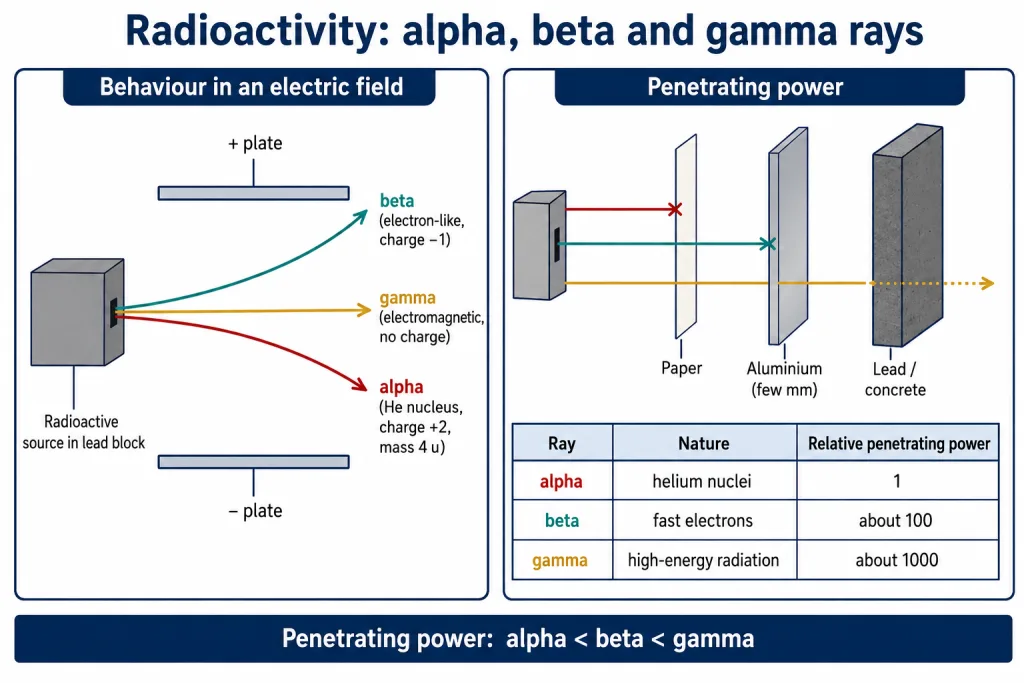
Henri Becquerel (1852-1908) discovered that certain elements emit radiation on their own, with no tube and no voltage. He named the phenomenon radioactivity and the elements radioactive elements. Marie Curie, Pierre Curie, Ernest Rutherford and Frederick Soddy developed the field, and three kinds of rays were identified: (alpha), (beta) and (gamma).
| Ray | What it is | Charge | Mass | Deflection in a field | Penetrating power |
|---|---|---|---|---|---|
| Helium nuclei (): high-energy particles with two units of positive charge and four units of atomic mass | 4 u | Towards the negative plate; small deflection (heavy) | Least | ||
| Negatively charged particles similar to electrons | ~0 | Towards the positive plate; large deflection (light) | About 100 times that of | ||
| High-energy electromagnetic radiation like X-rays; neutral, does not consist of particles | 0 | 0 | Undeflected | About 1000 times that of |
Rutherford identified -particles as helium nuclei by collecting them in an evacuated tube: once each had picked up two electrons, the tube held ordinary helium.
Key Point: Penetrating power increases in the order , with about 100 times and about 1000 times as penetrating as . A sheet of paper stops -rays; a few millimetres of aluminium stop -rays; -rays need thick lead or concrete.
The -particle matters most here, because it is the bullet Rutherford fires at gold foil in the next section: , mass 4 u, charge .
The whole story on one card
| Year | Discovery | Scientist | Tool |
|---|---|---|---|
| 1808 | Indivisible atom | Dalton | Laws of chemical combination |
| 1830 | Particulate nature of electricity | Faraday | Electrolysis |
| 1895 | X-rays | Röntgen | Cathode ray tube with metal target |
| 1896 | Radioactivity | Becquerel | Uranium salts on photographic plates |
| 1897 | Electron, | J.J. Thomson | Cathode rays in crossed fields |
| 1906-14 | Charge on electron, | Millikan | Oil drop |
| 1919 | Proton | Rutherford | Canal rays from hydrogen |
| 1932 | Neutron | Chadwick | Be + |
By 1932 the atom had three kinds of building block: electrons, protons and neutrons. How they are arranged is the subject of the atomic models in Section 2.
[JEE Main] Three facts tested as "which statement is incorrect": -rays are not particles; -particles are least penetrating but most ionising; X-rays come from electron bombardment of a target while -rays come from radioactive nuclei, though both are electromagnetic.
Solved Examples
Question 1: Mass of the electron from two experiments
Thomson's experiment gave C kg and Millikan's experiment gave C. Calculate the mass of the electron in kg and express it in u ( kg).
Answer:
I know and , so I get the mass by dividing: .
The mantissas give , the powers give , so kg.
In atomic mass units: u.
Ans: kg u. Watch out: Neither experiment alone gives the mass — Thomson gives the ratio, Millikan gives the charge.
Question 2: How many electrons weigh one gram?
Calculate the number of electrons which will together weigh one gram.
Answer:
The electron mass is in kg, so I convert first: 1 g kg, and one electron has mass kg.
Tidying up, electrons.
Ans: About electrons (using kg gives ; both are accepted). Watch out: Convert grams to kg before dividing, or the answer is out by .
Question 3: Mass and charge of one mole of electrons
Calculate the mass and the total charge of one mole of electrons.
Answer:
One mole contains electrons.
Mass: kg kg kg, which is g, about 0.55 mg.
Charge: C C. Electrons are negative, so the charge is C.
Ans: Mass kg; charge C (magnitude about 96,500 C). Watch out: That magnitude is the Faraday constant, 96,485 C mol — the charge on one mole of electrons.
Question 4: Electrons in one mole of methane
Calculate the total number of electrons present in one mole of methane, .
Answer:
For a neutral molecule the electrons per molecule are the sum of the atomic numbers. Carbon () gives 6 and each hydrogen () gives 1, so per molecule. One mole holds molecules, so the total is electrons.
Ans: electrons.
Question 5: Neutrons in 7 mg of carbon-14
Find (a) the total number and (b) the total mass of neutrons in 7 mg of . (Mass of a neutron kg.)
Answer:
has mass number 14 and atomic number 6, so each atom has neutrons. Its molar mass is 14 g mol, so
That is atoms.
(a) Neutrons: .
(b) Their mass: kg kg.
Ans: (a) neutrons; (b) kg, about 4.0 mg. Watch out: Use the isotope's own mass number, 14 and not 12, for the molar mass.
Question 6: Protons in 34 mg of ammonia
Find (a) the total number and (b) the total mass of protons in 34 mg of at STP. Will the answer change if the temperature and pressure are changed?
Answer:
Nitrogen () has 7 protons and each hydrogen 1, so a molecule has protons. Molar mass g mol, so
Molecules: .
(a) Protons: .
(b) Their mass: kg kg (using kg gives kg).
The number of protons is fixed by the mass of ammonia, which does not change with temperature or pressure. Only the volume would change, so the answer stays the same.
Ans: (a) protons; (b) about kg; no change with T and P. Watch out: "At STP" is a distraction — you were given a mass, not a volume, and counting particles from mass never depends on the conditions.
Question 7: Electrons on a charged particle
A certain particle carries C of static electric charge. Calculate the number of electrons present in it.
Answer:
Charge is quantised, , so :
The mantissas give , the powers give , so electrons.
Ans: About electrons. Watch out: Rounding to 1.6 instead of 1.602 changes only the last digit.
Question 8: Electrons on a Millikan oil drop
In Millikan's experiment, the static charge on an oil drop was obtained by shining X-rays. If the charge on the drop is C, calculate the number of electrons present on it.
Answer:
Using ,
The mantissas give , the powers give , so . The charge is negative, so these are 8 extra electrons picked up from the air ionised by the X-rays.
Ans: 8 electrons. Watch out: must come out close to a whole number, as quantisation demands. If it does not, recheck the arithmetic.
Question 9: Which charge is impossible?
In a Millikan-type experiment a student reports the charges on four droplets as C, C, C and C. Which reading must be wrong, and why?
Answer:
I divide each charge by C and check whether is a whole number:
- , allowed.
- , allowed.
- , not a whole number.
- , allowed.
A droplet cannot carry two and a half electrons.
Ans: C is the wrong reading, because it gives . Watch out: Any value that is not a whole-number multiple of C is forbidden.
Question 10: Cathode rays versus canal rays
Cathode rays have the same whatever gas fills the discharge tube, but canal rays do not. Explain why, and state what this told scientists about the atom.
Answer:
Cathode rays are electrons knocked out of the atoms of the gas and of the cathode metal. Every element's atoms contain identical electrons, so the particle that emerges has the same charge, mass and whatever the gas or electrode material.
Canal rays are the positive ions left behind when atoms lose electrons. A hydrogen tube gives (mass 1 u), a neon tube (mass 20 u), and some ions lose two electrons and carry . The particle changes with the gas, so its mass and change too.
The universality of the electron makes it a fundamental constituent of all atoms. The positive part is not one universal particle in the same sense — it is the rest of the atom, whose mass depends on the element. The lightest positive ion, from hydrogen, is the proton.
Ans: Cathode rays are the same electron from every gas, so is fixed; canal rays are gas-specific positive ions, so their mass and vary. The electron is therefore present in every atom. Watch out: "Independent of the gas" is the fingerprint of a universal particle.
Question 11: Deflection of an electron and a proton
An electron and a proton, travelling with the same speed, enter the same uniform electric field perpendicular to their motion. Compare the magnitude and direction of their deflections. (.)
Answer:
Both carry a charge of magnitude C, so the electric force on each is the same, . Acceleration is , and the proton is 1836 times heavier, so its sideways acceleration is of the electron's.
Both cross the plates in the same time, since the speed and plate length are the same, and the sideways displacement is . So deflection at fixed field and speed, giving
The electron bends towards the positive plate and the proton towards the negative plate.
Ans: The electron is deflected about 1836 times more than the proton, and in the opposite direction. Watch out: Same charge does not mean same deflection — the mass decides. This is also why -rays bend far more sharply than -rays in the same field.
Question 12: Chadwick's reaction and the neutron mass
(a) Write the nuclear equation for the production of neutrons when beryllium-9 is bombarded with -particles. (b) Using the table of fundamental particles, find the mass of a neutron in u and state by what percentage it exceeds the proton mass.
Answer:
(a) The reactants are and the -particle . Total mass number ; total atomic number . A neutron (, ) is emitted, leaving , , which is carbon-12.
(b) Neutron mass in u:
The proton mass is u, so the difference is u, and
Ans: (a) ; (b) u, about heavier than the proton. Watch out: Balance on top and at the bottom, and write the neutron as .