
Two Notes That Are Almost the Same
Ask two friends to sing the same note and listen carefully. If they land on it exactly you hear one steady sound. If one of them is a whisker off, something new happens: the sound does not just sit there. It swells and fades, swells and fades, at a slow, perfectly regular rate you can count out loud.
That throbbing has a name. It is called beats, and it is the most useful thing in this chapter, because it turns a difference in frequency that is far too small to hear as a difference in pitch into something you can count on your fingers.
Key Point: Beats are the regular waxing and waning of loudness heard when two sound waves of nearly equal frequencies and comparable amplitudes reach the ear at the same time.
Setting the problem up properly
Everything so far in this chapter has followed a wave through space. Beats are different: they happen at one place, and what changes is time. So fix a point — one ear, one microphone — and watch the air there.
Two sources of the same amplitude send waves to that point. Their frequencies are and , and they are close but not equal. Start the clock at an instant when both waves happen to be at a crest there. Then the two displacements at that point are
Notice what is not in those expressions: there is no . We are standing still at one place, so the part of each wave is a fixed number, and choosing at a common crest absorbs it. What is left is a pure history: displacement against time at one point.
Adding them
The principle of superposition says the air at that point does the algebraic sum:
Two cosines added — that is what the identity
exists for. Put and :
and the sum becomes
Key Point — the beat equation:
That single line contains the whole topic. The rest of this section is learning to read it.
Reading the two factors
Two frequencies have appeared, and neither of them is or :
Because the two sources are close, these two numbers are wildly different in size. Take a 256 Hz fork sounded with a 260 Hz fork:
The second cosine goes through 258 cycles every second. The first goes through 2. One is 129 times faster than the other — and that gap is what lets us read the equation as
| Factor | Frequency for 256 Hz and 260 Hz | What your ear makes of it |
|---|---|---|
| 258 Hz | the pitch — a single note halfway between the two | |
| 2 Hz | too slow to be a pitch; heard as the loudness changing |
So two forks 4 Hz apart do not sound like two notes. They sound like one note, at the average frequency, that keeps getting louder and softer.
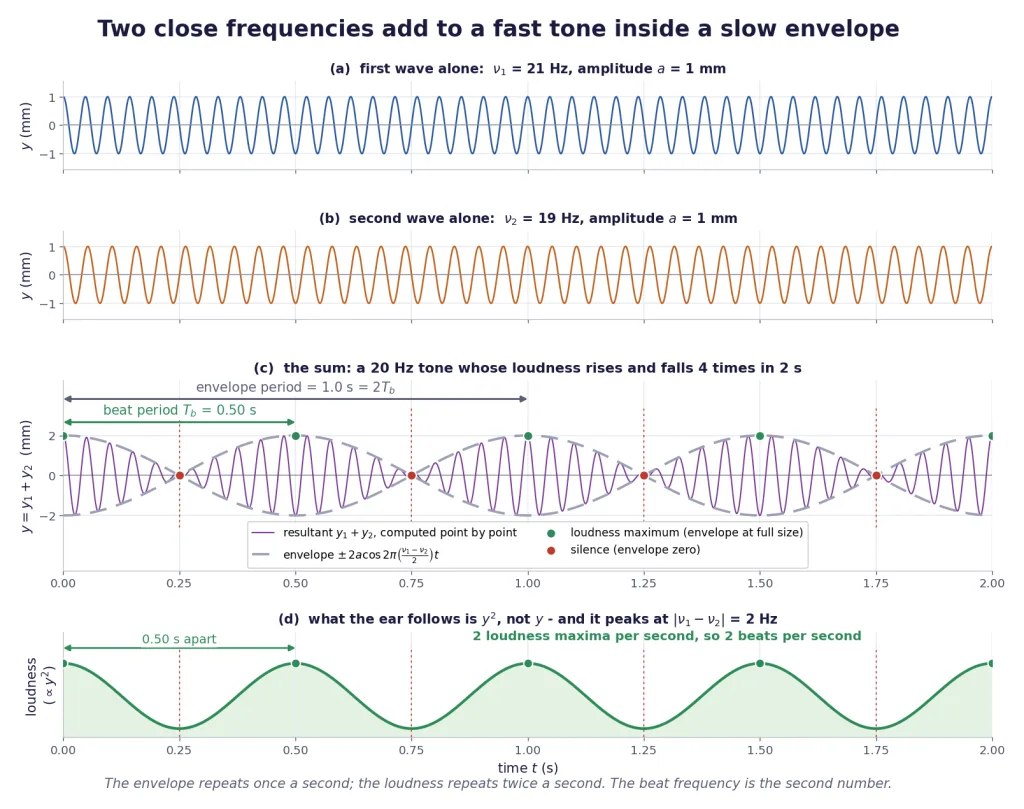
Panels (a) and (b) of the figure are two waves of 21 Hz and 19 Hz, drawn on their own. Individually they are indistinguishable — you would never guess they differed. Panel (c) is their point-by-point sum, and the dashed grey curves are the bracket traced out. The fast wiggle inside runs at the average, 20 Hz. Panel (d) is the part that decides the next block.
Notation for this section
- is the average frequency, the half-difference. Neither is the beat frequency; that is settled in the next block.
- is the beat period, in seconds. Where a tension appears in this section — as it does when a string is tightened — it is written as and its unit, the newton, is named on the same line, because also means a time period elsewhere in this chapter.
- The angular wave number does not appear at all here: we never leave the one point in space.
[Board Important] A derivation question on beats carries its marks on four lines: write the two waves at a point, state the principle of superposition, apply the identity, and identify the bracket as a slowly varying amplitude. Then, and only then, quote — with the reason.
Why the Beat Frequency Is the Difference, Not Half of It
Here is the trap, and almost everyone falls into it once.
The amplitude bracket is , with . A cosine of frequency repeats itself once every
For our 256 Hz and 260 Hz forks that is s, so the envelope goes through two complete cycles a second. It looks obvious that you should hear two beats a second.
You hear four. The measured answer is , and getting the factor of two right is the whole point of this section.
The reason: your ear hears loudness, and loudness goes as the square
An ear does not respond to displacement. It responds to loudness, and the loudness of a sound is proportional to the square of its amplitude. Squaring throws away the sign — and that is exactly where the extra factor comes from.
The picture version. Follow the bracket through one of its cycles:
At the start the amplitude is : the sound is at its loudest. A quarter of the way through, the amplitude is zero: silence. Half way through, the bracket is . Is that quiet? No. An amplitude of means the air swings just as far as it did at , merely starting in the opposite direction, and the ear has no way of telling the difference. That instant is just as loud as the first one.
So in one cycle of the envelope you hear two maxima of loudness and two silences. The loudness cycles twice as fast as the envelope does.
The algebra version. Write the amplitude and square it:
Now use , which is the identity that does all the work:
Look at what came out. The half has cancelled. The loudness is a constant plus a cosine whose frequency is exactly , with no factor of two anywhere. The loudness therefore rises and falls times every second.
Key Point — the beat frequency: and the beat period, the time from one loud moment to the next, is The beat period is half the envelope's period, because the ear hears a maximum twice in every envelope cycle.
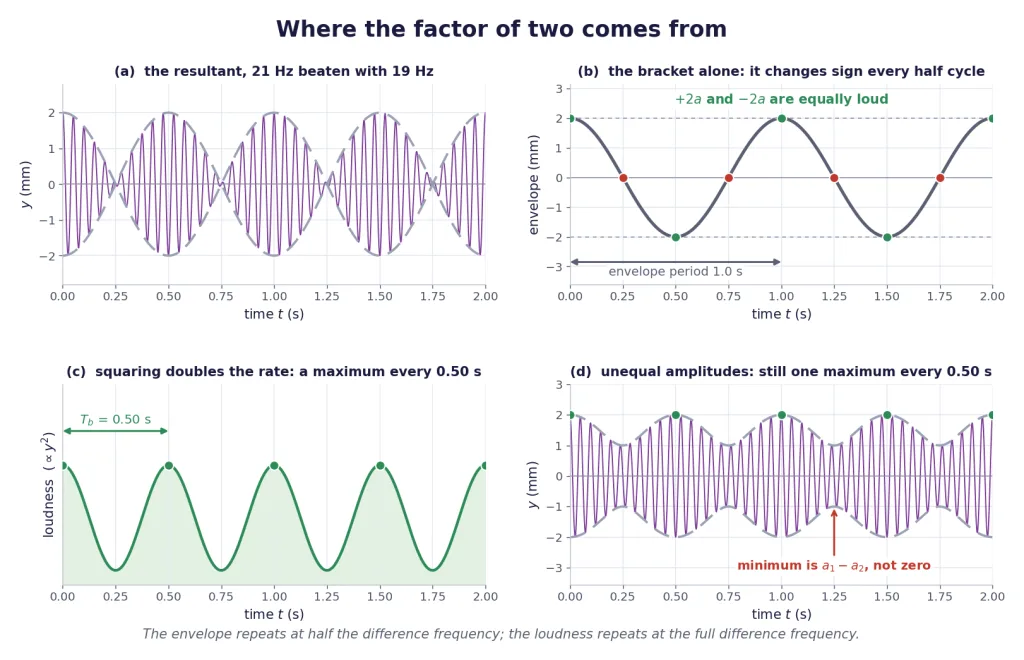
Panel (b) of the figure is the bracket on its own, and the green dots are the moments of maximum loudness — at and at . Panel (c) is the loudness, and it has twice as many peaks in the same two seconds. Panel (d) shows that unequal amplitudes change the depth of the dips but not the rate at all.
Why the modulus sign
could come out negative if you happen to subtract in the unlucky order, and a negative number of beats per second means nothing. Sounding 256 Hz with 260 Hz is the same physical situation as sounding 260 Hz with 256 Hz, so the answer must be the same either way. Always take the positive difference.
The three frequencies, side by side
For 256 Hz sounded with 260 Hz:
| Quantity | Formula | Value | What it is |
|---|---|---|---|
| Pitch of the tone heard | 258 Hz | the note you would name | |
| Envelope frequency | 2 Hz | how often the bracket repeats | |
| Beat frequency | 4 Hz | how often you hear it get loud | |
| Beat period | 0.25 s | gap between two loud moments |
[JEE Tip] The single commonest error in this topic is answering because that number is sitting right there in the equation. It is the frequency of the envelope, not of the beats. If a question hands you the equation in the product form, read the difference frequency off the bracket and then double it.
[NEET Important] For a one-mark question, the working is one line: subtract, take the modulus, done. . Never halve it, never average it.
Reading a Beat Waveform Off a Graph
Beat questions very often hand you a picture instead of numbers, and there is a short list of things to measure. The graph always has the same anatomy: a fast oscillation trapped inside a slow envelope.
The four things you can read
1. The fast oscillation gives the pitch. Pick a stretch of the graph where the wave is at full size, count how many complete fast cycles fit into a measured time, and divide:
That is the average of the two frequencies, not either one of them.
2. The waists give the beat period. The places where the wave shrinks to nothing are the moments of silence — the envelope is passing through zero, the two waves are exactly out of step, and they cancel completely. Consecutive waists are one beat period apart:
3. The loud moments give the same thing. The fattest points of the envelope are also apart, and they sit exactly halfway between the waists.
4. Then the two frequencies separate out. Once you have and , the individual frequencies follow immediately:
Which one belongs to which source, the graph cannot tell you. That is a real limitation and the last block of this section is about it.
The measurement that goes wrong
Key Point: The envelope's period and the beat period are not the same number. The envelope only returns to the same value, with the same sign, after two beat periods. If you measure from one fat point to the next fat point of the same sign — that is, from a bulge on the top branch to the next bulge on the top branch, ignoring the one in between — you have measured and your beat frequency will come out half the true value.
The safe habit: measure between two consecutive waists. A waist is unmistakable and every waist counts.
| What you measure on the graph | What it gives you |
|---|---|
| Fast cycles per second, measured at a bulge | |
| Time between consecutive waists | , so |
| Time between consecutive loud moments | again |
| Full period of the envelope curve | — halve the frequency you get from this |
| Greatest height reached | |
| Least height reached |
When the two amplitudes are not equal
Real sources are never matched exactly. Take amplitudes and with . At the loud moments the two waves are in step and the amplitude is ; at the waists they are exactly opposed and the amplitude is , which is not zero. So:
- the sound never goes completely silent — the throb has shallow dips instead of gaps;
- since loudness goes as the square of the amplitude, the ratio of loudest to quietest is ;
- the beat frequency is completely unchanged at . Amplitudes set how deep the throb is; frequencies set how fast.
That is why the definition insists on "comparable amplitudes". If one source is a whisper next to the other, the dips are so shallow that nobody notices them, and the beats are effectively inaudible even though they are mathematically still there.
[JEE Tip] A question that gives you and asks for is asking you to run that formula backwards. Take the square root first: , then solve. Forgetting the square root is the standard slip.
Beats Are Heard Only While the Frequencies Stay Close
Every formula so far works for any two frequencies. Feed 200 Hz and 300 Hz into and it dutifully returns 100 Hz. But sound 200 Hz and 300 Hz together and you hear no throbbing at all — you hear two clearly separate notes. The mathematics has not failed. Your ear has a limit, and it matters.
The ear's response time
Hearing is not instantaneous. A sound impression lasts about a tenth of a second after the sound itself, an effect called persistence of hearing. Anything that changes faster than roughly ten times a second is therefore smeared into a single continuous sensation instead of being followed as separate events.
Key Point: Beats can be counted only when the beat frequency is less than about 10 Hz, which means the two frequencies must be within roughly 10 Hz of each other. Beyond that the loudness is still fluctuating exactly as the equation says, but the ear can no longer resolve the fluctuations.
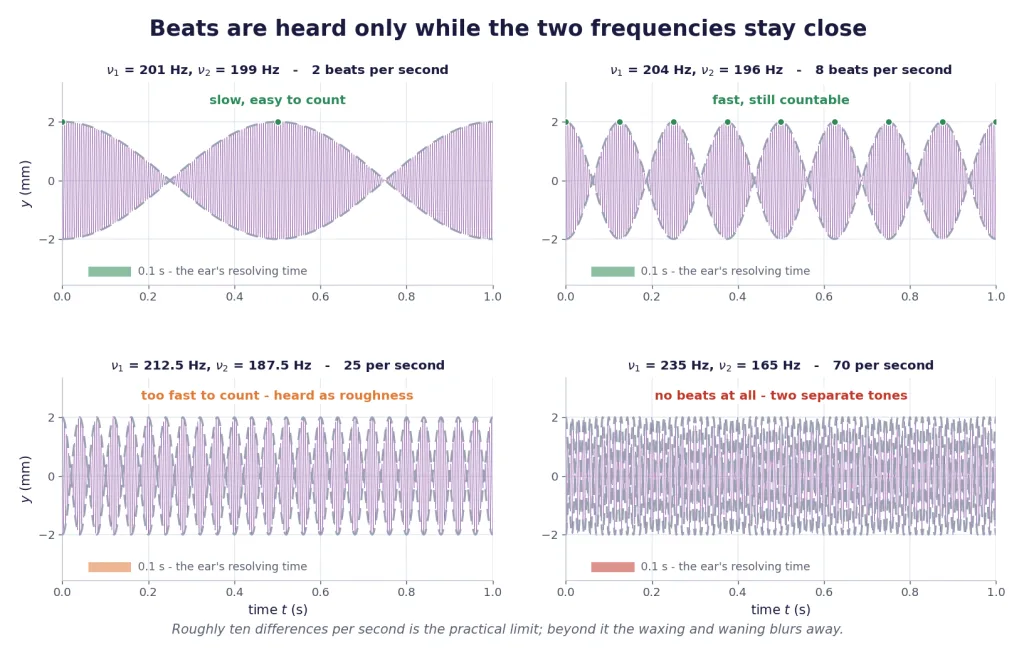
Each panel of the figure is the same 200 Hz region beaten against a different partner, over one second, with the ear's tenth-of-a-second window drawn in for scale.
What is actually heard as the gap widens
| Difference | What you hear |
|---|---|
| Less than about 1 Hz | a very slow swell, easy to count on a watch — this is what tuners listen for |
| 1 Hz to about 10 Hz | clear, countable beats: the standard case, and the one every problem is about |
| About 10 Hz to about 20 Hz | a fast flutter you can no longer count; the sound acquires a harsh, grating quality |
| Above about 20 Hz | no throbbing at all; the two notes separate and are heard as two distinct pitches |
The change is gradual, and the exact numbers depend on the listener and the pitch, so "roughly 10 Hz" is the figure to carry into an exam, not a sharp cut.
Three more conditions, easily forgotten
For beats to be heard at all:
- The two waves must overlap at the same place at the same time. Beats happen where the two sounds meet — in your ear, or at a microphone. Two forks sounded in different rooms produce nothing.
- The amplitudes must be comparable. If one wave is much weaker, the dips are shallow and the effect is lost, as the previous block showed.
- The frequencies must be steady. A note that wanders in pitch produces a beat rate that wanders with it, and there is nothing to count.
Two things beats are not
Beats are not interference in space. Interference gives you loud and quiet places, fixed in the room, produced by two waves of the same frequency arriving with different path lengths. Beats give you loud and quiet moments at every place, produced by two waves of different frequencies. One is a pattern in space, the other a pattern in time.
The beat frequency has nothing to do with the pitch. Two flutes at 1000 Hz and 1003 Hz beat three times a second. Two tubas at 100 Hz and 103 Hz beat three times a second. The beat rate is set by the difference alone, and the difference does not care how high the notes are.
[NEET Important] Two facts worth memorising as sentences. Beats are audible only up to about 10 per second, because of persistence of hearing. And the beat frequency depends only on the difference of the frequencies, never on their size.
Tuning by Beats, and the Ambiguity You Have to Resolve
This is what beats are for. A trained ear can tell two notes apart when they are perhaps a few hertz different in pitch — but beats let anyone at all detect a mismatch of a fraction of a hertz, because a mismatch of Hz announces itself as one swell every five seconds.
The procedure
To tune a sitar or guitar string to a fork of known frequency:
- Sound the fork and pluck the string together, and listen for the throbbing.
- Adjust the string — tighten or loosen the peg — and listen again.
- If the beats got slower, keep going that way. If they got faster, go back.
- Keep going until the beats disappear. When there are no beats, the two frequencies are equal.
Key Point: Zero beats means the two frequencies match. It is the only setting at which the beat rate is zero, which is why the method is so sharp: you are hunting for a null, not for a maximum, and nulls are easy to find precisely.
The ambiguity, which is the examinable part
Here is the catch, and every year it is asked. You sound a string against a 256 Hz fork and hear 4 beats per second. What is the string's frequency?
Both answers fit. The beat rate is a modulus — it reports the size of the mismatch and destroys its sign. No amount of listening more carefully will tell you which one you have, because the two situations produce identical sounds.
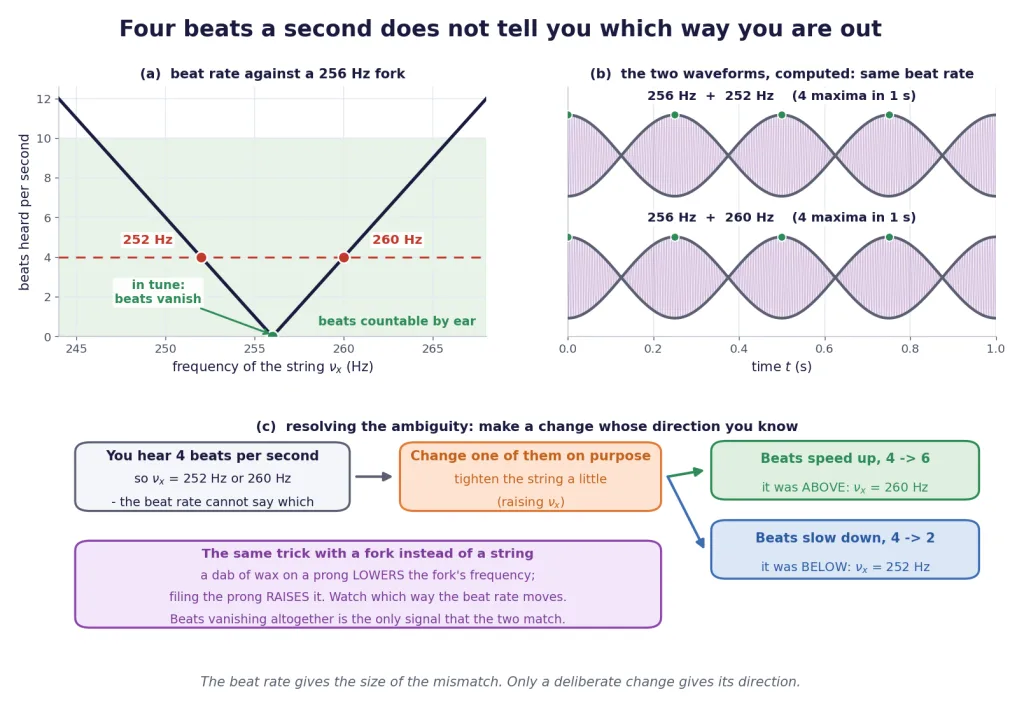
Panel (a) of the figure is the reason, drawn: the beat rate against the unknown frequency is a V, and any horizontal line crosses a V twice.
The way out: change something on purpose
The cure is to make a deliberate change whose direction you already know, and listen to which way the beat rate moves.
Once you know which way you moved it and which way the rate went, the sign is fixed. Suppose you tighten the string, which raises its frequency:
- if the beats speed up, the string was above the fork — it was 260 Hz;
- if the beats slow down, the string was below the fork — it was 252 Hz.
The standard tricks, and which way each one pushes
| Deliberate change | Effect on that source's frequency | Why |
|---|---|---|
| Tighten a string (increase the tension , in N) | raises it | for a stretched string |
| Slacken a string | lowers it | same relation, run backwards |
| Shorten the vibrating length of a string | raises it | |
| Load a fork prong with a small blob of wax | lowers it | added mass, same stiffness |
| File a fork prong thinner near the tip | raises it | mass removed from where it moves most |
| Shorten an air column | raises its note | shorter column, shorter wavelength |
| Warm the air in a pipe | raises its note | sound travels faster in warmer air |
Every one of these is a one-line consequence of results established earlier in the chapter; here they are simply tools for settling a sign.
Key Point — the exam routine for a loading question:
- Write both candidates: .
- Say in words which way the stated change pushes the frequency.
- Test each candidate against the observed change in the beat rate.
- Exactly one survives. Quote it.
[Board Important] Marks are given for the reasoning, not the arithmetic. A solution that writes "the beat frequency decreased, so the changed frequency moved closer to the other one, hence it was originally on the higher side" earns them. A solution that writes only "422 Hz" does not.
One honest limitation
"No beats" does not mean the two frequencies are identical to the last decimal place. It means the difference is too small to detect — smaller than about a fifth of a hertz, since that is roughly the slowest throb a person can pick out during the few seconds a note lasts. For a musician that is far more than good enough. For a laboratory, an electronic counter does better.
Where Beats Turn Up
Tuning, in every form
The laboratory version of the tuning routine is the one you may have to describe: a set of forks of known frequency, an unknown source, and a systematic search for the fork that produces no beats with it. The same idea sets the frequency of a resonance tube against a fork, matches two organ pipes, and puts a whole orchestra on the same A.
Piano strings, deliberately out of tune
A piano uses two or three strings for most of its notes, all struck by the same hammer. A tuner does not set them to exactly the same frequency. They are left a small fraction of a hertz apart on purpose.
The result is a beat with a period of several seconds. Instead of a flat, dead tone that dies away quickly, the note shimmers gently and appears to sustain for much longer, because the strings feed energy back and forth rather than all fading together. Push the mistuning past about a hertz and the shimmer turns into an obvious wobble that sounds wrong; keep it small and it is the difference between a musical piano and a mechanical one.
Engines and propellers
A twin-engined aircraft whose two engines are turning at slightly different rates produces a slow wow — wow — wow that passengers can hear plainly. It is a beat between two nearly equal frequencies, and the pilot's fix is exactly the tuner's: adjust one engine until the throbbing stops, at which point the two are synchronised. The same trick works on any pair of rotating machines running side by side.
Measuring a speed from an echo
Send a steady note at a moving object and listen to the echo. The returning sound comes back at a slightly shifted frequency — this is the Doppler effect, and the next section is devoted to it — and mixing that echo with the outgoing note produces beats whose rate is the size of the shift. Counting the beats therefore measures how fast the object is moving — which is how a speed gun, a marine sonar and an ultrasonic blood-flow monitor all work. Why a moving reflector shifts the frequency, and by exactly how much, is worked out there.
Notice, though, that the ambiguity is back in a new costume: a beat rate of 100 Hz against a 40 kHz transmitter says the echo came back at either 40100 Hz or 39900 Hz, which is the difference between approaching and receding. A real instrument settles that separately.
The others, briefly
| Where | The two nearly equal frequencies |
|---|---|
| An organ's "celeste" stop | two ranks of pipes deliberately tuned a little apart, for a shimmering tone |
| A tanpura backing an Indian classical performance | strings tuned in near-unison, giving a rich pulsing drone |
| Detecting a leaky gas | the note of a whistle fed by the gas beats against a reference whistle in clean air |
| Checking a machine shaft | a reference tone is beaten against the note the machine makes |
Counting beats over an interval
Nearly every applied question ends the same way: multiply.
Six beats a second for half a minute is 180 beats. A beat every two seconds for a minute is 30. There is nothing more to it than that, but do check the units of before you multiply.
[JEE Tip] If a question gives you a rotation rate in rpm, convert to hertz first by dividing by 60. Engines at 1200 rpm and 1230 rpm are running at 20.0 Hz and 20.5 Hz, so the beat rate is 0.5 Hz — one surge every two seconds — and not 30 of anything.
Solved Examples
Conventions used throughout: SI units unless a question states otherwise. The speed of sound in air is taken as 340 m/s unless a problem gives another value. Loudness (intensity) is taken as proportional to the square of the amplitude. Beat frequency always means , the number of times per second the sound is loudest. Where a tension appears it is written and measured in newtons; the beat period is written and measured in seconds.
Example 1: Two forks, and every number you can get from them
A 256 Hz fork and a 260 Hz fork are struck together and held near one ear. Find (a) the pitch of the note heard, (b) the frequency of the amplitude envelope, (c) the beat frequency and the beat period, and (d) how many beats are heard in 5 seconds.
Solution:
Step 1 — the pitch is the average. The fast factor in the beat equation carries the frequency :
(a) The listener hears a single note of 258 Hz — not two notes, and not 256 or 260.
Step 2 — the envelope. The bracket carries the half-difference:
(b) so the envelope repeats twice a second, with period s.
Step 3 — the beat frequency is not that. Loudness goes as the square of the amplitude, so the ear hears a maximum at and again at : twice per envelope cycle.
(c) Four beats a second, one every quarter second — exactly half the envelope's period, as it must be.
Step 4 — count them.
Final Answer: (a) 258 Hz; (b) 2 Hz, envelope period 0.5 s; (c) 4 beats per second, s; (d) 20 beats.
Takeaway: Three different frequencies come out of two forks, and only one of them is the beat frequency. Average 258, envelope 2, beats 4. Write all three down and you will never confuse them.
Example 2: Reading the frequencies out of the product form
The displacement at a point due to two superposed sound waves is
Find (a) the amplitude of each of the two original waves, (b) their frequencies, and (c) the beat frequency and beat period.
Solution:
Step 1 — line the expression up against the standard form. The beat equation is
Comparing term by term:
(a) Each original wave had an amplitude of 1 cm.
Step 2 — the slow factor.
Step 3 — the fast factor.
Step 4 — solve the pair. Adding and subtracting,
(b) The two waves are 303 Hz and 297 Hz.
(c)
Final Answer: (a) 1 cm each; (b) 303 Hz and 297 Hz; (c) 6 beats per second, s.
Takeaway: The number in the slow bracket is half the difference — double it. Reading 3 Hz off and calling it the beat frequency is the error this example exists to prevent.
Example 3: Two sitar strings and a change in tension
Two sitar strings A and B, played together, produce 6 beats per second. The tension in string A is reduced slightly, and the beat frequency drops to 3 per second. If A was originally at 324 Hz, what is B's frequency?
Solution:
Step 1 — write both candidates. A beat rate of 6 per second means the two frequencies differ by 6 Hz, in one direction or the other:
Step 2 — say which way the change pushes A. For a stretched string , with the tension in newtons. Reducing the tension therefore lowers A's frequency, from 324 Hz to something a little below it — say 321 Hz, since the beat rate must land on 3.
Step 3 — test each candidate.
- If Hz: A falls from 324 towards 318, so the gap narrows. Beat rate falls from 6 to 3. This matches the observation.
- If Hz: A falls from 324 away from 330, so the gap widens from 6 to 9. Beat rate would have increased. This contradicts the observation.
Step 4 — the survivor. Only 318 Hz is consistent.
Final Answer: Hz.
Takeaway: Beats falling means you moved towards the other frequency. That one sentence solves every loading problem; the arithmetic is trivial once the direction is settled.
Example 4: A fork loaded with wax
A fork X sounded with a standard 288 Hz fork gives 4 beats per second. A small blob of wax is stuck to a prong of X, and the beat rate falls to 2 per second. Find X's original frequency.
Solution:
Step 1 — candidates.
Step 2 — which way does wax push? Wax adds mass to the prong without changing its stiffness, so it makes the prong sluggish. Loading a fork with wax lowers its frequency. So falls.
Step 3 — test.
- Hz falling towards 288: the gap narrows from 4 to 2. Matches.
- Hz falling away from 288: the gap widens from 4 to 6. Contradicts.
Final Answer: Hz. After waxing it is at about 290 Hz.
Takeaway: Wax lowers a fork; filing raises it. Remember it as "wax is extra weight to carry", and you have the direction you need for half the beat questions ever set.
Example 5: Two organ pipes that are almost the same length
Two pipes, both open at both ends, are 100 cm and 101 cm long. Both are sounded in their fundamental mode. Take the speed of sound as 340 m/s. Find the beat frequency and the beat period.
Solution:
Step 1 — the fundamental of an open pipe. A pipe open at both ends holds half a wavelength in its fundamental, so and
Step 2 — put the numbers in.
Step 3 — the beat frequency.
Roughly five beats every three seconds, which is easy to count — and the two pipes differ in length by only 1%.
Final Answer: about 1.68 beats per second, s.
Takeaway: A 1% error in length gives about a 1% error in frequency, which at 170 Hz is nearly 2 Hz — clearly audible as beats. This sensitivity is why beats are the right tool for matching two pipes or two strings.
Example 6: Trimming a pipe until the beats stop
A pipe closed at one end is 25.0 cm long. It is sounded in its fundamental alongside a 344 Hz fork. Take the speed of sound as 340 m/s. (a) How many beats per second are heard? (b) By how much must the pipe be shortened so that the beats disappear?
Solution:
Step 1 — the pipe's fundamental. A pipe closed at one end holds a quarter of a wavelength in its fundamental, so and
(a)
Step 2 — what length would give 344 Hz? Rearranging the same relation,
Step 3 — the shortening.
Shorter, because a shorter closed pipe sounds a higher note and we need to come up from 340 Hz to 344 Hz.
Final Answer: (a) 4 beats per second; (b) shorten it by about 0.29 cm, i.e. 2.9 mm.
Takeaway: Check the direction before trusting the arithmetic. We needed a higher frequency, and says that means a shorter pipe. If your algebra had returned a longer pipe, something went wrong.
Example 7: A row of forks
Forty-one tuning forks are arranged in order of increasing frequency. Each fork gives 5 beats per second with the next one in the row, and the last fork is exactly one octave above the first. Find (a) the frequency of the first fork, (b) that of the last, and (c) that of the twenty-first.
Solution:
Step 1 — write the row as an arithmetic sequence. Since the frequencies increase and neighbours differ by 5 Hz,
Step 2 — use the octave condition. One octave above means twice the frequency, so . With ,
Step 3 — the rest.
Final Answer: (a) 200 Hz; (b) 400 Hz; (c) 300 Hz.
Takeaway: "Each gives beats with the next" is just an arithmetic progression with common difference . The general result is worth remembering: for forks with a constant and the last an octave above the first, .
Example 8: Getting both frequencies off a graph
The beat waveform from two sources is recorded. Consecutive points at which the trace shrinks to nothing are found to be 0.20 s apart, and exactly 60 complete fast oscillations are counted between one such point and the next. Find the two frequencies.
Solution:
Step 1 — the shrink-to-nothing points are the silences. Consecutive silences are one beat period apart, so
Step 2 — the fast oscillation gives the average. Sixty cycles in 0.20 s:
Step 3 — separate the two.
Check: their difference is 5 Hz and their average is 300 Hz, as required. Note also that the envelope's period here is s — a reader who measured that instead would have reported 2.5 beats per second, which is wrong by exactly the factor this section is about.
Final Answer: 302.5 Hz and 297.5 Hz.
Takeaway: Silence to silence is one beat period. Measure between waists, never between two bulges of the same sign, and the factor of two takes care of itself.
Example 9: Unequal amplitudes
Two sound waves reach a point together. One has amplitude 3.0 mm and frequency 300 Hz; the other has amplitude 1.0 mm and frequency 304 Hz. Find (a) the beat frequency, (b) the pitch heard, (c) the largest and smallest amplitudes of the resultant, and (d) the ratio of the loudest to the quietest intensity.
Solution:
Step 1 — the frequencies do not care about the amplitudes.
(a)
(b)
Step 2 — the extremes of the resultant amplitude. At a loud moment the two waves are in step and their amplitudes add; at a quiet moment they are exactly opposed and subtract.
(c) The amplitude swings between 4.0 mm and 2.0 mm — it never reaches zero, so the sound never falls completely silent.
Step 3 — intensity goes as the square of the amplitude.
(d) The sound is four times as intense at its loudest as at its quietest.
Final Answer: (a) 4 beats per second; (b) 302 Hz; (c) 4.0 mm and 2.0 mm; (d) .
Takeaway: Unequal amplitudes change how deep the throb is, never how fast. The beat frequency stayed at 4 Hz; only the dips became shallow.
Example 10: Two aircraft engines
The two engines of an aircraft are running at 1200 rpm and 1230 rpm. Each produces a sound whose frequency equals its rotation rate. (a) What beat frequency do the passengers hear? (b) What is the interval between two successive surges of loudness? (c) How many surges occur in one minute?
Solution:
Step 1 — convert rpm to hertz. Revolutions per minute must become revolutions per second, so divide by 60.
Step 2 — the beat frequency.
(a)
Step 3 — the beat period.
(b)
One surge every two seconds — the slow wow … wow that gives the effect away.
Step 4 — over a minute.
(c)
Final Answer: (a) 0.5 Hz; (b) 2.0 s; (c) 30 surges in a minute.
Takeaway: Divide rpm by 60 before you do anything else. Subtracting 1200 from 1230 and announcing 30 beats per second is the trap here, and it is off by a factor of sixty.
Example 11: A beat against an echo
An ultrasonic transmitter sends out a steady 40.0 kHz note towards a moving vehicle. The returning echo is mixed with the outgoing note and the mixture is found to beat 100 times per second. (a) What are the possible frequencies of the echo? (b) Can the beat rate alone tell you whether the vehicle is approaching or receding?
Solution:
Step 1 — the beat rate is the size of the shift. The echo comes back at a frequency shifted from 40000 Hz, and the beat rate between the two is the modulus of that shift:
(a)
Step 2 — the ambiguity, again. The two possibilities produce exactly the same beat rate, so listening harder cannot separate them.
(b) No. The beat rate carries the magnitude of the shift and nothing else. A reflector moving towards the transmitter returns a higher frequency and one moving away returns a lower one, so 40100 Hz means approaching and 39900 Hz means receding — but the instrument has to establish the sign some other way. Why a moving reflector shifts the frequency at all, and by how much, is the subject of the next section.
Final Answer: (a) 40100 Hz or 39900 Hz; (b) no — the beat rate gives only the size of the shift.
Takeaway: The modulus in costs you a sign every single time. Whether you are tuning a sitar or clocking a car, the beat rate tells you how far off, never which way.
Example 12: A sonometer wire brought into tune
A 480 Hz fork sounded with a sonometer wire gives 5 beats per second. The tension in the wire is increased slightly and the beat rate falls to 3 per second. (a) What was the wire's original frequency? (b) By what percentage must the original tension be increased to silence the beats altogether?
Solution:
Step 1 — candidates.
Step 2 — direction. For a stretched wire , with the tension in newtons, so increasing the tension raises the wire's frequency.
- Hz rising towards 480: the gap narrows from 5 to 3. Matches.
- Hz rising away from 480: the gap widens from 5 to 7. Contradicts.
(a) The wire was at 475 Hz.
Step 3 — the tension needed for unison. Since , the ratio of tensions is the square of the ratio of frequencies:
(b)
Final Answer: (a) 475 Hz; (b) the tension must be raised by about 2.1%.
Takeaway: A 2% change in tension moves the note by only 1%, because of the square root. That is exactly why tuning pegs are usable at all — the frequency responds gently, so you can creep up on the null instead of overshooting it.