
The Pitch That Drops as the Ambulance Goes Past
You have heard it a hundred times. An ambulance comes towards you with its siren going, and the note is high and urgent. It passes. Instantly the note drops — not gradually, but in one clear step as the vehicle sweeps by — and stays low as it recedes.
Here is the thing worth being surprised by: the siren never changed. Its electronics drove the same oscillation at the same rate the whole time. The driver, sitting a metre from it, heard one steady note from the moment it was switched on. What changed was the relative motion between the siren and your ears.
Key Point — the Doppler effect:
When there is relative motion between a source of waves and an observer, the frequency the observer receives differs from the frequency the source emits. The received frequency is written ; the emitted one is . Closing the gap raises the pitch, opening it lowers the pitch, and the source's own behaviour is unaltered throughout.
The Doppler effect sits outside the rationalised syllabus body text, and Boards, JEE Main and NEET ask it every single year, so it is developed here from first principles.
Two effects that look alike and are not
Almost every mistake in this topic comes from treating "the source moves" and "the observer moves" as the same situation seen from two sides. They are not. They are two physically different things, and they change two different quantities.
Key Point — the two mechanisms:
If this moves What it changes What it leaves alone the source the wavelength in the medium — the crests are laid down closer together ahead of the source and further apart behind it the speed of sound, and the wave once it has left the observer the rate at which crests arrive — the observer runs into them faster or lets them catch up the wavelength in the medium, which is untouched Both end up changing , and both are real. But one edits the wave and the other only changes how it is sampled.
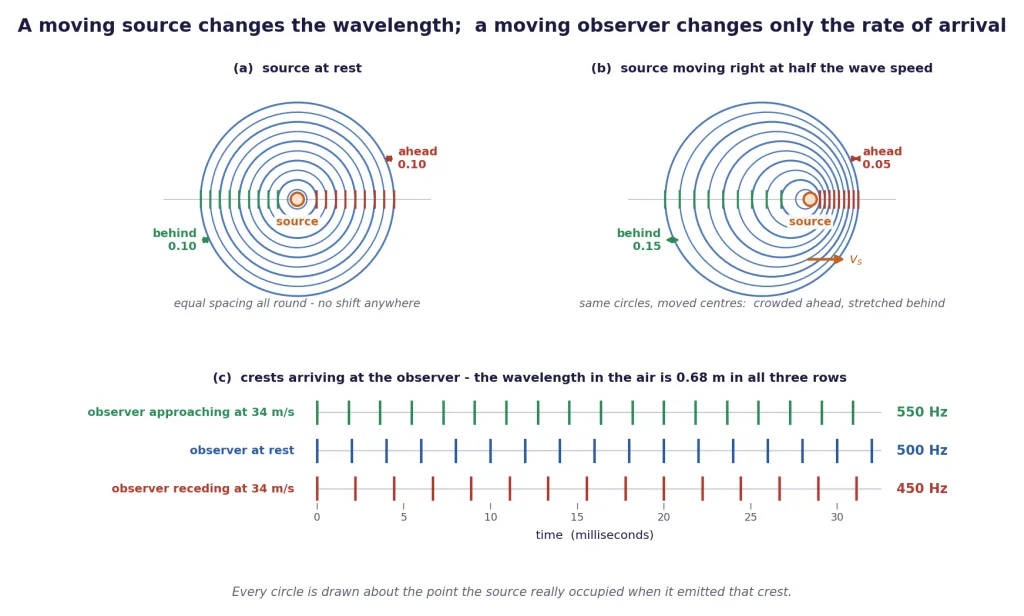
Look at the figure carefully, because it is the whole section in one picture.
In panel (a) the source sits still and emits a crest every seconds. Each crest is a circle that has been expanding at the speed of sound ever since it left, so the older ones are the bigger ones — and because the centre never moved, they are concentric and equally spaced all round. A listener anywhere hears exactly .
In panel (b) the source is running to the right at half the speed of sound. Every circle is drawn about the point the source really occupied at the instant it emitted that crest, which is further right each time. Nothing else has changed — the circles are the same size as before and they still spread at the same speed. But now their centres march to the right, so ahead of the source the crests are crowded together and behind it they are stretched apart. In the figure the spacing ahead is one-third of the spacing behind, exactly as the geometry requires.
Panel (c) is the other mechanism, and notice how different it is. The source is still, so the air carries one fixed wavelength of 0.68 m. Three observers stand in that same wave. The one at rest is passed by 500 crests a second; the one walking towards the source runs into them faster and meets 550; the one walking away lets them catch up and meets only 450. The wave in the air is identical in all three rows. Only the counting rate differs.
The medium is the referee
One fact underpins everything that follows, and it comes straight from the earlier work on wave speed.
Key Point: The speed of sound is a property of the medium — of the air, water or steel the wave is crossing. It is not affected in the slightest by how fast the source is moving, or the observer. A siren racing towards you at 30 m/s still sends its sound through the air at 340 m/s. What the motion changes is where each crest was born, not how fast it travels afterwards.
This is why the sound of an approaching source is not "squashed and speeded up". The sound arrives at the usual rate; it is the spacing of the crests inside it that has been altered.
Notation for this section
| Symbol | Meaning | Unit |
|---|---|---|
| frequency the source emits | Hz | |
| frequency the observer receives | Hz | |
| speed of sound in the medium | m/s | |
| signed velocity of the source along the chosen line | m/s | |
| signed velocity of the observer along the same line | m/s | |
| wavelength the source makes when it is at rest, | m | |
| wavelength actually laid down in the medium | m | |
| period of the source, | s | |
| signed wind velocity along the same line | m/s |
here is a period, in seconds — the time between one crest leaving the source and the next. And is the wave speed, the rate at which the disturbance crosses the medium; it has nothing to do with how fast a particle of air is oscillating.
[Board Important] "What is the Doppler effect? Give one example." is a guaranteed short question. The marks are for: the apparent change in the observed frequency due to relative motion between source and observer, with the emitted frequency unchanged — plus any everyday example, the passing train whistle being the safest.
A Moving Source Rewrites the Wavelength
Take the source first, with the observer standing still. This is the case that changes the wave itself, so it is the one worth deriving slowly.
The set-up
The source emits a crest, then waits one period , then emits the next. Between those two events, two things happen at once:
- the first crest travels outwards through the air at the speed of sound, covering a distance ;
- the source itself travels a distance in whatever direction it is going.
The distance between crest 1 and crest 2 — which is the wavelength now sitting in the air — is whatever is left over.
Ahead of the source
Let the source be moving towards the observer at speed . In one period the crest has run towards the observer, but the source has chased after it through before releasing the next crest. So the gap between them is short by exactly that much:
That is a genuinely shorter wavelength, physically present in the air, and it would be measured as shorter by anybody — moving or not.
The observer is standing still, so the crests sweep past at the ordinary speed of sound, and the rate at which they arrive is
Key Point — source approaching a stationary observer: The denominator is smaller than , so : the pitch rises.
Behind the source
Now stand behind it as it drives away. In one period the crest has travelled backwards from where the source was, and the source has moved a further in the opposite direction — so the gap is now longer:
The denominator is larger than , so and the pitch falls.
A worked feel for the size of it
Take a 500 Hz siren, sound in air at 340 m/s, and a source speed of 34 m/s — about 122 km/h, fast for a road vehicle.
| Wavelength in the air | Frequency heard | |
|---|---|---|
| source at rest | 0.680 m | 500 Hz |
| moving towards you at 34 m/s | 0.612 m | 555.6 Hz |
| moving away from you at 34 m/s | 0.748 m | 454.5 Hz |
So the note jumps by about 101 Hz — roughly a musical third — as the vehicle sweeps past you. That is the step you actually hear, and it is why the drop is so abrupt: you are not hearing a gradual slide, you are switching from the crowded side of the source to the stretched side.
Three things the derivation quietly tells you
- The wavelength really changed. Put a microphone in the air and measure the crest spacing; it is 0.612 m in front and 0.748 m behind. Nothing about the observer entered that calculation.
- The two shifts are not equal and opposite. Approaching gave Hz and receding gave Hz. The rise is bigger than the fall, because sits in the denominator and a denominator responds more sharply when it shrinks than when it grows.
- Something dramatic happens if reaches . The denominator goes to zero and the formula blows up. That is not a failure of algebra; it is the sonic boom, and the last block of this section deals with it.
[JEE Tip] When a question mentions a wavelength anywhere in a Doppler problem, it is almost always testing whether you know that only source motion changes . An observer sprinting towards a stationary siren hears a higher note while measuring exactly the same wavelength in the air as everyone else.
A Moving Observer Just Counts Faster
Swap the roles. The source is bolted to the ground and emits steadily at ; the observer is the one in motion.
Nothing at all happens to the wave
The source is at rest, so it lays down crests in the ordinary concentric way, spaced
and that spacing is fixed for good the moment each crest leaves. The observer's motion cannot reach back and alter it. So in this case , always.
What does change is the closing speed
Stand still, and the crests come at you at the speed of sound: you meet of them per second, which is . Start walking towards the source at speed and the crests and you are now closing on each other at , so they arrive at the rate
Key Point — observer moving towards a stationary source: Walk away instead and the crests must chase you, closing at only , so and the pitch falls.
This is the same idea as walking along a station platform counting sleepers: the sleepers do not move, but how many you pass per second depends entirely on how fast you walk.
The two mechanisms give different answers
Put the same numbers through both. A 500 Hz source, sound at 340 m/s, and a speed of 34 m/s — but this time it is the listener who moves.
| Who is moving | Approaching | Receding |
|---|---|---|
| the source, at 34 m/s | 555.6 Hz | 454.5 Hz |
| the observer, at 34 m/s | 550.0 Hz | 450.0 Hz |
Same speed of approach, same everything else, and the answers differ. The Doppler effect for sound is not symmetric between source motion and observer motion.
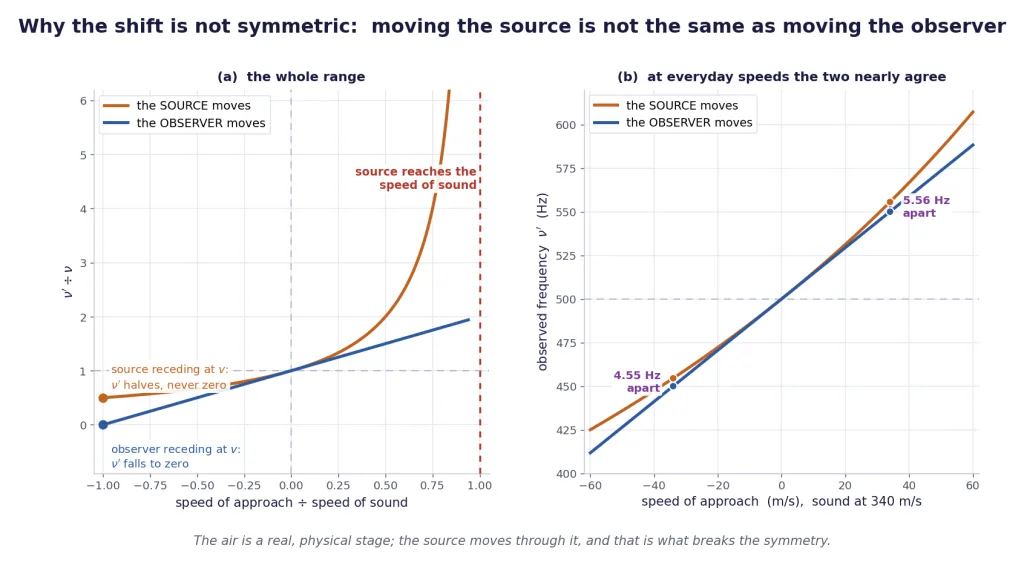
Why the asymmetry exists
Because sound has a medium, and the medium is a real physical stage that both parties can be moving with respect to. It is not a matter of point of view. A source rushing through the air genuinely deforms the pattern of crests it leaves behind; an observer rushing through the air leaves the pattern completely alone and merely samples it at a different rate. Those are different physical events, so there is no reason for them to give the same number.
Panel (a) of the figure shows how far apart they get. Write the speed of approach as a fraction of the speed of sound:
- source moving: , which runs away to infinity as the source approaches the speed of sound;
- observer moving: , a plain straight line, which only reaches 2 even when the observer travels at the speed of sound.
The two extremes make the point sharply. An observer receding at exactly the speed of sound hears nothing at all — the crests can never catch up, so . A source receding at exactly the speed of sound still delivers half its frequency, because its crests are still travelling forward at ; they are merely laid down twice as far apart.
Panel (b) shows why the asymmetry is easy to miss in practice. At everyday speeds the two curves are nearly on top of each other: at 34 m/s the answers differ by only 5.56 Hz out of 550, about 1%. Expand both and you can see why —
They agree in the first term and part company only at the square. For around 0.1 that squared term is 1%, which is exactly the gap in the table.
Key Point: For light the situation is different: light needs no medium, so there is no stage to be moving with respect to, and only the relative velocity of source and observer can matter. The Doppler shift for light is therefore symmetric — moving the source at a given speed and moving the observer at that same speed give identical results. Working that out properly needs special relativity and is not attempted here.
[NEET Important] "Is the Doppler effect in sound symmetric with respect to the source and the observer?" — the answer is no, and the reason is the medium. The follow-up "and for light?" — yes, because light has no medium and only relative velocity matters.
One Axis, One Formula
Four separate results have now appeared, and memorising four formulas with four sign patterns is exactly how marks get lost in an exam hall. They are all the same statement. Here is how to write them as one.
Draw the axis first
Key Point — the sign convention:
Draw the straight line joining the source to the observer, and take the direction from the SOURCE towards the OBSERVER as positive.
Then and are the signed velocity components of the source and the observer along that one line: positive if the body is moving in that direction, negative if it is moving the other way. Nothing else needs to be decided.
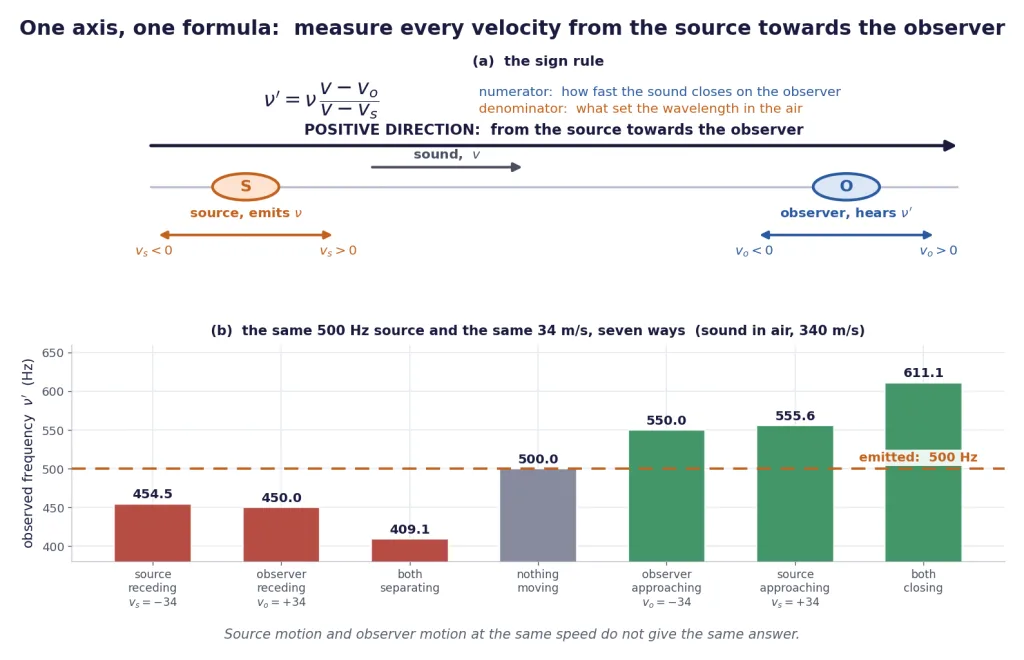
With that axis in place, both derivations fall into line.
- The source lays down a wavelength . (If the source is chasing its own sound and the crests crowd; if it is falling back and they stretch.)
- The observer meets those crests at a closing speed of . (If the observer is running away from the sound and the closing speed drops; if the observer is running into it.)
Divide the second by the first:
Key Point — the general Doppler formula for sound: with the positive direction taken from the source towards the observer, and the speed of sound in the medium. Read it as: the numerator is how fast the sound closes on the observer, and the denominator is what set the wavelength in the first place.
That single line covers every case in the topic. Nothing is memorised except the axis.
The four cases, worked separately as a check
Take Hz, m/s and a speed of 34 m/s throughout, and put each case through the formula. Panel (b) of the figure plots them.
| Case | Substituting | Expected | |||
|---|---|---|---|---|---|
| source approaching | 555.6 Hz | higher | |||
| source receding | 454.5 Hz | lower | |||
| observer approaching | 550.0 Hz | higher | |||
| observer receding | 450.0 Hz | lower | |||
| both closing | 611.1 Hz | higher still | |||
| both separating | 409.1 Hz | lower still | |||
| nothing moving | 500.0 Hz | unchanged |
Notice the signs in the third row. The observer is approaching the source, which means moving back along the axis, towards the source — so is negative, and the numerator grows. This is the one line where students routinely put the sign in the wrong way round, so it is worth saying out loud every time: approaching the source means moving in the negative direction, because the axis points away from the source.
The other way it is written
The same result also appears in a second form, and the two must never be mixed.
| Form | What means | What means |
|---|---|---|
| signed along the axis from source to observer | signed along that same axis | |
| positive when the observer moves towards the source | positive when the source moves towards the observer |
Both rows give the same number for every case in the table above; their two differ by a sign because they are measured in opposite directions. Draw the axis on your answer sheet and mark the positive direction on it before substituting, and the ambiguity cannot bite you.
Both moving at once
Nothing new is needed. Sign both velocities on the same axis and substitute. Two situations deserve a mention because they surprise people:
- Both moving the same way at the same speed — a car following a truck at an equal speed, say. Then , the numerator and denominator are equal, and . The gap between them is not changing, so nothing shifts. This is not a coincidence; it is the formula working.
- The source overtakes the observer. Nothing special happens to the algebra; the pitch simply steps down as the source's position passes the observer's, because the observer moves from the crowded side to the stretched side.
A wind along the line
A wind moves the whole medium bodily, and the sound is carried along with it. The rule is one line long.
Key Point — with a wind blowing:
Take the component of the wind velocity along the same positive axis, and use in place of everywhere: A wind blowing from the source towards the observer has ; a headwind has .
There is one consequence worth knowing on its own. If both the source and the observer are at rest, then and the cancels top and bottom: a wind cannot change the frequency you hear from a stationary source. It does change the wavelength — a 500 Hz note in a 20 m/s tailwind is laid down 0.72 m apart instead of 0.68 m — and it changes how fast the sound arrives, but the two effects cancel exactly in the ratio. Only relative motion between source, observer and each other shifts the pitch.
[JEE Tip] Every quantity in the formula must be measured relative to the ground (or, more precisely, relative to still air), never relative to each other. A question that says "the two trains approach each other at 40 m/s" has not given you enough information: you need each train's own speed, because the answer depends on how each is moving through the air, not just on the closing rate.
Reflectors: When the Shift Happens Twice
A large family of Doppler problems — and almost every real application of the effect — involves sound that goes out, bounces off something, and comes back. Bats, speed guns, ultrasound scanners, sonar: all of them work this way. There is exactly one idea to get right.
Key Point — the reflector rule:
A reflecting surface plays two roles, one after the other:
- First it is an observer. It receives whatever frequency the Doppler formula gives for its own motion.
- Then it is a source, re-emitting at precisely the frequency it just received, from wherever it now is and moving however it is moving.
So you apply the Doppler formula twice, in that order, with the output of step 1 becoming the input of step 2. Draw a fresh axis for the second step, because the sound is now travelling the other way.
The standard case, worked
A car sounds a 400 Hz horn and drives at 20 m/s straight at a large stationary wall. What frequency does the driver hear in the echo? Take the speed of sound as 340 m/s.
Step 1 — the wall as observer. The axis runs from the car (the source) to the wall, in the direction the car is travelling. The car moves along it, so ; the wall is at rest, so . The car is closing on the wall, so the wall receives a higher frequency:
Step 2 — the wall as source. Now the sound travels back from the wall to the driver, so the new axis points from the wall towards the car. The wall is at rest, so . The driver is moving towards the wall, that is, backwards along this new axis, so . The driver is closing on the sound, so the frequency goes up again:
Both steps pushed the pitch up, so the echo is 450 Hz against the 400 Hz that was sounded — a rise of 50 Hz, which is far more than either step alone would have given.
For this common arrangement — source and observer both riding on the same vehicle, moving at speed straight at a stationary reflector — the two steps collapse into one tidy result:
Key Point:
Check it: Hz, the same answer. The appears once in each place, which is the algebraic signature of the shift having been applied twice.
Where this is actually used
The bat. A bat emits ultrasonic chirps at 40 to 100 kHz — far above the 20 kHz ceiling of human hearing, and deliberately so, because a short wavelength reflects cleanly off small objects. The echo comes back Doppler-shifted by both the bat's motion and the prey's, and the bat reads the shift as a closing speed, not merely a distance. A bat flying at 6 m/s towards a wall while emitting 45 kHz hears its own echo at about 46.6 kHz, a rise of some 1600 Hz — an enormous, easily detected signal.
Medical ultrasound. A probe on the skin sends about 2 MHz into the body, where the speed of sound in soft tissue is roughly 1540 m/s. Red blood cells scatter it back, and because they are moving, the returned signal is shifted. Blood flowing at 0.30 m/s towards the probe returns a shift of about 780 Hz on 2 MHz — a fractional change of four parts in ten thousand, which sounds tiny but is straightforward to measure by comparing against the transmitted signal. Colour Doppler imaging paints flow towards the probe in one colour and flow away in another, from the sign of the shift, and clinicians use it to find blocked arteries, leaking heart valves and a foetal heartbeat.
The speed gun. Traffic radar sends out a microwave beam, which reflects off the moving vehicle and returns shifted twice over. The instrument measures the shift and inverts the double-Doppler formula for . Rearranging gives
which is how a measured frequency becomes a number on a ticket. Some hand-held units use ultrasound instead of microwaves and work in exactly this way with m/s.
The red shift. Light from distant galaxies arrives with every one of its spectral lines moved towards longer wavelengths — towards the red end — by the same fractional amount. Since a shift to longer wavelength means a lower frequency, the source must be receding. Measuring the fraction gives the speed:
and the striking discovery, made in the 1920s, was that almost every galaxy is receding, and the further away it is the faster it goes. That is the observational foundation of the expanding universe.
[NEET Important] Two facts about the reflector case are asked directly: the reflector acts first as an observer and then as a source, and the shift is therefore applied twice. If a question gives you an echo frequency and asks for a speed, expect the form.
[Board Important] "Give two applications of the Doppler effect" is a standard two-mark question. Safe pairs: the speed gun and medical blood-flow imaging; or bat echolocation and the red shift of receding galaxies.
When the Source Catches Up With Its Own Sound
Go back to and push upwards. At 170 m/s, half the speed of sound, the note ahead of the source is doubled. At 340 m/s the denominator is zero and the formula gives an infinite frequency. Beyond that it goes negative, which is a formula's way of announcing that the physical picture has changed and needs redrawing.
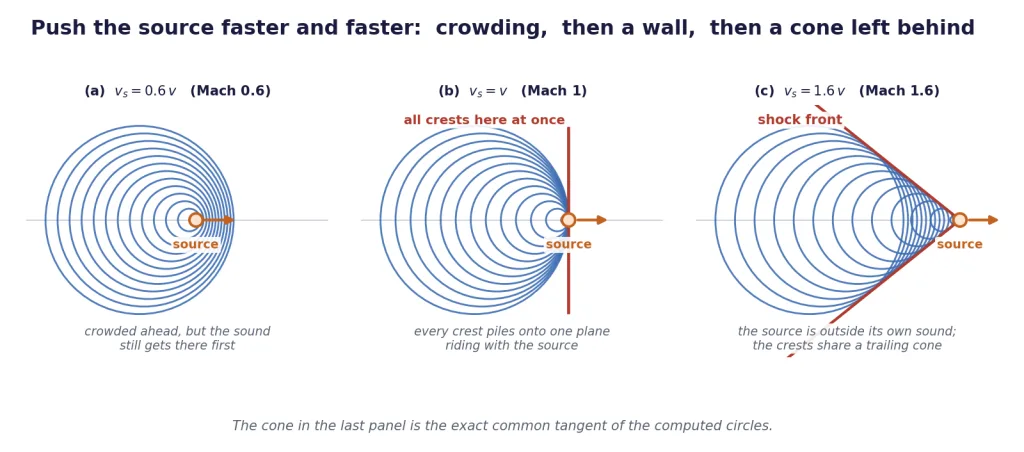
The wavefront construction tells the story better than the algebra does. It is the same construction as before — every circle drawn about the point the source actually occupied when it emitted that crest — pushed to three speeds.
Panel (a), below the speed of sound. The circles are crowded ahead of the source but the source is still inside them all. The sound gets there first; a listener ahead hears the source coming, at a raised pitch.
Panel (b), exactly at the speed of sound. Every crest the source has ever emitted now touches it. They pile up onto a single surface travelling along with the source, carrying the energy of all of them at once. The wavelength ahead has collapsed to zero, which is the infinity the formula was warning about.
Panel (c), above the speed of sound. The source has outrun its own sound and sits outside every circle it has made. There is now a region ahead of it that is completely silent — no sound has reached it, because nothing the source emitted can get there before the source itself does. Behind, the expanding circles all share a common tangent surface: a cone, trailing back from the source, on which the crowded wavefronts add up into a single sharp front.
Key Point — the shock front and the sonic boom:
When a source moves faster than the wave speed, the wavefronts it leaves behind pile up on a cone that trails from the source — the Mach cone. Across that cone the air pressure jumps abruptly, and when the cone sweeps over your ears you hear that jump as a single violent crack: the sonic boom. The ratio names the regime: below 1 is subsonic, exactly 1 is at the speed of sound, above 1 is supersonic. The faster the source, the narrower the cone. Its exact half-angle is taken up in the advanced work later in the chapter.
What people get wrong about the boom
It is not a one-off bang at the moment the aircraft "breaks the sound barrier". The cone trails behind the aircraft the entire time it is supersonic, sweeping along the ground beneath its flight path like the wake of a boat. Anybody the cone passes over hears a boom, whether the aircraft crossed Mach 1 a second ago or an hour ago. The pilot hears nothing unusual, being always ahead of the cone.
You hear it after the aircraft has gone past overhead, not as it arrives. The aircraft is outrunning its own sound, so it is well beyond you by the time the cone catches up. The characteristic experience is silence, then the aircraft passing overhead, then the crack.
It is not the Doppler effect breaking down. The Doppler formula is perfectly valid right up to ; what happens beyond is that no steady frequency can be defined ahead of the source at all, because the sound never arrives there. The formula does not fail so much as run out of a question to answer.
The same thing in other media
A boat travelling faster than the water waves it makes leaves a V-shaped wake behind it, for exactly the same geometric reason — the two-dimensional version of the same cone. And a fast charged particle moving through water faster than light does in water (which is well below light's speed in vacuum, so no rule is broken) leaves a cone of blue light behind it, called Cherenkov radiation. The construction in the figure is the whole explanation of all three.
[JEE Tip] If a problem gives a source speed at or above the speed of sound and asks for the frequency heard in front, the answer is not a number. There is no sound in front of a supersonic source, and the correct response is to say so.
Solved Examples
Conventions used throughout: SI units unless a question states otherwise. The speed of sound in air is taken as 340 m/s unless a problem gives another value. The positive direction is from the source towards the observer, and the direction of the shift is settled in words before the arithmetic, as a check. The general formula used is with and signed on that axis.
Example 1: The ambulance going past
An ambulance siren emits 500 Hz and the vehicle travels at 34 m/s along a straight road. A pedestrian stands still on the pavement. Find the frequency heard (a) as the ambulance approaches, (b) as it recedes, and (c) the wavelength in the air in each case.
Solution:
Step 1 — the axis and the prediction. Take the positive direction from the source (ambulance) towards the observer (pedestrian). The pedestrian is at rest throughout, so .
While approaching, the ambulance moves along the positive direction, so . It is closing the gap, so the frequency must come out higher than 500 Hz.
(a) Approaching:
Higher, as predicted.
(b) Receding. Now the ambulance moves the other way along the axis, so . The gap is opening, so the frequency must come out lower than 500 Hz.
Lower, as predicted.
(c) The wavelengths. These come from the source's motion alone, :
Final Answer: (a) 555.6 Hz; (b) 454.5 Hz; (c) 0.612 m in front and 0.748 m behind.
Takeaway: The total jump you hear as a vehicle passes is the sum of both shifts, here about 101 Hz, and it happens over the second or two the vehicle takes to sweep by. Note also that the rise (55.6 Hz) is bigger than the fall (45.5 Hz) — the source speed sits in the denominator, so shrinking it bites harder than growing it.
Example 2: The same speed, but now the listener moves
A siren fixed to a pole emits 500 Hz. A cyclist rides at 34 m/s (a) straight towards it and (b) straight away from it. Find the frequency heard in each case, and compare with Example 1.
Solution:
Step 1 — the axis and the prediction. Positive direction: from the source (siren) towards the observer (cyclist). The siren is bolted down, so throughout.
(a) Riding towards the siren. The cyclist moves back along the axis — towards the source, which is the negative direction — so . The gap is closing, so the frequency must be higher than 500 Hz.
(b) Riding away. Now , and the gap is opening, so the frequency must be lower.
Step 2 — the comparison.
| Who moves at 34 m/s | Approaching | Receding |
|---|---|---|
| the source | 555.6 Hz | 454.5 Hz |
| the observer | 550.0 Hz | 450.0 Hz |
The answers are close but not equal. In this case the wavelength in the air stays 0.680 m in every row of the observer's column, because a stationary source lays down the same wave no matter who is running about in it.
Final Answer: (a) 550.0 Hz; (b) 450.0 Hz — both differ from the corresponding source-motion answers.
Takeaway: The Doppler effect in sound is not symmetric, because the air is a real medium and moving through it is a different physical act from staying put in it. Get the sign of right by remembering that the axis points away from the source, so approaching it means a negative .
Example 3: Both of them moving, on the same road
A train sounds a 640 Hz whistle and travels at 20 m/s. Ahead of it, on a parallel road going the same way, a car travels at (a) 10 m/s, (b) 30 m/s, (c) 20 m/s. Find the frequency the driver hears in each case.
Solution:
Step 1 — the axis and the predictions. Positive direction: from the source (train) towards the observer (car), which here is the direction both vehicles are travelling. So both velocities are positive: throughout, and is , and in the three parts.
Before any arithmetic: in (a) the train is faster than the car, so the gap is closing and the answer must be above 640 Hz. In (b) the car is faster, the gap is opening, and the answer must be below 640 Hz. In (c) the gap is constant, so the answer must be exactly 640 Hz.
(a)
(b)
(c)
All three match the predictions.
Final Answer: (a) 660 Hz; (b) 620 Hz; (c) 640 Hz.
Takeaway: Sign both velocities on the same axis and the "both moving" case needs no new thinking. Part (c) is the one worth remembering: two bodies moving the same way at the same speed produce no shift at all, even though both are moving quite fast through the air.
Example 4: With a wind blowing
A source at rest emits 500 Hz. An observer runs towards it at 34 m/s. A steady wind of 20 m/s blows from the source towards the observer. Find the frequency heard, and compare it with the still-air answer.
Solution:
Step 1 — the axis and the prediction. Positive direction: from the source towards the observer. The wind blows along that direction, so and the effective speed is m/s. The source is at rest, ; the observer moves towards the source, so .
The gap is closing, so the frequency must be higher than 500 Hz. As for the wind: it speeds the sound along, which lengthens the wavelength in the air, and a longer wavelength being met at a given closing speed means slightly fewer crests per second. So the answer should be a little below the still-air value.
Step 2 — with the wind:
Step 3 — the still-air comparison ():
Higher than 500 Hz, and slightly below the still-air figure — both predictions confirmed. A headwind of 20 m/s would instead give and Hz, slightly above.
Final Answer: 547.2 Hz with the tailwind, against 550.0 Hz in still air.
Takeaway: A wind changes , not the velocities of the bodies. Add its signed component to the speed of sound in both the numerator and the denominator, and leave and alone — they are still measured relative to the ground.
Example 5: A wind, but nobody is moving
A stationary whistle sounds at 500 Hz and a listener stands still 100 m away. A 20 m/s wind blows from the whistle towards the listener. Find (a) the wavelength of the sound in the air and (b) the frequency heard.
Solution:
Step 1 — the axis and the prediction. Positive direction from source to observer; the wind is along it, so and m/s. Both bodies are at rest: .
Nothing is closing or opening the gap, so the prediction is that the frequency is unchanged — the wind alone cannot shift it.
(a) The wavelength. The whistle emits a crest every s, and in that time each crest is carried m downwind. So
against 0.680 m in still air. The wind has genuinely stretched the wave out.
(b) The frequency.
Unchanged, as predicted. The crests are 0.720 m apart but they sweep past the listener at 360 m/s instead of 340, and exactly.
Final Answer: (a) 0.720 m; (b) 500 Hz, unchanged.
Takeaway: A wind cannot Doppler-shift anything on its own. It stretches the wavelength and speeds the arrival in exactly compensating amounts. Only motion of the source or the observer relative to the air pattern changes the pitch.
Example 6: A horn, a wall and the driver's own echo
A car travelling at 20 m/s straight towards a large vertical wall sounds a 400 Hz horn. Find (a) the frequency the wall receives and (b) the frequency of the echo as heard by the driver.
Solution:
Step 1 — the wall as observer. Axis: from the car (source) to the wall (observer), in the direction the car is going. So and . The car is closing on the wall, so the wall receives a higher frequency than 400 Hz.
Step 2 — the wall as source. The wall now re-emits 425 Hz. Draw a new axis, from the wall (now the source) to the driver (now the observer) — it points backwards along the road. The wall is at rest, so . The driver is moving towards the wall, that is, against this new axis, so . The driver is closing on the returning sound, so the frequency rises again.
Step 3 — the check. For a source and observer riding together at towards a stationary reflector,
which agrees.
Final Answer: (a) 425 Hz at the wall; (b) 450 Hz heard by the driver.
Takeaway: The reflector is an observer first and a source second, so the shift is applied twice. Redraw the axis for the second step — the sound is coming back the other way now, and reusing the first axis is the standard way to lose this question.
Example 7: A bat and a wall
A bat flies at 6.0 m/s straight towards a wall, emitting ultrasound at 45.0 kHz. Find the frequency of the echo it hears.
Solution:
Step 1 — the wall as observer. Axis from bat to wall, along the flight direction: , . The bat is closing on the wall, so the wall receives a higher frequency.
Step 2 — the wall as source. New axis, from wall to bat. The wall is at rest, ; the bat flies towards the wall, so against this axis, . Higher again.
Step 3 — the one-shot check. Hz, the same.
The echo is 1616.8 Hz above what the bat emitted — a rise of 3.6%, which is a large and unmistakable signal.
Final Answer: about 46.6 kHz, roughly 1617 Hz above the emitted frequency.
Takeaway: The double shift makes echo methods sensitive. Applying the shift once at 6 m/s would give only about 808 Hz; doing it twice doubles the signal, which is why every practical Doppler instrument — bat, sonar, radar, ultrasound scanner — works by reflection.
Example 8: An ultrasonic speed gun
A hand-held speed gun emits ultrasound at 40.0 kHz towards a car approaching it head-on, and receives the reflected signal at 42.0 kHz. Find the speed of the car.
Solution:
Step 1 — the axis and the prediction. The gun is at rest and the car is the reflector, moving towards the gun. Both legs of the journey shift the frequency upwards — the car is an approaching observer on the way out and an approaching source on the way back — so the reflected signal must be above 40.0 kHz, and 42.0 kHz is consistent.
Step 2 — the double-shift relation. With the instrument at rest and the reflector approaching at speed , the same algebra as the previous two examples gives
Step 3 — invert it for . Cross-multiplying, , so and
That is about 29.9 km/h.
Step 4 — check by substituting back. Hz.
Final Answer: about 8.29 m/s, that is roughly 30 km/h.
Takeaway: Learn the inverted form — it is exactly what a speed gun computes, and it turns up in exams whenever a shift is given and a speed is wanted.
Example 9: Doppler imaging of blood flow
An ultrasound probe transmits 2.00 MHz into tissue in which the speed of sound is 1540 m/s. Blood is flowing directly towards the probe at 0.30 m/s. Find the frequency of the returned signal and the Doppler shift.
Solution:
Step 1 — the axis and the prediction. The red blood cells are the reflector, moving towards the stationary probe. As in the speed gun, the shift is applied twice and both steps raise the frequency, so the returned signal must be above 2.00 MHz.
Step 2 — the returned frequency.
Step 3 — the shift itself.
Step 4 — the useful approximation. Since here,
which agrees to better than one part in three thousand.
Final Answer: the returned signal is about 2.0008 MHz; the Doppler shift is about 779 Hz.
Takeaway: For a slow reflector the shift is very close to — twice the one-way shift, because the effect is applied twice. Note that a shift of 779 Hz on 2 MHz is a fractional change of only 0.04%, and the sign of that shift is what tells a clinician which way the blood is flowing.
Example 10: Working backwards from the two frequencies
An observer standing beside a straight road hears a vehicle's horn at 550 Hz as it approaches and 450 Hz after it has passed. The speed of sound is 340 m/s. Find (a) the speed of the vehicle and (b) the true frequency of the horn.
Solution:
Step 1 — the axis and the set-up. The observer is at rest, so throughout. Take the positive direction from the source towards the observer, and let the vehicle's speed be . Approaching, ; receding, .
Before any algebra, say where the answer must lie. The approaching value is raised and the receding value is lowered, so the horn's own frequency has to sit between 450 Hz and 550 Hz. And because the approach shift is always the larger of the two, it must sit below their midpoint of 500 Hz. Any answer above 500 Hz would be wrong on sight. So
Step 2 — divide, to kill .
Step 3 — back-substitute for .
Step 4 — check the other equation. Hz. It fits.
Notice where 495 Hz sits: it is not the arithmetic mean of 550 and 450, which would be 500. Eliminating instead of gives the exact rule,
the harmonic mean of the two heard frequencies.
Final Answer: (a) 34 m/s, about 122 km/h; (b) 495 Hz.
Takeaway: Divide the two equations first. The true frequency cancels immediately and you get the speed in one line; only then substitute back. And remember the true frequency is the harmonic mean of the approach and recede values, always a little below their average.
Example 11: The red shift of a receding galaxy
A hydrogen line whose laboratory wavelength is 656.3 nm is observed in the light of a distant galaxy at 663.0 nm. Taking the speed of light as m/s, find the speed of the galaxy and say whether it is approaching or receding.
Solution:
Step 1 — the direction, in words, first. Light has no medium, so there is no axis in a material to sign velocities against; all that can matter is whether the separation is growing or shrinking. The observed wavelength is longer than the laboratory value. A longer wavelength means a lower frequency, and a lowered frequency means the gap is opening. So the galaxy is receding — this is a red shift.
Step 2 — the fractional shift.
Step 3 — the speed. For light, and for speeds far below , the shift is symmetric in source and observer motion and depends only on their relative speed:
which is about 3060 km/s.
Step 4 — is the approximation safe? , about 1%, so relativistic corrections would enter at the level of — negligible here.
Final Answer: receding at about m/s, roughly 1% of the speed of light.
Takeaway: Red means receding, blue means approaching, and for light the whole calculation reduces to while . Unlike sound, it makes no difference whether it is the source or the observer that moves — light has no medium to move through.
Example 12: Mach numbers and the boom
An aircraft cruises at 680 m/s where the speed of sound is 340 m/s. (a) Find its Mach number. (b) A second aircraft flies at 300 m/s — will it produce a sonic boom? (c) The first aircraft carries a 500 Hz siren. What frequency does an observer directly ahead of it, on its flight path, hear before it arrives?
Solution:
(a)
The aircraft is supersonic, at Mach 2.
(b)
That is below 1, so the aircraft is subsonic and produces no sonic boom. Its sound still runs ahead of it, merely crowded.
(c) Take the positive direction from the source towards the observer, along the flight path. The aircraft moves along it, so , and the observer is at rest, so . The gap is closing, so the naive prediction is a raised frequency — but check the denominator first: , which is negative, and that is the warning. Try the formula anyway and it gives
which is meaningless as a frequency. The wavefront picture says why: the aircraft is travelling faster than any sound it emits, so no sound it has ever made has reached the region ahead of it. The observer hears nothing at all until the aircraft has gone past overhead and the shock cone sweeps over them — at which point they hear a single sharp boom rather than any steady note.
Final Answer: (a) Mach 2.0; (b) Mach 0.88, so no boom; (c) nothing is heard in front — the region ahead of a supersonic source is silent.
Takeaway: A negative or infinite answer from the Doppler formula is information, not an error. It is telling you that and the steady-frequency picture no longer applies ahead of the source. Say so in words; that is what the marks are for.