
Where Two Waves Meet
Everything so far has been about one wave at a time: one equation, one amplitude, one speed. A real medium is never that tidy. The air in the room you are sitting in is carrying a dozen sounds at once. A guitar string carries the wave you sent along it and the one coming back off the bridge. The sea surface carries swell from a storm a thousand kilometres away and ripples from the breeze right now.
So ask the question the chapter has been building towards. Two waves arrive at the same particle of the medium at the same instant. That particle cannot be in two places at once. What does it actually do?
The answer is the simplest one available, and it happens to be correct.
Key Point — the principle of superposition:
When two or more waves overlap in a medium, the resultant displacement of any particle at any instant is the algebraic sum of the displacements that the individual waves would have produced at that place on their own: Each wave travels as though the others were not there.
Two phrases in that statement carry all the weight.
Algebraic sum. Not "add the sizes". Displacements have signs: up is positive, down is negative. A crest arriving where another crest already is gives a bigger displacement. A crest arriving where a trough is gives a smaller one, and if the two match exactly it gives nothing at all. You always add with signs, never magnitudes.
As though the others were not there. Each wave keeps its own shape, amplitude, speed and direction right through the encounter. The medium is doing one thing at a time — a particle has one displacement, not two — but the waves themselves are unaffected by the meeting.
Waves are not particles, and this is where the difference shows
Roll two marbles at each other on a table. They collide, and afterwards both are changed: new speeds, new directions, possibly a chip out of each. A collision is an event that leaves permanent marks on both participants.
Two pulses on a string do nothing of the sort. They pass through each other and emerge on the far side with the shape, height and speed they had before, as though nothing had happened. This is not a small technical difference. It is the reason:
- you can pick out one friend's voice in a noisy room, when every sound in the room is sharing the same air;
- an orchestra of eighty instruments reaches you as eighty distinguishable sounds and not as mush;
- hundreds of radio and phone signals cross the same cubic metre of air every second without scrambling one another.
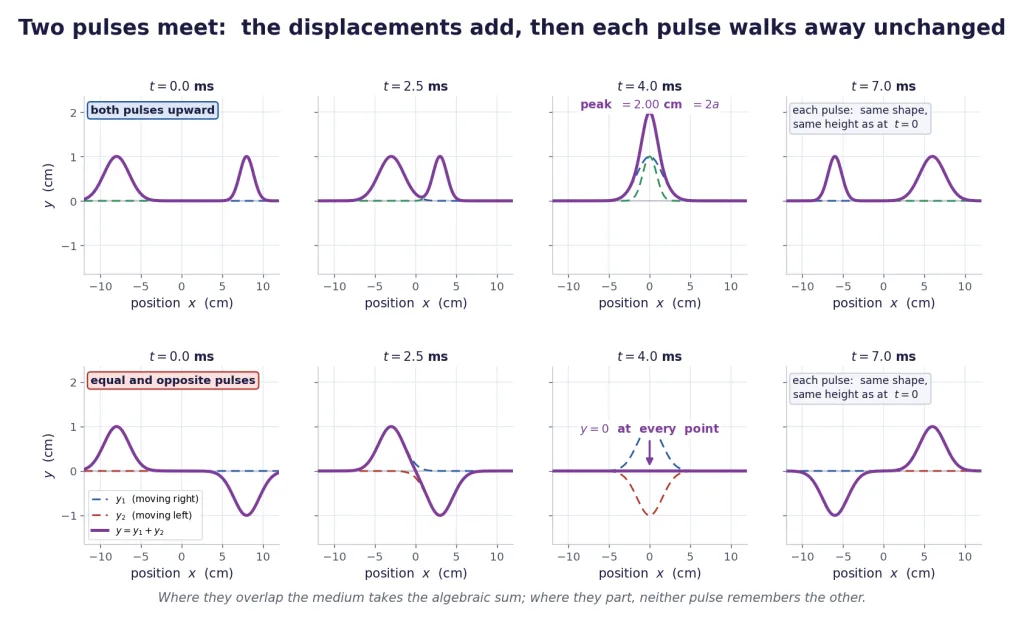
The top row of the figure follows two upward pulses of different widths. Far apart, the resultant curve just traces each pulse in turn. As they overlap the displacements add, and at full overlap the peak is 2.0 cm — the exact sum of the two 1.0 cm peaks. In the last frame the pulses have swapped sides and each is the shape and height it always was.
The bottom row is the more startling case: pulses of equal and opposite shape. At the moment of full overlap, every point of the sum is zero. The string is dead straight along its whole length.
The instant when the string looks empty
That third frame deserves a second look, because it sounds like a violation of energy conservation and is not.
At that instant the displacement is zero at every point. The velocity is not. Every element of the string is moving transversely, some upward and some downward, and a moment later the two pulses reappear on the far sides of one another exactly as they were. For that single instant the whole energy of both pulses is kinetic, with nothing stored as elastic potential energy. Nothing was destroyed and nothing was created; the energy simply changed form for an instant.
Why superposition works, and where it stops working
Superposition is not a fundamental law of nature in the way that conservation of energy is. It is a consequence of the medium responding in proportion to the disturbance.
On a stretched string with small displacements, the sideways restoring force on any element is proportional to how sharply the string is bent there. In a gas carrying ordinary sound, the pressure change is proportional to the fractional change in volume. "Proportional" is the key word: when the response is proportional, then if is a motion the medium can perform and is another, is automatically a third. That is exactly what the superposition principle asserts.
Push the disturbance hard enough and the proportionality breaks:
| Situation | What goes wrong |
|---|---|
| A string pulled sideways so far that its tension itself changes | The restoring force is no longer proportional to the displacement |
| The blast wave from an explosion | The compression is so violent that pressure is not proportional to the volume change |
| Very intense sound in air | The speed starts to depend on the wave's own amplitude, and the wave front steepens |
In those cases waves genuinely do alter one another, and the simple sum fails.
Key Point: The principle of superposition holds whenever the disturbance is small enough for the medium's restoring force to stay proportional to the displacement. Every wave in this chapter is of that kind, so the principle is used without further comment from here on.
[Board Important] The examiner's phrase is "algebraic sum of the individual displacements". Write it exactly like that. "Sum of the amplitudes" is wrong: amplitudes are fixed positive numbers belonging to whole waves, while displacements are signed and vary from point to point and moment to moment.
Two notation reminders
- is the angular wave number, , measured in rad/m. It is never a spring constant anywhere in this chapter.
- in this section is the phase difference between the two waves, not the phase constant of a single wave.
Two Waves, One Phase Difference
Adding pulses is a picture. To get numbers we need the principle applied to harmonic waves, and there is one case that carries almost the whole of the rest of the topic.
Take two waves on the same string that are as alike as two waves can be:
- same amplitude ,
- same angular frequency and the same angular wave number — so the same wavelength, the same frequency, and the same speed ,
- travelling in the same direction, towards .
The only way two such waves can differ at all is in where they are in their cycle. One is ahead of the other by a fixed phase . So write them as
Here is the phase difference: wave 2 reaches any given stage of its cycle earlier than wave 1 by that much phase.
Doing the sum
By the principle of superposition, the string's actual displacement is the sum:
Two sines added together — that is exactly what the identity
is for. Put and :
Cosine is an even function, so , and the sum collapses to
Key Point — the resultant of two identical waves differing in phase by : with resultant amplitude
Reading what came out
Three separate facts are hiding in that one line, and each is worth stating on its own.
1. The resultant is another harmonic travelling wave. It has the form , which is the standard form of a wave going towards . The and the are untouched, so the resultant has the same wavelength, the same frequency and the same speed as its two parents, and it runs in the same direction.
2. Its amplitude depends on the phase difference and on nothing else. contains no and no . Every particle of the string oscillates with that same amplitude; the amplitude is a property of the pair of waves, fixed once is fixed.
3. Its phase constant is . The resultant sits exactly halfway in phase between the two waves that made it, which is what symmetry demands — neither wave has any right to be favoured.
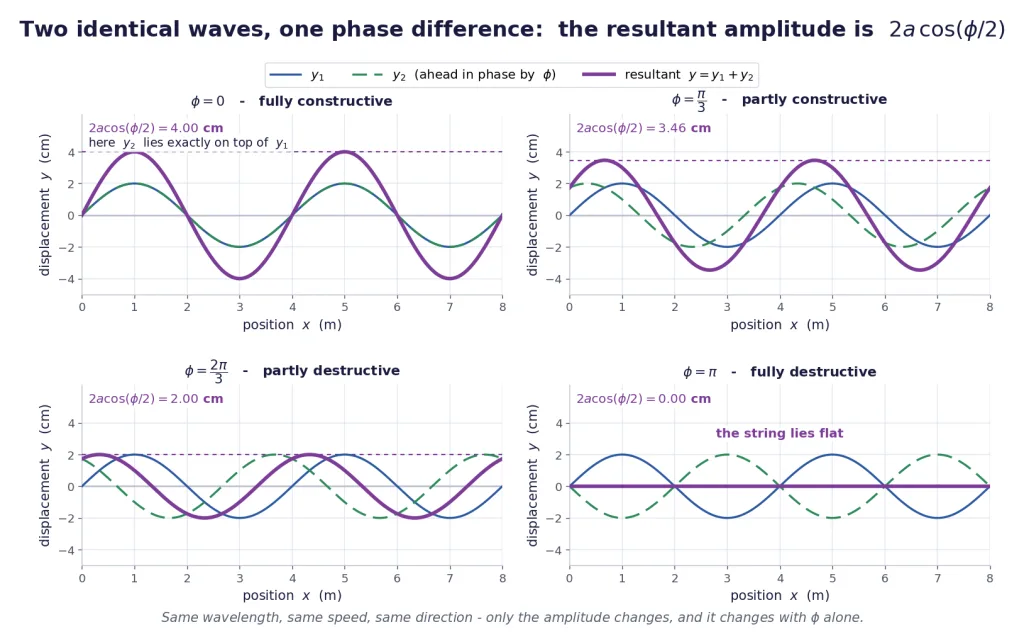
Each purple curve in the figure is the literal point-by-point sum of the blue and green curves above it, and in each panel the measured peak of that sum matches exactly.
A caution about the sign
For between and , comes out negative. An amplitude is a size and cannot be negative, so strictly
The minus sign has not disappeared — it has moved into the phase, since . In a numerical answer always quote the magnitude.
What the formula allows
| Phase difference | Resultant amplitude | Description | |
|---|---|---|---|
| largest possible | |||
| strongly reinforcing | |||
| partly reinforcing | |||
| same size as either wave alone | |||
| complete cancellation | |||
| magnitude again | |||
| largest again |
The fourth row is worth pausing on: two waves of amplitude can add up to a wave of amplitude . Nothing is wrong. Adding waves is not adding numbers, and the answer runs anywhere from to depending only on how the two are timed.
[JEE Tip] The resultant has the same frequency as the two waves. A frequent wrong answer doubles it, presumably because the amplitude doubled at . Superposing two waves of the same frequency can never manufacture a new frequency — look at the equation: the bracket still reads .
[Board Important] In a derivation question, the marks sit on four lines: write both waves, state the principle, apply the identity, and identify as the amplitude. Do not skip the middle two.
Constructive and Destructive Interference
The amplitude swings between and as changes. The two ends of that range have names, and they are the whole point of the topic.
Key Point: Interference is the superposition of two waves of the same frequency having a steady phase relationship, so that the resultant amplitude is larger than either wave alone at some places and smaller at others.
The two extreme cases
Constructive interference. is largest when , that is when , so
and then . The two waves are in phase: crest lands on crest, trough on trough, and the string swings twice as far as either wave could manage alone.
Destructive interference. is zero when , that is when , so
and then . The waves are exactly out of phase — crest lands on trough — and the string stays still, permanently, at every point.
Key Point — the phase conditions:
The same conditions written as path differences
In a real problem nobody hands you . You are given two sources and a point, and what you can actually measure is how much further one wave had to travel than the other. That extra distance is the path difference , and it converts to phase through
Substituting each condition in turn gives the two results that most interference questions are really testing.
In words, and this is the version to carry into the exam hall:
Key Point: With two sources in phase, a point is
- loud / bright when the path difference is a whole number of wavelengths, and
- quiet / dark when it is an odd number of half wavelengths.
The master table
| Character | Phase difference | Path difference | Amplitude | Intensity |
|---|---|---|---|---|
| Fully constructive | ||||
| Partly constructive | between and | between and | ||
| Neither | ||||
| Fully destructive |
Here is the intensity one wave would produce on its own, and the intensity of a wave goes as the square of its amplitude, so doubling the amplitude quadruples the intensity.
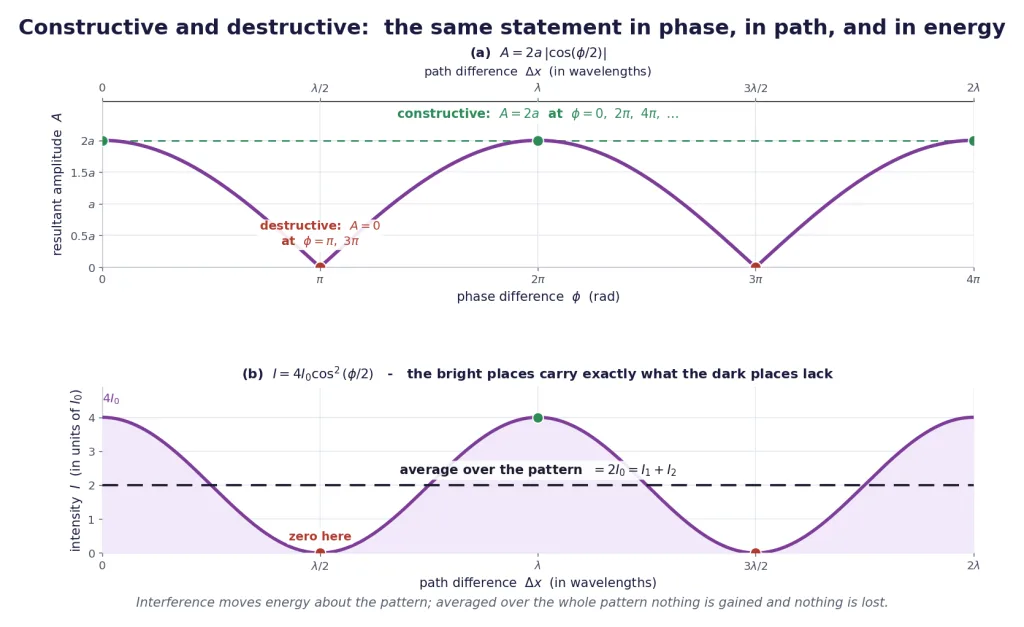
The upper panel of the figure is the amplitude curve with both scales on it at once: phase difference along the bottom, path difference in wavelengths along the top. The lower panel squares it into intensity, and the dashed line across it is the subject of the last block of this section.
A picture to keep in your head
Two loudspeakers, side by side, wired to the same amplifier so that they push out and pull in together. Walk slowly along a line in front of them.
- At the point equidistant from both, the two waves have travelled the same distance. , so : loud.
- Move sideways until one speaker is exactly half a wavelength further away than the other. , so : quiet, sometimes startlingly so.
- Keep going until the extra distance is a full wavelength: loud again.
That alternation of loud and quiet as you walk is interference made audible, and it needs nothing but two speakers and one amplifier.
[JEE Tip] The commonest trap in the whole topic. The conditions and assume the sources themselves are in phase. If the sources start with a built-in phase difference , the total is
and when the two conditions swap over completely: equal paths now give silence, and a path difference of gives the loudest point. Before you use any path-difference rule, ask: are the sources in phase?
[NEET Important] Two lines are worth committing to memory word for word: path difference gives a maximum; path difference gives a minimum — for sources that are in phase. Almost every single-step interference question in the paper is one of these two lines plus one division.
When the Amplitudes Are Not Equal
Two waves reaching the same point have almost never travelled the same distance from equally strong sources, so their amplitudes usually differ. The method does not change — you still just add the displacements — but the algebra needs one more step, and the answer is worth knowing on sight.
Take
and write to keep the page clean. Expanding the second wave,
so the sum groups into a part and a part:
We want that in the form , which expands to . Matching the two coefficients:
Square both and add, and clears the left side:
Key Point — the general two-wave resultant: The resultant is still a harmonic wave of the same frequency, wavelength, direction and speed; only its amplitude and its phase constant are new.
That is the parallelogram law wearing a hat
Look at the formula. It is identical in shape to the magnitude of the resultant of two vectors of lengths and with an angle between them. That is not a coincidence.
A harmonic wave of amplitude and phase can be represented by an arrow of length drawn at angle , called a phasor. Every phasor of the same frequency rotates at the same rate , so the angle between two of them stays fixed at forever. Adding waves of the same frequency is therefore nothing but adding those arrows head to tail — and the length of the closing arrow is the resultant amplitude, while the angle it makes is the resultant's phase constant .
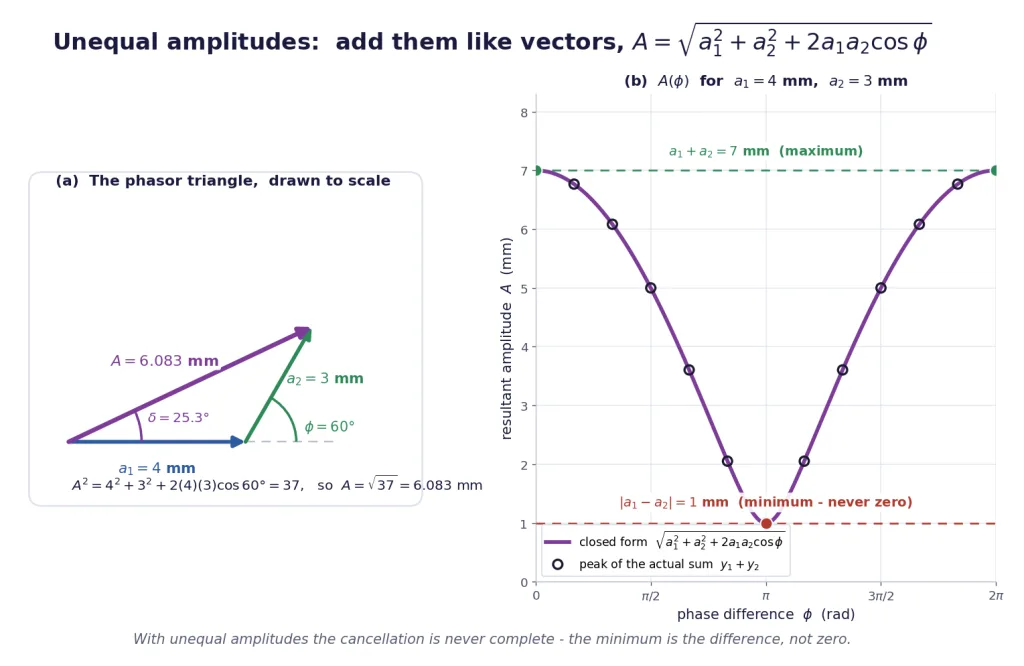
Panel (b) of the figure plots against for a mm wave and a mm wave. The open circles on it were obtained by taking the peak of the actual sum at each phase difference; they sit on the curve.
Three checks, and they all work
: , so . The largest the resultant can be.
: , so . The smallest it can be — and notice that it is not zero unless the amplitudes happen to be equal.
: , and , giving . The earlier result, recovered exactly, as it had to be.
Key Point: The resultant amplitude of two waves always lies between and . Complete darkness or complete silence is only possible when the two amplitudes are equal.
The same statement in intensities
The intensity of a wave is proportional to the square of its amplitude, so squaring the boxed result and writing , gives
The first two terms are what you would get by simply adding the two beams; the third, the interference term, is what makes the pattern. It is positive where the waves reinforce, negative where they oppose, and it averages to nothing — which is the subject of the next block.
Setting and gives the ratio that examiners love:
[JEE Tip] Watch which ratio you are given. If the question says "the amplitudes are in the ratio 3 : 1", work with , directly. If it says "the intensities are in the ratio 9 : 1", take square roots first to get amplitudes 3 and 1, and only then form . Feeding intensities into the amplitude formula is the single most common slip here.
Energy, and What "Coherent" Has to Mean
The awkward question
At a point of fully destructive interference the string never moves; a listener standing at one hears nothing at all. Meanwhile two sources are pouring energy into the medium without pause. So where has the energy at that point gone? Has interference destroyed energy?
It has not, and the bookkeeping is worth doing in full, because a version of this question appears in every exam.
Doing the accounting
Take the equal-amplitude case, and let be the intensity that one wave alone would produce at the point in question. Since intensity goes as the square of the amplitude, and ,
Now look at what that gives across a whole pattern:
- at a maximum, — four times what one source delivers, and twice the the two sources would give if they simply added without interfering;
- at a minimum, ;
- averaged over the pattern, , so
which is precisely the energy the two sources put in. The surplus at the bright places is exactly equal to the deficit at the dark places.
The general case says the same thing even faster. Averaging over the pattern, the interference term dies because , leaving .
Key Point: Interference redistributes energy; it never creates or destroys it. Energy missing from the minima has been moved into the maxima, and the average intensity over the whole pattern is exactly .
And the local picture matches the global one. Energy does not arrive at a dark point and get annihilated there; it never settles there in the first place. It flows sideways through the medium, away from the places of cancellation and towards the places of reinforcement.
[Board Important] The one-line answer to "is energy conserved in interference?" is: yes, energy is only redistributed — the maxima gain exactly what the minima lose, and the average intensity is unchanged at .
Why every interference pattern needs coherence
Everything above quietly assumed something: that the phase difference at a given point is the same now as it was a second ago. If at a point wandered, the point would be loud at one moment and quiet at the next, and there would be no pattern to see or hear — only a blur.
That requirement has a name.
Key Point — coherent sources are two sources that
- emit waves of the same frequency, and
- maintain a constant phase difference between them in time.
Interference that stands still and can be observed happens only between coherent sources.
Why the frequencies must match. If , then and pull apart as the clock runs, so the phase difference at any fixed point changes steadily with time instead of sitting still. No point stays permanently loud or permanently quiet, so no fixed pattern of maxima and minima exists at all.
Why the phase must be locked. Two independent sources — two candles, two bulbs, two whistles blown by two people — are made of a colossal number of atoms or molecules radiating on their own account. Each radiates in a short burst, and after each burst the phase starts again at a fresh random value. Millions of times a second, the phase difference at your chosen point jumps to a new random number. The maxima and minima do exist at every instant, but they rearrange themselves far faster than any eye or ear or instrument can follow, and what you actually detect is the time average:
Uniform illumination, uniform loudness, no pattern whatsoever.
Coherent and incoherent, side by side
| Coherent sources | Incoherent sources | |
|---|---|---|
| Frequencies | identical | need not be, and are not locked |
| Phase difference at a point | fixed in time | changes randomly and very fast |
| What adds | amplitudes, as phasors | intensities |
| Resultant intensity | everywhere | |
| What you observe | a steady pattern of maxima and minima | uniform, featureless |
How coherence is arranged in practice
There is one reliable trick: make both waves come from a single source.
- Two loudspeakers fed from the same amplifier are coherent, because one electrical signal drives both. This is why sound interference is easy to demonstrate in a corridor with equipment from the school lab.
- Two openings in a screen fed by one vibrating source behind it emit coherent waves, because a single oscillator is driving both.
- For light, a single beam is split into two and the two are recombined; a laser makes the whole business far easier because its light stays in step for a long time on its own.
[NEET Important] Two independent sources of exactly the same frequency are still not coherent. Sameness of frequency is necessary but nowhere near sufficient; the phase relationship has to be locked as well. That is why two identical bulbs side by side never produce dark bands on the wall, however carefully they are matched.
[JEE Tip] If a question says "two identical, independent sources", the expected answer is that the intensities simply add, giving uniformly. If it says "two coherent sources" or "driven by the same oscillator", you are expected to use the full formula with the term. Read that phrase before you start calculating.
Solved Examples
Conventions used throughout: SI units unless a question states otherwise. The standard form is , so a minus sign between and means travel towards . The symbol is the angular wave number in rad/m and the angular frequency in rad/s. Where a speed of sound in air is needed and no temperature is given, it is taken as 340 m/s. Sources are assumed to be in phase unless the question says otherwise. Intensity is taken as proportional to the square of the amplitude, and means the intensity one of the two waves would produce alone at the point being discussed.
Example 1: Two waves that differ only in phase
Two waves travel along the same string in the direction:
in SI units. Find (a) the wavelength, frequency and speed of each wave, (b) the amplitude of the resultant, and (c) the equation of the resultant wave.
Solution:
Step 1 — read the constants off the brackets. Comparing with ,
(a)
Both waves share all three, since they share and .
Step 2 — identify the phase difference. The brackets differ by , so , i.e. 60°.
(b)
(c) The resultant carries the same and and a phase constant of :
Final Answer: m, Hz, m/s; resultant amplitude 8.66 cm; .
Takeaway: Only the amplitude and the phase constant are new. Copy and straight across into the resultant — if your answer has a different or in it, you have made an algebra error.
Example 2: Working backwards from the amplitude
Two waves of equal amplitude 4.0 mm, equal frequency and the same direction of travel superpose, and the resultant has an amplitude of 4.0 mm. (a) What is the phase difference between them? (b) If the wavelength is 60 cm, what path difference does that correspond to?
Solution:
(a) Put the numbers into the amplitude relation and solve for :
(b) Convert phase to path with , rearranged:
so a path difference of 20 cm, which is one third of a wavelength — as it must be, since is one third of .
Final Answer: (a) rad, or 120°; (b) 20 cm, that is .
Takeaway: Two waves of amplitude each can give a resultant of amplitude . It happens at exactly , and it is a favourite one-line question.
Example 3: Two loudspeakers and a quiet spot
Two loudspeakers are driven in phase by the same amplifier at 340 Hz. A listener stands at a point 4.0 m from one speaker and 5.5 m from the other. Take the speed of sound as 340 m/s. (a) Is the point loud or quiet? (b) Keeping the listener where she is, what is the lowest frequency above 340 Hz that would make the point loud?
Solution:
Step 1 — the wavelength.
Step 2 — the path difference.
Step 3 — compare with the conditions. In wavelengths, . Written in half wavelengths, , an odd number of half wavelengths. So
which is an odd multiple of .
(a) The point is quiet: this is destructive interference, and since the two waves arrive with very nearly equal amplitudes the cancellation is close to complete.
(b) For a maximum the path difference must be a whole number of wavelengths, , so
gives 226.7 Hz, which is below 340 Hz. gives
Final Answer: (a) quiet — destructive interference, ; (b) 453.3 Hz.
Takeaway: Turn the path difference into a number of wavelengths and look at it. announces itself as destructive instantly; there is no need to compute at all unless the question asks for it.
Example 4: A sine and a cosine
Two waves travelling in the same direction along a string are
Find the amplitude and the phase constant of the resultant.
Solution:
Step 1 — put both waves in the same form. A cosine is a sine that is a quarter cycle ahead: . So
and the phase difference is , i.e. 90°.
Step 2 — the amplitudes are unequal, so use the general formula. With the cross term vanishes:
Step 3 — the phase constant.
So in millimetres.
Final Answer: amplitude 5.0 mm, phase constant 53.1° (that is 0.927 rad).
Takeaway: When the phase difference is 90° the amplitudes add in quadrature — the phasors are perpendicular and it is straight Pythagoras. Spot a sine-plus-cosine pair and you can write down immediately.
Example 5: Unequal amplitudes at 60 degrees
Two waves of the same frequency travel in the same direction with amplitudes 6.0 mm and 8.0 mm, the second leading the first by 60°. Find the amplitude of the resultant and the angle by which it leads the first wave.
Solution:
Step 1 — the amplitude, from the general result. With ,
Step 2 — sanity check the size. It must lie between mm and mm. It does, and it sits nearer the top of that range because 60° is a fairly small phase difference.
Step 3 — the phase constant.
Final Answer: amplitude 12.2 mm, leading the first wave by 34.7°.
Takeaway: The resultant's phase always lies between the two waves' phases, closer to the stronger one. Here sits between 0° and 60°, but past the halfway mark on the side of the 8.0 mm wave, which is exactly what a phasor triangle would show.
Example 6: From an intensity ratio to a contrast ratio
Two coherent waves arriving at a point have intensities in the ratio 9 : 1. Find the ratio of the maximum to the minimum intensity in the interference pattern they produce.
Solution:
Step 1 — convert intensities to amplitudes first. Intensity goes as amplitude squared, so
Take units and unit.
Step 2 — the extreme amplitudes.
Step 3 — square them to get intensities.
Final Answer: .
Takeaway: Square-root on the way in, square on the way out. Feeding 9 and 1 straight into gives , which is wrong, and it is the error this question is built to catch.
Example 7: A quarter of a wavelength
Two identical coherent sources produce waves that arrive at a point with a path difference of . Each wave alone would produce intensity at . Find (a) the phase difference, (b) the resultant amplitude in terms of the individual amplitude , and (c) the intensity at , both in terms of and as a fraction of the maximum intensity in the pattern.
Solution:
(a)
(b)
(c) Intensity goes as the square of amplitude. One wave alone has amplitude and intensity , so
The maximum in the pattern is (where ), so
Final Answer: (a) ; (b) , that is ; (c) , which is half the maximum intensity.
Takeaway: A quarter-wavelength path difference is the "neither" point — the intensity there, , is exactly what you would get with no interference at all. It is the level the pattern's average sits at.
Example 8: Adding two waves and getting one of them back
Two waves of amplitude 2.0 cm each, of the same frequency, travelling in the same direction, superpose with a phase difference of . (a) Find the amplitude of the resultant. (b) What fraction of a wavelength is the corresponding path difference? (c) If each wave alone gives intensity , what is the intensity of the resultant?
Solution:
(a)
The resultant has the same amplitude as either wave on its own.
(b)
(c) Amplitude unchanged means intensity unchanged:
Two sources are supplying between them and this particular point is receiving — the missing half has gone to the brighter parts of the pattern.
Final Answer: (a) 2.0 cm; (b) ; (c) .
Takeaway: A phase difference of 120° leaves the amplitude exactly as it was. Remember the pair ; it turns up constantly.
Example 9: Speakers wired the wrong way round
Two loudspeakers face a listener, and one has been connected with its terminals reversed, so the two cones move in exactly opposite senses: the sources are out of phase. They are driven at 680 Hz. Take the speed of sound as 340 m/s. (a) What does a listener standing exactly midway between them hear? (b) What is the smallest path difference that would make the sound loudest?
Solution:
Step 1 — the wavelength.
Step 2 — write the total phase difference. With a built-in source phase difference ,
(a) Midway between the speakers, , so : an odd multiple of , therefore destructive. The listener hears silence, or very nearly so — the point that would normally be the loudest of all is the quietest.
(b) For a maximum we need . The smallest positive path difference comes from :
Final Answer: (a) silence at the midpoint; (b) a path difference of 0.25 m, that is .
Takeaway: Reversing one source swaps every maximum and minimum in the pattern. Whenever the sources are not in phase, add to before applying any condition — never apply blindly.
Example 10: Where the energy at a dark point went
Two coherent sources each produce an intensity of 5.0 W/m² at a screen when the other is switched off. (a) What is the intensity at a point of fully constructive interference? (b) At a point of fully destructive interference? (c) What is the average intensity over the whole pattern, and how does it compare with the two sources' output? (d) What would the screen look like if the sources were made incoherent?
Solution:
Step 1 — set up. Equal intensities means equal amplitudes, so W/m², and
(a) At a maximum, :
(b) At a minimum, , so .
(c) Averaging over the pattern uses :
and the two sources between them are delivering W/m². The two numbers agree exactly. No energy has been gained or lost — the 20 W/m² at the maxima is paid for entirely by the zeros at the minima.
(d) With incoherent sources the interference term averages to zero everywhere, so the screen would be uniformly lit at W/m², with no bright or dark places at all.
Final Answer: (a) 20 W/m²; (b) zero; (c) 10 W/m², exactly equal to ; (d) uniform 10 W/m², no pattern.
Takeaway: A maximum is four times one source, not twice. The chain is , and it is that factor of 4 against an average of 2 that makes the energy books balance.
Example 11: Out of phase, but not silent
Two waves of amplitudes 5.0 mm and 3.0 mm, of the same frequency and direction, arrive at a point exactly out of phase. (a) Find the resultant amplitude. (b) Find the ratio of the maximum to the minimum intensity in the pattern. (c) Express the minimum intensity as a percentage of the maximum.
Solution:
(a) "Exactly out of phase" means , so :
Not zero. Complete cancellation needs equal amplitudes, and these are not equal.
(b)
(c)
So even at its darkest the pattern still carries 6.25% of its brightest intensity — the minima are grey, not black.
Final Answer: (a) 2.0 mm; (b) 16 : 1; (c) 6.25%.
Takeaway: Destructive does not automatically mean zero. The minimum amplitude is , and a question that asks for "the minimum intensity" when the amplitudes are unequal is checking whether you reached for zero out of habit.