
Writing a Travelling Wave Down
The previous section settled what a wave is: a disturbance that travels while the medium stays put, with each particle oscillating about its own fixed place. That description is complete, and it is also useless for calculation. To get numbers out of a wave we need a formula.
So ask what the formula has to do. A wave has a shape that changes its position as time runs, so the displacement of the medium must depend on two things at once — where you are looking, and when. The function has to be , of two variables, and it has to satisfy two separate demands:
- Stop the clock at some instant. What you should get is the shape of the wave right then — a sine curve laid out along the axis.
- Stand at one fixed place and watch. What you should get is one particle bobbing up and down about its rest position — simple harmonic motion, exactly what the previous chapter was about.
There is one function that does both jobs at once, and this is it.
Key Point — the displacement relation for a progressive wave:
- is the displacement, at time , of the particle of the medium whose rest position is .
- is the amplitude — the largest displacement any particle reaches.
- , the whole bracket, is the phase, measured in radians.
- is the phase constant (also called the initial phase angle) — the value of the phase at and .
- is the angular wave number and the angular frequency; the next block gives them properly.
Here is the angular wave number in radians per metre, not a spring constant.
Checking that it really does both jobs
Freeze the time. Put , some fixed number. Then is just a constant, and
which is a sine curve in . So a snapshot of the medium is sinusoidal, as a harmonic wave's snapshot must be.
Freeze the position. Put , some fixed number. Then is a constant, and
which is simple harmonic motion in , of angular frequency and amplitude . So every particle of the medium performs SHM — a different one at each , all with the same amplitude and the same frequency, and differing only in when each reaches its crest.
That is the whole idea: the same equation is a shape when you fix and an oscillation when you fix , and stitching those two together is what makes a wave.
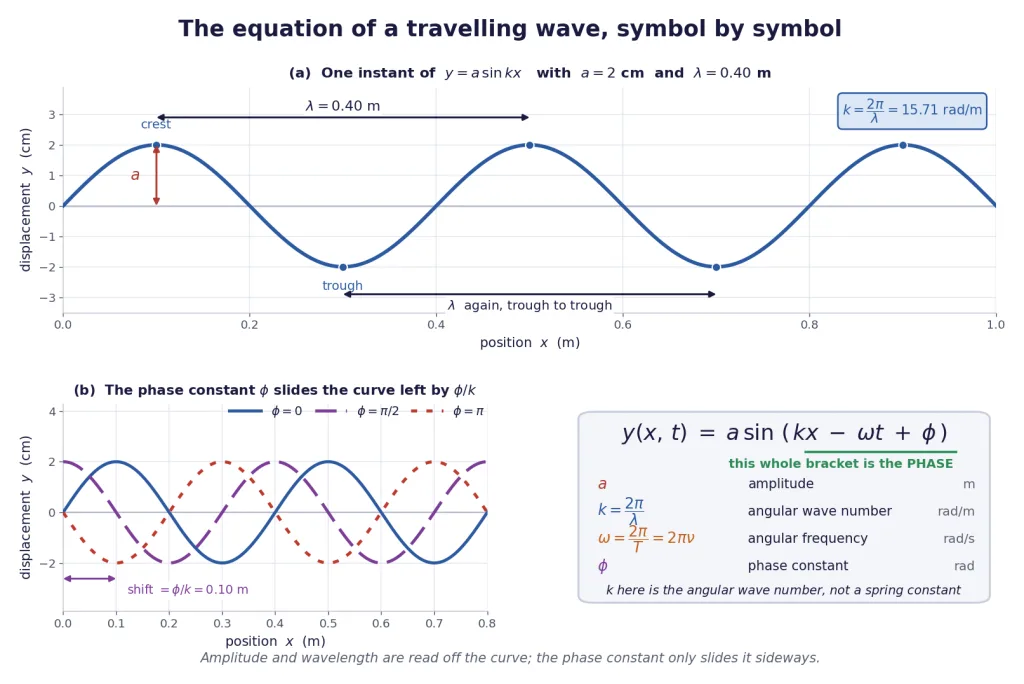
The amplitude
Since the sine of anything lies between and , the displacement lies between and . So is the maximum displacement of a particle from its equilibrium position, and it is taken to be positive — the sine already supplies both signs. Note the wording carefully: can be positive or negative, but never is, and the crest-to-trough height of the wave is , not .
The phase, and the phase constant
These two are constantly confused, and the confusion is worth killing early.
- The phase is the entire bracket, . It is a number of radians, it changes as you move along the wave and as time passes, and — given the amplitude — it fixes the displacement completely. Two particles "in the same phase" are two particles whose brackets differ by a whole number of .
- The phase constant is a single fixed number carried by the wave. Put and in the bracket and everything vanishes except , so is the phase at the origin at the instant the clock starts.
Key Point: The phase is the whole bracket. alone is the phase constant. Calling "the phase" will cost you marks in exactly the questions that ask for a phase difference.
What does actually do to the picture? Nothing except slide it sideways. Panel (b) of the figure shows three waves with the same and the same but , and : the shape is identical in all three, shifted left by . That is why a problem can almost always be set up with — you are free to start your metre rule and your stopwatch wherever you like, and a convenient choice makes zero. When the problem tells you where the particle at the origin was at , you are no longer free, and has to be worked out.
The sine-plus-cosine form
A wave is sometimes handed to you as a sine and a cosine added together:
This is the same wave in disguise. Comparing it with expanded out gives
so the amplitude is not , and it is not either. It is the square root of the sum of the squares, exactly as when two perpendicular vectors are added.
The longitudinal version
Everything above was written for a transverse wave, where it is natural to call the displacement because it is across the direction of travel. For a longitudinal wave the displacement is along the direction of travel, so writing it as would be misleading. The usual symbol is :
Here is how far the element of medium at position has been pushed forwards or backwards along the line of travel at time , and is the displacement amplitude. Not one symbol's meaning changes apart from that. Everything in this section applies to sound in a pipe exactly as it applies to a wave on a string.
[Board Important] "Write the equation of a progressive wave and explain the meaning of each symbol" is a standard three-marker. Write the equation, then define , , the phase, , and with their units. The units are where the easy marks are, and where most answers stop short.
The Four Constants and What They Measure
A wave repeats itself in two independent ways: it repeats along the wave at one instant, and it repeats in time at one place. Each repetition needs a pair of names — one for the repeat itself, one for how much phase that repeat is worth.
Wavelength and the angular wave number
Key Point: The wavelength is the minimum distance between two points of the wave that are in the same phase — most easily counted crest to crest, or trough to trough. Its unit is the metre.
Now find what that means for . Take the snapshot at with , so , and ask how far you must move for the displacement pattern to repeat. The sine function repeats when its argument grows by , so the displacement at and at are identical. The least such distance is the wavelength:
is called the angular wave number (or the propagation constant), and its SI unit is the radian per metre. Read it as the number of radians of phase packed into one metre of the medium. A short wavelength crams a lot of phase into a metre, so is large; a long wavelength gives a small .
Here is the angular wave number in rad/m. It is not a spring constant, and it carries no newtons.
Period, angular frequency and frequency
Now stand still instead. Take and , so , and ask how long you must wait for the motion to repeat. The sine repeats when its argument grows by , so
Key Point: The period is the time one particle takes to complete one full oscillation, in seconds. The frequency is the number of complete oscillations per second, in hertz, and the two are reciprocals: is the angular frequency, in radians per second.
The two are the same idea, applied to the wave's two variables
Set them side by side and the symmetry does the teaching:
| In space | In time |
|---|---|
| the repeat is the wavelength , in m | the repeat is the period , in s |
| phase per metre: , in rad/m | phase per second: , in rad/s |
| the term of the phase is | the term of the phase is |
| move one wavelength and the phase changes by | wait one period and the phase changes by |
and are twins: one counts radians per metre, the other radians per second. Everything you know about one has a mirror image for the other, and remembering that halves the work in this chapter.
The symbol table for this section
| Symbol | Meaning | Unit | Also written |
|---|---|---|---|
| , or | displacement of a particle from its rest position | m | |
| amplitude, the largest displacement | m | , | |
| angular wave number, | rad/m | ||
| angular frequency, | rad/s | ||
| phase constant | rad | ||
| wavelength | m | ||
| period — not tension, which shares this letter later in the chapter | s | ||
| frequency, | Hz |
Reading the constants straight off an equation
This is the single most common question type in the whole chapter, and it is pure pattern matching. Line the given equation up against and read across.
Take , with everything in SI units. Term by term:
- the number in front of the sine is m, that is 2 cm;
- the number multiplying is rad/m, so m;
- the number multiplying is rad/s, so s and Hz;
- there is no extra constant, so .
Four lines, four constants, and the wave is completely described. Notice the arithmetic check built into it: , and as well. Those two agree for a reason, which the next section takes up.
[NEET Important] Watch the units on the constants you read off. The number multiplying is in rad/m; the number multiplying is in rad/s. Neither of them is a wavelength or a period — you get those by dividing by them. Quoting as "the wavelength" is the single commonest slip in this topic, and it is worth checking twice, because and move in opposite directions: the bigger is, the shorter the wave.
[JEE Tip] If an equation is given with numbers but no units, assume SI: metres for and , seconds for , and hence rad/m for and rad/s for . If the displacement is quoted in centimetres, the amplitude is in centimetres too, but and are still tied to whatever unit and carry — read the bracket, not the front.
Which Way Is It Going?
and look almost identical, and they describe waves running in opposite directions. Here is why, argued rather than asserted.
Ride along with a crest
Pick any one feature of the wave — a particular crest, say. What makes it that crest, and not the one next to it, is its phase: a crest is a point where the phase is , or , or , and so on. If you want to keep your eye on the same crest as time goes by, you must move so that its phase stays constant:
Now let time run forward. The term is getting more and more negative. For the total to stay put, must grow by exactly as much, and since is positive, must increase. The crest is moving towards larger .
Do the same for the plus sign. The condition is now
and as grows, grows, so must shrink to compensate: decreases and the crest moves towards smaller .
Key Point — the direction rule: Opposite signs on and means the wave goes towards ; the same sign means it goes towards . That sentence covers every disguise, because it does not care what is in front of the bracket.
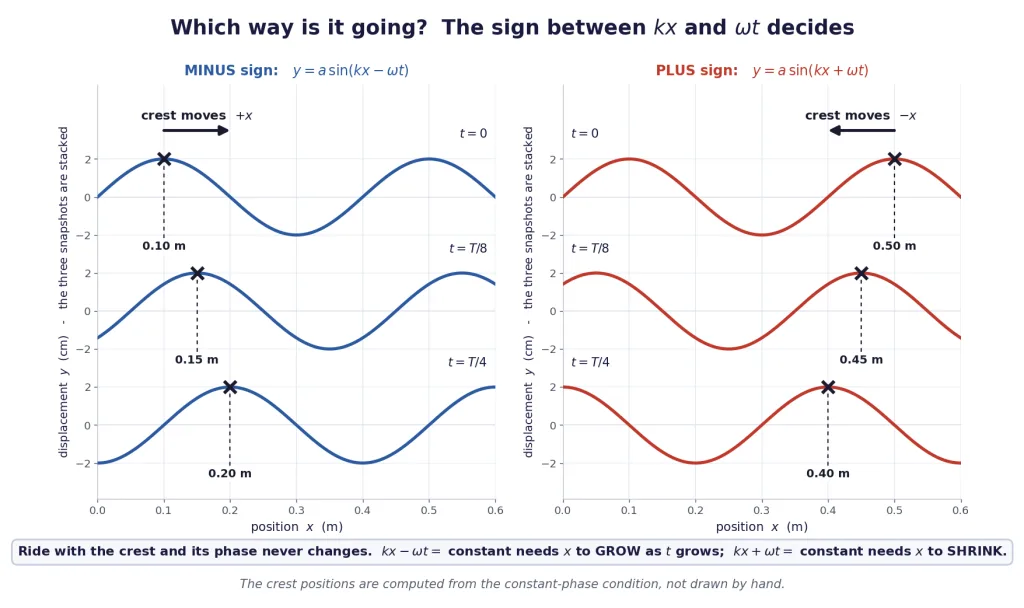
In the figure, one crest is marked with a cross in each of three snapshots taken a period apart in eighths. On the left the marked crest sits at 0.10 m, then 0.15 m, then 0.20 m — it is walking to the right. On the right it sits at 0.50 m, then 0.45 m, then 0.40 m. Same wavelength, same amplitude, same period; opposite directions, and the only difference in the two equations is one sign.
The four disguises
Examiners rarely hand you the equation in the standard form. Here is the same rightward-travelling wave written four ways, and the same test applied to each.
| The equation as given | term, term | Direction |
|---|---|---|
| , | ||
| , | ||
| , | ||
| , | ||
| , | ||
| , |
The second row deserves a second look, because it trips people every year. is not the same function as — the two are negatives of each other, since . But a minus sign in front only turns crests into troughs; it does not change which way the pattern moves. Formally,
which is a wave of the same amplitude travelling towards with a phase constant of . The direction is unchanged; only has shifted.
The form
The third row is worth knowing on sight, because it is compact and it hands you and without any arithmetic:
Multiply the in and you get , so it is the ordinary equation with the constants written as fractions instead. If a question gives you this form, read and straight off the denominators.
[JEE Tip] A five-second routine that never fails: look at the sign in front of inside the bracket and the sign in front of . Different signs, the wave goes towards . Same signs, towards . Do not try to remember which of and is "the standard one" — compare the two signs and move on. And a wave written with a cosine, or with a minus sign in front of the whole thing, follows exactly the same rule.
The Two Graphs a Wave Has
A wave depends on two variables, and a sheet of paper has only two axes. So a single graph can never show a whole wave — you must hold one variable fixed and plot against the other. That gives two different graphs, they are drawn with the same sine curve, and they answer different questions.
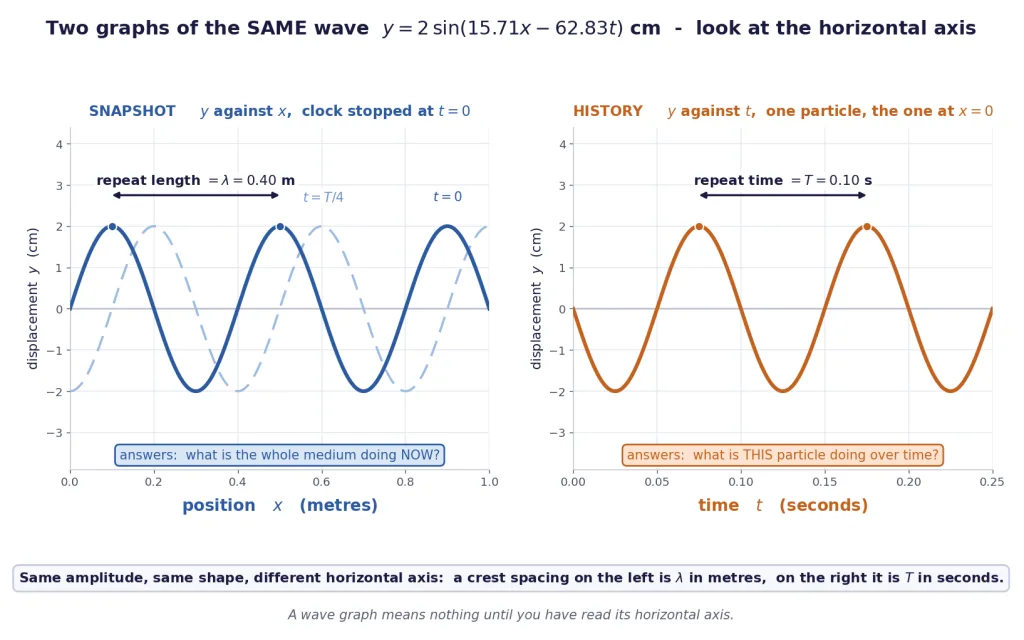
Both panels of that figure come from the same equation, in SI units — amplitude 2 cm, wavelength 0.40 m, period 0.10 s. Cover the axis labels and you cannot tell the two apart. Uncover them and they are about completely different things.
The snapshot: against , at one instant
Stop the clock at and plot the displacement of every particle at that one moment. This is a photograph of the medium: the shape the string actually has right now.
- The horizontal axis is a distance, in metres.
- The pattern repeats after a wavelength . Measure crest to crest and you have directly, and hence .
- The height of a crest above the axis is the amplitude .
- The graph tells you nothing on its own about how fast anything is happening. Two waves of the same wavelength but wildly different frequencies have identical snapshots.
The history: against , at one place
Now fix your attention on the single particle at and plot its displacement as the seconds tick by. This is not a picture of the medium at all — it is one particle's diary.
- The horizontal axis is a time, in seconds.
- The pattern repeats after a period . Measure peak to peak and you have directly, and hence and .
- The height of a peak is again the amplitude — this is the one quantity both graphs give you.
- The graph tells you nothing on its own about the wavelength. Two waves of the same frequency in different media have identical history graphs.
Key Point — read the horizontal axis first:
Snapshot History what is held fixed the time the position plotted against position (m) time (s) shows the whole medium at one instant one particle over an interval the repeat along the axis is the wavelength the period gives you , and so , and so and both give you the amplitude the amplitude Calling the repeat of a history graph "the wavelength" is the standard error, and it is worth two marks every time it is made. A wavelength is measured in metres; if the axis is in seconds, what you are looking at is a period.
One wave, two measurements, and you are done
Notice how neatly the two graphs divide the work. A snapshot alone gives and . A history alone gives and . Put the two together and you have all four of , , and , which is everything the equation needs apart from — and comes from one further piece of information, such as where the particle at the origin was when the clock started.
The particle's velocity comes from the history graph
The slope of a history graph is , which is the particle velocity — how fast that one bit of medium is moving across (or along) the wave's direction of travel. Differentiating with respect to , holding fixed,
The cosine runs between and , so
Key Point: the maximum particle speed is reached whenever the particle is passing through its mean position (, where the history graph is steepest), and falling to zero at a crest or a trough, where the particle has stopped to turn around.
For the wave in the figure, m/s. That is the fastest any particle of that medium ever moves, and it has nothing whatever to do with how fast the pattern advances — the two are separate quantities, and separating them was the point of the previous section. The speed at which the pattern advances is the business of the next one.
[NEET Important] On a snapshot, the particles moving fastest are the ones at the axis, not the ones at the crests. A crest is where a particle is momentarily at rest. Sketch questions ask this constantly, usually by putting an arrow on a crest and asking whether it is right.
Phase Difference
Phase is the wave's clock reading. Two particles that are doing exactly the same thing at the same instant — both at a crest, or both crossing zero and heading the same way — are in phase. Two that are doing opposite things are out of phase. The number that measures how far apart on the cycle they are is the phase difference, and there are two ways to generate one.
From a gap in space: the path difference
Look at two particles at positions and at the same instant . Their phases are
Subtract, and the and the cancel completely, leaving
and substituting :
Key Point — phase difference from a path difference: A separation of one whole wavelength is a phase difference of . So the rule in words is: the phase difference is times the fraction of a wavelength that separates the two points.
This is nothing more than a proportion. Move a whole wavelength and you go once round the cycle, rad. Move half a wavelength and you go half way round, rad. Move a quarter and you go a quarter of the way, rad. If you ever forget the formula, set up that proportion in one line:
From a gap in time
Now take the same particle at two instants and . Exactly the same subtraction, with cancelling this time instead:
Key Point — phase difference from a time difference: Wait one whole period and the phase advances by ; wait a quarter of a period and it advances by .
The two formulas are the same statement made about the wave's two variables — the pair in space and the pair in time — which is the -and- symmetry showing up again.
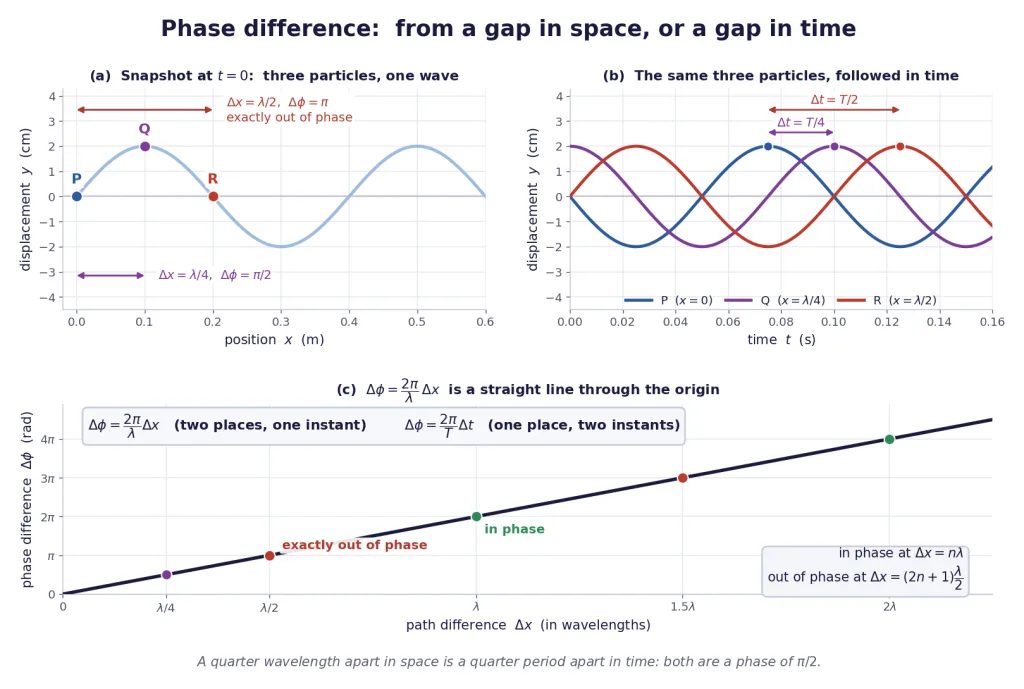
Panel (a) of the figure marks three particles of one wave, at , at and at . Panel (b) follows those same three particles in time, and the quarter-wavelength gap in space has become a quarter-period lag in time. That correspondence is worth stating on its own: for a wave travelling in the direction, a particle further along lags behind one further back, because the disturbance has not reached it yet.
The table worth memorising
| Path difference | Phase difference | In degrees | The two particles are |
|---|---|---|---|
| 0° | in phase | ||
| 90° | a quarter cycle apart | ||
| 120° | a third of a cycle apart | ||
| 180° | exactly out of phase | ||
| 360° | in phase again | ||
| in phase | |||
| exactly out of phase |
Phase differences are only ever meaningful modulo : a phase difference of describes precisely the same relationship as one of , since the extra is one complete lap. So when an answer comes out bigger than , subtract whole s until it is not, and then say whether the particles are in phase or out of phase.
Running the formulas backwards
Both boxed results are just as often needed the other way round:
"What is the smallest distance between two points differing in phase by ?" is asking for — the word smallest is there because you could always add whole wavelengths on top.
[Board Important] Whichever formula you are using, write down which two things you are comparing before you substitute. Two places at one instant takes . One place at two instants takes . Mixing a distance with a period, or a time with a wavelength, produces a number with no meaning at all, and it happens because the two formulas look alike.
[JEE Tip] Degrees are convenient for describing the answer but useless for calculating with. Work in radians throughout, in multiples of where you can, and convert to degrees only in the final line if the question asks for it.
Solved Examples
Conventions used throughout: all quantities are in SI units unless a question states otherwise — displacement and wavelength in metres, time and period in seconds, in rad/m, in rad/s, in Hz. The standard form is , so a minus sign between and means travel towards and a plus sign towards . "Particle speed" always means , the speed of one element of the medium. .
Example 1: Reading every constant off one equation
A wave travelling along a string is described by
with all quantities in SI units. Find (a) the amplitude, (b) the wavelength, (c) the period and the frequency, (d) the direction of travel, and (e) the displacement of the particle at cm at the instant s.
Solution:
Step 1 — line it up against the standard form. Comparing with :
(a) The amplitude is m, that is 5 mm.
(b) The wavelength follows from :
(c) The period follows from :
(d) The signs on and inside the bracket are opposite, so the wave travels in the direction.
(e) Substitute m and s. Work in radians throughout:
The particle happens to be almost exactly at a crest at that moment. (If your calculator gives something near zero, it is set to degrees — the argument of the sine here is in radians.)
Final Answer: mm; cm; s and Hz; travelling towards ; mm.
Takeaway: The number in front of the sine is the amplitude, the number multiplying is , and the number multiplying is . Wavelength and period are then divided by those — never the numbers themselves.
Example 2: Writing the equation from a description
A transverse harmonic wave travels along a string in the direction. Its amplitude is 3.0 cm, its wavelength is 0.50 m and its period is 0.20 s. At the particle at is at its maximum positive displacement. Write the equation of the wave.
Solution:
Step 1 — get and from and .
As a check, Hz, and rad/s again.
Step 2 — choose the form for the stated direction. Travel towards needs opposite signs on and :
Step 3 — use the initial condition to find . Put and :
Step 4 — assemble it, with m:
Since , this can equally be written
and the cosine form is the neater way of saying "the particle at the origin starts at a crest".
Final Answer: m, equivalently m.
Takeaway: Direction fixes the sign, and fix and , and the initial condition fixes . Those are the only three decisions in writing a wave equation, and they can be made in that order every time.
Example 3: A wave written back to front
A wave is given as
in SI units. Find the amplitude, the angular wave number, the wavelength, the angular frequency, the period, the frequency, the direction of travel and the phase constant.
Solution:
Step 1 — the direction, before anything else. Inside the bracket the term is positive and the term is negative: opposite signs, so the wave travels in the direction. Note that this is the same direction as would give — the order the terms are written in makes no difference.
Step 2 — put it into standard form. Since ,
and since ,
So the phase constant is , and the amplitude is m — positive, as an amplitude must be. The minus sign was never an amplitude; it was a phase.
Step 3 — read the rest off.
Final Answer: m, rad/m, m, rad/s, s, Hz, travelling towards , with .
Takeaway: A minus sign in front of a sine is a phase of , not a negative amplitude, and it never changes the direction of travel. Direction is decided by the two signs inside the bracket and by nothing else.
Example 4: The form
A wave on a string is described by
where is in centimetres, in metres and in seconds. Find the amplitude, the period, the frequency, the wavelength, , , the direction of travel and the maximum particle speed.
Solution:
Step 1 — recognise the form. Compare with and the two denominators are handed to you:
Step 2 — the derived constants.
Step 3 — direction. The term is positive and the term negative, so opposite signs: the wave travels towards .
Step 4 — maximum particle speed.
This is the greatest speed reached by any element of the string, as it whips through its mean position. It is a particle speed, and it is a different quantity from the speed at which the pattern travels along the string.
Final Answer: cm, s, Hz, m, rad/s, rad/m, towards , maximum particle speed m/s.
Takeaway: In the form the period and the wavelength sit in the denominators, ready to read. Recognising the form saves the whole of step one.
Example 5: Two graphs, one equation
A snapshot of a wave taken at shows consecutive crests 0.40 m apart, and the crest nearest the origin sits at m. A separate graph of the displacement of the particle at against time shows consecutive maxima 0.10 s apart. The amplitude is 2.0 cm and the wave travels towards . At the particle at the origin is at and moving in the direction. Write the equation of the wave and state its frequency.
Solution:
Step 1 — take from the snapshot and from the history. This is the whole point of having two graphs. The snapshot's repeat is a distance, so it is the wavelength; the history's repeat is a time, so it is the period:
Step 2 — the direction fixes the sign. Towards , so
Step 3 — the initial displacement narrows to two choices.
Step 4 — the initial direction of motion picks between them. Differentiate with respect to :
For this is , which is negative — the particle is moving in , as required. For it would be , moving in , which is wrong. So .
Step 5 — assemble.
Check it against the snapshot: crests occur where , that is m, and then every 0.40 m after that. That matches the stated snapshot exactly.
Final Answer: m, with Hz.
Takeaway: A snapshot gives , a history gives , and the initial displacement plus the initial direction of motion gives . Displacement alone always leaves two candidates for ; the sign of the particle velocity settles it.
Example 6: Phase difference from a separation
A harmonic wave has a wavelength of 0.40 m. Find the phase difference between two particles of the medium separated by (a) 0.10 m, (b) 0.60 m, and (c) find the smallest separation for which the phase difference is .
Solution:
Throughout, , with m.
(a)
That is 90°: the two particles are a quarter of a cycle apart, so when one is at a crest the other is crossing its mean position.
(b)
Now reduce it modulo : . So the pair are exactly out of phase — the extra was one complete lap and describes no difference at all. Sensible, because m is one and a half wavelengths.
(c) Run the formula backwards:
The word smallest matters: m would do just as well, and so would any further whole number of wavelengths.
Final Answer: (a) rad, 90°; (b) rad, which is the same as rad, exactly out of phase; (c) 6.67 cm.
Takeaway: Phase difference is times the fraction of a wavelength between the two points. Reduce any answer over before you describe the pair in words.
Example 7: Phase difference from a delay
A particle of a medium is executing simple harmonic motion as a wave of period 0.10 s passes it. Find the phase difference between the displacements of that same particle (a) 0.025 s apart, (b) 0.015 s apart, and (c) find the time interval corresponding to a phase difference of .
Solution:
Here we are at one place at two instants, so the formula is , with s.
(a)
A quarter of a period gives a quarter of a cycle. If the particle was at a crest at the first instant, it is at the mean position at the second.
(b)
In degrees, .
(c)
Final Answer: (a) rad or 90°; (b) rad or 54°; (c) s.
Takeaway: Two places at one instant needs ; one place at two instants needs . Decide which situation you are in before you reach for a formula — the two look alike and are not interchangeable.
Example 8: Particle velocity, and where it is largest
For the wave in SI units, find (a) the particle velocity at at , (b) the displacement and the particle velocity of the element at m at s, and (c) the maximum particle speed anywhere in the medium.
Solution:
Step 1 — differentiate with respect to , holding fixed.
(a) At , the phase is zero and :
The particle is moving in the direction at m/s — and since the cosine is at its largest possible value, this is the fastest that particle ever moves.
(b) At m, s the phase is
so
The element is at a trough, displaced cm the wrong way, and momentarily at rest — it has just stopped and is about to head back up. That is exactly what a trough means.
(c) The cosine cannot exceed 1, so
reached whenever the particle passes through .
Final Answer: (a) m/s; (b) m with zero particle velocity; (c) maximum particle speed m/s.
Takeaway: Particle speed is greatest at the mean position and zero at the crests and troughs — the opposite of what a first glance suggests. And is a particle speed; it is not the speed at which the wave travels.
Example 9: Reading a pair of graphs and building the equation
A snapshot of a wave shows an amplitude of 4.0 cm and exactly 3 complete waves in a length of 1.5 m. The history graph of one particle shows exactly 5 complete oscillations in 0.20 s. The wave travels in the direction, and the phase constant is zero. Write its equation, and find the maximum particle speed.
Solution:
Step 1 — the wavelength, from the snapshot. Three complete waves occupy 1.5 m, so one occupies
Step 2 — the period, from the history. Five complete oscillations take 0.20 s, so one takes
Step 3 — the direction fixes the sign. Travel towards needs the same sign on and :
Step 4 — assemble, with m.
Step 5 — the maximum particle speed.
Final Answer: m, with a maximum particle speed of m/s.
Takeaway: Count repeats, then divide. "Three waves in 1.5 m" is a wavelength of 0.50 m; "five oscillations in 0.20 s" is a period of 0.040 s. Reading the wrong graph for the wrong quantity is the only real hazard in this question.
Example 10: A cosine, and the wrong way down the axis
A wave is described by in SI units. Find its amplitude, wavelength, period, frequency, direction of travel and phase constant, and write it in standard sine form.
Solution:
Step 1 — direction first. Inside the bracket, the term and the term are both positive — same signs — so the wave travels in the direction. The fact that it is a cosine rather than a sine makes no difference at all to this.
Step 2 — convert the cosine to a sine. Since ,
so the phase constant is .
Step 3 — read off the rest.
Final Answer: cm, m, s, Hz, travelling towards , , and m.
Takeaway: A cosine is a sine with added to the phase, and nothing else changes. Convert it, read the constants, and treat the two signs inside the bracket as the only evidence about direction.
Example 11: A sound wave written as a longitudinal displacement
A sound wave travelling through air in the direction has a displacement amplitude of m, a wavelength of 0.68 m and a frequency of 500 Hz. Take the phase constant to be zero. (a) Write the displacement relation. (b) Find the maximum speed of an air molecule as the wave passes. (c) Find the phase difference between two points 0.17 m apart along the direction of travel.
Solution:
Step 1 — use , not . The displacement of the medium is along the direction of travel, so the standard symbol is and the amplitude is called the displacement amplitude. Nothing else about the equation changes.
Step 2 — the constants.
(a) With travel towards and ,
(b) The maximum particle speed is :
An air molecule shuffles back and forth at a top speed of about a centimetre and a half per second, through a total distance of ten micrometres. That is what "loud" looks like at the molecular level, and it is a completely different quantity from the speed at which the sound itself crosses the room.
(c) Two points at one instant, so use the path-difference formula:
Sensibly enough: m is exactly a quarter of m.
Final Answer: (a) m; (b) cm/s; (c) rad, or 90°.
Takeaway: A longitudinal wave uses exactly the same equation, with in place of . And an enormous with a microscopic still gives a very small particle speed — the two must be multiplied, never judged separately.
Example 12: Same wave, two particles, one instant and one delay
A wave of amplitude 1.5 cm, wavelength 0.25 m and frequency 40 Hz travels along a string in the direction, with .
(a) Write its equation. (b) What is the phase difference between the particles at and m at any given instant? (c) A particle is at moving upwards at some moment; how long until it next reaches its maximum displacement, and what phase difference does that interval correspond to?
Solution:
(a)
(b) Two places, one instant:
The separation is a quarter of a wavelength, so the phase difference is a quarter of . The particle at the larger lags the other, because the wave travels towards and has not reached it yet.
(c) Going from the mean position to the next maximum is a quarter of a cycle, so
Final Answer: (a) m; (b) rad; (c) s, a phase of rad.
Takeaway: A quarter of a wavelength in space and a quarter of a period in time are the same phase difference, . That equivalence is the tidiest single fact in this section, and it turns a great many two-step questions into one-liners.