
How to Use This Problem Bank
Nine sections of theory, and now the part that actually earns marks. What follows is 48 worked problems covering the whole chapter — classifying waves, reading an equation, snapshot and history graphs, phase differences, particle motion against wave motion, wave speed on strings and in gases, superposition, reflection, standing waves, pipes, beats and the Doppler effect.
They run easy first, hard last, in four parts that follow the order the chapter was taught in. Work them with a pen: cover the solution, try it, then compare — and read the takeaway at the end of each one, because that is where the marks usually leak away.
Notation for This Chapter
| Symbol | Meaning | Unit |
|---|---|---|
| displacement of a particle of the medium | m | |
| amplitude | m | |
| wavelength | m | |
| angular wave number, | rad/m | |
| frequency | Hz | |
| angular frequency, | rad/s | |
| time period, | s | |
| tension in a string (always named "tension") | N | |
| wave speed | m/s | |
| particle velocity | m/s | |
| linear mass density of a string | kg/m | |
| density | kg/m³ | |
| ratio of specific heats | none | |
| frequency an observer receives | Hz | |
| , | signed velocities of source and observer | m/s |
The Three Symbols That Get Confused
Key Point — read these before the first problem:
- does two jobs. In it is the tension, measured in newtons. Everywhere else it is the time period, measured in seconds. Every solution below names which one it means and writes the unit beside it.
- is the angular wave number, , in radians per metre. It is never a spring constant in this chapter.
- is the wave speed; the particle speed is . They are different quantities with different values. The greatest particle speed anywhere is , and it has nothing to do with .
Key Point — every formula this section uses, in one place:
Two Conventions Used in Every Solution
Direction of travel. A minus sign between and means the wave travels towards ; a plus sign means towards . A reflected wave must therefore have the opposite sign from the incident one.
The Doppler axis. Draw the line from the source to the observer and take that direction as positive. Then and are signed velocity components along that one line, and
covers all four cases with nothing memorised. An observer moving towards the source is moving in the negative direction, so is negative and the numerator grows. Every Doppler solution below states the positive direction, then says in words whether the answer should come out higher or lower, and only then substitutes.
Harmonics and Overtones
| System | Harmonics present | th harmonic is | First overtone |
|---|---|---|---|
| String fixed at both ends | the th overtone | 2nd harmonic | |
| Pipe open at both ends | the th overtone | 2nd harmonic | |
| Pipe closed at one end | only | the th overtone | 3rd harmonic |
The Constants Used Throughout
| Quantity | Value |
|---|---|
| Speed of sound in air | 340 m/s, unless a problem states otherwise |
| 9.8 m/s² | |
| for air | 1.4 |
| Gas constant | 8.314 J/(mol K) |
| Molar mass of air | 29.0 g/mol |
| 3.1416 |
Where a problem gives a different speed of sound, a different or a different temperature, that value is used and no other. Temperatures go into every gas formula in kelvin.
[Board Important] Every solution below writes the formula on its own line before any number goes into it, converts centimetres to metres on a line of its own, and names whether it is quoting or , tension or period, wave speed or particle speed. Do all three in the exam. A correct formula with an arithmetic slip still earns most of the marks; a dropped between and loses them all.
Solved Examples
Part 1: Reading the Wave, and Writing It Down
Twelve warm-ups. No tensions and no pipes yet — just the vocabulary, the five constants that live inside , and the business of turning a description or a pair of graphs into an equation and back again.
Constants for this part: ; speed of sound in air 340 m/s where sound appears.
Example 1: Six disturbances, sorted
For each, say whether the wave is transverse, longitudinal or a mixture, and whether it is mechanical, electromagnetic or a matter wave.
(a) A compression pulse sent along a slinky by pushing its end along its own length. (b) The vibration of a stretched tabla membrane. (c) A radio broadcast crossing 30 km of open country. (d) A seismic S wave crossing solid rock. (e) An X-ray beam in a hospital scanner. (f) The wave associated with an electron in a diffraction experiment.
Solution:
Two independent questions are being asked, and they must be answered separately. Transverse or longitudinal asks how the oscillation is oriented relative to the direction the wave travels. Mechanical, electromagnetic or matter asks what kind of thing is waving.
- (a) Longitudinal, mechanical. The coils move back and forth along the slinky, which is the same direction the compression travels. A medium is required, so it is mechanical.
- (b) Transverse, mechanical. Each element of the membrane moves perpendicular to the sheet while the disturbance spreads across it. A stretched membrane resists shear, which is what lets a transverse wave exist on it.
- (c) Transverse, electromagnetic. The electric and magnetic fields oscillate at right angles to the direction of travel. No medium is needed — this is the one family in the list that crosses a vacuum.
- (d) Transverse, mechanical. The "S" is for secondary, and also, conveniently, for shear. S waves need a shear modulus, which is why they cross rock and stop dead at the liquid outer core.
- (e) Transverse, electromagnetic. An X-ray is light with a very short wavelength. Same family as (c), different frequency.
- (f) A matter wave. It is neither mechanical nor electromagnetic; it is the wave nature of the electron itself, and the transverse/longitudinal labels do not apply to it in the way they do to the others.
Final Answer: (a) longitudinal, mechanical; (b) transverse, mechanical; (c) transverse, electromagnetic; (d) transverse, mechanical; (e) transverse, electromagnetic; (f) matter wave.
Takeaway: Answer the two questions separately. "Transverse or longitudinal" is about geometry; "mechanical, electromagnetic or matter" is about what is doing the waving. A single label can never carry both pieces of information, and examiners award the two halves separately.
Example 2: Every constant off one equation
A transverse wave on a long string is described by
with all quantities in SI units. Find (a) the amplitude, (b) the angular wave number and the wavelength, (c) the angular frequency, the frequency and the period, (d) the wave speed and its direction, and (e) the greatest speed any particle of the string reaches.
Solution:
Symbols first: compare with , where is the angular wave number in rad/m and the angular frequency in rad/s. Here will mean the time period in seconds; no tension appears in this problem at all.
Read off the three constants by matching brackets.
(b) Wavelength from .
(c) Frequency and period from .
(d) Wave speed, two ways. The sign between and is a minus, so the wave travels towards .
(e) Maximum particle speed — a different quantity entirely.
Final Answer: m; rad/m and m; rad/s, Hz, s; m/s towards ; maximum particle speed 2.4 m/s.
Takeaway: The wave crosses the string at 30 m/s while no particle of the string ever exceeds 2.4 m/s. The first number is , the second is . They are not related, they are not equal, and swapping them is the single commonest error in this chapter.
Example 3: Writing the equation from a description
A transverse harmonic wave of amplitude 5.0 mm and frequency 250 Hz travels at 100 m/s in the direction along a string. At the particle at is passing through and moving in the direction. Write the equation of the wave.
Solution:
The standard form is ; a plus sign between and means travel towards .
Convert to SI first.
Wavelength from the speed and the frequency.
The two bracket constants.
Choose the sign for the direction. Travel towards needs the plus form:
Use the initial condition to fix . At the equation reads . Now the direction of motion decides between them. The particle velocity is This must be positive, and while . So .
Final Answer:
Takeaway: Two facts fix the phase constant, not one. "At " narrows to two choices apart; only the direction of the particle's motion picks the right one. Whenever a question tells you which way the particle is moving, it is handing you the second condition on purpose.
Example 4: A wave written with the time term first
A transverse harmonic wave is described by
where and are in centimetres and is in seconds. The positive direction runs from left to right. (a) Is this a travelling wave or a standing wave, and if it is travelling, which way and how fast? (b) Give the amplitude and the frequency. (c) What is the initial phase at the origin? (d) What is the least distance between two successive crests? (e) Sketch in words the history graphs of the particles at , cm and cm — in what respect do they differ?
Solution:
Reading the symbols: is the angular wave number and the angular frequency. The bracket has been written with the time term first, which changes nothing: is exactly .
(a) Travelling, and which way. The displacement is a single sinusoid in the combination , not a product of a function of and a function of , so it is a travelling wave. The sign between and is a plus, so it travels towards — from right to left.
(b) Amplitude and frequency.
(c) Initial phase at the origin. Put and into the bracket:
(d) Distance between successive crests is one wavelength: Check: m/s, which is again.
(e) The three history graphs. Each is a plot of against for one fixed , so each is a sine curve of the same amplitude 2.5 cm and the same frequency 7.96 Hz. Only the starting phase differs, because enters the bracket as the constant :
Final Answer: (a) travelling, right to left, at 20 m/s; (b) 2.5 cm and 7.96 Hz; (c) rad; (d) 2.51 m; (e) identical in amplitude and frequency, differing only in phase — by 0.50 rad and 1.0 rad respectively.
Takeaway: Do the unit conversion on before you touch . Here came out in rad/cm because was in centimetres, so is a length in centimetres. And note part (e): in a travelling wave every particle has the same amplitude and the same frequency; only the phase varies from place to place.
Example 5: The same wave, seen as a snapshot and as a history
A wave on a string is in SI units. (a) A photograph is taken at and is plotted against . What is the horizontal spacing between two crests on that plot? (b) A sensor watches the single particle at and is plotted against . What is the horizontal spacing between two crests on that plot? (c) Which of the two graphs gives you the wave speed, and how?
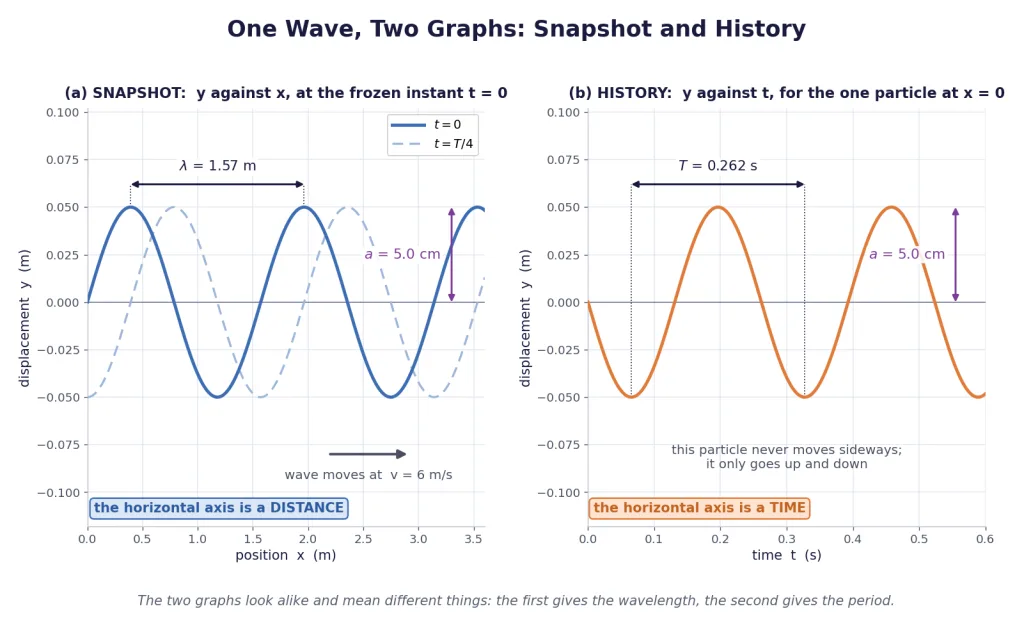
Solution:
A snapshot graph has distance on the horizontal axis; a history graph has time on it. They look almost identical and they carry different information, which is exactly why the axis label must be read first.
Read the constants.
(a) The snapshot spacing is the wavelength.
(b) The history spacing is the time period. Here is a period in seconds, not a tension. Equivalently Hz.
(c) Neither graph alone gives the speed; the pair does. and the direct check m/s agrees. A snapshot on its own tells you nothing about how fast the pattern is sliding — you would need a second snapshot a known time later.
Final Answer: (a) 1.57 m, the wavelength; (b) 0.262 s, the period; (c) the speed needs both, m/s.
Takeaway: Look at the horizontal axis label before anything else. Distance on the axis means the spacing you measure is ; time on the axis means it is . Getting this backwards turns a one-line problem into a wrong answer that looks completely reasonable.
Example 6: Phase difference from a path difference
A sound wave of frequency 680 Hz travels through air at 340 m/s. Find the phase difference between the oscillations of two air particles separated, along the direction of travel, by (a) 0.125 m, (b) 1.75 m, (c) , (d) . (e) What is the smallest separation for which the phase difference is ?
Solution:
Symbols and units: is a phase difference in radians, a path difference in metres, and the link is — one whole wavelength of separation is one whole cycle of phase.
Wavelength first.
(a) m, which is :
(b) m. In wavelengths that is : Phase repeats every , so subtract : the two particles are rad apart — exactly out of phase, one at a crest whenever the other is at a trough.
(c) :
(d) :
(e) Working backwards.
Final Answer: (a) ; (b) , equivalent to ; (c) ; (d) ; (e) 0.167 m.
Takeaway: Divide the path difference by the wavelength first and read the answer as a fraction of a cycle. Parts (c) and (d) never needed a number at all — the answer is fixed by the fraction of a wavelength, whatever happens to be.
Example 7: Phase difference from a time difference
A harmonic wave of frequency 200 Hz travels at 300 m/s. Find (a) the phase difference between the displacements of one particular particle at two instants 0.50 ms apart; (b) the phase difference between two particles 0.375 m apart at one instant; (c) the path difference that is equivalent to the 0.50 ms delay in part (a).
Solution:
The rule in play: phase can be shifted by moving in space () or by waiting in time (). Here is the time period in seconds.
The two basic quantities.
(a) Time difference of 0.50 ms. That is one tenth of a period:
(b) Path difference of 0.375 m. That is a quarter of a wavelength:
(c) Converting a delay into a distance. In a time the wave advances : Check it: rad, the same answer as (a). It has to be — the wave taking 0.50 ms to cover 0.15 m is the same statement.
Final Answer: (a) 0.628 rad (36°); (b) rad (90°); (c) 0.15 m.
Takeaway: A delay of and a separation of produce exactly the same phase difference. That equivalence is why of path is quoted as a " phase change" and why of waiting is quoted as "90° behind". One relation, two doors into it.
Example 8: One source, two microphones
A loudspeaker on a stand emits a steady 500 Hz note. Two microphones stand on the same straight line out from it, at 6.12 m and 7.14 m. Take the speed of sound as 340 m/s. Find (a) the wavelength, (b) the phase difference between the signals the two microphones pick up, and (c) the time lag between them.
Solution:
Working rule: phase difference from path difference, , with the extra distance the sound must cover to reach the further microphone.
(a) Wavelength.
Path difference.
Express it in wavelengths — always do this before reaching for a calculator. One and a half wavelengths.
(b) Phase difference. which is rad once whole cycles are stripped out: the two microphones receive signals exactly out of phase. When one sees a compression arriving, the other sees a rarefaction.
(c) Time lag. Sense check: the period is ms, and ms is one and a half periods — matching the one and a half wavelengths exactly.
Final Answer: (a) 0.68 m; (b) rad, that is rad or 180°, exactly out of phase; (c) 3.0 ms.
Takeaway: A phase difference of and one of describe the same physical state. Always reduce to the interval from to before answering "in phase or out of phase", and always cross-check the time lag against the period — the two must give the same number of cycles.
Example 9: Two graphs into one equation
A snapshot of a wave on a string shows exactly 5 complete waves in a length of 3.0 m. A history graph of one particle shows exactly 30 complete oscillations in 0.60 s. The amplitude is 6.0 mm, the wave travels towards , and at the particle at is at its greatest negative displacement. Find the equation of the wave, its speed, and the maximum particle speed.
Solution:
What each graph gives you: the snapshot supplies , the history supplies ; the standard form for travel towards is .
From the snapshot.
From the history.
Wave speed, both ways.
Phase constant from the initial condition. At , the displacement must be :
The equation (with mm m): which is the same as , since .
Maximum particle speed.
Final Answer: m; m/s; maximum particle speed 1.88 m/s.
Takeaway: "So many waves in so many metres" is ; "so many oscillations in so many seconds" is . Nothing else in the question can supply either. And when the particle starts at an extreme, is — the sign follows from which extreme.
Example 10: Travelling, standing, or neither?
Classify each of the following, all in SI units, as a single travelling wave, a standing wave, or neither. Give the speed where there is one.
(a) (b) (c) (d)
Solution:
The test is structural, and it is quick. A travelling wave contains and only through the single combination . A standing wave is a product of a function of alone and a function of alone, with one frequency.
(a) Standing wave. It is with one frequency. The pattern does not move; nodes sit wherever . The two travelling waves it is built from each have and they run in opposite directions. The standing wave itself has no speed — that number belongs to its two ingredients.
(b) A single travelling wave. Both terms share the identical bracket , so combine them: So , a travelling wave of amplitude 7.07 towards with
(c) Neither. Each term on its own is a standing wave, but they have different frequencies (1 rad/s and 2 rad/s) and different wave numbers. Their sum is a superposition of two different normal modes: periodic, but not a single travelling wave and not a single standing wave.
(d) A single travelling wave towards (plus sign in the bracket), with
Final Answer: (a) standing, its component waves running at 3.33 m/s; (b) travelling towards at 4.0 m/s, amplitude 7.07; (c) neither; (d) travelling towards at 2.5 m/s.
Takeaway: Product means standing, single bracket means travelling. And check (b) before you classify: two terms are not automatically two waves — if they carry the same bracket they merge into one. Two terms with different brackets, as in (c), genuinely cannot be reduced.
Example 11: What the slope of each graph means
For the wave of Example 2, find at , : (a) the slope of the snapshot graph, ; (b) the particle velocity, ; (c) verify the relation between them.
Solution:
Two speeds, kept apart: m/s is the wave speed here (from Example 2). is the particle velocity — a completely different quantity, and the one that is measured in the same units.
(a) Slope of the snapshot. Differentiate with respect to , holding fixed: This is a pure number — a slope, not a speed. It has no units.
(b) Particle velocity. Differentiate with respect to , holding fixed: The particle at the origin is moving downwards at that instant, at 2.4 m/s.
(c) The relation. Compare the two derivatives: every is times the corresponding , with a sign flip. And note that m/s is exactly , so at this instant the particle at the origin happens to be moving at its maximum speed — which fits, because there.
Final Answer: (a) slope , dimensionless; (b) particle velocity m/s, downwards; (c) , and m/s.
Takeaway: Particle velocity = (wave speed) (slope of the snapshot). So on a snapshot, a particle on a rising part of the curve (positive slope) is moving down for a wave going right. That single sentence answers a whole family of "which way is this particle moving?" questions without any calculation.
Example 12: Four short answers that carry full marks
Answer briefly. (a) A violin and a sitar play the same note, at the same loudness. Why can you still tell which is which? (b) Why does a sharp pulse gradually lose its shape as it travels through a dispersive medium? (c) A wave's frequency is fixed by one thing and its speed by another. Which is which, and what does that force to happen when a wave crosses into a new medium? (d) Why does a standing wave transport no energy along the string?
Solution:
Units first: is a frequency in hertz, a wavelength in metres, and the wave speed of the medium — no particle speeds appear in any of these four answers.
(a) Timbre — the harmonic mixture. Both instruments sound the same fundamental, which is what fixes the pitch, so the note is the same. But the relative strengths of the overtones are set by how the instrument is built and how it is played, and they differ completely between a bowed violin string and a plucked sitar string. The ear reads that mixture as the quality, or timbre, of the note.
(b) Dispersion means the speed depends on the frequency. A pulse of any shape other than a pure sinusoid is, by Fourier's theorem, a sum of many harmonic components. In a dispersive medium those components travel at different speeds, so after a while they are no longer lined up as they were at the start, and the sum they add up to has a different shape. The pulse spreads out.
(c) Frequency belongs to the source; speed belongs to the medium. The source shakes the medium at oscillations per second, and every boundary the wave crosses passes on that same — layers on the two sides of a boundary cannot oscillate at different rates without tearing apart. The speed, though, is fixed by the elastic property and the density of whatever the wave is now in. Since must still hold and cannot change, the wavelength takes the whole of the change.
(d) A standing wave has permanent nodes. A node never moves, so no energy can be carried across it: transporting energy past a point requires that point to do work on its neighbour, and work needs displacement. Energy sloshes between kinetic and potential within each loop, twice per cycle, but the net flow across any node is zero.
Final Answer: (a) different overtone mixtures, that is different timbre; (b) different frequencies travel at different speeds and fall out of step; (c) the source fixes , the medium fixes , so changes at a boundary; (d) nodes are permanently at rest, and no energy crosses a point that never moves.
Takeaway: These four one-liners appear in Board papers almost every year, and each is worth two marks for two sentences. Learn the reason, not the sentence: overtone mixture, speed depending on frequency, the source owning , and a motionless node blocking energy flow.
Part 2: Particle Motion, Strings, and the Speed of Sound
Twelve problems on the two speeds that live in every wave, and on what sets the wave speed in a string and in a gas. Watch the letter throughout this part: in it is a tension in newtons, and in it is a period in seconds. Each solution says which one it means.
Constants for this part: m/s²; speed of sound in air 340 m/s unless stated; J/(mol K); ; g/mol.
Example 13: Maximum particle speed, and where on the wave it happens
A transverse wave on a string is in SI units. Find (a) the wave speed, (b) the greatest speed reached by any particle of the string, (c) the points on the waveform at which a particle is moving fastest and those at which it is momentarily at rest, and (d) the amplitude the wave would need for the maximum particle speed to equal the wave speed.
Solution:
Name the two speeds: is the wave speed — the rate at which the pattern slides along the string. The particle speed is , and its greatest value is .
Read the constants.
(a) Wave speed. (Cross-check: m, Hz, and m/s.)
(b) Maximum particle speed. That is one tenth of the wave speed, and the two numbers have nothing to do with each other.
(c) Where each happens. Differentiating, This is largest in magnitude when the cosine is , which is precisely when , that is when . So:
- fastest at the mean position, — every point where the curve crosses the axis;
- momentarily at rest at the crests and troughs, , where the cosine is zero.
This is simple harmonic motion seen sideways: each particle is an oscillator, fastest in the middle and stationary at the ends of its swing.
- (d) Making the two equal. A 20 cm amplitude on a wave of wavelength 1.26 m — a violently distorted string, which is why the two speeds are so rarely comparable in practice.
Final Answer: (a) 50 m/s; (b) 5.0 m/s; (c) fastest at , at rest at the crests and troughs; (d) m.
Takeaway: A crest is where the displacement is largest and the particle speed is zero. Students routinely say a particle "moves fastest at the crest" because the crest looks like the exciting part of the picture. It is the flattest, dullest part of the motion — the particle has just stopped and is about to turn round.
Example 14: Particle velocity and acceleration at one point
A wave on a string is in SI units. Find, for the particle at m at the instant s, (a) its displacement, (b) its velocity, and (c) its acceleration. Also give (d) the maximum particle speed and maximum particle acceleration, and (e) the wave speed.
Solution:
Whose motion is asked about: all three of , and describe the particle; only the last part of the question is about the wave.
Constants and the phase at the stated point and time. Angles inside and are in radians — do not let a calculator sit in degree mode.
(a) Displacement.
(b) Particle velocity. Negative, so the particle is moving in the direction.
(c) Particle acceleration — and here the shortcut is worth more than the differentiation: The acceleration always points back towards , which is the signature of simple harmonic motion.
(d) The two maxima.
(e) Wave speed.
Final Answer: (a) m; (b) m/s; (c) m/s²; (d) 10 m/s and m/s²; (e) 50 m/s.
Takeaway: saves you the second differentiation every time. Get first, multiply by , and you have the acceleration in one line — with its sign already correct, pointing back towards the mean position.
Example 15: A jerk along a heavy rope
A rope of mass 3.0 kg and length 15.0 m is stretched taut with a tension of 250 N. One end is given a sharp transverse jerk. How long does the disturbance take to reach the other end?
Solution:
Mind the : in the symbol is the tension, in newtons, and is the mass per unit length in kg/m. No period appears in this problem.
Linear mass density.
Wave speed.
Time to cross the rope.
Final Answer: 0.424 s.
Takeaway: The mass of the rope enters only through , never on its own. A rope twice as long with twice the mass has the same , the same wave speed — and takes twice as long, because the pulse has twice as far to go.
Example 16: A stone dropped from a tower
A stone is dropped from rest at the top of a 200 m tower and splashes into a pond at its base. Taking m/s² and the speed of sound in air as 340 m/s, when is the splash heard at the top?
Solution:
Two separate journeys, in sequence — the stone falling down under gravity, then the sound travelling up at a constant 340 m/s. The total is the sum, never the average.
Time for the stone to fall. It starts from rest, so
Time for the sound to climb back. Sound moves at a steady speed, so
Total.
Final Answer: The splash is heard 6.98 s after the stone is released.
Takeaway: The falling stone accelerates; the sound does not. Use for one leg and for the other, and never mix them. Notice too that the sound leg is under a tenth of the total here — but at 8% it is far too big to neglect if the question quotes three figures.
Example 17: Tuning a wire to the speed of sound
A steel wire is 10.0 m long and has a mass of 2.50 kg. What tension must it be under so that transverse waves travel along it at 340 m/s, the speed of sound in air?
Solution:
Symbol check: here is the tension in newtons, the unknown of the problem.
Linear mass density.
Rearrange the speed formula.
Substitute.
Final Answer: A tension of N, that is about 28.9 kN.
Takeaway: Because , the tension goes up as the square of the speed you want. That is why matching a wire's wave speed to the speed of sound needs a tension of nearly three tonnes-weight on a wire — and why this arrangement is a calculation, not an experiment.
Example 18: A hanging block sets the tension
A light string of linear mass density 2.0 g/m runs horizontally across a table, passes over a light frictionless pulley at the edge, and carries a 5.0 kg block hanging from its free end. Take m/s². Find (a) the tension in the string, (b) the speed of transverse waves on it, (c) the time a pulse takes to cross the 1.6 m horizontal stretch, and (d) the hanging mass that would double the wave speed.
Solution:
Which is which: is the tension in newtons. It is set by the hanging block, and an ideal pulley passes it unchanged around the corner, so the horizontal stretch is under the same tension as the vertical one.
Convert.
(a) Tension. The block hangs in equilibrium, so the string tension balances its weight:
(b) Wave speed.
(c) Crossing time.
(d) Doubling the speed. Since and , doubling needs four times the tension and hence four times the mass: Check: N, m/s, which is . Correct.
Final Answer: (a) 49 N; (b) 156.5 m/s; (c) 10.2 ms; (d) 20 kg.
Takeaway: A hanging mass is just a tension in disguise: write on its own line and the problem becomes an ordinary question. And remember the square root — to double a wave speed you must quadruple the load, not double it.
Example 19: A wire of given radius and density
A steel wire of radius 0.40 mm is stretched by a tension of 160 N. The density of steel is 7800 kg/m³. Find (a) the linear mass density of the wire, (b) the speed of transverse waves on it, and (c) the frequency of a wave whose wavelength on the wire is 0.25 m.
Solution:
Two densities, two symbols: is the volume density in kg/m³ and the linear density in kg/m; they are linked by the cross-sectional area, . is the tension in newtons.
Cross-sectional area. Convert the radius first:
(a) Linear mass density. A one-metre length has volume , so
(b) Wave speed.
(c) Frequency.
Final Answer: (a) kg/m; (b) 202 m/s; (c) 808 Hz.
Takeaway: is the bridge between a wire you can measure with a screw gauge and a wave speed. Square the radius after converting it to metres — doing the conversion last is where the factors of go astray.
Example 20: Sound in carbon dioxide, twice over
For carbon dioxide at 0°C take and molar mass g/mol, with J/(mol K). (a) Compute the speed of sound in it from Newton's isothermal formula. (b) Compute it with the Laplace correction. (c) By what percentage do they differ? (d) Compare with air at the same temperature, for which and g/mol.
Solution:
What goes into the formula: is the ratio of specific heats, the molar mass in kg/mol, and the temperature goes in as in kelvin — this is the one place in the chapter where means neither a tension nor a period, so it is written below.
Convert the inputs.
(a) Newton's formula treats the compressions as isothermal, so the relevant modulus is itself. Using from the gas law,
(b) With the Laplace correction the compressions are adiabatic, the modulus is , and
(c) The gap. The ratio is exactly : For air, where , the same argument gives — which is why Newton's prediction of roughly 280 m/s for air fell about 15% short of the measured 331 m/s.
(d) Air at 0°C, for comparison. Carbon dioxide is slower, and the reason is mostly its mass: at 44 against 29 g/mol its molecules are more sluggish, and .
Final Answer: (a) 227 m/s; (b) 259 m/s; (c) 14.0% higher; (d) 331 m/s in air, so sound is about 22% slower in carbon dioxide.
Takeaway: The whole of the Laplace correction is one factor of . Compressions in a sound wave happen far too fast for heat to leak out of them, so the process is adiabatic, not isothermal — and the correction is bigger for a gas with a bigger .
Example 21: A hot afternoon and a cold night
The speed of sound in air is 340 m/s at 15°C. Find it (a) at 40°C and (b) at . (c) At what temperature would it be 20% greater than its 15°C value?
Solution:
Before substituting: , so every temperature must be converted to kelvin before any ratio is taken. Celsius temperatures in a ratio give nonsense — and a negative one gives an impossible square root.
Convert all three temperatures.
(a) At 40°C.
(b) At .
(c) Twenty per cent faster means m/s. Square the ratio to undo the root:
A cross-check worth doing. At 0°C the same rule gives m/s, which is the standard measured value for dry air. The starting figure of 340 m/s at 15°C is consistent with it.
Final Answer: (a) 354 m/s; (b) 325 m/s; (c) 414.7 K, that is about 142°C.
Takeaway: A 20% rise in speed needs a 44% rise in absolute temperature, because of the square root. Sound speed is a lazy function of temperature — a 25-degree swing between (a) and the starting point moves it by only 4%, which is why the rule of thumb "about 0.6 m/s per degree Celsius" works so well over ordinary ranges.
Example 22: Hydrogen against oxygen
At the same temperature, compare the speed of sound in hydrogen (, g/mol) with that in oxygen (, g/mol). (a) Find the ratio of the speeds. (b) Evaluate both at 0°C, with J/(mol K).
Solution:
The formula to use: with in kg/mol and in kelvin. At a common temperature the cancels from any ratio, leaving only and .
(a) Take the ratio and cancel. So sound travels about four times faster in hydrogen, and the two values, being almost equal, contribute almost nothing — the factor of 4 is essentially , pure molar mass.
(b) Absolute values at K. Their ratio is , as it must be.
Final Answer: (a) about 4.01 to 1; (b) 1265 m/s in hydrogen, 315 m/s in oxygen.
Takeaway: Lighter gas, faster sound — and the dependence is , not . Sixteen times lighter gives four times faster. When two gases have similar , you can do the whole comparison from the molar masses in your head.
Example 23: Ultrasound meeting a water surface
An ultrasonic source in air emits at 1.20 MHz. The beam strikes a flat water surface: part reflects back into the air, part is transmitted into the water. Take the speed of sound as 340 m/s in air and 1486 m/s in water. Find (a) the wavelength of the reflected sound and (b) of the transmitted sound. (c) A hospital scanner works at 4.0 MHz in tissue where the speed of sound is 1.70 km/s — what wavelength does it use?
Solution:
The frequency is fixed by the source and is the same in both media and in the reflected beam; the speed is fixed by the medium. Since , the wavelength absorbs the entire change.
(a) The reflected sound never leaves the air. Its speed is still 340 m/s and its frequency is still 1.20 MHz:
(b) The transmitted sound is in water, where the speed is 1486 m/s, but the frequency is unchanged at 1.20 MHz: About 4.4 times longer, which is exactly the ratio of the two speeds.
(c) The scanner. With km/s m/s:
Final Answer: (a) 0.283 mm; (b) 1.24 mm; (c) 0.425 mm.
Takeaway: At a boundary, frequency is conserved and wavelength is not. Ask "which medium is this part of the beam in?" and read the speed off that; the frequency was decided back at the source and never changes. Part (c) also shows why scanners run at megahertz — you cannot resolve detail finer than about a wavelength, and 0.4 mm is fine enough to see inside a body.
Example 24: Pressure, temperature and humidity
Explain, using , why the speed of sound in air (a) does not depend on the pressure, (b) increases with temperature, and (c) increases with humidity. For (c), estimate the change when 3.0% of the air molecules (by mole) are replaced by water vapour, taking the molar mass of dry air as 29.0 g/mol and of water as 18.0 g/mol, and holding fixed.
Solution:
What each symbol carries: is the pressure in pascals, the density in kg/m³, the ratio of specific heats. The gas law lets be rewritten as , and that rewriting is what makes all three parts obvious.
(a) Pressure. Compress a fixed mass of gas at constant temperature and the pressure rises — but so does the density, in exactly the same proportion, because the same mass now occupies a smaller volume. The ratio is untouched, so is untouched. Formally, in which does not appear at all. Sound at the top of a mountain travels no slower for the thinner air, provided the temperature is the same.
(b) Temperature. The same rewriting gives Heat the gas and its molecules move faster; a disturbance is passed along by molecular collisions, so it is handed on more quickly.
(c) Humidity. Water vapour has g/mol, well below dry air's 29.0 g/mol. At a given pressure and temperature, a fixed number of molecules occupies a fixed volume whatever they are, so swapping heavy nitrogen and oxygen molecules for lighter water molecules makes the air less dense — and .
The estimate. The average molar mass of the mixture is the mole-weighted average: a rise of 0.57%, or about 2 m/s on a speed of 340 m/s.
Final Answer: (a) cancels out of at fixed temperature; (b) ; (c) moist air is less dense, and 3% water vapour raises the speed by about 0.57%, roughly 2 m/s.
Takeaway: Rewrite as and all three answers fall out at once. The second form contains no pressure, an explicit temperature, and an explicit molar mass — which is precisely the list of things the question asked about.
Part 3: Superposition, Reflection, Standing Waves and Pipes
Twelve problems on what happens when two waves share a medium: adding them, bouncing them off an end, and trapping them between two ends. Tension is in newtons; the time period is in seconds — both appear in this part, sometimes in the same problem, so each is named where it is used.
Constants for this part: speed of sound in air 340 m/s unless a problem says otherwise; .
Example 25: Two waves a quarter of a cycle apart
Two waves travel in the same direction along the same string:
in SI units. Find (a) the wavelength, frequency and speed common to both, (b) the amplitude of the resultant and the equation of the resultant wave, (c) the path difference that this phase difference corresponds to, and (d) the phase difference that would instead give a resultant amplitude of m.
Solution:
The standard result: for two waves of equal amplitude and phase difference travelling together, the resultant is — amplitude , and the resultant sits halfway in phase between the two.
(a) The shared constants.
(b) Resultant amplitude, with so : Note that mm is times mm, not — a quarter-cycle offset costs you a good deal of the possible reinforcement.
(c) Path difference.
(d) Working backwards from the amplitude. corresponding to a path difference of m.
Final Answer: (a) m, Hz, m/s; (b) 8.49 mm, m; (c) m; (d) .
Takeaway: It is , never . Half the phase difference goes into the amplitude and the other half into the phase of the resultant. Feed straight into the cosine and a quarter-cycle offset comes out as zero amplitude, which is badly wrong.
Example 26: The same wave at a rigid end and at a free end
A string lies along the -axis occupying , with its end at . The wave
travels along it towards the end. Find (a) the wave speed, wavelength and frequency; (b) the reflected wave if the end at is clamped to a rigid wall; (c) the reflected wave if the end instead carries a light ring free to slide on a smooth rod; (d) the total displacement at in each case; and (e) the standing wave formed in the clamped case, with the node spacing.
Solution:
Signs first: the incident wave has , so it travels towards . A reflected wave must travel towards , so it must be written with . Whatever sign sits in front is then decided by the boundary condition, never by memory.
(a) The constants.
(b) Rigid end: the displacement at must be zero at every instant. Write and impose it: The plus sign is not a missing : reversing the direction of travel has already supplied one sign change, so the phase change of a rigid reflection lands on a plus.
(c) Free end: the slope at must be zero at every instant.
(d) The end point itself.
- Clamped: always — a node, exactly as demanded.
- Free: , an oscillation of amplitude m — an antinode, swinging to twice the incident amplitude.
- (e) The standing wave in the clamped case. Add the two waves using : Nodes are where , that is , so consecutive nodes are
Final Answer: (a) 20 m/s, 0.251 m, 79.6 Hz; (b) ; (c) ; (d) node with at a clamped end, antinode with amplitude 0.016 m at a free end; (e) , nodes 0.126 m apart.
Takeaway: Never read a reflection sign off the page — substitute and test the boundary condition. A clamped end pins the displacement; a free end pins the slope. Each condition fixes the sign in one line, and the check takes ten seconds.
Example 27: A clamped string, read off its equation
The transverse displacement of a string clamped at both ends is
with and in metres and in seconds. The string is 2.0 m long and has a mass of 50 g. Answer: (a) does this represent a travelling wave or a standing wave? (b) Write it as the superposition of two travelling waves and give the wavelength, frequency and speed of each. (c) Find the tension in the string. (d) Do all the points of the string oscillate with the same frequency, the same phase, the same amplitude? (e) What is the amplitude of the point 0.25 m from one end? (f) Which harmonic is this, and which overtone?
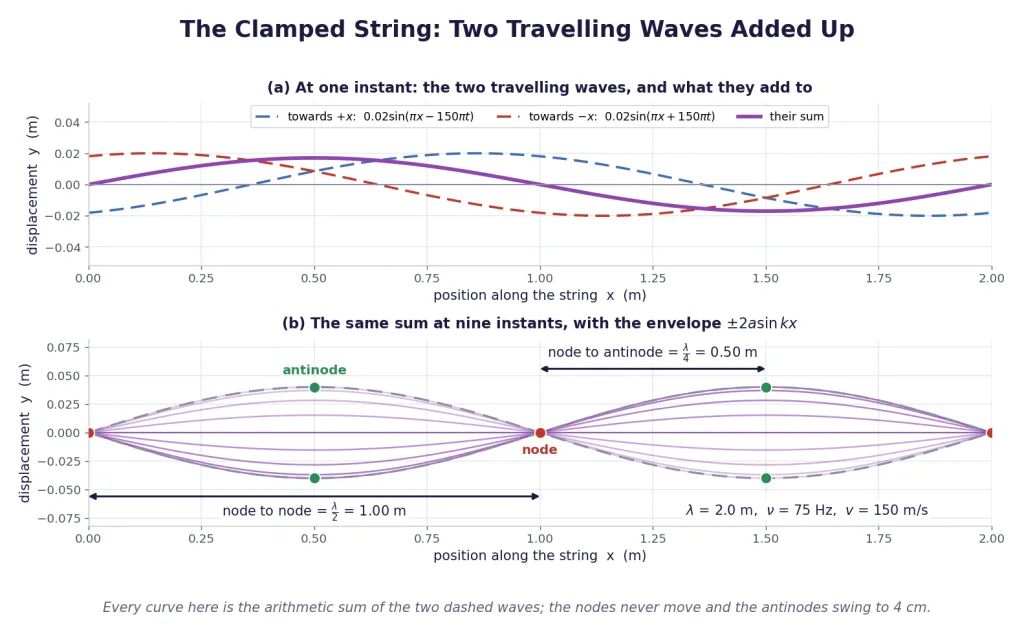
Solution:
One letter, two jobs: in part (c) the letter means the tension, in newtons; in the phrase "time period" it would mean seconds. This problem needs the tension only.
(a) Standing wave. The displacement is a product of a function of alone and a function of alone. Nothing travels: the shape stays put and only its size pulses.
(b) Split it back into two travelling waves. Reverse the identity with and : Each has amplitude 0.02 m — half the standing-wave amplitude — and
(c) Tension. First the linear mass density:
(d) Frequency, phase and amplitude across the string.
- Frequency: the same, 75 Hz, for every point except the nodes, which do not oscillate at all.
- Phase: the same within one loop, opposite across a node. The time factor is common to every point, and the only thing that can differ is the sign of — which flips as you cross a node. So the two loops of this string move in exact opposition.
- Amplitude: different at every point, given by . This is what most distinguishes a standing wave from a travelling one, where every particle has the same amplitude.
(e) Amplitude at m.
(f) Which mode. The nodes lie where : at , and m. That is two loops in the 2.0 m length, so the second harmonic, which for a string is the first overtone. Its fundamental would be Hz, and Hz. Consistent.
Final Answer: (a) standing; (b) two waves of amplitude 0.02 m each, m, Hz, m/s; (c) N of tension; (d) same frequency everywhere, same phase within a loop and opposite across a node, different amplitude at every point; (e) 2.83 cm; (f) second harmonic, first overtone.
Takeaway: Halve the amplitude when you split a standing wave into its two travelling parents. The standing wave's has m in it, so each parent carries m. Feeding 0.04 m into the tension calculation would not change the answer — but feeding it into an energy or intensity question would double it.
Example 28: Harmonics and overtones, side by side
A string 0.60 m long is fixed at both ends, and transverse waves travel on it at 240 m/s. (a) Find its fundamental frequency. (b) List its first four normal modes. (c) 600 Hz is which harmonic, and which overtone? (d) Can this string be made to vibrate steadily at 500 Hz?
Solution:
Harmonics are counted from the fundamental; overtones are counted from the first mode above the fundamental, so for a string the th harmonic is the th overtone.
(a) Fundamental. In the lowest mode the string holds exactly half a wavelength, so m and
(b) The series. A string fixed at both ends needs a node at each end, so must hold a whole number of half-wavelengths, giving :
| Frequency | Name | Overtone | |
|---|---|---|---|
| 1 | 200 Hz | fundamental, 1st harmonic | — |
| 2 | 400 Hz | 2nd harmonic | 1st overtone |
| 3 | 600 Hz | 3rd harmonic | 2nd overtone |
| 4 | 800 Hz | 4th harmonic | 3rd overtone |
(c) 600 Hz. the third harmonic, which is the second overtone.
(d) 500 Hz. not a whole number, so 500 Hz is not a normal mode of this string. Driven at 500 Hz the string would jiggle feebly at the driver's frequency and never build a standing wave.
Final Answer: (a) 200 Hz; (b) 200, 400, 600, 800 Hz; (c) third harmonic, second overtone; (d) no.
Takeaway: Divide by the fundamental first. The quotient is the harmonic number ; subtract one and you have the overtone number. If the quotient is not a whole number, the answer to "will it resonate?" is no, and no further work is needed.
Example 29: The fundamental gives the tension
A wire stretched between two rigid supports vibrates in its fundamental mode at 60 Hz. Its total mass is kg and its linear mass density is kg/m. Find (a) the length of the wire, (b) the speed of transverse waves on it, and (c) the tension in it.
Solution:
Mind the : in part (c) is the tension in newtons. The 60 Hz is a frequency, and its reciprocal would be a time period in seconds — the two must not be confused with each other in the formula .
(a) Length from the mass and the linear density.
(b) Wave speed from the fundamental. In the fundamental the wire holds half a wavelength:
(c) Tension.
Final Answer: (a) 0.80 m; (b) 96 m/s; (c) 276 N (more precisely 276.5 N).
Takeaway: The single formula contains this whole problem, but doing it in three steps — length, then speed, then tension — is faster and much harder to get wrong than substituting into one crowded expression.
Example 30: One length, two pipes
A pipe is 68 cm long. Take the speed of sound as 340 m/s. (a) Find the fundamental and the next three modes if it is open at both ends. (b) Do the same if one end is closed. (c) Name the first overtone in each case. (d) In the closed pipe, 875 Hz is which harmonic and which overtone?
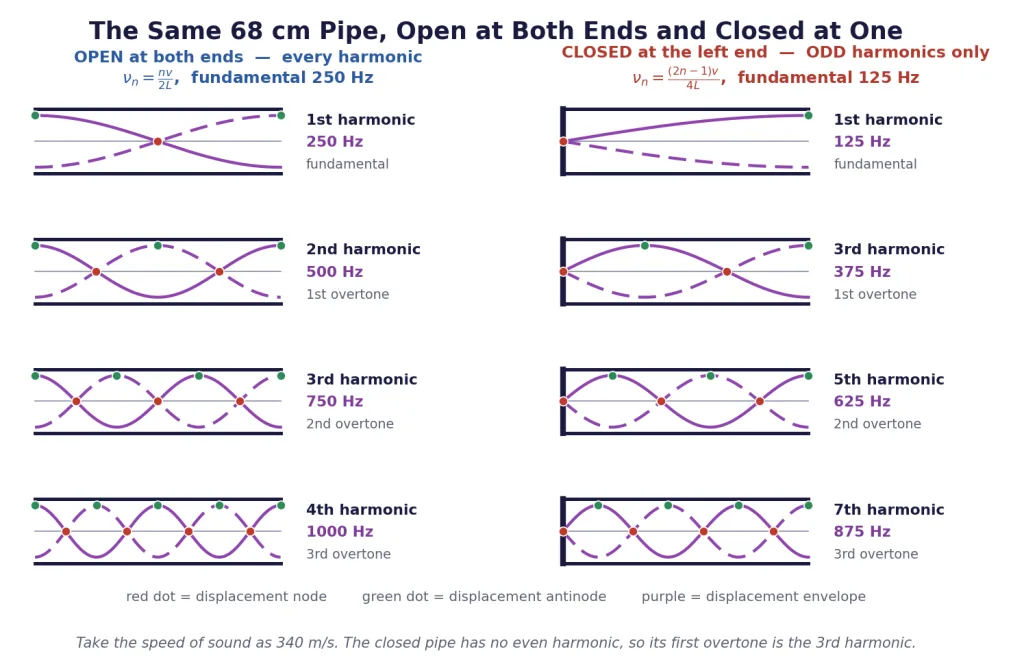
Solution:
An open end is a displacement antinode; a closed end is a displacement node. Those two boundary conditions generate everything below.
(a) Open at both ends — antinode at each end, so the pipe holds a whole number of half-wavelengths:
(b) Closed at one end — node at the closed end, antinode at the open one, so the pipe holds an odd number of quarter-wavelengths: The closed pipe's fundamental is half the open pipe's, and its even harmonics are missing entirely.
(c) First overtone. It is simply the next mode that actually exists:
| Pipe | Fundamental | First overtone | Which harmonic |
|---|---|---|---|
| Open at both ends | 250 Hz | 500 Hz | 2nd |
| Closed at one end | 125 Hz | 375 Hz | 3rd |
- (d) 875 Hz in the closed pipe. the seventh harmonic. Counting overtones, the modes present are , so is the third overtone — and in general, for a closed pipe, the th harmonic is the th overtone.
Final Answer: (a) 250, 500, 750, 1000 Hz; (b) 125, 375, 625, 875 Hz; (c) open — 500 Hz, the 2nd harmonic; closed — 375 Hz, the 3rd harmonic; (d) seventh harmonic, third overtone.
Takeaway: "First overtone" always means the next mode that exists, not the next integer. For a string or an open pipe that is ; for a closed pipe does not exist at all, so the first overtone is . This single line is asked in some form in almost every paper.
Example 31: Which mode responds?
A pipe 25 cm long is closed at one end. A source of frequency 1700 Hz is held at its open mouth. Take the speed of sound as 340 m/s. (a) Which harmonic of the pipe is resonantly excited? (b) Will the same source resonate with the pipe if both of its ends are opened?
Solution:
Resonance occurs only when the driving frequency coincides with a normal mode of the air column. Anything else produces a feeble forced vibration and no standing wave.
(a) The closed-pipe series. With m, so : the fifth harmonic, which for a closed pipe is the second overtone. It resonates.
(b) Now open both ends. not a whole number, so no, the same source will not resonate with the open pipe.
Final Answer: (a) the fifth harmonic (second overtone) of the closed pipe; (b) no.
Takeaway: Opening the far end does not simply double every frequency — it changes which frequencies exist at all. The closed pipe offers odd multiples of 340 Hz; the open pipe offers all multiples of 680 Hz. A source sitting comfortably in one series can fall in the gaps of the other.
Example 32: A tube with a movable piston
A tube one metre long, open at one end, has a movable piston at the other. Sounded with a fixed 512 Hz tuning fork at its open end, it resonates when the air column is 16.5 cm long and again when it is 49.5 cm long. Estimate the speed of sound in the air of the laboratory. Edge effects may be neglected.
Solution:
The set-up: with the piston in place the tube is a closed pipe of adjustable length. Consecutive resonances of a closed pipe are separated by half a wavelength, whatever the end correction is — which is precisely why two readings are taken rather than one.
The separation of the two resonances is .
Speed of sound.
A consistency check. With edge effects neglected the first resonance should sit at cm — which is exactly the reading given, so the two readings are consistent with a negligible end correction, as the question claims.
Final Answer: About 338 m/s.
Takeaway: Take the difference of two resonance lengths, never one length on its own. The difference is a clean ; a single length is plus an unknown end correction, and quoting it as is where the systematic error in this experiment comes from.
Example 33: The resonance tube and the end correction
In a resonance tube experiment with a 480 Hz tuning fork, the first resonance is heard when the air column is 17.0 cm long and the second when it is 52.5 cm long. Find (a) the wavelength, (b) the speed of sound, (c) the end correction, (d) the internal radius of the tube from , and (e) the value of the speed that the first resonance alone would have given, and its percentage error.
Solution:
The effective length of the air column is the measured length plus a small end correction , because the antinode sits slightly outside the open mouth. So and .
(a) Subtract the two conditions and cancels.
(b) Speed of sound.
(c) End correction. Eliminate instead: multiply the first condition by 3 and subtract the second. Check it: cm and cm. They match.
(d) Radius of the tube. so the internal diameter is 2.5 cm.
(e) What one reading alone would have given. Ignoring entirely, and it is a systematic error — always low, never high, because the true column is always a little longer than the measured one.
Final Answer: (a) 0.710 m; (b) 340.8 m/s; (c) 0.75 cm; (d) 1.25 cm radius, 2.5 cm diameter; (e) 326.4 m/s, low by 4.2%.
Takeaway: Two resonances kill the end correction; one resonance is contaminated by it. Learn both formulas — and — because the second is what turns the experiment into a measurement of the tube itself.
Example 34: Where the pressure swings hardest
A pipe open at both ends is 51 cm long and is sounded in its second harmonic. Take the speed of sound as 340 m/s and measure from one open end. Find (a) the frequency and the wavelength, (b) the positions of the displacement nodes and antinodes, and (c) the positions at which a pressure sensor would record the largest and the smallest variation. Explain the relation between the two sets.
Solution:
What the words mean: "node" and "antinode" refer to displacement unless the word pressure is written. The two patterns are different, and the whole point of this problem is how they are related.
(a) Frequency and wavelength. So the whole pipe holds exactly one wavelength, which is what "second harmonic of an open pipe" means.
(b) Displacement pattern. Both ends are open, so both are displacement antinodes, and they repeat every m: Nodes sit halfway between neighbouring antinodes, a quarter-wavelength from each:
(c) Pressure pattern — the exact opposite. The excess pressure in a sound wave is so pressure follows the slope of the displacement curve, not the displacement itself.
- At a displacement node the displacement is always zero but the slope is steepest: the air on one side is moving in while the air on the other side moves out, so gas piles up and thins out there. That is a pressure antinode.
- At a displacement antinode the whole neighbourhood swings together, the slope is zero, and the gas is neither compressed nor rarefied. That is a pressure node.
Final Answer: (a) 667 Hz, m; (b) displacement antinodes at 0, 25.5 and 51 cm, nodes at 12.75 and 38.25 cm; (c) the sensor reads a maximum at 12.75 and 38.25 cm and essentially nothing at the two open ends and the middle.
Takeaway: A displacement node is a pressure antinode, and vice versa. The physical reason is worth one sentence in an exam: at a displacement node the air on the two sides moves in opposite senses, so it is squeezed and stretched hardest there — and at an open end, which is a displacement antinode, the pressure must stay at atmospheric, which is exactly a pressure node.
Example 35: A pulse reaching the far end
A single crest 2.0 cm high is sent along a 6.0 m string on which waves travel at 12 m/s. (a) How long does it take to reach the far end? (b) The far end is tied to a rigid wall: describe the returning pulse and say when it gets back to the start. (c) At the instant the pulse is exactly at the wall, the string near the wall is momentarily flat — where has the energy gone? (d) The wall is now replaced by a light ring free to slide on a smooth vertical rod. What is different?
Solution:
A rigid end reflects with inversion (a phase change) and is a node; a free end reflects erect (no phase change) and is an antinode.
(a) Time out.
(b) The rigid end. The string pulls up on the clamp; by Newton's third law the clamp pulls down on the string, and that downward push travels back as a trough. So a 2.0 cm crest returns as a 2.0 cm trough — same size, same speed, upside down. It arrives back at the start after
(c) The flat instant. The incident crest and the emerging inverted reflection overlap and cancel in displacement. They do not cancel in velocity: every element there is moving at that moment, and the whole energy of the pulse is momentarily kinetic. A fraction of a second later the trough emerges with the full original amplitude. Nothing is absorbed by an ideal clamp, because the point where it applies its force never moves, so it does no work.
(d) The free end. No transverse force can act on a light ring on a smooth rod, so the slope at the end must be zero and the ring is free to overshoot. It rises to and then, pulled back by the taut string, launches an erect crest back down the string. Same 0.50 s out and 0.50 s back; the difference is entirely in the sign and in what the end point does.
Final Answer: (a) 0.50 s; (b) an inverted 2.0 cm pulse, back at the start at s; (c) it is all kinetic at that instant — the string is flat but moving; (d) the end swings up to 4.0 cm and the returning pulse is erect.
Takeaway: The flat frame at a rigid wall is the most misread picture in the chapter. Zero displacement is not zero energy. Ask what the velocity of the string is, and the paradox evaporates.
Example 36: A string tuned to a pipe
A pipe 60 cm long is closed at one end. A wire 50 cm long, of linear mass density 1.0 g/m, is stretched between two rigid supports, and its fundamental is found to match the first overtone of the pipe exactly. Take the speed of sound in air as 340 m/s. Find (a) that common frequency, (b) the speed of transverse waves on the wire, and (c) the tension in the wire.
Solution:
Two speeds in one problem: two different wave speeds live in this problem — 340 m/s for sound in the air inside the pipe, and an unknown speed for transverse waves on the wire. They are never interchangeable. In part (c) is the tension in newtons.
(a) The pipe's first overtone. A closed pipe has only odd harmonics, so its first overtone is the third harmonic:
(b) The wire's wave speed. For a wire fixed at both ends, the fundamental holds half a wavelength, so m and The numerical coincidence with 425 Hz is an accident of m; the units are different and the quantities are unrelated.
(c) Tension.
Final Answer: (a) 425 Hz; (b) 425 m/s on the wire; (c) about 181 N of tension.
Takeaway: Frequency is the only quantity a string and an air column can share. Their wavelengths differ, their wave speeds differ, and writing for the wire — an extremely common slip — puts the tension out by a factor of 1.6.
Part 4: Beats, Doppler Shifts and the Multi-Step Problems
The last twelve, and the hardest. Every Doppler solution here follows the same three-line ritual: draw the axis and state the positive direction, say in words whether the answer should come out higher or lower, then substitute. Skip the middle line and a sign error becomes invisible.
Constants for this part: speed of sound in air 340 m/s throughout; m/s².
Example 37: Two forks, and every number they give
A 320 Hz fork and a 326 Hz fork are struck together. Find (a) the beat frequency, (b) the beat period, (c) the pitch of the note actually heard, (d) how many beats are counted in 8.0 s, and (e) the frequency of the amplitude envelope.
Solution:
A beat is one surge of loudness. Loudness depends on the magnitude of the amplitude, so the ear registers a maximum whenever the envelope reaches and whenever it reaches — twice per envelope cycle. That factor of two is the whole content of the beat derivation.
(a) Beat frequency is the difference of the two, never half of it:
(b) Beat period. Here is a time period in seconds.
(c) The pitch you hear is the average of the two, because the fast oscillation inside the envelope runs at the mean frequency:
(d) Beats in 8.0 s.
(e) The envelope's own frequency is half the beat frequency: The envelope completes 3 cycles a second, but the loudness peaks 6 times a second — once at each of its own crests and once at each of its troughs, because loudness cannot tell the sign of the amplitude.
Final Answer: (a) 6.0 Hz; (b) 0.167 s; (c) 323 Hz; (d) 48; (e) 3.0 Hz.
Takeaway: The envelope oscillates at 3 Hz and you hear 6 beats a second. Whenever a question quotes the cosine factor rather than the beat rate, remember to double it — that missing factor of two is the classic trap in this topic.
Example 38: Which way did the beats go?
Two guitar strings P and Q, sounded together, give 5 beats per second. String P is then tightened slightly, and the beat rate is found to rise to 8 per second. P was originally sounding 392 Hz. What is Q's frequency?
Solution:
The rule in play: the beat rate gives only the magnitude of the difference, so a single reading always leaves two candidates. A deliberate change to one source is what breaks the tie.
The two candidates.
What tightening does. For a string, with the tension in newtons, so raising the tension raises P's frequency. Say it moves from 392 Hz to .
Test each candidate.
- If Hz, P is already above Q, so pushing P higher makes the gap wider: the beat rate would increase. ✓
- If Hz, P is below Q, so pushing P higher closes the gap: the beat rate would fall. ✗
The beats were observed to rise, so the first case is the one that happened.
- How far P was moved, as a check: the new gap is 8 Hz with P still above Q, so P is now at Hz — it went up by 3 Hz, which is a small tightening, as described.
Final Answer: Hz.
Takeaway: Ask "does my change push the two frequencies together or apart?" Tightening a string or shortening it raises its frequency; loading a fork with wax or lengthening a pipe lowers it. Match the direction of that push against the observed rise or fall in beats, and the ambiguity disappears in one line.
Example 39: Two closed pipes almost alike
Two pipes, each closed at one end, are 30.0 cm and 30.5 cm long. Both are sounded in their fundamental mode. Take the speed of sound as 340 m/s. Find the beat frequency and the beat period.
Solution:
A closed pipe's fundamental holds a quarter of a wavelength, so .
The two fundamentals. The longer pipe gives the lower note, as it must.
Beat frequency.
Beat period.
Final Answer: About 4.6 beats per second, one every 0.215 s.
Takeaway: Keep four figures in the two frequencies before subtracting. Rounding 283.3 and 278.7 to three significant figures each is fine, but rounding them to 283 and 279 turns a 4.6 Hz answer into 4 Hz. Subtraction of two near-equal numbers always eats precision.
Example 40: Reading both frequencies off a beat record
A microphone records two notes played together. The trace swells and fades: 24 surges of loudness are counted in 6.0 s, and the pitch of the note is measured as 500 Hz. Find (a) the beat frequency, (b) the two original frequencies, (c) the beat period, and (d) the frequency of the envelope curve drawn through the peaks of the trace.
Solution:
A "surge of loudness" is one beat. The pitch heard is the mean of the two frequencies; the beat rate is their difference.
(a) Beat frequency straight from the count.
(b) Solve the pair of equations. Adding and subtracting,
(c) Beat period.
(d) The envelope. The curve traced through the peaks completes only half as many cycles as there are beats: The two frequencies differ by 4 Hz, so the resultant is and the bracket passes through its extreme value four times a second even though it completes only two full cycles.
Final Answer: (a) 4.0 Hz; (b) 502 Hz and 498 Hz; (c) 0.25 s; (d) 2.0 Hz.
Takeaway: Mean plus half the difference, mean minus half the difference. That pair of lines turns any "pitch and beat rate" question into two frequencies in five seconds — and part (d) is the reminder that the envelope's frequency is not the beat frequency.
Example 41: The locomotive horn, coming and going
A locomotive travelling at 30 m/s sounds a 480 Hz horn. A signalman stands still beside the track. Take the speed of sound as 340 m/s. Find the frequency he hears (a) as the locomotive approaches and (b) after it has passed, together with (c) the wavelength actually present in the air in each case, and (d) the size of the step in pitch as the engine sweeps past.
Solution:
Sign convention: draw the line from the source to the observer and take that direction as positive. Then with and signed along that one line. The observer is at rest throughout, so in every part.
Expected direction of the shift, before substituting: while the locomotive is closing on the signalman the crests are laid down closer together, so the pitch must come out higher than 480 Hz; after it has passed they are stretched, so it must come out lower.
(a) Approaching. The engine moves along the axis, from source towards observer, so m/s. Higher, as predicted.
(b) Receding. Now the engine moves away from the observer, that is in the negative direction, so m/s. Lower, as predicted.
(c) The wavelength in the air, which the source's motion genuinely alters: Check: Hz, matching part (a).
(d) The step. and notice it is not symmetric about 480 Hz: the rise is Hz and the fall only Hz, because sits in the denominator and a shrinking denominator bites harder than a growing one.
Final Answer: (a) 526.5 Hz; (b) 441.1 Hz; (c) 0.646 m ahead, 0.771 m behind; (d) a step of 85.4 Hz.
Takeaway: A moving source really does change the wavelength in the air. Anyone standing anywhere ahead of that locomotive would measure 0.646 m between crests, whether they were moving or not. This is what makes source motion physically different from observer motion.
Example 42: The same speed, but the listener moves
Now the 480 Hz horn is bolted to a stationary post, and the signalman rides a scooter at 30 m/s, first straight towards the post and then straight away from it. Take the speed of sound as 340 m/s. Find the two frequencies he hears, and compare them with Example 41.
Solution:
Positive direction first: the positive direction runs from the source to the observer — that is, from the post towards the scooter. Watch the sign carefully: a rider moving towards the post is travelling backwards along that axis, so his is negative.
Expected direction of the shift, before substituting: riding into the oncoming crests means meeting more of them per second, so the pitch must be higher; riding away lets them catch up more slowly, so it must be lower.
(a) Riding towards the source: m/s, .
(b) Riding away from the source: m/s, .
The comparison.
| Situation | Approaching | Receding |
|---|---|---|
| the source moves at 30 m/s | 526.5 Hz | 441.1 Hz |
| the observer moves at 30 m/s | 522.4 Hz | 437.6 Hz |
Same relative speed, different answers. The Doppler effect for sound is not symmetric between the two, because the air is a real medium and moving through it is a different physical event from staying still in it. (For light there is no medium, and the shift depends only on the relative velocity — that case is symmetric.)
- The wavelength in this example is untouched: the source is at rest, so the air carries m whichever way the rider goes. Only his rate of meeting crests changes.
Final Answer: 522.4 Hz approaching, 437.6 Hz receding — both smaller shifts than the equivalent source motion.
Takeaway: An approaching observer has on the source-to-observer axis, and the numerator therefore grows. Write the axis down before you substitute. Getting this one sign backwards makes an approaching listener hear a lower note, which is the commonest wrong answer in the whole topic.
Example 43: Two trains, and then a wind
Train A sounds a 600 Hz whistle and travels east at 25 m/s. Train B travels west at 15 m/s on a parallel track, approaching A head-on. A passenger on B is the observer. Take the speed of sound as 340 m/s. Find the frequency the passenger hears (a) in still air, (b) with a 20 m/s wind blowing from A towards B, and (c) with the same wind blowing from B towards A.
Solution:
Fix the axis first: positive direction is from the source (train A) towards the observer (train B), which is eastwards. Then A moving east is m/s; B moving west is moving towards A, that is in the negative direction, so m/s. A wind is handled by replacing with , where is the wind's component along the same positive axis.
Expected direction of the shift, before substituting: the two trains are closing on each other, so in every part the answer must be above 600 Hz.
(a) Still air.
(b) A tailwind from A to B, so m/s and the effective speed is m/s: Slightly lower than the still-air answer — which surprises people. The wind does not blow the pitch up; it raises the effective speed of sound, which makes both trains' speeds a smaller fraction of it, and so shrinks the shift towards .
(c) A headwind from B to A, so m/s and the effective speed is m/s: Slightly higher, for the mirror-image reason.
The sanity check that costs nothing. If both trains were at rest, and the wind cancels top and bottom, giving exactly. A wind alone cannot shift the pitch — only relative motion can.
Final Answer: (a) 676.2 Hz; (b) 671.6 Hz; (c) 681.4 Hz.
Takeaway: A wind changes , not the velocities of the source and the observer. Add to in both the numerator and the denominator and everything else stays exactly as it was — including the fact that with nobody moving, the wind changes nothing at all.
Example 44: A motorcyclist and a cliff
A motorcyclist rides at 25 m/s straight towards a tall vertical cliff, sounding a 500 Hz horn. Take the speed of sound as 340 m/s. Find (a) the frequency the cliff receives, (b) the frequency of the echo as the rider hears it, and (c) the beat frequency between the horn and its own echo at the rider's ears.
Solution:
A reflecting surface plays two roles in sequence — first an observer, then a source re-emitting exactly what it received. Apply the formula twice, drawing a fresh axis for the second step because the sound is now travelling the other way.
Expected direction of the shift, before substituting: both stages close the gap — the bike chases its own sound towards the cliff, then rides into the returning sound — so the echo must come back higher than 500 Hz, and by more than either stage alone would give.
(a) Step one: the cliff as observer. Take the positive direction from the bike (the source) towards the cliff (the observer) — forwards along the road. The bike moves that way, so m/s; the cliff is at rest, so .
(b) Step two: the cliff as source. New axis: the positive direction now runs from the cliff (the source) back towards the rider (the observer) — backwards along the road. The cliff is at rest, so . The rider is moving towards the cliff, which is against this new axis, so m/s.
The one-line version, worth memorising for this very common arrangement — source and observer riding together at speed towards a stationary reflector:
(c) Beats. The rider hears his own horn at 500 Hz directly and the echo at 579.4 Hz: Far too fast to be heard as beats — the ear resolves separate surges only up to about 10 per second — so he hears two distinct notes rather than a throbbing.
Final Answer: (a) 539.7 Hz; (b) 579.4 Hz; (c) 79.4 Hz, too rapid to be perceived as beats.
Takeaway: Two shifts, in this order: reflector as observer, then reflector as source. Doing it in one step with a single is fine once you can derive it — but write the two axes down the first few times, because the second one points the other way and that is where the sign goes wrong.
Example 45: A moving reflector in front of a fixed siren
A siren fixed to a wall sounds steadily at 1000 Hz. A car drives straight towards it at 20 m/s, and sound reflects off the car's flat rear panel back to a microphone placed beside the siren. Take the speed of sound as 340 m/s. Find (a) the frequency the car receives, (b) the frequency the microphone receives, (c) the beat frequency at the microphone, and (d) show how a speed gun inverts this to get the car's speed.
Solution:
The set-up: the same two-stage rule as before, but now it is the reflector that moves and the siren that stands still. Each stage gets its own axis, stated before substituting.
Expected direction of the shift, before substituting: the gap between siren and car is closing throughout, so both stages raise the frequency and the returned signal must be above 1000 Hz.
(a) Stage one: the car as observer. Take the positive direction from the siren (the source) towards the car (the observer). The car is driving towards the siren, that is against that direction, so m/s; the siren is at rest, .
(b) Stage two: the car as source. New axis: the positive direction now runs from the car (the source) towards the microphone. The car is moving towards the microphone, which is along this new axis, so m/s; the microphone is at rest, . The compact form again: Hz.
(c) Beats at the microphone, between the outgoing 1000 Hz and the returning 1125 Hz:
(d) Inverting for the speed. Starting from and solving for , which recovers the car's speed exactly. That is the whole principle of an ultrasonic speed gun: measure the beat frequency, and the arithmetic hands you a number for a ticket.
Final Answer: (a) 1058.8 Hz; (b) 1125.0 Hz; (c) 125 Hz; (d) m/s.
Takeaway: It makes no difference whether the source or the reflector is the thing that moves — comes out either way, because what matters is that the gap is closing at during both legs. But you only know that after doing the two stages properly once, which is why the axes are written out above.
Example 46: Two wavelengths, one siren
A stationary observer with a wavelength meter measures the sound of a passing siren. As it approaches, the crests in the air are 0.60 m apart; after it has passed, they are 0.76 m apart. Take the speed of sound as 340 m/s. Find (a) the speed of the siren and (b) the frequency it emits. (c) What two frequencies did the observer hear?
Solution:
Only source motion changes the wavelength in the medium, and the two wavelengths are with the source's speed (a positive number here, with the direction carried by which formula is used).
(a) Take the ratio and the unknown cancels.
(b) Now put back into either equation. Check with the other one: m. ✓
(c) The frequencies heard. The observer is at rest, so the crests sweep past at the ordinary speed of sound and
Final Answer: (a) 40.0 m/s; (b) 500 Hz; (c) 566.7 Hz approaching, 447.4 Hz receding.
Takeaway: Two unknowns, two measurements — and taking the ratio first removes the one you do not want. Because the emitted frequency divides out of , the source speed can be found from the wavelengths alone, before the frequency is known at all.
Example 47: A wire, a pipe and a beat
A sonometer wire of vibrating length 50.0 cm and linear mass density 4.0 g/m is stretched by a mass of 20 kg hanging over a pulley. Take m/s² and the speed of sound in air as 340 m/s. (a) Find the tension and the speed of transverse waves on the wire. (b) Find the wire's fundamental frequency. (c) How long must a pipe closed at one end be, for its fundamental to match? (d) If the pipe is actually made 40.0 cm long, what beat frequency is heard when the two are sounded together?
Solution:
Symbol check: is the tension in newtons all through part (a). Two wave speeds appear: an unknown one for transverse waves on the wire, and 340 m/s for sound in the pipe. They are never substituted for one another.
(a) Tension and wave speed.
(b) Fundamental of the wire. In the fundamental it holds half a wavelength, so m:
(c) The matching closed pipe. Its fundamental is , and setting it equal:
(d) The pipe as actually built. The pipe is longer than it should be, so its note is flat, as expected. Just inside the range the ear can follow as separate throbs.
Final Answer: (a) 196 N and 221.4 m/s; (b) 221.4 Hz; (c) 38.4 cm; (d) about 8.9 beats per second.
Takeaway: Two media, two wave speeds, one shared frequency. Whenever a problem couples a string to an air column, the frequency is the only quantity that crosses between them — and here it is also the quantity that decides the beat rate, which is what the question was really after.
Example 48: Two sirens and one cyclist
Two identical sirens, both sounding 800 Hz, stand at the two ends of a straight road 500 m apart. A cyclist rides along the road between them. Take the speed of sound as 340 m/s. (a) What beat frequency does she hear when she rides at 2.0 m/s? (b) And at 15 m/s? (c) Does she hear beats in both cases?
Solution:
Treat the two sirens separately — each with its own axis running from that siren towards the cyclist — and then take the difference of the two received frequencies. Both sirens are at rest, so in both calculations.
Expected direction of the shift, before substituting: she is approaching one siren and receding from the other, so one frequency must come out above 800 Hz and the other below it by a similar amount.
(a) Riding at 2.0 m/s. Siren she rides towards. The positive direction runs from that siren towards her, and she is moving back along it, so m/s:
Siren she rides away from. For this one the positive direction points from behind her, along the way she is going, so m/s:
Beat frequency. The general result is worth noticing:
(b) Riding at 15 m/s. The same two lines give
(c) Only in the first case. The ear can follow separate surges of loudness only up to roughly 10 per second; beyond that the surges blur together and the two notes are heard as two distinct pitches instead. At 2.0 m/s the 9.4 Hz throb is clearly audible; at 15 m/s the 70.6 Hz "beat" is a real frequency difference but is not perceived as beating at all.
Final Answer: (a) 9.4 Hz; (b) 70.6 Hz; (c) beats are heard only at 2.0 m/s — the 70.6 Hz difference is above the limit of audible beating.
Takeaway: Beat frequency is for an observer moving between two identical sources, and it grows in direct proportion to her speed. The physics never stops working; what stops is the ear, at around 10 beats a second. A question that asks "does she hear beats?" is testing that limit, not the arithmetic.