
What a Wave Actually Is
Drop a pebble into a still pond and rings spread outward from the splash. It looks for all the world as though water is streaming away from that point. Now float a small cork on the surface and watch it as the rings arrive. The cork bobs up and down and stays where it is. The rings pass underneath it and carry on to the edge of the pond; the cork does not go with them.
That single observation is the idea the whole chapter is built on, so it is worth stating as plainly as possible.
Key Point — the definition:
A wave is a disturbance that travels through a medium, carrying energy and momentum from one place to another without transporting the medium itself.
What travels is the pattern of disturbance. Each particle of the medium merely oscillates about its own fixed equilibrium position and stays there.
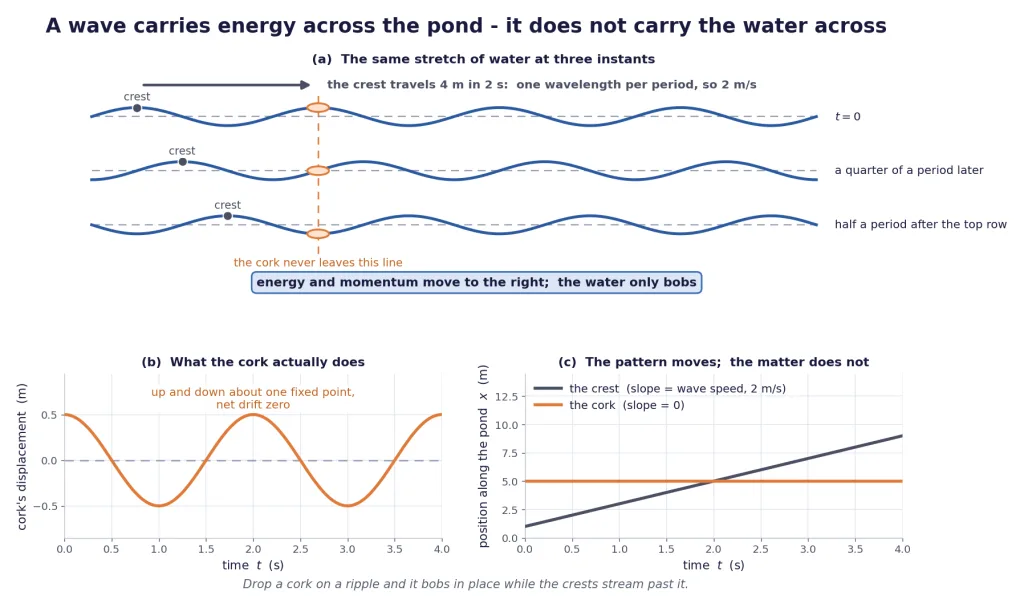
Look at the third panel above. The crest's position climbs steadily with time — a straight line whose slope is the speed of the wave. The cork's position is a flat line. Same picture, two completely different stories, and that is the difference between a wave and a flow.
How the disturbance gets handed on
Imagine a long row of identical trolleys, each joined to the next by a spring. Pull the trolley at one end sharply and let go. It moves, so the spring joining it to its neighbour stretches, so the neighbour feels a force and starts moving too, so the next spring stretches, and so on down the line. The disturbance runs from one end to the other. But no trolley makes the journey — each one only swings back and forth about the place it started from.
A real material medium is exactly this, with atoms in place of trolleys and interatomic forces in place of springs. A stationary train makes the same point on a larger scale: the engine gives a push to the bogie next to it, that bogie pushes the next, and the jolt runs down the train without the train being bodily shifted.
So a mechanical wave needs three things from its medium, and every one of them matters:
| Ingredient | What it does | If it is missing |
|---|---|---|
| inertia (mass) | lets a displaced element overshoot its equilibrium | the disturbance would stop dead |
| elasticity (a restoring force) | pulls a displaced element back | there would be nothing to pull it back |
| coupling between neighbours | passes the disturbance on | the disturbance would stay put |
A wave is not a flow — say it in these words
- A stream is water moving as a whole from one place to another. A water wave is not: only the disturbance moves.
- A wind is air moving as a whole. A sound wave is not: when you speak, you do not blow air into the listener's ear. What travels the ten metres between you is a pattern of squeezings and stretchings of the air.
Here is what a sound wave does in detail. As the disturbance passes a small region of air, it squeezes that region. The density there rises a little, and so does the pressure. Pressure is force per unit area, so the squeezed air pushes back — the restoring force, exactly as with a spring, with the change in density playing the part of the extension. Those molecules push out into the region next door, compressing it in turn, while the region they left is now comparatively thin. So the squeeze moves along, and so does the thinning behind it, and the air as a whole has gone nowhere.
What waves are for
Energy is only half the story. The pattern of a disturbance can carry information, which is why essentially every communication system on Earth is a chain of waves. You speak, producing sound waves in air; a microphone turns them into an electrical signal; that signal is used to generate an electromagnetic wave; the wave travels along an optical fibre or up to a satellite and back; and at the far end each step is undone in reverse order. Nothing material makes the trip. Only the pattern does.
[Board Important] "What does a wave transport?" is a one-mark question with a two-word answer: energy and momentum. If your answer contains the word "matter", "particles" or "medium", it is wrong. The full sentence worth memorising is: a wave transports energy and momentum through a medium without transporting the medium itself.
The Three Families of Waves
Not every wave needs a medium. Starlight crosses hundreds of light years of interstellar space, which is as close to empty as anything gets, and arrives perfectly well. So waves come in three families, and the first question to ask about any wave is which family it belongs to.
1. Mechanical waves
These need a material medium, and they cannot cross a vacuum. They are oscillations of the constituents of that medium, they run on ordinary Newtonian mechanics, and their speed is decided by the medium's inertia and its elastic properties. Waves on a string, ripples on water, sound in air, and seismic waves inside the Earth are all mechanical.
The classic demonstration: an electric bell ringing inside a glass jar. Pump the air out and the hammer goes on striking — you can see it — but the sound fades to nothing. Put the air back and the sound returns.
2. Electromagnetic waves
These need no medium at all. Light, radio waves, microwaves, infrared, ultraviolet, X-rays and gamma rays are all electromagnetic waves, differing only in wavelength. In vacuum every one of them travels at the same speed,
which is the value to use in problems. Note the word vacuum: inside glass or water an electromagnetic wave is slower, which is exactly why lenses and prisms work. They are studied properly in Class 12.
3. Matter waves
Every moving particle — an electron, a proton, a neutron, an atom, a whole molecule — has a wave associated with it. These matter waves come out of quantum mechanics and are more abstract than the other two families, but they are not a curiosity: the electron microscope works precisely because the matter wave of a fast electron has a far shorter wavelength than visible light, and so can resolve far smaller things.
Key Point — the three families at a glance:
Family Needs a medium? Speed Examples Mechanical yes set by the medium's inertia and elasticity sound, ripples on water, waves on a string, seismic waves Electromagnetic no m/s in vacuum, for all of them light, radio, microwaves, X-rays Matter (associated with moving particles) depends on the particle electron waves in an electron microscope
[NEET Important] Two facts from that table get asked directly, almost word for word. First, sound cannot travel through a vacuum, light can. Second, all electromagnetic waves travel at the same speed in vacuum, whatever their wavelength — a radio wave and a gamma ray keep exactly the same pace.
The rest of this chapter is about mechanical waves, because they are the ones you can see, shake and hear, and because everything you learn from them carries over.
[JEE Tip] A common trap asks which of four listed waves "requires a material medium". Ultrasound, infrasound and seismic waves are all mechanical, however exotic they sound; X-rays and radio waves are electromagnetic, however ordinary they sound. Judge by the physics, not by how technical the name is.
Transverse and Longitudinal Waves
Every mechanical wave involves particles of the medium oscillating. The classification that runs through the rest of this chapter is about which way they oscillate relative to the direction the wave is going.
Key Point — the two kinds:
- In a transverse wave the particles of the medium oscillate perpendicular to the direction in which the wave travels. The pattern is a series of crests (maximum displacement one way) and troughs (maximum displacement the other way).
- In a longitudinal wave the particles oscillate along the direction in which the wave travels. The pattern is a series of compressions (particles crowded together, density and pressure above normal) and rarefactions (particles spread out, density and pressure below normal).
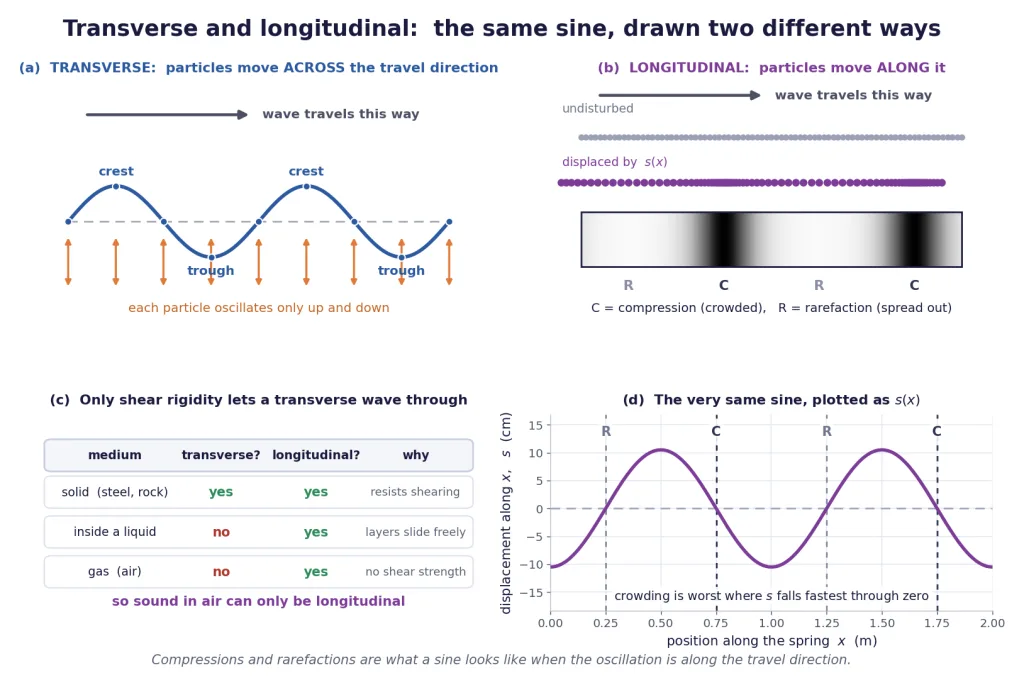
Look carefully at panels (b) and (d). The displacement in the longitudinal case is the same sine as in the transverse case — it has simply been drawn along the direction of travel instead of across it. The dark bands in the density strip are where the particles have been pushed together, and they sit exactly where the displacement curve is falling most steeply through zero. Compressions are not where the displacement is largest; they are where neighbouring particles have moved towards each other.
A jerk given sideways to a stretched string sends a transverse wave along it. A piston pushed and pulled at the end of an air-filled pipe sends a longitudinal wave along the pipe. Both are called travelling or progressive waves, because they carry the disturbance from one part of the medium to another.
Why sound in air has to be longitudinal
This is the reasoning to have ready; it is asked every year.
When a transverse wave passes, one layer of the medium is displaced sideways relative to the layer next to it. That is a shearing strain. For the wave to survive, the medium must fight back against being sheared — it needs shear rigidity, a restoring force that appears when one layer slides across another.
- A solid has exactly that. Its atoms are locked into a lattice, and sliding one plane across another costs energy. So a solid supports transverse waves.
- A fluid — a gas, or the interior of a liquid — has none. Its layers slide over one another freely; there is no restoring force at all for a shear. So no transverse wave can travel through a gas or through the body of a liquid.
Compression is a different matter. Every elastic medium resists being squeezed — solids, liquids and gases alike. Squeeze air and its pressure rises and pushes back. That is why longitudinal waves travel in all elastic media.
Key Point: Air can be compressed but cannot be sheared. Therefore sound in air is necessarily longitudinal, and there is no such thing as a transverse sound wave in a gas. In a solid such as steel, both kinds propagate, and they do so at different speeds.
Water waves are neither, quite
A ripple on a pond looks like the standard picture of a transverse wave, and students happily label it as one. It is not that simple.
The surface of a liquid is special. It is not the interior. A bump raised on the surface is pulled back — by surface tension for small ripples (these are the capillary waves, with wavelengths of no more than a few centimetres) and by gravity for larger ones (the gravity waves, from a few metres to a few hundred metres). So a surface has restoring forces that the interior does not, and surface waves exist.
But track a single water particle as a wave goes by and you find it moving up and down and back and forth at the same time, tracing out a roughly circular path, with the circles shrinking as you go deeper. So a water wave is a combination of transverse and longitudinal motion, not purely one or the other. Ocean waves are the standard example.
Reading the Earth with both kinds at once
An earthquake sends out both. The P waves (primary) are longitudinal and arrive first; the S waves (secondary) are transverse and arrive later. Seismometers on the far side of the planet record P waves but no S waves at all through a large region. Since transverse waves cannot cross a liquid, that missing signal is how we know the Earth's outer core is molten. One rule about shear rigidity, applied to a planet.
| Medium | Transverse? | Longitudinal? | Reason |
|---|---|---|---|
| solid (steel, rock, a stretched string) | yes | yes | it resists shearing and compression both |
| interior of a liquid (deep water, mercury) | no | yes | layers slide freely, but it resists compression |
| gas (air, any gas) | no | yes | no shear strength whatever; it does resist compression |
| surface of a liquid | a mixture of the two | surface tension and gravity restore a surface bump |
[JEE Tip] "A transverse wave cannot travel through a liquid" is not quite true as usually stated, and examiners exploit the gap. Transverse waves cannot travel through the interior of a liquid. The surface carries waves that are partly transverse and partly longitudinal. Read whether the question says "in a liquid" or "on the surface of a liquid".
Pulse, Periodic and Harmonic
Three words that get used loosely in conversation and precisely in physics. They describe how the source behaves, and therefore what the wave looks like.
A pulse
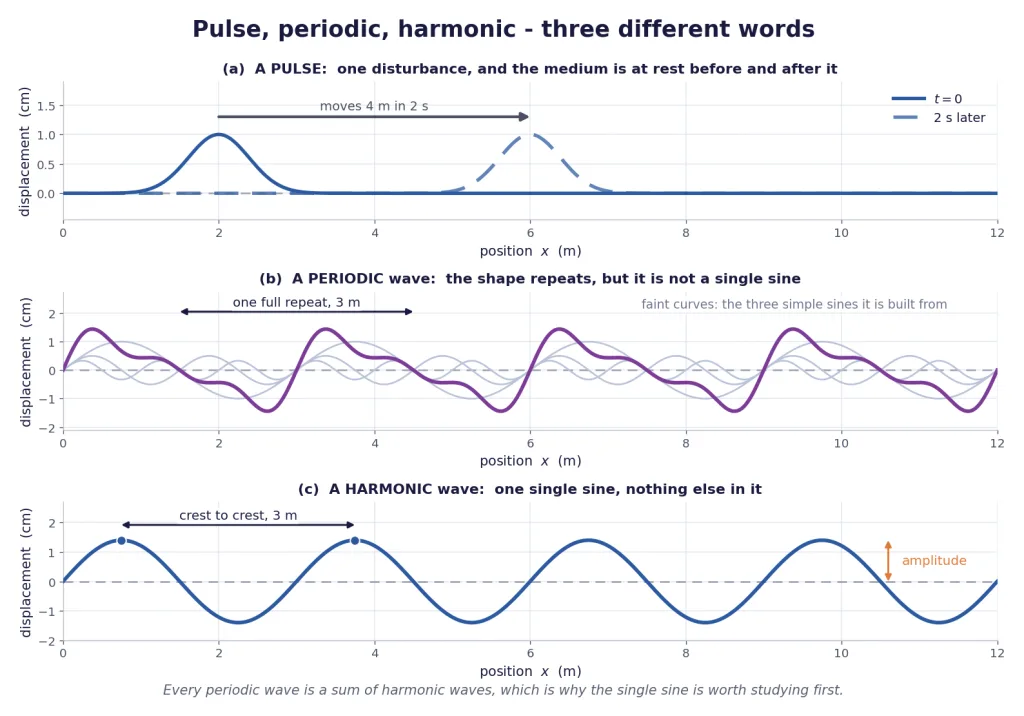
Give the end of a stretched string one sharp up-and-down jerk. A single hump runs along the string and that is all. Before it arrives, a given piece of string is at rest; while it passes, that piece moves up and comes back; after it has gone, the piece is at rest again. That single travelling disturbance is a pulse.
A pulse has no repeating pattern and therefore no wavelength and no frequency. A clap, a hammer blow, and the bang of a bursting balloon are pulses.
A periodic wave
Now keep shaking the end of the string, over and over, in the same way. The source repeats, so the disturbance repeats, and the string carries an unbroken train of humps and hollows. A periodic wave is one whose pattern repeats — in space, so that a snapshot shows the same shape over and over, and in time, so that any one particle repeats its own motion over and over.
The distance over which the pattern repeats itself in space is the wavelength, and the number of complete repeats a particle makes per second is the frequency. Both get their symbols and their proper treatment in the next section; here it is enough to know that a pulse has neither and a periodic wave has both.
A harmonic wave
A periodic wave need not be a nice smooth curve. Panel (b) above is perfectly periodic — the shape repeats every 3 m — but it is a lumpy thing, because it is three different sines added together.
A harmonic wave is the special case in which the shape is a single sine (or cosine) curve and nothing else, as in panel (c). Its source is executing simple harmonic motion. This is the wave the whole chapter is built around, for a reason that is not obvious but is enormously useful:
Key Point: Every periodic wave, however complicated its shape, can be built by adding harmonic waves together. So if you understand the single sine completely, you have in principle understood every periodic wave. That is why the next section spends all its time on one sine curve.
Note the hierarchy, because questions test it: every harmonic wave is periodic, but not every periodic wave is harmonic; and a pulse is neither.
| Repeats? | A single sine? | Has a wavelength? | Example | |
|---|---|---|---|---|
| pulse | no | no | no | one flick of a rope, a clap |
| periodic | yes | not necessarily | yes | the note of a violin, a train of ripples |
| harmonic | yes | yes | yes | a tuning fork's note, a rope shaken in simple harmonic motion |
[NEET Important] A tuning fork is the standard example of a source producing an (almost) pure harmonic wave. A violin or a human voice sounding the same note produces a periodic wave with the same repeat, but not a single sine — that difference in shape is what makes the two sound different, and it is called timbre.
Three Speeds, and Why They Get Confused
Here is the single most common conceptual error in this whole chapter, and it is worth meeting it now, before any formula can hide it. When a question says "the speed", there are three different things it could mean, and they are three different numbers.
1. The wave speed
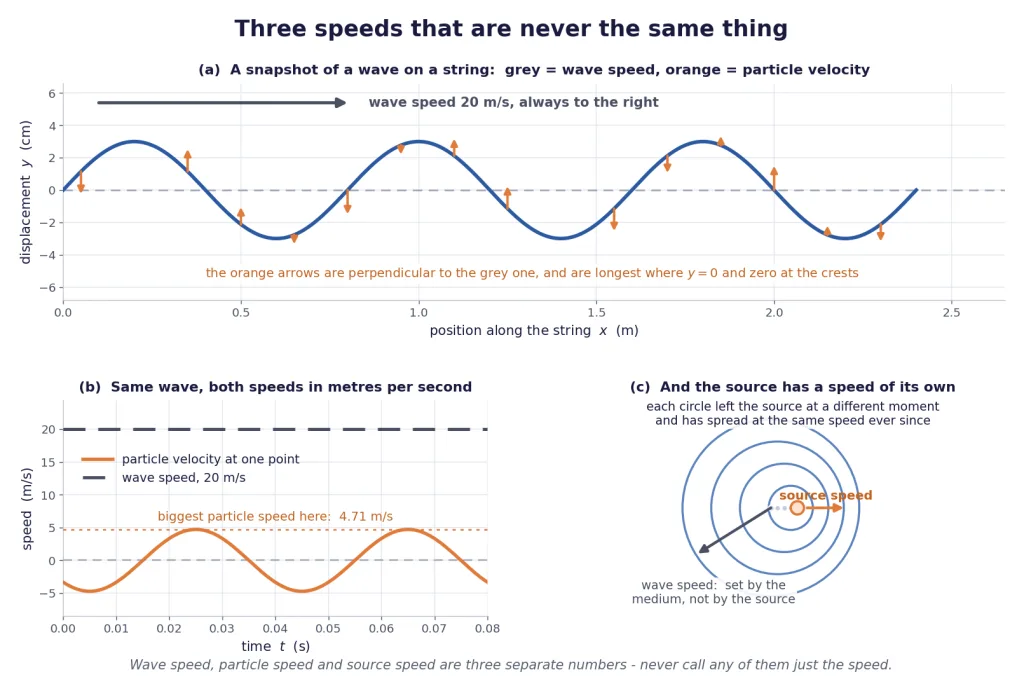
This is the speed at which the disturbance advances through the medium. Fix your eye on a crest and see how far it moves: in the pond figure earlier, a crest covered 4 m in 2 s, so the wave speed was 2 m/s. Pick any other feature of the pattern and it moves at the same rate, or the shape would not hold together.
For a mechanical wave this speed is a property of the medium, not of you. Shake the string harder, or faster, and the disturbance still runs along it at the same rate. It is written throughout this chapter.
2. The particle speed
This is the speed at which one small piece of the medium moves as it oscillates about its own rest position. It is not constant: it is largest as the particle rushes through its rest position and momentarily zero at the extremes — at a crest or a trough the particle has stopped, turned, and is about to come back. It depends on how hard the source was shaken, not on the medium alone.
Panel (b) of the figure is the point of this section. For a wave on a string travelling at 20 m/s, the particle velocity at one fixed point swings back and forth between about m/s and m/s. Both numbers are in metres per second; both are speeds; they describe two entirely different motions and there is no reason for them to be equal or even close.
3. The speed of the source
This is the speed of the thing that made the wave, moving through the medium — a moving siren, a passing aircraft, a boat. It changes nothing about how fast the wave travels. Every disturbance the source emits, it leaves behind, and each one then spreads through the medium at the medium's own speed. Panel (c) shows this: the circles were emitted at different moments from different places, and every one of them has been spreading at the same rate ever since. That a moving source does change what a listener hears is a real and important effect, and it is developed later in the chapter.
Key Point — three speeds, three meanings:
Speed What it measures Depends on Constant? wave speed how fast the disturbance advances the medium yes, in a uniform medium particle speed how fast one bit of medium oscillates how hard the source was shaken no, it varies through every cycle source speed how fast the source itself moves whatever is pushing the source whatever the source does Never write or say a bare "the speed" in this chapter. Write wave speed or particle speed every time.
The directions differ too
In a transverse wave, the wave velocity points along the string and the particle velocity points across it — they are at right angles, as the grey and orange arrows in panel (a) show. In a longitudinal wave both are along the same line, which makes the two even easier to confuse; they are still different quantities with different values.
And notice in panel (a) where the orange arrows are longest. They are longest where the curve crosses zero and they vanish at the crests and troughs — the opposite of what most people guess on first sight.
Two consequences worth having ready
- Increasing the amplitude increases the particle speed and leaves the wave speed alone. Shake the string through twice the distance in the same time and every particle moves twice as fast, but the disturbance still travels along the string at the rate the string's tension and thickness allow.
- A particle of the medium never travels with the wave. Over one complete cycle it comes back exactly to where it started; its net displacement is zero however long the wave goes on. In the pond example, the wave advanced 20 m in ten seconds while the cork covered a total path of about 1 m, up and down, and ended where it began.
[JEE Tip] If a question gives you a wave speed and asks for a particle speed — or the other way round — it is testing this distinction and nothing else. Read which one is wanted, twice, before you calculate. Marking the two with different symbols in your rough work, for the wave and for the medium, costs a second and saves the question.
Solved Examples
Constants and conventions used throughout: the speed of sound in air is taken as 340 m/s unless a question states otherwise; the speed of light in vacuum as m/s. Every wave travels through a uniform medium at rest unless stated. "Wave speed" always means the speed at which the disturbance advances; "particle speed" always means the speed of one element of the medium.
Example 1: What the cork really does
Ripples cross a pond at 2 m/s. A cork floating on the surface bobs up and down with a period of 2 s and an amplitude of 5 cm. Over a ten-second stretch, (a) how far does the disturbance travel, (b) what total path length does the cork cover, and (c) what is the cork's net displacement?
Solution:
(a) The disturbance advances at the wave speed, steadily:
(b) The cork is in simple harmonic motion. Its period is 2 s, so in 10 s it completes full oscillations. In each full oscillation a particle covers four amplitudes — down to one extreme, across to the other, and back:
(c) After a whole number of complete oscillations the cork is exactly where it started, so its net displacement is zero.
Twenty metres of wave, one metre of bobbing, zero net movement of water.
Takeaway: The disturbance travels; the medium does not. Distance covered by the wave and path covered by a particle are answers to different questions.
Example 2: Sorting four wave motions
State for each whether the wave motion is transverse, longitudinal, or a combination of both.
(a) A kink sent along a long coiled spring by displacing one end sideways. (b) Waves set up in a cylinder of liquid by pushing and pulling a piston at one end. (c) Waves made by a motorboat driving across a lake. (d) Ultrasonic waves in air, produced by a vibrating quartz crystal.
Solution:
(a) Both. The sideways jerk shears the coils, which sends a transverse disturbance; but displacing one end also stretches and compresses the spring along its length, which sends a longitudinal one. A coiled spring supports both, so both are generated.
(b) Longitudinal. The piston moves along the axis of the cylinder, pushing and pulling the liquid along that same direction. The liquid's interior has no shear rigidity, so a transverse wave could not travel there in any case.
(c) Both. These are surface water waves. Water particles at the surface move up and down and back and forth, tracing near-circles, so the motion is partly transverse and partly longitudinal.
(d) Longitudinal. "Ultrasonic" only means the frequency is above the range human ears respond to; it is still sound, and sound in air can only be longitudinal, because air has no shear strength.
Takeaway: Ask what direction the source pushes the medium in, and then ask whether the medium can resist a shear. Those two answers settle every classification question of this type.
Example 3: Why there is no transverse sound in air
Explain why a sound wave travelling through air must be longitudinal, and why a sound wave travelling through a steel rail need not be.
Solution:
Step 1 — what a transverse wave demands. In a transverse wave, each layer of the medium is displaced sideways relative to its neighbour. That is a shearing strain. For the disturbance to be handed on, the medium must produce a restoring force opposing that shear.
Step 2 — what air can do. Air is a gas. Its molecules are not bound into any structure, and one layer of air slides past another with no resistance at all: a gas has no shear rigidity. So a sideways displacement produces no restoring force, nothing is handed on, and a transverse wave in air simply cannot exist.
Step 3 — what air can still do. Compress a parcel of air and its pressure rises immediately and pushes back. That restoring force is all a longitudinal wave needs, and it is why sound in air propagates as compressions and rarefactions.
Step 4 — steel. Steel is a crystalline solid. Its atoms sit in a lattice, and sliding one plane of atoms across another does meet resistance: a solid has shear rigidity. Steel therefore carries both transverse and longitudinal waves, and in fact the two travel at different speeds through the same rail.
Takeaway: Shear rigidity is the deciding property. All elastic media resist compression, so all of them carry longitudinal waves; only media that resist shear carry transverse ones.
Example 4: Reading the inside of the Earth
After a large earthquake, stations right around the world record the longitudinal P waves, but there is a wide region on the far side of the planet where the transverse S waves never arrive. What does that tell us, and why?
Solution:
Step 1 — identify the two waves. P waves are longitudinal, S waves are transverse. Both start together at the earthquake's focus.
Step 2 — apply the rule. A transverse wave needs a medium with shear rigidity. Solids have it; liquids do not.
Step 3 — read the evidence. If S waves are blocked over a large region while P waves get through, the paths to that region must pass through something that cannot support a shear. That is a liquid.
Step 4 — conclude. The Earth's outer core is molten. The size and shape of the S-wave shadow even fix the depth at which the liquid layer begins.
Takeaway: One line of physics — transverse waves need shear rigidity — is enough to establish that a region thousands of kilometres beneath our feet is liquid, without anyone going there.
Example 5: Timing a pulse on a rope
A single flick of the hand sends a pulse along a long horizontal rope. The pulse is seen to cover 8 m in 0.4 s. (a) What is the wave speed? (b) How long will the pulse take to reach a mark 30 m from the hand? (c) How far will it have travelled 0.25 s after the flick?
Solution:
(a) The pulse keeps its shape and moves steadily, so
(b) The rope is uniform, so the speed does not change along it:
(c) m.
Note what was not needed anywhere: the pulse has no wavelength and no frequency, because nothing repeats. A pulse is timed exactly like any other steadily moving object.
Takeaway: For a pulse, wave speed is plain distance over time. The rope's own properties fix that speed; how hard you flicked it does not.
Example 6: The same rope, the other speed
The pulse of the previous example travels at 20 m/s. As it goes past, a particular point of the rope is seen to rise 4 cm in 0.02 s. Find the average speed of that point while it was rising, and compare it with the wave speed.
Solution:
Step 1 — be clear which speed is being asked for. The point of the rope is a particle of the medium. Its motion is across the rope, not along it. So this is a particle speed.
Step 2 — compute it.
Step 3 — compare.
The wave speed is ten times the average particle speed here — and that ratio is an accident of these particular numbers. Flick the rope through a bigger displacement in the same time and the particle speed rises while the wave speed does not budge; the ratio changes. The two are independent quantities.
Takeaway: Both answers are in metres per second, and that is all they have in common. Wave speed belongs to the medium; particle speed belongs to how the wave was made.
Example 7: Counting the seconds after the lightning
You see a flash of lightning and hear the thunder 5.0 s later. Take the speed of sound in air as 340 m/s. (a) How far away was the strike? (b) Was it reasonable to ignore the time the light took?
Solution:
(a) The light and the sound left the strike at the same instant. The sound is the slow one:
so the strike was about 1.7 km away.
(b) Check the light's travel time over the same distance:
Under six microseconds, against a five-second gap. Ignoring it changes nothing you could measure with a wristwatch, so yes, it was reasonable.
Takeaway: The old rule of thumb — roughly a third of a kilometre for every second between flash and bang — is just with 340 m/s in it.
Example 8: A horn on a moving car
A car travelling along a straight road at 20 m/s sounds its horn once. Take the air to be still and the speed of sound as 340 m/s. Two seconds after the horn sounds, (a) how far has the sound got, in the forward direction, from the point where it was emitted, and (b) how far ahead of the car's current position is that sound front?
Solution:
Step 1 — the key physical point. Once a disturbance has been created in the air, the air carries it at the air's own speed. The car's motion does not push it along faster. So measure the sound from the place where it was emitted, not from the car.
Step 2 — the sound.
from the emission point.
Step 3 — the car.
from the same point.
Step 4 — the gap.
The sound front is 640 m ahead of the car and pulling away, because 340 m/s is much greater than 20 m/s.
Takeaway: Source speed and wave speed are separate. The source's speed decides where each disturbance starts; the medium decides how fast each one then travels.
Example 9: Light from the Sun, and sound that never comes
The Sun is about m away. (a) How long does its light take to reach us? (b) Sound in air travels at 340 m/s; if space between us and the Sun were filled with such air, how long would sound take? (c) What actually happens to sound from the Sun?
Solution:
(a) Light is an electromagnetic wave and needs no medium:
(b) Treating it as a straight calculation,
which is about 14 years.
(c) None of it reaches us at all. Sound is a mechanical wave and the space between the Sun and the Earth is very nearly a vacuum, with no medium to carry a compression. Part (b) is a calculation about a hypothetical air-filled solar system, not about the real one.
Takeaway: Before putting numbers into for a sound problem, check that there is a medium. Mechanical waves die in a vacuum; electromagnetic waves cross it happily.
Example 10: Pulse, periodic or harmonic?
Classify each disturbance as a pulse, a periodic wave that is not harmonic, or a harmonic wave.
(a) A single hand-clap in a room. (b) A tuning fork sounding steadily. (c) A violin bowing a steady note. (d) The end of a long string moved up and down in simple harmonic motion.
Solution:
(a) A pulse. One brief disturbance, with the air at rest before it and after it. Nothing repeats, so there is no wavelength and no frequency.
(b) Harmonic. The prongs of a tuning fork execute simple harmonic motion to a very good approximation, and the wave they send out is a single sine.
(c) Periodic but not harmonic. The note repeats faithfully, so the wave has a definite wavelength and frequency, but the shape of one repeat is not a single sine — it is a sum of several. That extra content in the shape is what makes a violin sound like a violin and not like a tuning fork.
(d) Harmonic. A source in simple harmonic motion produces a harmonic wave, by definition.
Takeaway: Harmonic is a special case of periodic, and a pulse is neither. Look at the source: one jerk gives a pulse, a repeating source gives a periodic wave, and a source in simple harmonic motion gives a harmonic one.
Example 11: Is a ripple transverse?
A student writes: "A wave on the surface of water is a transverse wave, because the water goes up and down while the wave goes sideways." Where is this right, where is it wrong, and what is the correct answer?
Solution:
What is right. The water surface does move up and down while the pattern travels horizontally, and that part of the motion is genuinely transverse. For a rough sketch it is a fair description.
What is wrong. It is not the whole motion. Follow a single water particle carefully and it also moves back and forth horizontally, so that its path over one cycle is roughly a circle rather than a straight vertical line. That back-and-forth part is longitudinal. The circles shrink with depth but do not stop at the surface.
The correct answer. A surface water wave is a combination of transverse and longitudinal motion, not purely either.
One more thing worth knowing. The restoring force differs with size. For ripples up to a few centimetres, surface tension provides it and they are called capillary waves; for wavelengths of metres and upwards, gravity provides it and they are called gravity waves.
Takeaway: The interior of a liquid carries longitudinal waves only. Its surface is a special case, with its own restoring forces and a mixed particle motion.
Example 12: What crosses the room when you speak
You speak to someone standing 10 m away in still air. (a) How long does the sound take? (b) Does the air you exhaled reach the listener? (c) What travels the 10 m?
Solution:
(a) Using 340 m/s,
about three hundredths of a second.
(b) No. The air a person exhales drifts a short way and stops, at nothing like 340 m/s. A wind is a bulk motion of air; a sound wave is not.
(c) What crosses the room is a pattern of compressions and rarefactions — a disturbance in the pressure and density of the air. Each air molecule oscillates back and forth about its own position, through a distance far smaller than a millimetre for ordinary speech, and stays where it was. The energy and the information make the trip; the air does not.
Takeaway: The pattern travels at 340 m/s; the medium travels nowhere. This is the definition of a wave, restated as a sentence about a conversation.