
How Fast Does the Pattern Move?
The previous section left one question hanging. The equation
describes a shape that travels, and we can now say exactly how fast it travels — using nothing but the equation itself.
Ride along with one point of the wave
Pick out one particular point of the pattern: a crest, say, or a zero crossing on its way up. What identifies it is its phase. A crest is a point whose phase is ; the next crest along has phase ; and so on. So to keep your eye on the same crest as the seconds pass, you must move in such a way that its phase never changes:
Now let a small time elapse, during which the crest moves through a small distance . The phase at the new place and the new time must equal the phase at the old place and the old time:
Everything on the left that was on the right cancels, leaving
and in the limit of vanishingly small intervals that ratio is the speed of the crest — the wave speed.
Key Point — the speed of a travelling wave: Substituting and turns the first form into the second, since the s cancel; and turns the second into the third. Here is the period of the oscillation, in seconds.
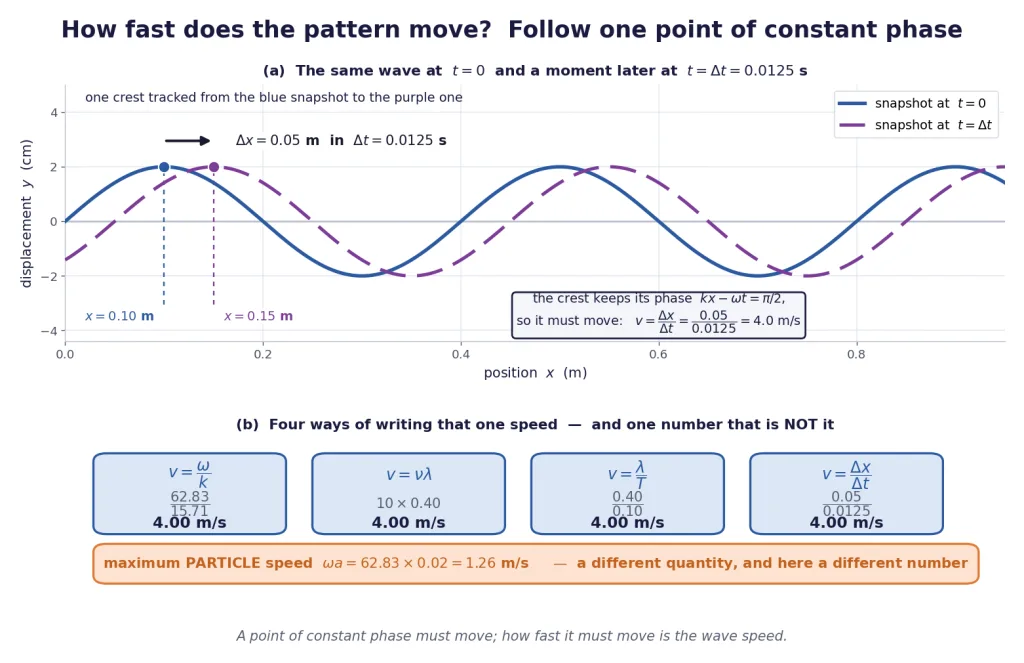
Panel (a) of the figure does the whole argument with numbers. A wave of wavelength 0.40 m and period 0.10 s is drawn at and again a moment later at s, which is an eighth of a period. The marked crest has walked from m to m — 0.05 m in 0.0125 s, which is 4 m/s. Panel (b) then evaluates , and for that same wave, and every one of them gives 4 m/s. They must, because they are the same statement written three ways.
The sentence behind the formula
deserves to be read in words rather than just used:
Key Point: In the time one particle takes to complete one full oscillation — that is, in one period — the wave pattern advances by exactly one wavelength . Divide the distance by the time and you have the speed.
That is why the relation is universal. It does not care whether the wave is transverse or longitudinal, on a string or in air or in steel, or whether it is light rather than sound. Any wave that repeats in space with period and in time with period travels at .
The wave speed is not the particle speed
This is the point where the chapter's commonest error appears, so it is worth pinning down while both numbers are in front of us. For the wave in the figure, with amplitude 2 cm:
- the wave speed is m/s — the rate at which the pattern advances along ;
- the maximum particle speed is m/s — the fastest any one bit of the medium ever moves, as it whips through its mean position.
Both are in metres per second and that is all they have in common. The wave speed is constant and belongs to the medium; the particle speed varies through every cycle and depends on how hard the source was shaken. Doubling the amplitude doubles and leaves untouched.
Notation for this section
Three different quantities in this section are written , and their units tell them apart at a glance.
| Symbol | Meaning | Unit |
|---|---|---|
| wave speed | m/s | |
| wavelength | m | |
| frequency | Hz | |
| period of the oscillation | s | |
| tension in a stretched string | N | |
| absolute temperature of a gas | K | |
| angular wave number, | rad/m | |
| angular frequency, | rad/s | |
| linear mass density | kg/m | |
| mass density | kg/m³ | |
| bulk modulus | Pa | |
| Young's modulus | Pa | |
| ratio of the specific heats | dimensionless | |
| pressure | Pa | |
| molar mass | kg/mol |
is the angular wave number in rad/m throughout; it is never a spring constant here.
[Board Important] "Derive for a progressive wave" is a standard question. Start from the constant-phase condition , take small changes of both, get , and then substitute and . Three lines, full marks.
The Speed Belongs to the Medium
contains three quantities. Which of them is in charge?
The answer is the one thing the formula does not show, and it changes how you read every problem in this chapter.
Key Point: For a mechanical wave, the speed is fixed by the medium — by how stiff it is and how heavy it is — and by nothing else. The source fixes the frequency , because the source is what drives the first particle of the medium and every other particle simply copies it. The wavelength is then whatever those two force it to be: Wavelength is the dependent one. It is never chosen; it is always a consequence.
What that means in practice
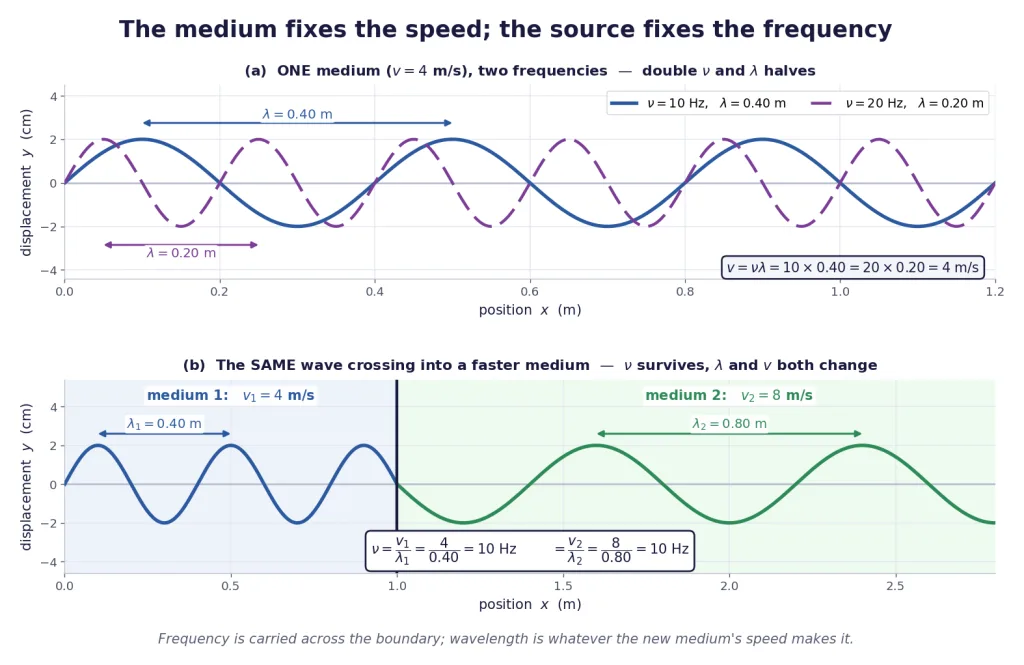
Change the frequency and the wavelength adjusts to compensate. Shout at a higher pitch and the sound still crosses the room at the same rate; what changes is how many crests fit into each metre. In air at 340 m/s, the lowest audible note of 20 Hz has a wavelength of 17 m, while the highest of 20 kHz has a wavelength of 1.7 cm. Same air, same speed, a factor of a thousand between the wavelengths. Panel (a) of the figure shows two such waves computed in one medium: double the frequency and the wavelength halves exactly.
Shake harder and nothing about the speed changes. The amplitude is set by how much energy the source puts in. It does not enter at all — as the next block's formula for a string will show explicitly. A gentle wave and a violent one on the same string travel side by side at the same rate.
The speed is also independent of the frequency. Air carries a 20 Hz rumble and a 20 kHz whistle at exactly the same 340 m/s. This is worth noticing because it is not obvious, and because it is what makes music possible: if low notes travelled more slowly than high ones, a chord played across the hall would arrive smeared out. (Media in which the speed does depend on frequency exist — that is what makes a glass prism split white light — but the ordinary mechanical waves of this chapter are not among them.)
Crossing into a new medium
Now the case exams love. A wave reaches a boundary and passes into a different medium — sound from air into water, a wave running from a light string onto a heavy one. Which of , and survives the crossing?
Think about what happens at the junction itself. The last particle of medium 1 and the first particle of medium 2 are in contact, so they must move together — they cannot separate or overlap. The particle in medium 2 is therefore driven at exactly the rate at which the particle in medium 1 is oscillating. The frequency is imposed across the boundary and is carried through unchanged.
The speed, meanwhile, is set by the new medium, and the new medium is different. So changes, and must change with it.
Key Point — what survives a change of medium:
Quantity Crossing into a new medium Why frequency unchanged the boundary particles move together, so the driving rate is passed on speed changes it is a property of the medium, and the medium is now different wavelength changes, in the same ratio as because with fixed So . A faster medium stretches the wave out; a slower one packs it tighter.
Panel (b) of the figure is one continuous computed wave crossing at m from a medium in which it travels at 4 m/s into one in which it travels at 8 m/s. The frequency is 10 Hz on both sides — you can check it from either half, and — while the wavelength doubles from 0.40 m to 0.80 m. Notice that the two halves join smoothly: they have to, because the medium is not torn at the junction.
[NEET Important] "A sound wave goes from air into water. What happens to its frequency, speed and wavelength?" is asked almost every year, and there is only one right shape of answer: frequency unchanged, speed increases, wavelength increases in the same proportion. Sound travels roughly four and a half times faster in water than in air, so a 500 Hz note whose wavelength in air is 0.68 m has a wavelength of about 2.96 m in water.
[JEE Tip] If a question ever tempts you to say "the wavelength stays the same and the frequency changes", stop. It is the wrong way round for a wave crossing a boundary. The only thing that can change a wave's frequency is a change at the source — or relative motion between source and observer, which is a separate effect taken up later in the chapter.
A Transverse Wave on a Stretched String
The medium decides the speed. So what, exactly, about the medium? Two things, always, for every mechanical wave:
- How strongly it springs back when it is disturbed — its elastic property, which supplies the restoring force.
- How much inertia it has — its mass, which resists being accelerated.
A stiffer medium hurries the disturbance along; a heavier one drags it back. So the speed should go up with the elastic property and down with the inertia. Every wave-speed formula in this chapter has that shape.
For a stretched string the elastic property is the tension , in newtons, and the inertia is the linear mass density — the mass of the string per metre of its length,
In the symbol is the tension, measured in newtons; the period of an oscillation, measured in seconds, is written as well. A tension is in newtons and a period is in seconds, so check the unit and the ambiguity disappears.
First, by dimensions
Suppose depends only on and . Tension is a force, so its dimensions are ; linear mass density is a mass per length, . Divide:
which is the square of a speed. So
for some pure number that dimensional analysis can never supply. The full calculation gives .
Then, by the physics of a curved element
Here is why comes out as exactly 1, and it is worth following because the argument is short and it explains where the square root comes from.
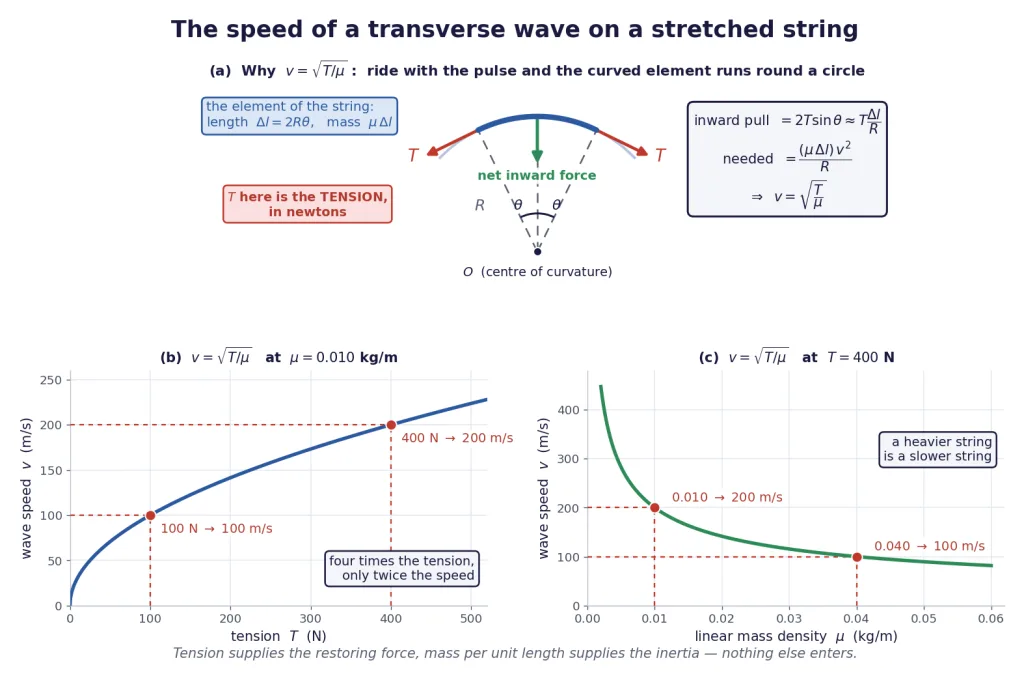
Run alongside a pulse at its own speed . In that moving frame the pulse stands still and the string streams backwards through it at speed . Look at a small element right at the top of the hump, of length , which is momentarily bent into an arc of a circle of radius subtending an angle at the centre, so that .
Two forces act on it: the tension pulling along the string at each end. The two pulls are equal in size but not parallel — each is tilted by from the horizontal — so the horizontal parts cancel and the vertical parts add, giving a resultant that points straight at the centre of the circle:
using for a small bend.
Meanwhile the element has mass and it is moving along that circular arc at speed , so the centripetal force it needs is
Set the force available equal to the force required. Both and cancel completely:
Key Point — the speed of a transverse wave on a stretched string: with the tension in newtons and the linear mass density in kg/m. Nothing else appears — not the amplitude, not the frequency, not the wavelength, not the length of the string.
That and both dropped out is the important part. It means the result does not depend on how sharp the hump is, so every part of the pulse travels at the same speed and the pulse keeps its shape.
Reading the formula
Panels (b) and (c) of the figure plot it. Because of the square root, the dependence is weak in both directions:
- Tighten the string. Four times the tension gives only twice the speed. At kg/m, raising the tension from 100 N to 400 N takes the speed from 100 m/s to 200 m/s.
- Thicken the string. Four times the mass per metre halves the speed. That is why the low strings of a guitar are the fat ones: a heavier string is a slower string, and a slower wave means a lower note.
- Neither amplitude nor frequency appears. Pluck the same string gently or hard, at any pitch you like, and the wave still runs along it at the same rate.
Getting when you are not given it
Problems rarely hand you directly. Two routes cover almost everything:
The second is for a uniform wire of material density and radius : a metre of it has volume , so its mass per metre is . It follows that for two wires of the same material under the same tension, — double the radius and the speed halves.
[JEE Tip] A wire hanging vertically with a mass tied to its lower end has tension — and if the wire's own weight is not negligible, the tension is larger at the top than at the bottom, so the wave speeds up as it climbs. That is a favourite Advanced-level twist; for Main and for Boards, the tension is uniform unless you are told otherwise.
[Board Important] Write the units when you quote the formula: in N, in kg/m, in m/s. A very common slip is to put the string's total mass in place of and forget to divide by the length, which inflates the answer by a factor of .
Longitudinal Waves, and Newton's Missing 15%
A longitudinal wave squeezes and stretches the medium along the direction it travels. So the elastic property that matters is no longer a tension but the medium's resistance to being compressed, and the inertia is its ordinary mass density in kg/m³.
In a bulk medium
Resistance to compression is measured by the bulk modulus : apply an extra pressure and the material's volume shrinks by a fraction , and
The minus sign is there because a positive pressure produces a negative change in volume, so itself comes out positive. has the units of pressure, the pascal.
Check the dimensions as before. is a pressure, ; density is ; their ratio is , the square of a speed. The exact treatment again gives the constant as 1:
Key Point — longitudinal waves: In a thin rod the sides are free to bulge outwards, so the material is under a simple longitudinal stretch rather than an all-round squeeze, and the relevant modulus is Young's modulus instead of .
Why sound is fastest in solids
Here is a result that looks backwards until you look at both terms. Solids and liquids are far denser than gases — and a bigger sits in the denominator, which should make them slower. Yet sound races through steel at some seventeen times its speed in air.
The resolution is that the modulus rises far more steeply than the density. Air is easy to squeeze and steel is not; between them the bulk modulus climbs by a factor of about a million, while the density climbs by only a few thousand. The ratio therefore comes out much larger for the solid.
| Medium | Speed of sound (m/s) |
|---|---|
| Air at 0°C | 331 |
| Air at 20°C | 343 |
| Helium at 0°C | 965 |
| Hydrogen at 0°C | 1284 |
| Water at 25°C | 1493 |
| Sea water | 1533 |
| Aluminium | 6420 |
| Steel | 5941 |
| Vulcanised rubber | 54 |
Rubber is the exception that proves the rule: it is dense and extremely easy to deform, so its speed is lower than that of air.
Newton's formula for a gas
For a gas we can go further and predict from the gas laws. Newton assumed the compressions and rarefactions of a sound wave happen slowly enough for the gas to stay at a constant temperature — that is, isothermally. For an ideal gas at constant , Boyle's law gives , so
The bulk modulus is simply the pressure itself, , and therefore
Key Point — Newton's formula:
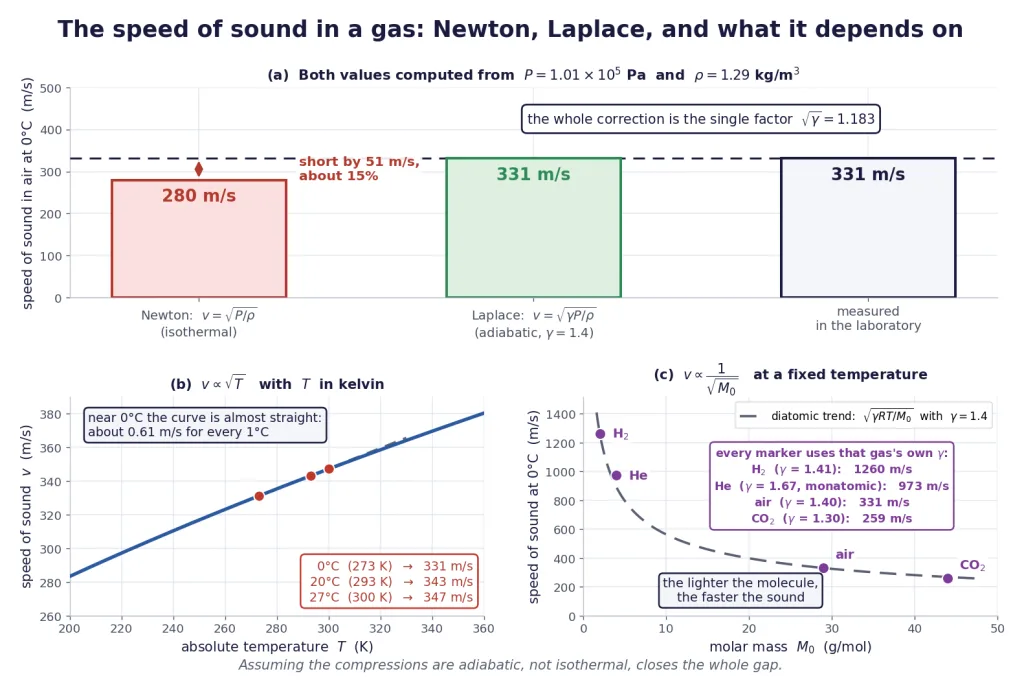
Put in the numbers for air at STP: Pa and kg/m³ (which is 29.0 g, the mass of a mole of air, divided by the 22.4 litres a mole occupies at STP). That gives about 280 m/s.
The measured value is 331 m/s. Newton's prediction is short by about 15% — far too large a gap to blame on sloppy measurement, and it stood unexplained for over a century.
The Laplace correction
Laplace saw what was wrong: the assumption, not the arithmetic. A sound wave of even a few hundred hertz squeezes and releases each parcel of air hundreds of times a second, and air is a poor conductor of heat. There is simply no time for heat to flow out of a compression into the neighbouring rarefaction before the wave has moved on. The compressions are therefore not isothermal at all — they are adiabatic, with each parcel of gas heating a little as it is compressed and cooling as it expands.
For an adiabatic change of an ideal gas, , where is the ratio of the specific heats. Differentiating,
So the adiabatic bulk modulus is , not , and
Key Point — the Laplace correction: The whole correction is a single factor of on Newton's answer. For air , so the factor is .
Multiply 280 m/s by 1.183 and you get 331 m/s, in agreement with experiment. Panel (a) of the figure sets the two computed values against the measured one; the whole of Newton's missing 15% is that one square root.
[Board Important] "State Newton's formula for the speed of sound and explain the Laplace correction" is a guaranteed short-answer question. The marks are for: Newton assumed isothermal compressions, giving and about 280 m/s against a measured 331 m/s; Laplace pointed out the changes are too rapid for heat flow and are therefore adiabatic, giving and , which agrees with experiment.
What the Speed of Sound in a Gas Really Depends On
is correct, but it hides the physics behind two symbols that are not independent of each other. Bring in the ideal gas law for a gas of molar mass ,
and substitute. The pressure cancels completely:
Key Point — the working form: here is the absolute temperature in kelvin, the molar mass in kg/mol, J per mole per kelvin, and the ratio of the specific heats. For a given gas , and are all fixed, so the temperature is the only thing left that can change the speed.
Three consequences follow, and every one of them is examined.
1. It does not depend on pressure
Pump more air into a room at the same temperature and the speed of sound in it does not budge. The reason is visible in the algebra above: raising raises in exact proportion, so the ratio — and with it — is unchanged.
This catches people out because appears explicitly in , and it is tempting to conclude that doubling the pressure raises the speed by . It does not, because you cannot double the pressure of a gas at constant temperature without doubling its density too. (If instead you heat a sealed rigid container until the pressure doubles, then the temperature has doubled and the density has not — and now the speed really does rise by . Which quantity is being held fixed is the whole question.)
2. It rises as the square root of the absolute temperature
with both temperatures in kelvin. Converting from Celsius first is not optional: a ratio of temperatures in degrees Celsius is meaningless, and putting 27 in place of 300 will wreck the answer.
Panel (b) of the figure plots the real curve. It passes through 331 m/s at 0°C, 343 m/s at 20°C and 347 m/s at 27°C. Over the narrow range of everyday weather the square-root curve is so nearly straight that a linear rule of thumb works well: near 0°C the speed rises by about 0.61 m/s for every 1°C, which is where the familiar approximation comes from, with in degrees Celsius.
3. It falls as the inverse square root of the molar mass
Light molecules move faster at a given temperature, and sound is carried by molecular motion, so a light gas is a fast gas. Panel (c) of the figure evaluates for four gases at 0°C: hydrogen 1260 m/s, helium 973 m/s, air 331 m/s, carbon dioxide 259 m/s.
Set those against the measured speeds in the table above and helium and hydrogen sit a little apart from them — 965 m/s against 973, and 1284 m/s against 1260. The formula treats a gas as ideal, and a real gas is not quite ideal, so agreement to within about 2% is as much as it promises. Use the formula for ratios and proportionalities, and a measured value whenever a problem supplies one.
This is why breathing helium makes a voice squeak. The vocal cords vibrate at the same rate as always, but the resonant frequencies of the air column in the throat go as , and in helium is nearly three times its value in air. The pitch of the vibration is unchanged; the resonances that shape it are all shifted up.
Humidity
Water vapour has a molar mass of 18 g/mol, well below air's 29 g/mol. Adding water vapour to air at a fixed pressure and temperature therefore makes it less dense, not more, and
Key Point: sound travels slightly faster in humid air than in dry air at the same temperature.
The effect is small — at 20°C, going from completely dry to fully saturated raises the speed by only about 1.5 m/s, less than half a percent — but the direction of it is a favourite one-mark question, and the intuitive guess is usually the wrong way round.
The numbers worth carrying
| Quantity | Value |
|---|---|
| speed of sound in dry air at 0°C | 331 m/s |
| speed of sound in air at 20°C | 343 m/s |
| the value used for problems in this chapter | 340 m/s |
| rise per degree, near room temperature | about 0.6 m/s per °C |
| time for sound to cover 1 km in air | about 3 s |
| speed in water compared with air | about 4.4 times |
| speed in steel compared with air | about 17 times |
| wavelength range of audible sound in air | 17 m down to 1.7 cm |
[NEET Important] Three statements are asked over and over, and all three are counter-intuitive: the speed of sound in a gas is independent of pressure at constant temperature, independent of frequency and amplitude, and greater in humid air than in dry air. Learn them as facts and the reasoning as backup.
[JEE Tip] When a problem gives you a temperature, convert to kelvin before you do anything else, and use the ratio form rather than recomputing from , and . You will not usually be given , and the ratio makes it unnecessary.
Solved Examples
Conventions used throughout: SI units unless a question states otherwise. The speed of sound in air is taken as 340 m/s unless a problem gives a temperature or states another value. For air, , kg/m³ at STP, g/mol; atmospheric pressure is Pa and J per mole per kelvin. In the symbol is the tension in newtons; where a period is also needed in the same question it is named as a period and carries seconds. "Particle speed" always means the speed of one element of the medium, never the speed of the wave.
Example 1: Every constant, and the speed, from one equation
A wave on a string is described by
in SI units. Find (a) the wavelength, (b) the period and frequency, (c) the wave speed, and (d) the maximum particle speed. Comment on (c) and (d).
Solution:
Step 1 — read off , and . Comparing with :
(a)
(b)
(c) The wave speed can be had directly from and , with no need for or at all:
and as a check, m/s. The two agree, as they must.
(d)
Comment. The wave advances at 8.00 m/s while the fastest any element of the string ever moves is 3.02 m/s. Two different speeds, two different meanings, and no reason for them to be equal.
Final Answer: m; s and Hz; wave speed m/s; maximum particle speed m/s.
Takeaway: is the shortest route to the wave speed — it needs only the two numbers already sitting in the bracket. Use as the check, not as the method.
Example 2: One medium, the whole audible range
Take the speed of sound in air as 340 m/s. Find the wavelength of (a) the lowest audible frequency, 20 Hz, (b) 2.0 kHz, and (c) the highest audible frequency, 20 kHz. What is the ratio of the longest to the shortest?
Solution:
The air is the same in all three cases, so is the same in all three cases and does all the work.
(a)
(b)
(c)
The ratio of the longest to the shortest is , exactly the ratio of the frequencies turned upside down.
Final Answer: 17 m, 17 cm and 1.7 cm; a ratio of 1000.
Takeaway: In one medium and are inversely proportional, because their product is pinned to the fixed speed. A wavelength of 17 m for the lowest audible note is worth remembering — it is longer than most rooms, which is why bass notes bend around corners so easily.
Example 3: From air into water
A sound wave of frequency 500 Hz travels in air at 340 m/s and passes into water, in which the speed of sound is 1480 m/s. Find the frequency and the wavelength of the wave in the water.
Solution:
Step 1 — decide what survives the boundary. The particles of air and water are in contact at the surface, so the water is driven at exactly the rate at which the air is oscillating. The frequency is unchanged: it is still 500 Hz in the water.
Step 2 — the wavelength in air, for comparison.
Step 3 — the wavelength in water, using the new speed and the same frequency:
Step 4 — check the proportion. , and as well. The two ratios must be equal because cancels between them.
Final Answer: frequency still 500 Hz; wavelength 2.96 m, about 4.35 times its value in air.
Takeaway: Frequency crosses the boundary; wavelength and speed do not. Whenever a wave changes medium, write down first and treat it as a constant of the problem.
Example 4: A wave on a stretched wire
A wire of length 2.0 m has a mass of 20 g and is stretched by a tension of 400 N. (a) Find the speed of a transverse wave on it. (b) If a wave of frequency 50 Hz is sent along it, what is the wavelength? (c) How long does a pulse take to travel from one end to the other?
Solution:
Step 1 — the linear mass density.
(a) With the tension N,
(b) The medium fixes the speed and the source fixes the frequency, so
Note that this is twice the length of the wire, which is perfectly possible — a wavelength is a property of the wave, not a length that has to fit inside anything.
(c) A pulse travels at the same 200 m/s, so
Final Answer: (a) 200 m/s; (b) 4.0 m; (c) 0.010 s.
Takeaway: Always convert the wire's mass and length into before touching the formula. Putting the 0.020 kg straight into gives 141 m/s, and the mistake is invisible unless you check the units.
Example 5: Getting the speed you want
A string of linear mass density 0.010 kg/m carries transverse waves at 200 m/s under its present tension. (a) What tension is needed to raise the speed to 300 m/s? (b) By what factor must the tension be changed to double the speed? (c) What happens to the speed if the tension is halved?
Solution:
Step 1 — turn the formula round. Squaring gives , with the tension in newtons.
(a)
(As a check on the starting point: N, which is indeed the tension that gives 200 m/s.)
(b) Since , doubling needs multiplied by . Four times the tension.
(c) Halving the tension multiplies the speed by , so the new speed is m/s — a 29% drop for a 50% reduction in tension.
Final Answer: (a) 900 N; (b) four times; (c) it falls to 141 m/s.
Takeaway: The square root makes the string speed stubborn. Big changes in tension produce modest changes in speed — which is exactly why tuning a guitar string takes a firm turn of the peg rather than a nudge.
Example 6: Two wires of the same material
A copper wire of radius 0.50 mm is stretched by a tension of 100 N. The density of copper is 8900 kg/m³. (a) Find the speed of transverse waves on it. (b) A second copper wire of twice the radius is stretched by the same tension. What is the wave speed on it?
Solution:
Step 1 — build from the density and the cross-section. A metre of wire has volume , so its mass per metre is
(a) With the tension N,
(b) Doubling the radius multiplies the area, and so , by 4. Since , the speed is halved:
Final Answer: (a) about 120 m/s; (b) about 60 m/s.
Takeaway: For wires of the same material under the same tension, — the radius appears squared in and then square-rooted in . Handle the proportion rather than recomputing the whole thing.
Example 7: A tension and a period in the same question
A wire of linear mass density kg/m is stretched by a tension of 80 N. A source at one end vibrates 200 times per second. Find (a) the wave speed, (b) the wavelength, and (c) the period of the oscillation of any one particle of the wire.
Solution:
Step 1 — identify which quantity is which. The 80 N is a tension, so it goes into . The 200 vibrations per second is a frequency, so its reciprocal is the period, in seconds. The two are different quantities that happen to share a letter, and their units keep them apart.
(a)
(b)
(c) The period of the oscillation is
Check: m/s, which is the speed again.
Final Answer: (a) 126.5 m/s; (b) 0.632 m; (c) 5.0 ms.
Takeaway: A tension is measured in newtons and a period in seconds. When a question hands you both, label them in your rough work before substituting; the whole trap is the shared symbol.
Example 8: Water and a steel rod
(a) The bulk modulus of water is Pa and its density is 1000 kg/m³. Find the speed of sound in water. (b) A thin steel rod has Young's modulus Pa and density 7800 kg/m³. Find the speed of a longitudinal wave along it. (c) Compare both with 340 m/s in air.
Solution:
(a) Water is a fluid, so the bulk modulus is the one to use:
(b) For a thin rod the sides are free to bulge, so Young's modulus applies:
(c) Water carries sound times faster than air, and the steel rod about 15 times faster. Both are far denser than air, which on its own would make them slower; the moduli win by a much larger margin.
One footnote on the steel. A thin rod gives about 5064 m/s, while a table of speeds in extended solid steel quotes a higher figure near 5900 m/s. The difference is real: inside a large block the sides of a compressed region cannot bulge outwards, so the material resists more stiffly than a free-sided rod does, and the wave goes faster. The words "thin rod" in the question are what select Young's modulus.
Final Answer: (a) about 1483 m/s; (b) about 5064 m/s; (c) roughly 4.4 times and 15 times the speed in air.
Takeaway: Bulk modulus for a fluid or a bulky solid, Young's modulus for a thin rod. Choosing the wrong modulus is the only real decision in this kind of question, and the words "thin rod" or "long bar" are the signal.
Example 9: Newton's estimate and Laplace's repair
For air at STP, take Pa, kg/m³ and . (a) Compute the speed of sound from Newton's formula. (b) Compute it with the Laplace correction. (c) The measured value is 331 m/s. By what percentage was Newton's value short, and what physical assumption caused it?
Solution:
(a) Newton assumed isothermal compressions, giving :
(b) Laplace's adiabatic bulk modulus is :
Equivalently, multiply Newton's answer by : m/s.
(c) The shortfall is
The fault was the assumption that the compressions are isothermal. They are far too rapid for heat to flow from a compression into the neighbouring rarefaction, so they are adiabatic, and the correct bulk modulus is rather than .
Final Answer: (a) 280 m/s; (b) 331 m/s; (c) short by about 15.5%, because the compressions were assumed isothermal when in fact they are adiabatic.
Takeaway: The entire Laplace correction is one factor of . If you can only remember one thing, remember that belongs under the square root and multiplies the pressure.
Example 10: Warming the air
The speed of sound in air is 331 m/s at 0°C. (a) Find it at 27°C. (b) At what temperature would it reach 350 m/s? (c) Check part (a) against the rule of thumb that the speed rises by about 0.6 m/s per degree Celsius.
Solution:
Step 1 — convert to kelvin first. This is not optional, because the law is with absolute.
(a)
(b) Run it backwards. If m/s then
which is 32°C.
(c) The rule of thumb gives m/s, within half a metre per second of the exact answer. Over the ordinary range of temperatures the square-root curve is almost a straight line, which is why the shortcut works so well.
Final Answer: (a) 347 m/s; (b) about 305 K, that is 32°C; (c) the rule of thumb gives 347.5 m/s, in good agreement.
Takeaway: Kelvin, always, before the square root. Using is not merely inaccurate, it is undefined — and using Celsius in a ratio is the single most common error in this topic.
Example 11: Why helium makes a voice squeak
At the same temperature, compare the speed of sound in helium (, g/mol) with that in air (, g/mol). Take the speed in air at 0°C to be 331 m/s and find the speed in helium at that temperature.
Solution:
Step 1 — use the form in which the temperature cancels. With and the same for both gases,
Step 2 — the speed itself.
Step 3 — what it does to a voice. The vocal cords still vibrate at the same rate, so the pitch of the source is unchanged. But the resonant frequencies of the air column in the throat and mouth go as , and with nearly three times larger those resonances all shift upwards. The voice is not raised in pitch so much as re-coloured, with all its emphasis moved to higher frequencies.
Final Answer: helium carries sound about 2.94 times faster than air, that is about 973 m/s at 0°C.
Takeaway: must be carried through as well as . Using only the molar masses gives , which is close enough to look right and is wrong — helium is monatomic, so its is 1.67, not 1.4.
Example 12: Two ways to double a pressure
(a) A sample of air is compressed to twice its pressure at constant temperature. What happens to the speed of sound in it? (b) Instead, the same air is sealed in a rigid container and heated until its pressure doubles. Now what happens to the speed?
Solution:
(a) Constant temperature. Write the speed in the form in which the physics is visible:
so that
At constant , nothing on the right changes. Doubling the pressure doubles the density in exact proportion and is untouched. The speed of sound is unchanged.
(b) Constant volume. The container is rigid, so the density cannot change. For the pressure to double at constant density, the ideal gas law requires the absolute temperature to double. Then
The speed rises by a factor of 1.41.
Final Answer: (a) unchanged; (b) larger by a factor of .
Takeaway: "The pressure doubled" is not enough information — ask what was held fixed. At constant temperature the speed of sound in a gas does not depend on pressure at all; what it depends on is the absolute temperature, and pressure only ever matters through its effect on that.