
Thirty Questions. Thirty-Five Minutes. Go.
Sections 1 to 13 built this chapter, worked more than forty problems through it and then rebuilt the whole of it for speed. This section finds out whether any of that survives contact with a timer.
There is no new physics below. There are 30 questions written the way this paper writes them, and one rule that matters more than any other: you are being tested on pace, not on cleverness. If a question here takes you five lines of algebra, you have misread it.
Physics carries 45 questions and deserves about 45 minutes of a 180-minute paper. Waves reliably supplies two to four of them. Thirty questions in thirty-five minutes is therefore not cruelty — it is the actual rate.
One syllabus note. Several items below rest on material that sits outside the body text of the rationalised syllabus — the Doppler effect in all its forms, and the naming of overtones. Both are asked in Boards, in JEE and in NEET every single year, so both are drilled here.
Close the Notes
Key Point: Blank sheet, pen, timer. Attempt all 30 questions in one unbroken sitting, and do not read a single explanation until your last answer is written. A drill you pause to check is a reading exercise, and reading exercises do not build speed.
| The setup | What it is |
|---|---|
| Number of questions | 30, single correct option |
| Marking scheme | correct, incorrect, unattempted |
| Maximum score | marks |
| Minimum possible score | marks |
| Suggested time limit | 35 minutes — a little over a minute a question |
| Speed of sound in air | 340 m/s everywhere, unless a question says otherwise |
| Temperature inside a square root | always in kelvin |
| Allowed | a rough sheet and your memory |
| Not allowed | calculator, formula sheet, or a glance back at Section 13 |
Three symbols that decide more marks here than any concept
Key Point: means tension, in newtons, inside , and time period, in seconds, everywhere else. Both meanings appear in this set, sometimes in the same question. Read which one the sentence is handing you before you write anything down.
Key Point: here is the angular wave number, , measured in rad/m. It is never a spring constant in this chapter.
Key Point: is the wave speed — how fast the disturbance crosses the medium. The particle speed is , it peaks at , and it has nothing to do with . Two questions below pay or on that distinction alone.
The rest of the alphabet, fixed for all 30 questions.
| Symbol | Meaning | Unit |
|---|---|---|
| amplitude | m | |
| wavelength | m | |
| frequency | Hz | |
| angular frequency, | rad/s | |
| angular wave number, | rad/m | |
| linear mass density of a string | kg/m | |
| tension (N) in ; period (s) elsewhere | N or s | |
| ratio of specific heats of a gas | none | |
| , | signed velocities of observer and source | m/s |
| the frequency actually received | Hz |
The four graphs three questions need
Questions 23, 24 and 25 read off the graphs below. Look at them now so that you are not meeting them for the first time against the clock.
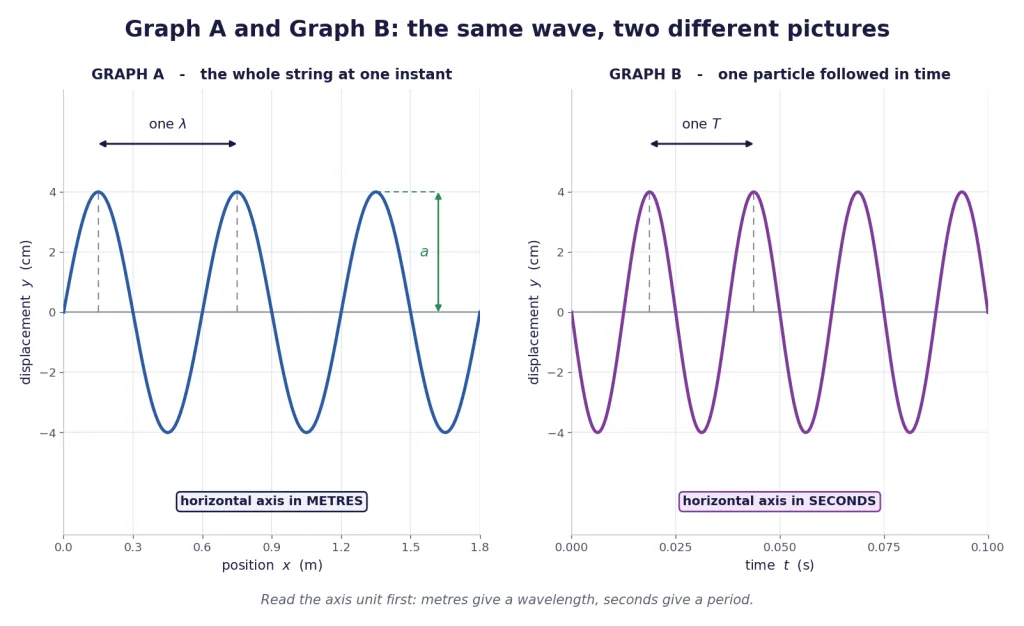
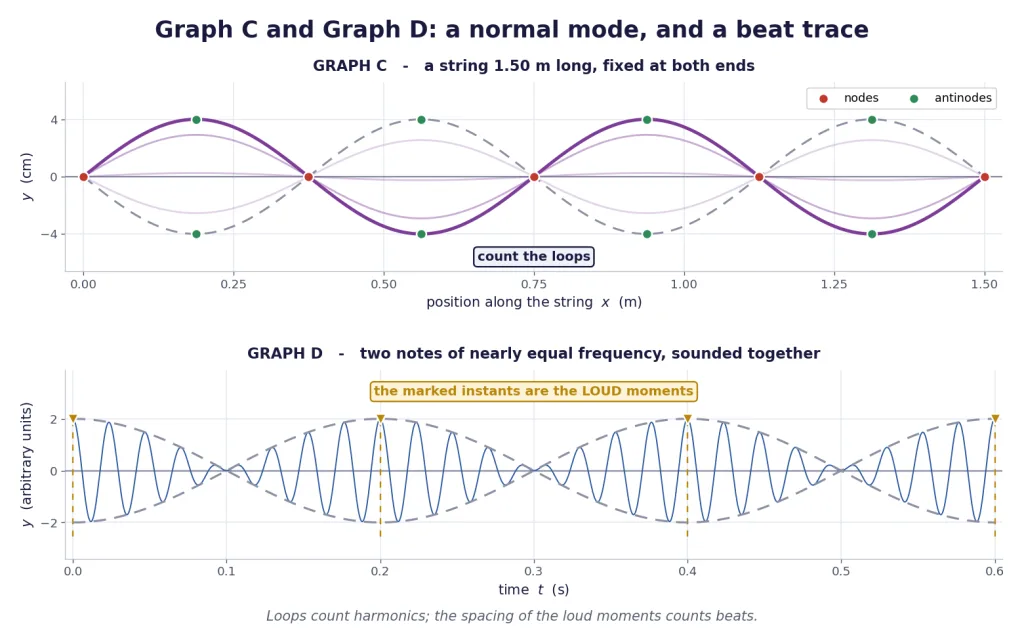
Graph A and Graph B describe the same wave. A is a snapshot — the whole string frozen at one instant, horizontal axis in metres, so it gives and and nothing about time. B is a history — one particle followed through time, horizontal axis in seconds, so it gives . Graph C is a string 1.50 m long, fixed at both ends, vibrating in one of its normal modes. Graph D is the trace of two notes of nearly equal frequency sounding together, with the loud moments marked.
What this set covers
| Topic | Questions | How many |
|---|---|---|
| Wave motion, the displacement relation, phase | Q1 to Q5 | 5 |
| Wave speed on a string, in a gas, with temperature | Q7 to Q9 | 3 |
| Superposition, interference, reflection | Q10 to Q12 | 3 |
| Standing waves and normal modes on a string | Q6, Q13, Q14 | 3 |
| Air columns and the resonance tube | Q15 to Q17 | 3 |
| Beats | Q18, Q19 | 2 |
| The Doppler effect | Q20 to Q22 | 3 |
| Reading the four graphs | Q23 to Q25 | 3 |
| Column matching | Q26, Q27 | 2 |
| Assertion-reason | Q28 to Q30 | 3 |
Five of the thirty are in a special format — two column-matching items and three assertion-reason items — which is about the share the real paper carries. Four more are pure proportionality: what happens to a fundamental or a frequency when the length, the molar mass or the absolute temperature is changed. Those four should take fifteen seconds each, and if they do not, that is the most profitable thing this set will teach you.
[Important] The 35-minute limit is the entire exercise. Most students can get 26 of these right given an hour — and an hour is exactly what the real paper will not give you. Finishing in 35 minutes with 23 correct puts you in far better shape than taking 55 minutes to get 27. Keep the timer where you can see it, and the moment a question passes 75 seconds, mark your best surviving option and move on.
Here is the arithmetic that makes that instruction safe. A blind guess among four options is worth , essentially nothing. Eliminate two options first and a guess between the survivors is worth marks on average. Eliminate first, then commit. Leave blank only what you could not narrow down at all.
Mark It Honestly, Then Read Your Own Answer Sheet
Score with the real scheme: for every correct answer, for every wrong one, for every blank. No half marks for "I nearly had that one". The number you end up with is the number that means something.
The bands
| Your score (out of 120) | Verdict | What to do next |
|---|---|---|
| 100 to 120 | Exam ready. Over on a full-length set, inside the time. | This chapter is now free marks for you. Revisit only the items you missed, then move on. |
| 76 to 99 | Fast but leaky. You know the material; something leaks on the way to the answer sheet. | Almost always a dropped between and , an overtone read as a harmonic, or a Doppler sign put in the wrong slot. Redo every wrong question without the explanation first, and count how many you fix alone. |
| 48 to 75 | Recall gaps. The speed is not the problem; the lookup is. | Go back to Section 13's recognition table and the string / open pipe / closed pipe lookup and learn them as flashcards. Then re-attempt this set cold. |
| Below 48 | Rebuild first. | Work Sections 1 to 9 properly, then Section 10's worked problems, then Section 13. Re-attempting this set today would teach you nothing except the answer key. |
How to use the solutions
Every solution below is written in the same three parts, and they are meant to be read in order.
- The working, step by step, with the substitution shown. If your arithmetic disagrees, this is where you find out where.
- A paragraph on the wrong options. Every wrong option in this set is a real mistake somebody actually makes, followed through to the number it produces. Find your own wrong answer in that paragraph and you will learn far more than from the correct working.
- The one-line habit — an exam tip or a key point that stops the same mistake next time.
Sort your mistakes into three piles
Do this before you read a single explanation. It is the most useful ten minutes in this section.
- Did not know it. A formula you could not recall — whether a closed pipe is or , whether the first overtone of a closed pipe is its second or its third harmonic, whether or . Cheapest to fix: it is a memory job, and it takes an evening.
- Knew it, computed it wrong. You left a out, left a mass in grams, put a Celsius temperature under a square root, or took a square root where the quantity was not under one. Slow down for four seconds on the final line.
- Knew it, answered a different question. You gave where it asked for , the wave speed where it asked for the particle speed, the harmonic number where it asked for the overtone, the envelope's period where it asked for the beat period. Each of those slips has a wrong option waiting for it below.
Key Point: Two students both score 84. The first has four pile-1 mistakes and a memory gap that revision closes in a day. The second has nine pile-3 mistakes and a reading habit that will follow them into the exam hall. Pile 3 is the expensive one — count it before you explain it away.
The twelve facts this set keeps testing
- , with in rad/m and in rad/s. Every "the frequency is 400" trap lives in that pair of s.
- The maximum particle speed is , and the ratio of it to the wave speed is — a pure number, usually far less than 1.
- converts a path difference into a phase difference in one line, and does the same for a time difference.
- on a string, with the tension in newtons and in kg/m. Grams left as grams make the answer times too small.
- in a gas, so and , and pressure alone changes nothing at fixed temperature.
- Two waves of equal amplitude with a phase difference give — note the half. With unequal amplitudes, .
- A rigid end reflects with a phase change of and is a node; a free end reflects with no phase change and is an antinode. With arriving at , the rigid-end reflection is and the free-end one is .
- Node to node is ; node to the nearest antinode is . Each loop of a standing wave is half a wavelength.
- String and open pipe: , all harmonics. Closed pipe: , odd harmonics only. The th harmonic is the th overtone for a string or an open pipe; for a closed pipe the first overtone is the third harmonic.
- In a resonance tube and . The difference of the two lengths kills the end correction; using alone does not.
- — the full difference, because loudness peaks twice per envelope cycle. The pitch you actually hear is the average of the two.
- , with the positive direction running from the source towards the observer. Say "higher" or "lower" in words before you substitute, and a reversed sign announces itself immediately.
[Important] If you got fewer than 22 right, count how many of your errors were an overtone read as a harmonic and how many were a Doppler speed put in the wrong slot. In this chapter those two between them usually account for more marks than everything else put together, and both are cheap to fix: write the harmonic number on the page before you compute a pipe or string frequency, and draw the source-to-observer arrow on the page before you compute a Doppler shift.